French Companies Unite On Superconducting Cable Project For Distant Offshore Wind Farms
The title of this post, is the same as that of this article on offshoreWIND.biz.
This is the sub-heading.
Air Liquide, CentraleSupélec, ITP Interpipe, Nexans, and RTE have joined forces to develop a project that connects distant offshore wind farms to shore via a High Voltage Alternating Current (HVAC) superconducting transmission system.
This introductory paragraph adds some detail.
The SupraMarine demonstrator project will study the electrical connection between offshore wind farms and the coastline using High-Temperature Superconducting (HTS) cables. Cooled by liquid nitrogen, the cables are said to transport electricity with near-zero energy loss.
Note.
- No details of the target distances are indicated.
- There is a detailed exploratory diagram.
It is certainly an ambitious project, but I feel it could have substantial uses.
I have a few thoughts and questions.
Can Sodium Metal Be Used For High Voltage Electrical Underground Cables?
Google AI answers this question as follows.
Yes, sodium metal was investigated and used in trial runs for high-voltage underground electrical cables in the late 1960s and early 1970s, as a potentially cheaper and more flexible alternative to copper and aluminum. However, it is not in common use today due to safety concerns and unfavorable lifecycle economics compared to aluminum.
When I was at ICI around 1970, they were researching the use of sodium for high voltage power cables.
- ICI had access to large amount of sodium chloride in Cheshire.
- The sodium metal can be obtained by electrolysis.
- Renewable electricity for electrolysis will be plentiful.
- Someone told me that their prototype cable was a polythene pipe with Sodium metal in the middle.
- I’ve read somewhere that sodium cables have interesting safe overload properties.
- I can understand the safety concerns and unfavorable lifecycle economics, especially where water is concerned.
Perhaps, French technology has improved in the sixty years?
Will Sodium Metal Be Used In The French Superconducting Cable?
Nothing has been disclosed!
But the office chat at ICI from those, who knew their sodium and their polythene, as they’d been working at ICI Mond Division for decades, was of the opinion that sodium/polythene cables were possible!
From The Diagram, It Looks Like Power Is Needed At Both Ends Of The Superconducting Cable
The diagram shows wind turbines at one end and the grid at the other end of the cable.
So will a battery or some other form of stabilisation be needed for when the wind isn’t blowing?
Will The French Superconducting Cable Have A High Capacity?
The basic capacity of a cable depends on three properties.
- The resistance of the cable.
- The cross-section area of the cable.
- The design of the cable must also be able too conduct away the heat generated by electricity flowing through.
Will The Technology Work For Interconnectors?
I don’t see why not!
Is Formula One Likely To Go To Hydrogen Fuel?
Formula One has a long term aim of decarbonising or at least going net-zero.
I’ve never been to an electric-car race, but it must be more boring to many to have motor-racing without the smells and the noise.
I asked Google AI, the question in the title of this post and received this answer.
Formula One is unlikely to switch to hydrogen fuel in the immediate future, as its current strategy is focused on using 100% sustainable “e-fuels” from the 2026 season. However, F1 leadership has stated that hydrogen is a potential long-term solution for the 2030s and beyond.
This article on the BBC is entitled Formula 1 boss Ross Brawn Says Hydrogen Could Be Future Fuel.
But I do believe, that the trucks, vans and transporters that accompany Formula One will be decarbonised earlier and hydrogen could play a major part, due to its proven longer range.
Hydrogen coaches are being developed and could be launches next year and are likely to have a 1,000 km. range, so expect to see some of these vehicles in the fleet of vehicles following Formula One.
Hydrogen In Aviation Offers Potential For Growth And Deeper Emissions Reductions, New Study Shows
The title of this post, is the same as that of this press release from Rolls-Royce.
These five paragraphs compose the press release.
Rolls-Royce, easyJet, Heathrow and University College London Air Transportation Systems Lab (UCL ATSLab) published a report highlighting how hydrogen-powered aircraft could enable European and UK aviation to cut carbon emissions while supporting future growth.
The study, Enabling Hydrogen in the European Aviation Market, found that hydrogen in aviation offers a unique opportunity to achieve both emissions reduction and market expansion. The analysis shows that introducing hydrogen alongside Sustainable Aviation Fuel (SAF) can accelerate progress towards net zero, particularly when policy incentives reward low-carbon fuels and if hydrogen were to be included within the EU’s SAF mandate.
The research also found that targeted hydrogen infrastructure at around 20 major European airports, including Heathrow, could deliver more than 80% of the emissions benefits of full hydrogen availability across the continent. Concentrating investment at key ‘hydrogen hubs’ would therefore provide a practical and cost-effective path to early adoption.
Further modelling indicates that the earlier novel technologies, such as hydrogen, can be introduced, the more opportunity they present for CO2 emission reductions, underscoring the value of early technological transition where it is financially and technically viable.
The study is underpinned by UCL ATSLab’s Airline Behaviour Model (ABM), which represents the complexity of airline decision-making through specific behavioural variables. Building on this, the research evaluates how fuel costs, incentives and new technologies shape airline responses. This provides a research-based, realistic picture of how hydrogen adoption could evolve, highlighting both opportunities and potential challenges for adoption.
Note, these two sentences recommending early adoption of hydrogen.
- Concentrating investment at key ‘hydrogen hubs’ would therefore provide a practical and cost-effective path to early adoption.
- Further modelling indicates that the earlier novel technologies, such as hydrogen, can be introduced, the more opportunity they present for CO2 emission reductions.
I also suspect, that introducing hydrogen early, feeds back to reduce Co2 emissions.
But what is Trump’s considered view on hydrogen aircraft?
Google AI gives this answer to my question.
Donald Trump’s view on hydrogen for transportation, including potential use in aircraft, is highly skeptical due to perceived safety risks and effectiveness concerns, which generally aligns with his broader opposition to green energy initiatives. He has specifically criticized hydrogen-powered vehicles as being dangerous and “prone to blowing up”.
Note.
- I used to work in a hydrogen factory and it’s still producing hydrogen.
- I doubt Trump gets on well with Jennifer Rumsey, who is CEO of Cummins, who are one of the world’s largest diesel-engine companies, who are following a zero-carbon route.
- Is Formula One Likely To Go To Hydrogen Fuel? This would set the Cat Among The Pigeons
I also feel that this University College London study will create a string of converts to hydrogen.
US Judge Overturns Trump’s Ban On Wind Energy Project Permits
The title of this post, is the same as that of this article on offshoreWIND.biz.
This is the sub-heading.
A federal judge has struck down the US President Donald Trump’s indefinite halt of all federal approvals and permitting for new wind energy projects.
Trump is obviously very strong in his opposition to wind power, as he issued the ”Wind Order” on his first day back in office.
He received this robust reply from Oceantic Network CEO Liz Burdock.
Today’s decision is welcome news, not just for the thousands of American workers and businesses across 40 states supporting offshore wind in the U.S., but also for the critical relief the wind industry will provide to lower skyrocketing electricity prices for millions of American families with reliable, affordable power.
Overturning the unlawful blanket halt to offshore wind permitting activities is needed to achieve our nation’s energy and economic priorities of bringing more power online quickly, improving grid reliability, and driving billions of new American steel manufacturing and shipbuilding investments. We thank the Attorneys General and the Alliance for Clean Energy New York for taking this case forward to protect American business interests against the politicization of our energy sector.
I don’t think we’ve heard the last of this legal argument.
Do Coeliacs Have More Varicose Viens?
I asked Google AI, the question in the title of this post and I received this answer.
Yes, studies suggest that people with celiac disease (CD) may have an increased risk of developing certain vein-related conditions, including a potential predisposition to varicose veins.
My mother had the worst varicose viens I’ve ever seen.
She was operated on in the 1950s, by an Indian lady surgeon, who performed her ward rounds in a sari, who my father told me, she was one of the most beautiful women, that he’d ever seen.
Although, my father was married twice, he didn’t seem to be a ladies’ man, although he had great loyalty from the ladies he employed, in his printing business. He also got on very well with my wife ; C, although they didn’t meet many times.
Mushroom Management On TfL And Uber
London has a new electric ferry between Rotherhithe and Canary Wharf, so this morning, I went to have a ride across the Thames.
I started by taking the East London Line to Rotherhithe station, where no-one had a clue, as to where to find the new ferry, which only started running late last week.
But, I did see it, in some of these pictures.




































Note.
- Rotherhithe station is unusual for the Overground, in that it has escalators, but not lifts.
- The station has a cosy little cafe in the entrance, which smelt good.
- The Brunel Museum is just round the corner from the station.
- The Wrightbus electric buses were constantly going East and West along the road behind the river bank beteen Victoria and Canada Water stations.
So, in the end, I took the bus back to Rotherhithe station and came home.
Is Carbon Black Used To Make Offshore Electrical Cable?
I asked Google AI, the answer to this question and received this answer.
Yes, carbon black is extensively used to make offshore electrical cables. It serves two primary functions: providing electrical conductivity to specific components and offering UV protection to outer jacketing materials.
That seems a positive answer.
It also could be a very complementary one.
HiiROC have a process that splits any hydrocarbon gas including natural gas, chemical plant off gas and biomethane, into turquoise hydrogen and carbon black.
Two methods of bringing energy to the shore from an offshore wind farm are electricity and hydrogen, through a cable or pipe respectively.
This looks to me, that there could be a possibility to use one of Baldrick’s cunning hybrid plans to bring energy onshore using both hydrogen and electricity.
Effectively, the transmission and use of the system, would use both the hydrogen and carbon black produced by HiiROC.
Artificial Intelligence To The Rescue
This evening, I had a Marks & Spencer Chicken jalfrezi with Basmati Rice for supper.
Marks put a green vegetable in the rice, which I’m not keen on as it gets stuck in the back of my throat.
So tonight, I picked it out with my hand before cooking, and put it in the food waste.
It didn’t make any difference to the cooking, but as I sat down to eat, I noticed that my right hand was going red.
As I’d never picked the dreaded green vegetable out of the rice before, I asked Google AI, if handling spices can make my hand go red and received this reply.
Yes, handling certain spices, particularly chili peppers, can definitely make your hands go red. This reaction is known as “Hunan hand syndrome” or “chili burn” and is caused by the chemical compound capsaicin.
That, certainly happened to me.
It might almost may have been worse for me because.
- My mother taught me to cook in the 1950s and she didn’t use lots of spices in her cooking. So I never learned about the dangers of spices.
- I have a leaking skin, which allows water in and out of my body easily.
- I have an immune system, like a platoon of the SAS on steroids.
So was this, why I was affected?
I then asked Google AI, “What do you do, if you react badly to chilli”, and received this reply.
If you experience a bad reaction to chili (caused by the compound capsaicin), consume dairy products (like milk or yogurt), acidic foods/drinks (lemonade or orange juice), or starches (bread or rice) for relief.
For severe symptoms like difficulty breathing or chest pain, seek immediate medical attention as it could be an allergic reaction.
For Reactions in the Mouth
The primary methods work because capsaicin is oil-soluble, not water-soluble. Water will only spread the burning sensation.
Dairy Products: Milk, yogurt, and sour cream contain a protein called casein, which acts like a detergent to strip away the oily capsaicin molecules from your pain receptors. Whole or full-fat dairy products tend to be more effective than low-fat versions.
Acidic Foods/Drinks: The acidity in items like lemon or lime juice helps to neutralize the alkaline capsaicin molecule.
Sugary Foods: A spoonful of sugar or honey can absorb the capsaicin oil and provides a distraction from the pain.
Starches/Carbohydrates: Eating plain bread, rice, or potatoes can help by creating a physical barrier and absorbing the capsaicin molecules.
Oils/Nut Butters: Capsaicin dissolves in fat. Swishing with a bit of olive oil or eating a spoon of peanut butter can help dissolve and remove the capsaicin.
For Reactions on the Skin
If you experience a burning sensation on your skin after handling chilies:
Wash the area thoroughly with dish soap and water several times, as dish soap is designed to cut grease and oil.
Soak the affected skin in milk or apply yogurt/sour cream.
You can also try a paste made of baking soda and water, or soaking the area in a diluted vinegar solution.
If the pain is severe and persistent, over-the-counter pain relievers or topical corticosteroid creams may offer relief.
When to Seek Medical Attention
While a normal reaction to chili is an intense sensation rather than actual harm, a true allergy can be serious.
Seek emergency medical care immediately if you experience:
Difficulty breathing, wheezing, or shortness of breath
Swelling of the mouth, lips, or tongue
Chest pain or heart palpitations
Uncontrollable nausea or vomiting
Luckily for me, a yogurt worked.
Conclusion
I shall use a suitable tool, like pliers or tweezers, when handling those dreaded green vegetables.
SeaTwirl AB Signs Agreement To Explore Ehe Feasibility Of Electrification Of Aquaculture In Chile
The title of this post, is the same, as that of this press release from SeaTwirl.
This is the sub-heading.
SeaTwirl AB has entered into an agreement to carry out a feasibility study for electrification of fish farms together with a global industrial supplier. The intention of the collaboration is to assess the use of SeaTwirl’s floating vertical-axis wind turbines to provide renewable electricity to offshore-based equipment at aquaculture assets in Chile.
These three paragraphs add more details.
The feasibility study will cover a comprehensive scope, including energy demand and power system requirements, environmental site conditions, cost assessments, supply chain opportunities, and logistics in Chilean waters with the intention to reduce dependence on diesel. The study is expected to be completed during 2026, and the results will help determine next steps.
Chile is home to one of the largest aquaculture industries in the world, and the sector is pursuing ambitious sustainability goals including lower emissions, increased use of renewable power and reduced risk of spills. While the contractual value of the agreement is limited, at approximately SEK 0,8 million, the engagement will generate revenue and represent an important step in SeaTwirl’s commercialization effort.
“This collaboration marks an exciting step towards our purpose to enable floating wind power wherever it is needed, and to expand the use of floating wind technology beyond traditional grid-connected applications. The aquaculture industry has a clear need for offshore renewable energy, and we believe our technology can deliver a robust and cost-effective solution. It is also a major milestone to become involved in the southern hemisphere where many of the challenges we try to address, such as limited availability of cranes, vessels, and yard infrastructure, may be more challenging than in the north. We see significant potential in the aquaculture segment and look forward to beginning this journey in South America”, says Johan Sandberg, CEO of SeaTwirl.
I do find it strange, that the two vertical wind turbines, that both seem to be more than prototypes are both Scandinavian.
The Ventum Dynamics turbine, that I talked about in Are These Turbines An Alternative To Solar Panels? is Norwegian and this one is installed on Skegness Pier.
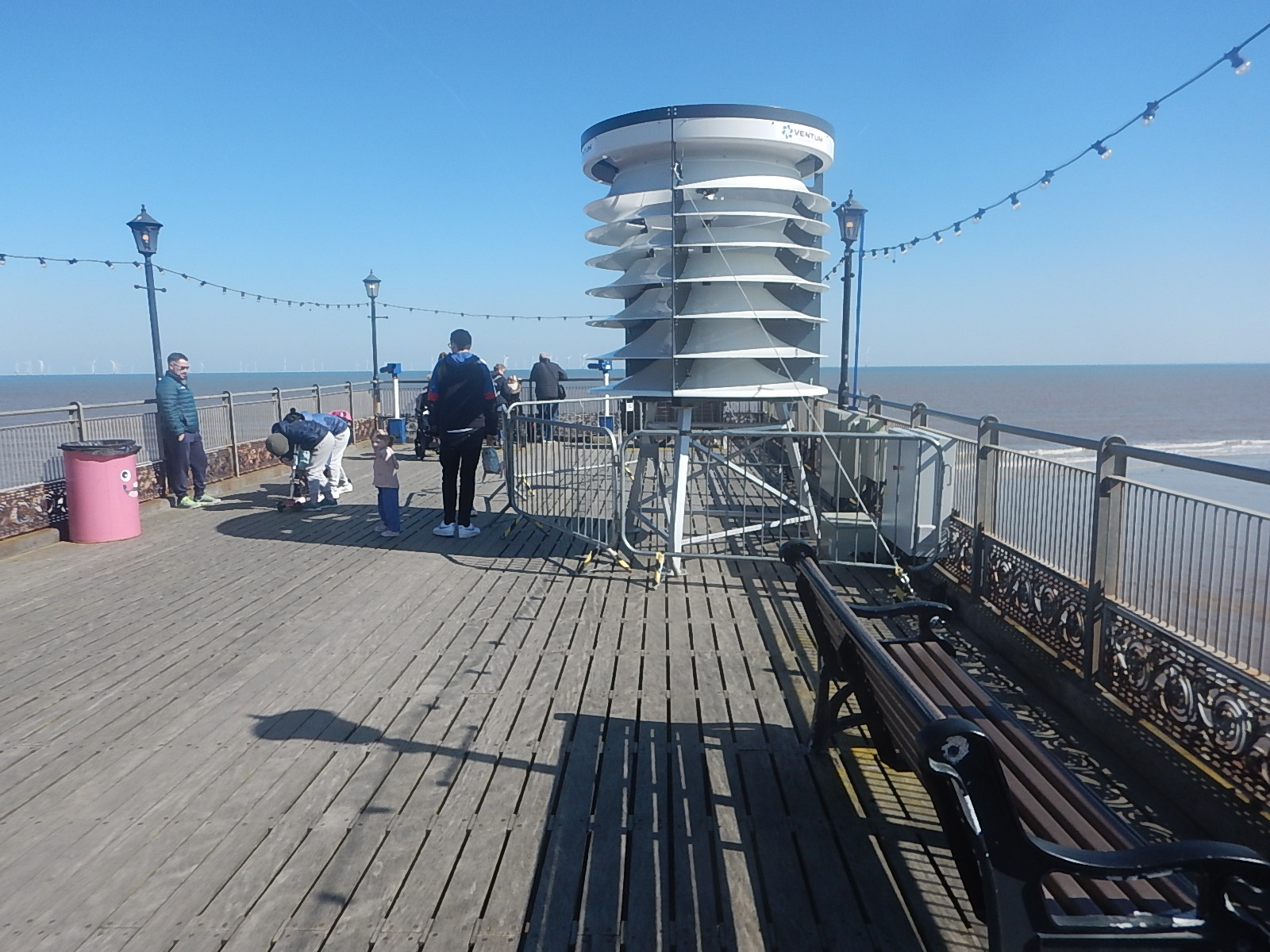
IKEA could sell these for DIY-enthusiasts to assemble and erect. On my stud, I used to have a barn, that could certainly have taken two of these 1.5 KW VX175 turbines.
This link is video of a dancing and swimming SeaTwirl.
If you follow, the SeaTwirl video to its conclusion, you’ll see one being erected in the sea. I can assure you that in the 1970s, my 25-year-old self, did the calculations for a reusable oil production platform called a Balaena, which erected on the same principle. So, I’m fairly certain, that SeaTwirls can be an alternative to traditional wind turbines.

