Up To £3 Billion For Crossrail To Ebbsfleet
The title of this post, is the same as that of an article in the July 2019 Edition of Modern Railways.
This is an extract.
Current estimates gave a cost range of between £1.3 billion and £3 billion, which Mr. Williams said depended on whether services shared tracks with existing Southeastern services east of Abbey Wood or had their own segregated tracks.
Mr. Williams is Transport for London’s Direct of City Planning; Alex Williams.
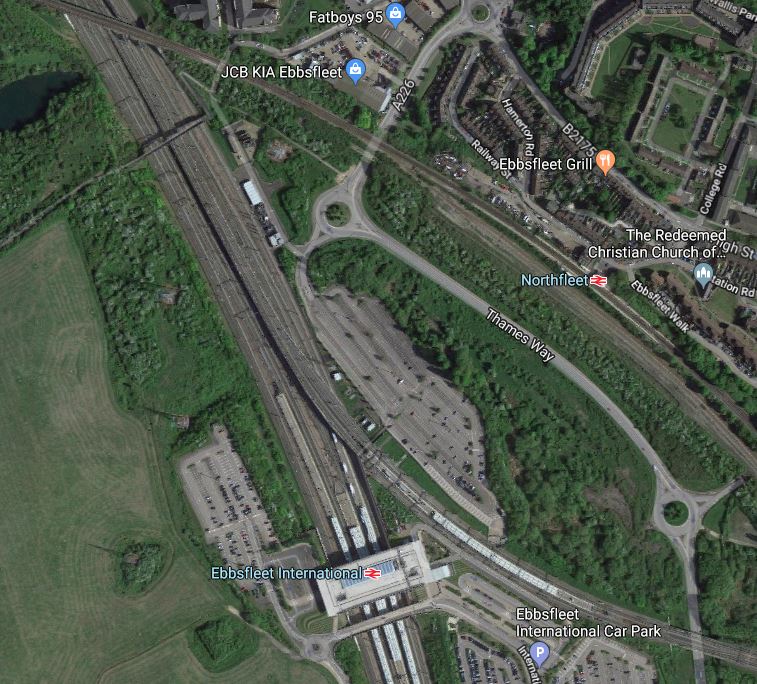
This Google Map shows Northfleet and Ebbsfleet stations.
Note.
- The large Ebbsfleet International station towards the bottom of the map.
- Northfleet station on the North Kent Line in the North East corner of the map.
- The two stations are about five hundred metres apart as the crow flies.
There has been a lot of pressure in the past to build a pedestrian link between the two stations, as reported by the Wikipedia entry for Northfleet station.
The station is very close to Ebbsfleet International station (the NNE entrance is only 334 yards (305 m) from Northfleet’s station), but passengers (using public transport) will find it far easier to access Ebbsfleet International from Gravesend or Greenhithe, as these stations are more accessible and offer easy access to Fastrack bus services. The walking route between the two stations is 0.6 miles (1 km) or 0.8 miles (1.3 km) and a suitable pedestrian link has not been built because of funding issues and objections from Land Securities.
Why when Ebbsfleet International station was built in the early 2000s for opening in 2007, was a pedestrian link not built between the two stations?
How much did omitting the link save?
Luton Airport are building the Luton DART, which is a people mover to connect Luton Airport Parkway station with the airport.
- It is 1.4 miles long.
- It is fully automated.
- It might have an extra station serving the mid-stay parking.
- It appears to be taking three years to build.
All of this very comprehensive system appears to be costing around £200 million.
I doubt that a simple pedestrian link, like a bridge with travelators, would have cost more than a few tens of million pounds.
To me, it is one of the great mysteries of the building of the Channel Tunnel Rail Link, that this pedestrian link wasn’t built.
I think, in future, we could come to regret that it wasn’t built along with the rest of Ebbsfleet International station in the early 2000s.
The extension of Crossrail to Ebbsfleet is about the following.
- Creating a high-frequency railway to serve all the new housing developments in the Thames Gateway and along the South Bank of the Thames.
- Connecting Ebbsfleet International station and other developments around the station to Crossrail.
In some ways, these two objectives are incompatible.
- To serve the housing developments along the river, the Crossrail extension needs to run roughly along the route of the North Kent Line.
- To serve Ebbsfleet International station, the route needs to be further inland.
Choosing either route is going to annoy people who live on the other.
For this reason, I feel we need a good old-fashioned British compromise or some very-radical thinking.
Current Services Along The North Kent Line
I shall start by looking at current services on the North Kent Line.
Thameslink – Luton And Rainham (Kent)
A Thameslink service
- Two trains per hour (tph)
- South of the Thames, the service calls at London Bridge, Deptford, Greenwich, Maze Hill, Whatcombe Park, Charlton, Woolwich Arsenal, Plumstead, Abbey Wood, Slade Green, Dartford, Stone Crossing, Greenhithe for Bluewater, Swanscombe, Northfleet, Gravesend, Higham, Strood, Rochester, Chatham and Gillingham.
- Eight-car Class 700 trains work the route, which have a 100 mph operating speed.
- The service calls at Northfleet for a possible interchange with services running from Ebbsfleet International station
- The service calls at Abbey Wood for interchange with Crossrail.
If there needed to be more capacity on this service, I suspect Thameslink could run twelve-car trains.
Southeastern – London Charing Cross And Gravesend
A Southeastern Metro service.
- Two tph
- Calls at Waterloo East, London Bridge, New Eltham, Sidcup, Bexley, Crayford, Dartford, Stone Crossing, Greenhithe for Bluewater, Swanscombe and Northfleet
- The service calls at Northfleet for a possible interchange with services running from Ebbsfleet International station.
- The service calls at Gravesend for interchange with Southeastern HighSpeed services between St. Pancras International station and North-East Kent, East Kent and soon-to-be East Sussex.
- Class 465 trains work the route, which have a 75 mph operating speed.
This picture shows a train for Gravesend in London Bridge station.
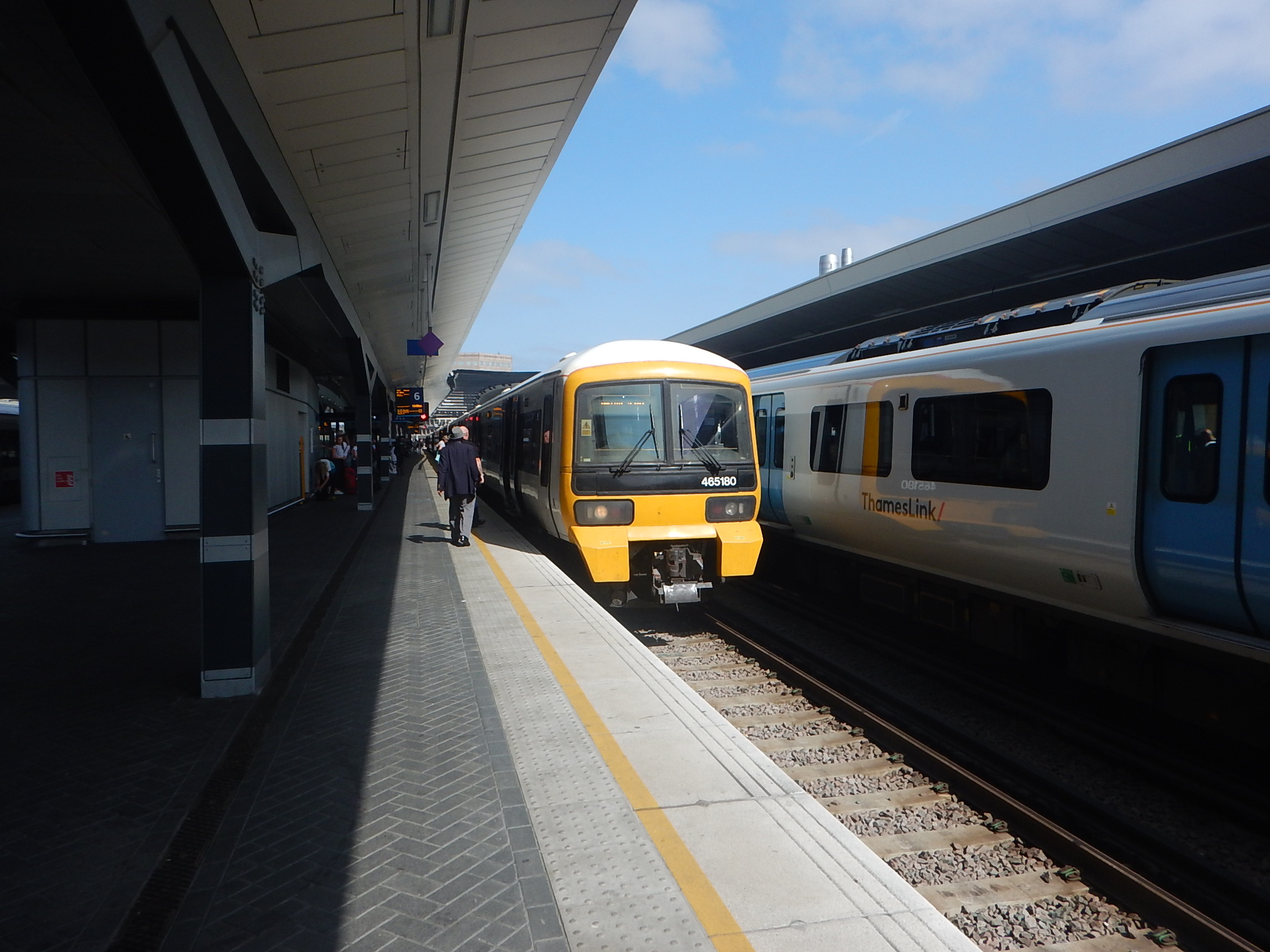
My feeling, is that the service would be improved by modern 100 mph trains, as these antique slow-coaches must restrict the speed of faster trains.
Southeastern – London Cannon Street And Dartford Loop Line
A Southeastern Metro service.
- Four tph in both directions.
- Calls at London Bridge, Deptford, Greenwich, Maze Hill, Westcombe Park, Charlton, Woolwich Dockyard, Woolwich Arsenal, Plumstead, Abbey Wood, Belvedere, Erith and Slade Green.
- Two tph return to Cannon Street via Crayford and Sidcup and two tph return to Cannon Street via Barnehurst and Bexleyheath.
- The service calls at Abbey Wood for a planned interchange with Crossrail.
- Class 465 trains work the route.
As I said with the previous service, these 75 mph trains need replacing with 100 mph trains.
Southeastern – London Charing Cross And Dartford
A Southeastern Metro service.
- Two tph
- Calls at Waterloo East, London Bridge, Lewisham, Blackheath, Charlton, Woolwich Dockyard, Woolwich Arsenal, Plumstead, Abbey Wood, Belvedere, Erith and Slade Green.
- The service calls at Abbey Wood for a planned interchange with Crossrail.
- Class 465 trains work the route.
As I said with the two previous services, these 75 mph trains need replacing with 100 mph trains.
Southeastern – London Victoria And Dover
A Southeastern Mainline service.
- Two tph
- Calls on the North Kent Line at Rochester, Chatham, Gillingham and Rainham.
- Class 465 trains work the route.
As I said with previous services, these 75 mph trains need replacing with 100 mph trains.
Southeastern – London Victoria And Ramsgate
A Southeastern Mainline service.
- One tph
- Calls on the North Kent Line at Rochester, Chatham, Gillingham and Rainham.
- Class 465 trains work the route.
As I said with previous services, these 75 mph trains need replacing with 100 mph trains.
Southeastern – London St. Pancras And Faversham
A Southeastern HighSpeed service.
- One tph
- Calls at Stratford International, Ebbsfleet International, Gravesend, Strood, Rochester, Chatham, Gillingham, Rainham and Sittingbourne.
- The service calls at Ebbsfleet International for an interchange with Continental services.
- Class 395 trains work the route, which have a 100 mph operating speed on lines electrified using a third-rail.
This picture shows a Class 395 train at Gravesend station.
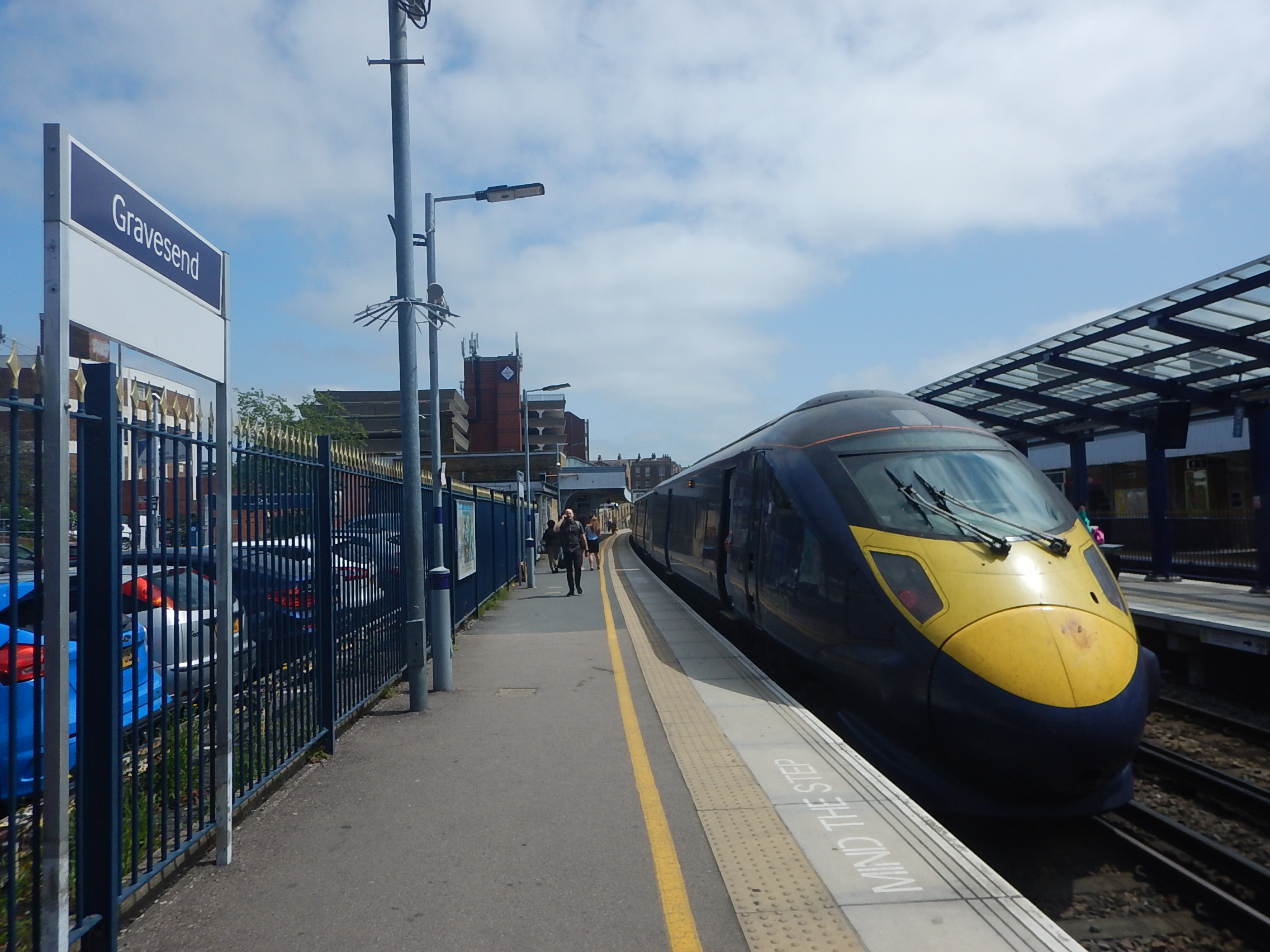
East of Ebbsfleet International, this service can be considered a 100 mph local train, that gets slowed by the 75 mph services.
Southeastern – London St Pancras International Loop Service
A Southeastern HighSpeed service.
- One tph
- Calls at Stratford International, Ebbsfleet International, Gravesend, Strood, Rochester, Chatham, Gillingham, Rainham, Sittingbourne, Faversham, Whitstable, Herne Bay, Birchington-on-Sea, Margate, Broadstairs, Ramsgate, Sandwich, Deal, Walmer, Martin Mill, Dover Priory, Folkestone Central, Folkestone West, Ashord International, Ebbsfleet International and Stratford International.
- The service calls at Ebbsfleet International and Ashford International for an interchange with Continental services.
- Class 395 trains work the route.
East of Ebbslfleet International, this service can be considered a 100 mph local train, that gets slowed by the 75 mph services.
Southeastern – London St Pancras International And Ramsgate
A Southeastern HighSpeed service.
- One tph
- Calls at Stratford International, Ebbsfleet International, Ashford International, Canterbury West, Ramsgate and Broadstairs
- The service calls at Ebbsfleet International and Ashford International for an interchange with Continental services.
- Class 395 trains work the route.
East of Ashford International, this service can be considered a 100 mph local train, that gets slowed by the 75 mph services.
A Summary Of Services By Station
I will look at the current number of trains at stations between London Bridge and Faversham.
- Deptford – 6 tph
- Greenwich – 6 tph
- Maze Hill – 6 tph
- Westcombe Park – 6 tph
- Charlton – 8 tph
- Woolwich Dockyard – 6 tph
- Woolwich Arsenal – 8 tph
- Plumstead – 8 tph
- Abbey Wood – 8 tph
- Belvedere – 6 tph
- Erith – 6 tph
- Slade Green – 6 tph
- Dartford – 12 tph to London and 6 tph to the East
- Stone Crossing – 4 tph
- Greenhithe for Bluewater – 6 tph
- Swanscombe – 4 tph
- Northfleet – 4 tph
- Gravesend – 6 tph to London and 5 tph to the East
- Higham – 2 tph
- Strood – 4 tph
- Rochester – 7 tph
- Chatham – 7 tph
- Gillingham – 7 tph
- Rainham – 7 tph to London and 5 tph to the East
- Sittingbourne – 5 tph
- Faversham – 5 tph
This is almost a train every ten minutes all the way from London to Faversham.
In addition Ebbsfleet International has four tph to and from London St. Pancras International.
Could Extra Services Be Run Along The North Kent Line?
Consider.
- Six tph is not a high frequency for a relatively simple route like this.
- The East London Line, which has about the same level of complication easily handles sixteen tph and it is planned to go to twenty tph in the next couple of years.
- Digital signalling and Automatic Train Control will handle twenty-four tph on Crossrail and Thameslink.
- Freight trains do not run at a high frequency on the route.
I wouldn’t be surprised to see another eight-ten tph added to the route.
How Many Trains Should Terminate At Ebbsfleet?
Currently, Crossrail has six fully-planned and built terminals.
- Abbey Wood will handle twelve tph in the Peak and ten tph in the Off Peak
- Heathrow Terminal 4 will handle four tph all day
- Heathrow Terminal 5 will handle two tph all day
- Maidenhead will handle two tph all day.
- Reading will handle four tph in the Peak and two tph in the Off Peak
- Shenfield will handle twelve tph in the Peak and ten tph in the Off Peak
It would appear that most terminals only handle between two and four tph.
I very much suspect, that research will show that four tph to and from Ebbsfleet will be sufficient.
It certainly meets the requirement for a Turn-Up-And-Go service, as used by London Overground and Merseyrail.
Possible Terminals For Crossrail In Kent
Wikipedia gives services to Abbey Wood station under Services as follows.
- Peak – Twelve tph
- Off Peak – Ten tph
There are several possible terminals for Crossail in Kent
Gravesend Station
When Crossrail was planned, the route was safeguarded to Gravesend station, with a depot at Hoo Junction to the East.
This section in Wikipedia, which is entitled To Gravesend And Hoo Junction, gives more details. This is the first sentence.
The route to Gravesend has been safeguarded by the Department for Transport, although it was made clear that as at February 2008 there was no plan to extend Crossrail beyond the then-current scheme.
These pictures show Gravesend station.
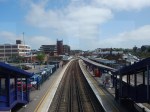
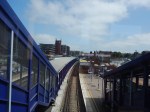
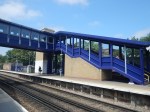
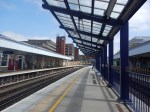
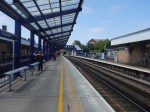
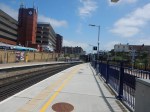
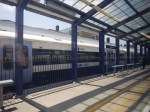
The station is well-appointed and has good services.
- The station is close to the Town Centre.
- It is step-free.
- There is a West-facing bay platform, which is currently used for a two tph service to Charing Cross.
- The platforms are very long.
- HighSpeed commuter services and Thameslink call at the station.
Crossrail services could either terminate in the bay platform or run through the station to a turnback siding at Hoo Junction.
Either way, I’m sure four tph could be easily handled.
Ebbsfleet International Station
Ebbsfleet International station is named in the title of this post and many are expecting that Crossrail will be extended to the station.
This Google Map shows this station.
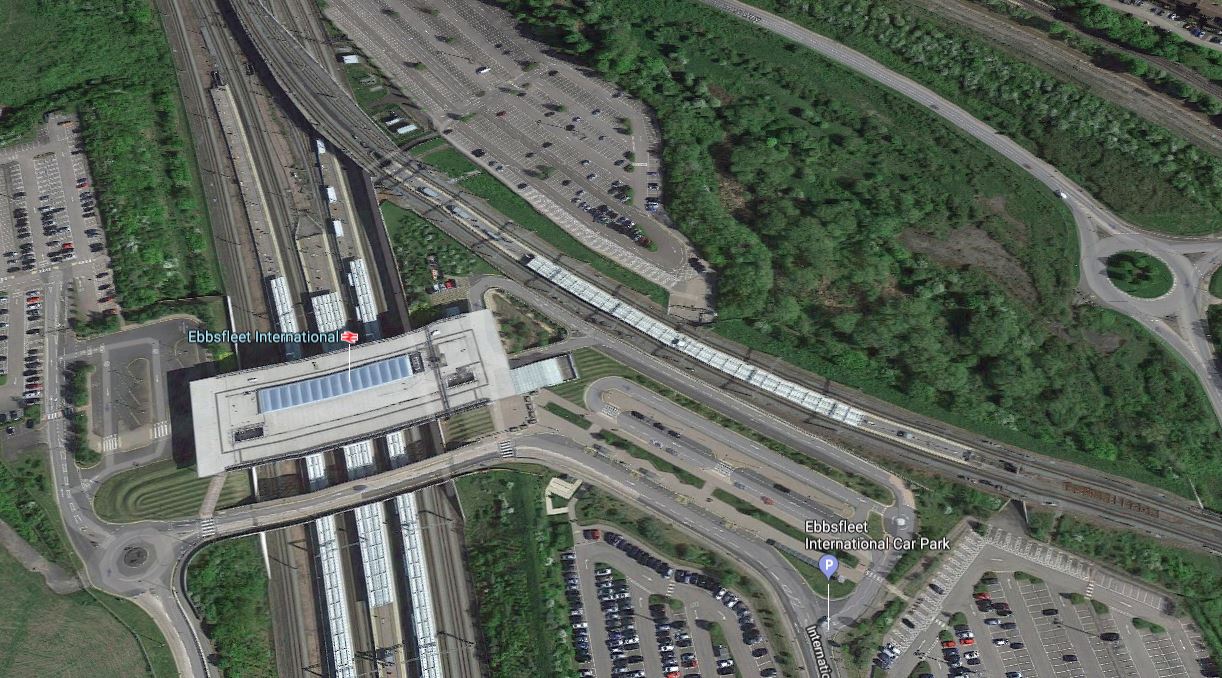
Note.
- The High Speed platforms 1 to 4, for St. Pancras, Ashford International and the Continent are to the left.
- The two separate platforms 5 and 6 for high-speed services to and from North Kent.
- The large amount of car parking around the station.
It’s not obvious, where a platform or two for Crossrail could fit in.
The Wikipedia entry for Ebbsfleet International station, says this about Crossrail.
It was formerly planned that Crossrail would terminate at a separate station between Northfleet and Ebbsfleet International but under the current plan, Abbey Wood further west will be the eastern terminus. However, a Crossrail extension from Abbey Wood to Gravesend (Hoo Junction) remains safeguarded
Perhaps, Crossrail platforms could be on the Northfleet side of the station, to the North of platforms 5 and 6.
If two platforms are good enough for Abbey Wood station, then surely, two platforms would be sufficient at Ebbsfleet International station.
This Google Map shows where the North Kent Line rrosses the Channel Tunnel Rail Link about five hundred metres North of Ebbsfleet station.
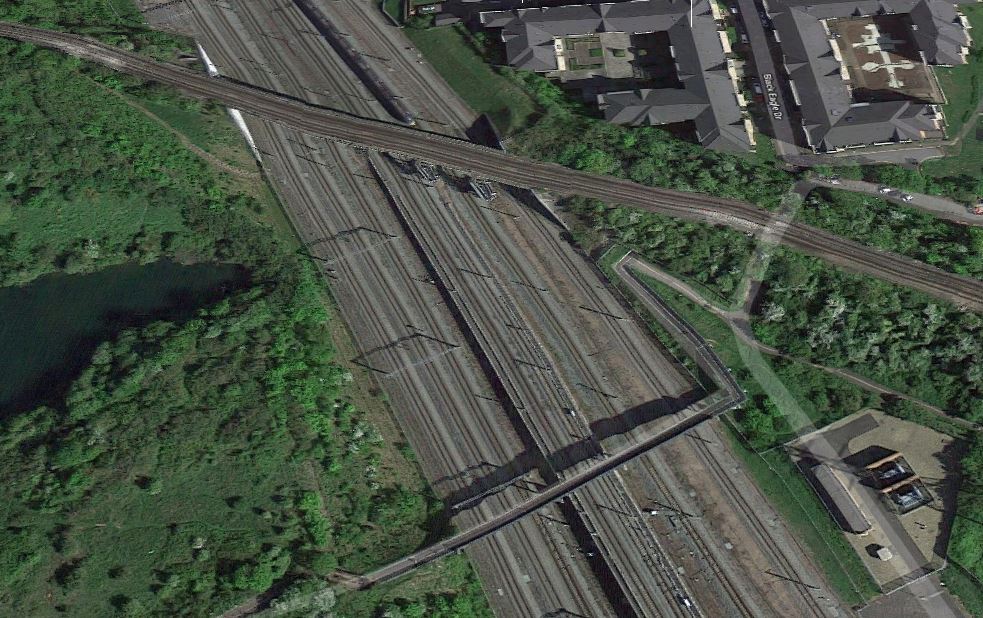
Could a flyover or dive-under be created to create a spur from the North Kent Line, that would allow Crossrail trains to sneak down the Eastern side of the high speed lines to platforms, alongside the current Platforms 5 and 6?
This picture was taken from a train on the bridge that carries the North Kent Line over the high speed lines.
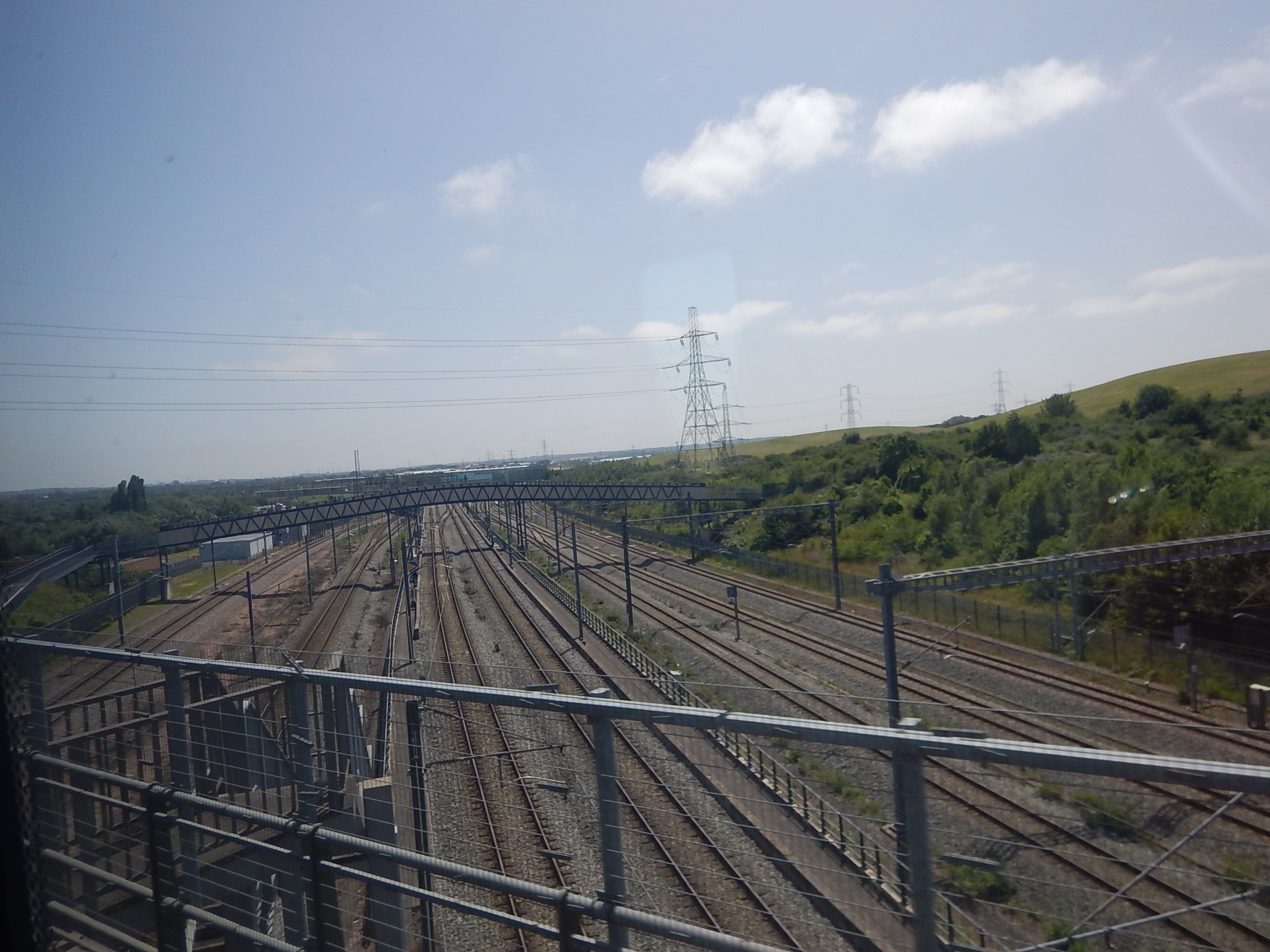
I suspect there is a solution in there somewhere.
One interesting possibility could be for the Crossrail trains to share Platforms 5 and 6 at Ebbsfleet International station with the HighSpeed commuter services to North Kent.
This picture shows the flying junction, where the tracks through Platforms 5 and 6, join the North Kent Line between Northfleet and Gravesend stations.
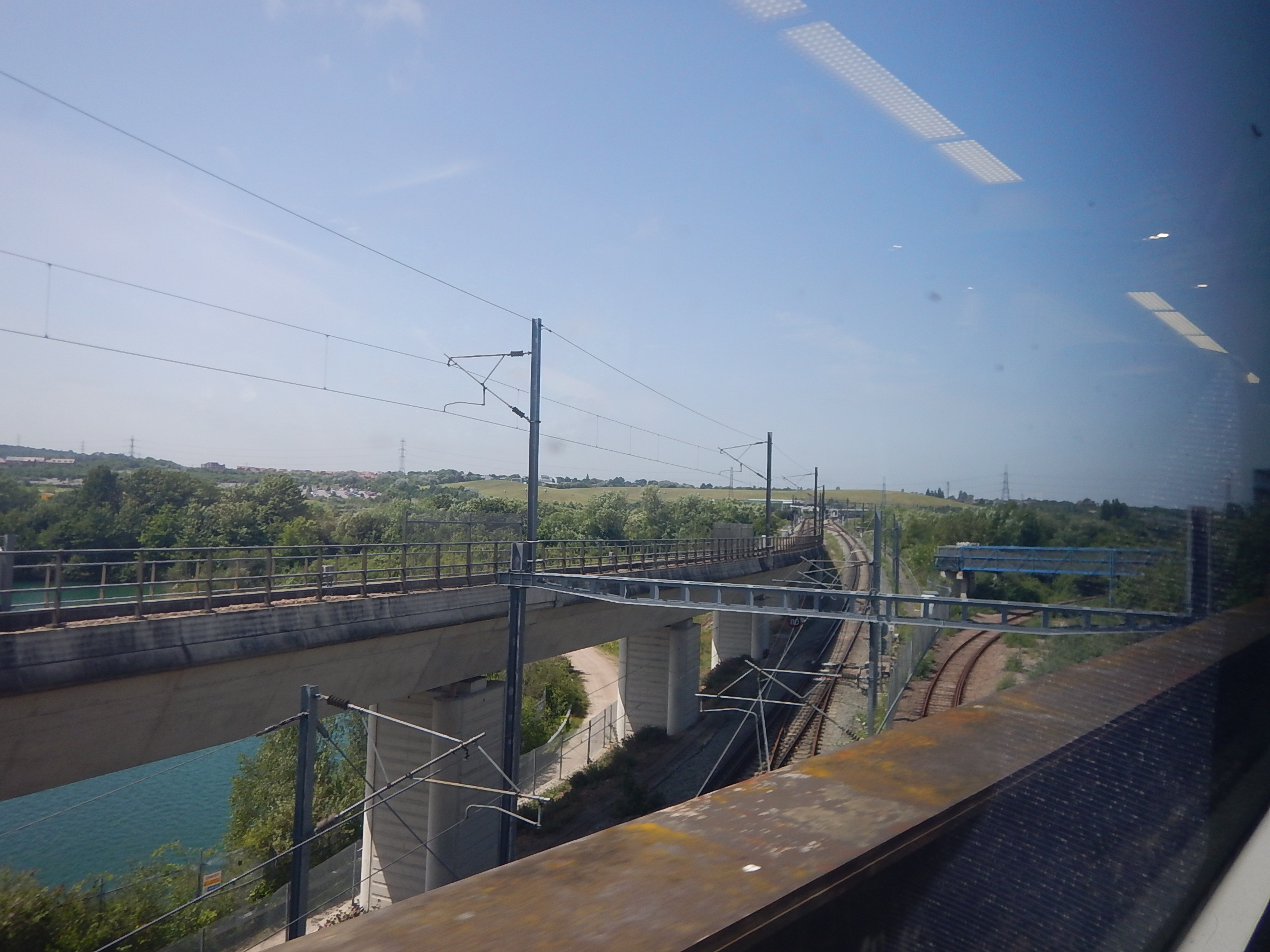
As currently, only two tph use the link, surely, Crossrail services of four tph could share, if they were to go through Ebbsfleet International and terminate at Gravesend?
I’m not an expert on designing bridges, but to my untrained eye, a flyover to connect the Ebbsfleet loop to the North Kent Line to the West of the station, wouldn’t be much more complicated, than the flyover to the East.
I think, a loop to serve Ebbsfleet would have other advantages.
- Crossrail would have access to a much-needed Park-and-Ride site.
- The interchange between Crossrail and Continental services would be a short walk.
- Probably only minimal improvements would be needed to Ebbsfleet International station.
- There would be a same-platform interchange between Crossrail and HighSpeed commuter services to and from St. Pancras.
- Construction would be more affordable and less disruptive.
Perhaps, it’s a better idea, than I originally thought?
Abbey Wood
Abbey Wood station has been designed to handle twelve tph.

The picture shows the four platforms at Abbey Wood station with a Class 345 train in one of the two Crossrail platforms.
- Two platforms can handle twelve tph.
- A turnback facility that has been built at the station to handle more trains or service recovery.
- There are three bridges, two escalators and at least two lifts to facilitate transfer between Crossrail and other services.
- Platforms are spacious.
- There is a wide gate line controlling entry to the station.
- The station is well-served by buses, but car parking is limited.
It is one of the better new stations and would certainly have no problems handling the eight tph, it would need to in the Peak, if four tph, carried on to terminate at Ebbsfleet.
Dartford Station
Dartford station probably has claims to be terminal for Crossrail.
It is a large town, clustered around the station.
There is a lot of new housing close to the station.
It has regularly services to several London terminals, by a variety of routes.
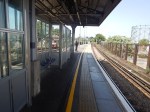
But it appears to be a very cramped station with narrow platforms, as some of these pictures shows.


Services at the station include.
- Eight tph – Charing Cross
- Two tph – Victoria
- Four tph – Gravesend
Thameslink also run two tph between Luton and Rainham.
It is much-more a station where travellers change trains, than one where services terminate..
But even for that it needs improvement.
My Preferred Crossrail Option
I would extend Crossrail to Ebbsfleet in a simple manner, that was capable of being expanded, as traffic needs changed in the future.
Four tph Would Continue Through Abbey Wood Station
I feel that a Turn-Up-And-Go service between Abbey Wood and Ebbsfleet, of four tph would be sufficient, especially if other services on the route, were to be increased in frequency and capacity.
Services Would Terminate At Gravesend Station
The original safeguarded plan for Crossrail to be extended to Gravesend, with a depot at Hoo Junction, is in my mind a good plan.
- Gravesend station is probably Crossrail-ready.
- Gravesend station could handle the turnround of Crossrail running at a frequency of four tph.
- There is plenty of space for a depot at Hoo Junction.
But perhaps most importantly,, it is the original plan suggested in the original design of Crossrail.
Have decisions been made by the various councils on the extended route, based on this plan?
Crossrail Services Would Use The North Kent Line
The extended Crossrail service would call at Belvedere, Erith, Slade Green, Dartford, Stone Crossing, Greenhithe for Bluewater, Swanscombe and Northfleet.
Frequencies of trains at the stations between Abbey Wood and Gravesend would be.
- Belvedere – 10 tph
- Erith – 10 tph
- Slade Green – 10 tph
- Dartford – 16 tph to London via a variety of routes and 10 tph to the East
- Stone Crossing – 8 tph
- Greenhithe for Bluewater – 10 tph
- Swanscombe – 8 tph
- Northfleet – 4 tph
In addition, Gravesend would have ten tph to and from London.
Handling these frequencies on a modern double-track railway shouldn’t be a problem.
Will Digital Signalling Be Needed?
Crossrail and Thameslink are both digitally signalled and will use a degree of Automatic Train Control, to handle up to twenty-four tph.
I could see advantages in applying similar systems to the Crossrail extension to Ebbsfleet.
Merging Of Services Between Abbey Wood And Belvedere Stations
Services through both these stations would include.
- 4 tph – Crossrail between London and Ebbsfleet/Gravesend
- 2 tph – Thameslink between Luton and Rainham, which don’t stop at Belvedere.
- 4 tph – Southeastern which are the Dartford Loop service to and from Cannon Street.
- 2 tph – Southeastern between Charing Cross and Dartford
The current track layout appears to allow Crossrail trains to access the North Kent Line, but Class 345 trains are not fitted with shoes for third-rail elecrification.
This Google Map shows the Western end of Belvedere station.
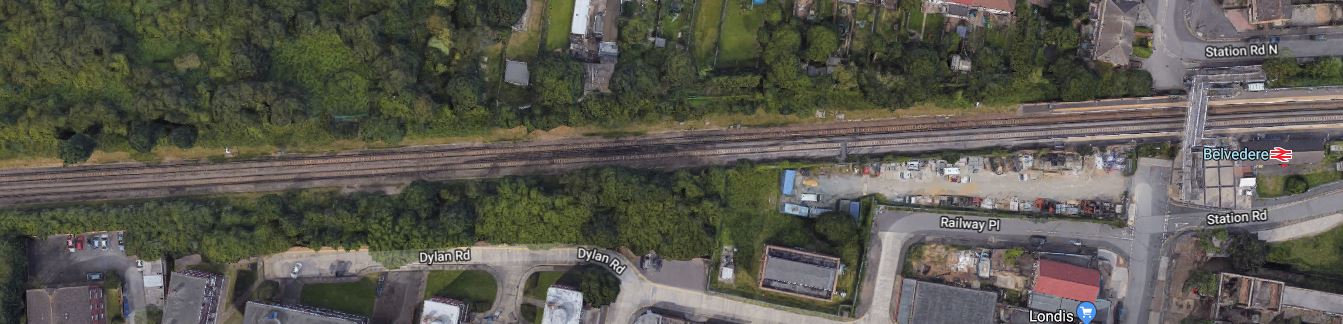
Note how there appears to be space on either side of the double track, which continues as far as Abbey Wood station.
I suspect that a track layout can be designed between the two stations, so that trains can merge and diverge efficiently between the four tracks at Abbey Wood and the two tracks at Belvedere.
Digital signalling would make it easier.
Station Improvement Between Abbey Wood and Grsvesend Stations
As I indicated earlier, Dartford station would need improvement.
On the other hand Abbey Wood, Greenhithe for Bluewater and Gravesend will need very little modification.
I also suspect, Dartford would not be the only station, that will need improvement.
All stations would be made step-free.
A Loop For Ebbsfleet International Station
I feel that the best way to give access to Ebbsfleet International station would be to create a loop from the North Kent Line and use the current island platform 5 and 6 at the station for Crossrail as well.
The Eastern end of the loop has already been built to a high standard and it would only need a Western connection to be designed and constructed.
I’ll repeat the advantanges of this scheme, I listed earlier.
- Crossrail would have access to a much-needed Park-and-Ride site.
- The interchange between Crossrail and Continental services would be a short walk.
- Probably only minimal improvements would be needed to Ebbsfleet International station.
- There would be a same-platform interchange between Crossrail and HighSpeed commuter services to St. Pancras.
- Construction would be more affordable and less disruptive.
Each side of the he island platform 5 and 6 would handle.
- Two tph – HighSpeed commuter services.
- Four tph – Crossrail services.
They may even be able to handle more trains in the future.
Will Crossrail’s Class 345 Trains Fleet Need Upgrading?
Crossrail’s Class 345 trains have a 90 mph operating speed, as opposed to the 100 mph operating speed of Thameslink’s Class 700 trains.
Southeastern Class 465 trains are even slower at 75 mph.
If all trains working the North Kent Line were 100 mph trains, it would surely make a robust timetable easier to create and operate.
I would expect that in a few years time, all trains working between London and Kent will be capable of at least 100 mph.
Where Will Gravesend and Ebbsfleet International Services Terminate In The West?
The obvious terminal would surely be Heathrow, as this would give a useful service Heathrow and Continental rail services, without the need to change trains.
Wikipedia is quoting 52 minutes between Heathrow and Abbey Wood on Crossrail and current times give twenty-three minutes between Abbey Wood and Gravesend stations, with perhaps four minutes less to Ebbsfleet in the future.
So timings could be as follows.
- Heathrow and Ebbsfleet – 75 minutes
- Heathrow and Gravesend – 79 minutes
Surely, this will be better than struggling around a crowded M25.
Southeastern HighSpeed Commuter Service Improvements
The Southeastern franchise may change later in the year and speculation has started on what this will mean for services and the trains used.
A Revamped HighSpeed Service
In an article in the July 2017 Edition of Modern Railways, which is entitled Kent On The Cusp Of Change, some well-founded speculation is made about the future of the HighSpeed commuter service.
- More Class 395 trains or similar need to be procured.
- A new service between St. Pancras and Hastings is planned.
- An all-day service between St. Pancras and Maidstone West via Gravesend.
- An extra two tph between St. Pancras and Ebbsfleet International.
- A second London terminal may be opened at possibly Waterloo or even Victoria.
Only the Maidstone West service would pass through platforms 5 and 6 at Ebbsfleet International station and would add a third hourly HighSpeed service.
In some ways, it might be better for HighSpeed services to run at four tph between Gravesend and St. Pancras via Ebbsfleet International and Stratford International, as this would fit much better with a four tph Crossrail service.
Improvements To Stratford International Station
Pedestrian routes between the various services and the Olympic Park at Stratford International station are not good.
- If HighSpeed services are going to be expanded, then it is only right that Stratford International station is improved, to a good modern connectivity standard.
- If Stansted Airport and Cambridge services serve Stratford in the future, then there must be an easy pedestrian route between the two services.
- Connectivity between HighSpeed and Great Eastern Main Line and Crossrail services is particularly poor.
- The HighSpeed platforms at Stratford International station are bleak and draughty and need improvement.
It’s almost as if, the whole station complex was designed for the Eastfield Shopping Centre.
A Summary Of Services By Station
I will look at the current number of trains at stations between Abbey Wood and Faversham, after adding in two extra HighSpeed sevices.
- St. Pancras and Maidstone West via Strood.
- St Pancras and Faversham.
These would give.
- Belvedere – 10 tph
- Erith – 10 tph
- Slade Green – 10 tph
- Dartford – 16 tph to London via a variety of routes and 10 tph to the East
- Stone Crossing – 8 tph
- Greenhithe for Bluewater – 10 tph
- Swanscombe – 8 tph
- Northfleet – 4 tph
- Gravesend – 8 tph to London and 7 tph to the East
- Higham – 2 tph
- Strood – 6 tph
- Rochester – 8 tph
- Chatham – 8 tph
- Gillingham – 8 tph
- Rainham – 8 tph to London and 6 tph to the East
- Sittingbourne – 6 tph
Thameslink Improvements
My only thought about Thamesink, is that if Crossrail and Southeastern’s HighSpeed services run at a frequency of four tph, through Gravesend, then surely Thameslink should run at the same frequency Between St. Pancras and Rainham.
I say St. Pancras rather than Luton, as it would probably be sensible to send the extra two tph up the East Coast Main Line to either Welwyn Garden City, Peterborough or Cambridge.
A Summary Of Services By Station
I will look at the current number of trains at stations between Abbey Wood and Faversham, after adding in two extra Thameslink sevices.
These would give.
- Belvedere – 12 tph
- Erith – 12 tph
- Slade Green – 12 tph
- Dartford – 18 tph to London via a variety of routes and 12 tph to the East
- Stone Crossing – 10 tph
- Greenhithe for Bluewater – 12 tph
- Swanscombe – 10 tph
- Northfleet – 6 tph
- Gravesend – 10 tph to London and 9 tph to the East
- Higham – 4 tph
- Strood – 8 tph
- Rochester – 10 tph
- Chatham – 10 tph
- Gillingham – 10 tph
- Rainham – 10 tph to London and 6 tph to the East
- Sittingbourne – 6 tph
When you consider that these frequencies are obtained by trains running at 100 mph on a railway, that was most;ly built in the mid-nineteenth century and electrified with 750 VDC third rail before the Second World War.
Southeastern Improvements
Both Southeastern’s Metro services to and from Dartford and Chatham and their main line services to East Kent will probably be improved under the new franchise holder
- New or refurbished 100 mph trains will replace the 75 mph Class 465 trains.
- Dover and Ramsgate will get increased frequencies from Victoria.
- Metro services to and from Dartford and Chatham will be at least a Turn-Up-And-Go four tph.
- The enhanced performance of the new trains would enable faster services and more stops to be made without degrading the timetable.
I feel that it would not be impossible to see every station between London Bridge and Rainham having twelve tph.
The Pedestrian Link Between Northfleet And Ebbsfleet International Stations
I am not saying a pedestrian link between Northfleet and Ebbsfleet International station shouldn’t be built, but consider that the loop through Ebbsfleet International station gives two routes between Swancombe and Gravesend.; one via Northfleet and the other via Ebbsfleet International.
A lot depends on how many passengers will actually want to travel between the two stations.
- Those from the West could change at a station like Dartford or Greenhithe for Bluewater to a train going to their required destination.
- Those from the East could change at Gravesend to a train going to their required destination.
All changes would be same-platform changes and the best stations could be encouraged by coffee kiosks and comfortable waiting rooms.
For passengers starting from Northfleet the following rules would apply.
- Passengers going East would take the first train and change if required at Bravesend, Rochester or their preferred station.
- Passengers going West would take the first train and change if required.
- Passengers going to Ebbsfleet International would probably catch the first train for a single stop and then cross-over to the other platform for a train to Ebbsfleet International.
If there were upwards of six tph on both routes and step-free access at all stations, these procedures would not be unduly tiresome.
Similar rules would apply for those starting their journeys at Ebbsfleet International.
Note that, as more trains ran on both routes between Swanscombe and Gravesend, the time to get between the two stations would decrease.
If as seems to be planned, a lot of housing is built on the undeveloped land between the two stations, I wouldn’t be surprised to see a progressively-minded developer build a pleasant tree-lined pedestrian and cycling route between the two stations.
This would be mainly to give easy access to the development to the two stations, but it would also link them together.
Conclusion
Everything, I have written in this post is based on sound facts and is possible with today’s technology.
- 100 mph suburban electric trains have been around for several decades.
- Digital signalling has been successfully running on Thameslink in the UK and other places in the world for a couple of years.
- The construction methods to build a loop at Ebbsfleet station are nothing out-of-the-ordinary.
What I have outlined would be much more of a £1.3 billion project than a £3 billion one!
I also believe everything can be achieved without massive disruption or inconvenience to passengers and probably delivered in full by 2025.
It should be noted that North Kent will be reaping the benefit of three major new cross-London high-capacity railways.
- The Chanel Tunnel Rail Link between Ebbsfleet International and St. Pancras via Stratford International.
- Crossrail between Abbey Wood and West London via Canary Wharf, the City and West End of London, Paddington and Old Oak Common.
- Thameslink between Kent and North of London via London Bridge, Blackfriars and St. Pancras.
As cross-London routes continue to develop in future decades, other commuter routes will benefit from similar strategies.
Transport for Wales Is Invading England
There is an article in the July 2019 Edition of Modern Railways, which is entitled TfW Targets Swansea To Bristol Services.
This is the first paragraph.
Transport for Wales Rail Services is aiming to start an open access service between Swansea and Bristol Temple Meads, commencing in December 2020.
These are characteristics of the proposed service.
- Hourly service
- Calls at Neath, Port Talbot Parkway, Bridgend, Cardiff Central, Newport, Severn Tunnel Junction and Filton Abbey Wood stations.
- Sixteen services per day will run Monday to Saturday in both directions, with twelve services on Sundays.
- Trains will be Class 170 or Class 175 diesel trains.
Looking at current times of sections of the route, I suspect that services could take a few minutes under two hours and would need four trains.
Reasons given for planning the service include.
- Long-term political pressure.
- Welsh ministers abandoning plans for the £1.6 billion M4 Relief Road around Newport.
- Cross-Severn road traffic has increased after abolition of tolls.
- Main roads on either side of the Severn are congested.
- Increased house sales in South Wales to people who work in the Bristol area.
Incidentally, before I read the article, if you asked me, I’d have thought there would be a direct service.
My only thought about the service, is that as there will be electrification between Bristol and Cardiff, why not run a proper fast bi-mode train like a Hitachi Class 800 train or a Stadler Class 755 train. The latter of which Transport for Wales have on order, for delivery in 2023.
The Class 755 train or its Welsh cousin, could be an interesting option.
- The distance without electrification between Cardiff and Swansea is 46 miles.
- Transport for Wales tri-mode version of the Class 755 train could have three batteries and a diesel engine in the four slots in the powrpack car.
Could it have the capability of jumping the gap.
Birmingham Services
The article also says that, Transport for Wales are also planning to extend their services that terminate at Birmingham to Coventry.
- Holyhead and Birmingham New Street takes three hours.
- Aberystwyth and Birmingham New Street takes three hours
- Pwllheli and Birmingham New Street takes five hours
As Birmingham and Coventry takes twenty minutes or perhaps a convenient hour to go to Coventry and return with a relaxed turnround, does the extension make these three long services simpler to operate?
Extra positioning services from Crewe to Coventry in the morning and return in the evening are also proposed.
These would also suggest that improving the ease of operation of these services is the reason for the extension to Coventry.
Liverpool Services
The article also says that these services to Liverpool will be added in 2022.
- An hourly service to Llandudno.
- A two-hourly service to Cardiff.
It isn’t said, if one of these services is an extension to the recently launched Liverpool and Chester service.
Conclusion
The Welsh are getting ambitious.
Future Stansted Airport Train Services
Currently, the following services go to Stansted Airport station, in trains per hour (tph)
- Four tph – Stansted Express – Liverpool Street
- One tph -CrossCountry – Birmingham New Street via Cambridge, Peterborough and Leicester
- One tph – Greater Anglia – Cambridge via Audley End and Whittlesford Parkway
Greater Anglia have plans to change the services.
- Extend the Norwich and Cambridge service to Stansted Airport.
- Reintroduction of a Stansted Express service between the Airport and Stratford is mentioned in Wikipedia.
With two very long and one shorter platform, the Airport station has plenty of capacity.
Stansted Express Journey Times And Trains Required
Currently, Stansted Express services run at a frequency of four tph, that take fifty minutes between London and the Airport.
If a turnround time of ten minutes is added, then it takes trains two hours to do a round trip between London and the Airport.
So this means that thse numbers of trains are needed for the following frequencies.
- One tph – Two trains
- Two tph – Four trains
- Four tph – Eight trains
As Greater Anglia have ordered ten Class 745/1 trains for Stansted Express, these would be able to provide a reliable service with eight in service, one as a spare and one in maintenance.
A Stansted Express service to Stratford would take the same time and would need similar numbers of trains.
Norwich and Stansted Airport Journey Times And Trains Required
The timing for the proposed service between Norwich and Stansted Airport, can be estimated by taking the timing of current services.
- Norwich and Cambridge – One hour 20 minutes
- Cambridge and Stansted Airport – 30 minutes
Both services are run by reasonably-modern 100 mph diesel trains.
Add in a ten minute turnround at both ends of the route and it should be possible to schedule a Stansted Airport and Norwich round trip in four hours.
Greater Anglia is introducing new bi-mode Class 755 trains on this route.
- The trains will be designed for fast stops.
- The trains will run on electricity on the nearly forty miles between Stansted Airport and Ely and around Norwich.
- The trains will run on diesel between Ely and Trouse Junction, just to the South of Norwich.
- The trains will probably be abe to achieve 100 mph on a good proportion of the route.
- The trains will probably be four-cars.
It would need four trains to run the proposed one tph service.
The current Norwich and Cambridge service probably needs three trains, so extending to Stansted Airport will need an extra train.
This seems to be good value for passengers, the Cities of Cambridge and Norwich, Stansted Airport and Greater Anglia.
Could There Be A Norwich And London Service Via The West Anglia Main Line?
I can remember seeing steam-hauled expresses thundering between Liverpool Street and Norwich in the 1950s, through places like Brimsdown.
They are long gone, but they gave places like Wymondham and Thetford a direct rail link to London.
Greater Anglia’s future plans will connect these towns and others directly to Stansted Airport, but could they go all the way to London?
What do the mathematics show?
The section timings of a Norwich and London service via Cambridge and Stansted Airport would be as follows.
- Norwich and Cambridge – One hour 20 minutes
- Cambridge and Stansted Airport – 30 minutes
- Stansted Airport and London – 50 minutes
This is just two hours and forty minutes.
Add in a few minutes for the reverse at Stansted Airport and the turnround at either end and I believe a round trip could be comfortably within six hours.
It would therefore mean that six trains would be needed to run an hourly service between London and Norwich.
- Stops could be Tottenham Hale, Broxbourne, Harlow Town, Bishops Stortford, Stansted Airport, Audley End, Whittlesford Parkway, Cambridge, Cambridge North, Ely and all stations to Norwich.
- The London terminal could be Liverpool Street or Stratford.
- If Stratford were to be used, trains could be turned round in the High Meads Loop.
- Trains would be Class 755 trains, which are bi-mode and capable of 100 mph running.
- Between London and Ely, the trains would take advantage of the electrification.
The service would give a lot of stations a direct connection to Stansted Airport, that would be complimentary to the Stansted Express.
It would require just two more trains, than the planned Norwich and Stansted Airport service.
The advantages of the service would be.
- Stations between Thetford and Norwich would get direct London and Stansted Airport services.
- Stratford would get a very useful direct service to Stansted Airport.
Greater Anglia would serve two markets with the extended service and just two extra trains, over the planned service.
If Greater Anglia say a London and Norwich via Stansted Airport service will never happen, they are being economical with the truth.
Could Class 755 Trains With Batteries Bridge The Electrification Gap,Between Ely And Trowse Junction?
The distance between the electrification at Ely station and Trowse Junction, South of Norwich, is just under fifty-three miles.
I believe that the tri-mode four-car Flirts for Trains for Wales are similar to Greater Anglia’s Class 755 trains, with three of the Deutz diesel engines replaced with 100-120 kWh batteries.
Would this be enough power to take the train across the electrification gap?
Consider.
- There is electrification at both ends and the batteries could be full, on entering the unelectrified section.
- The route is very gentle.
- There are a few stops, but the trains will have regenerative braking to charge the batteries.
- The trains could retain a single diesel-engine,, should livestock on the line cause the service to be suspended.
For these and other reasons, I suspect that in a couple of years, diesel will be relegated to emergency use only between Norwich and Stansted Airport.
The Herd Of Wannabe Unicorns In The Room
Other places have elephants, but the City of Cambridge has herds of wannabe unicorns.
For those of you, unfamiliar with the term, Wikipedia defines unicorn like this.
A unicorn is a privately held startup company valued at over $1 billion.
Cambridge is expanding at a fast rate and it needs public transport systems to bring in the workers, visitors and investors.
- A new Cambridge North station has been built.
- A guided busway linking Addenbrooke’s and Papworth Hospitals and the Cambridge Biomedical Campus to the City Centre has been built.
- A new Cambridge South station is being planned.
- The East-West Rail Link will connect Cambridge to Oxford.
Road travel in the local area is not an option.
Currently, most rail services radiate from Cambridge station, but like London and other cities are proving, Cambridge needs Cross-City services.
A high-frequency North-South route is being created across the City.
- To the North of the City is Ely station.
- North of Ely station, lines fan out to Peterborough, Kings Lynn and Norwich.
- From North to South across the City, there will be Waterbeach, Cambridge North, Cambridge and Cambridge South stations.
- South of Cambridge South station, lines will fan out to Bedford and Oxford, Royston, Hitchin and Kings Cross and Audley End, Stansted Airport and Livepool Street.
In addition routes to Bury St. Edmunds, Ipswich and Felixstowe reach out to the East.
The current North-South train services include.
- 1 tph – Birmingham New Street and Stansted Airport
- 1 tph – Kings Lynn and Kings Cross
- 1 tph – Cambridge and Norwich
- 2 tph – Cambridge and Brighton
- 2 tph – Cambridge and Liverpool Street
- 2 tph – Cambridge and Kings Cross
The number of these services will grow.
Will More Stations Be Built Or Reopened Between Stansted Airport And Norwich?
I know the route, South of Cambridge better than I know it to the North.
To the South of Cambridge, the current stations could be sufficient, with improved car and bicycle parking and provision for electric cars.
To the North, there appear to be new housing developments under consideration and surely, these will need good public transport to and from Cambridge.
Does The Norwich and Stansted Airport Service Need Two Trains Per Hour?
I have a feeling that Greater Anglia think, that East Anglia’s generally one tph services between major towns and cities is not enough.
Greater Anglia have said they will do the following.
- Increase the Ipswich and Norwich frequency from two to three tph.
- Run two tph between Ipswich and Kennett via Bury St. Edmunds.
I talked previously about Cambridge and its herd of wannabe unicorns.
I believe strongly, that the Cambridge Effect will in a couple of years, mean that the frequency between Norwich and Stansted Airport will need to be doubled.
But will Greater Anglia have enough trains?
Greater Anglia are purchasing a fleet of 38 Class 755 trains with a total of 138 carriages to replace 27 assorted trains with a total of 58 carriages.
- This is a forty percent increase in the number of trains.
- This is nearly two and a half times as many carriages.
- The average number of carriages per train is raised from 2.1 to 3.6.
That is a massive increase in train capacity.
There should be enough for either.
- Eight trains for two tph between Norwich and Stansted Airport.
- Twelve trains for two tph between Norwich and London via Stansted Airport.
These would be increases of four and eight trains respectively on Greater Anglia’s current plan for a one tph service between Norwich and Stansted Airport.
Conclusion
Greater Anglia have enough trains to run a two tph service between Norwich and London via Stansted Airport.
I believe that the Cambridge Effect will create enough demand to necessitate expansion of the proposed one tph service between Norwich and Stansted Airport into a Norwich and London via Stansted Airport service.
- Frequency will be two tph.
- New commuter-friendly stations could be built.
- The Southern terminal could be Stratford to give a second route to Stansted Airport from London.
Greater Anglia would be satisfying two markets with one train.
Barking Riverside Extension – 24th June 2019
I took these pictures, where the arking Riverside Extension will turn off to the East of Renwick Road bridge.
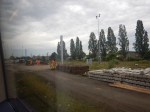


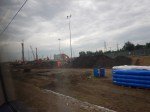

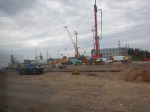

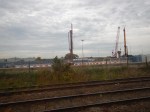
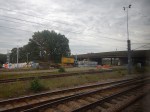
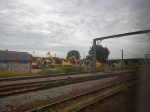
It looks like the piles are going in and there is a lot of catenary renewal.
I think that this project could be on time.
Engineering Work Closures Between Barnes And Feltham In June And July
There is more up-to-date information on this page on South Western Railway’s web site, which is entitled Engineering Works.
These are what I found.
Saturday 20 July and Sunday 21 July
Buses replace trains between Barnes and Feltham via Hounslow Saturday 20 and Sunday 21 July
Saturday 27 July and Sunday 28 July
Buses replace trains between Barnes and Feltham via Hounslow Saturday 27 and Sunday 28 July
Sunday 11 August
Buses replace trains between Barnes and Feltham via Hounslow Sunday 11 August
Sunday 18 August
Altered train services and replacement buses in the Feltham area Sunday 18 August
Sunday 25 August
Altered train services and replacement buses in the Feltham area Sunday 25 August
Thoughts On Works In The Area
My thoughts on the two projects follow.
Syon Lane Footbridge
When I wrote Why Are Replacement Buses Being Used To Syon Lane Station On July 20-21?, I didn’t find the two later closures through Syon Lane station.
I was checking the on-line timetable and it appears that the closure is not total on the days mentioned, in the current timetable.
It looks to me that Network Rail and South Western Railway are playing this in a safety first manner, as few people are going to complain, if a closure doesn’t happen and a shiny new step-free bridge has appeared and is almost ready for use.
Bedfont Lane Level Crossing Removal At Feltham Station
In The Removal Of Bedfont Lane Level Crossing, I gave a schedule of the works and it appears nothing much is slated to be done until later in the year.
I need more information about why there are closures in the Feltham area.
I did find this image of the proposed pedestrian and cycling bridge.
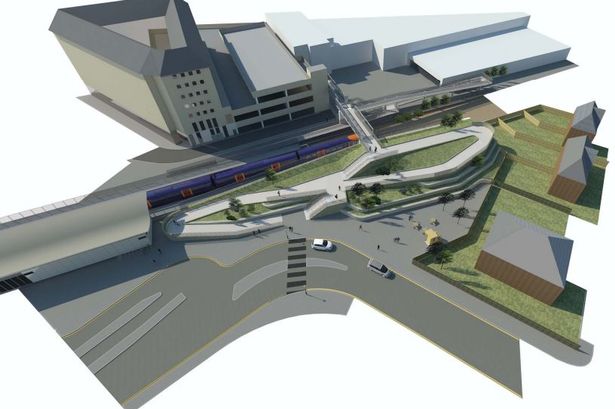
It certainly looks very traditional with long ramps.
This picture shows the progress on the 25th June 2019
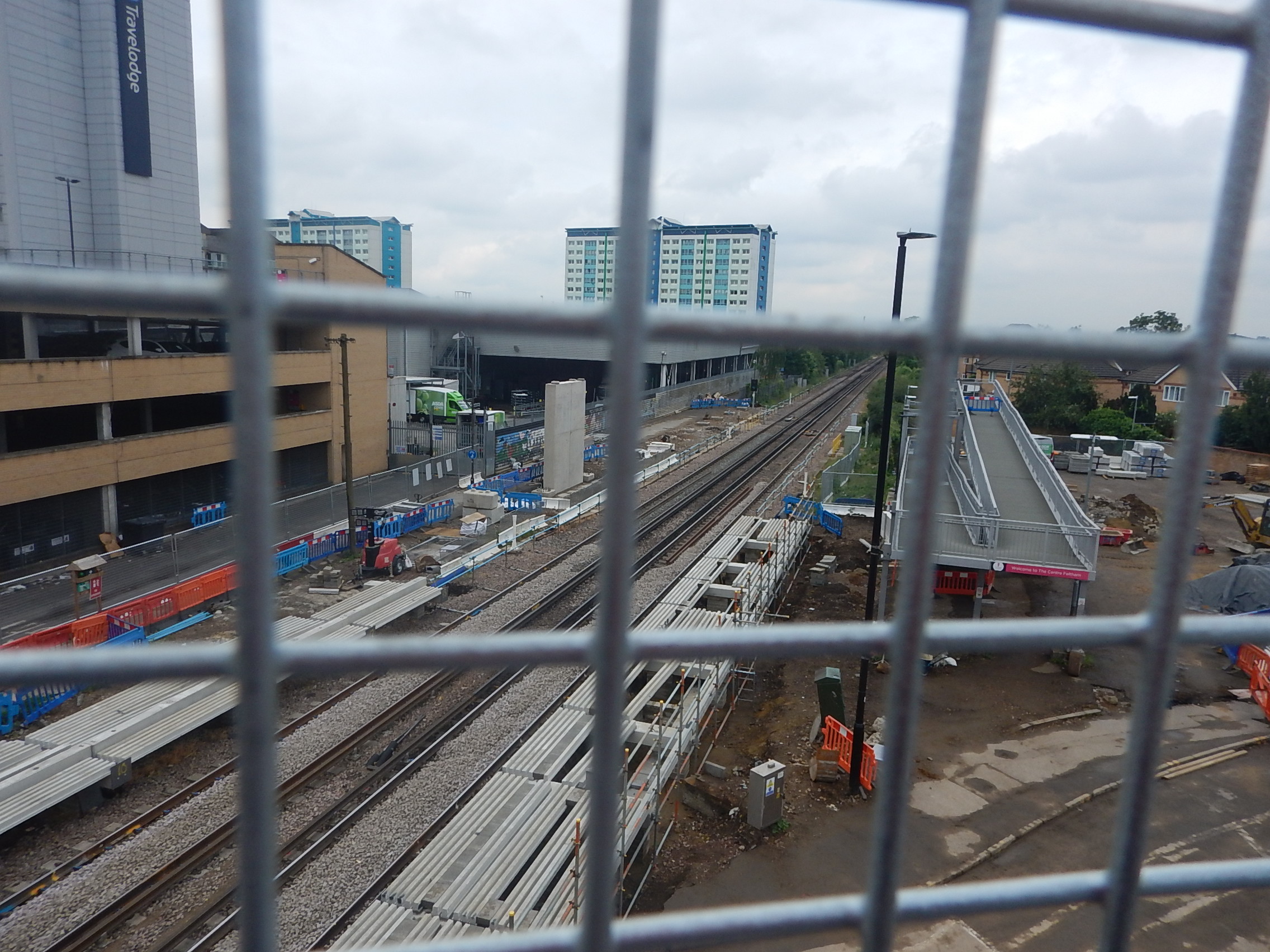
Note the platform extensions and the pillar on the far side to support the bridge.
I’m not sure, if the ramps in the picture are part of an older bridge or new!
Conclusion
It’s all happening in Hounslow.
The New Entrance To Moorgate Station
The new entrance to Moorgate station, is now more visible behind the hoardings.
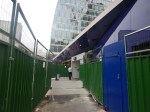
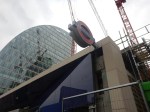

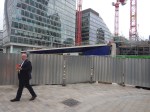
But there still appears to be a lot to do!
Tottenham Hale Station Is Beginning To Make Sense
These are pictures, I took of Tottenham Hale station, this morning.

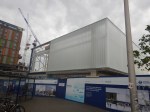

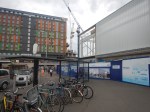
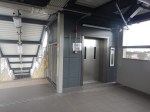
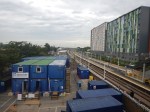
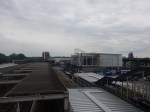
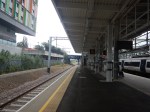
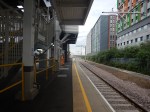
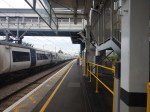
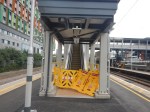
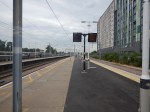
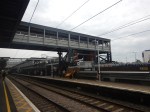
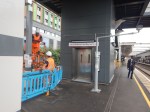
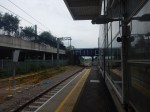
A few of my observations.
The Cladding Is Going On
The cladding is going on the building above the Victoria Line ticket hall.
It appears to be fireproof glass on a concrete and steel frame.
A Wide Island Platform
Platforms 2 and 3 form a wide island platform.
- Only Platform 3 appears to be in use for London-bound services to both Liverpool Street and Stratford.
- Both faces appear long enough for a 240 metre long Stansted Express train.
- There is a step-free bridge at the half-way point of the platform.
- The original bridge with its escalator is still in place.
It is a design with good potential for handling more services.
- Platform 3 could handle all services to Liverpool Street station.
- Platform 2 could handle all services to Stratford station.
Travellers would just walk across the island platform.
The Step-Free Bridge Appears Almost Complete
The bridge appears to be almost complete.
- The bridge has lifts and stairs with double handrails on both sides.
- The lift and stairs on the London-bound side are in the middle of the island platform 2 & 3.
- There is an escalator for London-bound travellers to access the bridge, to give an easy route to the Victoria Line.
There appears to be just a bit of testing before full commissioning.
The Old Bridge Is Still In Place
It still has its up escalator from Platform 2 & 3 and there have been statements that this bridge will be modified to create a link between the Underground station and the developments on the other side of the tracks.
Most Of The Bus And Taxi Interchange Is Complete
With buses and black taxis, the interchange seems finished.
- Much of North and East London can get a bus to and from the station.
- Today, I got a 76 bus to Dalston for a two hundred metre walk.
- But with a heavy case, I’d get a black cab,
Transport planners usual only plan for travellers to and from the City centre.
The Future
The Stratford And Meridian Water Shuttle
This is rumoured to start in September and will probably be the following.
- Two trains per hour (tph) between Stratford and Meridian Water stations.
- Stops will be at Lea Bridge, Tottenham Hale and Northumberland Park stations.
- Trains could be any length up to probably 240 metres, as all platforms are long.
- Current trains take sixteen minutes between Stratford and Meridian Water stations.
In addition services between Stratford and Hertford East and Bishops Stortford stations would stop at Meridian Water, to give the station a four tph service to and from Stratford.
The new Meridian Water station has been built with a dedicated bay platform for the shuttle service.
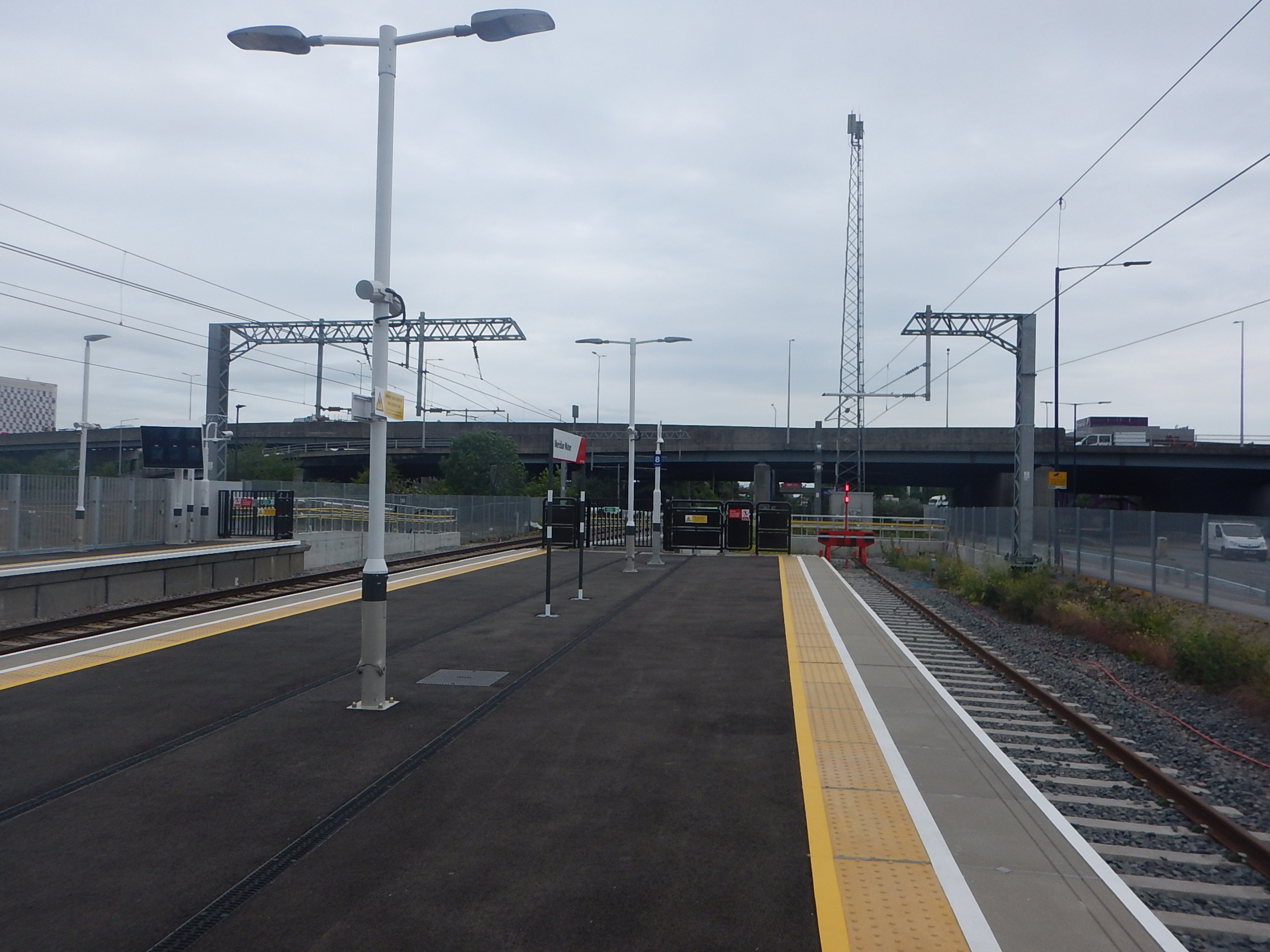
The bay Platform 2 is on the right and the through Platform 3 is on the left in this picture taken looking North at Meridian Water station.
Two tph to Stratford would leave from each side of this platform.
The new track between Meridian Water and Lea Bridge stations has been built without a passing loop, so the two tph shuttle must probably be run by a single train.
The shuttle would.
- Have exclusive use of the new track between Lea Bridge and Meridian Water stations.
- Have shared use of the existing track between Lea Bridge and Stratford stations.
- Call at Platform 2 at Tottenhale and Northumberlan Park station in both directions.
A two tph shuttle would consist of the following.
- Four journeys between Stratford and Meridian Water stations.
- Twenty-four intermediate station stops.
- Two turnrounds each at Meridian Water and Stratford stations.
- Current turnrounds at Stratford have in excess of twenty minutes to unload and load passengers and for the driver to change ends.
- Greater Anglia will be running the shuttle in September with nearly nearly forty-year-old British Rail-built Class 317 trains.
As there is not enough time to fit the trains with wings and jet engines, what the hell will be happening?
Go to Stratford station and there is an out-of-date sign at the end of Platform 1 and 2, where the Overground trains terminate.

It directs passengers to Platform 12 for Stansted Airport.
It dates from the time, when Stansted Express trains used to go to Stratford station.
They didn’t turnround in Platform 12, but used the High Meads Loop underneath the Eastfield Shopping Centre to reverse direction.
- The train stopped in Platform 12 long enough for passenger to leave and join the train.
- The driver stayed in the same cab and carried on driving.
I suspect that a Class 317 train could go from Platform 1 at Lea Bridge station, round the High Meads Loop and back to Platform 2 at Lea Bridge station, in these split times.
- Lea Bridge to Stratford – 6 minutes.
- Stop in Platform 12 at Stratford – 1 minute
- Straford to Lea Bridge – 6 minutes.
I believe all these times can be achieved by well-driven Class 317 trains, which gives a timing of thirteen minutes.
Currently, Lea Bridge to Meridian Water takes nine minutes in the elderly Class 317 trains, sharing the track with other trains.
But the shuttle trains will have a clear track, once they are on the new track North of Lea Bridge station.
I believe they could do this in perhaps seven minutes.
Applying, the sort of maths a bright nine-year-old should be able to master.
60 – 2*13 – 4*7 = 6
So could you turn a train round at Meridian Water station in three minutes?
- London Overground regularly do this at Dalston Junction station.
- Stepping-up might be needed, where a second driver immediately gets into the rear cab and takes over the train.
But it all leads me to the conclusion, that a single Class 317 train can run a two tph shuttle between Meridian Water and Stratford stations.
The following conditions would apply.
- The trains must use the High Meads Loop.
- There would be a fast stop in Stratford, taking less than a minute.
- Stratford to Lea Bridge times should be six minutes or less.
- Meridian Water to Lea Bridge times should be seven minutes or less.
- Stepping-up might need to be employed at Meridian Water.
- Trains could be up to 240 metres long.
- The trains would have to be well-driven.
There is also the fall-back position, that the new Class 720 trains to be delivered later in the year will have increased performance.
Development Of The High Meads Loop
The High Meads Loop is an almost unique piece of railway infrastructure on the UK rail network.
- The simpler Wirral Line Loop under Liverpool turns upwards of twelve tph back for the Wirral Line.
- The Wirral Line also has four stations on the loop.
- I believe the High Meads Loop could easily handle a similar frequency to the Wirral Line Loop.
- The High Meads Loop is also double-track.
I believe, that currently, the High Meads Loop is only planned to only handle the following services.
- Two tph – Meridian Water Shuttle
- Two tph – West Anglia Main Line services.
There is a lot more capacity to handle services from the West Anglia Main Line or its branches.
Liverpool Street And Meridian Water Services
When the Field Day Festival took place a couple of weeks ago, Greater Anglia stopped several services, including some Stansted Express services at Meridian Water station to bring festival-goers back to Central London.
Currently, the following Liverpool Street services pass through Meridian Water station.
- Two tph – Liverpool Street and Hertford East
- Two tph – Liverpool Street and Cambridge
- Four tph – Stansted Express
As Greater Anglia’s new fleet of trains, will all be optimised for fast stops, I wouldn’t be surprised to see some Greater Anglia services to and from Liverpool Street station doing the following.
- Northbound services would stop in Platform 4 at Tottenham Hale, Northumberland Park and Meridian Water stations.
- Southbound services would stop in Platform 3 at Tottenham Hale, Northumberland Park and Meridian Water stations.
If Northumberland Park and Median Water stations deserve four tph to and from Stratford, surely they deserve the same frequency to and from Liverpool Street. Could both Cambridge and Hertford East services stop at Northumberland Park and Meridian Water station?
- Both Northumberland Park and Meridian Water stations could get direct services to and from Liverpool Street station.
- The island platforms at all three stations could give some useful cross-platform interchanges.
Stations North of Tottenham Hale would get these frequencies to and from the station and the Victoria Line.
- Eight tph – Northumberland Park
- Eight tph – Meridian Water
- Two tph – Ponders End
- Two tph – Brimsdown
- Four tph – Enfield Lock
- Three tph – Waltham Cross
- Six tph – Cheshunt
- Six tph – Broxbourne
Note.
- With a few extra stops by Stratford services, all stations between Tottenham Hale and Broxbourne could get at least a very customer-friendly four tph.
- If your station didn’t have a Stratford service, there would be a cross- or same-platform interchange going at Tottenham Hale station.
- Using Stratford and Crossrail may be preferable on some journeys than Tottenham Hale sand the Victoria Line.
- In this hot weather give me an air-conditioned Aventra over a furnace on the Victoria Line any time.
A Lea Valley Metro could be emerging.
Stansted Express And Meridian Water
Consider.
- Various arguments and statistics could be used to decide whether Stansted Express trains stopped at Meridian Water station.
- I suspect too, that if Spurs continue to play in Europe, that a strong case can be made for stopping Stansted Expresses at Northumberland Park station.
- But the performance of the trains on the West Anglia Main Line will enable Greater Anglia to do what’s best for passengers and profits.
As Greater Anglia did a couple of weeks ago with the Field Day Festival, they can even be selective.
Stansted Express And Stratford
The Stansted Express is currently a four tph service between Liverpool Street and Stansted Airport.
Consider.
- In the past, Stansted Expresses ran to and from Stratford.
- As they did in the past, they could terminate in the High Meads Loop at Stratford.
- Big International events are held at Stratford.
- The Central Line links Stratford and Liverpool Street.
- Crossrail will link Stratford and Liverpool Street at a frequency of twelve tph.
- Stratford and Tottenham Hale will soon be linked at a frequency of four tph.
- Extra trains could be needed to run Stansted Expresses to and from Stratford.
I think that running a Stansted |Express to and from Stratford that will remain under review and could be implemented at some date in the future.
In Future Stansted Airport Train Services, I outline how trains might serve Stansted Airport from Norwich and Stratford stations.
Any trains between Stratford and Stanstead Airport, would probably terminate in the High Meads Loop, as they did in the past.
Should High Meads Loop Services Use Platform 11 Or Platform 12?
When Stansted Express services used the High Meads Loop a few years ago, they used to use Platform 12, as the sign still shows.
It could obviously handle the planned four tph, but suppose the High Meads Loop was handling twelve or sixteen tph, as a high-frequency route to Crossrail would Platform 11 be a better option?
Certainly, if the High Meads Loop was handling a lot of services including Stansted Express, Cambridge and local services, there would need to be a lot of thought about how to organise passengers.
There would need to be a fast pedestrian route between Platform 11 or 12 and the two Crossrail/Central Line platforms.
Extra Services That Could Use The High Meads Loop
As I said earlier, I think that if a Stratford and Stansted Airport service is revived, it will use the High Meads Loop.
My preference would be to run a Stratford and Norwich service, that would call at Stansted Airport.
- It would serve greatly increase capacity all along the West Anglia Main Line, through Cambridge.
- It could give intermediate stations a direct service to Stansted Airport.
- Two tph would be a sensible frequency.
- Calls could include Tottenham Hale, Broxbourne, Harlow, Bishops Stortford, Whittlesford Parkway, Cambridge, Cambridge North, Ely and all stations to Norwich.
A two tph service would need twelve Class 755 trains.
The High Meads Loop would also be available to turn extra local services.
One possibility is to reinstate the Hall Farm Curve and run services between Chingford and Stratford.
The level crossing at Highams Park station is a problem, but in Improving The Chingford Branch Line, I outlined how it could be possible to run four tph between Chingford and Stratford stations, using clever timetabling, digital signalling and good driver aids.
Another possibility is to terminate some London Overground services from Cheshunt and Enfield Town at Stratford, instead of Liverpool Street.
Services could be .
- Two tph between Enfield Town and Liverpool Street
- Two tph between Cheshunt and Liverpool Street
- Two tph between Enfield Town and Stratford.
- Two tph between Cheshunt and Stratford.
This would mean.
- London Overground’s preferred frequency of four tph to Enfield Town and Cheshunt.
- All stations between Edmonton Green and Seven Sisters, including White Hart Lane, would get an eight tph service to London and Crossrail.
- Four tph in both directions would call at South Tottenham station to give a same platform interchange with the Gospel Oak to Barking Line..
Most of the infrastructure is already in place, although improvements might be needed to the Seven Sisters Chord, that links Seven Sisters station to the Gospel Oak to Barking Line.
Summing up, I believe we could see the following services using the High Meads Loop.
- Two tph to and from Meridian Water
- Two tph to and from Bishops Stortford via Meridian Water
- Two tph to and from Norwich via Stansted
- Four tph to and from Chingford via the Hall Farm Curve.
- Two tph to and from Enfield Town via South Tottenham and Seven Sisters
- Two tph to and from Cheshunt via South Tottenham and Seven Sisters
That is an easy-to-handle fourteen tph.
This map from carto.metro.free.fr, shows the lines connecting the North London Line and the High Meads Loop to platforms 1m 2, 11 and 12 at Stratford station.
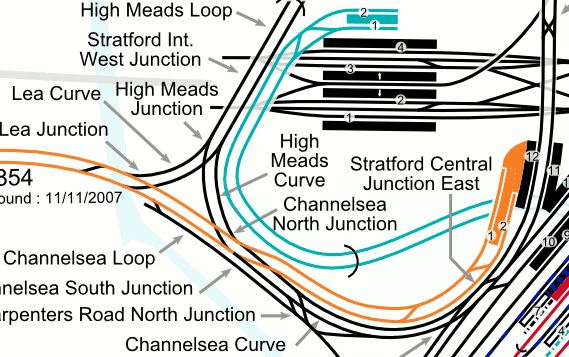
Given that freight trains pass through the area to get between the North London Line and the Great Eastern Main Line, there may need to be some track reorganisation to make full use of the High Meads Loop.
Digital signalling would also help, as it would all over the London Overground network.
I think it would not be unreasonable to expect that in some point in the future twenty tph could be running around the High Meads Loop.
A new rail terminus for London would have been created with the ability to handle more trains than either Cannon Street, Fenchurch Street or Marylebone. stations.
Could we see all West Anglia Main Line services terminate in the High Meads Loop?
Probably not, as the platform wouldn’t be able to cope with all the passengers.
Crossrail 2
If Crossrail 2 is ever built, it will terminate at Broxbourne on the West Anglia Main Line.
It will need four-tracking of the West Anglia Main Line between Tottenham Hale and Broxbourne stations, which will create massive disruption for passengers and residents.
Conclusion
There is a lot of development, that is possible on the West Anglia Main Line to make it into a world-class commuter route and a main line route with good services to Stansted Airport, Cambridge and Norwich.
Cambridge is a big growth point in the UK economy and dveloping the West Anglia Main Line will only improve the economy of the area.
 The Anonymous Widower