And Finally!
They have been a long time coming, but today two Class 710 trains, started running on the Gospel Oak to Barking Line.
I took these pictures.
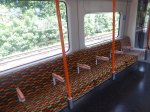
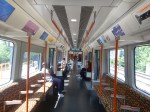
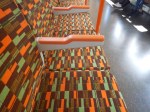
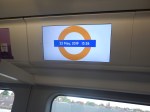

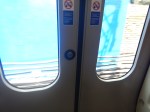
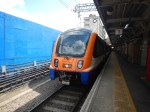
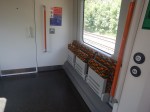
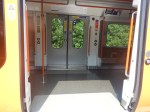
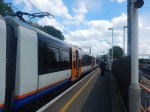
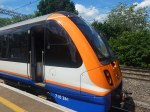
They certainly stand out with their large orange noses.
A few thoughts on various topics.
Doors And Controls
The doors are all double and wide as they should be for easy entry.
There are also full door controls on each side of the door and a door opening button in the door itself.
So on a crowded train, there won’t be the problem, you get on some trains, that the buttons are blocked by a large person standing in the way.
Information Displays
They are clear and very much follow the style of the displays on the Crossrail trains.
Although, they do have a clock, that seemed to be liked by other passengers and myself.
I also suspect the displays can be used advertising.
Noise
Like the Class 345 trains, they are quiet inside.
Seats
The longitudinal seats are as comfortable as those of their elder siblings; the Class 378 trains.
There are also lots of armrests.
As on those trains, passengers find their own place to put their legs and the passage up the middle of the train seems to stay free.
There are also no perches either side of the door, as in the Class 378 trains. It this to cut out canoodling?
USB Sockets
There isn’t a large number and they are only accessible from a few seats.
This picture shows the sockets on a Vivarail Class 230 train.
I think each armrest should have one.
Wi-Fi
I tested it and it worked
The Train Software
If I was designing something like a train, a tram, a bus or a car, the vehicle would have a backbone, that was compatible with the Internet.
The train software, that seems to have caused the delay could even be an operating system, like the one on your computer or phone.
In my experience, operating systems are very difficult to write, but once they are working, the following is possible.
- They work for all compatible computers, phones or trains.
- They can analyse the hardware to see what they’ve got connected.
- A large team of programmers can write compatible additions, just like thousands write apps for mobile devices.
I also believe that testing operating systems work as they should is one of the most difficult things to do in computing.
I don’t believe that the delay to the Class 710 trains because of software problems has been overly long in my experience.
Complex systems just take an awful long time to get write.
The good news though, is that if Bombardier have got their design right, they may well have cracked the computer systems for all other Aventras.
Conclusion
They tick a lot of boxes and I like the design.
I also feel that if Bombardier have solved the software problems, then Aventras could be delivered in a steady stream.
Norwich-In-Ninety Is A Lot More Than Passengers Think!
But, I very much expect that Greater Anglia know what they are doing.
This post describes a trip to Norwich that used two Norwich-In-Ninety services, using Class 90 locomotives and Mark 3 coaches.
I came up to Norwich on the 1100 train, which was timed to get in at 1230. According to the driver, there were signalling problems at Manningtree, which meant we arrived in Norwich twenty-one minutes late.
I was going on to Cromer or Lowestoft. So by the time I’d had a cider and bought a ticket, I didn’t leave Norwich until 1345 for Cromer. But I did have time by the sea to take a few pictures and have a coffee and a gluten-free scone, before getting the return train to Norwich.
Back at Norwich, I had a choice of two trains.
- The 1700 stopping at just Ipswich and Norwich
- The 1703 stopping at Diss, Stowmarket, Ipswich and a few other places.
I was booked on the 1700, from where I’m writing this note on my phone.
These are some of my observations.
Operating Speed
I have just travelled between Norwich and Ipswich in thirty minutes, with Speedview on my phone reading within a couple of mph of 100 mph all the way from where we got to operating speed South of Norwich to where we slowed for Ipswich station.
Diss, Stowmarket and Needham Market stations were passed at almost 100 mph
Ipswich to Colchester was at a slower 90 mph, but then from Marks Tey to just before Chelmsford, the train was back to around 100 mph.
Speeds between 70 and 90 mph were held from Chelmsford to Liverpool Street, which was reached at 1830 as scheduled.
Acceleration
I got the impression, that the acceleration of the train wasn’t up to the operating speed. Certainly, it didn’t seem to accelerate as fast as an InterCity 125,
But then we’re talking about a powerful Class 90 locomotive with 3730 kW pulling eight Mark 3 coaches. Perhaps it was having an off day?
In an InterCity 125, there is nearly 2,640 kW to accelerate the same number of similar coaches to 125 mph.
But these are similar numbers compared to a four-car Class 755 train running on electrical power, which according to Stadler’s data sheet is 2,600 kW, which is 86% more power than an InterCity 125.
As there are two power-bogies each must be good for 1,300 kW.
Typical four-car electric Flirts seem to have around 2-3,000 kW, according to various Stadler data sheets.
Flirts seem to be seriously powerful trains and I can understand why some Norwegian Flirts are capable of 125 mph running. This is said in Wikipedia about the Norwegian Flirts.
All trains have five cars. However, in contrast to previous five-car FLIRTs they will have a third powered bogie giving them a maximum power output of 4,500 kW (6,000 hp) and a top speed of 200 km/h (120 mph).
If that extract is saying that each bogie can provide up to 1,500 kW, then Class 745 trains with four bogies have 6,000 kW.
If they were Class 755 train-sized bogies, then Class 745 trains, then the trains have 5,200 kW.
For comparison, an eleven-car Class 390/1 train has 5,950 kW.
With these figures, I feel it is reasonable to assume, that Class 745 trains, will accelerate to operating speed faster than the current forty-year-old BR stock.
- They appear to have a lot more power, than the current trains.
- Their aluminium bodies probably mean they weigh less, than the steel-bodies of the current trains.
- Their aerodynamics are probably more advanced.
- They probably have sophisticated technology that stops wheel slip, controls the train in a smooth manner and assists the driver.
- The rolling dynamics will be no worse than that of the current trains.
Some conclusions can be drawn about the current trains and their operation.
- A Class 90 locomotive with only 930 kW has sufficient power to keep an eight-car train running at 100 mph. It looks like the figure is around 1.2 kWh per car per mile.
- They must be in top condition.
- The drivers probably know the route like the back of their hand and can coax the required performance from their ageing charges.
BR’s forty-year-old design must still be seriously good and the trains get the TLC they need.
Passing Stations At 100 mph
Diss, Stowmarket, Needham Market, Marks Tey, Kelvedon, Hatfield Peverel and Ingatestone stations were all passed within a few mph of 100 mph, with Maningtree and Colchester stations passed at around 85-90 mph.
Obviously, this must be allowed and not having to slow means that the speed is not degraded.
The only station where there was a substantial slowing was Chelmsford, where the train slowed to about 60 mph.
The Current Norwich-in-Ninety Services
These are the current ninety minutes services between Liverpool Street and Norwich.
- 0900 – Norwich to Liverpool Street
- 1100 – Liverpool Street to Norwich
- 1700 – Norwich to Liverpool Street
- 1900 – Liverpool Street to Norwich
Only one train is needed that starts and finishes in Norwich, where it is stabled overnight.
Serving The Intermediate Stations
Both the 1100 train to Norwich and the 1700 to Liverpool Street only stop at Ipswich.
But leaving a couple of minutes behind was another Class 90 locomotive/Mark 3 coach set stopping at more stations.
- Going North, the train takes nineteen minutes longer, with stops at Colchester, Manningtree, Ipswich and Diss.
- Going South, this train takes ten minutes longer, with stops at Diss, Stowmarket, Ipswich, Colchester and Stratford.
I suspect that when the Bombardier Class 720 trains have been delivered, these might be used for the stopping trains.
How Many Trains Will Be Needed?
It appears that the slower trains are currently timetabled to take between 111 and 115 minutes.
If a round trip can be done in four hours, then two trains per hour (tph), will require eight Class 745 trains.
As there are ten trains on order, this means the following.
- Eight trains will be used to run the two tph stopping service.
- One train will be needed for the Norwich-in-Ninety service.
This leaves one train as a spare or in maintenance.
Cromer And Back In A Day
In the four-and-a-half hours, I was in Norwich, I was able to take a train to Cromer, take a few pictures, have a quick lunch and then return to Norwich.
This is possible using the slower trains, but the fast trains can give you another hour in Norwich.
Obviously, this hour will be available for many journeys and must surely open up many possibilities for frequent travellers on the route.
How Reliable Is The Norwich-in-Ninety Service?
There have been twenty services in the first week of the service..
- Fourteen have been on-time or a couple of minutes early.
- Five have been under ten minutes late.
- One was late by more than ten minutes.
That last train was twenty-two minutes late and I was on it, on the first Wednesday of the service.
I shall update this table, until I get bored with it!
Can The Timetable Be Changed?
The way the timetable is set out is an interesting solution to trying to be all things to all passengers.
- There is a basic two tph service, which stops between London and Norwich according to a simple pattern.
- Four services per day, with two in each direction, are delayed by two or three minutes.
- The original departure times are taken by a fast train, that only stops at Ipswich.
- These four departure times, are arranged, so that the services can be handled by a single fast train shuttling between Liverpool Street and Norwich
- The fast train starts in Norwich at 0900 in the morning and returns to Norwich and its depot at 2030. The train can then have a good service after a hard day’s work!
Obviously, Greater Anglia have all the passenger data, so they have probably laid out a fast timetable, that will reflect current passenger numbers.
But as time goes on, this timetable can be augmented.
At present, they are using their express trains for both the two tph and the fast services.
These will be changed to Class 745 trains during the remainder of this year.
The venerable Class 90 locomotives and their Mark 3 coaches have blazed the trail and made everybody’s dream of Norwich-in-Ninety a reality, but now it is up to Greater Anglia’s new trains to fully develop the timetable.
- If they are successful in attracting passengers more services will do Norwich in ninety and Ipswich in sixty.
- The back-up stopping service running behind the fast train could be run by a new Class 720 train, which have a similar 100 mph operating speed.
- Several services per day, using Class 755 trains, will be running between Lowestoft and London and augmenting the fast service between London and Ipswich.
Interestingly, as I left Norwich for Cromer, there was a Class 321 Renatus at Norwich station in Platform 2 Checking with Real Time Trains, this other relic from British Rail, but refurbished to a modern standard for passengers and performance, formed the 1400 express to London and arrived on time after seven stops.
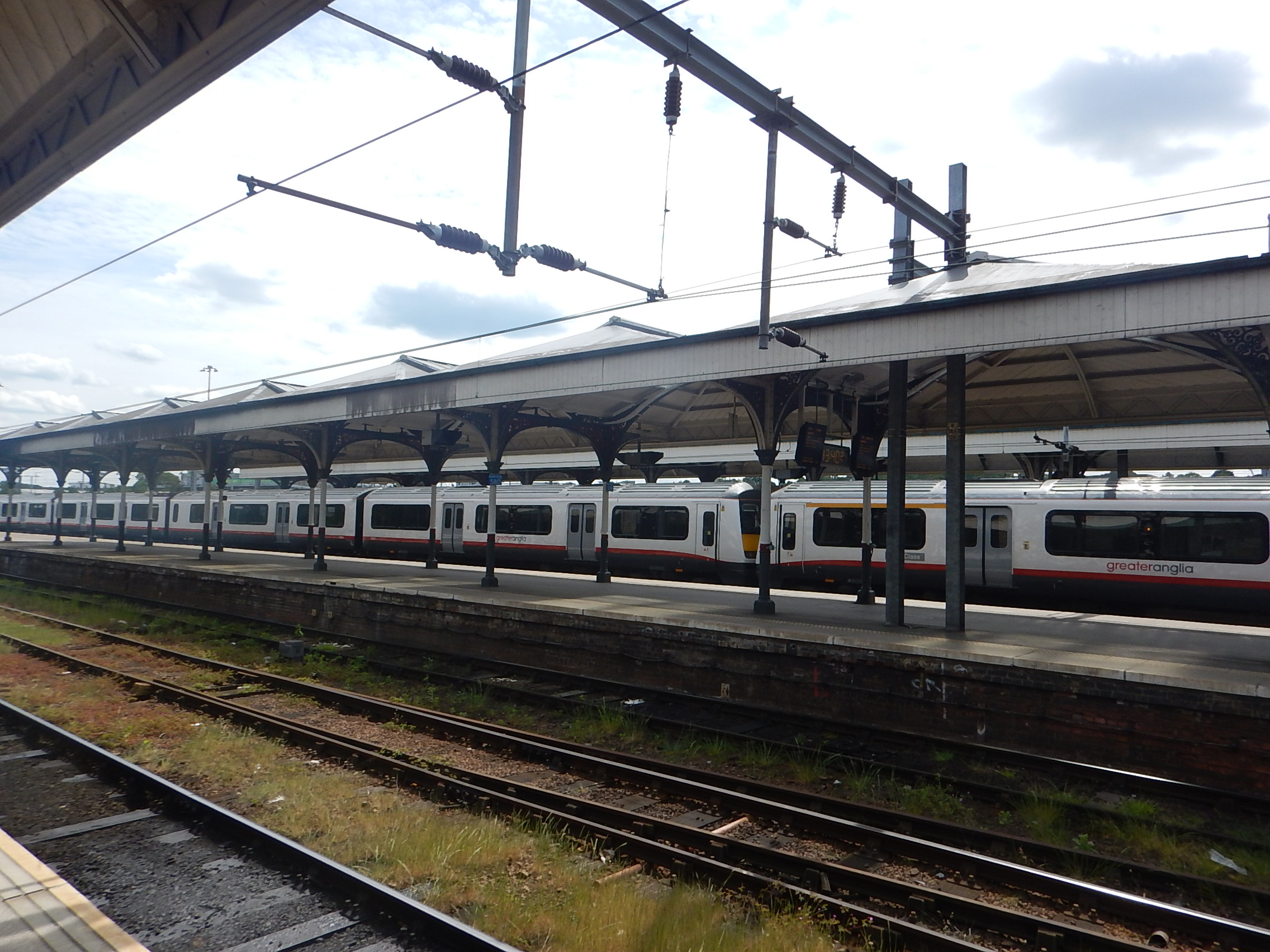
It looks to me that Greater Anglia have a creditable back-stop, if there should be any unforeseen problems with the new trains.
But it also shows that the stopping service that follows the Norwich-in-Ninety service can be run by a 100 mph electric multiple unit.
This would surely release Class 745 trains to run more fast services.
An Improved Ipswich And Norwich Service
Greater Anglia have said that there will be three tph between London and Norwich and that one may or will be run the new Class 720 trains.
The only section of the Great Eastern Main Line, that won’t have four tph will be between Ipswich and Norwich. So could we see a 100 mph local service between two rivals.
Yesterday’s Class 321 Renatus did Norwich to Ipswich in forty-one minutes.
- The route is fully-electrified.
- Class 720 or Class 321 Renatus trains could be used.
- Trains would stop at Diss, Stowmarket and Needham Market stations.
- The rail line is not busy North of Stowmarket.
- The bottleneck of Trowse bridge South of Norwich is to be replaced.
Running four tph between Ipswich and Norwich would be a lot more affordable, than improving the capacity on the mainly single-carriageway A140.
Would Faster Running Be Possible North Of Ipswich?
There are two major problems on the Great Eastern Main Line to the North of Ipswich.
- Trowse Bridge to the South of Norwich.
- Haughley Junction, where the Cambridge and Norwich routes divide to the North of Stowmarket.
Both projects have been kicked into the long grass more times than most, but it does look, that these two bottlenecks could be fixed in the next few years.
I also observed the following between Ipswich and Norwich.
- The line wasn’t busy North of Stowmarket.
- The train had no difficulty maintaining 100 mph.
- The quality of the overhead electrification gantries might suggest a need for replacement.
- There are some level crossings, that have no place on a 100 mph main line.
Would it be advantageous to update the line, so that higher speeds were possible?
I suspect that both the Class 745 and Class 720 trains could handle perhaps 110 mph with modifications, that are proven or planned with similar trains.
Conclusion
I had an exhilarating ride yesterday and it is a foretaste for the greatest improvement in transport for East Anglia in my lifetime.
Grayling: No Solution To Oxford Road Woes
The title of this post, is the same as that of this article on Place North West.
This is the first two paragraphs.
Transport Secretary Chris Grayling has said there is no “simple, quick, non-disruptive solution” to improving journeys on one of the most congested rail routes in and out of Manchester, arguing the cost of the original scheme was “way out of kilter”.
Plans to extend platforms at Oxford Road station have been mooted for a number of years, and were designed to take advantage of the completion of the Ordsall Chord to allow more frequent trains between Piccadilly, Victoria, and beyond.
The more I read about the problems of the Castlefield corridor through Manchester, the more I’m coming to the conclusion, that British Rail’s three tunnel scheme for the North was the right solution.
Liverpool
Liverpool got the Loop And Link Project, which is described like this in Wikipedia.
The major engineering works required to integrate the Northern and Wirral lines became known as the ‘Loop’ and ‘Link’ Project. The ‘Loop’ was the Wirral Line tunnel and the ‘Link’ the Northern Line tunnel, both under Liverpool’s city centre. The main works were undertaken between 1972 and 1977. A further project, known as the Edge Hill Spur, would have integrated the City Lines into the city centre underground network. This would have meshed the eastern section of the city into the core underground electric city centre section of the network, releasing platforms at mainline Lime Street station for mid to long haul routes.
The Edge Hill Spur was never built and if it had, it may have created the extra capacity, that Liverpool Lime Street station has now finally got, but several years ago.
Liverpool’s Underground railways are getting a new fleet of Class 777 trains and will be expanded in the next few years.
British Rail’s scheme for Liverpool has been successful.
Although, I am surprised that the layout of a single-track loop tunnel, that is used to terminate the Wirral Line, has not been copied more.
Newcastle
Newcastle got tunnels under the city, to join up the Tyne and Wear Metro in the late 1970s.
The Metro is now getting a new fleet of trains and will be further expanded.
British Rail’s scheme for Newcastle has been successful.
Manchester
Manchester had a scheme in the pipeline called the Picc-Vic Tunnel.
This Proposal section in Wikipedia gives a full description of the project. This is the first paragraph.
The South-East Lancashire and North-East Cheshire Public Transport Executive (SELNEC PTE) – the local transport authority which became the Greater Manchester Passenger Transport Executive (GMPTE) in 1974 (now Transport for Greater Manchester – TfGM) – made a proposal in 1971 to connect the unjoined railways running through Manchester city centre under the Picc-Vic scheme. The Picc-Vic proposal envisaged joining the two halves of the rail network by constructing new tunnels under the city centre, connecting Manchester’s two main railway stations, Piccadilly and Victoria. This new underground railway would be served by three new underground stations, joining together the regional, national and local rail networks with an underground rapid transit system for Manchester.
It also gives these three objectives for the scheme.
- To improve the distribution arrangements from the existing railway stations which are on the periphery of the central core
- To link the separated northern and southern railway systems
- To improve passenger movement within the central area.
This is also said.
It formed part of a four-phase, Long Term Strategy for GMPTE over 25 years, which included bus priority and an East-West railway network, as well as a light rapid transport system.
The scheme was cancelled by Harold Wilson’s government, partly because he believed that railways were of the past and that everybody would be able to afford their own car and wouldn’t need to use trains.
It should also be remembered that his government also cancelled the Channel Tunnel and London’s Third Airport at Maplin.
It’s funny, but I thought, I’d used the Channel Tunnel several times. Perhaps, Harold Wilson didn’t get his out-of-kilter thinking sufficiently into the minds of Civil Servants. Although, there is still the Treasury’s periodic attempts to kill High Speed Two. But that is driven by the belief of the average Oxford graduate, that there is nothing worth visiting North of Watford.
The Picc-Vic Tunnel may not have completely solved Manchester’s rail connectivity, but it is my belief that it would have been a good start.
A Few Random Thoughts
These are a few random thoughts on the various schemes in Manchester.
Development of Piccadilly And Victoria After A Picc-Vic Tunnel
One of the reasons for cancellation, was that after the building of the tunnel, two large stations would still be maintained in the City.
Looking at various schemes across Europe including Kassel and Leipzig in Germany, where central tunnels have been built, this releases the terminals for development with smaller numbers of platforms.
I think if the Picc-Vic Tunnel had been built, then Piccadilly and Victoria might have morphed into combined through and terminal station like the excellent London Bridge. The released space at Piccadilly would have allowed High Speed Two to be integrated.
But of course, the elite in the Civil Service isn’t interested in High Speed Trains, except on their holidays in France.
TransPennines New Trains
Greater Anglia needed to have new rolling stock for services between London and Norwich.
They needed trains with following.
- 100 mph running
- Eight coaches
- Powerful traction
- Short station dwell times.
- High quality.
So they ordered a fleet of new Class 745 trains.
- 100 mph running
- Twelve coaches
- Walk-through trains
- 757 seats
- Double doors for easy entry and exit.
It’s also rumoured that platform height will be adjusted so that that buggy-pushers and wheelchair-users will have level access between train and platform at all stations.
- If you want to do Norwich-in-90 for all trains, then a short station dwell time is essential.
- It also means if passenger numbers need another station to be added to a route, the extra stop only blows a small hole in the schedule, as opposed to a large one for a train of Mark 3 coaches.
- I have a feeling Greater Anglia are aiming to send all their disabled ramps to the scrapyard.
So what trains have TransPennine ordered?
- Class 802 trains
- Class 397 trains
- Mark 5A coaches to be used with a Class 68 locomotive.
AQll these trains will have single-doors at both end of each car. That’s classic crap design!
It will be interesting to see the average dwell time of a train on the Castlefield Corridor and compare it with that of Class 745 trains calling at Ipswich, Colchester and Chelmsford.
My money’s on Swiss clockwork!
Northern’s New Trains
Northern’s new Class 195 and Class 331 trains appear to have two sets of double-doors on each side of each car.
Now that’s more like it!
Improving Throughput On The Castlefield Corridor
If you look at successful high-capacity lines with a lot of stopping trains like most lines on the London Underground, Thameslink the Tyne and Wear Metro and the Merseyrail Northern Line, all trains are the same.
One of the problems with the trains through Castlefield, is that there are a lot of diffeent trains. So doors on your train may be in a different position to those on the previous train.
This means that passengers will be more likely to be in the wrong place, which means loading takes longer.
It is probably too much to get identical trains running on the route, but TransPennine’s trains with end doors will make matters worse for capacity.
I don’t think, any train should be allowed on the route, unless it has two sets of double-doors on each side of all cars.
The route should also have digital signalling.
If the North London Line can handle eight passenger and two freight trains per hour, then surely the Castlefield Corridor can do the same.
Passenger Behaviour
I was chatting to a station guy on Platform 14 at Piccadilly, who had also worked on the London Underground.
He told me, that Londoners obey his instructions to stand-back, whereas Mancunians don’t!
I watched for about twenty minutes and I think because the trains are rather bad time keepers, when one arrives everybody wants to get on immediately.
Single doors on TransPennine’s trains will make this behaviour worse!
Conclusion
I think Chris Grayling mades a good summary of the problems of doing major work on a busy passenger and freight corridor through a major city.
The only way to deal with the problems of the Castlefield Corridor, is a series of small improvements to the existing system.
- All trains through the corridor must have two double-doors on each side of each car.
- Digital signalling must be installed.
- Platform access must be improved with lots of lifts and escalators.
I also feel that if the trains were running to the timetable, then passengers wouldn’t crowd the platforms.
Two Crossrail Stories
There are two Crossrail stories this morning.
- London City Airport In Talks With TfL About Crossrail Station on New Civil Engineer.
- Crossrail Stations And Tunnels ‘To Be Finished This Year’, TfL Documents Reveal on Building.
Both would appear not to be gloomy news.
World’s Largest Fleet Of Fuel Cell Trains’ Ordered
The title of this post, is the same as that of this article on Railway Gazette.
This is the first paragraph.
Following a European tender, the Fahma rolling stock subsidiary of Rhein-Main transport authority RMV has awarded Alstom a contract to supply and support a fleet of 27 fuel cell multiple-units.
These are a few points from the rest of the article.
- The trains are Alstom Coradia iLint.
- Range on hydrogen is up to 500 miles with a top speed of 87 mph.
- Each train will have 160 seats.
- The order is worth around €500million.
- 25 years of maintenance is included.
- Hydrogen will be supplied by Höchst KG.
- The trains will be delivered in time for the December 2022 timetable change.
This is said about the refuelling.
The refuelling point will be located at the Höchst industrial park. ‘With its existing hydrogen infrastructure, Industriepark Höchst is an ideal filling station location for fuel cell vehicles’, said Dr Joachim Kreysing, Managing Director of Infraserv Höchst. ‘The operation of the hydrogen filling station for trains as a supplement to the tanking facilities for buses and trucks fits in perfectly with our concept’.
These routes will be converted from diesel to hydrogen.
- RB11 Frankfurt-Höchst – Bad Soden, – 25 minutes
- RB12 Frankfurt – Königstein, – 36 minutes
- RB15 Frankfurt – Bad Homburg – Brandoberndorf – 83 minutes
- RB16 Friedrichsdorf – Friedberg – 23 minutes
Services look to be half-hourly.
Only one is a longer route.
A Simple Plan
It is a fairly simple plan with probably a low risk.
This Google Map shows Industriepark Höchst.
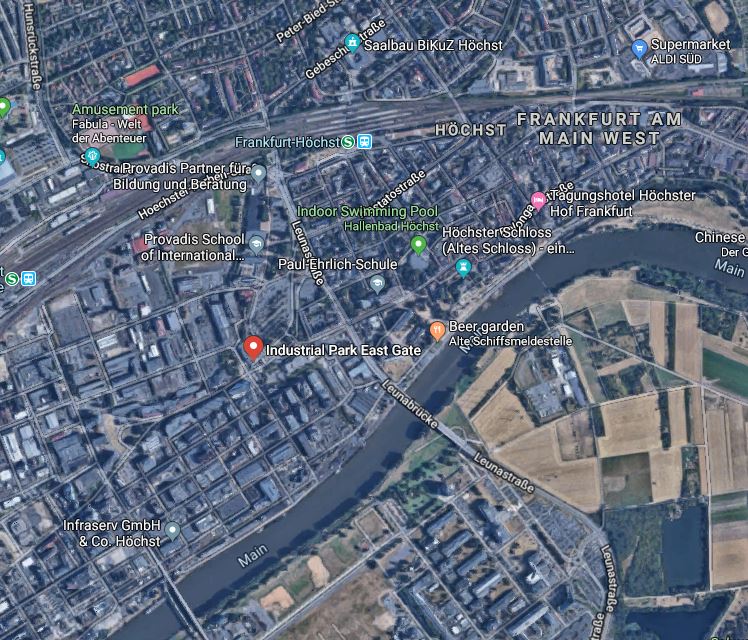
Note the Frankfurt Höchst station and Infraserv Höchst.
It seems to be all very convenient.
And The Wires Came Tumbling Down!
Today, I intended to go to Doncaster on the 11:03 train to Leeds from Kings Cross.
I had intended to travel in First on an Azuma, to see what the quality was like.
So I booked an Advance ticket online for around £50.
But then the train didn’t run, as the wires had come tumbling down!
This must be the third time, I’ve been affected by faulty overhead wires on the East Coast Main Line in the last few years.
In one case, we were delayed for about two hours and in the other, it didn’t affect me for long, as I was in an InterCity 125, which drove through the problem.
I have lost my fifty pounds, as you take the risk with an Advance Ticket.
Conclusion
The electrification on the East Coast Main Line seems to be built and maintained by morons.
Next time, I take the train on the East Coast Main Line, I’ll check trains are running before buying a ticket.
Seven Sisters Station To Go Step-Free
This document on the Government web site is entitled Access for All: 73 Stations Set To Benefit From Additional Funding.
Seven Sisters station is on the list.
These pictures show the current station.


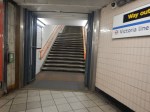
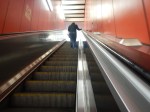
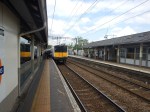
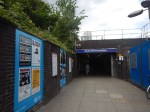
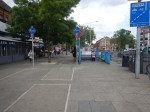
It is a nightmare.
- There are two London Overground platforms on a viaduct and three deep-level ictoria Line platforms.
- The Overground platforms are accessed by stairs although there is one up escalator and provision was made for another, although it was never installed.
- The Victoria Line station is double-ended with escalators and steps which must be negotiated by all passengers.
- Rabbits would probably feel at home in the warren of tunnels of the Underground station.
- The three subway entrances on Tottenham High Road all have just steep steps.
If ever there was a station designed by a committee of bean counters, with no children or disabilities and rail experience, it is Seven Sisters station.
Extra Pressures
Other factors will come into play in the next few years.
Tottenham Hotspur
As Seven Sisters station is the nearest Underground station to the ground, a lot of supporters walk to matches and other events along Tottenham High Road.
White Hart Lane station is being rebuilt, with increased capacity and full step-free access, so hopefully, passengers on match days at Seven Sisters station will decrease.
But the obvious route to the ground from Euston is probably to take the Victoria Line and walk from Seven Sisters station.
With the new station at White Hart Lane, there may even be an increase in interchange passengers at Seven Sisters station.
Crossrail
In any London railway scheme, Crossrail is the elephant in the room.
Will passengers between Tottenham and Enfield and the West End and Heathrow take the Overground to and from Liverpool Street and then use Crossrail?
For many passengers with limited movement, it could be a better route to avoid Seven Sisters station.
New Trains On The Overground
Hopefully, new Class 710 trains will start to arrive on the Overground this year.
As all new trains do, these will increase the number of passengers through Seven Sisters station, especially as the trains may have a much larger capacity, than the existing Class 315 trains.
Extra Services On The Overground
Transport for London are planning to add extra services through Seven Sisters, which will surely bring more passengers wanting to interchange with the Victoria Line.
Increased Frequency On The Victoria Line
The Victoria Line currently runs at thirty-six trains per hour (tph) all day, with trains running between Walthamstow Central and Brixton stations.
I am sure that the line’s engineers would love to squeeze the magic forty tph out of the line, but the capacity of some stations couldn’t handle the extra passengers.
But one way or another, more passengers will be squeezed into Dear Old Vicky and as she always does, she will deliver and more passengers will want to interchange at Seven Sisters station.
Services Between Seven Sisters And Stratford Stations
The track exists to run services between Lower Edmonton and Statford stations, via Seven Sisters, South Tottenham and Lea Bridge stations.
With all the new housing being built in the area, I feel this could be valuable addition to London’s railways.
As South Tottenham and Lea Bridge stations have step-free access, this might be an improvement that takes pressure from Seven Sisters station, by giving passengers a new route to Crossrail.
Improving Access At Seven Sisters Station
It is obvious, that passenger numbers wil be increasing at Seven Sisters station will be increasing and there will also be a substantial increase in passengers wanting to change between the Overground and the Victoria Line.
So what can be done to solve the various problems?
The Tottenham High Road Subway Entrances
These really only give access to the Victoria Line via an escalator.
Lifts tom the subway could be provided, but that would just get passengers to and from the gate-line. After the gate-line, it is just escalators to the platforms with some steps thrown in for good measure.
Victoria Line Platforms
If you were pushing a buggy or in a wheelchair, your best route to the Underground is probably to take a bus from outside the station in Tottenham High Road to Tottenham Hale station and use the step-free access there, which in a couple of months will also apply to the trains as well.
I doubt we’ll see much improvement to the Underground station, until Crossrail 2 is built, which will probably be in the 2050s.
Overground Platforms
There is a side entrance on Seven Sisters Road, that was probably the original entrance to the station.
Making this route to the Overground platforms step-free, is probably the best way to at least do something positive, as regards step-free access at the station.
It could also be relatively easy to put an escalator on the Londonj-bound platform, where there are two parallel staircases.
Conclusion
This is a very important station, that needs to be made step-free.
But it will be very difficult.
Tottenham Hale Station – 20th May 2019
I took these pictures today at Tottenham Hale station.
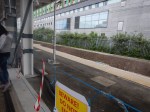
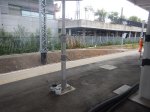
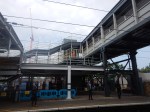
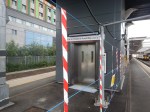
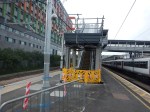
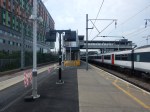
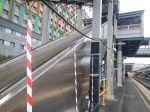
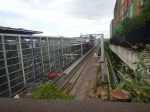
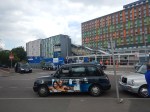
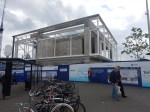
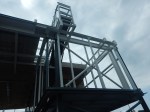
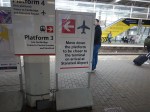
The new station is still a shortish time away.
The bridge and Meridian Water station should have opened today.
But as you can see, they didn’t!
The First Norwich To London Service In Ninety Minutes
These pictures show the arrival of the first Norwich-in-Ninety service in Liverpool Street


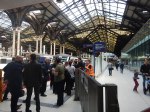
Looking at Real Time Trains, it appears the train left Norwich at 0900 and arrived in Liverpool Street at 1030.
Normal services take three or four minutes under two hours, so ninety minutes with a Class 90 locomotive, eight Mark 3 coaches and a driving van trailer isn’t bad!
 The Anonymous Widower