‘Europe’s Biggest Battery Farm’ Built On Coal Mine
The title of this post, is the same as that of this article on the BBC.
This is the sub-heading.
Work is under way to create what has been described as Europe’s largest battery storage project at Coalburn in South Lanarkshire.
These three paragraphs add a bit more detail.
Developers say the two huge neighbouring battery farms – one at the site of a former opencast coal mine – will store enough electricity to power three million homes.
Battery Energy Storage Systems (BESS) are being built across the UK to help balance the electricity grid, which is becoming increasingly powered by renewables.
Almost 90% of the electricity generated in Scotland last year was from low carbon sources like wind, solar or nuclear, according to figures from the Scottish government.
A search of the Internet found this paragraph describing the size of the battery.
The CIP BESS portfolio (Coalburn 1, Coalburn 2, and Devilla) will have total power capacity of 1.5GW and will be able to store and supply the grid with a total of 3GWh of electricity, equivalent to the electricity demand of over 4.5 million households, across a 2-hour period.
Note.
- CIP is Copenhagen Infrastructure Partners, who are a large developer of energy infrastructure.
- It appears there are three separate 500 MW/ 1 GWh batteries being developed together.
- The batteries can supply electricity for two hours.
This looks like a sensible project in an area, where there could be plenty of spare electricity.
Competition With Highview Power
Highview Power’s web site has a Projects section, where this is said.
Scotland And The North-East, UK
Highview Power’s next projects will be located in Scotland and the North East and each will be 200MW/2.5GWh capacity. These will be located on the national transmission network where the wind is being generated and therefore will enable these regions to unleash their untapped renewable energy potential and store excess wind power at scale.
I can see Highview Power’s 200MW/2.5GWh liquid air batteries and 500 MW/ 1 GWh Battery Energy Storage System (BESS) competing for the same projects.
However, it does appear at Trafford Energy Park, both types of battery appear to be being installed.
- Carlton Power Secures Planning Consent For World’s Largest Battery Energy Storage Scheme
- Centrica Invests In Renewable Energy Storage Capabilities To Boost UK’s Energy Security And Accelerate Transition To Net Zero
Perhaps the two together give the best response?
Thoughts On Lumo’s Proposed Paddington And Carmarthen Service
Lumo have permission for an open access service between London Paddington and Carmarthen.
- Stops will be Bristol Parkway, Newport, Severn Tunnel Junction, Cardiff Central, Gowerton and Llanelli
- It will be run under the Lumo brand.
- There will be five services per day.
Lumo hope services will start in 2027.
I would suspect that the train would run between London Paddington and Carmarthen like this.
- Run between London London Paddington and Cardiff Central using the 25 KVAC overhead electrification.
- Whilst running between London Paddington and Cardiff Central, the train’s batteries will be fully charged using the overhead electrification.
- Run between Cardiff Central and Carmarthen using the onboard battery power.
- Charge the train as required at Carmarthen.
Note.
- London Paddington and Cardiff Central is 145.2 miles or 233.7 km.
- Cardiff Central and Carmarthen via Gowerton is 75.3 miles or 121.2 km.
- In case of disruption, trains could wait at Cardiff Central, until the batteries had enough charge.
A battery capability of 75.3 miles or 121.2 km will be needed to reach Carmarthen.
A Fast Run Between London Paddington And Bristol Parkway
Consider.
- Currently, the fastest trains to Bristol Parkway take one hour and thirteen minutes between London Paddington and Bristol Parkway.
- The route is fully electrified.
- But the trains do make as many as three stops at Reading, Didcot Parkway and Swindon, before they stop at Bristol Parkway.
- London Paddington and Bristol Parkway are 111.7 miles apart.
This is an average speed of 91.8 mph.
Lumo will be making Bristol Parkway the first stop.
- 60 mins will be 111.7 mph.
- 54 mins will be 125 mph.
It could be a very fast time from London Paddington, if the trains can hold their operating speed of 125 mph for long periods to Bristol Parkway.
I would expect that a fast service between London Paddington and Bristol Parkway could attract passengers, if there were lots of parking.
A Fast Run Between Bristol Parkway And Cardiff Central
Consider.
- Currently, the fastest trains take thirty-five minutes between Bristol Parkway and Cardiff Central.
- The route is fully electrified.
- The speed limit varies between 75 and 90 mph.
- The train makes a single stop at Newport.
- Bristol Parkway and Cardiff Central are 34.2 miles apart
This is an average speed of 58.7 mph.
Lumo will be stopping at Severn Tunnel Junction and Newport.
The time may be a couple of minutes slower.
But I still expect that Cardiff Central will be reached in ninety minutes from London Paddington.
A Battery Run Between Cardiff Central and Carmarthen via Gowerton
Consider.
- Cardiff Central and Carmarthen via Gowerton is 75.3 miles or 121.2 km.
- The route has no electrification
- The train makes stops at Gowerton and Llanelli
- Cardiff Central and Carmarthen via Gowerton has a speed limit of mainly 75 mph, although there are sections up to 90 mph.
Times between Cardiff Central and Carmarthen via Gowerton would be.
At 75 mph the trip would be 60 minutes.
At 80 mph the trip would be 56 minutes.
I would estimate a time between London Paddington and Carmarthen of two hours and 35 minutes, as opposed to an hour longer by Great Western Railway, but that train makes eleven stops, as opposed to the six that Lumo intend to make.
Conclusion
It looks like Lumo will make most of their time savings to Camarthen by cutting stops and high speed running to betweeen London Paddington and Bristol Parkway stations.
Fast Battery-Electric Hitachi Trains Between Paddington And Bristol Temple Mead Stations
It was when I was writing Thoughts On Lumo’s Proposed Paddington And Paignton Service, that I realised how significant Hitachi’s battery-electric high speed trains will be.
This page on the Hitachi web site gives this overview of their Intercity Battery Trains.
A quick and easy application of battery technology is to install it on existing or future Hitachi intercity trains. Hitachi Rail’s modular design means this can be done without the need to re-engineer or rebuild the train and return them to service as quickly as possible for passengers.
Replacing one diesel engine with just one battery reduces emissions by more than 20% and offers cost savings of 20-30%. Our intercity battery powered trains can cover 70km on non-electrified routes, operating at intercity speeds at the same or increased performance.
For the purpose of this exercise, I will assume the following.
- All trains are five-car trains.
- They were all originally manufactured as Class 800, 802 or 805 trains.
- They were all originally manufactured with three 750 kW Rolls-Royce mtu diesel generators.
- One diesel generator in each train has been replaced by a 750 kW battery-pack of the same size, weight and performance.
According to Hitachi’s web page, that I quote above, this gives intercity speeds at the same or increased performance, for 70 km. on non-electrified routes.
I will now look at how a Hitachi battery-electric high speed train would handle the line between London Paddington and Bristol Temple Mead stations.
This OpenRailwayMap shows the electrification between Chippenham and Bath Spa stations.
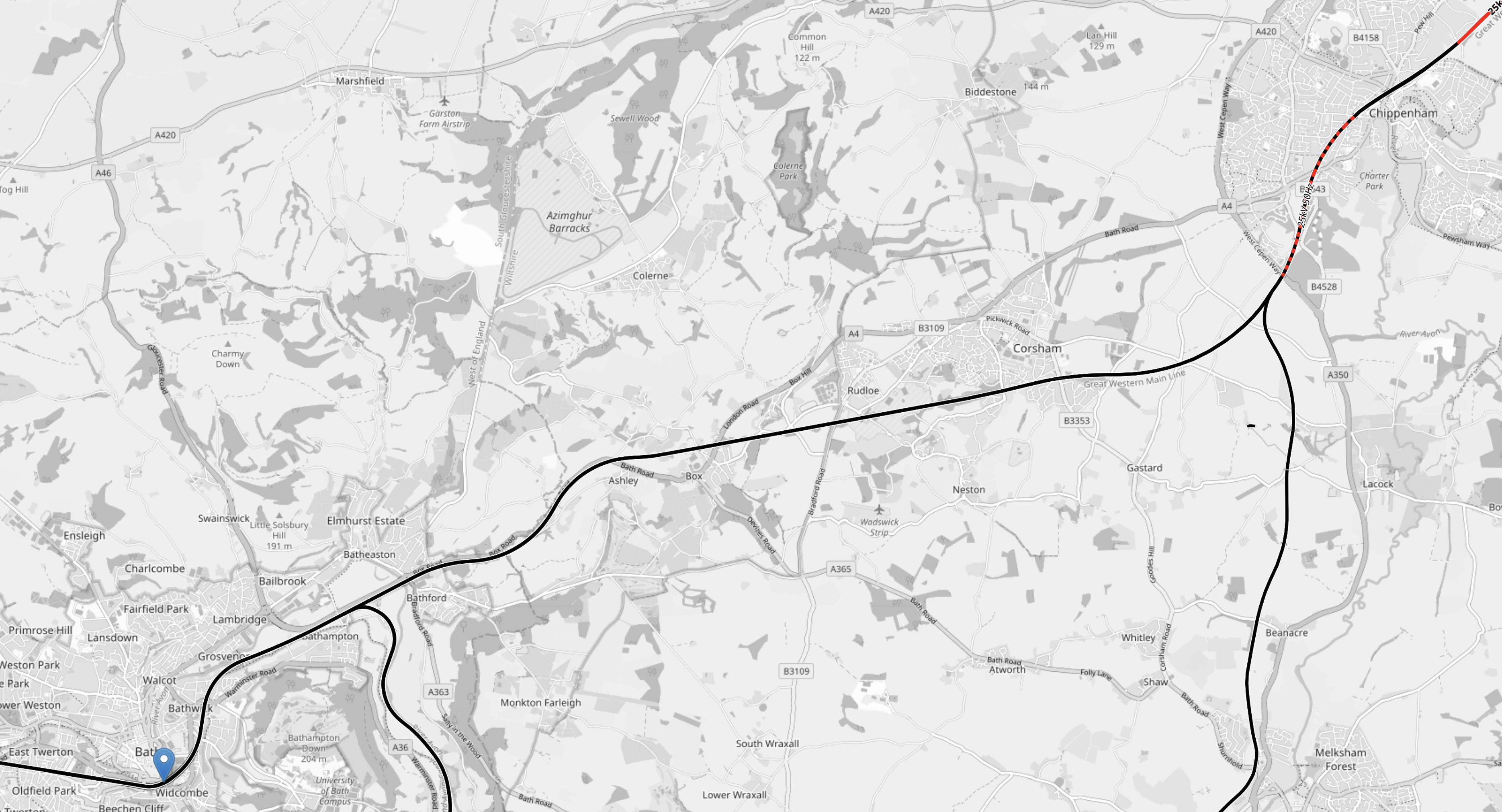
Note.
- London Paddington and Bristol Temple Mead stations are 118.3 miles apart.
- The blue arrow indicates Bath Spa station.
- Bristol Temple Meads station is 11.5 miles to the West of Bath Spa station.
- Chippenham station is in the North East corner of the map.
- Black lines are not electrified.
- Red lines are electrified with 25 KVAC overhead wires.
- The 93.9 miles betweeen London Paddington and Chippenham is fully-electrified.
- Red and black dotted lines are being electrified.
- The 24.4 miles between Chippenham and Bristol Temple Mead stations is not electrified.
- The residents of Bath Spa are not keen for the railway through Bath to be electrified.
The single battery-pack in the train, will have to propel the train between Chippenham and Bristol Temple Mead stations.
- On arrival at Chippenham, the battery will have been fully charged on the 93.9 miles from London Paddington.
- The train will be switched to battery power and proceed through Bath Spa station to Bristol Temple Meads station.
- The 24.4 miles between Chippenham and Bristol Temple Mead stations is only 39.26 km. so it is well within range of a single battery pack.
- The trains will be able to reach Bath, as fast as the track allows, so they could have come much of the way from London Paddington at speeds approaching 125 mph.
Hence my belief that Bath Spa could be reached in around an hour without any stops from London Paddington and Bristol Temple Meads in a very fast time.
There may be a need to top up the battery at Bristol Temple Meads station for London trains to return to the electrification at Chippenham or for other trains to continue their journey through Bristol.
This could be handled by some lengths of electrification in platforms in Bristol Temple Meads station, where the Hitachi trains terminate.
However, I feel Network Rail will be able to avoid the sensitive and possibly very challenging electrification through Bath.
Conclusion
London Paddington and Bristol Temple Meads via Bath Spa trains would be substantially speeded up. Especially, if the first stop out of London Paddington were to be Bath Spa station.
Great Western Railway would only cut out the stops if they wanted to speed up services.
Who’d have thought, that powering services by batteries, would speed up services?
Thoughts On Lumo’s Proposed Paddington And Paignton Service
Modern Railways says this about Lumo’s proposed new service between Paddington and Paignton.
Under the plans for Paignton, announced on 5 December, there would be five return Lumo trains running between Paddington and Paignton, serving Bath Spa, Bristol Temple Meads, Taunton, Exeter St David’s and Torquay. These could start in May 2028. A sixth path is planned between Highbridge & Burnham and London Paddington.
Modern Railways says that currently there are only three direct trains between Torbay and London and that rail has a 29% modal share on that route compared to 71% for road.
Modern Railways tell us that GWR current run three trains per day to Paignton and these call at Reading, Newbury, Hungerford, Pewsey, Westbury, Castle Cary, Taunton, Tiverton Parkway and Exeter St. David’s and Torquay.
Note.
- Lumo will be taking five stops using a longer route.
- GWR currently take ten stops using a shorter route via Westbury.
- GWR currently take ten stops between London Paddington and Bristol Temple Meads.
- The fastest GWR service I can find takes three hours and four minutes between London Paddington and Paignton.
- The fastest GWR service I can find takes one hour and thirty-five minutes between London Paddington and Bristol Temple Meads.
- The fastest service I can find takes one hour and thirty-nine minutes with five stops between Bristol Temple Meads and Paignton.
- Lumo’s trains will probably be fitted with traction batteries rather than diesel engines, so it is likely, that the fewer stops they execute will be done quieter and faster.
I would not be at all surprised to find that Lumo’s journey times would be of this order.
- London Paddington and Bath Spa – One hour
- London Paddington and Bristol Temple Meads – One hour and thirty minutes
- London Paddington and Taunton – Two hours
- London Paddington and Exeter St. David’s – Two hours and thirty minutes
- London Paddington and Torquay – Two hours and fifty minutes
- Paddington and Paignton – Three hours
These sections would not be electrified.
- Chippenham and Bristol Temple Meads – 24.4 miles
- Bristol Temple Meads and Paignton – 103.8 miles
In Fast Battery-Electric Hitachi Trains Between Paddington And Bristol Temple Mead Stations, I discuss how Lumo and Great Western Railway will speed trains to Bristol Temple Meads via Bath Spa and Chippenham.
If 128.2 miles on batteries sounds a tough ask, remember that a similar-sized Stadler Addu ran 139 miles on one charge in 2021. Lumo, Hitachi and their battery makers from Sunderland didn’t enter this contest to come a distant second.
Paignton has a big advantage, as this OpenRailwayMap shows.
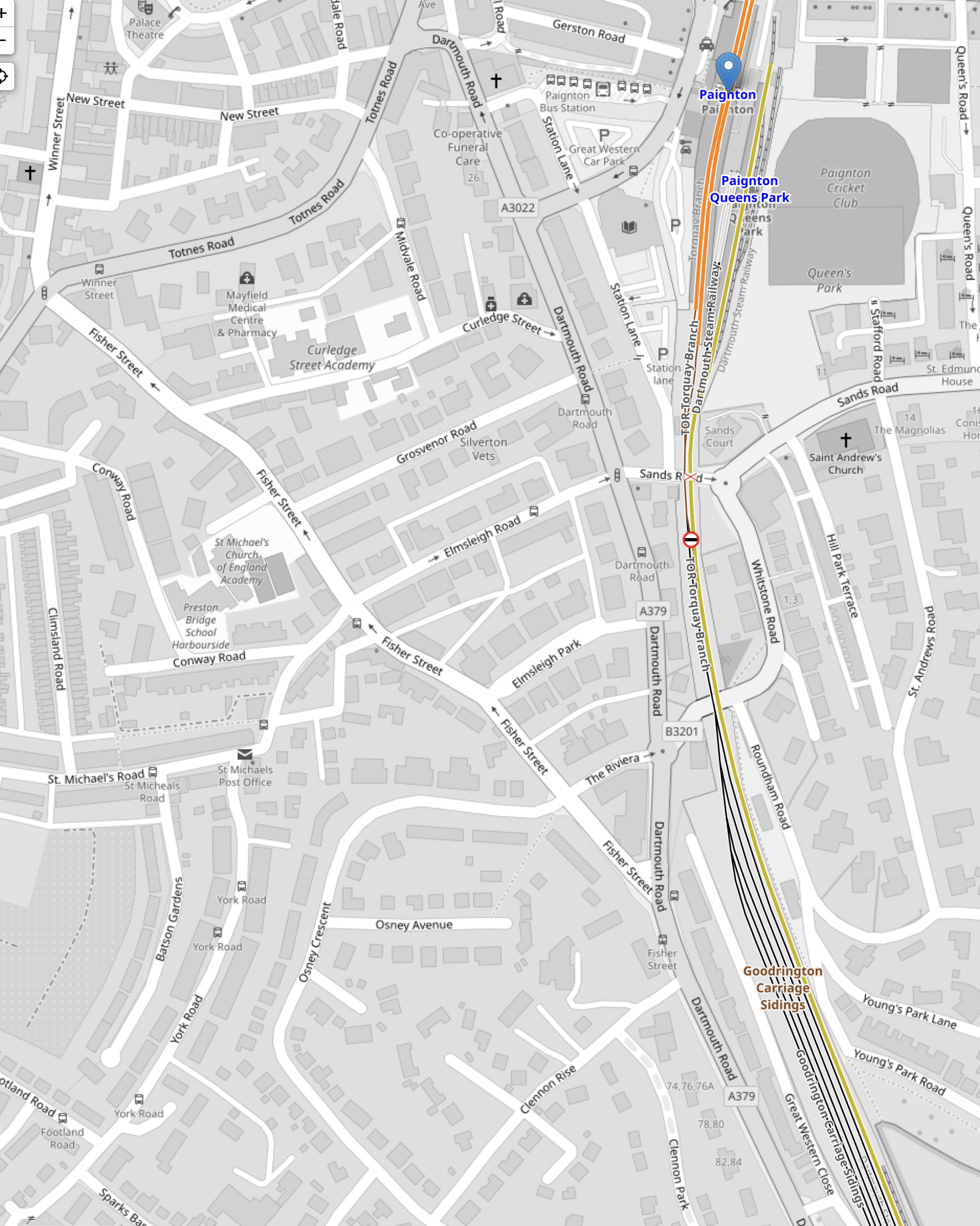
Note.
- Paignton station is marked by the blue arrow and writing at the top of the map.
- There are two platforms, one of which normally handles arrivals and the other departures.
- There are the Goodrington Carriage sidings to the South of the station.
I’m sure Hitachi will electrify some of the sidings, so that Lumo’s trains can leave Paignton with full batteries. But they only need enough charge to cover the 128.2 miles to Chippenham!
I have a few extra thoughts.
The Train’s Batteries Will Get Bigger
Hitachi must have access to the best battery chemistry, that the world and especially Japan can offer.
I feel very strongly, that the performance of Hitachi’s trains will get better, as the years progress.
Pairs Of Trains Could Be Used
I suspect all the stations that will be used by the service ; Paddington, Bath Spa, Bristol Temple Meads, Taunton, Exeter St David’s, Torquay and Paignton can handle a pair of five-car Hitachi trains on a busy day.
The Goodrington Carriage sidings at Paignton station would certainly appear to be long enough.
This could be useful.
An Early Bath
Consider.
- Currently, the fastest trains to Bath Spa take one hour and fourteen minutes from London Paddington.
- But the trains do make as many as three stops at Reading, Swindon and Chippenham, before they stop at Bath Spa.
- London Paddington and Bath Spa are 106.8 miles apart.
- The route is fully electrified between London Paddington and Chippenham.
This is an average speed of 86.6 mph.
Lumo will have two advantages
- They will be making Bath Spa the first stop.
- They will be able to maintain at least 100 mph for a large part of the route between London Paddington and Bath Spa, by the use of traction batteries, where there are no wires.
- To go between London Paddington and Bath Spa in an hour, requires an average speed of 106.8 mph
If they could average 100 mph, the time would be 66 minutes.
Bath Spa may not be an hour from Paddington, but it will be very close to it.
I would expect that a fast service to Bath could fill up with day-trippers.
How Long Will A Round Trip Take?
If I’m right that Lumo’s battery-electric high speed trains will be able to do one-way in three hours, then adding in half-an-hour to turn and charge the train at Paignton would suggest a six-an-a-half hour round trip.
How Many Trains Will Be Needed For A Full Service?
Lumo are talking of five round trips per day to Paignton and one to Highbridge & Burnham, so this would probably need two trains to run the service.
The Wikipedia entry for Highbridge & Burnham station says this.
A loop on the west side of the line south of the station can be used by goods trains in either direction, southbound trains crossing over to run wrong line through the northbound No.2 platform to do so. This crossing also allows terminating passenger trains from the north to reverse here if required.
Perhaps this loop will be used to allow one train to start from here in the morning and at the end of the day stable here overnight.
The loop could be electrified to make sure that the first train of the day gets to Chippenham.
Trains could follow a schedule like this.
- Train 1 – Leaves Highbridge & Burnham – 06:00
- Train 1 – Arrives London Paddington – 08:00
- Train 1 – Leaves London Paddington – 08:30
- Train 1 – Arrives Paignton – 11:30
- Train 1 – Leaves Paignton – 12:00
- Train 1 – Arrives London Paddington – 15:00
- Train 1 – Leaves London Paddington – 15:30
- Train 1 – Arrives Paignton – 18:30
- Train 1 – Leaves Paignton – 19:00
- Train 1 – Arrives London Paddington – 22:00
- Train 2 – Leaves London Paddington – 06:30
- Train 2 – Arrives Paignton – 09:30
- Train 2 – Leaves Paignton – 10:00
- Train 2 – Arrives London Paddington – 13:00
- Train 2 – Leaves London Paddington – 13:30
- Train 2 – Arrives Paignton – 16:30
- Train 2 – Leaves Paignton – 17:00
- Train 2 – Arrives London Paddington – 20:00
- Train 2 – Leaves London Paddington – 20:30
- Train 2 – Arrives Highbridge & Burnham – 22:30
Someone with more experience of writing timetables could make this work.
But it does appear to me, that using Highbridge & Burnham station for an early start and an overnight charge of one of the trains could mae the whole service work.
Building A New Concrete Revolution To Net Zero
he title of this post, is the same as that of this article on Pearls and Irritations.
The article is a good explanation of the contributions concrete makes to global warming and what we should do about it.
At least I can find entrepreneurs and scientists willing to develop concretes that will be friendlier to the planet.
- Low-Carbon Concrete: Separating Greenwash From Reality
- Earth Friendly Concrete
- Carbon-Neutral Concrete Prototype Wins €100k Architecture Prize For UK Scientists
- UK Breakthrough Could Slash Emissions From Cement
- HS2 Reveals Dramatic Carbon Saving With Ambitious Modular Design For Thame Valley Viaduct
I believe that this will be a problem that will be solved by technology.
Start-Up’s Plan To Convert Food Waste Into Green Fuel
The title of this post, is the same as that, of this article in The Times.
This is the sub-heading.
Dark Green wants to build biogas production plants to supply local authorities and businesses
These three paragraphs give some detail to the plans.
A Nottingham-based start-up wants to become the first company to build a fleet of plants that would convert food waste into green energy in urban centres across Britain, producing an alternative fuel for businesses and local authorities attempting to shrink their carbon footprints.
Dark Green expects to submit planning applications for six biogas production plants, including one each in Birmingham and Huddersfield, with a further six in the pipeline.
The facilities, which are more usually sited on farms, will be capable of handling 60,000 tonnes of organic waste a year, saving the same amount of carbon dioxide as taking 65,000 cars off the road, the company estimates, and will produce seven megawatts of energy, capable of powering around 6,000 homes.
I have a feeling that Dark Green fit a theme, that this blog has been following for a couple of years now.
I have been commenting on a company called HiiROC.
- I first became aware of HiiROC and their new method of generating hydrogen in this news item from Centrica, which is entitled Centrica And HiiROC To Inject Hydrogen At Brigg Gas-Fired Power Station In UK First Project.
- HiiROC is a Hull-based startup-up, that is backed by Cemex, Centrica, Hyundai, Kia, Siemens and other big names.
- HiiROC can take any hydrocarbon gas from something like chemical plant off-gas, through biomethane to natural gas and split it into hydrogen and carbon black.
- HiiROC call their process thermal plasma electrolysis.
- The carbon black has uses in the manufacture of tyres and rubber products, anodes for lithium-ion batteries and other materials and in agriculture, it can be used to improve soils.
HiiROC claim that their method uses a fifth of the energy to create hydrogen, than electrolysis.
It looks to me that if you pipe Dark Green’s methane-rich gas into one of HiiROC’s thermal plasma electrolysers, you’ll get two valuable products; hydrogen and carbon black.
Centrica have also been active with an energy storage company called Highview Power recently, in the company of Goldman Sachs and Rio Tinto.
Centrica seem to have a cunning plan!
Is Dark Green going to be part of it?
A New Metier
This article in The Times today is entitled Too many Sir Humpreys are stopping London from taking a punt.
The article is about one of Britain’s most successful private investors ; John Gunn.
The article also introduces a new company to me, with this paragraph.
His latest enthusiasm is for Metier, a company that aims to leapfrog electric vehicle power to convert buses and heavy trucks to hydrogen fuel cells. Several big firms such as Volvo are making new hydrogen-powered vehicles, but Gunn and his partners reckon there is more money in reconfiguring existing ones.
It was Metier, that caught my eye.
In the 1970s, with three others, I started a company called Metier Management Systems, which developed a project management system called Artemis.
We were very successful, in that we sold the company for a nine figure sum and won two Queen’s Awards for Exports.
Since then, there have been several successful companies named Artemis, but we haven’t seen a Metier.
Until now that is and I hope that the hydrogen vehicle company is as successful worldwide as we were.
Strangely, my first job on leaving Liverpool University was in a hydrogen factory and I am a great believer in using the gas as a source of energy.
Metier have a web site, if you want to find out more about the company.
UK, Netherlands To Connect Grids via Nederwiek 3 Offshore Wind Farm
The title of this post, is the same as that of this article on offshoreWIND.biz.
This is the sub-heading.
Dutch Climate and Green Growth Minister Sophie Hermans has included LionLink, said to be the first direct-current hybrid interconnector, in the country’s latest Offshore Wind Energy Development Framework. LionLink will use the offshore grid connection of Nederwiek 3 offshore wind farm in the Netherlands to connect to both the Dutch and the UK onshore high-voltage grids.
These are points from the article.
- The interconnector can also be used as an additional high-voltage link to exchange electricity between the countries.
- With LionLink now added to the offshore wind development framework, TenneT may now make investments in the project, which the Dutch transmission system operator (TSO) is realising in close cooperation with UK partner National Grid Ventures (NGV).
- Nederwiek 3 is planned to be launched in 2026.
The offshore grid between the UK and Europe is on its way.
£10bn Investment In AI Data Centre Confirmed
The title of this post, is the same as that of this article on the BBC.
This was the sub-heading.
A £10bn investment in a new artificial intelligence data centre will create about 4,000 jobs, the government has said.
These two paragraphs add more details.
The site in Cambois, near Blyth, Northumberland, will become one of Europe’s biggest AI data centres.
The land was bought by private equity giant Blackstone earlier this year, after the collapse of Britishvolt which had planned to build an electric car battery factory on the site.
In My First Trip On The Northumberland Line – 18th December 2024, I said this after my first trip to the line.
The Blyth Valley Is Well Supplied With Electricity
Several high-capacity connections to wind farms and Norway are planned to come ashore at Blyth and it appears from the pictures that the area is well connected to the grid.
This must have nudged Britishvolt to put their battery plant at Blyth.
But no matter for those jobs, as with a rail service to Greater Geordieland and lots of electricity, there must be other energy-hungry businesses like datacentres or small modular reactor factories, who would want the site.
The Long Platforms
I am fairly sure that some of the platforms have been sized to take a five-car Hitachi Class 80x train, which are only 130 metres long and can carry around 400 passengers.
This must enable the ability to use the Northumberland Line as a diversion for the East Coast Main Line.
Some services could perhaps stop at Blyth for the large factories and/or Northumberland Park for the Metro.
It looks to me, that the Northumberland line was designed for large factories or businesses with lots of workers, that needed lots of electricity.
Trump Calls On UK To ‘Get Rid’ of Offshore Wind Farms In Favour Of Oil & Gas; Gets Invited To Hull
The title of this post, is the same as that of this article on offshoreWIND.biz.
This is the sub-heading.
Donald Trump has urged the UK government to “get rid of windmills” in the North Sea and open it up for oil & gas, which earned the US president-elect an open invitation from Humber Marine and Renewables, a UK regional industry organisation, to visit Hull and witness the effects of offshore wind on the economy first-hand.
This paragraph sums up Trumps views on wind farms, which he incorrectly calls windmills.
According to global media, on 3 January, Donald Trump said via his social media platform Truth Social that the UK was “making a very big mistake” with wind energy and that it should “open up the North Sea”, accompanying the post with a link to news about US oil company Apache saying it would exit the North Sea, citing the windfall tax in the UK. The news on Apache’s UK exit followed the UK government’s announcement on raising the tax from 35 per cent to 38 per cent and using the profit for renewable energy.
But then he wouldn’t realise that a windmill grinds corn and a wind turbine generates electricity.
This paragraph describes the invitation of Trump to Hull.
After the incoming US president’s social media post, director of the UK industry organisation Humber Marine and Renewables, Dave Laister, said in a comment to BBC: “I’d like to invite Donald Trump, or a representative here in the UK, to come to Hull and take in Offshore Wind Connections 2025. He needs to hear what those ‘windmills’ have done for the economy, for our maritime heritage and for the region’s sense of purpose. I’d like him to understand the appetite for working in this clean, green sector from those at our schools and colleges, to sample the hunger to be part of a climate emergency solution.”
I doubt he’ll go to the city.
One problem, he’ll have getting to Hull, is that the city doesn’t have an airport, so he’ll have to go into Humberside, Leeds or Robin Hood.
If you would like to go to Offshore Wind Connections 2025, then this is the web site.
Enjoy the party!
 The Anonymous Widower