IAG To Operate 10 Per Cent Of Flights With Sustainable Aviation Fuel By 2030
The title of this post, is the same as that of this article on Business Traveller.
These are the first two paragraphs.
International Airlines Group has announced a commitment to operate 10 per cent of its flights with sustainable aviation fuel (SAF) by 2030.
The owner of Aer Lingus, British Airways, Iberia and Vueling says it will purchase one million tonnes of sustainable jet fuel per year, enabling it to cut its annual emissions by two million tonnes by 2030.
It is a welcome development.
My feeling is that although a lot of greens, think that sustainable aviation fuel (SAF) is a cop-out, it is the only way we have to cut aviation’s carbon emissions in the short-term.
- It would not need any expensive modifications to aircraft.
- SAF can also be delivered to airports using existing infrastructure like pipelines or rail tankers.
- SAF can be made from household and industrial waste, disposable nappies and other materials like scrap wood and unwanted clothes, most of which will otherwise end up in landfill.
I also think that SAF could be a way to decarbonise existing rail locomotives by replacing the diesel engines with gas turbines.
So will IAG commitment give a boost to the production of SAF? I certainly hope it does, as we’ll all benefit.
Hydrogen-Powered Aircraft
This infographic from Airbus shows three of their proposed designs for hydrogen-powered aircraft.
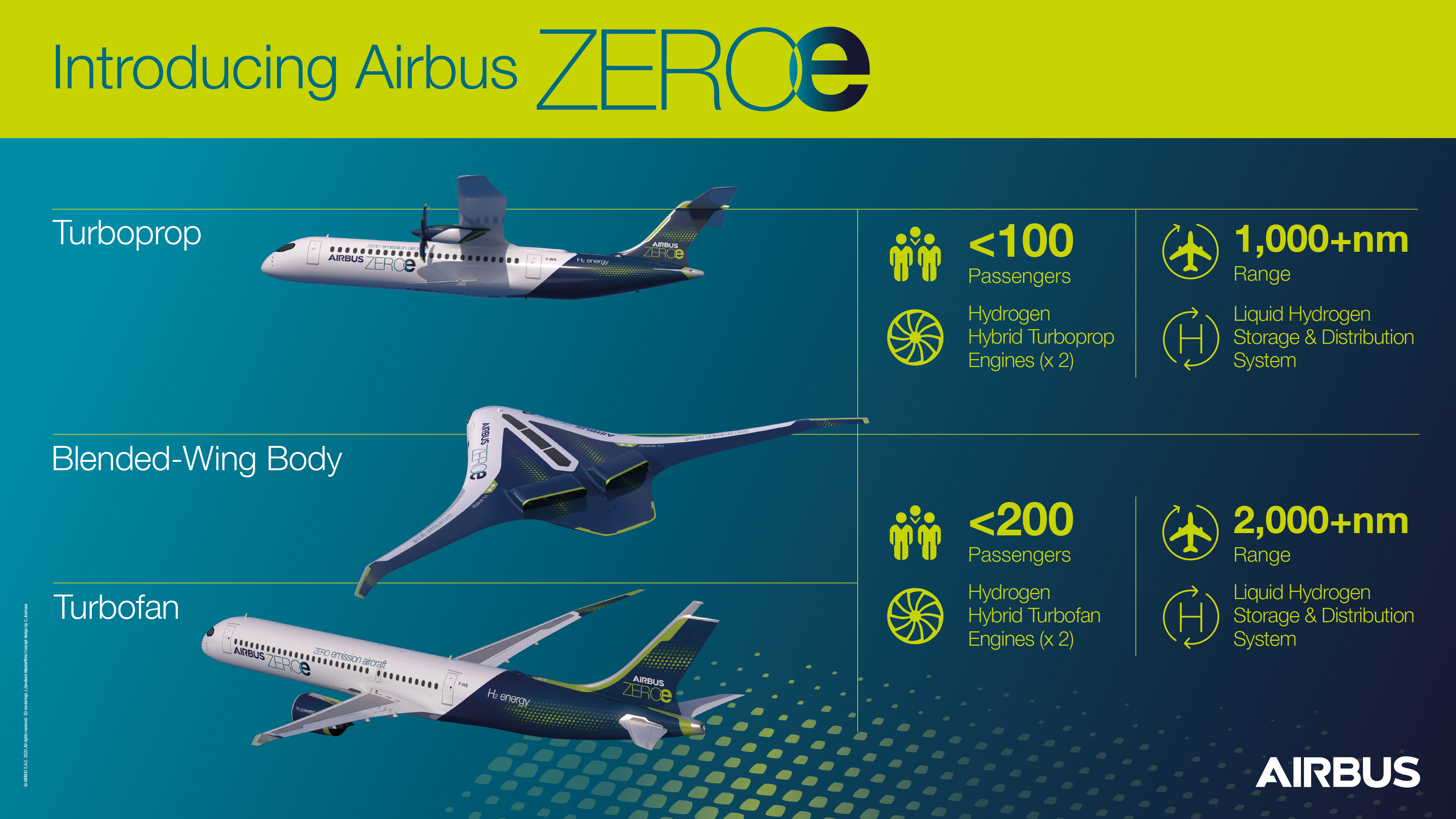
Discover the three zero-emission concept aircraft known as ZEROe in this infographic. These turbofan, turboprop, and blended-wing-body configurations are all hydrogen hybrid aircraft.
Two of the designs; the ZEROe Turboprop and ZEROe Turbofan appear to have been designed by re-engineering current technology and designs.
The one I like is the Turbofan, which I feel is based on the airframe of the current A 320 neo.
- Much of the wing, cockpit and fuselage appear very similar to that of the A 320 neo
- There is a hydrogen tank in the rear fuselage.
- The engines are probably modern turbofans, adjusted to run on hydrogen.
- Range and passenger capacity are very similar to the current aircraft.
- The ZEROe Turbofan would fit current airport infrastructure like tugs and terminals.
- Aircrew would need little retraining between current A 320s and ZEROe Turbofans.
There might even be the possibility of being able to convert an A 320 neo into a ZEROe Turbofan!
But there is a flaw in my reasoning.
IAG have placed a large order for Boeing 737 MAX aircraft. Wikipedia says this in the entry for IAG.
In June 2019, IAG signed a letter of intent to purchase 200 Boeing 737 MAX aircraft even though at the time of the signing the 737 MAX was still grounded worldwide following the two fatal crashes likely caused by the design of the MCAS system. Aviation analysts have questioned IAG’s leadership in making such an order when the 737 MAX design is still being rectified. IAG CEO Willie Walsh, shrugged off the plane’s uncertain future. “We’re partnering with the Boeing brand”, he said. “That’s the brand that I’m doing business with. That’s the brand that I’ve worked with for years. And it’s a brand that I trust”
Could Boeing have offered a 737 MAX, that can be converted to hydrogen?
I certainly feel that both a 737 MAX and an A 320 neo can be converted to hydrogen.
- The visualisations from Airbus of the A 320 neo and the ZEROe Turbofan are remarkably similar.
- The 737 MAX is a traditional aluminium aircraft, so may be easier to convert.
- As Boeing probably need a winner more urgently than Airbus, perhaps they can deliver a hydrogen-powered aircraft around the middle of the decade.
- Both aircraft are a bit like Lego and can be shortened or lengthened as required.
- Perhaps one or other of the planemakers have come up with a technique for storing environmentally-friendly liquid ammonia in the wings.
- See Could Current Airliners Be Fuelled With Ammonia?
As my mother used to say. “It’ll all come out in the wash!”
But I do feel by 2030, we’ll be seeing zero-carbon airlines on short-haul routes. So IAG’s aim of getting ten percent of planes powered by SAF by 2030, is probably a stop-gap that will continue with older planes for some years.
Uniper To Make Wilhelmshaven German Hub For Green Hydrogen; Green Ammonia Import Terminal
The title of this post, is the same as that of this article on Green Car Congress.
This is the first two paragraphs.
Under the name “Green Wilhelmshaven,” Germany-based international energy company Uniper plans to establish a German national hub for hydrogen in Wilhelmshaven and is working on a corresponding feasibility study.
Plans include an import terminal for green ammonia. The terminal will be equipped with an ammonia cracker for producing green hydrogen and will also be connected to the planned hydrogen network. A 410-megawatt electrolysis plant is also planned, which—in combination with the import terminal—would be capable of supplying around 295,000 metric tons or 10% of the demand expected for the whole of Germany in 2030.
I can’t help feeling that there is some bad thinking here.
The Wikipedia entry for ammonia, says this about green ammonia.
Even though ammonia production currently creates 1.8% of global CO2 emissions, a 2020 Royal Society report claims that “green” ammonia can be produced by using low-carbon hydrogen (blue hydrogen and green hydrogen). Total decarbonization of ammonia production and the accomplishment of net-zero targets are possible by 2050.
So why is green ammonia imported rather than green hydrogen, which may have been used to manufacture the ammonia?
Green ammonia would appear to have two main uses in its own right.
- As a feedstock to make fertiliser and other chemicals.
- As a possible fuel for large ships, which could also be powered by hydrogen.
The only thing, I can think of, is that as liquid hydrogen boils at -253 ° C and liquid ammonia at -33 ° C, ammonia may be easier to transport by ship.
It may make a better fuel for large ships for the same reason.
This policy briefing from The Royal Society is entitled Ammonia: Zero-Carbon Fertiliser, Fuel And Energy Store.
This is the introductory paragraph.
This policy briefing considers the opportunities and challenges associated with the manufacture and future use of zero-carbon or green ammonia.
It is an excellent explanation of green ammonia and a must read.
Hydrogen for Wilhelmshaven
On the other hand, Wilhelmshaven, which is situated on Germany’s North West Coast would be in a good position to be a terminal for a hydrogen pipeline or electrical interconnector from the Dogger Bank, where both the Netherlands and the UK have plans for some of the largest windfarms in the world.
The UK’s Dogger Bank Wind Farm, which is being developed by SSE, looks to have an initial capacity of 4.8 MW, whereas the North Sea Wind Power Hub, being developed by the Danes, Dutch and Germans on their side of the Dogger Bank could be rated at up to 110 GW.
Wikipedia says this about how the two huge projects could be connected.
The power hub would interconnect the three national power grids with each other and with the Dogger Bank Wind Farm.
We could be seeing a 200 GW power station in an area of the sea, generally only known to those who listen to the shipping forecasts and fans like Marti Caine.
Under a section in the Wikipedia entry for the North Sea Wind Power Hub, which is entitled the North Sea Wind Power Hub Consortium, these points are made.
- It is hoped that Norway, the United Kingdom, and Belgium will join the consortium.
- Dutch gas-grid operator Gasunie has joined the consortium, suggesting converting wind power to gas and using near offshore gas infrastructure for storage and transport.
- The Port of Rotterdam became the fifth member of the consortium.
This looks like a party, where some of our North Sea gas fields and infrastructure, lying in the triangle of the Humber, Teesside and the Dogger Bank could add a lot of value.
We could even see hydrogen generated in the European Eastern part of the Dogger Bank, stored in a worked-out gas field in the UK sector of the North Sea and then when needed, it could be pumped to Germany.
A 410 Megawatt Electrolyser
Ryze Hydrogen are building the Herne Bay electrolyser.
- It will consume 23 MW of solar and wind power.
- It will produce ten tonnes of hydrogen per day.
This would produce just 5.6 percent of the hydrogen of the Wilhelmshaven electrolyser
In H2 Green Steel Plans 800 MW Hydrogen Plant In Sweden, I wrote about a 800 MW electrolyser, that would produce 380 tonnes of hydrogen per day.
It looks like the Wilhelmshaven electrolyser is very much a middle-sized one and would produce around 65,000 tonnes per year.
Conclusion
It looks like the Germans will be importing lots of green ammonia and green hydrogen from the North Sea.
H2U Eyre Peninsula Gateway Hydrogen Project Begins Largest Green Ammonia Plant
The title of this post, is the same as that of this article on Hydrogen Fuel News.
- South Australia will be creating the largest green ammonia plant in the world.
- It will make 40,000 tonnes of green ammonia every year.
- The plant will be powered totally by renewable energy.
- At its heart will be a 75 MW hydrogen electrolyser.
This paragraph sums up the main objective of the plant.
According to Dr. Attilio Pigneri, H2U CEO, the project will play an important role in the ongoing development of the emerging green hydrogen and green ammonia markets.
It appears a lot of the green ammonia will be exported to Japan.
What Is Green Ammonia?
It is just ammonia produced by renewable energy. This is the first paragraph of the Wikipedia entry for ammonia.
Ammonia is a compound of nitrogen and hydrogen with the formula NH3. A stable binary hydride, and the simplest pnictogen hydride, ammonia is a colourless gas with a characteristic pungent smell. It is a common nitrogenous waste, particularly among aquatic organisms, and it contributes significantly to the nutritional needs of terrestrial organisms by serving as a precursor to food and fertilizers. Ammonia, either directly or indirectly, is also a building block for the synthesis of many pharmaceutical products and is used in many commercial cleaning products. It is mainly collected by downward displacement of both air and water.
It is a very useful chemical compound and it is now being developed as a zero-carbon fuel, as I wrote in The Foul-Smelling Fuel That Could Power Big Ships.
It can also be used as a refrigerant.
One of the most amazing pieces of engineering, I ever saw was a very old barn, where a farmer stored vast tonnages of apples. It was kept cool, by a refrigeration plant certainly built before the Second World War or possibly even the First, which used ammonia as the refrigerant.
Now that’s what I call engineering!
The Foul-Smelling Fuel That Could Power Big Ships
The title of this post, is the same as that of this article on the BBC.
The article talks in detail about using liquid ammonia to power large ocean-going ships.
- A research project is underway in Copenhagen.
- The ammonia would be green ammonia produced by renewable energy.
The aim is to seriously reduce emissions of greenhouse gases from shipping.
 The Anonymous Widower