Gresham House Energy Storage Sets GBP80 Million Fundraise
Gresham House Energy Storage Fund must be doing something right, as similar headlines are used in half-a-dozen places on the Internet and they regularly seem to be raising more money.
But then, as a Graduate Control Engineer and a previous owner of half a finance company, I’ve always thought raising money to build batteries was a good idea.
My only niggle with Gresham House, is that I would have thought by now, they would have put some money into building one of the excellent new technology batteries that are coming through.
The storage fund or some of its employees, may of course have contributed to some of the crowdfunding for these new technologies, all of which I feel have a good chance of being a success.
Note.
- Energy Dome is Italian and all the others are at least fifty percent British.
- Most of the British batteries have had backing from the UK government.
- All these batteries are environmentally-friendly.
- None of these batteries use large quantities of rare and expensive materials.
- Energy Dome even uses carbon dioxide as the energy storage medium.
In addition, in Scotland, there is traditional pumped storage hydro-electricity.
Project Iliad
This article on renews.biz has a slightly different headline of Gresham House To Raise £80m For US Battery Buildout.
This is the first two paragraphs.
Gresham House Energy Storage Fund is seeking to raise £80m through a share placing.
The new equity raised will primarily be used to finance 160MW of solar with co-located four-hour battery projects in California, US, known as Project Iliad.
The article then gives a lot of financial details of Project Iliad and Gresham House.
Will Gresham House be backing co-located solar/battery projects in the UK?
- In Cleve Hill Solar Park, I write about a co-located solar/battery project in Kent.
- This press release from National Grid is entitled UK’s First Transmission-Connected Solar Farm Goes Live, which also describes a co-located solar/battery project, being built near Bristol.
These two projects are certainly serious and could be pathfinders for a whole host of co-located solar/battery projects.
WillGresham House back some of this new generation?
Boralex Commissions BESS At Wind Farm In France In EU-Supported Demonstration Project
The title of this post, is the same as that of this article on Energy Storage News.
These two paragraphs outline the project.
Canada-based renewable energy firm Boralex has turned on a 3.3MWh battery storage unit attached to a wind farm in France.
The battery storage project has been installed at the site of the Plouguin wind farm, an 8MW generating facility in the Finistere department of Brittany, northwest France.
Note.
- The project was co-financed by the European Union through its European Regional Development Fund (ERDF).
- The project was launched to demonstrate the technical feasibility of a hybrid wind-plus-storage project.
- Boralex added in its announcement that the project will contribute to the stability of the French electricity grid.
There will be a lot of projects like this in the future.
This paragraph makes an interesting point about using batteries with solar and wind power.
Wind farms are less frequently hybridised with energy storage than solar PV because of the larger minimum project size and less predictable variability, with sharper peaks meaning heavier battery cycling and potentially faster degradation.
My control engineering knowledge and experience says that larger power sources and those that are highly variable will need batteries with more capacity for the same stability and quality of power output.
This sounds to me like a very good reason for developing larger and more affordable batteries, like those of Cheesecake Energy, Energy Dome, Gravitricity and Highview Power.
It also probably means that to stabilise several gigawatts of wind power, you need a very large amount of storage, that can only be provided by pumped storage hydroelectricity.
Conclusion
A very large amount energy storage is going to be needed.
Projects like these are essential to make sure we use them to their full possibilities.
UK Government Grants £30 Million For Long Duration Energy Storage Projects
The title of this post, is the same as that of this article on Solar Power Portal.
These two paragraphs outline the grants and their recipients.
The UK Department for Energy Security and Net Zero (DESNZ) is providing £30 million in grants for three long-duration energy storage (LDES) projects using novel energy storage technologies.
The three projects awarded funding are from Synchrostor, Invinity Energy Systems and Cheesecake Energy. Synchrostor and Cheesecake Energy are to receive £9.4 million each to fund thermal energy storage systems and Invinity Energy Systems receiving £11 million to develop a vanadium flow battery.
The UK Government seems to give out a lot of these grants for research and development purposes and from feedback I have received from recipients and also by applying my own experience, I am of the opinion, that they are spending tax-payers money more in a wise, rather than a foolish direction.
Cheesecake Energy
I wrote about Cheesecake Energy’s grant in Cheesecake Energy Collects £9.4m Government Funding.
The Government’s press release says this about Cheesecake’s grant.
Cheesecake Energy Ltd, Nottingham, which will receive £9.4 million to test their FlexiTanker technology which stores electricity using a combination of thermal and compressed air energy storage and uses a reversible air compression / expansion train to charge and discharge. They will then install pilot units at 2 sites within a microgrid development in Colchester.
If this project proves successful, it surely is one that can be duplicated in many places.
I have had my eye on Cheesecake Energy for some time and this could be their breakthrough.
Invinity Energy Systems
I first wrote about Invinity Energy Systems in UK’s Pivot Power Sees First Battery On Line By 2021.
The Government’s press release says this about Invinity’s grant.
Invinity Energy (UK) Limited, Scotland, which will receive £11 million to develop and manufacture their 7MW, 30MWh 4-hour Vanadium Flow Battery (VFB), the largest in the UK. Invinity will manufacture the 30 MWh VFB at the Company’s factory in West Lothian, Scotland. The location of the plant will be confirmed in due course.
In this article on renews.biz, which is entitled Invinity Wins Funds For 30MWh UK Battery, these two paragraphs introduce the project.
Invinity Energy Systems plc has today been awarded £11m in funding by the Department for Energy Security and Net Zero to build what it says is the largest grid-scale battery ever manufactured in the UK.
The £11m in funding will come from the Longer Duration Energy Storage Demonstration (LODES) Competition, with funding matched by Invinity’s, as yet unnamed, project partner.
These are other points from the article.
- It will be a fast-response 30MWh battery.
- The battery will be assembled at Bathgate in Scotland.
- It will operate as a stand-alone energy storage asset.
- It will be connected to the National Grid.
- Invinity’s vanadium flow batteries are an alternative to lithium-ion.
The aim is to go live by 2025.
This paragraph indicates the differences between a vanadium flow battery and a traditional lithium ion one.
Invinity said this battery is safer as they cannot catch fire, more durable as they do not degrade with use and are almost completely recyclable at the end of their 25+ year life, reducing environmental impacts and disposal costs for project owners.
I believe that there will come a point, when fully-developed vanadium flow batteries, will become very attractive for financial reasons to the successful energy storage funds like Gresham House and Gore Street.
If the UK government’s funding hastens the day, when energy storage funds feel that these new-fangled vanadium flow batteries are a safe investment, then it is money well spent.
It is not as though the money is going to an early start-up, as this page on the Invinity Energy Systems web site indicates at least a dozen installations.
This project for an as yet unnamed customer, which has a capacity of 30 MWh, is probably much bigger and the Government help is probably very much welcomed.
SynchroStor
SynchroStor was new to me, today.
The Government’s press release says this about SynchroStor’s grant.
Synchrostor, Edinburgh, Scotland, which will receive £9.4 million to build a Pumped Thermal Energy Storage (PTES) grid-connected demonstration plant operating at 1MW, with the ability to charge and discharge for a period of 10 hours, longer than current battery technology.
This page named Technology on their web site, explains their technology, both with words and diagrams.
It is probably the most complex technologies of the three batteries, but I don’t think that will be a problem.
Conclusion
The Government has given grants to three different storage technologies.
If all goes well three good sizable pilot plants will be created and those companies like Centrica, Gore Street, Gresham House, National Grid, Ørsted, SSE and others, will be able to judge, which system is best for their needs.
Cheesecake Energy Collects £9.4m Government Funding
The title of this post, is the same as that of this article on UKTN.
These two paragraphs outline how they will use the grant.
Cheesecake Energy will use the government funding to install its energy storage solution as a microgrid in Colchester to help with local grid limitations.
University of Nottingham spinout Cheesecake Energy’s installation will collect energy made by a solar farm with a capacity of 8MW and a central heat pump that supplies a district heat pump network.
Cheesecake Energy have been on my list of possible successful energy storage systems for some time and this sounds like a very neat application for energy storage.
Cheesecake Energy bill themselves on their web site as The World’s Greenest Battery, which is a big claim to make.
This outline of their technology is given on their Our Technology page.
Cheesecake Energy’s eTanker energy storage system is a stationary, medium to long-duration energy storage solution which delivers cheap, reliable, efficient energy storage in a modular, containerised package.
The technology stores energy in the form of heat and pressurised air, re-tasking ex-service truck engines to become zero-emission electrical power-conversion machines for putting energy into storage and recovering it from storage. The resulting system does not use diesel or any fuel. It is safe, straightforward to operate, has a lifetime of up to 25 years and can deliver turnaround efficiencies of around 70%.
I like the idea of using recycled truck engines at the heart of the system.
Conclusion
The World’s Greenest Battery could be right!
Diversifying A US$200 billion Market: The Alternatives To Li-ion Batteries For Grid-Scale Energy Storage
The title of this post, is the same as that of this article on Energy Storage News.
This is the introductory paragraph.
The global need for grid-scale energy storage will rise rapidly in the coming years as the transition away from fossil fuels accelerates. Energy storage can help meet the need for reliability and resilience on the grid, but lithium-ion is not the only option, writes Oliver Warren of climate and ESG-focused investment bank and advisory group DAI Magister.
Oliver starts by saying we need to ramp up capacity.
According to the International Energy Agency (IEA), to decarbonise electricity globally the world’s energy storage capacity must increase by a factor of 40x+ by 2030, reaching a total of 700 GW, or around 25% of global electricity usage (23,000TWh per annum). For comparison, this would be like swelling the size of the UK’s land to that of the USA.
Similar to how “nobody ever gets fired for buying IBM”, lithium-ion holds a similar place in grid scale electrical storage today.
And just as IBM did in the last decades of the last century, the builders of lithium-ion will fight back.
He then lists the problems of grid-scale lithium-ion batteries.
- Shortage of cobalt.
- Toxic and polluting extraction of some much needed metals and rare earths from unstable countries.
- Lack of capacity to load follow.
- Limited lifespan.
He does suggest vehicle-to-grid can provide 7TWh of storage by 2030, but it has similar problems to lithium-ion grid scale batteries.
Finally, he covers these what he considers several viable methods of energy storage in detail.
He introduces them with this paragraph.
No single killer application or technology exists to get the job done. Diversification is key with success dependent on the wide-scale adoption of multiple grid-scale energy storage solutions.
- Energy Dome – Italy – Stylish Use of CO2
- Augwind Energy – Israel – Stores Energy As Compressed Air Underground
- Cheesecake Energy – UK – Stores Energy As Heat And Compressed Air
- Highview Power – UK – Stores Energy As Liquefied Air
- Ocean Grazer – Netherlands – Ocean Battery
- RheEnergise – UK – High Density Hydro
- Lumenion – Germany/Japan – Stores Energy As Heat
- Energy Vault – Switzerland – Raising And Lowering Of Weights
Note.
- All systems are environmentally-friendly and use readily-available materials like air, water, sea-water, steel and concrete for their systems.
- The most exotic materials used are probably in the control computers.
- Some systems use readily-available proven turbo-machinery.
- Most systems appear to be scalable.
- All systems would appear to have a working life measured in decades.
- I would expect that most well-educated teenagers could understand how these systems worked.
Only Augwind Energy and Lumenion are new to me.
He finally sums up the economics and the market potential.
Our ability to expand energy storage capacity is one of the most pressing issues that will determine whether this defining ‘transitional’ decade is a success. But we’ll need to invest wisely into the right technologies that get the greatest bang for the buck (in terms of GWh capacity and return on capital) given the limited lifespan of Li-Ion and the decarbonisation of the grid.
At a current capital cost of US$2,000 per kW quoted by the US National Renewable Energy Laboratory (NREL) for 6-hour Li-ion battery storage, the 700GW of capacity needed by 2030 equates to around a US$1.5 trillion market over the coming decade, making it worth nearly US$200 billion a year.
The Energy Storage News article is a comprehensive must read for anyone, who is considering purchasing or investing in energy storage.
I have some further thoughts.
From My Experience Would I Add Any Other Systems?
I would add the following.
- Form Energy, because its iron-air battery is well-backed financially.
- Gravitricity, because it can use disused mine shafts to store energy and the world has lots of those.
- STORE Consortium, because its 3D-printed concrete hemispheres, that store energy using pressurised sea-water can be placed within a wind farm.
I also suspect that someone will come up with an energy storage system based on tidal range.
Finance
When we started Metier Management Systems, finance to breakout from the first initial sales was a problem. We solved the problem with good financial planning and an innovative bank manager who believed us all the way.
David, was a rogue, but he was a rogue on the side of the angels. Long after Metier, he even came to my fiftieth birthday party.
David would have found a way to fund any of these systems, as they tick all the boxes of demonstrated, environmentally-friendly, safe and understandable. They are also likely to be bought by companies, governments and organisations with a high net value, a very respectable reputation and/or large amounts of money.
I also think, that just as we did with the original Artemis project management system, some of these systems can be leased to the operators.
Second-Use Of Systems
Several of these systems could be moved on to a new location, if say they were supporting an industry that failed.
That would surely help the financing of systems.
Cheesecake Energy Secures £1M Seed Investment
The title of this post, is the same as that of this Press Release from Cheesecake Energy.
This is the first paragraph.
Cheesecake Energy Ltd (CEL), a Nottingham, UK-based energy storage startup today announced it has raised £1M in Seed funding to fuel the development of its manufacturing capabilities and support product development of its eTanker storage system. The round was led by Imperial College Innovation Fund alongside prominent investors including Perivoli Innovations, former Jaguar Chairman, Sir John Egan and other angel investors.
And the third and fourth paragraphs describe the technology.
The company’s unique technology, dubbed eTanker, takes established compressed air energy storage concepts and revolutionises them by storing two-thirds of the electricity in the form of heat which can be stored at far lower cost. To store the energy, electric motors are used to drive compressors, which deliver high pressure air & heat into storage units. When the electricity is required, the high-pressure air and heat is passed back through the same compressor (but now working as a turbine), which turns a generator to produce electricity. The company believes its system will cut the cost of storing energy by 30-40% and offers a solution that can be used in several sectors including electric vehicle (EV) charging, heavy industry and renewable energy generation.
The startup has filed 10 patents for stationary, medium-long-duration, long-lifetime energy storage technology. It is based on innovative design work by CEL, a spin-out from over a decade of research at University of Nottingham. Employing circular economy principles, truck engines are converted into zero-emission electrical power-conversion machines for putting energy into and out of storage. Its technology brings together the low cost of thermal storage, the turnaround efficiencies of compressed air energy storage, together with the long life and robustness of a mechanical system, making a game-changing technology in a modular containerised package.
It all sounds feasible to me and if I’d have been asked, I’d have chipped in some of my pension.
The system in some ways can almost be considered a hybrid system that merges some of the principles of Highview Power’s CRYOBattery and Siemens Gamesa’s ETES system of heating large quantity of rock. Although, Cheesecake’s main storage medium is comptressed air, as opposed to the liquid air of the CRYOBattery.
One market they are targeting is the charging of fleets of electric vehicles like buses and from tales I have heard about operators of large numbers of electric buses, this could be a valuable market.
I also noted that the Press Release mentions a National Grid report, that says we will need 23 GW of energy storage by 2030. Assuming we will need to store enough electricity to provide 23 GW for five hours, that will be 115 GWh of energy storage.
At present, pumped storage is the only proven way of storing tens of GWh of energy. In 1984, after ten years of construction, Dinorwig power station (Electric Mountain) opened to provide 9.1 GWh of storage with an output of 1.8 GW.
So ideally we will need another thirteen Electric Mountains. But we don’t have the geography for conventional pumped storage! And as Electric Mountain showed, pumped storage systems are like Rome and can’t be built in a day.
Energy storage funds, like Gresham House and Gore Street are adding a large number of lithium-ion batteries to the grid, but they will only be scratching the surface of the massive amount of storage needed.
Note that at the end of 2020, Gresham House Energy Storage Fund had a fleet of 380 MWh of batteries under management, which was an increase of 200 MWh on 2019. At this rate of growth, this one fund will add 2GWh of storage by 2030. But I estimate we need 115 GWh based on National Grid’s figures.
So I can see a small number of GWh provided by the likes of Gresham House, Gore Street and other City funds going the same route.
But what these energy storage funds have proved, is that you have reliable energy storage technology, you can attract serious investment for those with millions in the piggy-bank.
I believe the outlook for energy storage will change, when a technology or engineering company proves they have a battery with a capacity of upwards of 250 MWh, with an output of 50 MW, that works reliably twenty-four hours per day and seven days per week.
I believe that if these systems are as reliable as lithium-ion, I can see no reason why City and savvy private investors money will not fund these new technology batteries, as the returns will be better than putting the money in a deposit account, with even the most reputable of banks.
At the present time, I would rate Highview Power’s CRYOBattery and Siemens Gamesa’s ETES system as the only two battery systems anywhere near to a reliable investment, that is as safe as lithium-ion batteries.
- Both score high on being environmentally-friendly.
- Both rely on techniques, proven over many years.
- Both don’t need massive sites.
- Both systems can probably be maintained and serviced in nearly all places in the world.
- Highview Power have sold nearly a dozen systems.
- Highview Power are building a 50 MW/250 MWh plant in Manchester.
- Siemens Gamesa are one of the leaders in renewable energy.
- Siemens Gamesa have what I estimate is a 130 MWh pilot plant working in Hamburg, which I wrote about in Siemens Gamesa Begins Operation Of Its Innovative Electrothermal Energy Storage System.
Other companies are also targeting this market between lithium-ion and pumped storage. Cheesecake Energy is one of them.
I believe they could be one of the winners, as they have designed a system, that stores both compressed air and the heat generated in compressing it. Simple but efficient.
I estimate that of the 115 GWh of energy storage we need before 2030, that up to 5 GWh could be provided by lithium-ion, based on the growth of installations over the last few years.
So we will need another 110 GWh of storage.
Based on 50 MW/250 MWh systems, that means we will need around 440 storage batteries of this size.
This picture from a Google Map shows Siemens Gamesa’s pilot plant in Hamburg.
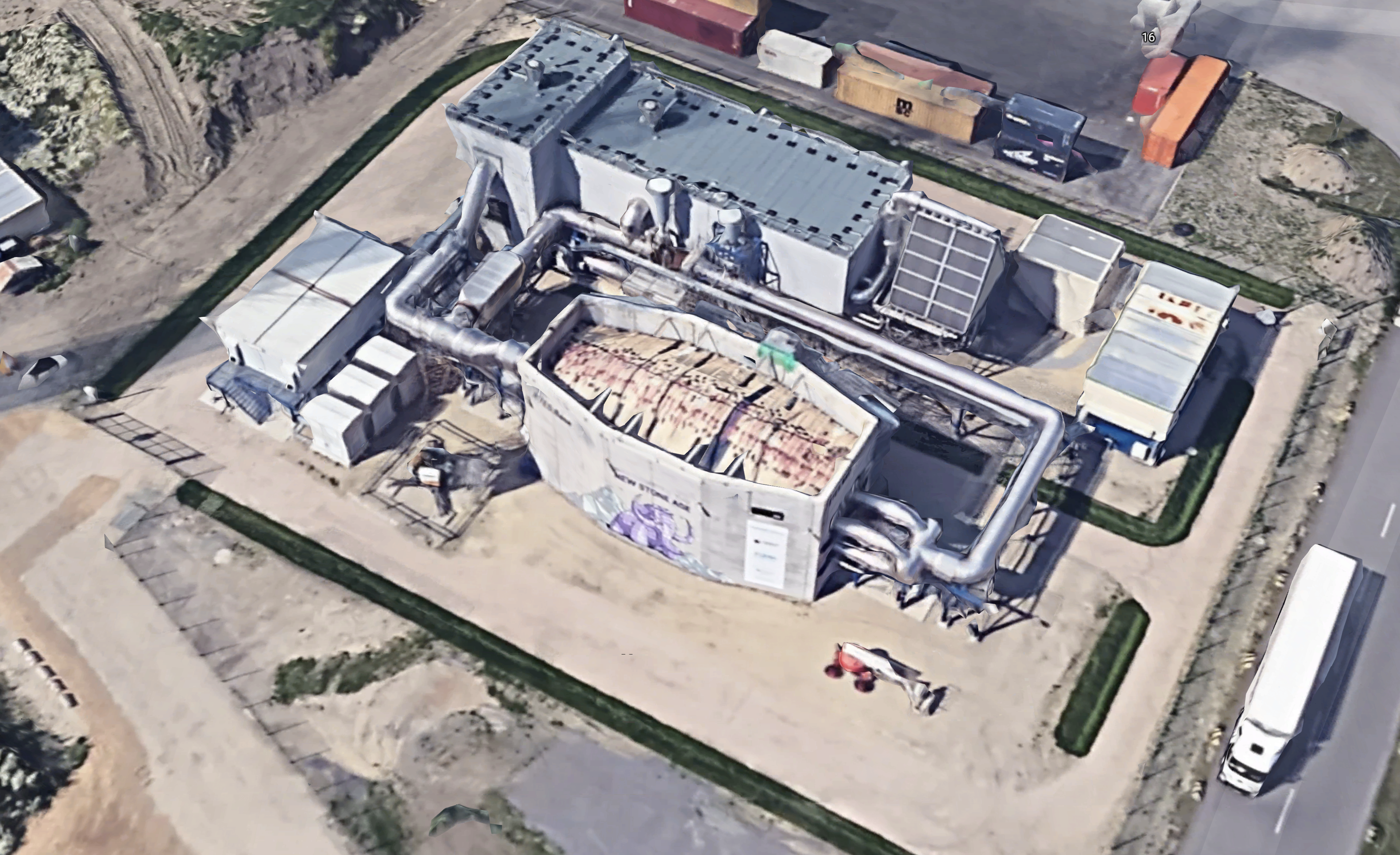
I estimate that this plant is around 130 MWh of storage and occupies a site of about a football pitch, which is one hectare.
I know farmers in Suffolk, who own more land to grow wheat, than would be needed to accommodate all the batteries required.
Conclusion
I believe that National Grid will get their 23 GW of energy storage.
Cheesecake Energy Receives Investment From The University Of Nottingham
The title of this post, is the same as that of this article on NewsAnyway.
This is the introductory paragraph.
Cheesecake Energy Limited (CEL) today announced it has received investment from the University of Nottingham to support UK-wide pilot programmes for the company’s energy storage solution.
Thse two paragraphs are a brief description of the company, their technology and what they do.
Cheesecake Energy Limited is a fast-growing startup developing energy storage at 30-40% lower cost than the current market leader, lithium ion batteries. Its system uses compressed air and thermal energy storage to achieve high efficiency, long lifetime and dramatically lower environmental impact.
Founded in 2016, the company has already established itself within the Nottingham, and wider East Midlands energy ecosystem — having secured initial interest from local councils and bus services for pilot programmes. The company is currently designing a 150 kW / 750 kWh prototype system for completion in Q4 2020 which will be deployed with a local bus depot for charging of electric buses using renewable energy.
This is the home page of their web site, which proudly announces.
The Greenest Battery In The World
We’ll see and hear that slogan many times in the next few years.
A few of my thoughts on the company.
Cheesecake Energy’s Technology
Cheesecake Energy says it uses compressed air and thermal energy storage to achieve high efficiency, long lifetime and dramatically lower environment impact.
Three other companies also use or may use compressed air to store energy.
- Highview Power – See Highview Power To Build Europe’s Largest Battery Storage System
- Form Energy – See Will The Real Form Energy Please Stand Up!
- Hydrostor – See Hydrostor Announces Australia’s First CompressedAir Energy Storage Project Secures Funding From Arena And South Australia Renewable Technology Fund
As Cheesecake appear to be using a thermal energy storage, have they found a unique way to create another type of compressed air storage?
Battery Sizes
How do the sizes of the three companies batteries compare?
- Cheesecake Energy prototype – 150 kW – 750 kWh – five hours
- Form Energy for Great River Energy – 1MW – 150 MWh – 150 hours
- Highview Power for Vermont – 50MW – 400 MWh – 8 hours
- Hydrostor for South Australia – 50+MW – 4-24+ hours
The Cheesecake Energy prototype is the smallest battery, but Highview Power built a 750 KWh prototype before scaling up.
Note.
- The first figure is the maximum power output of the battery.
- The second figure is the capacity of the battery.
- The third figure is the maximum delivery time on full power.
- The capacity for Hydrostor wasn’t given.
The figures are nicely spread out, which leas me to think, that depending on your power needs, a compressed air battery can be built to satisfy them.
Charging Electric Buses
Buses like this Alexander Dennis Enviro200EV electric bus are increasingly seen in the UK.




And they all need to be charged!
Cheesecake Energy say that their prototype will be deployed with a local bus depot for charging of electric buses using renewable energy.
- An electric bus depot should be a good test and demonstration of the capabilities of their battery and its technology.
- Note that according to this data sheet of an Alexander Dennis Enviro200EV, which is a typical single-decker electric bus, the bus is charged by BYD dual plug 2×40kW AC charging, which gives the bus a range of up to 160 miles.
- With a 150 kW output could Cheesecake’s prototype charge two buses at the same time and several buses during a working day?
- Would DC charging as used by Vivarail’s charging system for trains be an alternative?
To me, it looks like Cheesecake are showing good marketing skills.
I do wonder if this size of charger could make the finances of electric buses more favourable.
Suppose, a bus company had a fleet of up to a dozen diesel single-decker buses running services around a city or large town.
- How much would they spend on electricity, if they replaced these buses with electric ones?
- Would being able to use cheaper overnight energy to charge buses in the day, be more affordable?
- Would electric buses run from renewable electricity attract passengers to the services?
These arguments for electric buses would also apply for a company running fleets of vans and small trucks.
To me, it looks like Cheesecake are showing good engineering/marketing skills, by designing a product that fits several markets.
 The Anonymous Widower