Tideway – Blackfriars Bridge Foreshore – 12th February 2024
It is two years since I took the last set of pictures here.




The tunnelling is now complete.
TCP Is Using Hydrogen To Create Cleaner Construction Sites
The title of this post, is the same as that of this article on the Eastern Daily Press.
This is the sub-heading.
Air and noise pollution are challenges for every construction project. For green energy infrastructure developers especially, cutting emissions is a pressing conundrum.
These are the first four paragraphs.
Large-scale construction demands diesel-guzzling heavy plant and noisy diesel generators powering off-grid site work for years before a project generates its first clean energy.
Back in 2012, Andrew Barker identified hydrogen as a fuel of the future and a solution to pollution issues during construction projects in his Essex-based family business, Taylor Construction Plant (TCP Group).
His concerns about health issues caused by carbon emissions, combined with a drive to make a difference, led to game changing inventions using hydrogen to transform power for site operations – making sites better neighbours, with fewer health dangers to site workers and helping the drive against climate change.
He developed his first hydrogen powered product more than a decade ago – mobile lighting towers that are the flagship product for the business and first choice for building and maintenance projects across the UK on the mission to net zero.
It appears now Andrew Barker has a strong business, which can be found at this web site.
First Massive ‘Lego Block’ Beams Lifted For HS2’s Pioneering Thame Valley Viaduct
The title of this post, is the same as that of this press release from High Speed Two.
HS2 has begun lifting the first of 72 huge beams that will support the deck of the Thame Valley Viaduct – the first of its kind in the UK to have all major elements manufactured off site.
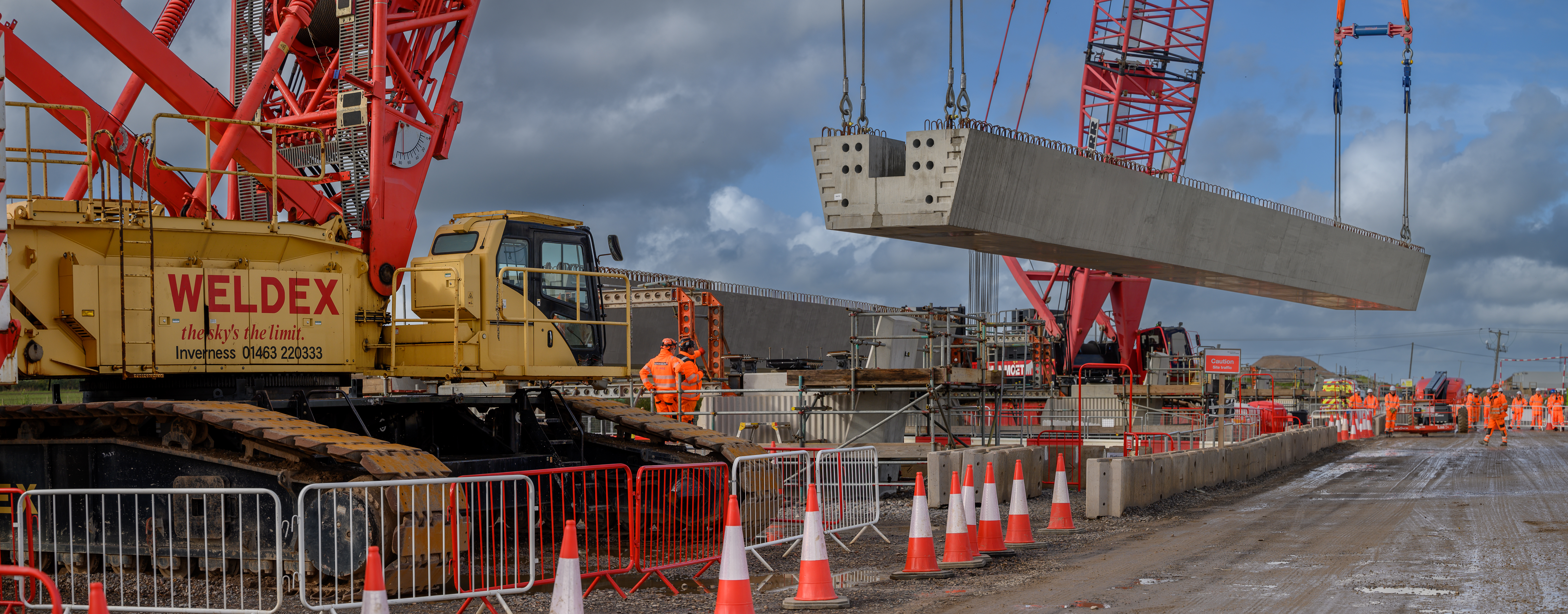
HS2 Bicester viaduct beam placement.
These paragraphs describe the building of the viaduct.
Engineers at the site near Aylesbury used two massive cranes to lift the beams – 25 metres long and weighing 90 tonnes each – into position on top of the viaduct piers, like giant Lego blocks.
Instead of using a more traditional approach, with multiple smaller beams for each span, the design team opted for a simple structural solution with just two larger hollow u-shaped beams per span, which allows for a lighter structure and simpler construction.
The lighter-weight design, inspired by viaducts on the Spanish high speed rail network, also reduces the amount of carbon-intensive concrete and steel in the structure – cutting its carbon footprint by around a third.
It doesn’t say, if they are using low-carbon concrete for the beams, but High Speed Two have used this material before.
Seratech’s Technology Explained
I first wrote about Seratech in Carbon-Neutral Concrete Prototype Wins €100k Architecture Prize For UK Scientists, after reading about this carbon-neutral concrete in the Architect’s Journal.
I have just received Seratech’s October 2023 Newsletter, which contains two must-read articles.
Olivine In The Age Of Climate Crisis
I’d never heard of olivine until I read about the architecture prize, that was won by Seratech.
This is the Wikipedia entry for olivine.
These are the first three paragraphs of Seratech’s article.
On the west coast of Norway, a few kilometres from the village of Åheim, is an open excavation pit – home to the largest commercial olivine deposit in the world.
This seaside quarry, run by Belgian industrial minerals company, Sibelco, works to extract olivine from the earth’s crust by drilling, blasting and crushing. A single blast (used to break up the rocks) removes up to 40,000 tonnes of olivine.
The site is predominantly powered by hydroelectricity and boasts a 4km conveyor system for transport which limits the need for heavy vehicle or double-handling of materials in a bid to reduce emissions.
This is Sibelco’s video of their impressive mining process.
Note.
The mining operation is fully-integrated with its own ort.
- The video does the mining operation justice.
- Sibelco aim to make the mining of olivine carbon-neutral.
Olivine has this Wikipedia entry, which gives more information.
This Google Map shows the port complex at Åheim.
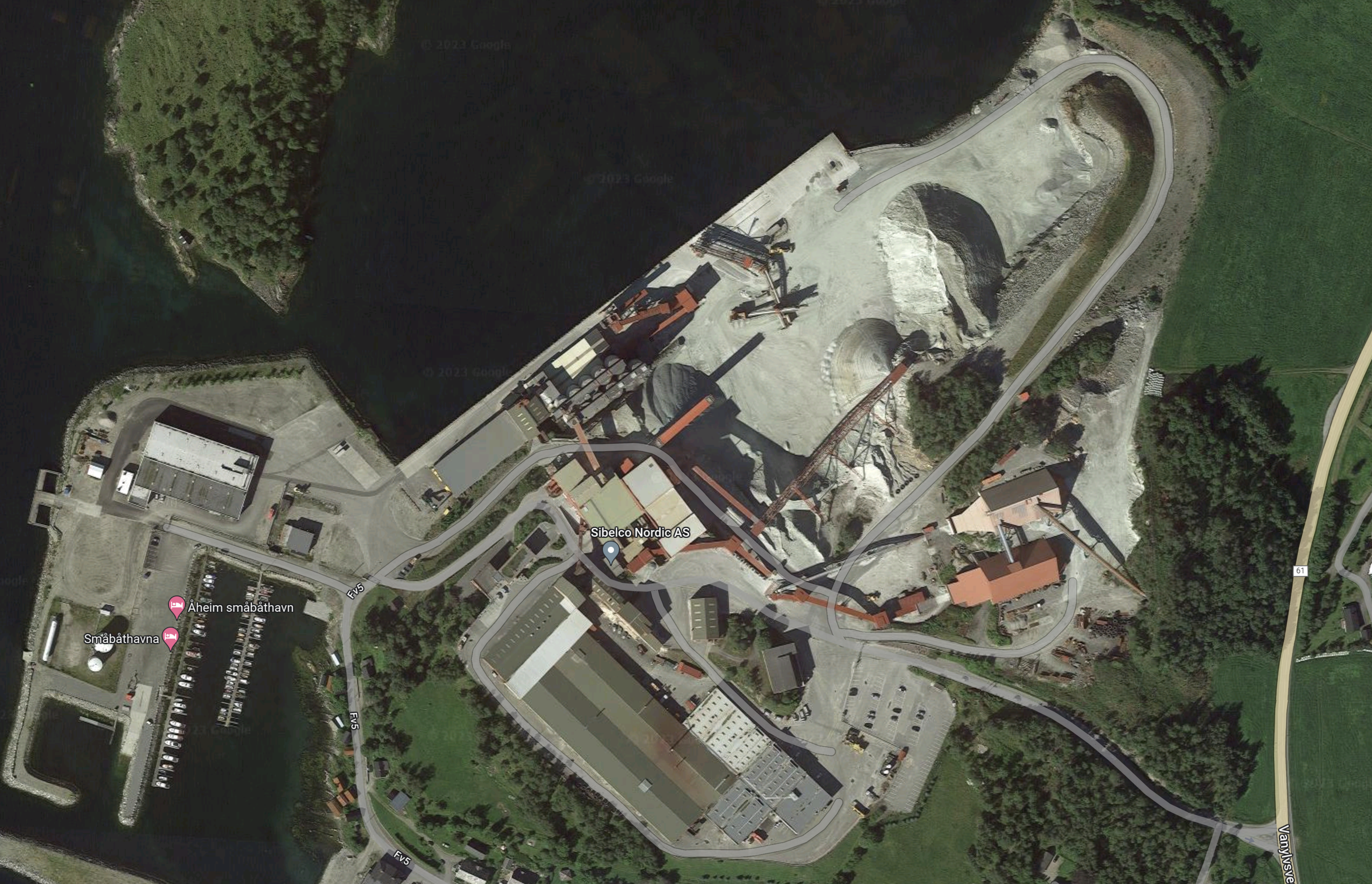
It looks like mine, processing and port all on one site.
The Big Interview With Mike Eberlin
This is the sub-heading.
Former Managing Director of Tarmac Cement & Lime and chair of MPA Cement, Mike Eberlin, became Seratech’s business advisor in June this year. He was intrigued by the novel technology Sam Draper and Barney Shanks had uncovered
These paragraphs are a summary of what Mike Eberlin said.
As we begin to talk, Mike is quick to point out there are two big advantages to Seratech: “They are using magnesium silicate as a starting material which produces silica as a cement replacement and magnesium oxide which can then absorb CO2”.
The CO2 absorption is what fascinates Mike as the type of magnesium carbonate Seratech produces is a “slightly unstable” version which when cured, becomes stable and reverts to the rock-like substance you would find in nature. “This came as a surprise because the chemistry wouldn’t indicate that was possible,” he explains.
Following this discovery, and as Seratech’s research progressed, it soon became apparent that the magnesium carbonate lends itself well as a binder and can be used in applications like building blocks and plasterboard: “It’s effectively carbon capture and use, not carbon capture and storage because you are mineralising the CO2 into a product.
“We end up in this clever situation whereby it’s not that we don’t emit the CO2, it’s better than that, we absorb CO2 and create two binders that replace cement”.
That’s what I call an endorsement.
Conclusion
I have this feeling that Seratech will be a very significant company in a couple of years.
Low-Carbon Concrete: Separating Greenwash From Reality
The title of this post is the same as that of this article from Construction Management.
This is the sub-heading.
Tales of low-carbon concrete abound, but what exactly does that mean? Kristina Smith looks at what’s in the mix.
This is a paragraph, which shows the scale of the problem.
The oft-quoted statistic is that cement contributes to 7% of the world’s carbon emissions. However, MPA says that in the UK concrete and cement account for just 1.5% of emissions. “From 1990 we have reduced our absolute emissions by 53%, which is faster than the overall economy, mainly by improving energy efficiency at the plants,” says Khosravi.
Noushin Khosravi, is sustainable construction manager at the Concrete Centre, which is part of Mineral Products Association (MPA).
Companies mentioned include.
- Capital Concrete with their Earth Friendly Concrete.
- CarbonCure Technologies, which I wrote about in Mote – World’s First Carbon Removal Plant Converting Wood Waste To Hydrogen.
- Seratech, which I wrote about in Carbon-Neutral Concrete Prototype Wins €100k Architecture Prize For UK Scientists.
I find the Seratech process amazing as it takes carbon dioxide straight from flues to make the cement.
Could we fit a Seratech cement process on the back of a gas-fired power station?
The article is a must-read summary of where the technology is with respect to low-carbon concrete.
Should Hydrogen-Powered Trucks Pay A Lower Charge In The Silvertown And Blackwall Tunnels?
London has a lot of heavy diesel trucks, which include.
Cement mixer trucks.
Large eight-wheeler trucks transporting aggregate, building materials and construction spoil to and from construction sites.
Council refuse trucks.
Skip trucks.
Supermarket delivery trucks.
They are large polluters and the only way they will be made zero-carbon, will be to use hydrogen.
In Cummins Agrees To Integrate Its Hydrogen ICE Technology Into Terex® Advance Trucks, I write about how Cummins and Terex are going to be building hydrogen-powered cement mixers.
This picture shows the baby of the range, which could be ideal for a smaller country like the UK.

Note how it is the other way round to traditional cement mixer trucks.
As companies are now selling low-carbon concrete in the UK, I suspect, it won’t be long before they will be delivering it in a hydrogen-powered zero-carbon truck.
If hydrogen-powered trucks could be given an economic boost, by lowering their charges for the Silvertown And Blackwall Tunnels, this might increase their uptake by owners of large trucks, which would in turn reduce pollution.
But this would need the election of a London Mayor, who had a hydrogen policy other than ignore it and hope it goes away.
Development Around Liverpool Street Elizabeth Line Station
After my Full English breakfast in Leon this morning, I walked around the area between the two entrances to Liverpool Street station on the Elizabeth Line, before entering the station at the Liverpool Street entrance.
I took these pictures as I walked.




















































Note.
- The large development with the naked concrete towers is the Western extension to Broadgate.
- The old entrance to Moorgate Underground station and two pubs are squeezed in between the modern buildings.
- The cylindrical building behind the Globe pub, is Moor House.
- Some buildings are brand new and others are older ones, that have been refurbished and/or reskinned.
There is hardly any space left to put in a dog kennel.
Signalling Team Trials Hydrogen Power
The title of this post, is the same as that of this article on Railway Gazette.
These two paragraphs outline the project.
The use of hydrogen to provide power for staff welfare compounds and to recharge battery tools and electric vehicles has been tested by Colas Rail UK’s signalling team during a project in the Gloucester area.
H-Power Tower fuel cell stacks designed by AFC Energy to replace diesel generators at off-grid construction sites were used to provide power for Eco-Cabins supplied by Sunbelt Rental. The H-Towers were also used to recharge battery-operated equipment and electric-hybrid vehicles.
There has been a large saving in carbon emission during the work.
Whilst living in the Suffolk countryside for nearly forty years, we had three major power outages.
The first was the smallest and Eastern Electricity or whoever it was around 1980, needed to change the transformer that fed the village where we lived. So a diesel generator was plugged in and it fed the village, whilst the new transformer was connected.
Then in the Great Storm of 1987, where we were without power for fourteen days until a load of happy foreigners from the other side of Offa’s Dyke, got the system up and singing again. I think today, that waiting two weeks to be reconnected would be unacceptable. Although the problems in 1987, were more down to the considerable amount of damage in Suffolk.
The last time, the power went just as we were going to bed on a summer evening.
We woke to find that the power had been restored.
The manner of the restoration was a textbook case of how power outages can be solved.
- Our house and the farm buildings around it, were fed from a transformer up a pole in the hedge by the drive.
- A driver who had known what they were doing had backed a full-size articulated lorry into the field alongside the transformer.
- Inside the trailer was a diesel generator and this had been connected to the transformer.
- When I investigated early in the morning, an engineer appeared from inside the trailer and asked if everything was OK.
- I said it was and asked a few technical questions.
- It turned out, that someone had brought the overhead cables down, whilst moving a load of straw near the prison.
So as our house was on one end of the cable that connected a few villages and farms to the grid, by temporarily connecting their mobile generator to the transformer everybody could be reconnected until the damage done near the prison could be repaired.
How long will it be before emergencies like these are handled by generators powered by hydrogen rather than diesel?
In HS2 Smashes Carbon Target, I describe how High Speed Two are making use of hydrogen electricity generators.
In UK Consortium To Develop Mobile Hydrogen Refuelling For Construction Sites, I talked about a UK government project to develop the hydrogen refuelling technology for construction sites. This would also work for the refuelling of emergency generators.
I can envisage the development of a series of zero-carbon hydrogen-powered trucks with onboard hydrogen generators of different sizes.
Conclusion
Hydrogen will bring a revolution in how we provide power on construction sites, in emergencies and in remote areas.
UK Consortium To Develop Mobile Hydrogen Refuelling For Construction Sites
The title of this post, is the same as that of this article on H2 View.
These first two paragraphs outline the project.
A UK consortium has secured over £3m ($3.7m) in government funding to develop mobile hydrogen refuelling for construction sites.
The Ryze-led consortium, made up of iGAS, Wrightbus, Skanska, Mace Dragados and Sizewell C, has been awarded £3.2m ($3.99m) from the Department of Energy Security and Net Zero’s Red Diesel Replacement Programme to develop and demonstrate a new suite of production-ready hydrogen refuelling equipment suitable for construction sites.
It appears to be a very comprehensive project and everything will be tested in a working quarry.
Having recently had a diesel-powered truck outside my house, that was clearing up the mess left by a dead tree, I feel that the health benefits of zero-carbon construction sites could be immense.
Sizewell C
I find it interesting that Sizewell C is part of the consortium.
Does this mean, that all construction on Suffolk’s new nuclear power station will use hydrogen and electric power, to lower the carbon footprint?
In Ryze Hydrogen’s Suffolk Freeport Hydrogen Vision Takes Shape, I gave this quote from this article on S & P Global.
Ryze Hydrogen plans to install a 6 MW electrolyzer at the Sizewell nuclear site in Suffolk as a launchpad for mass production of low carbon hydrogen in and around the future freeport of Felixstowe, company founder Jo Bamford told S&P Global Platts March 3.
As Sizewell C is to be built by a consortium led by EDF Energy and the French company operates Sizewell B, will the Sizewell electrolyser be built first and powered by Sizewell B, so that the hydrogen can be used to lower the carbon footprint of Sizewell C?
The Zero-Carbon Toilet
In Cadent’s Hydrogen-Hybrid Solar Toilet, I describe how Cadent are looking after their workers on a site in London.
These ideas will inspire a lot more.
Cadent’s Hydrogen-Hybrid Solar Toilet
You see some strange sites on the streets of London, but this is one of the strangest I’ve seen for some years.
It describes itself as a Zero-Emission Support Unit, which is solar-powered with hydrogen back-up.
I suspect some of the conversation and banter amongst users is priceless to say the least.


But at least it doesn’t hide its achievement of a zero-carbon toilet under a bushel.
 The Anonymous Widower