Cornish Plant Produces Geothermal Power
The title of this post, is the same as that of this article on Ground Engineering.
This is the sub-heading.
Hot water from a granite fault zone in Cornwall is being used to create electricity after a pioneering plant was switched on last week.
These two paragraphs add a few more details.
Geothermal Energy Lithium (GEL) started generating power from its United Downs facility near Redruth in late February.
The company drilled down more than 5km to reach hot water sitting in natural fractures in the rock deep below Cornwall.
This excellent video, shows the wide significance of what is happening in Cornwall.
South West Freight Set For Resurgence
The title of this article is the same as that of a feature article in the November Edition of Modern Railways.
One of the topics, the article discusses is lithium mining in Cornwall and its transport from the South West.
I started by asking, Google AI, where lithium is mined in Europe, and received this answer.
Portugal is the only country in the EU currently mining lithium, with the Barroso project being the main focus of future production. However, there are multiple other European countries with significant lithium deposits that are expected to begin mining in the near future, including the Czech Republic, Finland, France, Germany, Spain, and Serbia.
So Cornish lithium will be one of several sources, but surely ideal for UK batteries.
The Modern Railways article has two paragraphs, which describe lithium mining in Cornwall.
But it’s the potential for lithium that may be the most exciting development for rail freight in the region. Cornish Lithium plans to extract it from an open pit at Trelavour, near St Austell, and it is adamant that rail will be vital for its plans to come to fruition. Trelavour is next to the Parkandillack china clay processing plant, and Cornish Lithium plans to use this to bring in essential materials. The volumes are significant – an estimated 180,000 tonnes per year of input are anticipated, most if not all brought in by rail, and the site’s output of around 8,000 tonnes per year could also go by rail. It is hoped the first traffic could run to the site before the end of Control Period 7 in March 2029 in a project that could run for 20 years.
It isn’t just Cornish Lithium seeking to extract this ‘white gold’ from Cornwall. Imerys British Lithium is extracting lithium and producing lithium carbonate, initially at a pilot site in Roche – with the aim of producing around 21,000 tonnes of the material every year for 30 years.
In total the two sites will produce 790,000 tonnes of lithium ores over thirty years, which when averaged is about 72 tonnes per day.
I then asked Google AI, where the lithium will be processed and refined and received this answer.
Lithium from Cornwall will be processed and refined at demonstration and full-scale plants located within the county. Specifically, Cornish Lithium has a demonstration plant in St Dennis and plans to build a full-scale plant there to produce refined lithium hydroxide. Similarly, the British Lithium project, a joint venture with Imerys, is developing a pilot plant and full-scale processing facility in the St Austell area to produce lithium carbonate from granite, says BBC News.
That seems a very comprehensive answer from a computer!
This Google Map shows the area of Cornwall between St. Dennis and St. Austell.
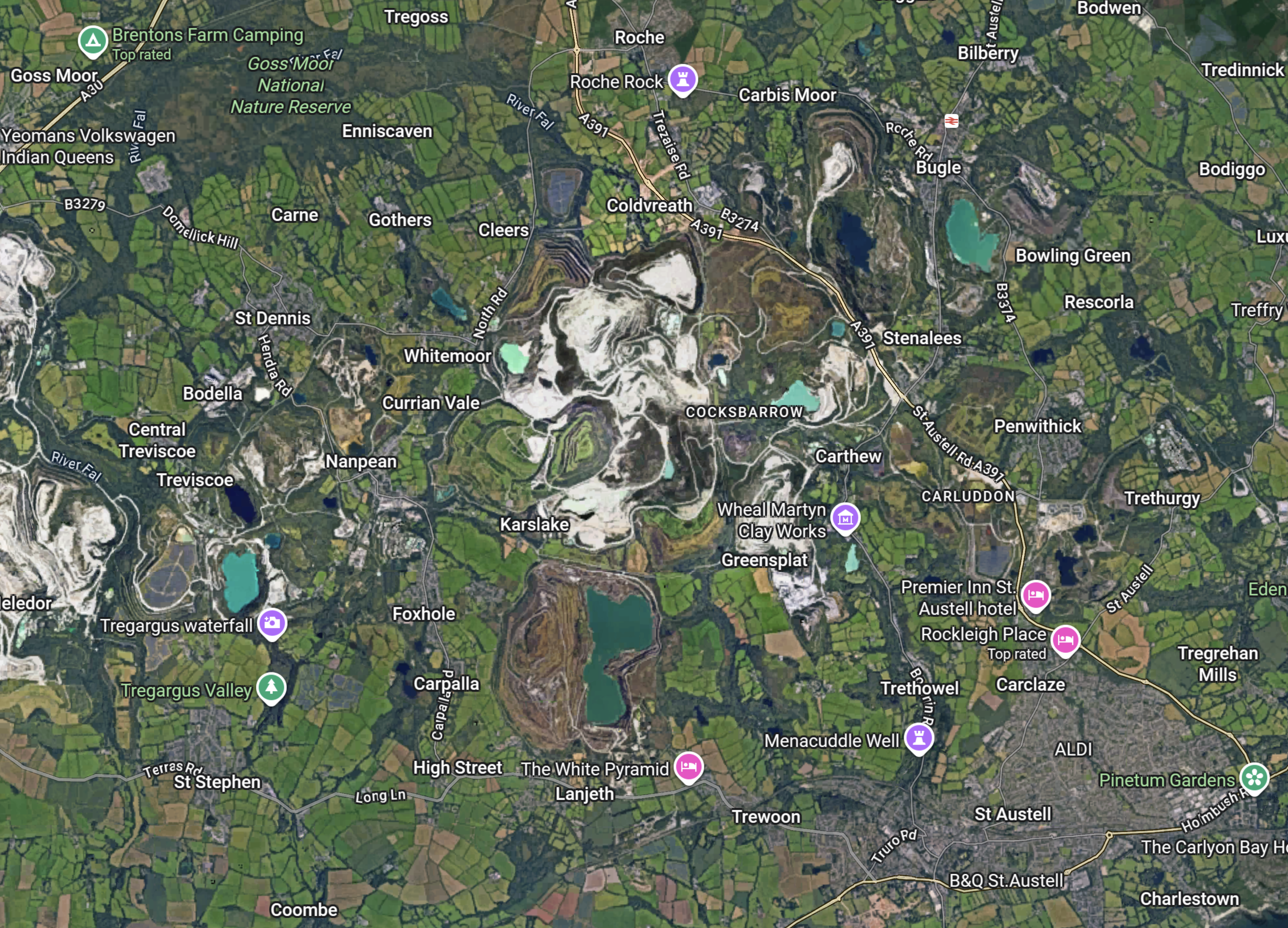
Note.
- St. Austell is in the South-East corner of the map.
- St. Dennis is in the North-West corner of the map.
- Trelavour appears to be just South of St. Dennis.
- In the middle of the map, are the china clay workings.
Although rail is mentioned, it looks like new tracks will have to be laid.
The Modern Railways article says this about using rail.
Should these plans come to fruition, it seems likely rail will play a part in the supply chain. It is not much of an exaggeration to suggest that Cornwall’s lithium deposits offer a generational opportunity for the Duchy, and by extension, for rail freight.
But, if I’m right about the daily amount being around 72 tonnes, then not many trains will be needed.
I have a few further thoughts.
How Much Will The Lithium Be Worth?
I asked Google AI, what is a tonne of lithium metal worth and got this answer.
A tonne of battery-grade lithium metal is worth approximately $77,962 to $80,398 USD, with an average of about $79,180 USD. The price fluctuates significantly based on market conditions, and the value can differ for industrial-grade lithium metal or other lithium compounds like carbonate or hydroxide.
Assuming a price of $80,000, then a day’s production is worth $5,760,000 and a year’s production is worth about $2 billion.
This could be a massive Magic Money Mine for Rachel from Accounts.
Will The Royal Albert Bridge Cope With The Extra Trains?
The Modern Railways article says this.
While there is excitement about the potential from Cornwall’s new and revived minerals industries, there are caveats. One is the train weight limit on the Royal Albert Bridge, Saltash.
Note.
- A five-car Class 802 train weighs 243 tonnes and I’ve seen pairs in Cornwall.
- Other trains may be heavier, but if the lithium refining is done in Cornwall, the lithium trains won’t be too heavy.
As lithium is the lightest metal, is it sensible to perform the processing and refining in Cornwall and leave the unwanted rocks in the Duchy?
The Complex Web At Sunderland
This article on the BBC is entitled Nissan Announces Major UK Electric Car Expansion.
This is the first few paragraphs.
Nissan has announced a major expansion of electric vehicle production at its car plant in Sunderland which will create 1,650 new jobs.
The Japanese carmaker will build its new-generation all-electric model at the site as part of a £1bn investment that will also support thousands of jobs in the supply chain.
And Nissan’s partner, Envision AESC, will build an electric battery plant.
I think there is more to this than meets the eye!
We wait several years for a battery gigafactory to come along and then two come along in a month or two; Blyth and Sunderland. On television today, a BBC reporter talked of eight possible battery gigafactories in the UK.
Lithium Supply
Where do they all think the lithium will come from, as some say there’s a world-wide shortage?
The only explanation, is that the UK government and the gigafactory owners have bought into a secure source of lithium, that is convenient for or easily transported to the North-East.
I am very suspicious that Cornish Lithium or British Lithium have found something bigger than anybody expected.
The numbers don’t add up otherwise!
Lithium Refining
On the other hand, it appears that lithium needs a lot of electricity to extract the metal from the ores, as electrolysis is used.
But with all the windpower being developed off the North-East Coast, there could be more than enough to refine the lithium.
Remember too, that lithium has applications in defence and aerospace applications, when alloyed with magnesium and aluminium.
So could a substantial lithium refining capability be built in the North-East?
The Chinese View
In The Times, Lei Zhang, who is chief executive of Envision also said he liked our masses of offshore wind power, so perhaps the Chinese want to produce green batteries in Sunderland after refining the lithium in the North-East?
Conclusion
We probably need battery-electric cars built from green steel, fitted with green batteries and charged with green electricity.
Is the Gigawatts of offshore wind electricity in the North-East luring the battery and car makes to the area.
Could we also see green steel manufacturing on Teesside?
Crown Estate’s Auction Of Seabed For Wind Farms Attracts Sky-High Bids
The title of this post, is the same as that of this article on The Times.
This is the opening paragraph.
An auction of seabed rights to build offshore wind farms around England and Wales has attracted frenzied bidding that could be worth hundreds of millions of pounds a year to the Treasury and the Queen.
I don’t find this surprising.
Bigger Seems Better Offshore
Wind turbine technology is getting better and much larger. It also seems that the new larger floating turbines are much more efficient and generate power for a greater proportion of the day.
- Hywind Scotland is the world’s first commercial wind farm using floating wind turbines.
- It is situated off Peterhead.
- It consists of five 6 MW turbines.
- Wikipedia says it has a capacity factor of over 50 %.
My project management software helped to harvest North Sea Oil and I have been told by many in the industry, that North Sea Oil really took off when platforms and the equipment like cranes used to build them got truly enormous.
I feel, we could be seeing the same size effect happening as we harvest the wind!
Hydrogen And Wind Power
The latest development is not to generate electricity, but to use it in the turbine to generate hydrogen, which is then piped to the shore.
- The UK Government is funding this technology in part with a grant to ITM Power.
- I wrote about the technology in ITM Power and Ørsted: Wind Turbine Electrolyser Integration.
- Existing gas networks can be reconfigured to bring the hydrogen to the shore.
- Piping hydrogen costs less than cabling electricity.
- Hydrogen networks are being built at several places in the UK, to fuel homes, power stations and industry like steel-making and petrochemicals.
Could all this explain Big Oil’s involvement?
Do they want to exchange fossil fuels for green hydrogen?
They certainly know how to distribute it.
Energy Storage
For my own investments, I’m looking at energy storage, where the UK has at least three promising new ideas, all of whom have had Government grants.
- Gravitricity
- Highview Power
- ReEnergise
The Government has also indirectly-backed Cornish Lithium
Faraday Battery Challenge Funded Project “Li4UK” Announces The First Domestic Production Of Lithium Carbonate From UK Sources
The title of this post, is the same as that of this press release from Li4UK.
This is the introductory paragraph.
Li4UK (Securing a Domestic Lithium Supply Chain for the UK), the Faraday Battery Challenge-funded project under the patronage of UKRI (UK Research and Innovation), is pleased to announce that the project Consortium, comprising Wardell Armstrong International Limited (WAI), The Natural History Museum (NHM) and Cornish Lithium Ltd (CLL), has successfully produced lithium carbonate from two UK sources – one from Cornish Lithium’s Trelavour project site in Cornwall and another from Scotland. High purity lithium carbonate is a raw material for lithium-ion battery cells, such as those used in electric vehicles.
When I first heard of this project, I wrote How To Go Mining In A Museum and felt that this project deserved to succeed, given the diligence of the founder.
You never know what you will find in the dusty vaults of a museum.
Ecotricity Seals 10-year Agreement To Take Geothermal Power From Cornish Plant
The title of this post, is the same as that of this article on Energy Live News.
This is the first two paragraphs
British utility Ecotricity has sealed a power purchase agreement (PPA) to buy geothermal electricity from Geothermal Engineering Limited.
The ten-year PPA will see a minimum of 3MWh of baseload electricity produced by the United Downs demonstration project in Cornwall being distributed to power the equivalent of 10,000 homes every year.
The article also says that this is the first time geothermal electricity has been produced and sold in the UK.
The remarkable thing, is that the same site will be used by Cornish Lithium for a pilot plant to extract lithium.
It does look like the Cornish will both have their cake and eat it!
As rum is also going to be matured using more of the energy, as I wrote about in And Now Geothermal Rum From Cornwall!, they’ll also be able to drink it as well!
Lithium Project Raises Millions In A Day
The title of this post, is the same as that of this article on Cornish Stuff.
This is the introductory paragraph.
Cornish Lithium raised over £3m yesterday to fund new exploration and today opens up the crowd fund to the community.
It does seem to have been a very successful funding.
This to me is a key paragraph.
The company say they are delighted to note that approximately 15% of the pre-registered investors were from Cornwall.
The Cornishmen and Cornishwomen seem to be backing their local business!
Alternative Funding Seems To Be Doing Well
I watch a couple of crowdfunding sites and they certainly seem to be still attracting funds.
I have recently invested a small sum in Cornish Lithium, as I like both the technology and history of the company.
Their round of crowdfunding is coming to an end, as they have raised £4.5 million against a target of £1.5 million.
It certainly appears that there is money for a good company in these troubled times.
Preliminary Sampling Indicate Significant Lithium Grades In Geothermal Waters At United Downs Project, Cornwall
The title of this post, is the same as that of this article on Think Geoenergy.
This is the introductory paragraph.
Cornish Lithium releases announcement on finding “globally significant” lithium grades in geothermal waters at the United Downs Deep Geothermal Power Project in Cornwall, UK and is now preparing for work on a pilot plant.
The article gives a full explanation.
There is more on this press release on the Cornish Lithium web site.
Government Funding For Lithium Recovery From Geothermal At United Downs Project
The title of this post, is the same as that of this article on Think Geoenergy.
This is the sub heading.
A demonstration project to produce Lithium from geothermal brines at the United Downs Deep Geothermal Project in Cornwall, UK has received government funding.
This is certainly, an idea to watch.
The company behind the project is Cornish Lithium, that I wrote about in How To Go Mining In A Museum.
 The Anonymous Widower