Will Crossrail Open To Reading in 2019?
The latest rather dodgy date for the opening of Crossrail’s Core Tunnel is Autumn 2019.
In the January 2019 Edition of Modern Railways, there is an article, which is entitled Crossrail Can’t Commit To Autumn Opening.
This a paragraph from the article.
TfL also says that it is exploring with DfT the possibility of beginning to operate Reading to Paddington services ahead of the completion of the Elizabeth Line to help provide a boost in revenue.
This is a very interesting possibility.
How Much Work Is Still To Be Done To The West of Hayes & Harlington?
This is the key factor as to whether Western Branch of Crossrail can be opened.
- The biggest problem is that Class 345 trains can’t run to Heathrow as there are signalling issues to eradicate.
- There are also several stations, that need to be completed.
There is no work-round to the first problem, but trains seem to be able to call at the unfinished stations.
It would appear, that for TfL’s proposal to be taken fully forward, the signalling issues to and from Heathrow, must be dealt with.
The stations can be finished later.
The Current Proposed Crossrail Service To Reading And Maidenhead
These are the proposed services shown on Wikipedia, so they could have been updated.
Reading To Paddington – Limited Stop
This service will be run at two trains per hour (tph) in the Peak with no trains in the Off-Peak.
Stops are Twyford, Maidenhead, Slough, West Drayton and Ealing Broadway.
Reading To Paddington – All Stations
This service will be run at two tph all day.
The service will call at all stations except Hanwell and Acton Main Line.
Maidenhead To Paddington
This service will be run at two tph all day.
The service will call at all stations except Hanwell and Acton Main Line.
A Summary Of Peak/Off Peak Calls
Adding these service up, gives the following numbers for Peak and Off Peak calls in trains per hour (tph)
- Reading – 4,2
- Twyford – 4,2
- Maidenhead – 6,4
- Taplow – 4.4
- Burnham 4,4
- Slough – 6,4
- Langley – 4,4
- Iver – 4,4
- West Drayton – 6,4
- Hayes & Harlington – 4.4
- Southall – 4,4
- Hanwell – None to Reading/Maidenhead
- West Ealing – 4.4
- Ealing Broadway – 6,4
- Acton Main Line – None to Reading/Maidenhead
- Paddington – 6,4
Note.
- 4,2 means 4 tph in the Peak and 2 tph in the Off Peak.
- It would appear that all stations except Reading and Twyford have at least four tph all day.
- Stations between Hayes & Harlington and Ealing Broadway will get another six tph all day going to Heathrow.
- Acton Main Line station will get another four tph all day going to Heathrow.
This gives the following frequencies.
- Reading – 4,2
- Twyford – 4,2
- Maidenhead – 6,4
- Taplow – 4.4
- Burnham 4,4
- Slough – 6,4
- Langley – 4,4
- Iver – 4,4
- West Drayton – 6,4
- Hayes & Harlington – 10,10
- Southall – 10,10
- Hanwell – 6,6
- West Ealing – 10,10
- Ealing Broadway – 12,10
- Acton Main Line – 4,4
- Paddington – 12,10
I can draw these conclusions from the figures.
- Every station has a good service from Crossrail.
- But could Reading and Twyford have another two tph in the Off-Peak to make the services four tph all day?
- Paddington station would need perhaps two or three platforms dedicated to Crossrail to handle twelve tph.
- The maximum frequency of 12 tph should be easily handled with conventional signalling and could be increased with modern digital signalling.
It looks like running the Western services of Crossrail from Paddington could be a possibility.
Consider.
- The Reading and Maidenhead services will be run on routes with mainly conventional signalling.
- The Class 345 trains, which each can hold 1,500 passengers would give a massive capacity boost to the outer Crossrail stations.
- Heathrow services can be run with Class 345 trains, when the signalling problems are solved.
- Higher frequencies to and from Paddington may enable trains to provide a better interchange with branch line services, at West Ealing, Slough, Maidenhead and Twyford.
But I think that separating these services initially from Crossrail will have substantial operational and development benefits.
- Paddington to Reading is essentially a self-contained railway, with a major branch to Heathrow and four small branch lines worked by diesel shuttle trains.
- The route, with the exception of the Heathrow branch, has conventional signalling.
- The signalling problems of the Heathrow branch can be solved independently.
- The Western branches of Crossrail could be fully debugged before trains start running through the Core Tunnel.
I also wonder, if the route could be useful for mileage accumulation, driver training and certification of newly-delivered trains.
Is It Just About The Money?
The original Modern Railways extract said that the proposal was to help provide TfL with extra revenue.
It must bring in revenue and especially when the Heathrow Branch is working reliably to plan.
Faster Journeys
Modern Class 345 trains have the following advantages over the current British Rail-era Class 156 trains.
- They are slightly faster.
- They have better acceleration.
- They are modern trains designed for short dwell times at stations.
It would be very likely, that journey times between Paddington and Reading, will improve..
Passenger Behaviour
But passengers may change their behaviour .
- Will passengers use Crossrail as a lower-cost alternative to Heathrow Express?
- Will passengers use Crossrail as a faster alternative to the Piccadilly Line?
- Will passengers, going between Heathrow and the West and Wales, use Crossrail to and from Reading, with a change at Hayes & Harlingon?
- Will passengers on branch lines find the extra capacity helpful, when travelling to London or Reading?
In addition, as I said earlier, I think opening Paddington to Reading early,, could make finishing the Crossrail project easier.
If nothing else, it shortens the to-do list!
GWR Might Object
Will GWR object to losing their local services between Reading and London to Crossrail?
Consider the following issues.
Heathrow Express
GWR have taken over the lucrative Heathrow Express.
- Heathrow Express will be run using 110 mph Class 387 trains in an Airport Express configuration.
- Will these trains be less of a block on the line, than the 100 mph Class 332 trains currently running the service?
- Currently both Class 332 and Class 800 trains take nine 9½ minutes to go between Paddington and Heathrow Airport Junction.
Perhaps GWR could squeeze in extra trains, by replacing the Class 332 trains with faster Class 387 trains?
The more trains they could squeeze into Paddington, the larger their revenue.
Reading, Bedwyn and Oxford Services
I am not sure, but it does appear that GWR services to places like Bedwyn and Oxford will in future be run using the new five-car Class 802 trains.
- The trains will surely use electric traction on the fast lines to Paddington.
- Will passengers going between Bedwyn/Oxford and stations between Reading and Paddington, be happy to change at Reading?
As it appears that Bedwyn/Oxford services might not need to use the slow lines, these will be used exclusively by Crossrail and the occasional freight.
Could Bedwyn And Oxford Services Be Combined?
There is also the possibility that to save paths on the fast lines between Reading and Paddington, that hourly Bedwyn and Oxford services could be combined and split at Reading.
- GWR already splits and joins Class 387 trains at Reading.
- Class 800/802 trains are designed to be split and joined quickly.
- Timings to the two destinations are about the same, being around 75 minutes.
Two five-car Class 802 trains with one running to Bedwyn and one to Oxford might be a good idea. Especially, as it saves one high-speed path between Paddington and Reading and possibly a few trains.
It does look, that Oxford and Bedwyn services could be moved out of the way of Crossrail services.
Will There Be Enough Class 800/802 Trains?
In Huge Increase In Capacity On GWR As Final Class 800 Enters Traffic, I wrote that there are now only fifteen trains of a total fleet of 93 trains to be delivered.
I suspect that GWR can find enough trains to run Bedwyn/Oxford services to London.
Too Many Class 387 Trains!
But it does strike me that GWR will have too many Class 387 trains, if Crossrail takes over local services to Reading and Class 802 trains take over services to Bedwyn and Oxford.
Twelve Class 387 trains are being converted to take over Heathrow Express services, but that still leaves GWR with 33 trains to find a use for.
It seems like Greater Anglia’s twenty Class 379 trains, they could become homeless orphans.
Will The Class 769 Trains Get In The Way?
Original plans talked about using 100 mph Class 769 trains to back up the Class 387 trains, whilst twelve of these were updated to Heathrow Express standard.
But it appears now from Wikipedia and other sources on the Internet, that these trains will concentrate on the following services.
- Reading To Gatwick Airport
- Reading to Oxford
I can’t find any reference of them continuing to serve Paddington, so it looks like they should keep out of the way.
Serving The Henley And Marlow Branches
Henley-on-THames station on the Henley Branch Line and Bourne End station on the Marlow Branch Line are having their Peak services to London gradually withdrawn.
If Crossrail took over services between Reading and Paddington, the frequencies in the Peak at the interchange stations would be.
- Maindenhead for the Marlow Branch Line – 6 tph,
- Twyford for the Henley Branch Line – 4 tph
Two tph at each interchange station run limited stop to and from Paddington.
The trains will each hold 1,500 passengers.
Could it be that GWR feel that the increased frequencies and reduced journey times to and from Paddington mean that there is a lesser need to run a direct diesel service.
But I could see the following.
- A four-car shuttle train, which could be a Class 769 bi-mode, at two tph on the Henley Branch Line.
- Two tph on the Marlow Branch Line.
At least GWR have the trains to provide a service to match customer demand.
I also wouldn’t be surprised to see a radical plan for these branches.
No Diesel Running Into Paddington
Every train run by GWR and Crossrail, between Paddington and Reading, would use electric traction.
- Now that large numbers of Class 800/802 trains have been delivered, it can’t be long before the last InterCity 125 runs into Paddington on a regular service.
- Class 165 and Class 166 diesel trains will be refurbished and sent to the West Country.
- Bedwyn and Oxford services will be run by Class 800/802 trains.
In addition all GWR trains running into Paddington will be 125 mph units running on electricity.
What is that worth as a marketing hook?
Conclusion
It looks to me, that running a full Western Branch service for Crossrail could be a good move.
So will it happen in 2019?
I think it all depends on solving the signalling issues on the Heathrow Branch!
But I feel, it should be possible, otherwise TfL wouldn’t have suggested it!
Could The Abbey Wood Branch Of Crossrail Be Opened In Phases?
When the Victoria Line opened in 1968, it opened in phases.
- Highbury & Islington and Walthamstow Central – September 1968
- Highbury & Islington and Warren Street – December 1968
- Warren Street and Victoria – March 1969
I wonder why parts of Crossrail, aren’t opening in a similar way?
Crossrail’s Original Plan
Stage 3 of the original plan, called for services to start between Abbey Wood and Paddington stations in December 2018.
This date has now slipped to Autumn 2019.
Reasons stated include.
- Signalling issues.
- Non-completion of the fit-out of stations.
I discuss the various issues as I see them in Thoughts On The Lateness Of Crossrail.
If you look at Stage 3, it is effectively running an independent new railway between Abbey Wood and Paddington stations with the following characteristics.
- Turnback facilities designed to handle twelve trains per hour (tph) at both ends.
- No sharing of tracks with other rail services.
- Comprehensive intermediate stations at Woolwich, Custom House, Canary Wharf, Whitechapel, Liverpool Street, Farringdon, Tottenham Court Road and Bond Street.
- One signalling system on the whole section.
It should also be noted, that on this section, trains can go straight through the important underground junction with the Shenfield branch at Stepney Green.
I would think, that the original plan was a sensible one. provided the following had been achieved.
- Completion of all stations on the route.
- A working signalling system.
- Turnback of trains at Abbey Wood and Paddington stations.
Have all of these objectives been achieved?
Whitechapel Station
In Thoughts On The Lateness Of Crossrail, I showed several pictures, that indicated that Whitechapel station was by no means finished.
Perhaps this is the main reason, as Whitechapel is on both the two Eastern branches.
Other Stations
Are they any nearer to completion than Whitechapel?
I was surprised this Autumn, during Open House, that a couple of stations were not opened up for members of the public to walk around.
Below surface stations like Woolwich and Canary Wharf and possibly some others, which will have platform-edge doors, would surely be safe to give interested parties a tour.
There doesn’t even appear to be a recent video in the stations from a respected organisation like the BBC.
I must therefore assume that the stations are not going well.
Turnbacks And Crossovers
Looking at the detailed maps of the Victoria Line on carto.metro.free.fr, there are the following turnbacks and crossovers.
- A double crossover at Walthamstow Central station, so that trains can go into either platform.
- Links at Finsbury Park station to the Piccadilly Line. Could Walthamstow to Piccadilly Circus been a non-realised objective?
- A simple crossover North of Highbury & Islington station.
- A turnback at Kings Cross St. Pancras station, so that trains can be turned back to the South.
- A simple crossover between Euston and Warren Street station.
- A simple crossover North of Victoria station.
- A turnback at Victoria station, so that trains can be turned back to the North.
- A double crossover at Brixton station, so that trains can go into either platform.
Crossrail has the following between Abbey Wood and Paddington stations.
- A double crossover at Abbey Wood station, so that trains can go into either platform.
- Crossovers either side of Custom House station.
- A simple crossover West of Whitechapel station.
- A simple crossover between Farringdon and Tottenham Court Road stations.
Note that is no crossovers to the Eastern side of Paddington station.
Overall, Crossrail would appear to have a much simpler track layout.
Trains could probably be turned back at Custom House, Whitechapel, Farringdon or Tottenham Court Road stations.
But there is no complete turnback on the line in Central London, as there is no most of London’s Underground lines.
Turnback At Paddington
I wrote Are Crossrail’s Turnback Sidings At Westbourne Park Without Electrification? to try to answer the question in the title.
I decided they were electrified, but I also finished the post like this.
It looked to me, that there was still some work to do.
If Crossrail were to open in early December, then it looks that it could be impossible.
So were these works at Westbourne Park, the reason for the postponement?
It certainly seems that trains will not be able to turn back at Paddington at the frequency required to open the Central Tunnel.
But then they will have at least a year to complete the Paddington turnback.
Turning Trains At Whitechapel
Trackwise, this is surely possible, as there is a cross-over to the West of the station.
There are reasons why this might not be done.
The station is reportedly, a long way from completion.
Would it be worthwhile opening to serve just Abbey Wood, Woolwich, Custon House, Canary Wharf and Whitechapel?
But it would create a link between East and South-East London.
The frequency would probably be low, but a train every ten minutes should be possible.
Surely, this could be used initially for driver training and train testing, but as soon as all stations on the route were completed and all staff trained and trains certified, I can’t see any reason, why the service couldn’t be opened to passengers.
Turning Trains At Tottenham Court Road Or Farringdon
The track layout at Tottenham Court Road has a crossover to the East of the station and I would expect that a limited number of trains could be turned at Tottenham Court Road.
Turning back at Farringdon using the same crossover may be a better possibility.
- A service running every ten minutes could be possible.
- It would connect Canary Wharf to Liverpool Street and Thameslink.
If necessary, Whitechapel station could be skipped, as the sub-surface lines should be able to cope.
Conclusion
I am led to the possibility, that there is a slight chance, that portions of Abbey Wood branch of Crossrail could be opened before the predicted dates of the pessimists.
Crossrail’s Latest Issues Begs The Question, How Do We Judge Success In Transport Megaprojects?
The title of this post is the same as this article on Forbes.
The article makes some interesting points about transport megaprojects. It is definitely a must-read.
As an example of a megaproject that went wrong, it cites the Channel Tunnel, which exceeded its budget by 80%, required refinancing and then Eurostar only carried a third of forecast traffic.
This article on the BBC, which is entitled How Eurotunnel Went So Wrong, gives the full story of the Channel Tunnel finances.
So should it now be closed? Obviously not, as the alternatives of driving and flying would create a lot more unwanted carbon dioxide and would need more motorways and airports.
The benefits of building Crossrail, such as increasing the capacity of London’s transport system, reducing congestion in Central London and giving better access to Canary Wharf, East London, Heathrow, The City and West London will just come in a year or so later.
The article also says that according to Oxford professor; Bent Flyvbjerg, Crossrail is suffering a 7% cost overrun, where the average for rail projects is 45%.
In my view Crossrail has suffered from a number of problems that together have caused the cost and time overruns.
- Not enough time was built into the schedule to test the sophisticated trains with their three signalling systems.
- No dedicated Crossrail test track was created, so the trains could be fully tested.
- An unfortunate transformer explosion, was a big cause of delay in testing systems.
- There were not enough workers to finish the project.
- Central London is awash with large projects, some of which became viable because of Crossrail, that are sucking up masses of workers.
- Brexit uncertainty has meant that a lot of EU workers have gone back to Europe to build projects nearer their homes.
Where was the European project supremo, who added up all the needs of these European megaprojects, to make sure, we had enough resources to build all of them on time?
The Design And Development Of Crossrail’s Unique Luminaires
The title of this post is the same as that of this article on Global Railway Review.
It is a very informative article and the lights look well-designed.
The lights were developed by a company called Future Designs.
The Bank Station Upgrade And The Western Extension Of The DLR
This map from Transport for London (TfL), shows the possible Western extension of the Docklands Light Railway (DLR).
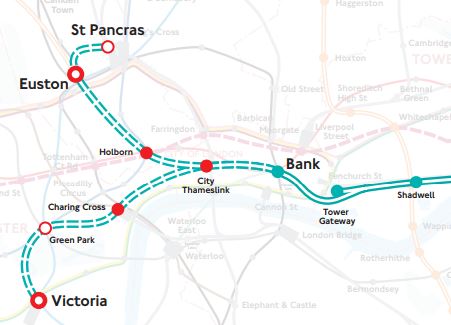
With all the problems of the funding of Crossrail 2, that I wrote about in Crossrail 2 Review Prompts Fresh Delays, could this extension of the DLR, be a good idea?
If you look at the Bank Station Upgrade in detail, the DLR gets a much needed boost in the upgrade.
The two DLR platforms underneath the Northern Line get a triple-escalator connection to the Northern Line level, from where they have the following.
- Level access to the Northern Line.
- Escalator access to the Cannon Street entrance.
- Travelator/escalator access to the Central Line.
- Access to the current escalators and lifts to the various entrances around Bank Junction.
There will also be lifts everywhere.
According to Services in the Wikipedia entry for the DLR, the following services turn at Bank station.
- 22.5 trains per hour (tph) in the Peak.
- 18 tph in the Off Peak.
So the turnback is handling a train around every three minutes.
I have no idea, what is the maximum frequency of the DLR, but as it is an automated system, with new trains to be delivered in the next few years, I suspect the frequency will be pushed higher in the future.
The Bank Station Upgrade has been designed to handle more passengers using the DLR, so there should be no problem about handling more passengers in the two platforms deep in Bank station.
The limiting factor would more likely be in the turnback.
This map from carto.metro.free.fr, shows the DLR lines at Bank station.
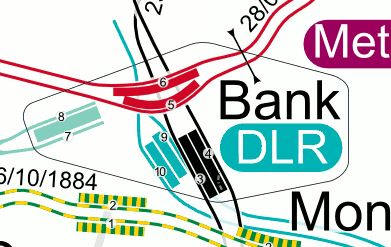
Note the turnback for the DLR, under the Central Line platforms 5/6, running alongside the Northern Line.
- Trains stop in the arrivals platform 10 at Bank station and unload all passengers.
- They then move to the turnback and the automation then switches to the other end.
- They then move to the departures platform 9 to pick up passengers.
It is an inefficient way to turn trains. A through station at Bank would have a much greater capacity.
If you look at the map of the proposed Western extension, it has two branches which join and split at City Thameslink station.
- Charing Cross, Green Park and Victoria.
- Holborn, Euston and St. Pancras
It should be noted that the two-platform terminal station at Lewisham currently handles upwards of 20 tph in the Peak.
This would mean that if both Western branches had a two-platform terminus, then there could be a theoretical total of forty tph through Bank station.
If Dear Old Vicky can manage thirty-six tph with ten year-old-trains and less automation, I wouldn’t be surprised to see the DLR manage the magic forty tph, with twenty tph on each branch.
Obviously, though there would be other considerations and capacity limits, but I can see a big increase in the numbers of passengers using the DLR.
I would expect that the improvement to the DLR access being added in the Bank Station Upgrade must have been designed to handle the highest number of DLR trains and passengers that anybody can practically envisage.
It should also be noted that the DLR station is below the Northern Line and the turnback siding, which is shown in the map of the lines, will be well out of the way of the new Northern Line and travelator tunnels.
The map of the Western DLR Western Extension, also shows the extension going West away from the Northern Line tunnels. This would mean it would comfortably pass underneath the new Southbound Northern Line tunnel.
It therefor looks to me, that the Bank Station Upgrade is very much preparing Bank station for the DLR Western Extension to be built.
So will the DLR Western Extension be constructed?
Why Is It Needed?
Various reasons Have been given.
Better Connection To The Docklands Light Railway for Commuters From The South
The DLR Western Extension will connect to commuter routes at the following stations.
- Charing Cross
- City Thameslink
- Victoria
This should help commuters get to the City and the business areas of East London.
Another Direct Connection Between East London And West Central London
It will also help travellers get betweenEast London and West Cerntral London without changing or using the overcrowded Victoria Line.
A few points.
- c2c commuters would also be able to change at Limehouse station to trains going further than Bank station.
- It would help me get to places South of Crossrail and Victoria becomes much easier.
- Access to Thameslink from the East will be improved, if you’re not near a Crossrail station.
- New housing in the East will get the transport links it needs.
East London has a great need for the DLR Western Extension.
Increase The Number Of Trains Serving Bank Station
The Mayor wants to extend the DLR to Abbey Wood and Thamesmead in the South East.
This will mean that extra capacity is needed in the West to turn the trains.
The DLR Western Extension and the Bank Station Upgrade seems a pretty good way to obtain this much-needed capacity.
The People Mover Between High Speed One, High Speed Two, West Coast Main Line And The East Coast Main Line
Proposals exist for a high capacity people mover between High Speed One at St. Pancras and High Speed Two at Euston.
The DLR Western Extension will accept this challenge and do it superbly and could even have connections to the East Coast Main Line.
Take The Pressure Off The Northern Line
Consider.
- The Northern Line connects Euston and Bank stations via Kings Cross St. Pancras.
- The Northern Line is supposed to take ten minutes.
- The route is overcrowded and it is impossible to get a seat, for most of the day.
- When High Speed Two opens in 2026, more travellers will want to travel to and from the City.
The DLR Western Extension could give as many as twenty tph on the following route.
- St. Pancras
- Euston
- Holborn
- City Thameslink
- Bank
With the new DLR trains and the full automation of the DLR, the route will certainly outperform the Northern Line and possibly a black cab, driven by Lewis Hamilton.
Improve Capacity Between Victoria And The City
Just as the DLR Western Extension will improve the route between Euston and the City of London, the other branch will improve the route between Victoria and the City
I’ve taken a District Line train from .Whitechapel to Victoria station and there are better ways to enjoy yourself.
It’s The Poor People’s Crossrail 2
Crossrail 2 with its mega station at Euston/Kings Cross/St. Pancras will give North-East London much better access to National Rail services going North.
To get to any of these stations now, I have to take a bus to either Angel or Moorgate stations and then get a tube.
I used to be able to get a bus to Highbury & Islington station, but the Mayor from South London has halved the service, so I don’t bother to wait fifteen minutes for a bus and go via Angel.
If the DLR Western Extension were to be opened, I’d get an Overground train to Shadwell station and change to the required route.
Agility – The DLR Advantage
I must say something about the big advantage of the DLR.
The trains have the ability to twist, turn and climb gradients, that a conventional train would find impossible.
This means that the tracks can be threaded through places, where heavy rail just can’t go!
Tunnels
The DLR tunnels and platforms at Bank station are the deepest in London. This article in the Telegraph says this about the deepest station in Central London.
It is the DLR concourse at Bank, which is 41.4 metres below.
Crossrail’s depth by comparison is described in this page on the Crossrail web site like this.
A network of new rail tunnels have been built by eight giant tunnel boring machines, to carry Crossrail’s trains eastbound and westbound. Each tunnel is 21 kilometres/13 miles long, 6.2 metres in diameter and up to 40 metres below ground.
The DLR Western Extension tunnels would cross Crossrail close to Holborn station, so they would probably need to go below Crossrail at this point.
Designing the route of the tunnels is probably the easy part, as construction will be much harder and will take a lot of planning.
Consider, the places for construction sites, where a tunnel boring machine (TBM) could be inserted or the spoil could be taken out.
- Bank, St. Pancras and Victoria stations are very crowded places, with most of the land already built on.
- There are the Royal Parks and London’s leafy squares, on the route.
- This article on IanVisits describes the railway sidings under Smithfield Meat Market, which could be somewhere to start digging. Could spoil be taken out at night by train on Thameslink?
- As Holborn station is getting a second entrance, this could also be a key site in the construction of the tunnels.
The tunnellers might use the techniques employed in the Bank Station Upgrade, where the tunnel was dug without a TBM and spoil was taken out by truck. But the tunnels for the DLR Western Extension will be much larger.
Stations
It is worth looking at the stations on the route.
Charing Cross
Charing Cross station has been rebuilt in recent decades and still has the two former Jubilee Line platforms in working order, that might be able to be reused.
This map from carto.metro.free.fr shows the lines around Charing Cross station.
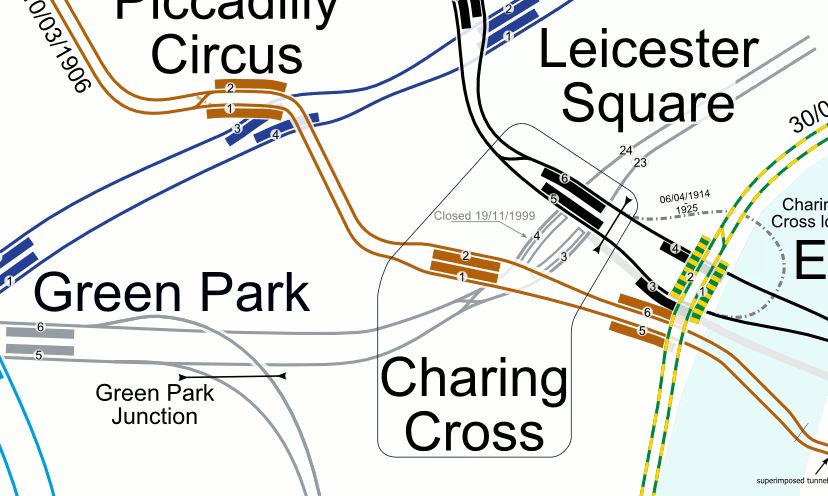
Note.
- The old Jubilee Line tunnels go through the platforms.
- They are long enough to hold two trains.
- The tunnels would have to be enlarged to fit the larger DLR trains.
As these platforms and tunnels were built to be extended on a route not unlike that of the DLR extension, I suspect TfL have ideas about how this station could be rebuilt to be part of the Western DLR extension.
City Thameslink
– City Thameslink station is a reasonably-modern, one-line double-ended step-free station.
The DLR Extension would cross the station at right-angles, deep below Thameslink.
Euston
Euston station is being rebuilt for HS2 and the Underground station will be extensively improved.
I would be very surprised, if the new station, has been designed without a feasible place for DLR platforms to be added.
Green Park
Green Park station has been updated several times and I suspect that TfL have ideas about how the station could be served by the extension.
Holborn
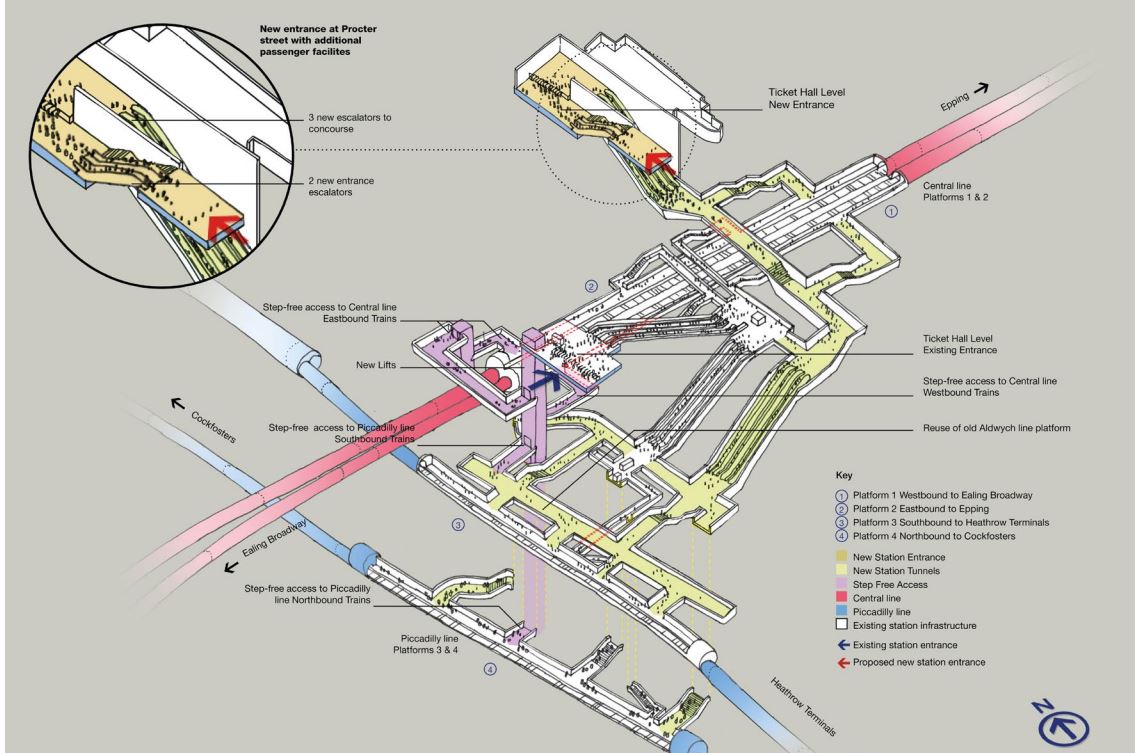
Holborn station is being extended with a new entrance. As with Euston, I suspect it has been designed with a feasible place for DLR platforms to be added.
This document on the TfL web site, gives more details of what is proposed at Holborn station.
I extracted this visualisation of the proposed station.
This map from carto.metro.free.fr shows the lines in the through and around the station.
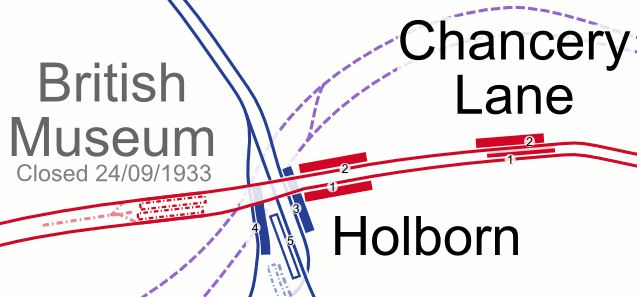
.Note, Crossrail, which is shown by dotted lines passes to the North of the station.
This diagram from Crossrail shows a depth profile of the tunnels between Farringdon and Bond Street stations.
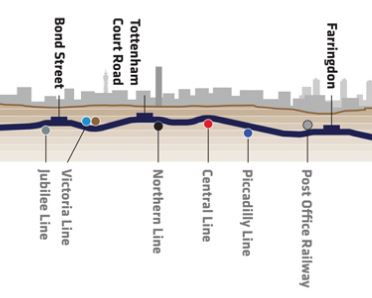
Note.
- The blue dot indicating the Piccadilly Line.
- The red dot indicating the Central Line
These two lines are close to Holborn station.
I would feel that the DLR Western Extension could be accommodated in the lower level of the updated station. If required, it could use the DLR’s agility to use a route, no normal railway could.
St. Pancras
St. Pancras station is virtually a new station, so at least, the surveys and drawings are up-to-date. This might make designing two platforms below the current complex a bit easier.
Although, actually building them might be more difficult.
Victoria
The Underground station has been substantially remodelled and rebuilding of the National Rail station is in the pipeline.
Plans are also being drawn up, as to how this station will connect to Crossrail 2.
Hopefully, they’ve taken the DLR Extension into account.
Should There Be Any Other Stations?
The DLR Western Extension must be built, so that if required, the two new branches can be extended.
Extending From St. Pancras
One article, I’ve read, says that this branch should be extended to Camden Town.
In Maiden Lane And York Road Stations, I suggested that it should be extended to these two former stations. I said this.
But why stop at S. Pancras? The DLR could be extended under Kings Cross station, stopping where required to finish at York Road station.
- Only the building would be used.
- There would be no connection to the Piccadilly Line.
- The Docklands Light Railway tunnels would be several metres down to travel under buildings and the stations.
- An underground passage could be built to a reopened Maiden Lane station.
A worthwhile use would have been found for an iconic building and Kings Cross Central would have much better public transport connections.
Given that over the next few years, there will be a large increase in capacity on the North London Line through Maiden Lane station, this could be a very important extension.
Extending further in the future from York Road would be enabled. Next stop Finsbury Park?
Or would it be better to create a connection to the Piccadilly Line at the combined York Road/Maiden Lane station complex?
Extending From Victoria
Obviously, if the Victoria Branch could be extended to Waterloo, this would be an ideal solution.
I would look at the possibility of having a very easy interchange between the Victoria Line and the DLR at Victoria.
Cross-platform interchange would probably be difficult, but if the DLR platforms were under those of the Victoria Line, I would feel a fast step-free interchange could be designed.
This would effectively mean that the Victoria Line would be a virtual extension to the Victoria Branch of the DLR Western Extension.
A Connection To Crossrail
Surely, the DLR Western Extension should connect to Crossrail. Especially, as it connects to Thameslink!
Conclusion
Build the DLR Western Extension!
Why?
- It will add capacity between Euston and the City.
- It will add capacity between Victoria and the City
- It will unlock capacity at Bank and allow more services to the East.
It is the poor people’s Crossrail 2
It won’t be built though!
- East London isn’t a priority and it’s where the scum and great unwashed live.
- It doesn’t do much for South and West London, where important people live.
- The North of England will object, as it’s another London project!
But I’m hoping that it will be built, as it will transform the lives of many who live in the East and/or rely on the DLR.
In 2010, I wrote Cinderella Will Take You to the Ball!, where I was looking forward to the Olympics.
After the Olympics, I was told by a Senior Manager of the DLR, whilst riding on a DLR train, that the system had performed magnificently at the Games and carried more passengers than everybody expected it would!
There certainly weren’t any complaints.
But I did find this article on Rail Magazine, which is entitled The Secret Of Serco’s Success.
This is the first two paragraphs.
In January 2013 Serco was awarded an 18-month contract extension to operate the Docklands Light Railway, one of the most reliable train services in the UK.
This extension (to September 2014) to the original seven-year franchise rewarded a remarkable performance in 2012, a performance that was also a principal reason for National Rail Awards judges awarding Serco Docklands the City & Metro Operator of the Year accolade.
So they got a Gold Medal too!
This is said about their performance during the year.
Almost 12 million passengers were carried during the entire Games period, and during the busiest times, passenger numbers reached more than double the normal level. Numbers peaked at around 500,000 passengers in a single day, over 125,000 more than DLR’s previous record. And yet, despite all that extra pressure, 2012 was DLR’s most reliable year ever.
Sexy the DLR is not, but like the character I name her after, this light railway, works incredibly hard and to a high standard!
It is a true heavyweight amongst urban transport systems.
Perhaps we should abandon Crossrail 2 and just extend the Docklands Light Railway?
Has The Possibility Been Created For A Pedestrian Tunnel Between Bank And Moorgate Stations?
This visualisation shows the Bank Station Upgrade at Bank station, which is now underway to sort out the station’s problems of capacity and poor step-free access.
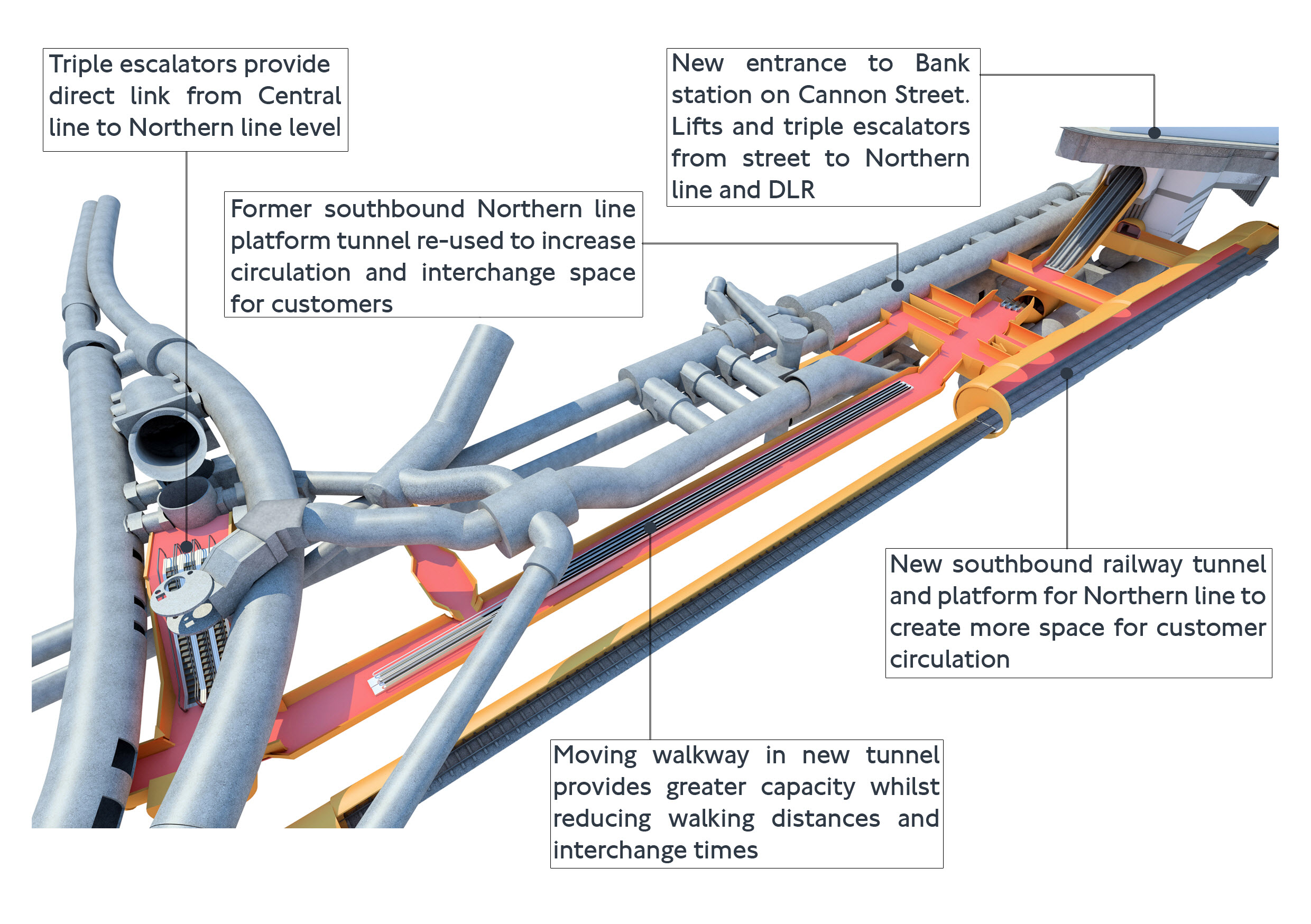
This is the bottom-left corner of the visualisation.
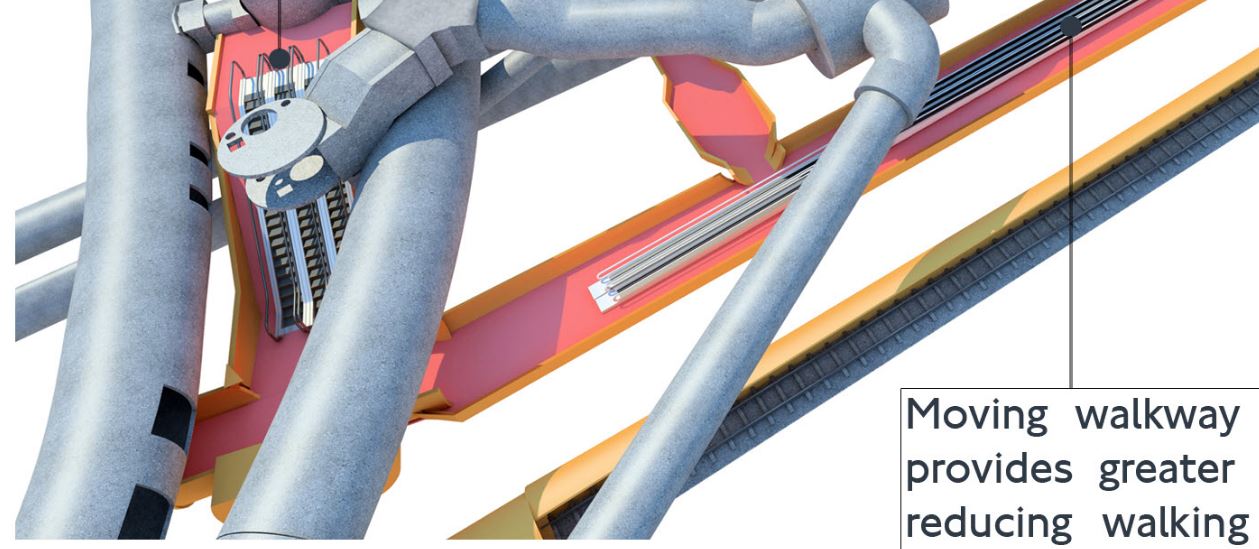
Notice that there are two fat tunnels running top to Bottom across the visualisation, which are the Central Line tunnels, with the Eastbound on the left and the Westbound on the right.
There are also four tunnels running left to right across the visualisation.
The top two, which are sticking out to the left of the Eastbound Central Line tunnel, are the current Northern Line running tunnels
- The top one is the Northbound tunnel going to Moorgate station.
- The other one is the current Southbound tunnel, which under the plans for Bank station will be closed to trains and used to improve passenger access to the Northbound platform. If you go to the Northern Line platforms, there are tell-tale blue hoardings, indicating where better access will be created.
These pictures show the current state of the current Southbound tunnel.
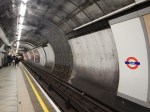
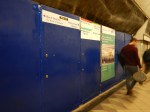
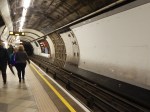

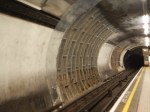
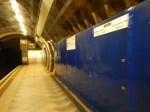
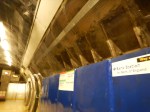
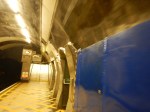
It looks like at least three sections of the wall between the two platforms will be removed.
The third tunnel, which is shown pink in the visualisations is the connecting tunnel between the Central Line and the new entrance to the station on Cannon Street.
Note the following.
- It has a travelator.
- it connects to a lobby, where there are triple escalators to the Central Line.
- It appears to come to a stop under the Eastbound Central Line platform.
What lies at the Northern end of this tunnel?
The fourth tunnel, which is the new Southbound running tunnel for the Northern Line, has been helpfully drawn with a rail track inside.
This is the top-right corner of the visualisation.
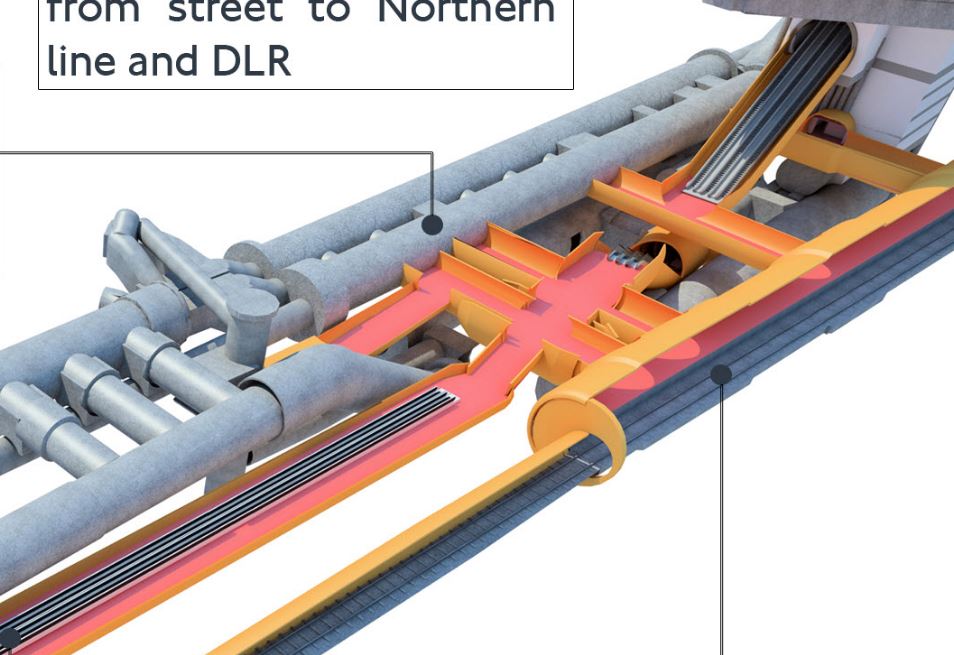
Note.
- There are three cross passages between the two running tunnels, just as there appears to be three blue hoardings in the existing Southbound running tunnel.
- The Northbound running tunnel now has a wide platform, which has been built inside the existing Southbound tunnel.
- The new Southbound running tunnel will be built with a wide platform.
- There are three escalators leading to the new Cannon Street entrance.
- There are three escalators leading down to the Docklands Light Railway (DLR) platforms
This map from carto.metro.free.fr, shows the layout of lines at Bank station and between Bank and Moorgate stations.
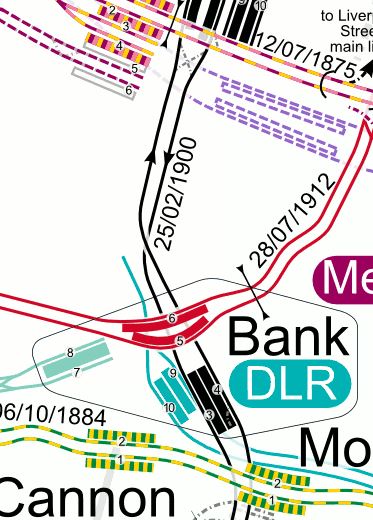
Note.
- The Central Line is shown in red.
- The Northern Line is shown in black.
- The DLR is shown in turquoise.
- The two Northern Line tracks cross to the North of Bank station.
- The lines at Moorgate station are shown at the top of the map.
- Crossrail is shown in violet.
The new Southbound tunnel will be created to the West of the DLR platforms.
This article on IanVisits is entitled Behind The Scenes At London Underground’s Bank Tube Station upgrade.
I suggest you read the article and I feel, you will get the impression the Bank Station Upgrade is a very difficult project, that is being achieved in an innovative manner by the contractors.
In one section, the article describes how they are actually building the new Southbound tunnel, through the piled foundations of existing buildings.
A Travelator Between Bank and Moorgate Stations
I now feel I can answer the question in the title of this post.
The Route
If the route started at the Northern end of the long connection tunnel with the travelator at Bank station, a route could probably be found on the West side of the Northern Line to break-in to the basement of the Crossrail station at Moorgate station.
This image shows a cross-section through the Moorgate Crossrail station.
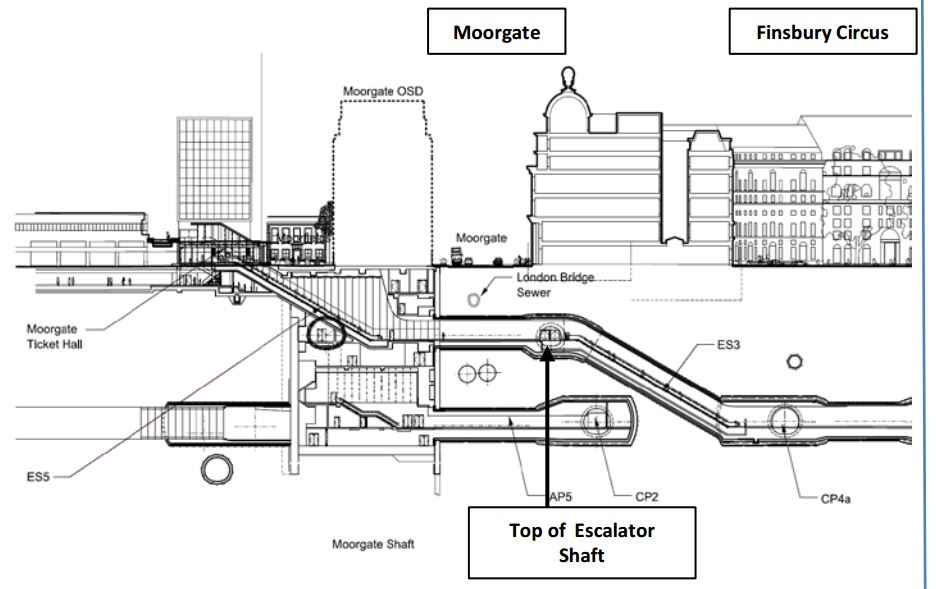
Note that under the escalators leading down from the Moorgate Ticket Hall to Crossrail, are a pair of circles.
- These are the Northern Line running tunnels.
- A travelator tunnel would be at this level but perhaps twenty or more metres to the West (left in the cross-section).
With modern design and construction techniques, I would expect that a connection could be made.
The Length
I estimate that the travelator would be between three and four hundred metres long.
As there are longer travelators either built or in planning in the world, I suspect, the length wouldn’t be a problem.
By comparison, these are example travelators in London.
- Jubilee to Northern/Bakerloo Lines at Waterloo – 140 metres.
- Sloping travelators to Waterloo and City Line at Bank – 76 metres
- Proposed Central to Northern Lines at Bank – 94 metres
A travelator between Bank and Moorgate stations would probably be, the longest in London.
Building The Tunnel
If you read the IanVisits article, it details how the new Northern Line and travelator tunnels at Bank station were excavated.
I suspect similar techniques could be used to build the new tunnel.
The biggest problem would be removing the tunnel spoil and I suspect that if the tunnel were to be built, when a building on the route needed to be replaced, this would make construction a lot easier.
Why The Tunnel Should Be Built
The main argument for building the tunnel is that it would connect Bank station directly to Crossrail.
Why The Tunnel May Not Be Needed
There are various reasons, why the travelator may not be needed.
Pedestrianisation
The City of London is in favour of pedestrianisation and has already disclosed plans to make Bishopsgate, which is one of the most important North-South arteries through the Square Mile, much more pedestrian friendly.
I would expect more initiatives like this to follow.
So many travellers will use their feet on the surface, between Crossrail and Bank, when the two stations are completed.
Improved Northern Line Connections
The connections to the Northern Line will be improved at both Moorgate and Bank stations, when Crossrail and the Bank Station Upgrade are completed.
So those travellers needing or wishing to do a one-stop transfer, will find it easy.
Connectivity between Crossrail And The Central Line
Crossrail and the Central Line have good connectivity.
- Stratford – A cross-platform interchange.
- Liverpool Street – A step-free connection
- Tottenham Court Road – A step-free connection
- Bond Street – A step-free connection
- Ealing Broadway – A step-free connection.
If travellers need Bank and they are coming from either direction on Crossrail, they can change at a convenient station.
Given that Bank station will have a large number of step-free entrances after the Bank Station Upgrade is completed, I suspect many Crossrail passengers will transfer to the Central Line to avoid the walk from Moorgate or Liverpool Street stations.
Conclusion
It may be feasible to build a trevelator between Bank and Moorgate stations, but developments already in hand, may give the project a very bad financial case.
Big Names Chase £50m Crossrail Office Job At Bond Street
The title of this post is the same as that of this article on Building.
This is the first two paragraphs.
Scheme is one of a dozen planned for central London link of rail route
Three firms are in the race to build a new £50m office block above the Crossrail station at Bond Street.
It just shows how much is being pumped into London to develop office and housing complexes.
Crossrail – Northern – Northern City Interchange At Moorgate Station
In New Bank Tube Station Entrance In Final Stages Ahead Of Opening, Mrlvyn said this in a comment.
I visited Moorgate Station recently and noticed the new lift of the Northern Line behind the hoarding. I then used escalator to go up to the Northern City Line which is directly above the Northern Line but there is no sign of work for the lift to stop at this level !
I have discovered from another site that Line will not be going step free due to arguments between DFT and TFL when Boris Johnson was Mayor and who should fund a hole in the wall for lift to stop!
Plus ca change! My company provided the planning computer and software for the Jubilee Line Extension. We heard stories of bad planning all the time and it certainly wasn’t a happy project.
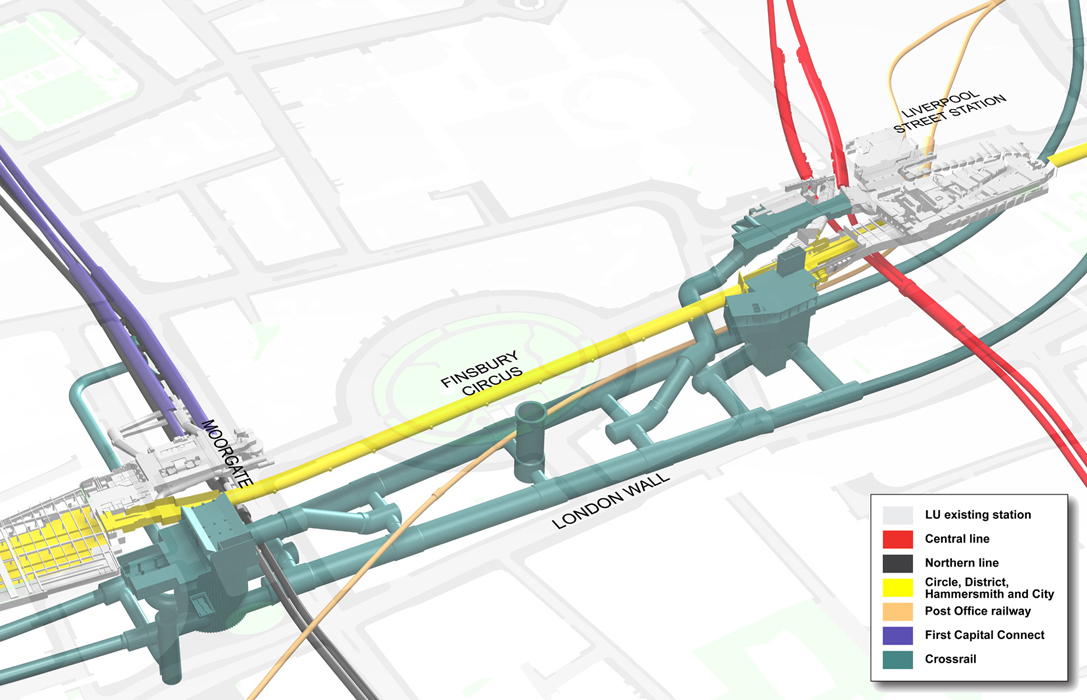
But look at this image, I’ve clipped from this large visualisation of the massive Liverpool Street-Moorgate Crossrail Station.
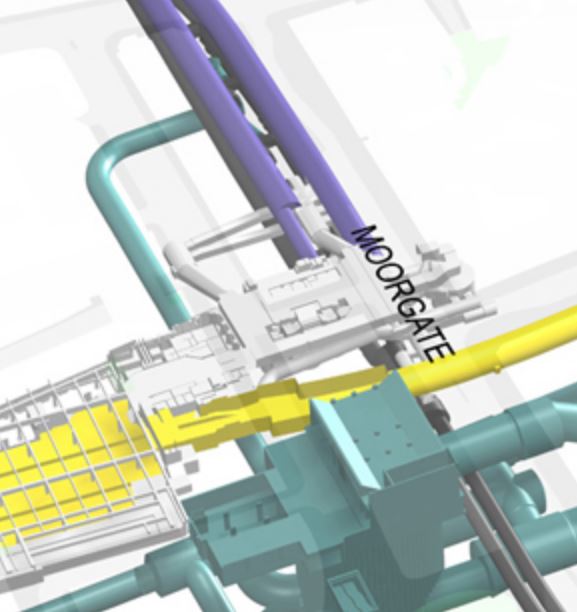
The image shows the Northern City Line coming into Moorgate station.
Colours are as follows.
- Blue – Northern City Line
- Yellow – Circle and Hammersmith & City Lines
- Black – Northern
- Turquoise – Crossrail
Details to note.
Existing Northern City Escalators
The escalator shaft to the existing ticket hall is shown in white by the letter M of Moorgate.
Existing Northern Line Escalators
The double tunnels from the stairs leading to the platforms to the escalators are shown in white underneath the Northern City Line.
The escalators to the existing ticket hall are clearly shown.
Circle And Hammersmith & City Lines
When Crossrail opens, passengers would seem to still do, as they do now to interchange between Norther/Northern City and the Sub-Surface Lines.
The only problem now, is if you need a lift, there is none to the deep lines or in the subway under the Sub-Surface Lines.
I am sure that the Crossrail reconstruction will address these problems.
The New Crossrail Station
The big turquoise block is the new Crossrail station and Ticket Hall.
This image shows a cross-section through it.
It will be two escalators down from street level to Crossrail. But then rhen Crossrail is deep.
A New Tunnel
In the visualisation, there is a new tunnel from around the centre of the Northern and Northern City Lines to the new Crossrail station.
I am not sure of where it joins the new construction over Crossrail, but assuming that the visualisation is to scale, the tunnel is larger than a typical Underground tunnel.
This size will mean that it will attract a lot of passengers.
At the Crossrail end, if would probably connect by a level route to an interchange floor, where the following would be possible.
- Take an escalator or lift to and from Crossrail.
- Take a level connection to the Westbound platforms of the Sub-Surface Lines.
- Take an escalator or lift to street level.
I suspect that would handle all connections except for step-free access to the Eastbound Sub-Surface Lines.
At the other end of this tunnel, it would need to have large capacity and step-free access to the Northern and Northern City Lines.
Conclusion
It looks like the Northern and Northern City Lines are being given a second route to both the surface and other lines through Moorgate.
I shall go and have a look this morning.
I took these pictures.



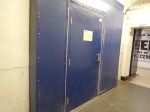
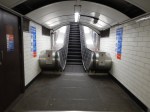
A few observations.
- The two escalators connecting the Northern and the Northern City Lines are in good condition with refurbished walls and tiling.
- There are no tell-tale blue walls on the platforms for the Northern City Line, which still retains its Network South East livery.
- There are two blue walls on the opposite side of the cross passages to both escalators on the Northern Line platforms
- The blue wall, facing the up connecting escalator is wider than that facing the down escalator.
- There doesn’t seem to be any works for a lift to take passengers to and from the existing tickey hall.
It looks like it will be a tight squeeze fitting in all the access stairs, escalators and lifts between the Northern Line platforms and the new tunnel, that is shown connecting the Northern Line platforms to Crossrail.
I come to one or more of these conclusions.
- There will be other passages dug in the future.
- Passengers will continue to use the existing escalators.
- I’m missing something obvious.
As Moorgate station is one of the busiest and will get even more so, there must be a sensible plan.
The only thing I can find on the internet is this page on the Acanthus Architects web site.
Cross-Platform Interchange Between Crossrail And Central Line At Stratford
Crossrail and the Central Line have a cross-platform interchange at Stratford.
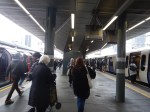
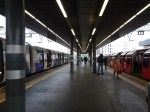
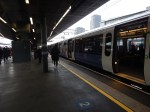

I turned up today, with trains in both platforms.
There needs to be more interchanges like this between different lines, around the UK.
I can’t think of many.
- Acton Town – District and Piccadilly Lines
- Barons Court – District and Piccadilly Lines
- Euston – Northern and Victoria
- Finchley Road – Metropolitan and Jubilee Lines
- Finsbury Park – Victoria and Piccadilly Lines
- Hammersmith – District and Piccadilly Lines
- Highbury & Islington – Northern City and Victoria Lines.
- Mile End – Central and Hammersmith & City Lines
- Oxford Circus – Victoria and Bakerloo Lines
- Ravenscourt Park – District and Piccadilly Lines
- Stockwell – Victoria and Northern Lines
- Turnham Green – District and Piccadilly Lines
- Wembley Park – Metropolitan and Jubilee Lines.
I don’t know of one outside the London area.
London City Airport Appoints Former Crossrail Boss Rob Holden As New Chairman
The title of this post is the same as that of this article on City AM.
If this doesn’t get the extra station on Crossrail at Silvertown, that London City Airport needs and wants, then nothing will.
 The Anonymous Widower