New Station Openings In Early 2026
This post is for two reasons.
I needed an answer to my query.
I wanted to explore the competence of Google AI.
When I typed the title of this post into Google AI, I received this answer.
Several new railway stations in the UK are scheduled to open or begin passenger services in early 2026, primarily in the West Midlands, Northumberland, Devon, and Cambridgeshire.
- Darlaston (between Walsall and Wolverhampton)
- Willenhall (between Walsall and Wolverhampton)
- Kings Heath (Camp Hill line, Birmingham)
- Moseley Village (Camp Hill line, Birmingham)
- Pineapple Road (Camp Hill line, Birmingham)
- Bedlington
- Northumberland Park (interchange with Tyne and Wear Metro)
- Cambridge South (Cambridgeshire) – Expected to open in June 2026, connecting the biomedical campus to London, Birmingham, Stansted, and Gatwick airports.
- Okehampton Interchange (Devon) – This new park and ride station, part of the Devon Metro plan, is planned to open in spring 2026.
- Magna (Rotherham) – A new tram-train and park & ride stop is due to open in early 2026.
- Darlington Station redevelopment (County Durham) – Major redevelopment works are “on target” for completion in spring 2026.
It looks to me, that Google AI made a good fist of my question.
Labour’s Great Rail Revival Has Already Hit The Buffers
The title of this post, is the same as that of this article in The Telegraph.
This is the sub-heading.
The decision to relaunch just one defunct train line has sparked anger and frustration across Britain
These four paragraphs summary the article.
Labour came to power with a pledge to improve Britain’s creaking railways, spearheaded by a headline-grabbing commitment to renationalisation.
But a year on, the Government stands accused of blocking the resurrection of dozens of routes across England, most of them mothballed since the Beeching cuts of the 1960s.
The decision to relaunch just one defunct train line out of dozens was announced by the Government earlier this month.
In doing so, it has sparked anger in communities across the country, many of which were given hope by ministers who pledged to reconsider a fleet of reopenings, despite scrapping Boris Johnson’s Restoring Your Railway programme last year.
I find this particularly disappointing.
- The two railways, that have been reopened in England in the last few years; the Dartmoor Line and the Northumberland Line have done very well.
- The Levenmouth Link in Scotland appears to be going the same way.
- Merseyrail Extension to Headbolt Lane appears to be well-used.
- The government wants to build lots of Starmer’s semis.
Surely, a few more rail reopenings will help the last objective.
Northumberland Line Set To Hit 250,000 Passenger Journeys By Easter
The title of this post, is the same as that of this article on the Northumberland Gazette.
This is the sub-heading.
The Northumberland Line is set to hit a major milestone by Easter with a quarter of a million journeys undertaken.
These are the first three paragraphs.
Three of the line’s planned six stations are now in operation following the recent opening of Blyth Newsham.
However, council leader Glen Sanderson was forced to defend the £300 million investment in the railway line at Wednesday’s meeting of the county council.
It followed criticism from former council leader Jeff Reid, who has been a long-time sceptic of the impact reopening the line between Newcastle and Ashington would have.
There’s no pleasing some people.
The line just seems to be following a better pattern to the Dartmoor Line, which I wrote about in Dartmoor Line Passes 250,000 Journeys On Its First Anniversary, As Rail Minister Visits To Mark Official Opening Of The Station Building.
But then Newcastle is a much larger city than Exeter and the Northumberland Line serves more towns and villages than the Dartmoor Line, so it is not surprising, it has met the 250,000 milestone earlier.
I think it’s time to start building the next new line.
Central London and Gatwick Airport For Free On A Freedom Pass
I have always found it odd, that I can get to Heathrow Airport for free on my Freedom Pass, but for Gatwick Airport, I must buy a ticket.
Not that I’m bothered about the price of the ticket, but for some it might mean that they can’t get to their preferred holiday destination, as planes only fly from Heathrow.
The different treatment of the two airports must also annoy some airport and airline owners and bosses.
But recently, a free route for London’s Freedom Pass holders has opened.
This article on Inside Croydon is entitled Metrobus Rolls Out Zero-Emission Hydrogen Fleet Into Sutton.
These are the first two paragraphs.
Metrobus has been rolling out a fleet of hydrogen-powered buses, and last week its first double deckers, operating the 420 route from Sutton town centre to Gatwick Airport and Crawley, were brought into service.
Metrobus is planning on having more than 40 hydrogen-powered buses, in a partnership with West Sussex, Surrey and Kent county councils and Gatwick, in a £24million investment by the partners including a £10 million grant from the Department for Transport.
Note.
- The range of a Wrightbus Hydroliner is 280 miles on a full tank of hydrogen.
- It looks like as Crawley to Sutton station is a 42.2 miles round trip, so that means six round trips are possible on a tank of hydrogen.
- The Hydroliners may have the speed to use the M23 between Sutton and Crawley.
According to the article, refueling would be at Crawley.
A Zero-Carbon Extension To The Freedom Pass Zone
The free route for Freedom Pass holders to Gatwick Airport will be.
- Southern or Thameslink Train to Sutton.
- 420 bus to Gatwick Airport.
The article says this about the routes that are being planned.
The 420 route runs from Sutton town centre, through Belmont and Banstead, to Tadworth and then on to Reigate and Redhill, serving East Surrey Hospital before going on to the airport and Crawley. Metrobus is planning to use other hydrogen-powered buses on routes that will serve Caterham, Dorking, Tunbridge Wells, Haywards Heath and Brighton.
It appears that the hydrogen buses will add a large zero-carbon area to the Freedom Pass zone.
The only new infrastructure, would be the refueling equipment at Crawley.
I can also see the buses becoming an unusual tourist attraction for the area.
An Extension To An Electric Railway Or Tramway
They may also set a precedent for how a transport network can be extended in a zero-carbon manner from a tram or rail terminal served by an electric railway or tramway.
Battery electric buses could be used, but their range means that on anything but the shortest routes, they would constantly need recharging.
Okehampton Interchange Station
The first paragraph of the Wikipedia entry for Okehampton Interchange station describes it like this.
Okehampton Interchange (formerly known as Okehampton Parkway) is a proposed railway station in Okehampton on the Dartmoor Line. The station would be part of the Devon Metro and has been described as a priority station. The station is to be sited off Exeter Road, by the Business Park and close to the junction with the A30, in the Stockley Hamlet area of Okehampton. It would also serve 900 new homes to be built nearby.
But I believe that Okehampton Interchange station also has another purpose.
If the sea should destroy the coastal railway, as it did a few years ago, then passengers for the South-West could be ferried to and from Okehampton Interchange station by high-speed hydrogen-powered coaches along the A30, to catch trains to Exeter and London.
So, I would build a hydrogen filling station at Okehampton Interchange station, so that if the sea destroys the coastal railway again, the alternative is ready.
Normally, the hydrogen filling station would refuel local hydrogen buses, trucks, cars and other vehicles and those passing on the A30 to and from Cornwall.
Okehampton Interchange station would be the ultimate extension to an electric railway. Even if the Dartmoor Railway was worked by electro-diesel trains.
More Government Details Emerge On How Fleetwood’s Rail Link Will Be Restored – Using Tram-Train Technology
The title of this post, is the same as that of this article on the Blackpool Gazette.
This is the sub-heading.
New details have emerged about how the Government plans to restore the rail link between Fleetwood and Poulton using state-of-the-art tram-train technology.
These are points from the article, which mainly come from a letter to the local MP; Paul Maynard.
- In a letter to Mr Maynard, Rail Minister Huw Merriman has set out for the first time how the Government intends to restore the rail link.
- The Government is now looking at the finer details of a tram-train scheme and how the project can be funded.
- Tram-trains will be used for the link.
- The re-opened railway can be linked into the existing Blackpool to Fleetwood tramway, allowing services to run into the heart of Fleetwood.
- Services would operate twice hourly from Preston station to Poulton-le-Fylde over the existing heavy rail network, before joining a new light rail link between Poulton-le-Fylde and the Denham Way roundabout on Amounderness Way, calling at up to three new intermediate stops.
- From the roundabout, the services would continue on the existing Blackpool tram network towards Fleetwood town centre and Fleetwood ferry terminal.
- The Government is committed to the project.
These are my detailed thoughts.
The Route
The Blackpool Gazette article describes the route like this.
Services would operate twice hourly from Preston station to Poulton-le-Fylde over the existing heavy rail network, before joining a new light rail link between Poulton-le-Fylde and the Denham Way roundabout on Amounderness Way, calling at up to three new intermediate stops.
From the roundabout, the services would continue on the existing Blackpool tram network towards Fleetwood town centre and Fleetwood ferry terminal.
This map from OpenRailwayMap shows the route.
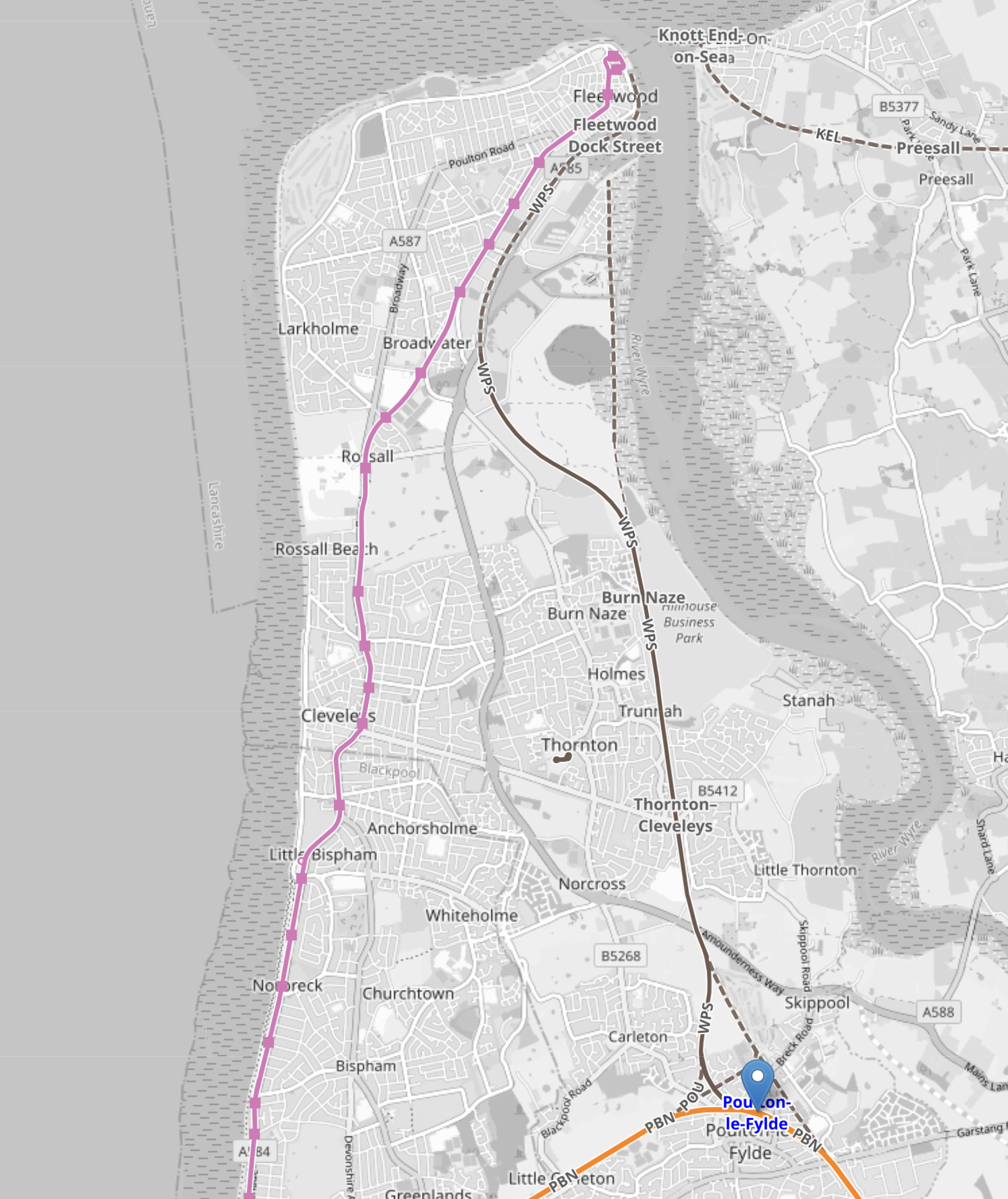
Note.
- Poulton-le-Fylde station is marked by the blue arrow in the South-East corner of the map.
- The pink line running up the coast is the Blackpool tramway.
- The Blackpool tramway terminates at Fleetwood Ferry at the top of the map.
This second OpenRailwayMap shows Fleetwood Ferry tram terminus.
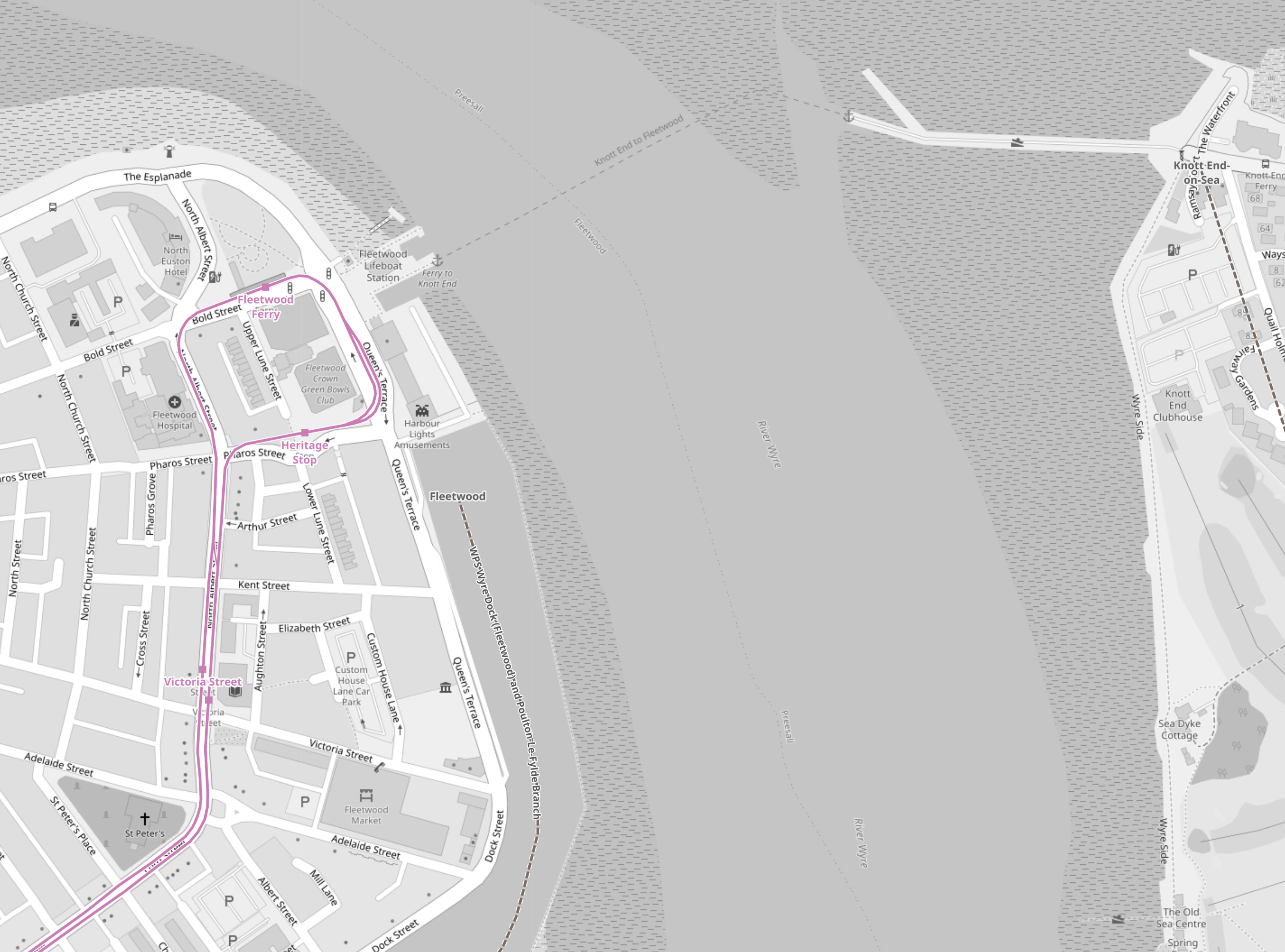
Note.
- As before, the Blackpool tramway tracks are shown in pink.
- There is a lifeboat station and a ferry to the other side.
- The tracks allow a tram to come from the South, go round the loop and return to the South.
- I believe that both the Blackpool tramway and the Fleetwood tram-train will both reverse direction in the same way.
- No new infrastructure would be needed at the Fleetwood Ferry terminal, except for perhaps a few signs.
This third OpenRailwayMap shows the track from Fleetwood Ferry to the Lindel Road tram stop.
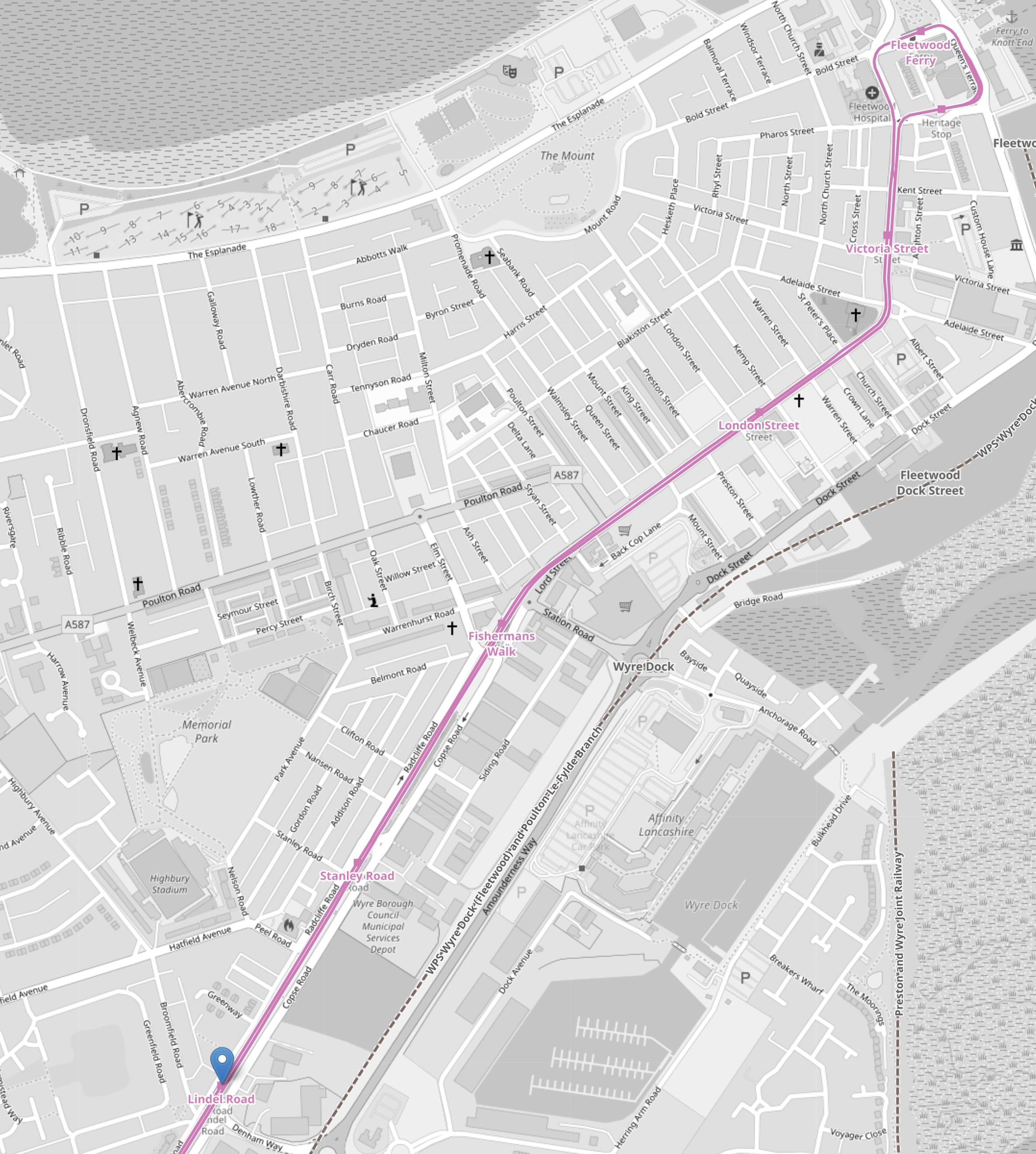
Note.
- As before, the Blackpool tramway tracks are shown in pink.
- Fleetwood Ferry is in the North-East corner if the map.
- Lindel Road tram stop is marked by the blue arrow in the South-West corner if the map.
This fourth OpenRailwayMap shows the Lindel Road tram stop area at a larger scale.
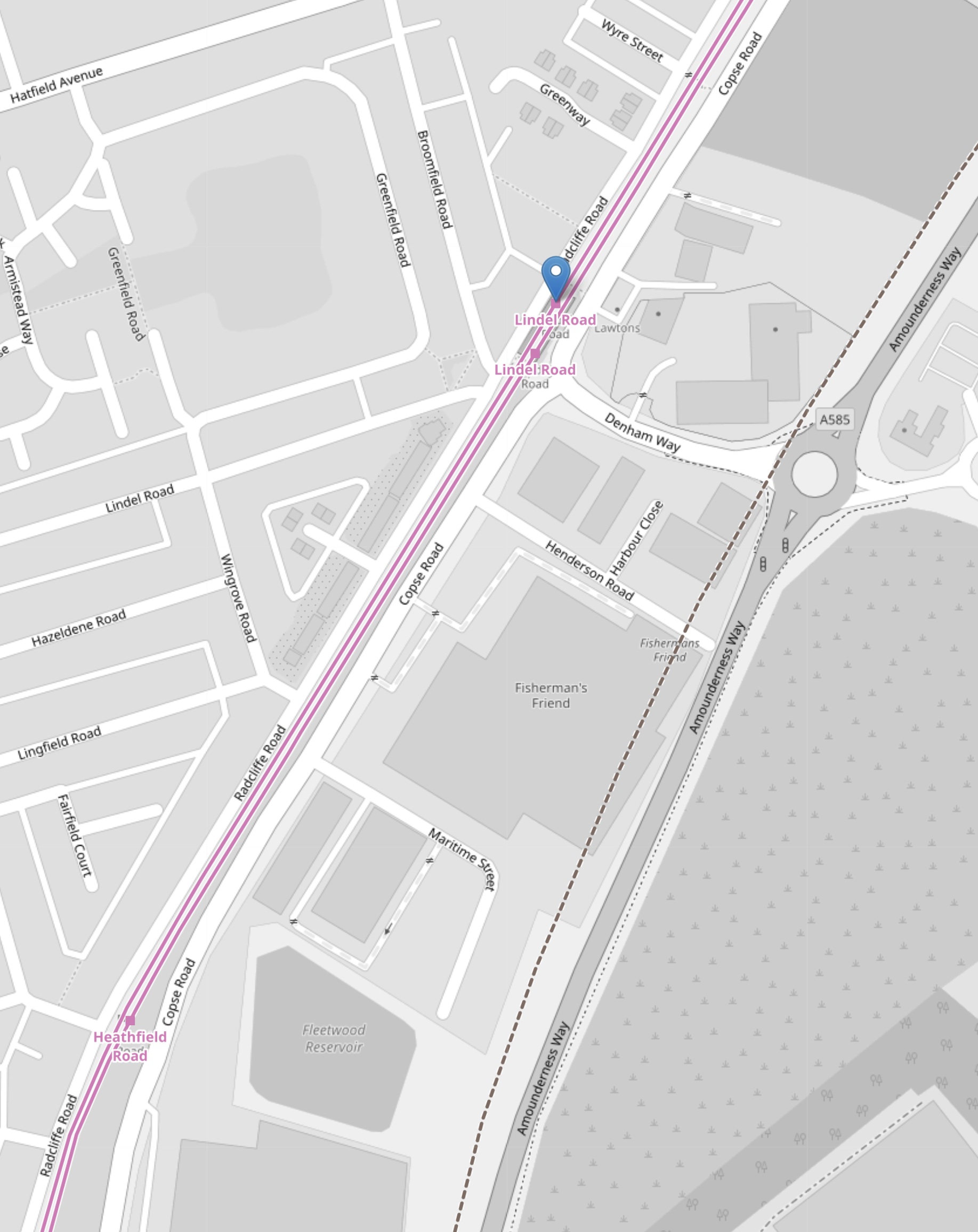
Note.
- As before, the Blackpool tramway tracks are shown in pink.
- Lindel Road tram stop is marked by the blue arrow.
- Running parallel to and to the East of the Blackpool tramway is Amounderness Way, which appears to have been built on the line of the railway to Fleetwood.
- Along the West side of Amounderness Way, a disused railway is indicated, which must be the closed railway to Fleetwood.
I believe that Network Rail or their engineers have found a route to connect the old branch line to the Blackpool tramway.
- The railway connecting the Blackpool tramway and the closed railway to Fleetwood, would only need to be single-track.
- There might be a convenient route, where all the land is owned by the Council.
- If the tram-trains were to be was fitted batteries, then there would be no need to electrify the line.
I suspect, that the connection would be to the South of Lindel Road tram stop.
- This would mean that the tram-train would serve a number of stops in the town centre.
- The tram-train could use the catenary of the Blackpool tramway.
- Connection and disconnection to the catenary could be done in the Lindel Road tram stop.
This Google Map shows the area of the Lindel Road tram stop and Denham Road.
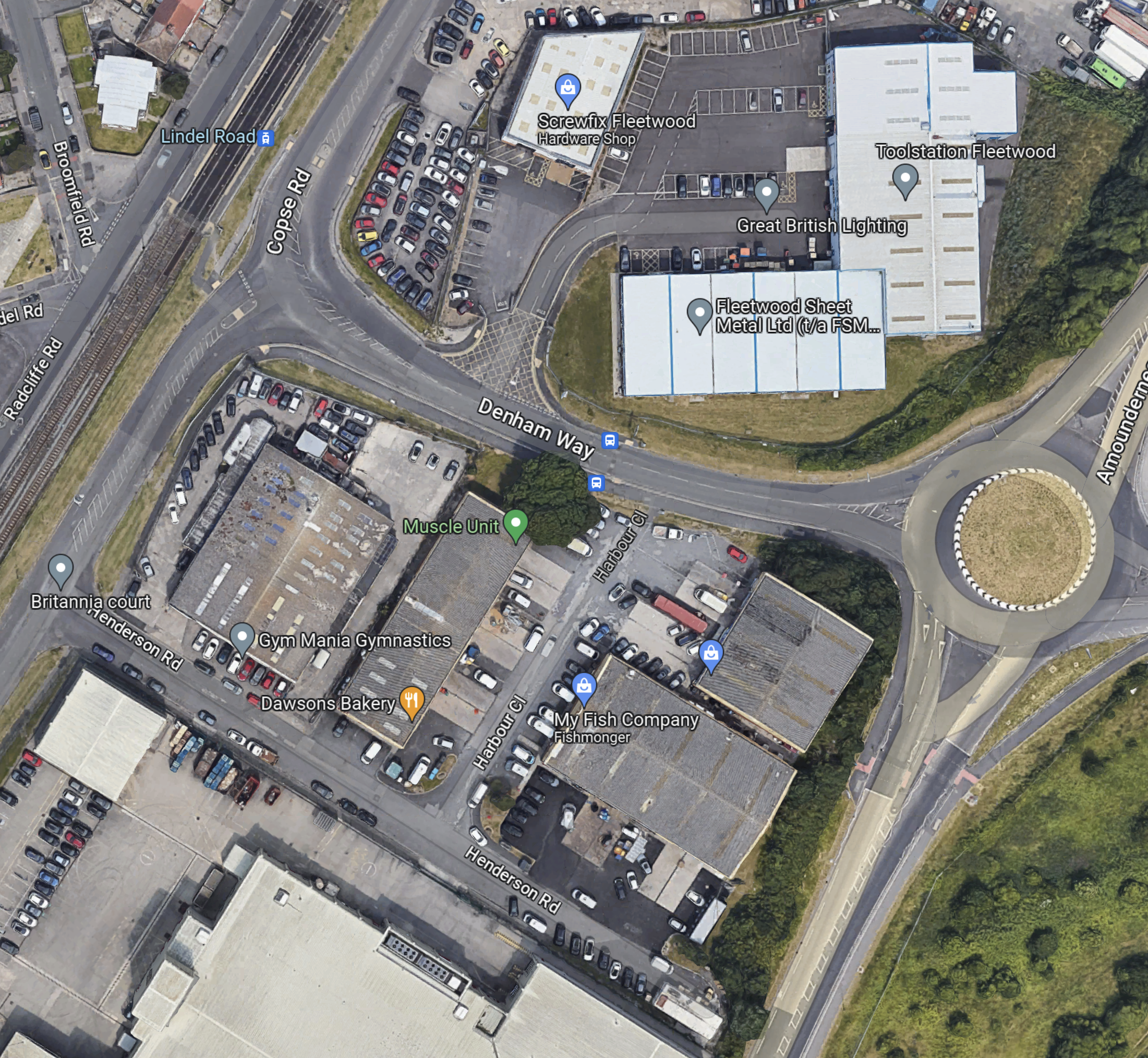
Note.
- The Lindel Road tram stop in the North-West corner of the map, with the Blackpool tramway running NE-SW across the corner of the map.
- The roundabout and Amounderness Way on the East side of the map.
- Denham Way connecting the roundabout to Copse Road and the tram stop.
- On the fourth OpenRailwayMap it showed the original line of the railway was to the West of Amounderness Way.
So could the spur between the Lindel Road tram stop and the railway to Poulton-le-Fylde station take the following route?
- Just South of the tram stop the two tracks connect to a new single-track that goes East on the South side of Denham Way.
- The turn would be quite sharp, but trams and tram-trains have the articulation of a snake and can use tight turns and narrow formations.
- The crossing of Copse Road would be protected by traffic lights.
When the tram-train gets to the roundabout other end of Denham way, I think there are two choices.
- Turn sharp right and go South alongside the West side of Amounderness Way.
- Somehow cross Amounderness Way and go down the West side.
This Google Map Amounderness Way going South.
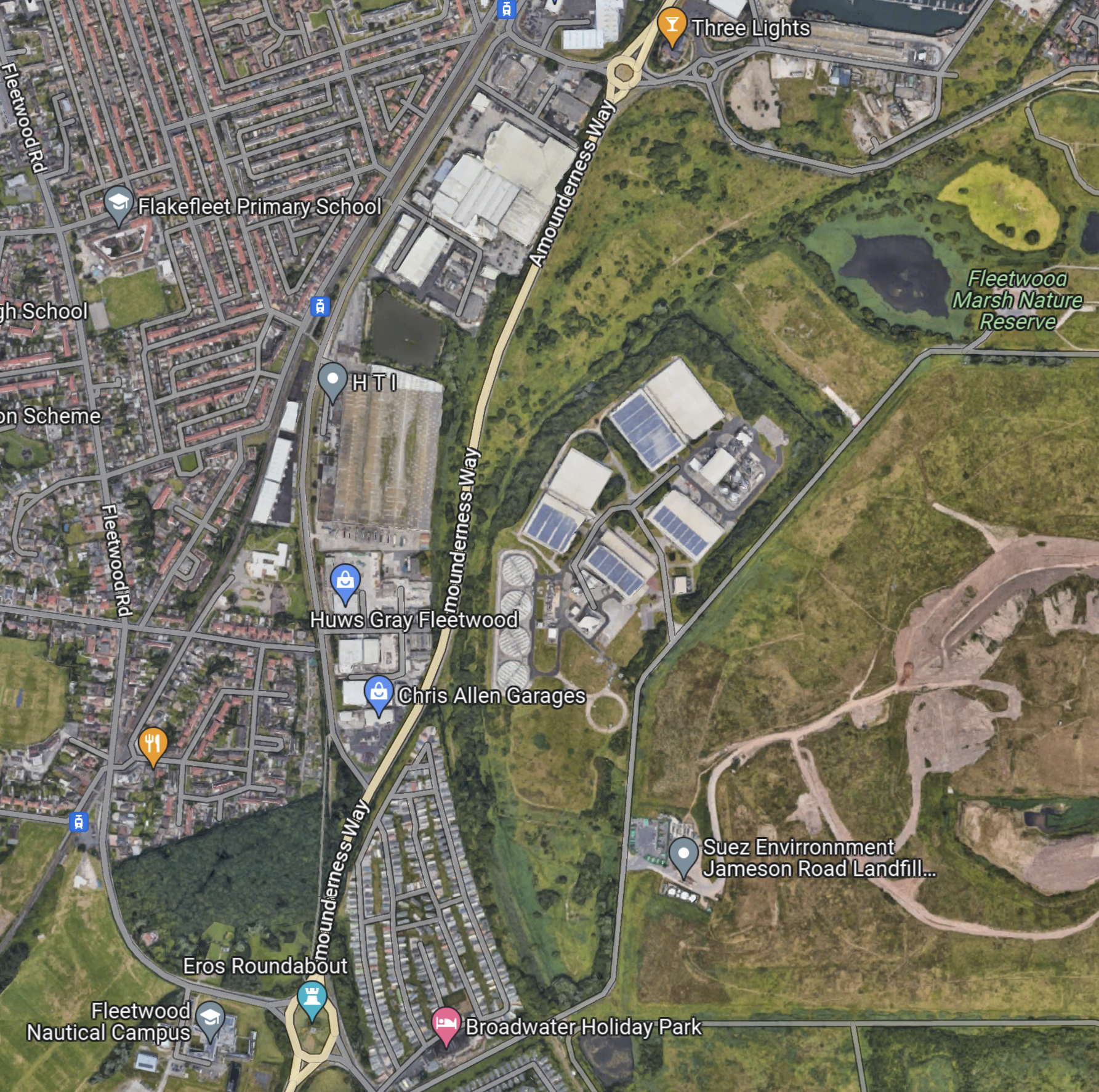
Note.
- Amounderness Way runs North-South down the map between two roundabouts.
- The large industrial area to the East of the road is labelled as SUEZ Recycling and Recovery.
- North-East of SUEZ is Fleetwood Marsh Nature Reserve.
- South-East of SUEZ is SUEZ Environmental Jameson Road Landfill and Lancashire County Council’s Fleetwood Household Waste Recycling Centre.
- There also seem to be a lot of large holiday caravans.
- There is a road running along the South-East of the large SUEZ site called Jameson Road.
The Wikipedia entry for the Fleetwood branch line, says this about the state of the branch.
Some of the line is now cleared of overgrowth because the northern track was not lifted from past Burn Naze Halt to just beyond Jameson Road Fleetwood. However, the road bridge was filled in below it. The junction, last used when goods trains took coal to Fleetwood Power Station, still exists. Looking over the road bridge on Jameson Road, the track to both north & south can still be seen through the undergrowth. In the 1990s, the new A585 The Amounderness Way bypass has been built on the former trackbed, although sufficient space still exists for a reinstated railway should it be required.
Note.
- It appears that enough space has been left at the Northern end to connect to the Blackpool tramway.
- It doesn’t seem to be in too bad a state.
- I suspect that rebuilding the branch has a similar degree of difficulty to rebuilding the Dartmoor Line to Okehampton, which is now operating successfully.
This gave me hope, that a single-track tramway could be built between Poulton-le-Fylde junction and the Lindel Road tram stop.
This Google Map shows the track meeting the filled in road bridge on Jameson Road.
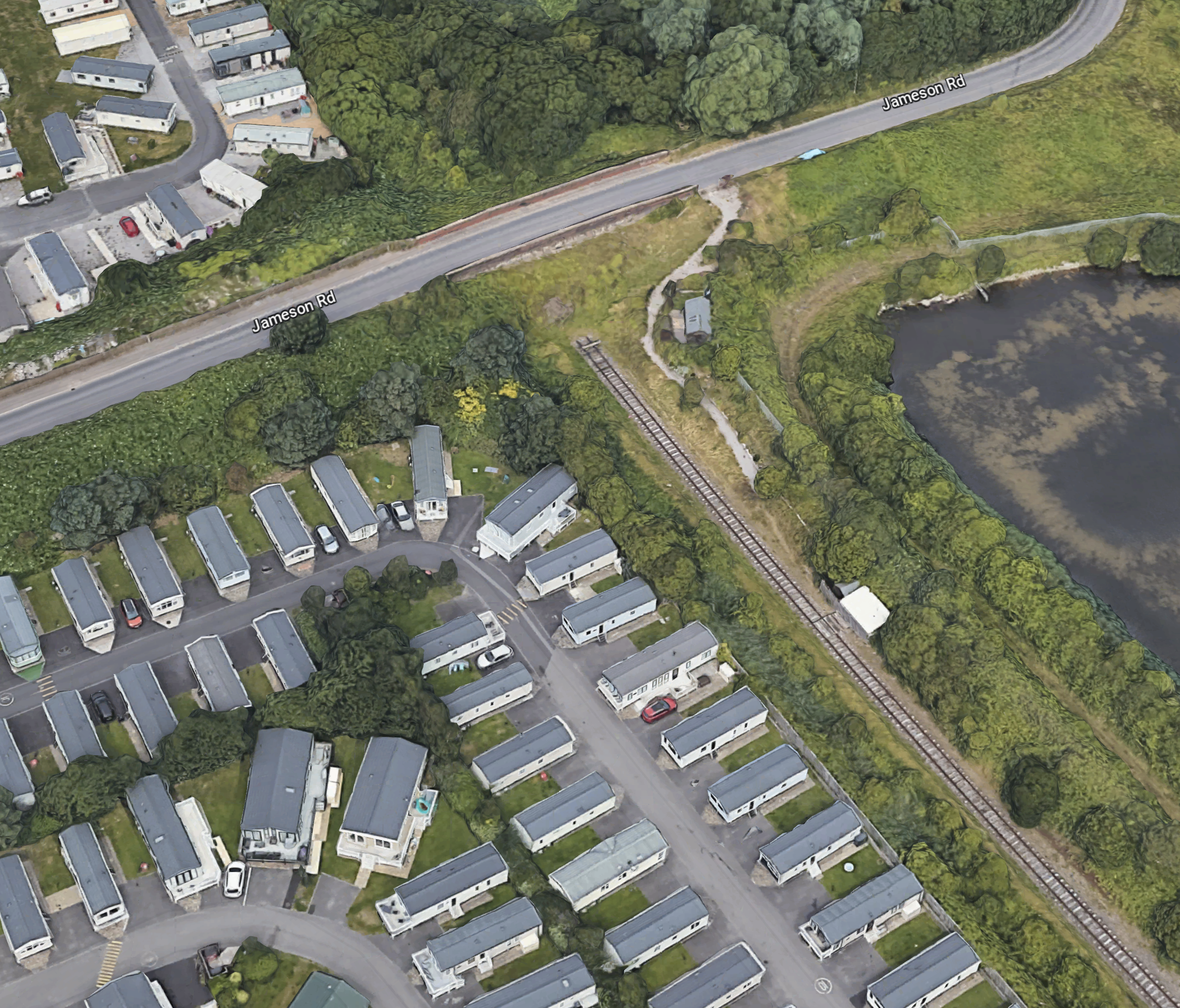
Note.
- If that’s not a single-track railway and the filled-in bridge on Jameson Road, I’m a Dutchman.
- The railway can be followed on Google Maps for most of the way to Poulton-le-Fylde station.
- Google Maps also shows traces of railway to the North of the bridge on Jameson Road.
This Google Map shows the section of Amounderness Way from the North of the SUEZ Recycling and Recovery site to the Denham Way roundabout.
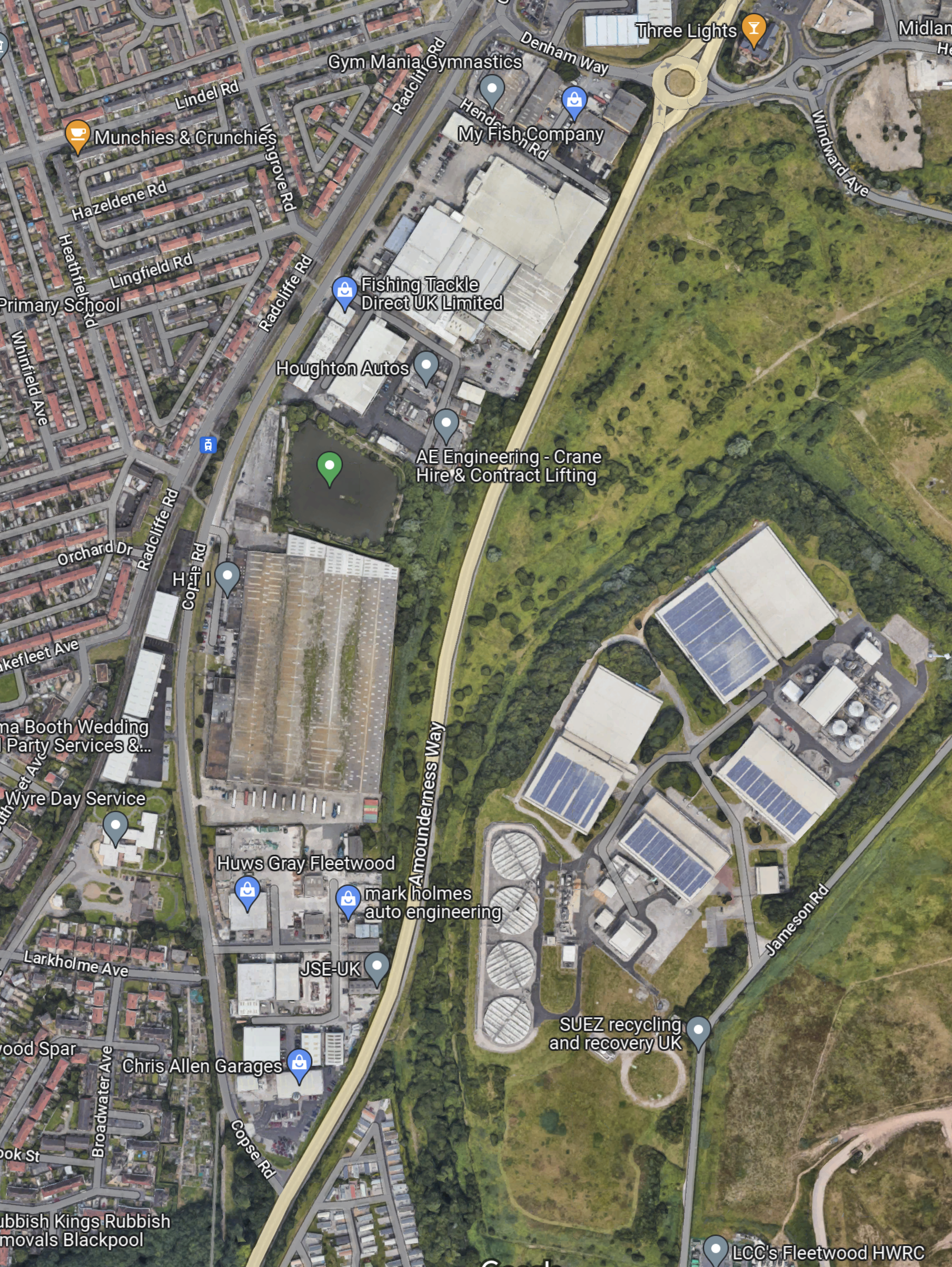
I suspect that the tram would go straight up the East side of ‘Amounderness Way.
But how would the tramway cross the road.
This Google Map shows Denham Way, the roundabout and Lindel Road tram stop.
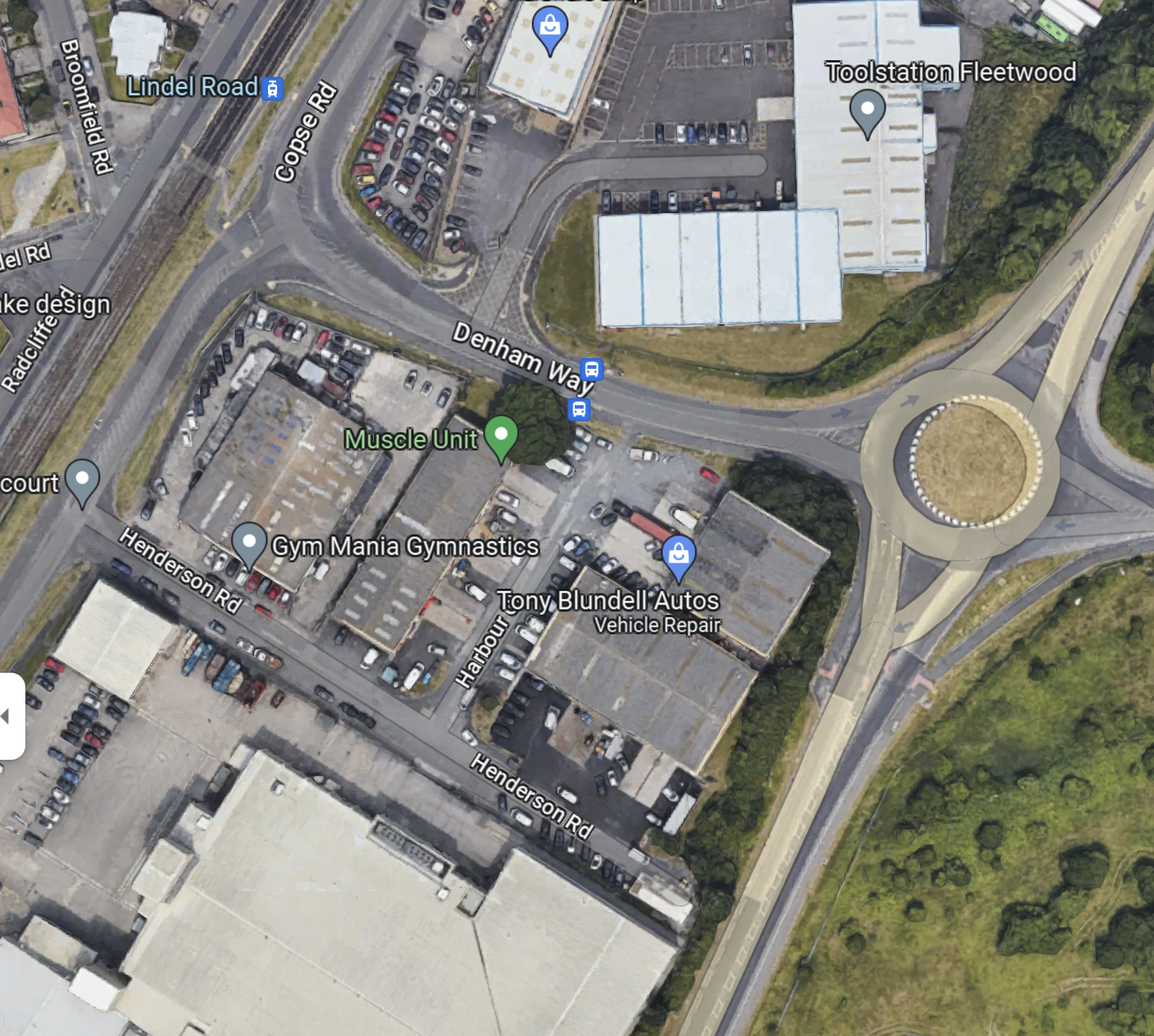
I am fairly sure that a single-track bridge of some sort could connect Lindel Road tram stop with a single-track railway along the East side of Amounderness Way, to link up with the orphaned track South of Jameson Road.
This OpenRailwayMap shows Poulton-le-Fylde junction, where the former railway to Fleetwood, joins the Blackpool branch.
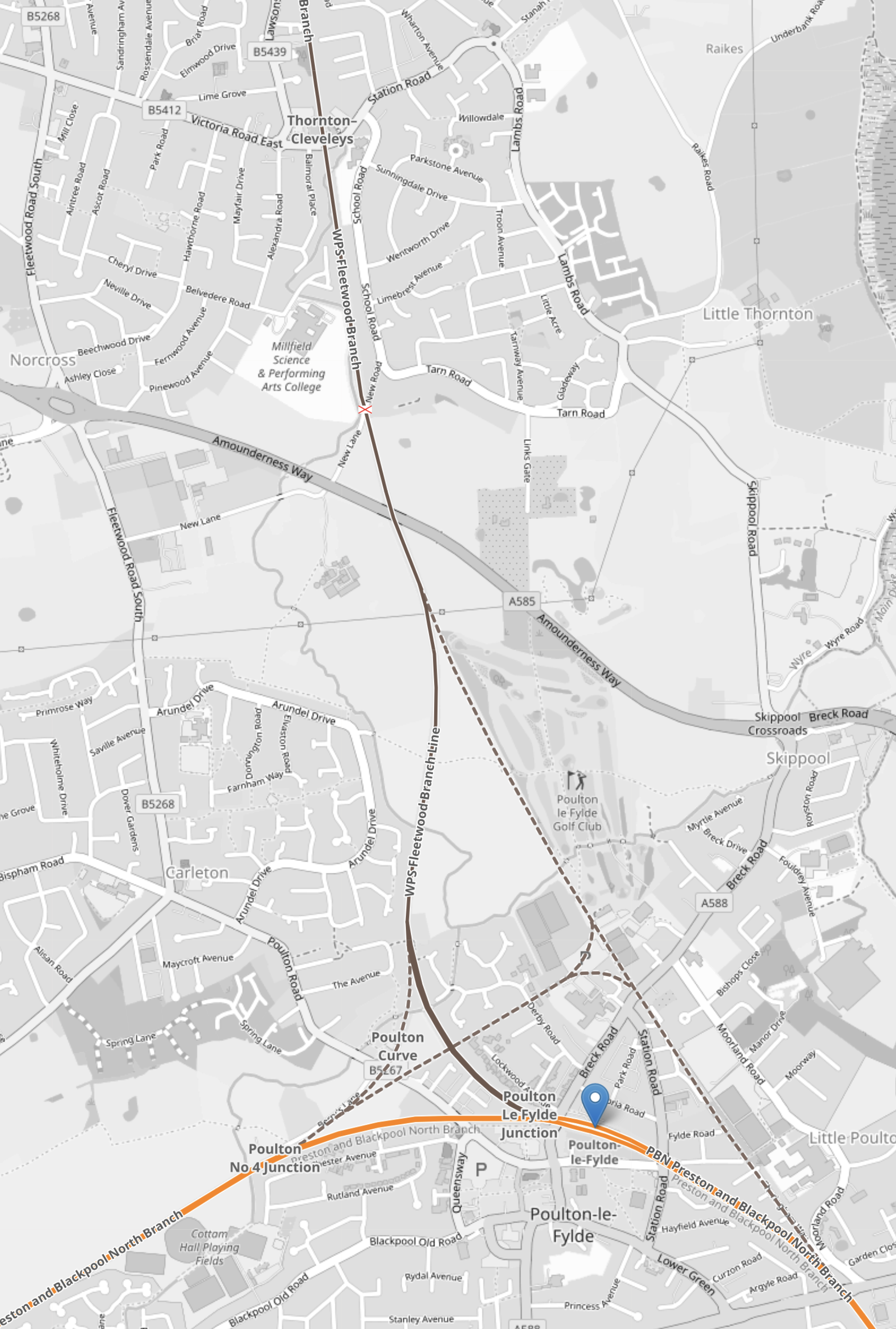
Note.
- Poulton-le-Fylde station is indicated by the blue arrow.
- The orange track is the Blackpool branch to Blackpool North station.
- Poulton-le-Fylde junction is to the West of the station.
- The track going North from the junction, is the disused track to Fleetwood.
- The map also shows a couple of level crossings.
I am fairly certain, that a single-track tramway could be built between Poulton-le-Fylde junction and the Lindel Road tram stop.
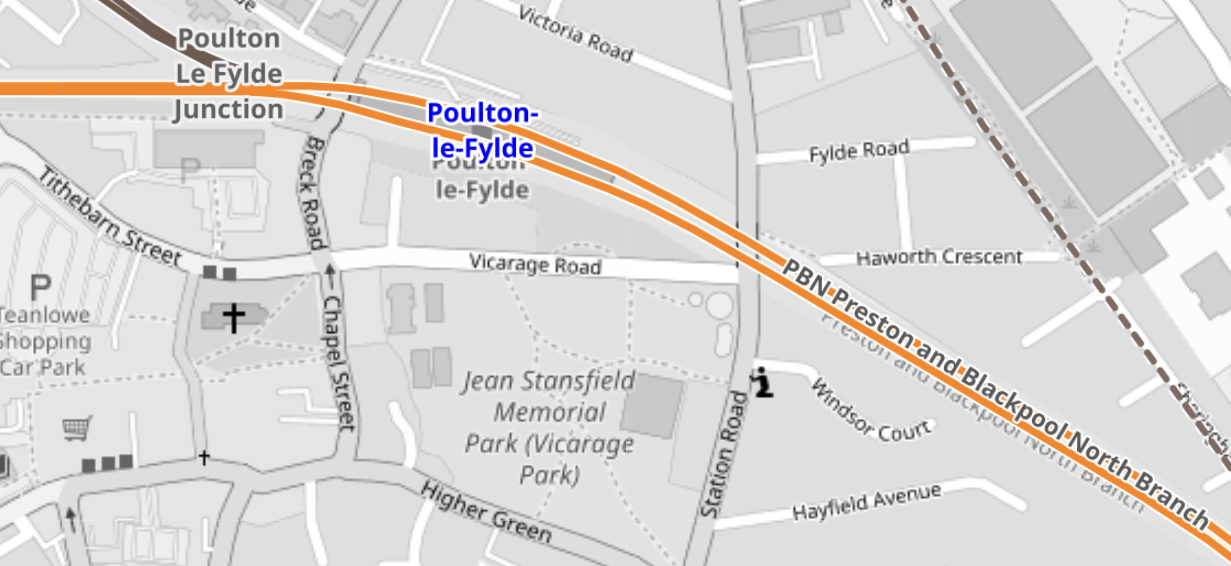
This OpenRailwayMap shows Poulton-le-Fylde junction and Poulton-le-Fylde station.
These pictures taken in 2018, show Poulton-le-Fylde station.
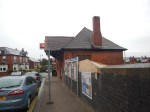
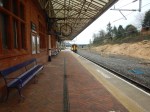
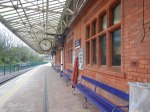
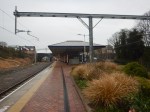
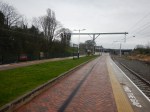


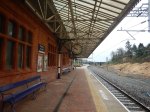

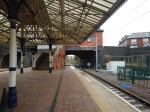
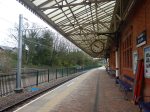
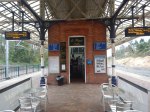
Note.
- It is a small station, that oozes quality.
- The tracks and electrification were all installed or renewed in the last few years.
- There is even a cafe and a lift to the street.
- The flower-beds in the middle of the platform, are at the Preston end of the station.
- As the tram-trains will stop in the station, they can raise and lower the pantograph in the station.
- Tram-trains and trains will share the appropriate platform.
The possibility can probably be arranged that an incoming train to Blackpool North will be able to drop passengers at a waiting tram-train for Fleetwood Ferry.
Will The New Fleetwood Branch Be Electrified?
There are various arguments for and against electrification between Poulton-le-Fylde station and the Lindel Road tram stop.
In favour, is that a continuous catenary can be run from end-to end, with 750 VDC electrification.
- An insulated section would be used at Poulton-le-Fylde station to separate the 750 VDC of the tramway and the 25 KVAC of the Blackpool branch.
- Standard tram-trains, like Sheffield’s Class 399 tram-trains could be used.
- Battery-electric tram-trains are probably more expensive.
Against electrification are.
- There would be no electrification between Poulton-le-Fylde station and the Lindel Road tram stop to install.
- There would be no need for any modifications to the catenary at Poulton-le-Fylde station and the Lindel Road tram stop.
- The filled in bridge mentioned in Wikipedia, might only need a tram-sized hole and not complete rebuilding to get the trams through.
- Occasional freight trains could probably be run, if required.
- Battery-electric tram-trains are proven technology.
It will definitely one for the accountants to decide.
The Tram-Trains
These are pictures of Stadler Citylink tram-trains in Sheffield.
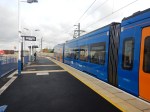
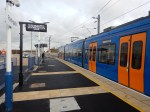

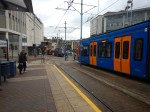
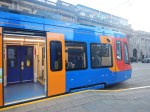
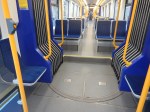

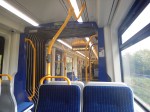
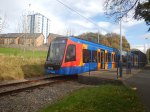
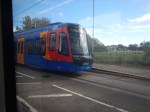

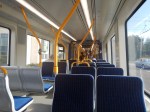
Note.
- These Class 399 tram-trains were the first tram-trains to run in the UK, when they entered service in 2017.
- They were built by Stadler in Spain.
- They share the tracks in Sheffield happily with Sheffield’s other trams of a different type.
- At the time, Paul Maynard, who is the local MP, was the Parliamentary Under Secretary of State for Transport, so I suspect that explains, why the MP appears pleased with the choice of tram-trains and talks knowledgeably about them.
- There is also a battery electric version of these tram-trains, which has been ordered by the South Wales Metro.
- Blackpool’s tramway uses Bombardier Flexity 2 trams. However, it doesn’t seem, that there is a tram-train version of the Flexity 2.
- Merseyrail in the Liverpool area, are introducing a large fleet of Stadler trains, which will be running to Preston in a couple of years.
I suspect that these tram-trains will be built by Stadler and they could be fitted with batteries.
Tram-Train Frequency Between Fleetwood Ferry And Poulton-le-Fylde Station
The Blackpool Gazette article is definite, that the frequency of the tram-train will be two trains per hour (tph).
Consider.
- The Blackpool tramway operates a service of trams every 10-15 minutes between Starr Gate and Fleetwood Ferry, so the frequency will be increased by two tph North of Lindel Road tram stop.
- As heritage trams also share the route to Fleetwood, I suspect that at some busy times, the Fleetwood Ferry and Preston service could be reduced to hourly.
- But it does look to me, that the all-important terminal at Fleetwood Ferry has been well-designed and can handle the extra traffic.
- Looking at the timetable for the Blackpool tramway, trams take forty-one minutes between Fleetwood Ferry and the North Pier.
- As Poulton-le-Fylde station and North Pier tram stop, are probably similar distances from Fleetwood Ferry, I suspect that Poulton-le-Fylde station and Fleetwood Ferry would take thirty minutes or more.
- Real Time Trains indicates that electric trains to Blackpool North station take around 16-17 minutes between Poulton-le-Fylde and Preston stations, with diesel trains taking a couple of minutes more.
- Add in time for stops at Kirkham & Wesham, possibly another at Salwick and cleaning and crew changeover at Preston station, I suspect that a roundtrip from Preston to Fleetwood Ferry and back will take a very convenient two hours.
A two hour round trip and two tph, will mean four trains will be needed to work the timetable.
I can’t prove it, but I my gut feeling is that there there will be a passing loop somewhere between Poulton-le-Fylde station and the Lindel Road tram stop.
The passing loop would also give scope for operational flexibility.
Train Services Through Poulton-le-Fylde Station
Train services through Poulton-le-Fylde station are currently as follows.
- Avanti West Coast – London Euston and Blackpool North – 1 train per day (tpd)
- Northern – Liverpool Lime Street and Blackpool North – 1 tph
- Northern – Manchester Airport and Blackpool North – 2 tph
- Northern – York and Blackpool North – 1 tph
Note that all trains stop at Preston.
The Avanti West Coast service only calls Southbound, but I wouldn’t be surprised, if the Fleetwood tram-train is built, that Avanti West Coast started a Northbound service.
Could The Blackpool South Branch Be Served By Similar Tram-Trains?
In Beeching Reversal – South Fylde Line Passing Loop, I talked about improving the Blackpool South branch.
Objectives included.
- Two tph.
- Better trains.
- A passing loop that would enable the 2 tph.
Note.
- Pacers have been replaced with Class 150 trains.
- The route is electrified between Preston and Kirkham & Wesham station.
- 12.2 miles are without electrification.
It certainly would seem possible that if a battery-electric tram-train had sufficient range, it could handle the current route to Blackpool South station.
The trams would have a ninety-minute round trip between Preston an Blackpool South stations and two tph, will mean three trains will be needed to work the timetable.
The MP is quoted in the Blackpool Gazette article, as liking the concept of a tram loop to Blackpool from Preston.
Trams might go to Fleetwood, down the promenade and then take the Blackpool South branch beck to Preston.
It could obviously go the other way around the loop.
This Google Map shows the location of Blackpool South station.
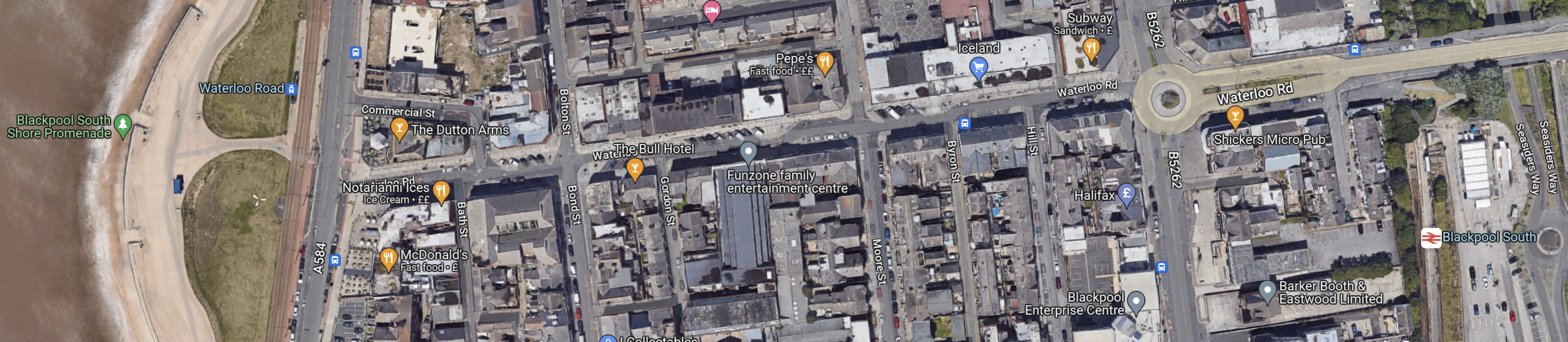
Note.
At the West side of the map is the promenade, with tramway running North and South.
At the East side of the map is Blackpool South station.
The walking route between the tramway and the station is not arduous, but it is not a seamless transfer.
It might be better to make the connection at Blackpool Pleasure Beach, which is shown in this Google Map.
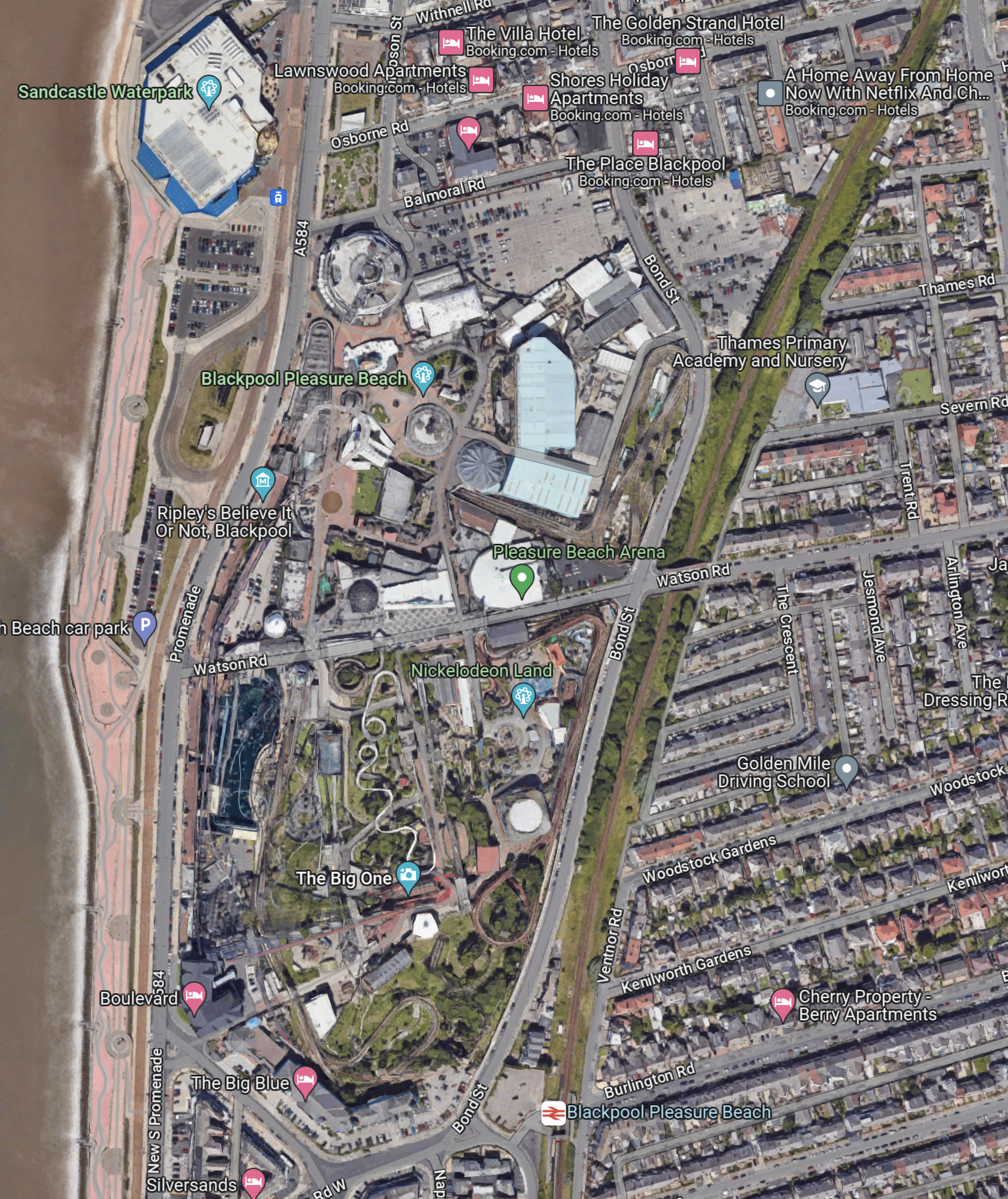
Note.
- The Pleasure Beach lies between the tramway and the promenade by the beach and the Blackpool South branch on the East side.
- There are two stops on the tramway and a station just to the South.
Perhaps, if the Pleasure Beach were redeveloping an area, they might leave provision for tram-trains to to sneak through to join the tramway going North.
But it’s a difficult problem, as there is not much space, that is undeveloped and the roads aren’t very wide.
This Google Map shows the North Pier and Blackpool North station.
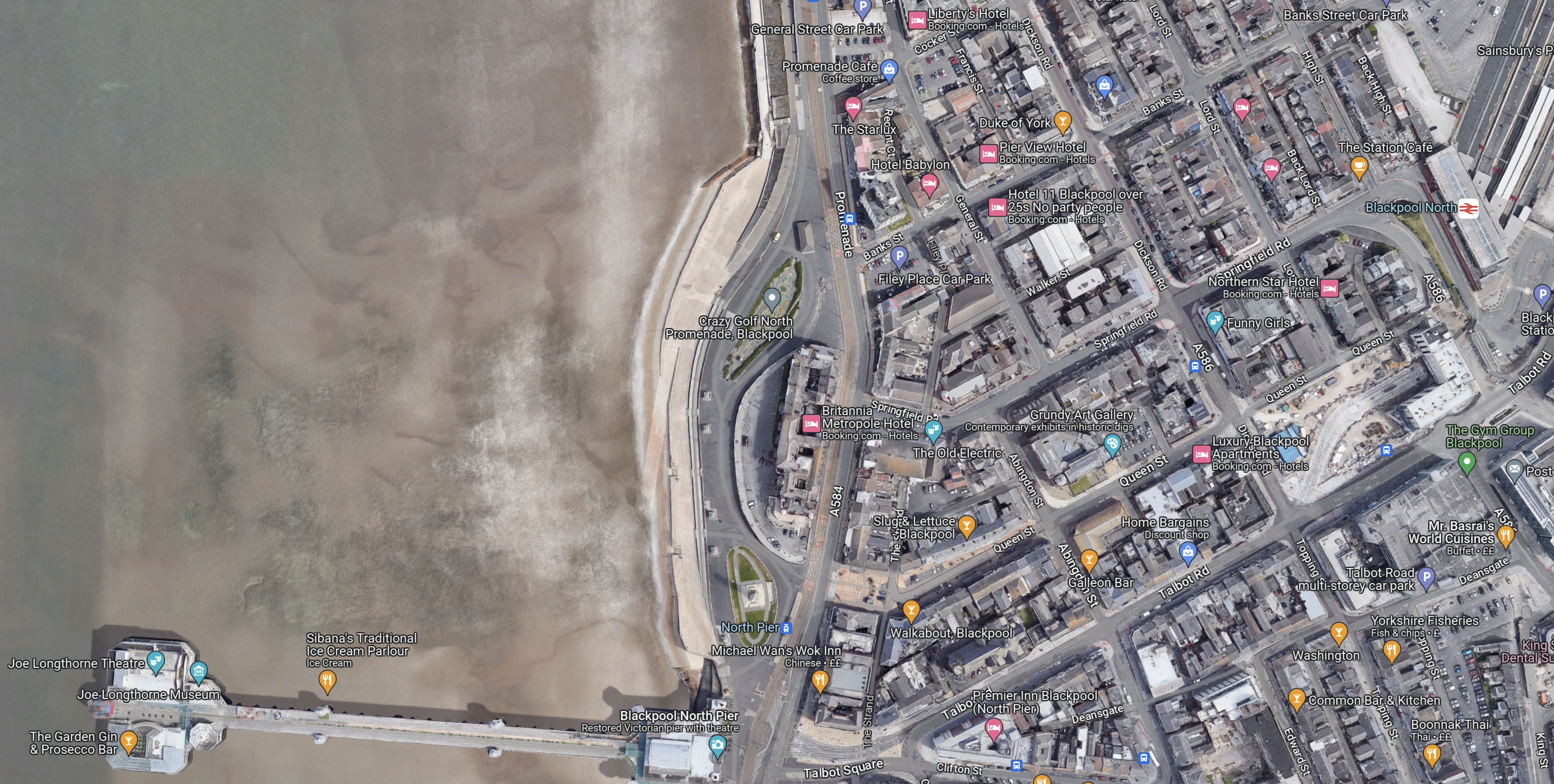
Note.
- The North Pier is in the South-West corner of the map.
- Blackpool North station, which is Blackpool’s main station is in the North-East corner of the map.
- The tramway runs along the sea-front.
The North Pier and the station are linked by Talbot Road.
This Google Map shows Talbot Road and the development of a tram stop by Blackpool North station.
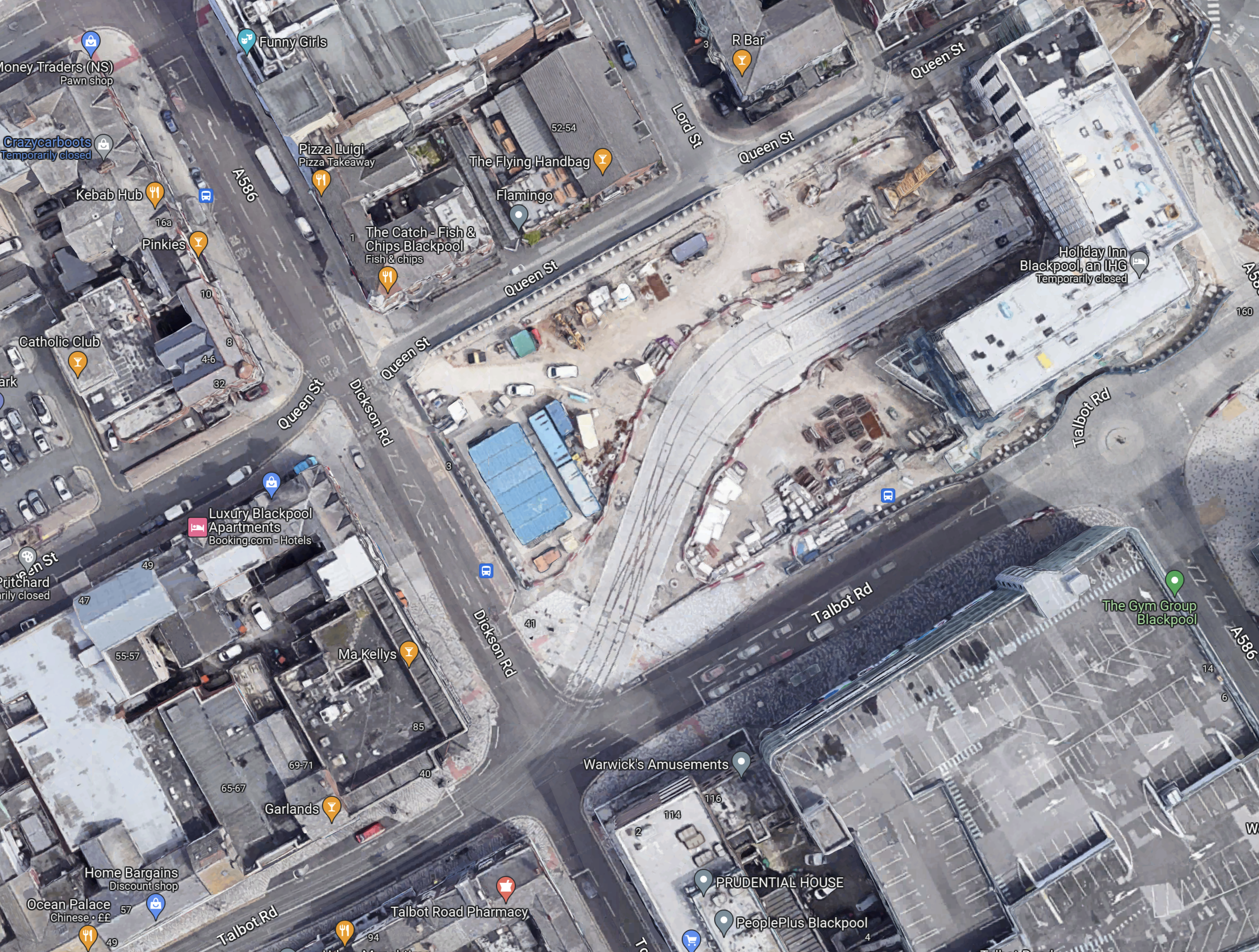
Note.
- To create the space a large Wilkinson’s store was demolished.
- Blaxkpool North station is just off the North-East corner of the map.
- The tram stop will have two platforms.
- There is a large diamond crossing on the approach to the tram stop, so operation is smooth and reliable.
- It looks like there will be substantial development around and possibly over the tram stop.
This Google Map shows Talbot Square, where the tram branch to Blackpool North station joins the main North-South tramway.
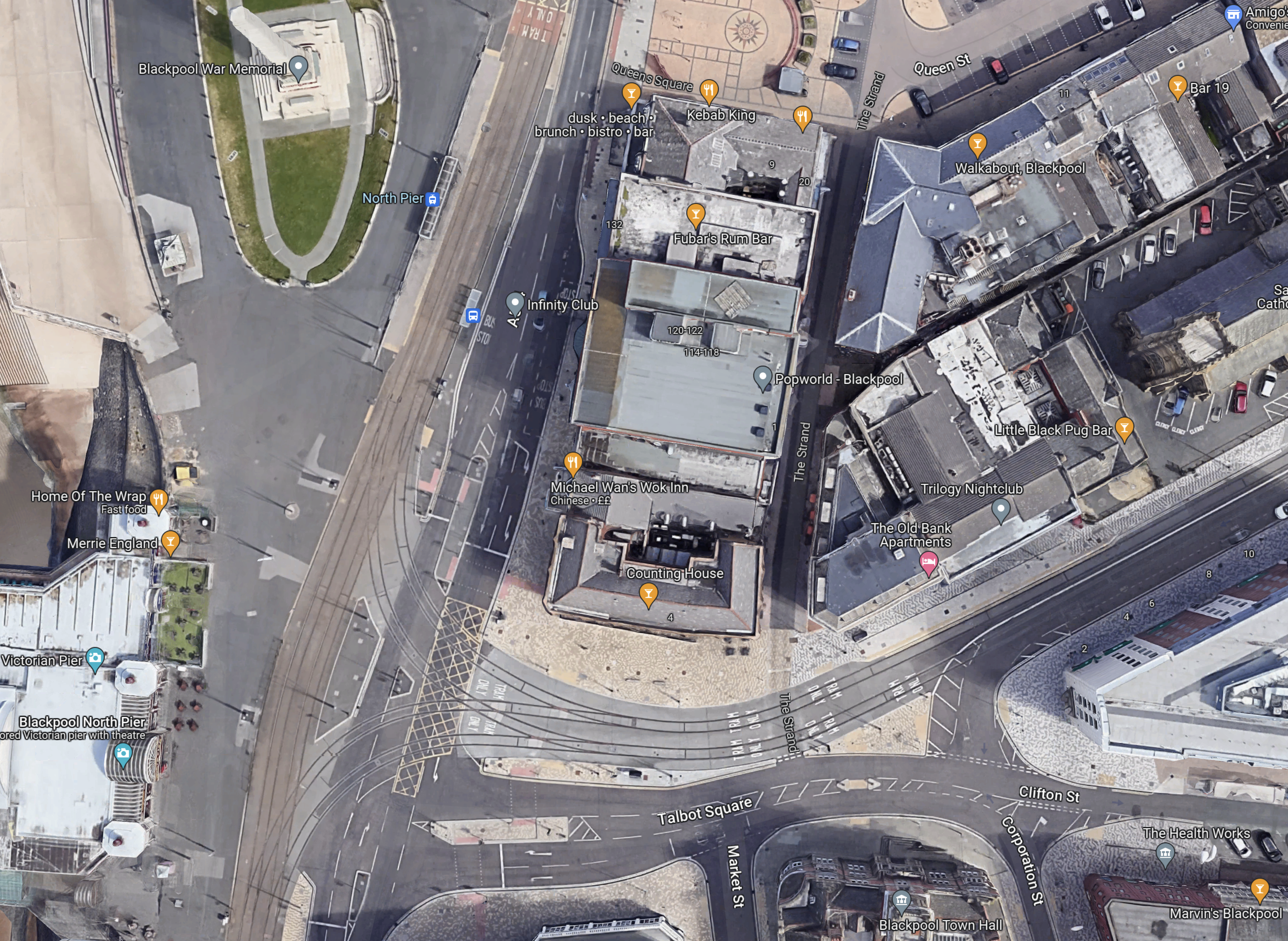
It is all very crowded and I believe this illustrates, why despite their close proximity, there is no rail connection between the Blackpool South branch and the Blackpool tramway.
There just isn’t the space to put in junctions like this and the tramway doesn’t go past Blackpool Airport, so the connection would have to be amongst the crowded houses on the sea front.
The Development Of Blackpool Airport
Aviation is changing and I believe a new breed of airliners and the airports to serve them, will be developed in the next few years.
- Zero-carbon aircraft are being developed and I believe some will have entered service by 2026.
- They will be powered directly by batteries or from green hydrogen.
- Some like the Eviation Alice are already entering a flight-test program, that will lead to certification.
- These airliners are likely to be smaller and quieter than current airliners, with typically a passenger capacity of around 19 passengers.
- They will often fly routes between smaller regional airports.
Blackpool Airport could be an ideal airport for these airliners.
- Offshore electricity and even hydrogen generated offshore will be easy to deliver to Blackpool Airport.
- It could have excellent transport connections with trams and trains.
- Blackpool Airport has good runways.
- Many take-offs will be over the sea.
- We will see airports converting to zero-carbon airports.
So why not Blackpool Airport?
These are distances between Blackpool Airport and other airports.
- Aberdeen – 238 miles
- Amsterdam Schipol – 340 miles
- Belfast City – 128 miles
- Cardiff – 165 miles
- Dublin – 134 miles
- Edinburgh – 150 miles
- Exeter – 211 miles
- Geneva – 661 miles
- Glasgow – 155 miles
- Haverfordwest – 157 miles
- Jersey – 318 miles
- Kirkwall – 358 miles
- London Gatwick – 220 miles
- London Heathrow – 192 miles
- London Southend – 219 miles
- Newcastle – 89 miles
- Paris Orly – 422 miles
- Isle of Man Ronaldsway – 68 miles
- Shannon – 254 miles
- Southampton – 208 miles
- Sumburgh – 427 miles
These distances fit nicely with the range of the nine-seater Eviation Alice electric aircraft, which is predicted to be 620 miles.
This Google Map shows Blackpool Airport.
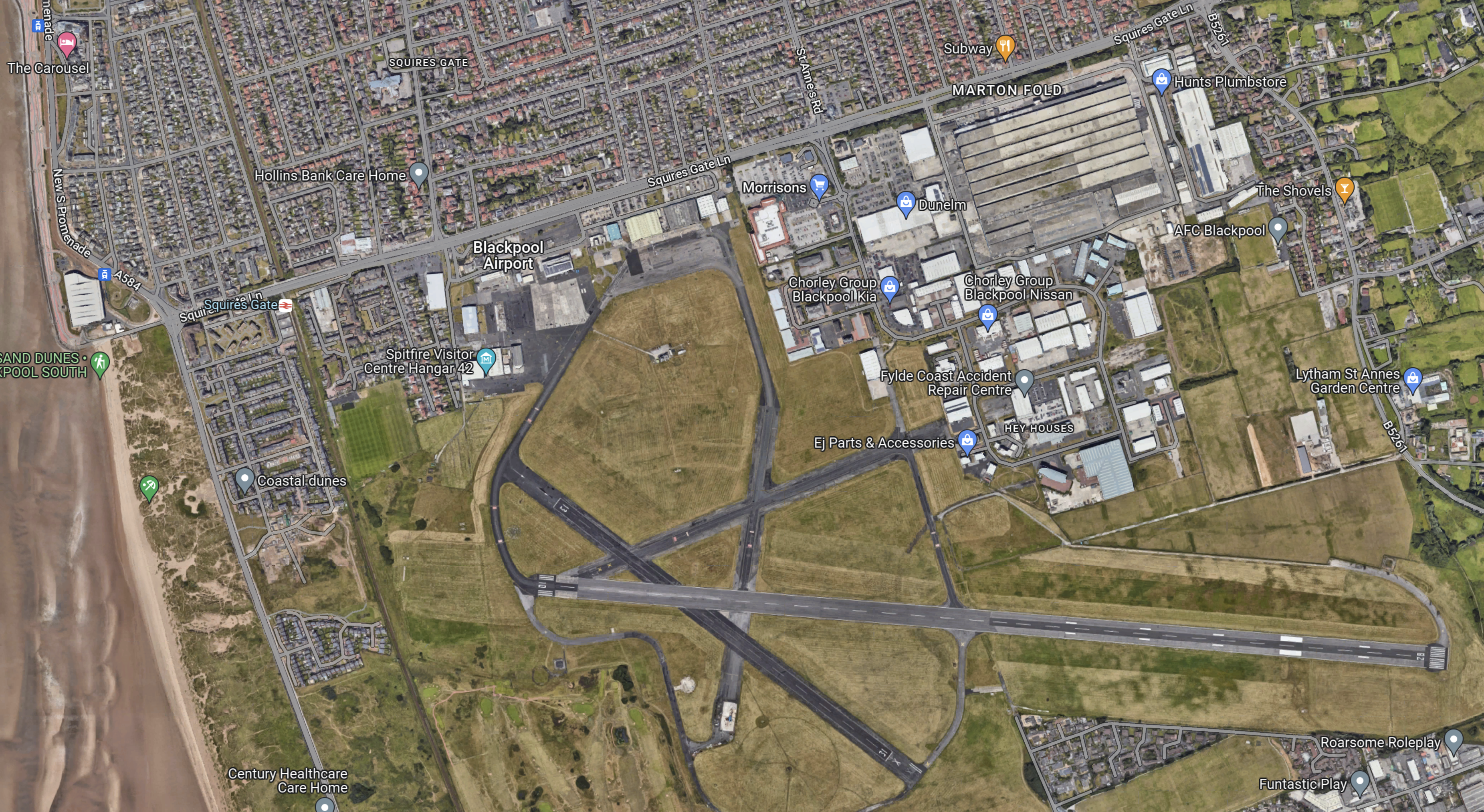
Note.
- The East-West main runway, which is over 1,800 metres long, which will probably mean an easier takeoff into the wind, for much of the time.
- The acres of space.
- The Blackpool South branch running down the side of the airport, with Squires Gate station on the road past the Airport.
- But zoom in on the airport and some improvement and refurbishment needs to be done. Years of neglect and uncertainty has taken its toll.
This Google Map shows the North-West corner of the map at a greater scale.
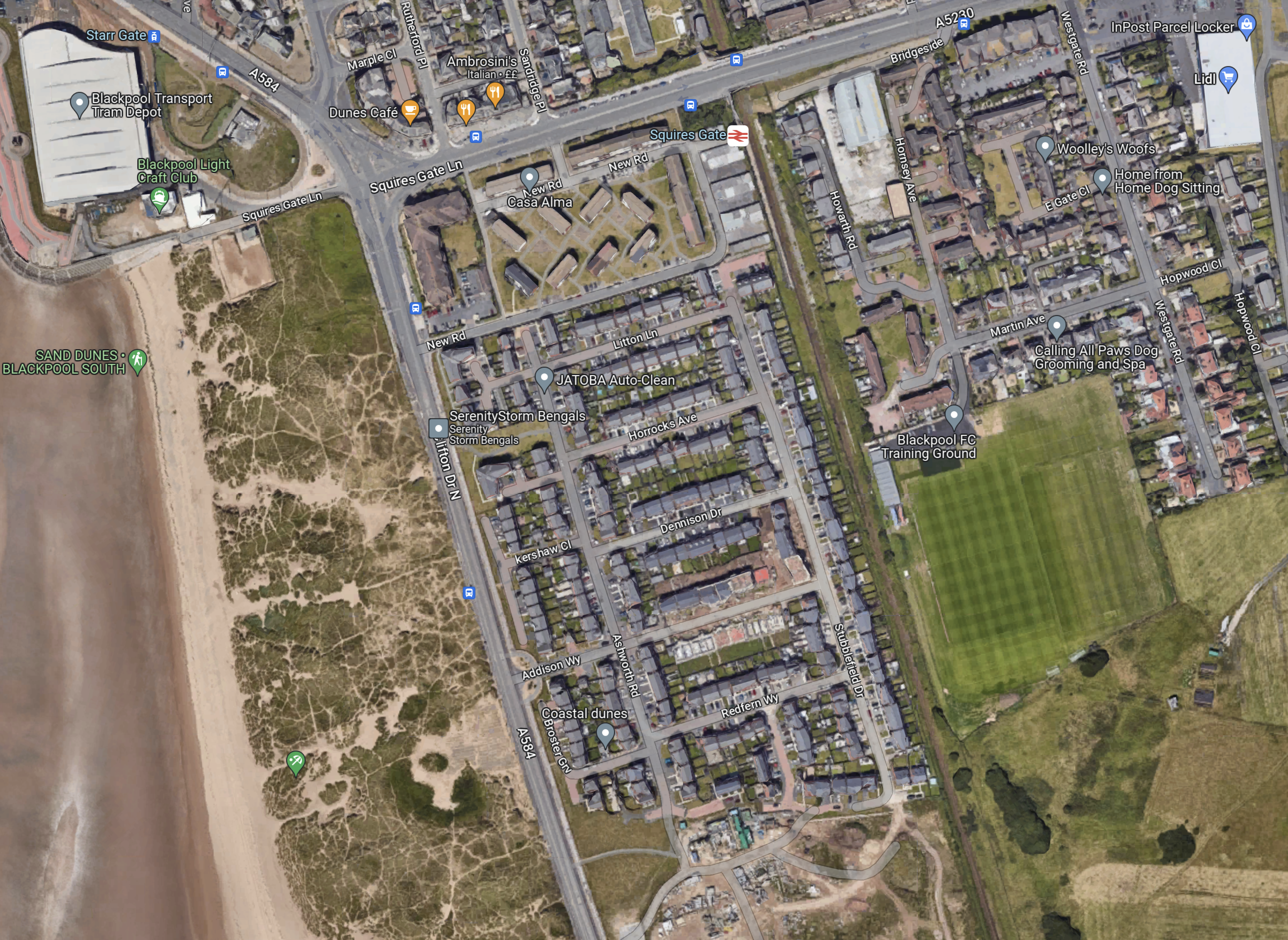
Note.
- In the North-West corner of the map is Blackpool tramway’s depot and Starr Gate tram stop with its loop.
- The rail station is Squires Gate for Blackpool Airport.
- The smart green space to the East of the railway is Blackpool FC’s training ground.
- Below the training ground on the East side is Blackpool Airport.
- On the other side of the track from the Airport, it appears to be the local rubbish dump.
I wonder, if this is where the Blackpool tramway and the Blackpool South branch could be joined up.
- A joint two-platform station partly on Airport land would replace the current Squires Gate station.
- It could be connected to the Airport terminal by some form of shuttle or travellator.
- The trams would be connected to the Starr Gate loop by a line going along the front, as the tramway does in much of Blackpool, before cutting through the waste ground.
- Trains to Blackpool South station would use their current route.
This plan and probably lots of others could allow a Blackpool loop tram-train from Preston.
What would a zero-carbon airport do for Blackpool?
Historic Northumberland Line To Reopen Next Summer
The title of this post, is the same as that, of this news story from the UK Government.
This is the sub-heading.
Fully accessible stations are being built to give 6 Northumberland communities regular train services.
And these are the main bullet points.
- Transport Secretary announces regular train services will return to Northumberland Line in 2024
- Journey times will be slashed in half and communities reconnected to jobs and opportunities helping to level up and grow the region’s economy
- Investment forms part of government’s Restoring Your Railway programme, which reopens old stations and lines across the country
Let’s hope this line follows the Dartmoor Line in being a success.
I wrote about this success in Dartmoor Line Passes 250,000 Journeys On Its First Anniversary, As Rail Minister Visits To Mark Official Opening Of The Station Building.
Elizabeth Line: Commuters Say Service ‘Not What Was Promised’
The title of this post, is the same as that of this article on the BBC.
This is the sub-heading to the article by Tom Edwards.
All of the huge modernist stations are now open and it is architecturally impressive, but what has service on the Elizabeth line been like since it opened in the summer?
These three paragraphs talk about how passengers have reported problems to Tom.
Many say it has been hit and miss, and commuters in West Ealing have been in touch with me to highlight some of the problems.
They recorded some of their journeys for BBC London, and it doesn’t look pleasant.
Many are really fed up with the delays and cancellations and above all the overcrowding.
As with many new railways, like the London Overground, the Borders Railway and the Dartmoor Line, the passenger numbers on the Elizabeth Line have exceeded projections.
The main reasons are probably.
- Convenience of the new route and its stations.
- Curiosity about the new infrastructure.
- The improved access to the trains with heavy cases.
But in the case of the Elizabeth Line two other factors also apply.
Are Passengers Changing From the Piccadilly to the Elizabeth Line?
Consider.
- The Piccadilly Line trains are smaller than the Elizabeth Line trains.
- The Piccadilly Line trains are not air-conditioned.
- Heathrow Central to Holborn is 62 minutes on the Piccadilly Line and several minutes quicker using the Elizabeth and Central Lines with a change at Bond Street or Tottenham Court Road.
Many passengers, who previously used the Piccadilly Line may swap to the Elizabeth Line for a quicker journey on a more comfortable and spacious train.
The new Piccadilly Line trains will have more space, walk-through carriages and air conditioning, so may well tempt passengers back.
Bond Street And All Stations To the East On the Elizabeth Line Are Only Five Minutes Slower By Elizabeth Line Direct
Consider.
- Heathrow Central and Bond Street is 38 minutes using Heathrow Express and the Elizabeth Line with a change at Paddington.
- Using the Elizabeth Line all the way takes 43 minutes.
- The figures for Liverpool Street are 46 and 51 minutes respectively.
- The figures for Canary Wharf are 53 and 58 minutes respectively.
Note.
- The direct route avoids the change at Paddington.
- The change at Paddington between Heathrow Express and the Elizabeth Line is not onerous.
- Routes using Heathrow Express are fifteen pounds more expensive.
- If you’re desperate for a coffee, you can pick one up, when you change at Paddington using Heathrow express.
I believe a regular traveller to Heathrow, who has easy access to an Elizabeth Line station and in the past has used Heathrow Express will give the Elizabeth Line a chance.
The Jewel In The East Is On The Elizabeth Line
In 2014, I wrote Is Whitechapel Station Going To Be A Jewel In The East?.
Consider.
- The Elizabeth Line will go through the station with a frequency of up to 24 trains per hour (tph).
- The two Eastern branches of the Elizabeth Line split to the East of Whitechapel station.
- There will be four tph between Heathrow and Whitechapel.
- The East London Line of the London Overground goes through the station with a frequency of 16 tph, that will be raised to at least 20 tph in a few years.
- The District Line goes through the station with a frequency of upwards of 12 tph.
- The Hammersmith and City Line goes through the station with a frequency of 6 tph.
- The station has large numbers of lifts and escalators.
Passengers from all over the Eastern half of London will change at Whitechapel on their journey to and from Heathrow.
Farrington station Connects Thameslink And The Elizabeth Line
Consider.
- The Elizabeth Line will go through Farringdon station with a frequency of up to 24 tph.
- The Circle, Hammersmith and City and the Metropolitan Lines will go through the station with a combined frequency of up to 24 tph.
- Thameslink will go through the station with a frequency of up to 14 tph.
Passengers from Thameslink’s catchment area will change at Farringdon on their journey to and from Heathrow.
Overcrowding On The Elizabeth Line
It is not a surprise to me, that the Western end of the Elizabeth Line is overcrowded.
I noticed it in November 3022, when I wrote So Many Cases On A Train!.
What Can Be Done To Ease The Overcrowding?
These are possible ways to ease the overcrowding.
Increase The Number Of Trains To Heathrow
I would feel the obvious way to increase the number of trains to Heathrow, would be to run direct trains between Shenfield and Heathrow.
Currently, there are these trains.
- 4 tph – Heathrow Express – Paddington and Terminal 5
- 2 tph – Elizabeth Line – Abbey Wood and Terminal 4
- 2 tph – Elizabeth Line – Abbey Wood and Terminal 5
But is there the capacity to add extra trains between Hayes & Harlington and Heathrow through the tunnel?
Run A Service Between Shenfield And Hayes & Harlington
This would add capacity in West London, where it is needed, but wouldn’t add any extra trains through the tunnel to Heathrow.
By timing this service in combination with the Elizabeth Line services to Heathrow, I suspect a very efficient service between Heathrow and both Eastern terminals could be devised.
- As four tph run between Abbey Wood and Heathrow, four tph would be run between Shenfield and Hayes & Harlington.
- Going towards Heathrow, the train from Shenfield to Hayes & Harlington would be a few minutes in front of the train from Abbey Wood to Heathrow. Passengers going from Shenfield to Heathrow would be instructed to change at any station between Whitechapel and Southall, by waiting a few minutes for the following train.
- Coming from Heathrow, passengers wanting to go to Shenfield would walk across the platform at Hayes & Harlington to catch the waiting train to Shenfield. The Shenfield train would follow a few minutes behind the Abbey Wood train.
Note.
- The two train services would run as a pair, a few minutes apart.
- No new infrastructure would be required.
Currently, there are eight tph between Whitechapel and Hayes & Harlington.
Four tph between Shenfield and Hayes & Harlington would increase the following.
- The capacity between Whitechapel and Hayes & Harlington by fifty percent.
- The train frequency in the central tunnel to twenty tph or a train every three minutes.
- The frequency between Paddington and Shenfield to twelve tph.
There would still be four tph available for more services.
Dartmoor Line Passes 250,000 Journeys On Its First Anniversary, As Rail Minister Visits To Mark Official Opening Of The Station Building
The title of this post, is the same as that of this press release from Network Rail.
These three paragraphs talk about the Dartmoor Line’s reopening.
Just over a year after the Dartmoor Line reopened to regular passenger trains, journey numbers on the line have passed 250,000 this Monday morning [28 November], with the arrival of an extra special visitor, Rail Minister, Huw Merriman MP, to officially open the renovated station building.
The line reopened on 20 November 2021, restoring a regular, year-round service for the first time in almost 50 years following more than £40m of Government investment.
The previously mothballed rail line, which runs between Okehampton and Exeter, was restored in just nine months and delivered £10m under budget, becoming the first former line to reopen under the Government’s £500m Restoring Your Railway programme.
I have a few thoughts.
A Well-Managed Project
It does appear that Network Rail upped a gear or two to fulfil this project. The press release puts it like this.
Reinstatement of the Dartmoor Line was made possible by Network Rail’s team of engineers who worked tirelessly to deliver a huge programme of work including laying 11 miles of new track and installing 24,000 concrete sleepers and 29,000 tonnes of ballast in a record-breaking 20-day period.
But it does appear that over recent months Network Rail seems to do things a lot better and quicker.
I do wonder, if on the construction side, Network Rail have been able to bring in new working practices, that they are still trying to get lots of their other workers to accept.
A Quarter Of A Million Journeys
The press release says this about passenger numbers.
In the same week as it celebrated its one-year anniversary, the Dartmoor Line also saw its 250,000th journey, showing an incredible patronage on the line and more than double the demand originally forecast.
But they still can’t get the forecasts right.
Passenger Numbers Are Still Rising
The press release says this about rising passenger numbers
Since Great Western Railway (GWR) increased services to hourly in May 2022, passenger use has continued to rise, with over 500 journeys starting at Okehampton every day and a further 300 travelling into the town from across the rail network.
Is There Still Growth To Come?
There are several zero-carbon trains under development, so why not have a civilised shoot out, with each manufacturer given say four weeks in which to show off their products in passenger service.
This would hopefully indicate, if there was more growth to come and what would be the best trains to use.
Conclusion
The Dartmoor Line has been shown to be a success so lets repeat the dose.
Possible Regular Services Between West Somerset Railway And Taunton
The title of this post, is the same as that of this article on Rail Advent.
These are the introductory paragraphs.
Hopes are growing that regular scheduled train services will once more operate between the West Somerset Railway (WSR) and the national rail network.
There is an increasing interest in re-opening long-closed stations and lines on the network. To this end, a partnership working group has been set up to look at the prospects of running scheduled trains between WSR’s Bishops Lydeard station and Taunton, which would safeguard the WSR’s long-term future.
The working group comprises representatives of the Heart of South West Local Enterprise Partnership, Great Western Railway, Network Rail, Somerset County Council, and WSR Plc.
Given the success of the reopened Okehampton station, that I wrote about in Success For The Dartmoor Line, where 2,500 passengers a week have used the trains since last November, I wonder if Somerset is aiming to emulate Devon’s success, with the West Somerset Railway.
There are certainly similarities between the two routes.
Connection To The County Town
Both routes connect to the county town.
- The Dartmoor Line connects to Exeter, which is the county town of Devon.
- The West Somerset Railway connects to Taunton, which is the county town of Somerset.
As the county town usually contains important local services like the council offices and the Courts, this is often convenient.
Connection To The Great Western Railway
Both routes could have excellent connections to the Great Western Railway.
- Exeter St. David’s station is a major interchange.
- Taunton station could be a more important interchange.
Note.
- Both stations have connections to Bristol, London and Cornwall.
- The two stations are well-connected to each other.
- Both stations have six platforms, which include some bay platforms for branch line services.
This Google Map shows the less developed Taunton station.
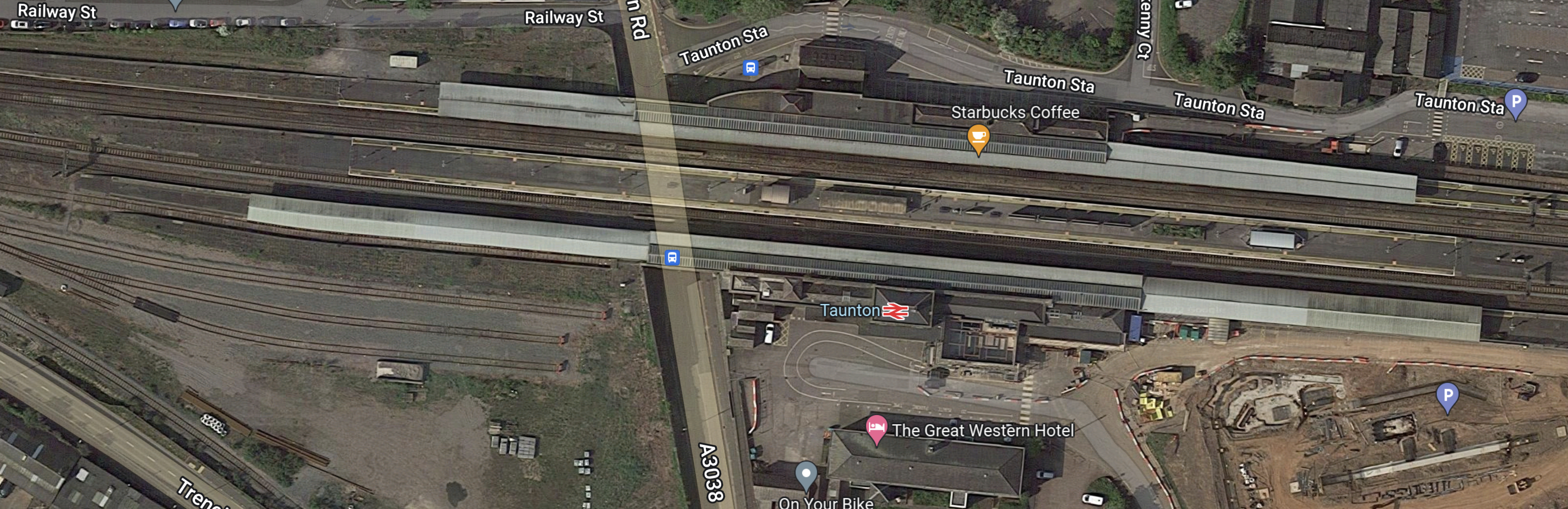
Note that there appears to be lots of space for development of rail and related development.
Both Branches Were/Are In Use Before Development
Before the Dartmoor Line was reopened, the route was in occasional use for both freight and passenger trains. Great Western Railway have in recent years run InterCity125 trains to Okehampton station.
With reopening the line to Okehampton, there was no major viaduct or bridges to rebuild, although Network Rail took the prudent decision to relay the track.
It would appear that the West Somerset Railway has similar use for both freight and passenger trains. How much work will be needed to bring it up to an acceptable standard.
Great Western Railway Are Providing Initial Weekend Services
On the Dartmoor Line services started between Exeter and Okehampton in 2019 and Wikipedia says this about initial services between Taunton and Bishops Lydeard station.
In 2019, the WSR entered into a partnership with the modern Great Western Railway (GWR) to operate Summer Saturday services to Bishops Lydeard from Taunton beginning on 27 July 2019. The introduction of these GWR services will mark the first time the station has been connected to the rest of the national rail network since its initial closure in 1971.
Is history going to repeat itself?
The First Step
This paragraph from the Rail Advent article, indicates the first step to reopening a service between Taunton and Minehead.
The first task will be to look at the simplest and most effective way in which the link between the WSR and the mainline can be improved, signalled, and operated. An outline business plan will then be developed to estimate how much it would cost.
This Google Map shows the link between the West Somerset Railway and the mainline.
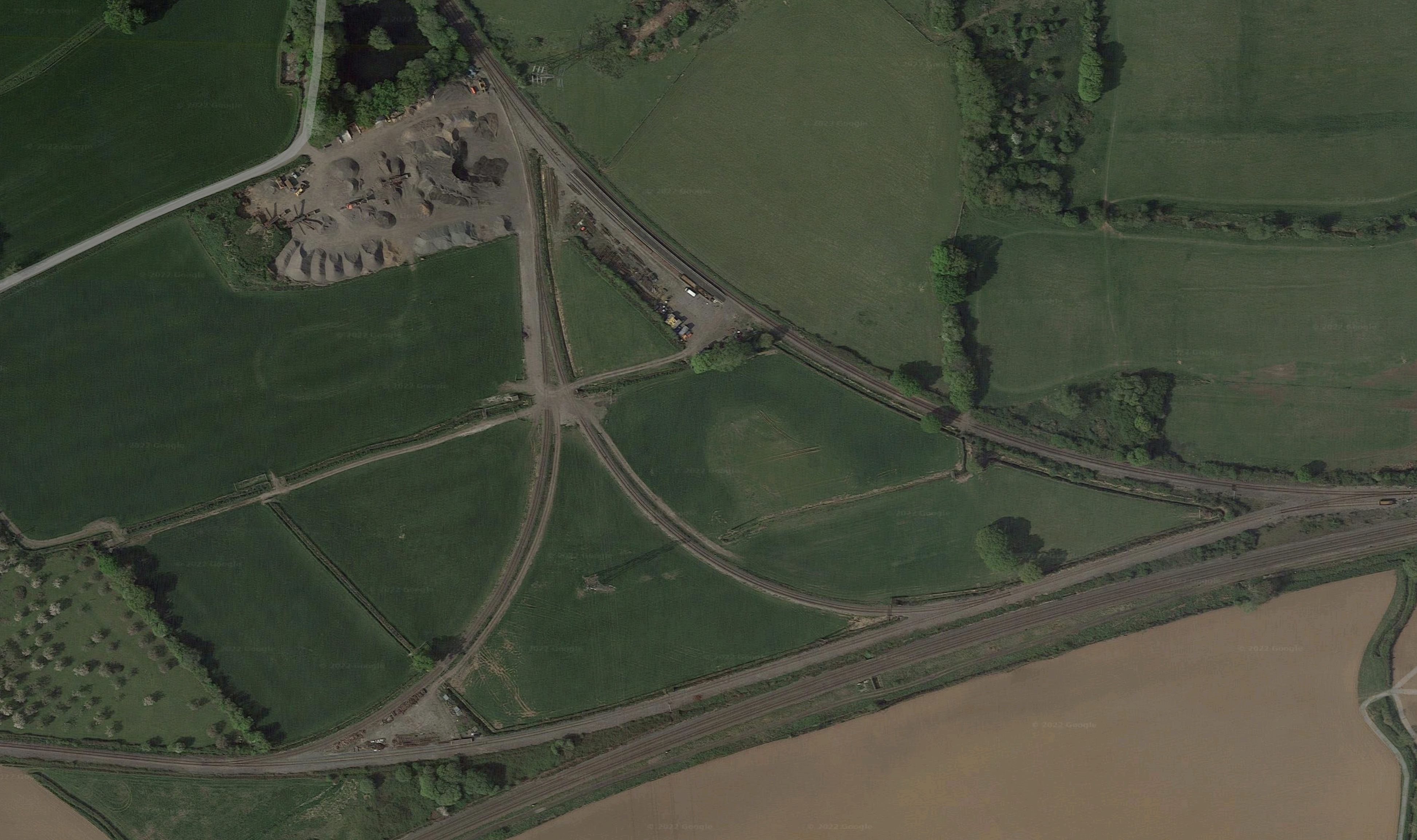
Note.
- The large triangular junction.
- The Bristol-Exeter railway runs East-West across the bottom of the map.
- Minehead is to the North.
- Taunton is to the East.
- A disused line to Barnstaple is to the West.
- The site to the West of the top of the triangular junction is a ballast cleaning site.
It does appear that there could be the space to create an efficient junction linking the two railways.
Initial Regular Services
This was one of the introductory paragraphs.
There is an increasing interest in re-opening long-closed stations and lines on the network. To this end, a partnership working group has been set up to look at the prospects of running scheduled trains between WSR’s Bishops Lydeard station and Taunton, which would safeguard the WSR’s long-term future.
This page on the Railway Touring Company web site is entitled The West Somerset Steam Express.
This paragraph describes the trip.
This series of trains from London Paddington to Minehead features haulage by two steam locomotives in one day.
One steam locomotive will haul our train from London Paddington to the West Somerset Railway at Bishops Lydeard.
The Heritage Railway will then provide a steam locomotive to haul our train to Minehead and back. This provides a truly fascinating day out travelling through beautiful scenery to the Bristol Channel coast.
So it looks like, the initial services on the between Taunton and Bishops Lydeard stations, will duplicate services that are already planned on a very much less frequent basis.
Bishops Lydeard Station
Bishops Lydeard station is the station, where mainline and West Somerset services meet.
This OpenRailwayMap shows the track layout at the station.
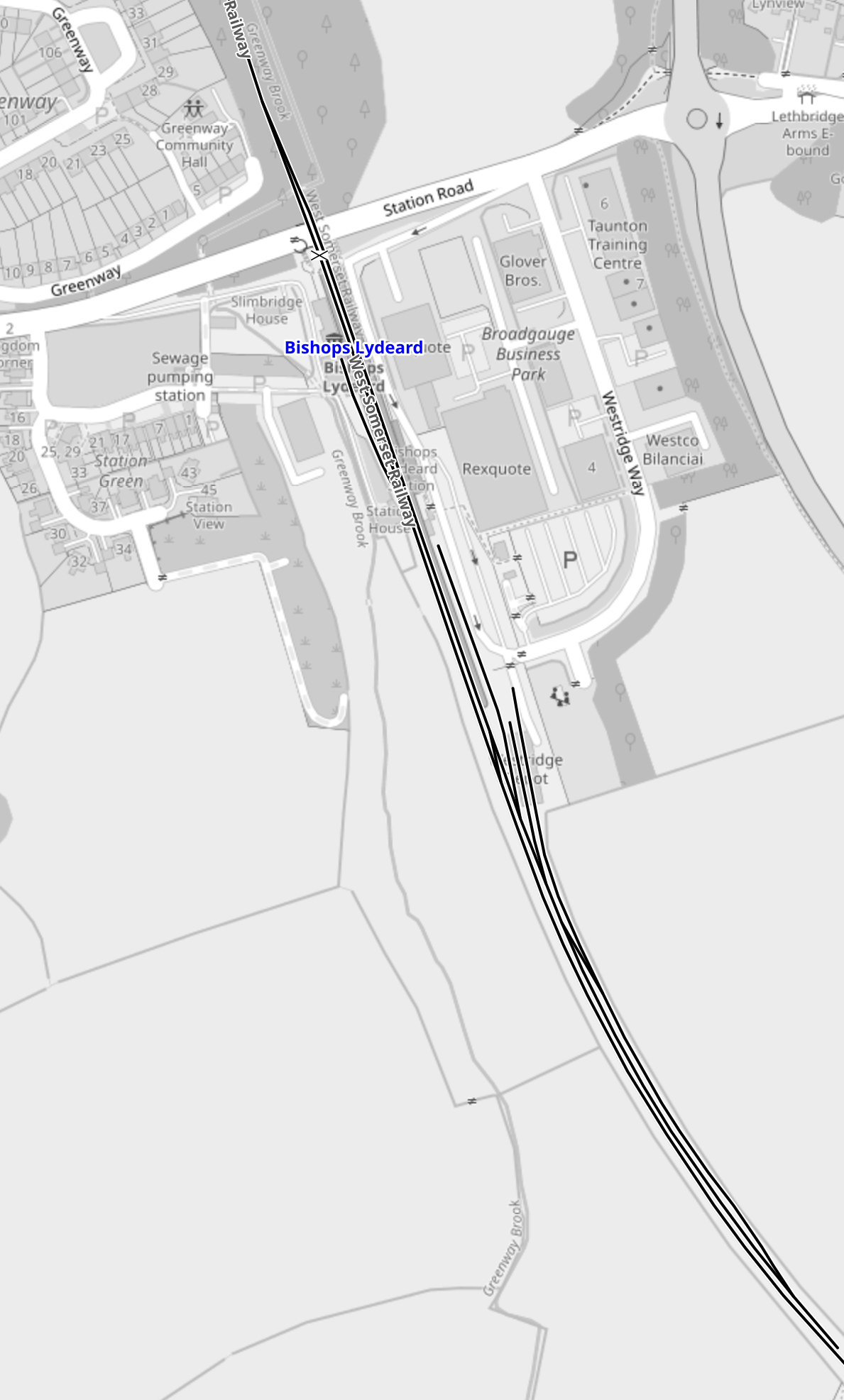
Note.
- The station is the Southern terminus of the West Somerset Railway.
- Track is single to the North and South of the station.
- Bishops Lydeard station has two platforms.
- There is a passing loop.
If the terminal station has a serious problem, it doesn’t appear to have much parking.
So it would appear, that a link to Taunton might improve the finances of the West Somerset Railway, by attracting more visitors.
Onward To Minehead
This OpenRailwayMap shows the last section of the West Somerset Railway to Minehead.
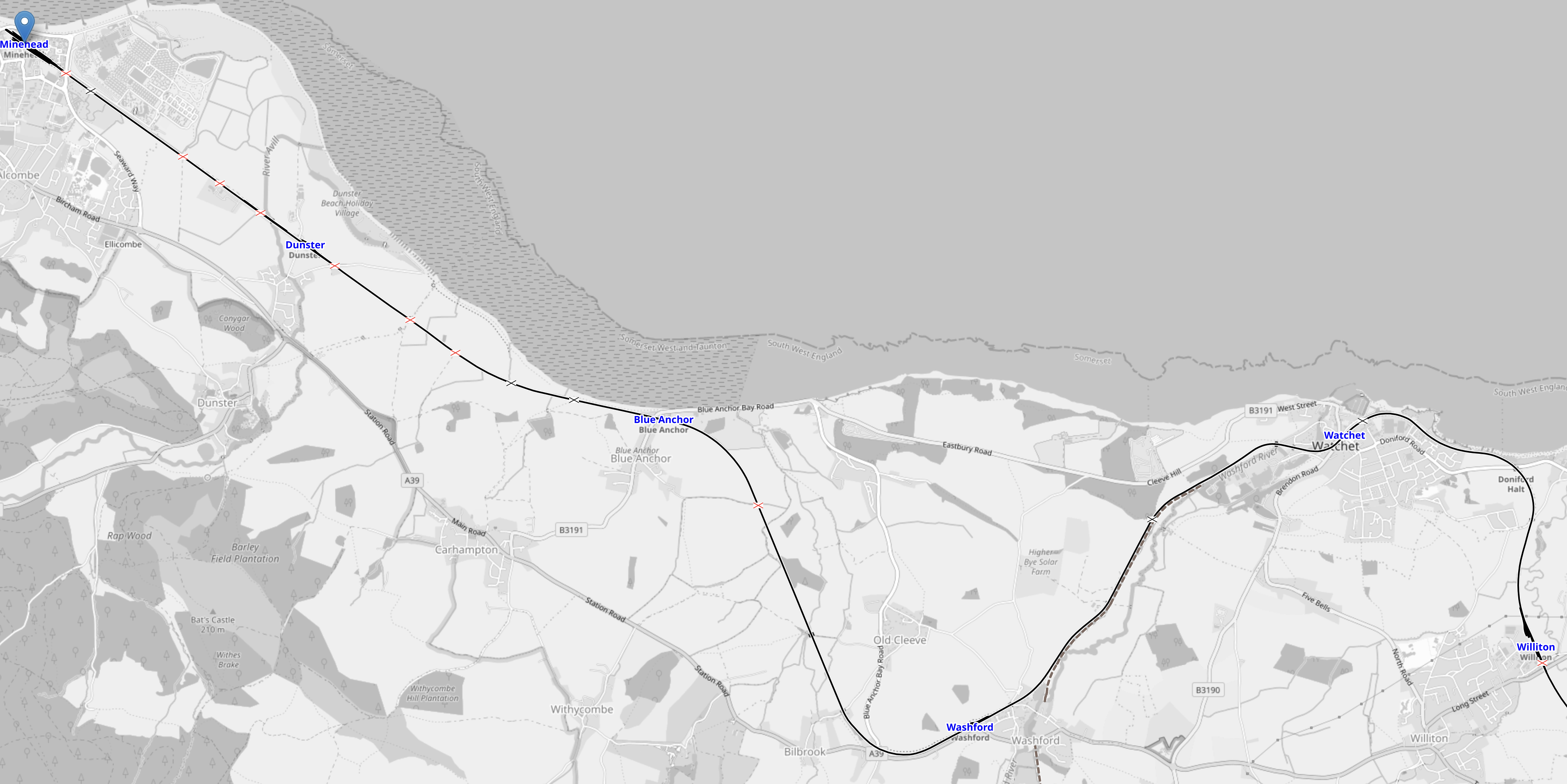
Note.
- Minehead station is in the North West corner of the map.
- Minehead station appears to be a well-equipped station, with two platforms.
- Minehead station even has a turntable for turning locomotives.
- There are four or five stations close to the coast.
The Wikipedia entry for Minehead, says this about the town.
The parish of Minehead has a population of approximately 11,981, making it the most populous town in the western part of the Somerset West and Taunton local government district, which in turn, is the worst area in the country for social mobility.
The West Somerset Railway could become both a useful and a real bucket-and-spade railway. Surely, that could generate revenue and level-up the area.
Financing
If you want something to work well, you must get the finances right.
I have lived in Dalston in London for twelve years now. When I moved here after my wife died and I had had a serious stroke, which left me unable to drive, I relied on an antiquated mainly bendy-bus-based public transport system.
Then along came the Overground and fleets of shiny new buses and Hackney and Dalston in particular was more than levelled up with London’s more salubrious boroughs.
Shopping improved with M & S returning after at least seventy years. There’s even a Pret, which boomed during the pandemic.
Transport for London got the financing for the Overground right and they created a success.
Conclusion
Can the initial working group find a financial model so that the West Somerset Railway can do for West Somerset, what the Overground has done for Dalston and the Dartmoor Line appears to be doing for Devon?
I thoroughly hope so!
 The Anonymous Widower