Are Zero- And Low-Alcohol Beers Cutting Road Accidents?
In The Times today, there is an article, which is entitled Drink-Driving ‘Effectively Legalised’ As Number Of Breath Tests Falls, where these are the first three paragraphs.
Drink-driving has effectively been legalised due to plummeting rates of breathalyser tests and light punishments for offenders, campaigners have warned.
The number of breath tests conducted by police has fallen by more than 62 per cent over the past decade as dangerously inebriated drivers receive short bans.
In 2009, police carried out 647,380 breath tests, but by 2023, that figure had fallen to just 240,322.
This later paragraph, adds a few more statistics.
In 2002, 18 per cent of breath tests were positive, compared to 16 per cent in 2023, while the number of drivers prosecuted for drink-driving offences has significantly decreased. Convictions for drink-driving fell from 55,300 in 2012 to 40,292 in 2023, coinciding with the sharp decline in breath testing.
Note, that in both extracts the latest comparison date is 2023, whereas the earliest date is 2009 and 2002.
This analysis is not the full picture, as there are two big differences between drinking in 2002 or 2009 and 2023.
The first difference is that 2002 and 2009 are pre-Covid, but 2023 is post-Covid.
So did Covid alter our drinking habits, which could have perhaps meant more people drank at home?
The second difference is that in 2023, zero and low alcohol beer was readily available.
I don’t drive, after a stroke ruined my eyesight, but I do drink up to four bottles a day of 0.5 % real ale. The beer I drink has been regularly available since 2017.
I wonder how many nominated drivers are now drinking these beers?
A serious survey and analysis needs to be done.
Thoughts On The NHS Infected Blood Scandal
In the early 1970s, I was working with the Chief Management Accountant of a retail bank, writing a computer system to analyse and compare the performance and costs of all their branches.
We used scatter diagrams and other graphical techniques to show all the branches on single sheets produced by line printers on a powerful time-shared computer. It would be so much easier today.
Any branch not following the rules was often found sitting alone away from the mass of branches on the graphs.
I remember one branch had costs, that were much higher than expected. It turned out it was the Stevenage Branch, where the premises were rented rather than owned freehold.
Expanding The System To Other Industries
The Accountant, who had also been Chief Accountant of a FTSE 500 company, felt that the techniques we had developed had other applications in the management and auditing of large companies and organisations.
Sadly my partner in crime, died of cancer and I went on to other things.
From my own generally good family experiences of the NHS, I feel that this sort of analysis used rigorously could give early warning of some of the scandals we’ve seen in the NHS.
Around the turn of the century, I used similar techniques to improve the manufacturing quality in a diesel engine factory.
Conclusion
Perhaps we need an independent Office of NHS Responsibility?
Gluten Sensitivity And Epilepsy: A Systematic Review
Yesterday, The Times published this article, which was entitled ‘Game-Changing’ NHS Laser Therapy To Prevent Epileptic Seizures.
One reader had made this comment.
Be ace too if they can tweak to help migraine.
I used to suffer from something like migraine about thirty years ago. But after being found to be coeliac and going gluten-free, what ever it was seemed to disappear from my life.
Type “Coeliac Disease and Migraine” into Dr. Google and there are lots of references.
This indicates to me that serious scientists and doctors, must believe there could be a link.
There certainly is with me and going gluten-free eased my migraine-like symptoms.
I then typed “Coeliac Disease and Epilepsy” into Dr. Google and found this paper, which was entitled Gluten Sensitivity And Epilepsy: A Systematic Review.
This information is from the Abstract of the paper
Objective
The aim of this systematic review was to establish the prevalence of epilepsy in patients with coeliac disease (CD) or gluten sensitivity (GS) and vice versa and to characterise the phenomenology of the epileptic syndromes that these patients present with.
Methodology
A systematic computer-based literature search was conducted on the PubMed database. Information regarding prevalence, demographics and epilepsy phenomenology was extracted.
Results
Epilepsy is 1.8 times more prevalent in patients with CD, compared to the general population. CD is over 2 times more prevalent in patients with epilepsy compared to the general population. Further studies are necessary to assess the prevalence of GS in epilepsy. The data indicate that the prevalence of CD or GS is higher amongst particular epileptic presentations including in childhood partial epilepsy with occipital paroxysms, in adult patients with fixation off sensitivity (FOS) and in those with temporal lobe epilepsy (TLE) with hippocampal sclerosis. A particularly interesting presentation of epilepsy in the context of gluten-related disorders is a syndrome of coeliac disease, epilepsy and cerebral calcification (CEC syndrome) which is frequently described in the literature. Gluten-free diet (GFD) is effective in the management of epilepsy in 53% of cases, either reducing seizure frequency, enabling reduced doses of antiepileptic drugs or even stopping antiepileptic drugs.
Conclusion
Patients with epilepsy of unknown aetiology should be investigated for serological markers of gluten sensitivity as such patients may benefit from a GFD.
My Thoughts
These are my thoughts.
Coeliacs Prior To 1960
Consider.
- Even if my excellent GP; Doctor Egerton White, felt I was coeliac, there was no test until 1960 for coeliac disease.
- And the test that was developed using endoscopy wasn’t anywhere near to the endoscopies of the present day.
- My late wife, who was a family barrister, likened the test to child abuse on a young child.
- I have heard some terrible horror stories of doctors looking for coeliac disease in young children in the 1950s.
- But there were some successes. A friend of mine, who is in her eighties, was successfully diagnosed by her parents using food elimination. But they were both GPs.
- Recently, I’ve met two elderly ladies, who only in the last couple of years have been diagnosed as coeliacs.
Luckily, I was never tested until 1997 and I was diagnosed in 48 hours, by gene testing.
Methodology
The methodology was based on a systematic computer-based literature search of the PubMed database.
This has these advantages.
- The rules for the search can be published and peer-reviewed.
- Its Wikipedia entry says PubMed is a free database including primarily the MEDLINE database of references and abstracts on life sciences and biomedical topics.
- The technique can surely be applied repeatedly, to see how results are changing with time.
- The search can be modified to analyse any topic, drug or condition, that appears in the PubMed database.
- The analysis could surely be applied to other databases.
As a writer of data analysis software, developing this sort of software, would be really enjoyable.
Norway’s Answer To Wind Power Intermittency Lies Offshore – Study
The title of this post, is the same as that of this article on offshoreWIND.biz.
This is the first paragraph.
SINTEF has revealed in its recent study that there is no statistical covariation or systematic correlation in time between the occurrence of offshore wind conditions in southern and northern Norway, and adds that this knowledge will increase the commercial value of Norwegian offshore wind energy.
It does seem lucky for the Norwegians, that their wind farms appear to be able to supply a more constant amount of electricity, than many of those against wind farms would have you believe.
I hope that a reputable UK agency or university, is doing a similar analysis for UK wind farms.
I Can Now See Why A Big Pharma Company Liked My Software Daisy
Yesterday, I went to a seminar about medical research.
There was a presentation, where data in several dimensions was shown and the data was crying out for a Daisy Chart.
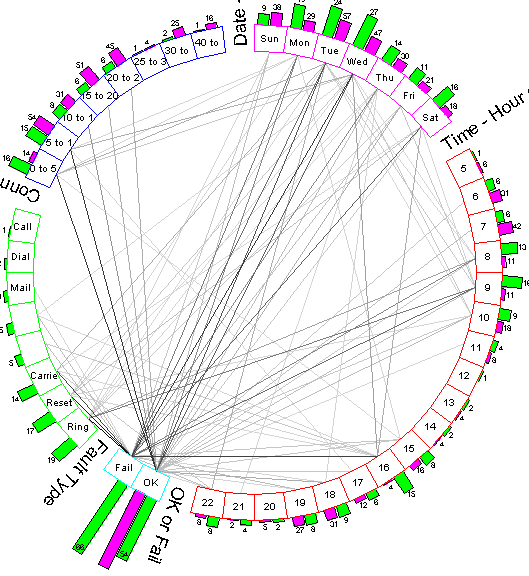
A Daisy Chart
This chart is a very simple presentation of telephone data, but I can imagine arcs showing factors like Dose, Blood Pressure, Sex, Patient Satisfaction etc.
Note.
- This chart is what I call a Day of the Week/Hour of the Day chart, which is a powerful way of looking at any time-based data, like faults or A & E arrivals.
- You can click on the nodes and links of the chart to access the data underneath. So if you wanted all female patients with high blood pressure in a separate Excel spreadsheet, this is possible with a couple of clicks.
- The charts can also be clipped from the screen and inserted into reports.
Daisy was used by one Big Pharma company twenty years ago and after yesterday’s presentation, I can understand, why they used it.
The seminar changed my mind about my attitude to Daisy and I got rather fired up about its possibilities.
State Of The Railway Compiler Data Solution (SORClite): Open Access Real-Time Signalling Data
This project was one of the winners in the First Of A Kind 2022 competition run by Innovate UK.
In this document, this is said about the project.
Project No: 10038973
Project title: State Of The Railway Compiler Data Solution (SORClite): Open Access Real-Time Signalling Data
Lead organisation: PARK SIGNALLING LIMITED
Project grant: £217,128
Public description: Our project seeks to support Network Rail in regaining understanding and ownership of key
signalling asset information so that this data can be used to adopt new performance measures,
identify bottlenecks within the rail network and target the 800,000 unexplained delay minutes that
occur annually. The project combines a number of existing technologies to deliver the hardware,
pipeline, analytics, and visualisation as a working demonstration. The data stores will also be
available for use by train operators and the wider data analytics supply chain, removing some of
the systemic blockers around access to data.
My Thoughts And Conclusion
National Grid Installs LineVision Sensors To Expand The Capacity Of Existing Power Lines
The title of this post, is the same as that of this press release from National Grid.
These are four bullet points from the press release.
- LineVision’s Dynamic Line Rating (DLR) technology trialled for first time in Great Britain following successful deployment on National Grid’s electricity networks in the US.
- The sensors and data analytics platform will highlight spare capacity on overhead power lines allowing for the integration of more renewable power.
- Technology has the potential to unlock 0.6GW of additional capacity, enough to power more than 500,000 homes and save £1.4 million in network operating costs per year based on the results from the US networks.
- Combined with the construction of new infrastructure, the innovative technology forms part of National Grid’s work to upgrade and adapt the electricity network to meet increased demand and help deliver a net zero grid.
In some ways this seems like the sort of story, that could be filed under Too-Good-To-Be-True.
But as a Graduate Control Engineer, I’m willing to give National Grid and LineVision the benefit of the doubt.
- It appears to be technology proven in the United States.
- That experience should feed over, once the manuals are translated into the dual English-American form of English.
- I suspect that applying this technology to interconnectors could increase their capacity.
- I also think that as we add more storage, power sources or interconnectors to our electricity network, this will open up more savings.
- As the UK power network gets more complicated, the system should come into its own.
This is an excellent decision by National Grid.
Does Anybody Have Good Contacts At Network Rail?
In the 1980s, I did some business with British Rail, as it then was.
I provided my Daisy software and they used it to analyse signal failures.
It led to a guy called J S Firth, writing a paper called Failure Recording And Analysis On British Rail.
He had the courtesy to send me a copy of the paper, which mentions SigTech, which appears to have been a business unit of the British Railways Board.
All my dealings with Firth and his colleagues were in person at an office block in front of Marylebone station, which is now a posh hotel.
And then, a few months ago, someone contacted me from Network Rail.
Apparently, his father had worked on the signal failure project with me and he was now working in Milton Keynes for Network Rail on a similar project.
He asked if I had a copy of the paper.
At the time, I didn’t, but today I had a small sort out and found a copy.
Unfortunately, I have now lost the piece of paper on which I wrote the guy’s details.
Does anybody have any ideas, how I can find the guy, who contacted me?
Novac Djokovic Is Screwed, Glued And Tattooed By The BBC
This article on the BBC is entitled Novak Djokovic: Doubts Over Timing Of Covid Test.
This is the introductory paragraph.
BBC research has cast doubt on the timing of the positive Covid test Novak Djokovic used to enter Australia to try to compete in the Australian Open.
The BBC have done some impeccable research on the tests and their dates.
Read it, as nothing they did was difficult, once they had details of all the tests.
As my old company accountant would say.
Novac Djokovic Is Screwed, Glued And Tattooed.
But then the accountant had ways of making money and numbers talk and perform!
In my life, I’ve had three accountants as friends and all have shown me simple ways to detect fraud.
One even showed me how to dress up a spreadsheet, so that a banker would believe it. As he had been Chief Accountant of one the most famous names in British industry, I always wrote my software to his rules.
 The Anonymous Widower