Audacious’ Contract To Revive Nancy – Contrexéville Route
The title of this post, is the same as that of this article on Railway Gazette.
These first two paragraphs give more details of the project.
The 89 km route from Nancy to Contrexéville, much of which has been closed to passenger and freight traffic since 2016, is to reopen in December 2027. This follows the award by the Grand Est regional council on May 24 of a contract to a private-sector consortium formed of Transdev SA, NGE Concessions and Caisse des Dépôts et Consignations.
The ‘audacious’ 22-year concession deal is worth €721m and covers both rehabilitation of the line at a cost of €150m plus management of the infrastructure and operations. Following detailed studies, work on the ground is expected to start in April 2025.
This OpenRailwayMap shows the route.

Note.
- Nancy is at the top of the map in the middle.
- Contrexéville is in the South-West corner of the map.
- Vuttel is shown by the blue arrow.
- The distance between Nancy and Contrexéville is 89 kilometres.
- It appears to be a double-track railway.
As the picture in the Railway Gazette article shows, the route needs to be refurbished.
These are my thoughts.
The Route Will Be Operated By An Augmented Form Of Open Access
- An augmented form of open access will seem to be used to run services.
- The infrastructure will be donated to the regional government.
- Upwards of a dozen round trips per day will be run.
Nothing is said about the traction to be used!
Modernised, it could be an interesting route for tourism.
Will It Provide A New Route Between Metz and Dijon?
Consider.
Metz with TGV connections, is not far to the North of Nancy.
Dijon with TGV connections, is not far to the South of Contrexéville.
These connections could be invaluable for tourism and development of the area.
This map shows the South-Western section of the route between Contrexéville and Vittel.
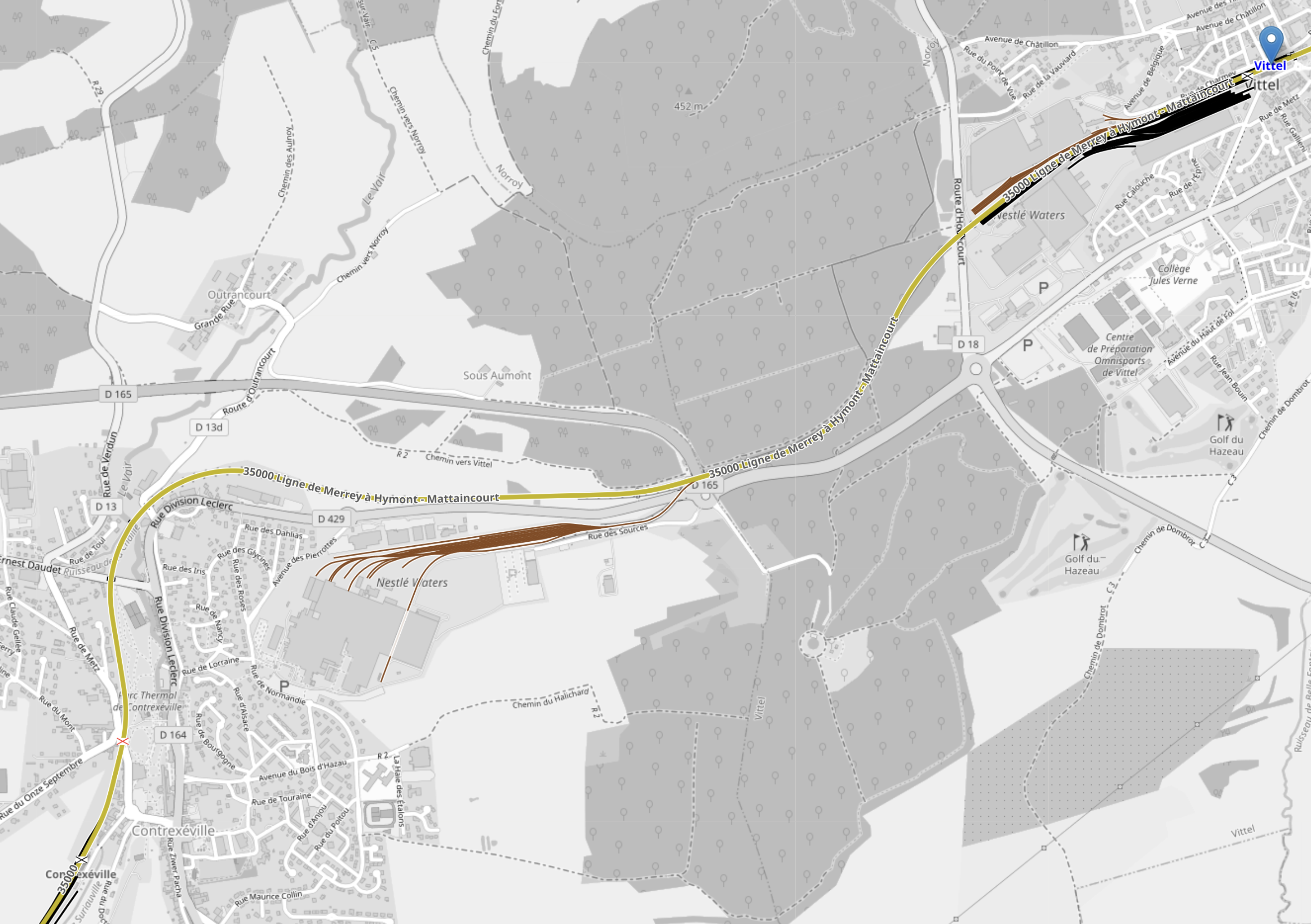
Note.
- Vittel is marked by the blue arrow in the North-East corner of the map.
- Contrexéville is in the South-West corner of the map.
- In the middle of the map are sidings, which are marked Nestlé Waters.
- There appear to be sidings at Contrexéville and Vittel
In From 2025, Nestlé Waters France Will Use The First Hydrogen-Powered Freight Train Through An Innovative Solution Developed by Alstom and ENGIE, I talk about how Nestlé will move water from the Vosges, using hydrogen-hybrid locomotives pulling freight trains.
This is a visualisation of the train.
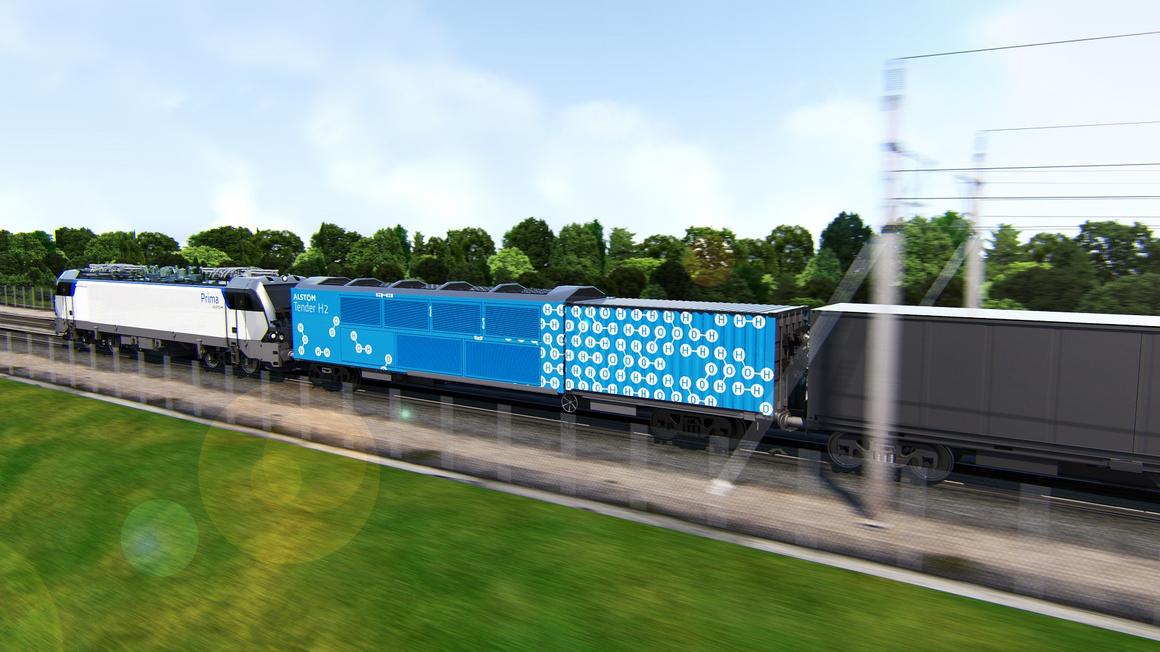
This is said in the original Alstom press release.
From 2025, this freight train powered by electricity from the rail network and from hydrogen in non-electrified sectors will aim to progressively ensure the transport of VITTEL® natural mineral water between the factory located in the Vosges and its various distribution centers in France (i.e Vittel/Arles 600 kms and Vittel/Montreuil-Bellay 760 kms). The dual-mode solution will be composed by a generator wagon incorporating a high-power fuel cell system powered by renewable hydrogen and a line-electric locomotive, all connected by an electrical power cable. The generating wagon will be able to supply the locomotive with electricity in the without the need for any catenary.
It does appear, that within a year or to, freight trains from between Contrexéville and Vittel will be hauled by hydrogen-hybrid locomotives.
- Trains to and from Montreuil-Bellay could go via Nancy or Contrexéville.
- Trains to and from Arles could go via Contrexéville.
I suspect at present all trains have to go via Contrexéville.
If the Nancy and Contrexéville route were to be rebuilt and could take the water trains, this would open up routes to the Channel Ports and Belgium, Luxembourg, Northern France, Northern Germany and The Netherlands.
- Hydrogen trains would certainly advertise the zero-carbon nature of the transport.
- It has to be remembered that a couple of years ago, Highland Spring opened a rail distribution facility in Scotland, with the aim of moving 40 % of their water by rail.
I wonder if Nestlé are building a zero-carbon rail network for the delivery of their bottled waters.
What Traction Would Be Used For Passenger Trains?
Consider.
- The distance between Nancy and Contrexéville is 89 km or 55 miles.
- This distance, is within the range for battery-electric and hydrogen-powered trains.
- There is reason to believe that Nestlé’s water trains will be hydrogen-powered.
I suspect either battery-electric and hydrogen-powered trains could be used.
Reform UK leader Richard Tice To Stand In Boston And Skegness
The title of this post, is the same as that of this article on the BBC,
This is the sub-heading.
The leader of Reform UK has announced he is to stand as a candidate in Boston and Skegness at the general election.
Anr this is the first paragraph.
Richard Tice announced his intention to stand in the Lincolnshire constituency on social media on Thursday morning.
This article on The Times is entitled What are Reform UK’s Policies — And How Is The Party Polling?
The article has these two paragraphs on energy, decarbonisation and net-zero.
Energy and net zero is another major area of focus. Tice has referred to net zero as “net stupid” and wants to accelerate the granting of oil and gas licences in the North Sea.
Reform has said all existing carbon emissions targets should be abandoned, due to what it says is an unfair burden being placed on taxpayers and consumers.
I shall do some arithmetic to give a few pointers to the constituency he hopes to win.
The Boston and Skegness constituency is a large green energy hub, where in a few years electricity from various source will be collected for distribution to East Anglia and the South of England.
Currently, in operation, under construction or in planning, are the following sources of green electricity.
- Viking Link is a 1.4 GW interconnector between Bicker Fen in Lincolnshire and Denmark.
- EGL3 is a 2 GW interconnector between Lincolnshire and Peterhead in Scotland.
- EGL4 is a 2 GW interconnector between Lincolnshire and Westfield in Scotland.
- Lincs is a 270 MW wind farm.
- Lynn and Inner Dowsing is a 194 MW wind farm.
- Outer Dowsing is a 1500 MW wind farm.
- Triton Knoll is a 857 MW wind farm.
- Race Bank is a 573 MW wind farm.
Note.
- The three interconnectors can send electricity in both directions.
- The wind farms are in North-South order.
- There would appear to be space in the sea for more wind farms.
- The 950 MW Spalding gas-fired power station is available locally, when the wind is on strike.
- The owners of Spalding power station are rumoured to be putting a large battery alongside the power station.
The totals are as follows.
- 1.4 GW – Interconnector to Denmark
- 4 GW – Interconnector to Scotland
- 3.4 GW – Wind farms
- 1 GW – Gas-fired power station.
These total up to 9.8 GW of power.
Conclusion
Consider.
- It would appear that Richard Tice of Reform UK, has decided to stand in a constancy with one of the highest levels of green energy and energy security in the UK.
- It is also likely to be a constituency, which in the future will benefit from investment and employment, as more wind farms are developed in the North Sea.
It looks to me, that he’s a politician with very little mathematical ability.
UK Breakthrough Could Slash Emissions From Cement
The title of this post. is the same as that of this article on the BBC.
This is the sub-heading.
Scientists say they’ve found a way to recycle cement from demolished concrete buildings.
These five paragraphs outline, why cement is such an environmental problem.
Cement is the modern world’s most common construction material, but it is also a huge source of planet-warming gas emissions.
That is because of the chemical reactions when you heat limestone to high temperatures by burning fossil fuels.
Recycling cement would massively reduce its carbon footprint. Researchers say that if they switched to electric-powered furnaces, and used renewable energy like wind and solar rather than fossil fuels, that could mean no greenhouse gases would be released at all.
And that would be a big deal. Cement forms the foundation of the modern economy, both literally and metaphorically.
It is what binds the sand and aggregate in concrete together, and concrete is the most widely used material on the planet after water.
If cement was a country, it would be the third biggest source of emissions after China and the US, responsible for 7.5% of human-made CO2.
This article shows how by applying chemical magic to two effectively unrelated processes; the recycling of steel and the recycling of concrete to make new cement, very high rewards are possible.
Cambridge University are calling their new product electric cement.
As large amounts of electricity are used in an arc furnace, to produce the two products
These paragraphs outline the innovative Cambridge process.
Cement is made by heating limestone to up 1600 Celsius in giant kilns powered by fossil fuels.
Those emissions are just the start. The heat is used to drive carbon dioxide from the limestone, leaving a residue of cement.
Add both these sources of pollution together and it is estimated that about a tonne of carbon dioxide is produced for every tonne of cement.
The team of scientists,, has found a neat way to sidestep those emissions.
It exploits the fact that you can reactivate used cement by exposing it to high temperatures again.
The chemistry is well-established, and it has been done at scale in cement kilns.
The breakthrough is to prove it can be done by piggybacking on the heat generated by another heavy industry – steel recycling.
When you recycle steel, you add chemicals that float on the surface of the molten metal to prevent it reacting with the air and creating impurities. This is known as slag.
The Cambridge team spotted the composition of used cement is almost exactly the same as the slag used in electric arc furnaces.
They have been trialling the process at a small-scale electric arc furnace at the Materials Processing Institute in Middlesbrough.
These are my thoughts.
The Only Inputs Are Steel Scrap, Green Electricity And Used Cement
Consider.
- We probably need to increase the percentage of steel scrap we collect.
- Gigawatts of green electricity in a few years, will be available in those places like Port of Ardersier, Port Talbot, Scunthorpe and Teesside, where large amounts of steel will be needed.
- I can envisage large steel users having their own hybrid electric cement/electric arc furnace plants.
- Used cement would be collected and brought to the plants.
- Years ago, I used to live next door to an old World War II airfield. The farmer who owned the airfield, told me, that the concrete was his pension, as when he needed money, he called a company, who crushed it up for aggregate.
I can see a whole new integrated industry being created.
Conclusion
This could be one of the best inventions since sliced bread.
C-Capture Launches Innovative Carbon Capture Trial For Cement Industry
The title of this post, is the same as that of this news item from C-Capture.
This is the sub-heading.
C-Capture, developers of next generation technology for carbon dioxide removal, has launched a new carbon capture trial in the cement manufacturing sector in partnership with Heidelberg Materials.
This is the first paragraph.
The trial, which utilises C-Capture’s innovative solution for industrial decarbonisation, is taking place at Heidelberg Material’s cement manufacturing plant in Ketton. It forms part of C-Capture’s national project, ‘XLR8 CCS – Accelerating the Deployment of a Low-Cost Carbon Capture Solution for Hard-to-Abate Industries’. Working with project partners across the UK, C-Capture’s XLR8 CCS project will demonstrate that a low-cost carbon capture solution is a reality for difficult-to-decarbonise industries in the race to net zero.
I wrote about C-Capture’s technology in Could Drax Power Station Solve The Carbon Dioxide Shortage?
The technology appears to have been spun out of Leeds University.
BP and Drax are investors.
This page on the C-Capture web site is called Technology and has a very neat interactive guide to how the technology works.
Conclusion
I have high hopes for this company and its technology.
Electricity Networks Accelerate Potential Connection Dates Of Over 200 Clean Energy Projects
The title of this post, is the same as that of this press release from National Grid.
This is the sub-heading.
7.8GW of clean energy projects, more than double the output of Hinkley Point C nuclear power station, have had their connection offer dates brought forward by up to 10 years through the Technical Limits programme, which is allowing projects to connect to lower voltage distribution networks prior to reinforcement of the high voltage transmission network.
These are the first two paragraphs.
Networks have so far sent offers to 203 projects totalling 7.8GW with an average connection acceleration of 6.5 years. In total 393 projects are eligible for the programme with the further 190 projects able to receive accelerated offers once they have progressed through the connection offer process. Last month a solar farm near Bridgwater in Somerset became the first project to be energised under this scheme. Horsey Levels solar farm, which will provide clean energy for 10,000 homes annually, connected to National Grid’s electricity distribution network significantly ahead of its original planned connection date. This initial acceleration has been delivered in the first phase of the Technical Limits programme, with further phases and analysis planned.
Technical Limits, a collaborative project from National Grid Electricity Transmission, Energy Networks Association, the Electricity System Operator and the Distribution Network Operators (DNOs) forms part of the ongoing collaborative industry efforts, together with Ofgem and government, to speed up and reform connections to the grid. Scottish Transmission and Distribution network owners have been involved in developing the Technical Limits programme and are in the process of rolling out the programme in their license areas also.
Note.
- National Grid seem to measure large amounts of power, with respect to Hinkley Point C nuclear power station, which will have an output of 3.26 GW.
- The Technical Limits programme seems to be a sensible idea.
- Was the idea thought up by National Grid or is it an idea borrowed from another country?
- If it allows another 7.8 GW of clean electricity projects to be connected an average of 6.5 years earlier, then there can’t be much wrong with the idea.
- Horsey Levels solar farm is to the East of the M5, just to the North of Bridgwater.
I shall be following the roll-out of National Grid’s Technical Limits programme, as more clean power projects are connected to the grid.
National Grid And Innovation
This is another post about innovation at National Grid.
Others include.
- £9.2m Electricity Research Project To Save 39,000 Tonnes Of C02 Gets Go-Ahead, which talks about modifying transmission lines to carry more electricity. This means, that theoretically, we’ll need less and smaller transmission lines.
- £400k For National Grid Innovation Projects As Part Of Ofgem Fund To Help Shape Britain’s Net Zero Transition, which talks about Ofgem grants to fund innovation.
- National Grid Fast-Tracks Overhead Line Upgrade Project To Help Accelerate Connection Dates Of 175 Clean Energy Projects, which describes acceleration of projects.
- National Grid To Accelerate Up To 20GW Of Grid Connections Across Its Transmission And Distribution Networks, which also describes acceleration of projects.
- National Grid Goes Carbon-Free With Hydrogen-Powered Substation Trial, which describes work to use hydrogen as back-up power for substations.
- University Of Manchester And National Grid Team Up To Develop SF6-Free Retrofill Solution For Electricity Network, which describes a project to remove SF6 from the grid. SF6 is a greenhouse gas.
- National Grid Installs LineVision Sensors To Expand The Capacity Of Existing Power Lines, which describes an interesting idea from the United States.
- National Grid ESO And Reactive Technologies Launch Flagship Inertia System To Measure Grid Stability, which describes an innovative Spanish way to measure grid stability.
Note.
- I have included projects, that accelerate connection of new projects to the grid.
- Does National Grid benefit from operating grids in the UK and US, as it gets offered the best technology from both sides of the Pond?
National Grid seem to be big innovators.
How Hydrogen Will Power The Green Construction Eevolution
The title of this post, is the same as that of this news item from Ryze Hydrogen.
These two paragraphs introduce the news item.
According to the International Energy Agency buildings operations and construction emissions account for more than one-third of global energy-related emissions, significantly contributing to environmental degradation, with heavy machinery and standby power solutions relying heavily on fossil fuels.
Yet here at Ryze we know the industry stands on the brink of a green revolution, as clean energy solutions lead the charge towards decarbonisation.
The news item, is a must-read for anybody involved in construction.
Recently, a gas leak killed the roadside tree outside my house. I wrote about the incident in It Looks Like The Gas Leak Has Killed The Tree Outside My House.
What I didn’t say, was that when they cleaned up the mess, I had an eight-wheeled diesel truck with a grab, working outside my house for a couple of hours, spewing fumes everywhere.
Hopefully, green construction is friendlier to the neighbours and the workers on site.
High Speed Two is using green construction for this reason in sensitive locations.
BW Ideol And Holcim To Explore Use of Low-Carbon Concrete In Floating Offshore Wind
The title of this post, is the same as that of this article on offshoreWIND.biz.
This is the sub-heading.
BW Ideol and Holcim have signed a Memorandum of Understanding (MoU) for a feasibility study on supplying beneficial low-carbon concrete for the floating offshore wind industry, with particular reference to Scotland.
These are the first three paragraphs.
BW Ideol and Holcim aim to collaborate on optimising the supply of the innovative concrete needed for the intended mass production of BW Ideol’s floaters in the Port of Ardersier.
Low-carbon concrete’s advantages as a building material for offshore wind farms include its durability in marine environments, its local availability and its comparatively lower carbon emissions, the companies said.
The collaboration includes developing specific durable maritime low-carbon concrete mixes with enhanced mechanical performance perfectly suited to slipform application.
This is surely a good development.
Europe’s First Commercial-Scale Floating Offshore Wind Farm Secures All Planning Approvals
The title of this post, is the same as that of this article on offshoreWIND.biz.
This is the sub-heading.
Flotation Energy and Vårgrønn, a joint venture between Plenitude (Eni) and HitecVision, have obtained the offshore planning approval for the Green Volt floating wind farm offshore Scotland.
This is the first paragraph.
With onshore consent announced earlier this month, Green Volt has now received all its planning approvals and remains on track to be the first commercial-scale floating offshore wind farm in Europe.
Note.
- This is the Green Volt web site.
- Capacity will be between 300 and 560 MW.
- It should be fully operational by 2029.
- It is an INTOG wind farm designed to decarbonise offshore oil and gas fields.
It will also have the side effect of bringing more gas ashore in the UK, instead of burning it to power the platforms.
£9.2m Electricity Research Project To Save 39,000 Tonnes Of C02 Gets Go-Ahead
The title of this post, is the same as that of this press release on National Grid.
These four paragraphs detail the project.
National Grid Electricity Transmission (NGET) has been successful in securing £8.12m of funding from Ofgem’s Network Innovation Competition (NIC) to research the uprating of overhead lines, with the remainder being funded by National Grid.
The RICA (Retro-Insulated Cross-Arms) research project will commence in early 2021 and aims to develop an innovative method for uprating overhead lines, allowing the voltage on 275kV overhead lines to be increased to 400kV. This potentially paves the way for uprating 400kV lines to 550kV in the future.
By removing the suspended insulators on these overhead lines and instead insulating the cross arms, the wires will be held higher and further apart, thereby enabling an increased voltage to be carried.
Uprating lines in this way could allow 45% more power to be carried on some existing routes and support significant reductions in UK CO2 emissions – 39,000 tonnes. This could deliver up to £286m of efficiencies to consumers and with future development, it could open the door to ultra-high voltage networks in the UK.
This is a National Grid picture of fitters installing the new system.
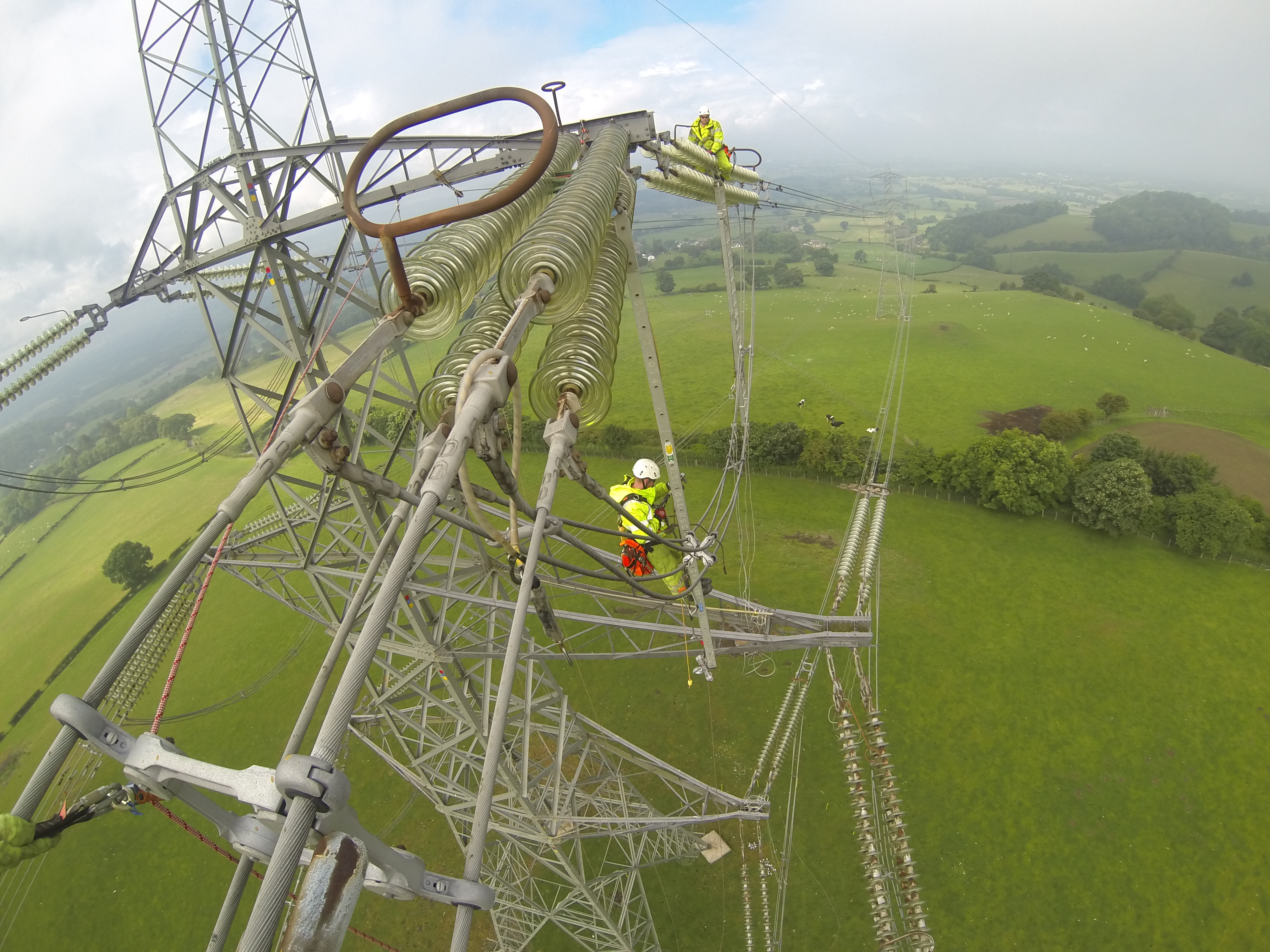
Note.
- Surely, if you can increase the capacity of an electricity line by 45 %, by using innovation and just changing the insulators, this would be much cheaper, than adding another high voltage line.
- It would also incur less legal costs and disruption, than a second line.
I like this idea and hopefully it will please the Nimbies.
More About RICA
This web page is the RICA web site.
This document gives a lot more information.
Conclusion
It appears to be a simple solution to increasing the capacity of the grid.
I’d like to see some recent results.
Rolls-Royce To Be A Partner In Zero-Carbon Gas-Fired Power Station In Rhodesia
This press release from Rolls-Royce is entitled Rolls-Royce, Landmark And ASCO Collaborate On CO2 Recovery Power Generation Solutions.
These three bullet points serve as sub-headings.
- Cooperation plans to develop solutions for clean power generation with carbon capture from gas reciprocating engines
- Captured CO2 will be available for use in industries such as food, Efuels, sustainable aviation fuels (SAF), cement and plastic production
- First of-its-kind flexible power generation and carbon capture plant currently under construction in Nottinghamshire, UK
This image shows a Rolls-Royce mtu Series 4000 gas genset.
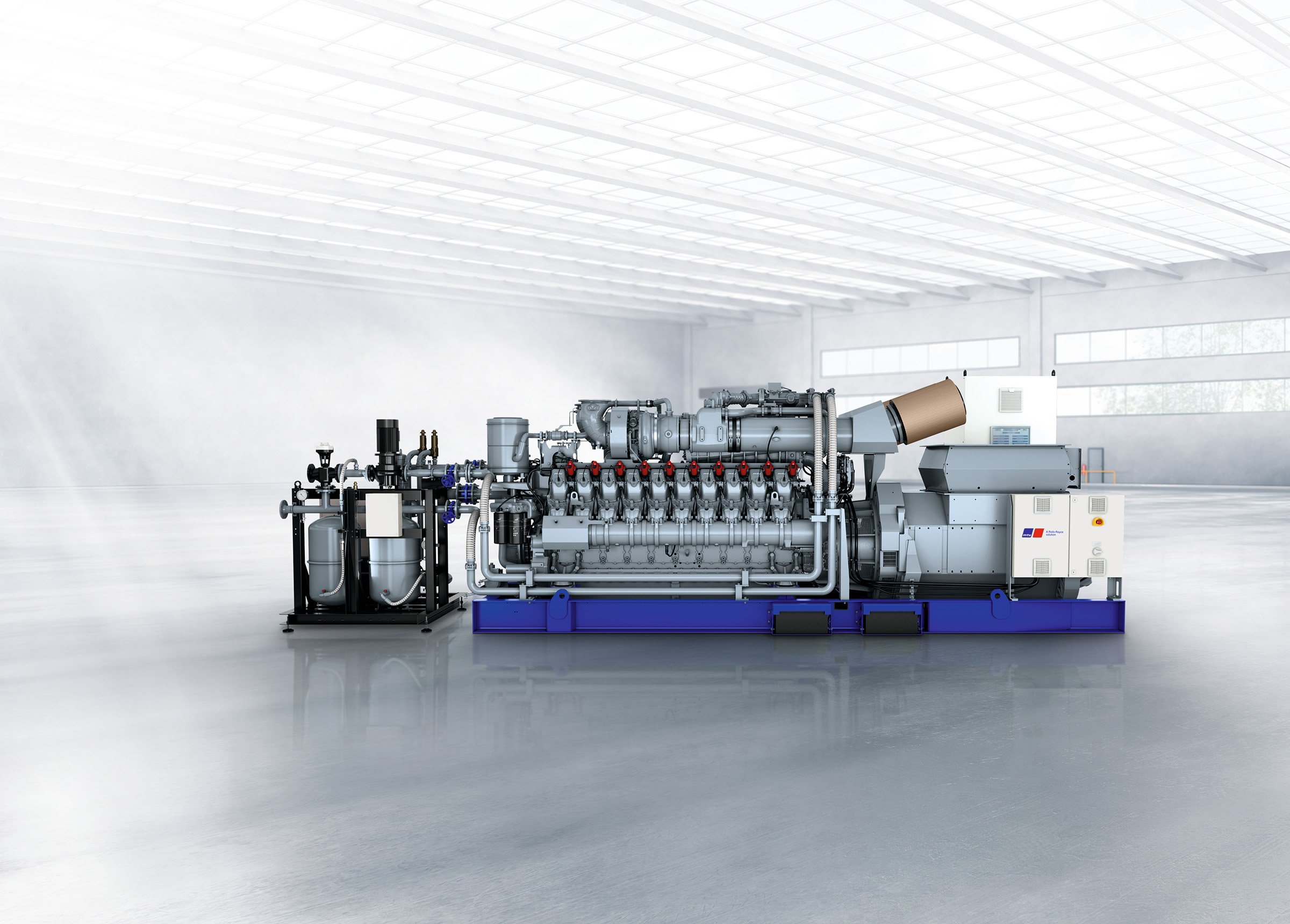
Note.
- Power is up to 2.5 MW.
- The engine is labelled H2-ready on its web page.
These two paragraphs add some detail to the project.
Rolls-Royce, ASCO Carbon Dioxide Ltd (ASCO), and Landmark Power Holdings Limited (LMPH), have signed a Memorandum of Understanding (MoU) aimed at developing scalable solutions for clean power generation with carbon capture from mtu gas reciprocating engines. This strategic partnership will help enable power generation customers to achieve their net zero ambitions and marks a significant step towards addressing climate change.
“Power generation is a highly attractive, growing market segment and an area of strategic focus for Rolls-Royce, where partnerships can help further grow market position and broaden its power generation offering, as set out at last November’s Capital Markets Day”, said Tobias Ostermaier, President Stationary Power Solutions at Rolls-Royce Power Systems. Rolls-Royce is committed to becoming a net zero company by 2050 and supporting customers to do the same.
These are my thoughts.
Uses Of Carbon Dioxide
The press release from Rolls-Royce lists a few uses of carbon dioxide.
The plan is to make the captured CO2 available (utilisation) for use in various industries such as food production, Efuels, sustainable aviation fuel (SAF), cement and plastic production (utilisation). The captured CO2 will also be ready for transportation should permanent sequestration be preferred (storage).
Carbon dioxide can also be added to the air in greenhouses, that are producing flowers, herbs, salad vegetables, soft fruit and tomatoes.
ASCO Carbon Dioxide
ASCO Carbon Dioxide is a subsidiary of French company; Schneider Electric.
The home page on their web site, describes ASCO Carbon Dioxide like this.
The Swiss ASCO CARBON DIOXIDE LTD is a globally operating company that offers complete solutions for CO2 and dry ice. The range of services includes carbon capture plants, CO2 recovery systems, ASCOJET dry ice blasting machines, dry ice production machines, CO2 cylinder filling systems, CO2 vaporisers, CO2 storage tanks, CO2 dosing systems for water neutralization and various other CO2 and dry ice equipment.
Thanks to this broad product range and more than 130 years of practical experience in the comprehensive CO2 and dry ice sector, the customer benefits from individual, complete CO2 solutions from a single source. ASCO has been part of the international industrial gases company Messer Group since 2007 and is its centre of competence for CO2.
In other words, the world and especially the climate change activists may hate carbon dioxide with a vengeance, but ASCO Carbon Dioxide see it as a way to make money and something that needs love.
It also seems, that if you want to do something with or to carbon dioxide, then ASCO Carbon Dioxide could be one of the first companies that you call.
Landmark Power Holdings Limited
The About page on their web site, describes the mission of Landmark Power Holdings Limited like this.
LMPH was established in 2019 with the purpose to help to build a circular economy, by applying new methodologies to proven technologies in energy production.
We support the transition to net zero by supplying dispatchable, low carbon energy that enables more renewable energy production while contributing to a circular economy, by eliminating inefficiencies in production, ensuring that every input is used to its maximum potential and treating all production waste as a profitable resource.
This Solutions page on their web site, describes their FlexPower Plus system.
These are the two introductory paragraphs.
FLEXPOWER PLUS® is LMPH’s modular approach to optimising the generation of clean flexible power. It is a combination of High Efficiency Flexible Power Generation modules and Carbon Capture Utilisation (CCU) modules.
Each of the modules can be added to the production processes depending on the site and production needs.
This last paragraph describes the result.
When you combine the the High Efficiency Flexible Power Generation modules with the Carbon Capture Utilisation (CCU) modules, the power generation is classified as low carbon and considered to be as clean as wind power but with the capacity to provide baseload power.
They certainly sound like my kind of company, as I was simulating processes like this for ICI in the 1970s.
ICI taught me that only four things should leave a chemical or other process plant.
- Product, that is sold at an advantageous price.
- Pure water
- Clean air
- Everybody who worked there.
It appears a FlexPower Plus system produces three valuable products; electricity, heat and pure food-grade carbon-dioxide.
The Rhodesia Project
The Rhodesia project has its own page on the Landmark Power Holdings web site, where these four paragraphs describe the project.
The Rhodesia project is a joint venture with Victory Hill, a specialist investment firm targeting direct investments in global energy infrastructure that support the UN Sustainable Development Goals.
The Rhodesia project is located in north Nottinghamshire near Worksop and has an electrical capacity of 10MW.
Additional capacity is to be sold through a private wire power supply for local businesses with the intent to facilitate vehicle charging stations.
Construction started in March 2022 and the start of power production is projected for Q3 2024 with the full CO2 capture from Q4 2024.
There is also this paragraph, that lists the partners in the Rhodesia project.
For the development of the Rhodesia project LMPH and Victory Hill have partnered with global industrial groups such as Mitsubishi Turboden S.p.A., MTU Rolls-Royce Solutions UK, ASCO CARBON DIOXIDE LTD, Climeon.
With three of the world’s largest companies amongst the partners, this partnership must have a high chance of success.
Victory Hill Capital Hill Partners
Victory Hill Capital Partners are partners in the Rhodesia project.
Their joint philosophy with Landmark Power Holdings is summed up on this video.
Working Together
The press release from Rolls-Royce says this about the partnership.
Rolls-Royce is contributing its extensive experience and global network in the field of decentralized power generation to the cooperation through its Power Systems division with the mtu product portfolio. The contribution of LMPH, a developer of high-efficiency Combined Heat and Power (CHP) projects, is its patented FLEXPOWER PLUS® concept, combined with technical expertise and patented technologies. ASCO has over 50 years of experience in developing and building carbon capture (or CO2-Recovery) plants and will be providing valuable insights and solutions from the carbon capture industry.
There is also this diagram of the system.

Note.
- The 4000 gas genset is in the bottom-left corner.
- The HT PRC and LT ORC are two Mitsubishi turbo-generators generating electricity from waste heat.
- The ASCO carbon capture system is in the top-left corner.
- Carbon dioxide can either be stored or used.
This system should be zero-carbon, once the design is fully tested.
A View From The Top
This paragraph from the Rolls-Royce press release gives the view of the President Stationary Power Solutions at Rolls-Royce Power Systems.
Tobias Ostermaier, President Stationary Power Solutions at Rolls-Royce Power Systems, said: “We are convinced that CO2 capture and storage systems in combination with our mtu gas gensets are an important building block on the way to Net Zero. As a complement to renewable energy sources, internal combustion engines can already provide clean, cost-effective and extremely reliable power generation.”
I suspect he’s rather pleased.
 The Anonymous Widower