Solar Panel Pilot For Aldershot
The title of this post is the same as that of an article in the August 2019 Edition of Modern Railways.
This is the two paragraphs.
Solar panels are to be installed on derelict land near Aldershot station as part of an experiment into whether renewable energy can be used to power trains.
A total of 135 discrete solar panels are being installed and are expected to go live in August. The Riding Subnbeams ‘First Light’ demonstrator project is a collaboration between climate change charity 10:10, Community Energy South and Network Rail, alongside a consortium of specialist consultants and university departments.
I wrote about the company and its ideas in Solar Power Could Make Up “Significant Share” Of Railway’s Energy Demand, which I posted in December 2017.
I won’t repeat myself, but I will say that since I wrote the original article, a compatible development has happened.
In Vivarail Unveils Fast Charging System For Class 230 Battery Trains, I wrote about Vivarail’s charging system for battery trains, which uses battery-to-battery power transfer to charge batteries on trains, through standard third-rail technology.
I do feel that the 10:10 and Vivarail ought to be talking, as I feel that between them, they could come up with some good joint ideas.
Electrification West Of Cardiff Central Station
These pictures show erected gantries for the electrification to the West of Cardiff Central station.
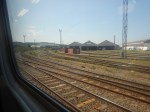

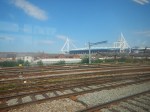
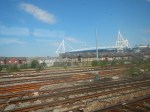
I have been sent a map of the proposed works and facilities for the South Wales Metro. This snippet shows the lines to the West of Cardiff Central station.
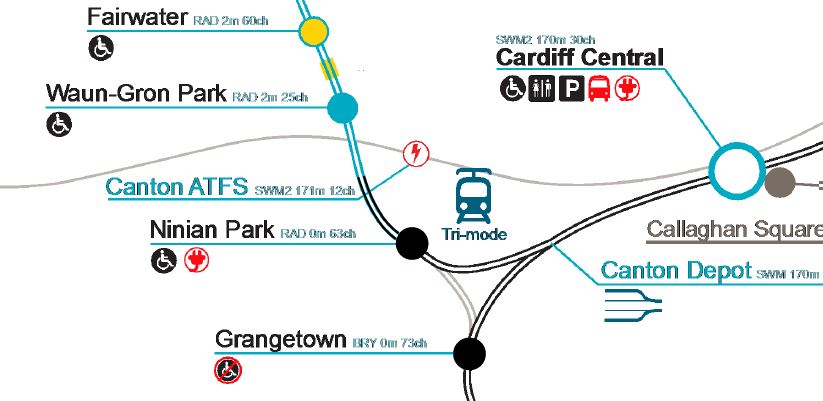
Note.
- Electrified lines are shown in blue and unelectrified ones in black.
- The South Wales Main Line is shown as a feint line going East-West to the North of Ninian Park station.
- Trains for Barry Island, Bridgend, Cardiff Airport, Maesteg and Penarth go via Grangetown station.
- Tram-trains for Radyr will go via Ninian Park station.
It looks like tram-trains emerging out of Canton Depot will have immediate access to 25 KVAC overhead electrification.
Treforest Station To Go Step-Free
This document on the Government web site is entitled Access for All: 73 Stations Set To Benefit From Additional Funding.
Treforest station is on the list.
These pictures show the station and the current bridge,


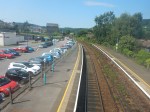

The bridge is not the easiest to cross and I tripped.
I wouldn’t like to cross it in the worst weather the Valleys could through at it!
Installing The Step-Free Access
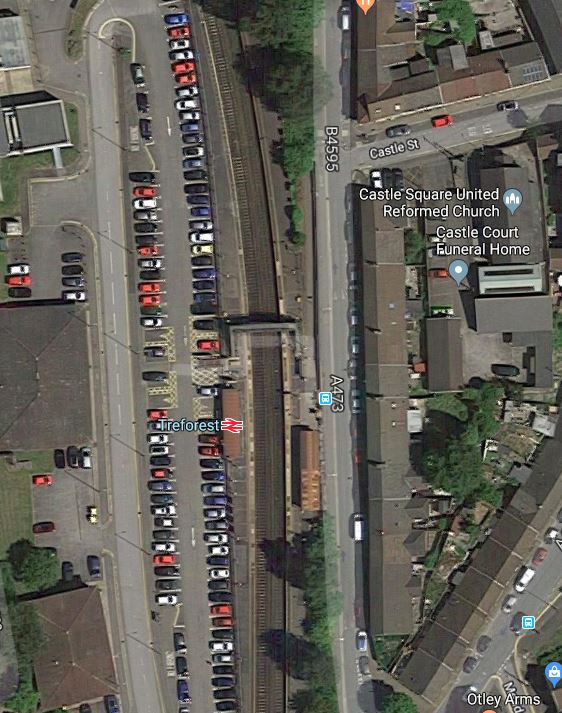
This Google Map shows the station.
In Winner Announced In The Network Rail Footbridge Design Ideas Competition, I wrote how the competition was won by this bridge.
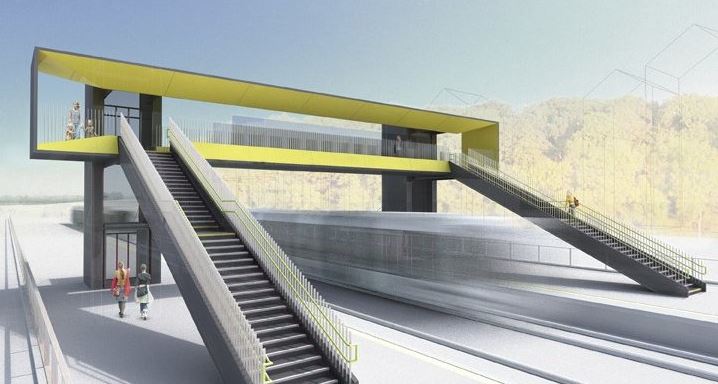
I believe that one of these bridges could be built at the Northern end of the station.
- The Southbound platform could be widened if necessary.
- The Western end of the bridge might mean a few car-parking spaces would be lost.
- Disabled car-parking spaces could be close to the bridge.
- The bridge could be used to support the electrification in the station.
But most importantly, the bridge could be installed without any disruption to trains and passengers.
I have been sent a map of the proposed works and facilities for the South Wales Metro. This snippet shows Treforest station.
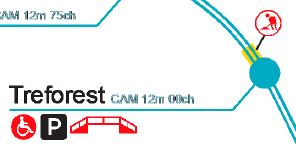
Note.
- Treforest station is shown with a PRM-compliant bridge and step-free access from street to train. The new bridge would deliver this.
- The station is shown electrified.
- A short section of line North of the station is without electrification.
This Google Map shows the area to the North of the station.
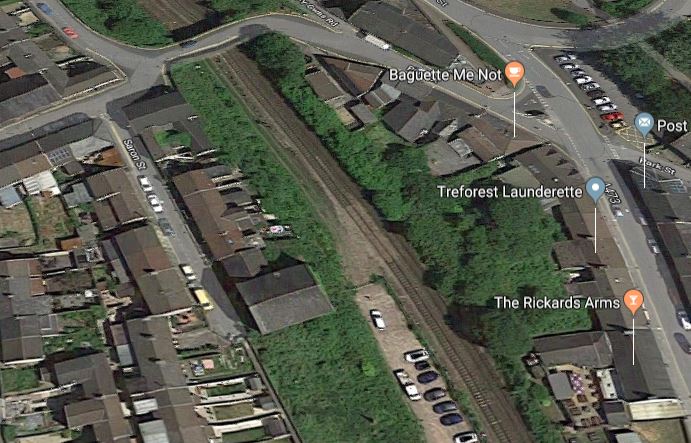
It would appear, that instead of rebuilding the bridge to squeeze the wires underneath, a short earthed section of overhead conductor rail would be used.
Conclusion
Using one of Network Rail’s new bridges at Treforest station, solves all the problems of the station and could even make the electrification easier.
Industry Urged To Decide On Alternative Technology
The title of this post, is the same as that of this article on Rail Magazine.
This is the first paragraph.
The rail industry needs to decide on the right approach to alternative technology as soon as possible, to ensure the industry can continue to reduce emissions.
Speaking to the All-Party Parliamentary Rail Group, Anthony Perratt of the RSSB, outlined how there was a huge opportunity to replace ageing Sprinter trains with new units powered by alternative energy sources like batteries and hydrogen.
The Size Of The Opportunity
Sprinter trains in service of stored in the UK include.
- Class 150 – 135 x two-car, 2 x three-car
- Class 153 – 70 x one-car
- Class 155 – 7 x two-car
- Class 156 – 114 x two-car
- Class 158 – 147 x two-car, 21 x three-car
- Class 159 – 30 x three-car
These add up to 516 trains, with a total of 1035 cars.
In the Wikipedia entry for the Class 710 train, this is said.
TfL announced that it had placed a £260m order for 45 four-car Bombardier Aventra EMUs.
This works out at nearly £1,500,000 for each car of a modern train.
This means that replacement of the Sprinters, with new independently-powered trains, would be project of the order of £1.5billion.
That is a market, that would be very much desired by a train builder.
Battery, Diesel Or Hydrogen Power?
Diesel power is probably not a good idea, if it can be avoided.
The following points about hydrogen- and battery-powered trains should be noted.
- Most hydrogen-powered trains are battery-powered trains, with a hydrogen fuel-cell to recharge the batteries.
- Battery technology is improving fast.
- Systems to rapidly charge batteries will be available in a couple of years.
- Battery-powered trains can use existing electrification to charge the batteries.
- Hydrogen-powered trains may need a large tank for the hydrogen, which limits passenger capacity.
- Hydrogen-powered trains need a refuelling structure, which may be more difficult to install, than a charging system for battery trains.
I feel that innovative engineers will be able to find ways to enable battery-powered trains on routes that need independently powered trains.
Conclusion
I don’t think, that we’ll see many long-term applications of hydrogen-powered trains in the UK.
Warning As Electricity Cables Are Switched On In Manchester
The title of this post is the same as that of this article on Rail Advent.
This is the first paragraph.
Network Rail has warned members of the public to stay off the railway as new high voltage equipment goes live on the line between Stalybridge and Manchester Victoria.
It now looks like electric the current service between Stalybridge and Wigan North Western stations can now be run more efficiently by a Class 769 train, when these enter service.
If Network Rail were to get their skates on and electrify between Bolton and Wigan North Western stations via Lostock Junction, the talybridge and Wigan North Western Route could be run by electric traction.
This electrification of the Lostock Junction route, would also allow the Wigan North Western and Alderley Edge service to be run by electric traction.
Looking at Google Maps of the route, it appears that gantries are being or have been erected.
The High Speed Local Train
If Great Western Railway (GWR) are going to run a train service between Paddington and Bedwyn, they need an electric train which can power itself on the last thirteen miles between Newbury and Bedwyn, which is not electrified and is unlikely to be so in the next couple of decades.
The train must also be capable of cruising at 125 mph on the fast lines of the Great Western Main Line between Reading and Paddington.
GWR have no choice, but to run the service with a five-car Class 802 train.
When Hitachi were designing these 125 mph trains in Japan, I don’t suspect that running a service over a distance of 66.5 miles between London and a small village in Berkshire, was in the specification.
This morning, I took the 10:05 service from Paddington to Bedwyn, with the intention of returning on the 11:41 from Bedwyn to Paddington.
These are a few of the pictures that I took.
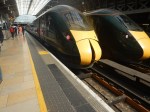
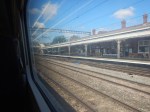
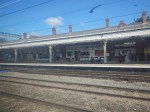
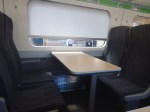
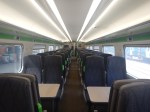

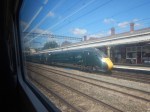

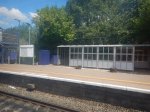
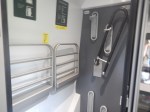
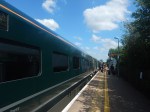

But things didn’t turn out as planned.
- Nothing serious and some animals got on the tracks between Reading and Swindon, meaning that we were some minutes late into Bedwyn, due to platform congestion at Reading.
- The return journey was consequently delayed.
These are a few observations.
Operating Speed
These were speeds on various parts of the journey.
- I timed the train at 115 mph through Southall and at 123 mph through Hayes & Harlington as the train accelerated out of Paddington.
- The train was doing just short of 125 mph for the major part of the route between London and Reading, until it had to stop because of the congestion.
- The train was doing around 100 mph on the electrified line between Reading and Newbury.
- Between Newbury and Bedwyn, speeds were between 80 and 90 mph.
Similar speeds were attained on the return journey.
Passenger Numbers
As the pictures show, there weren’t that many passengers who were travelling to Bedwyn, although there were more heading back to London.
Many more joined and left the service at the three larger stations of Reading, Newbury and Hungerford.
Now that the service is hourly between Reading and Bedwyn and half-hourly between Reading and Newbury in modern, comfortable trains, I can see passenger numbers growing.
Current Service
There are eleven trains per day, between Paddington and Bedwyn, at an hourly frequency, which take around three hours for a round trip.
So it would appear that three trains are needed for the service.
The service is also supplemented by an hourly stopping shuttle train between Reading and Newbury.
Two years ago, the service was just one three-car diesel train per hour between Paddington and Bedwyn with a few additional stops from long-distance trains.
Bedwyn Station Improvements
I got the impression, that Bedwyn station is probably at its limit for car parking with the current twenty-five spaces and cars all over the place.
This article on the Wiltshire Gazette and Herald, is entitled It’s A Rail Problem At Great Bedwyn and indicates that commuters and residents don’t see eye-to-eye with the car parking.
If the car parking were to be increased and usage at the station increased then I feel that a step-free bridge could be needed.
In Winner Announced In The Network Rail Footbridge Design Ideas Competition, I wrote how the competition was won by this bridge.
So could a factory-built bridge like this be installed at Bedwyn station?
The installation wouldn’t be difficult, but the politics could be.
Other Station Improvements
A quick look at other stations suggest these improvements.
- Hungerford station, which has a large car park, needs a step-free bridge.
- Kinbury station doesn’t have a bridge.
- Midgham station doesn’t have a bridge
- Theale station has improvements planned.
There are level crossings at Hungerford, Kintbury, Thatcham and Midgham.
Future Trains To Bedwyn
In Hitachi Plans To Run ScotRail Class 385 EMUs Beyond The Wires, I discussed how Hitachi were proposing to add battery power to Class 385 trains, which are in the same family as GWR’s Class 802 trains.
So surely, what is a power source for the goose is also a power source for the gander.
As it would only be a journey of thirteen miles both ways between Newbury and Bedwyn, this would surely be an ideal route for the use of battery power.
The other route, where battery power could be used would be between Didcot and Oxford, which is just over ten miles.
A Future Service To Marlborough
I covered this proposal in A Station For Marlborough.
Marlborough would be served by a single-track branch line on an old railway alignment, probably terminating near the large Tesco superstore in a single platform station.
The advantages of doing this would be.
- Marlborough, which is an important market town of 8,500 people would be connected to the rail network.
- Adequate car parking could be provided.
- Creating a station at Marlborough could be an alternative to expanding Bedwyn station, which could be problematical.
- It would improve the economics of the Paddington and Bedwyn service.
This is the sort of service, that should be developed.
Other Possible Services
The big advantage of this high speed local service for Great Western Railway, is that when it is on the Great Western Main Line, it becomes just another 125 mph service or once digital signalling is installed a possible 140 mph service.
These routes could have this type of high speed local services.
Great Western Main Line
Great Western Railway has several routes, where Class 800 and Class 802 trains break away from the Great Western Main Line to operate local services.
- Paddington and Bedwyn
- Paddington and Oxford
It could be argued that services to Cheltenham and Hereford are also high speed local services.
East Coast Main Line
In April 2018, I wrote Call For ETCS On King’s Lynn Route.
This post was based on an article in Rail Magazine, which talked about running 125 mph trains on the Kings Cross and Kings Lynn route.
This would make operation of the East Coast Main Line easier with herds of 125 mph trains steaming into and out of London.
I think, improvement would also extend to the Cambridge Line, in addition to the Fen Line.
- Operating speed up from 90 mph to 110 mph plus.
- Full digital signalling.
- Automatic Train Control.
Journey times and frequency to and from London Kings Cross would be improved significantly.
Siemens would probably need to uprate the Class 700 trains for faster running, as 100 mph trains are just too slow!
If you look at the East Coast Main Line between Doncaster and Edinburgh, large sections of the line are only double track.
It is the ambition of train operating companies to run more high speed expresses between London and the North of England and Scotland.
I can see a time, when all trains using the East Coast Main Line will have to confirm with a high minimum speed, otherwise the future plans cannot be fulfiled.
Midland Main Line
By the end of 2020, the Midland Main Line South of Market Harborough, will be a 125 mph electrified railway with a high speed branch to Corby, which will be served by a half-hourly twelve-car electric service.
From 2022, 125 mph bi-mode trains will be running services on the Midland Main Line.
I can see services between St. Pancras and Corby becoming another high speed local service.
- Half-hourly service.
- 125 mph running.
- Limited stop between Corby and London, with stops at Kettering, Luton And Luton Airport Parkway.
- The journey time could even be under an hour.
Selected trains could even use battery power to extend the service to Melton Mowbray.
West Coast Main Line
The West Coast Main Line will become increasingly crowded with fast 140 mph trains, especially after the opening of Phase 2a of High Speed Two to Crewe in 2027.
I believe that this will mean that all passenger services using the West Coast Main Line will need to be run using trains capable of at least 110 mph and possibly 125 mph.
The new operation of suburban services on the West Coast Main Line; West Midlands Trains are replacing their fleet with new Class 730 trains. Like the previous trains, they are 110 mph units, but are they capable of upgrading to 125 mph?
If they are upgradeable, they would ease timetabling problems between London and the West Midlands, as they could mix it with Virgin’s Class 390 trains.
Further North, Northern run services like these.
- Barrow and Manchester Airport.
- Blackpool and Manchester Airport
- Windermere and Manchester Airport
Currently, the operator is introducing new Class 195 and Class 331 trains, alongside the Class 319 trains.All of these trains are 100 mph capable, which is probably not fast enough, if they have to use the West Coast Main Line between Crewe and Lancaster, some of which is only double-track.
In Northern Considering Options For More New Trains, I wrote about Northern’s future rolling stock plans.
I suspect some 125 mph trains are in their plans for both the East and West Coast Main Lines.
Implications For Freight
There must surely be pressure for freight trains to go faster.
The 110 mph Class 93 locomotive is on its way, but with rail freight increasing we need to radically think how we run freight trains on a busy passenger line.
Conclusion
We will increasingly see upgrading of suburban services that use 125 mph line and not just around London.
Selby Station To Go Step-Free
This document on the Government web site is entitled Access for All: 73 Stations Set To Benefit From Additional Funding.
Selby station is on the list.
These pictures show the station and the current bridge,


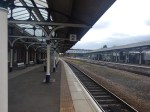


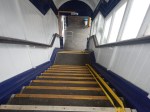

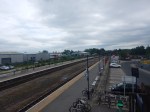

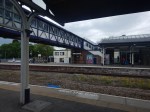
The existing pedestrian bridge has the following.
- Steep stairs at both ends.
- No provision for step-free access.
he bridge does appear to be in good condition.
Possible Electrification Through Selby Station
Perhaps most importantly, the current bridge could be too low for 25 KVAC overhead electrification to be erected underneath the bridge.
Although, it might be possible to lower the track or use one of Network Rail’s proven solutions to squeeze the electrification underneath.
At present though, it seems unlikely that the route through Selby will be electrified, due to the problem of the Selby Swing Bridge and Government policy.
Installing Step-Free Access
It could be feasible to add lifts to the existing footbridge, but it doesn’t solve the problem of the steep stairs.
In Winner Announced In The Network Rail Footbridge Design Ideas Competition, I wrote how the competition was won by this bridge.
So could a factory-built bridge like this be installed be installed at Selby station?
This 3D Google Map shows Selby station.
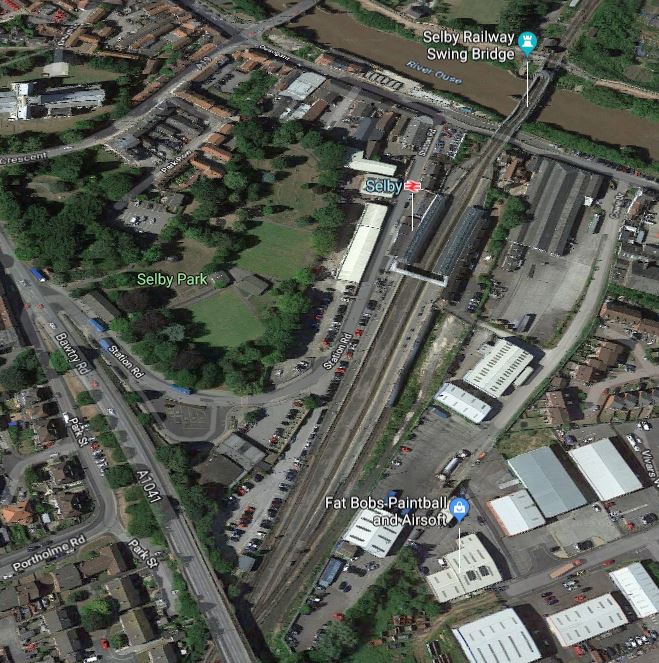
The platforms to the South of he footbridge are wide and there is lots of space.
Could the new bridge be installed there?
And The Wires Came Tumbling Down!
Today, I intended to go to Doncaster on the 11:03 train to Leeds from Kings Cross.
I had intended to travel in First on an Azuma, to see what the quality was like.
So I booked an Advance ticket online for around £50.
But then the train didn’t run, as the wires had come tumbling down!
This must be the third time, I’ve been affected by faulty overhead wires on the East Coast Main Line in the last few years.
In one case, we were delayed for about two hours and in the other, it didn’t affect me for long, as I was in an InterCity 125, which drove through the problem.
I have lost my fifty pounds, as you take the risk with an Advance Ticket.
Conclusion
The electrification on the East Coast Main Line seems to be built and maintained by morons.
Next time, I take the train on the East Coast Main Line, I’ll check trains are running before buying a ticket.
Balloons On The Line Blamed For £1m Worth Of Train Delays
The title of this post, is the same as this article in The Times
This is the first two paragraphs.
Families have been told to stop bringing helium-filled balloons into railway stations after they were blamed for delays that cost the network £1 million a year.
In the latest version of “leaves on the line”, Network Rail said there were 619 “balloon-related incidents” across Britain in the past 12 months.
Liverstock farmers don’t like them either, as they fall into fields and get eaten.
I don’t like banning things, but surely some regulation and sensible rules are needed.
 The Anonymous Widower