1 GW Wind Farm Proposed Offshore Jersey
The title of this post, is the same as that of this article on offshoreWIND.biz.
This is the sub-heading.
Jersey’s Council of Ministers has proposed to build a 1 GW offshore wind farm in the southwest of the island’s territorial waters that would produce enough electricity to meet its needs, with the remainder to be exported.
This first paragraph gives more details.
It is proposed that the offshore wind farm should be privately funded and designed, and delivered by a consortium with substantial experience of similar development elsewhere, according to the government.
I would have thought that Jersey would have been one of those places, that would have been too conservative for offshore wind.
But then, this is the last paragraph of the article.
In a 2019 Island Plan consultation, 85 per cent of respondents agreed or strongly agreed the plan should continue to encourage the development of offshore wind and tidal energy, according to the government.
But as the wind farm will export the surplus surplus, it could be a nice little earner.
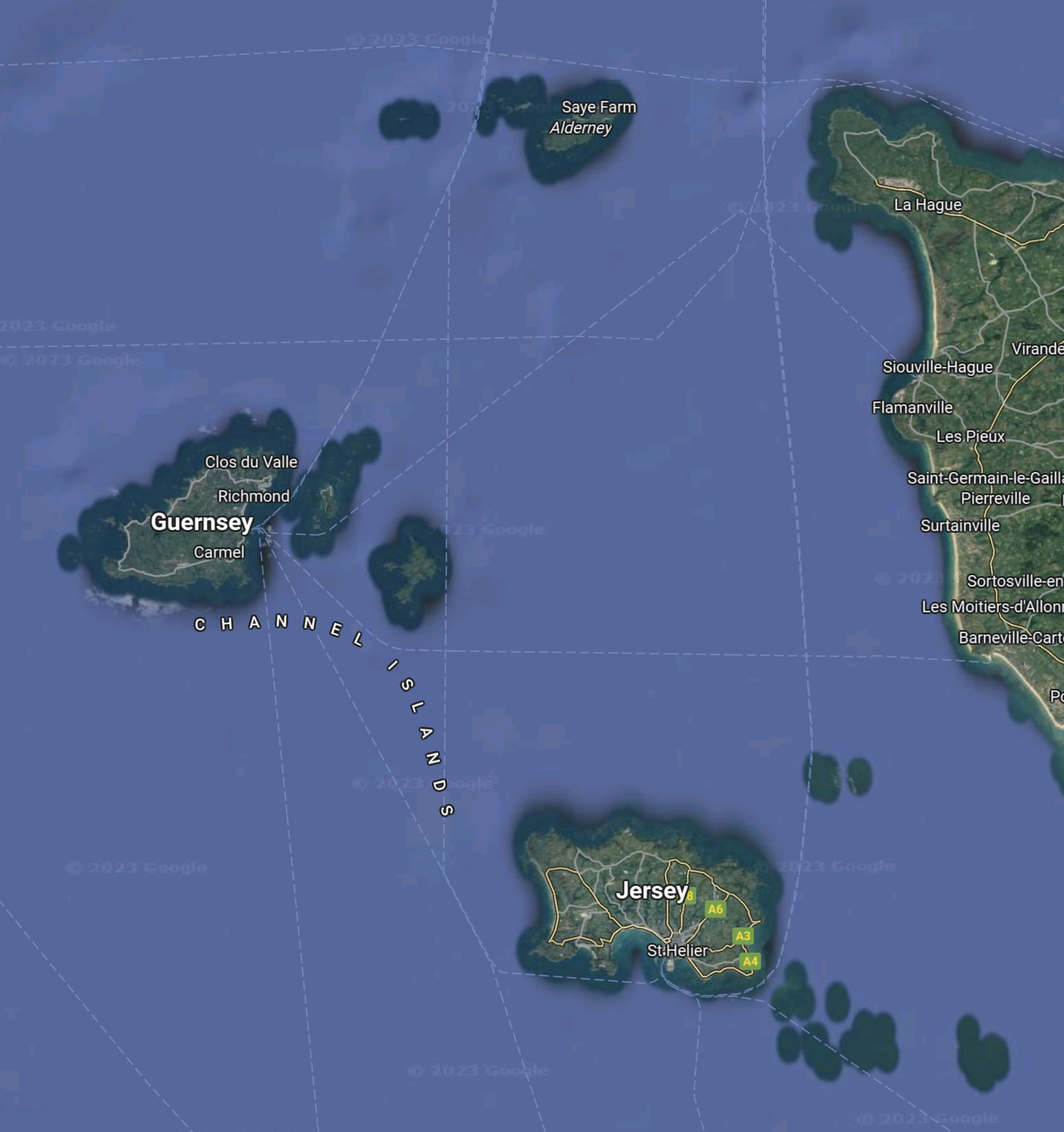
This Google Map shows the Channel Islands.
This article on the BBC is entitled Islands Could Work Together On Wind Farm Plans.
These three bullet points sum up the article.
-
Guernsey and Jersey may work together to create a wind farm
-
Both States are hoping to create the wind farm off Jersey’s south-west coast
-
It could generate enough energy for both islands.
This looks like a sound way to reap the wind!
Teen’s Killing Raises A French Policing Issue That Dare Not Be Named
The title of this post, is the same as that of this article on France24.
This is the sub-heading.
The killing of 17-year-old Nahel M. during a police traffic stop this week was a depressingly familiar addition to France’s list of police brutality cases. But when the UN called on the government to address racial discrimination in its police force, the official reaction was just as familiar and depressing for France’s minorities.
These are the first five paragraphs.
On Friday, just a few days after a French police officer shot dead a teenager during a traffic stop in a Paris suburb, the UN Human Rights Office urged France to tackle racial discrimination.
“We are concerned by the killing of a 17-year-old of North African descent by police in France,” UN human rights office spokeswoman Ravina Shamdasani told a press briefing in Geneva.
“This is a moment for the country to seriously address the deep issues of racism and discrimination in law enforcement,” she added.
Shamdasani’s comments echoed innumerable statements released over the past few years by international rights groups, such as Amnesty International and Human Rights Watch, calling on the French state to address “systematic discrimination” particularly “the use of ethnic profiling” during identity checks.
If the UN human rights office believed the police killing of the teenager of Algerian descent, named Nahel M., could be the “moment” for an official French reckoning, it proved to be mistaken.
These are a few choice paragraphs.
Many Cases
Nahel’s killing in the western Paris suburb of Nanterre was the latest in a string of cases of police violence in France’s deprived, multi-ethnic banlieues, or suburbs. These include high-profile cases, such as the 2005 deaths of two young men in Clichy-sous-Bois, a Paris suburb, and the 2016 death of Adama Traoré in Val d’Oise, a banlieue further north. The victims were all non-white young males.
France And America
“Of course France and America are very different countries, but they have a common enemy: racism,” a demonstrator told FRANCE 24 at a June 2020 “Justice for Adama Traoré” protest. “Nothing will ever change until people are educated about racism. Starting with the police.”
One Bad Apple, Not The Orchard
Several French officials and security experts conceded that the video footage appeared to show the policeman acting in breach of procedures. But they insist it’s a case of one bad apple, not a rot in the orchard.
French Police And Military Voting
A July 2019 study by the left-leaning Fondation Jean-Jaurès found that more than 50% of French military and law enforcement personnel said they voted for far-right politician Marine Le Pen’s party in recent elections.
In the first round of the 2022 presidential election, 39% of police and military personnel voted for Le Pen while 25% voted for another far-right candidate, Éric Zemmour, according to polling institute Cluster17.
France Police Union Tweet
“Congratulations to the colleagues who opened fire on a young 17-year-old criminal. By neutralising his vehicle, they protected their lives and those of other drivers. The only ones responsible for this thug’s death are his parents, who were incapable of educating their son,” it read.
France’s “Licence To Shoot” Law
The law, which was passed following a spate of terror attacks in France, has been slammed as a “licence to shoot” legislation. In 2022 alone, 13 people were shot and killed by police in cases of non-compliance. While French authorities have not released the racial or ethnic identities of the victims, sociologist Sebastien Roche told a local French daily that there was an “overrepresentation of ethnic minorities among those killed during refusals to obey” police traffic stops.
The article is worth a full read.
Run Larger, Multi-Site Offshore Wind Tenders, French Energy Commission Recommends To Gov’t
The title of this post, is the same as that of this article on offshoreWIND.biz.
This is the sub-heading.
The French Energy Regulatory Commission (CRE) has recommended that the government conducts larger offshore wind tenders, inviting bids for several sites. This is according to the latest update from CRE, which has now published specifications for the country’s AO5 tender for a floating wind farm in southern Brittany.
Looking at the building of large numbers of wind turbines and their fixed or floating foundations, I am drawn to the conclusion, that it might be better if all were as identical as possible.
I should also note, that we were very successful selling Artemis project management systems in France. Our manager in the country, said it was because all the country’s top managers had been to the same schools and universities and passed the best solutions around themselves.
So perhaps a standard solution appeals to the French psyche?
In the UK, BP are currently designing and planning these fixed foundation wind farms.
- Mona – 1500 MW – 35 m. depth – 30 km. offshore
- Morgan – 1500 MW – 35 m. depth – 30 km. offshore
- Morven – 2907 MW – 65-75 m. depth – 60 km. offshore
Given that Mona and Morgan are in the Irish Sea and Morven is North-East of Aberdeen, I wouldn’t be surprised to find that BP treat these three projects as two separate 3 GW projects, which could share the same turbine design and fixed foundation designs, that were very similar.
I’m sure BP would save money, if they used a similar design philosophy on all three projects.
Boralex Commissions BESS At Wind Farm In France In EU-Supported Demonstration Project
The title of this post, is the same as that of this article on Energy Storage News.
These two paragraphs outline the project.
Canada-based renewable energy firm Boralex has turned on a 3.3MWh battery storage unit attached to a wind farm in France.
The battery storage project has been installed at the site of the Plouguin wind farm, an 8MW generating facility in the Finistere department of Brittany, northwest France.
Note.
- The project was co-financed by the European Union through its European Regional Development Fund (ERDF).
- The project was launched to demonstrate the technical feasibility of a hybrid wind-plus-storage project.
- Boralex added in its announcement that the project will contribute to the stability of the French electricity grid.
There will be a lot of projects like this in the future.
This paragraph makes an interesting point about using batteries with solar and wind power.
Wind farms are less frequently hybridised with energy storage than solar PV because of the larger minimum project size and less predictable variability, with sharper peaks meaning heavier battery cycling and potentially faster degradation.
My control engineering knowledge and experience says that larger power sources and those that are highly variable will need batteries with more capacity for the same stability and quality of power output.
This sounds to me like a very good reason for developing larger and more affordable batteries, like those of Cheesecake Energy, Energy Dome, Gravitricity and Highview Power.
It also probably means that to stabilise several gigawatts of wind power, you need a very large amount of storage, that can only be provided by pumped storage hydroelectricity.
Conclusion
A very large amount energy storage is going to be needed.
Projects like these are essential to make sure we use them to their full possibilities.
BW Ideol In Talks To Raise EUR 40 Million For Floating Wind Development
The title of this post, is the same as that of this article on offshoreWIND.biz.
This is the sub-heading.
Norway-headquartered BW Ideol and French state-owned investment company ADEME Investissement have agreed to enter into exclusive negotiations for EUR 40 million in funding by ADEME Investissement for BW Ideol’s project development activities.
The rest of the post is all about the clever, but I suspect legal ways, that the € 40 million is raised.
When I needed any advice in that area, I used to consult my late friend the banker; David, who is mentioned in Diversifying A US$200 billion Market: The Alternatives To Li-ion Batteries For Grid-Scale Energy Storage.
When he needed computing advice, that is another story.
This Hydrogen Bus Will Take You And Your Car To Your Holiday Destination – Topgear
The title of this post, is the same as that of this article on Hydrogen Central.
The article details an interesting concept called Symone, from the French.
Looking at it, I suspect British Rail’s Motorail service was more efficient, as it had a larger capacity.
France’s First Offshore Wind Farm Fully Up And Running
The title of this post, is the same as that of this article on offshoreWIND.biz.
This is the sub-title.
France’s first commercial-scale offshore wind farm, the 480 MW Saint-Nazaire, has been fully commissioned.
Does this mean, that this is France’s only operational offshore wind farm?
It does appear so, whereas the UK has 13,628 MW of offshore wind.
With onshore wind, the French have 15,000 MW and England has 14,000 MW.So we’re ahead in offshore and total, but behind in onshore.
Consortium To Develop Low-Cost Operations To Revive France’s Local Lines
The title of this post, is the same as that of this article on Railway Gazette.
This was the first paragraph.
Thales has joined forces with a group of companies and the Nouvelle-Aquitaine Regional Council to develop innovative digital signalling and operations with a view to cutting the cost of running trains on lightly-used rural lines.
When I first read this article, I immediately thought, that the French problem is similar to problems we have in the UK, and I’ve also seen in other countries in Europe like Germany and The Netherlands.
The French consortium are looking at these technologies.
- Platform-agnostic, autonomous train positioning and odometry without trackside infrastructure.
- Cyber-secured data transmission via public telecommunications networks.
- High-density digital terrain mapping.
- Formal methods of generating safety data.
- A tablet-based supervision and operations interface for drivers.
- Integrated surveillance of level crossings.
- Network surveillance using sensors mounted on rail vehicles.
Thales says that the technology ‘will be fully interoperable with the core network and promises to reduce investment and operating costs by more than 30%’. Apart from reviving rural railways, it will improve safety, ‘especially at level crossings’, the company said.
As someone, who was designing and installing automation on heavy machinery nearly sixty years ago, I feel the French are on the right track.
I have a few thoughts.
Could Drone And/Or Missile Guidance Technology Be Used?
It should be noted that Thales Air Defence are a company who manufacture several successful missiles including the NLAW. They are also a subsidiary pf Thales Group, who are leading the French rural rail consortium.
I wouldn’t be surprised to find, that Thales have access to loads of applicable technology.
Could Drivers Use A Tablet To Drive The Train?
I don’t see why not!
The Elizabeth Line has been designed to use auto-reverse to speed up operations at Paddington, which I wrote about in Crossrail Trains Will Have Auto-Reverse.
I suspect that the driver has a simple controller to monitor the reversing train and stop it in an emergency.
Integrated Surveillance Of Level Crossings
Whoever solves this tricky problem will do the railways of the world a big service.
Network Surveillance Using Sensors Mounted On Rail Vehicles
This is starting to happen all over the world.
Conclusion
I think that the results of this French study will be felt worldwide.
French Farmers Are Covering Crops With Solar Panels To Produce Food And Energy At The Same Time
The title of this post is the same as that of this article on euronews.green.
These paragraphs explain the technique.
Agrivoltaics – the practice of using land for both solar energy and agriculture – is on the rise across France.
In the Haute-Saône region, in the northeastern part of the country, an experiment is being conducted by solar-energy company TSE. It is hoping to find out whether solar energy can be generated without hindering large-scale cereal crops.
Previous attempts to experiment with agrivoltaics have been through smaller-scale projects. But, keen to see if it can thrive on an industrial level, 5,500 solar panels are being spread over this farm in the commune town of Amance by TSE.
The article also contains a picture, which shows panels high in the air and a tractor going underneath.
I’m not sure of the idea’s practical application, although, I do know of a farmer, who is experimenting with using solar panels in a field with sheep. He also has found that on another field fully fitted with solar panels, hares were thriving.
In Understanding Floatovoltaics, I talked about another French idea; floating solar panels, where solar panels are floated on calm water like a reservoir.
Talking of reservoirs, I remember seeing a Tomorrow’s World, as a child, where it was proposed that concrete reservoirs, like those under the Heathrow flightpath, be filled with foamed concrete and covered with soil, so they could be used to grow crops.
- The water capacity would be slightly smaller.
- There would be less water losses.
I wonder what happened to that idea.
 The Anonymous Widower