Heat From HS2 Trains Will Warm 500 New Homes
The title of this post is the same as that of an article in today’s copy of The Times.
This is the third paragraph.
HS2 Ltd, the company building the £56 billion high-speed line, has produced plans to recycle waste heat from the electric motors and brakes of trains approaching and departing from a £1 billion “super hub” station at Old Oak Common, near Willesden, North West London.
Other points from the article include.
- Five air source heat pumps will be used.
- , Each heat pump costs around £11,400.
- The carbon footprint of each house could be reduced by a fifth.
- Plans are at an early stage, but the technology is proven.
- Similar technology could be applied to tunnels on the Northern routes to Leeds and Manchester.
I can only see one problem with the idea.
The companies bidding to make the trains for HS2, will design trains with the following features.
- Highly-efficient aerodynamics of both trains and tunnels, to reduce energy losses and power required to move the train.
- Regenerative braking to onboard electricity storage.
- Train systems like air-conditioning, lighting and toilets that use smaller amounts of electricity.
HS2 will also draw heavily on proven innovative ideas from similar projects, to reduce the energy used by the trains, whether in the tunnels or the open.
But, I would also suspect that HS2’s proposal is based on a good assessment of the energy dissipated by the trains.
Articles In Today’s Times
In addition to World’s Top Wealth Fund Puts Billions Into Britain, there were other articles worth blogging about in today’s copy of The Times.
Build New Homes Away From Roads, Heath Watchdog Says
Surely, this very sensible! The distance can of course be vertical!
Plastic Packaging Used To Make Car Parts In Upcycling Revolution
Scientists working for the US Department of Defense have shown it is possible to convert recycled PET bottles and other packaging into useful long-life products.
Corbyn’s Favourite Firebrand Is Suspended In Antisemitism Row
My father believed that there was little different between the extreme left as represented by Stalin and the extreme right as represented by Hitler.
Royal Mint Gardens
Royal Mint Gardens is a housing development to the East of Fenchurch Street and Tower Gateway stations.
These are a few pictures of the development.








But this doesn’t tell the full story.
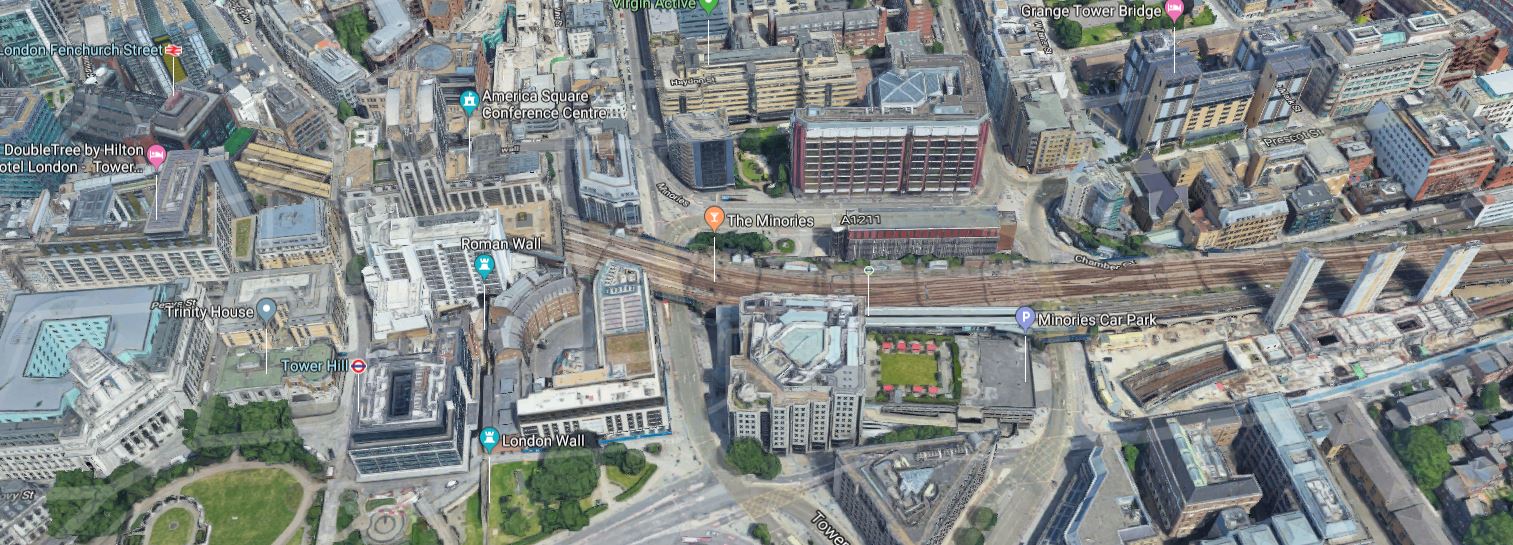
This Google Map shows the position of the development.
Note.
- Fenchurch Street station is towards the top-left corner of the map.
- The c2c tracks running to the East from Fencurch Street station.
- Tower Gateway DLR station is just to the right of the centre, just above the green space.
- The tracks of the Docklands Light Railway running to the East from Tower Gateway DLR station.
The three concrete towers at the right of the map, lying to the South of the railway tracks, are the three structural towers of Royal Mint Gardens.
This Google Map shows a close up of Royal Mint Gardens.
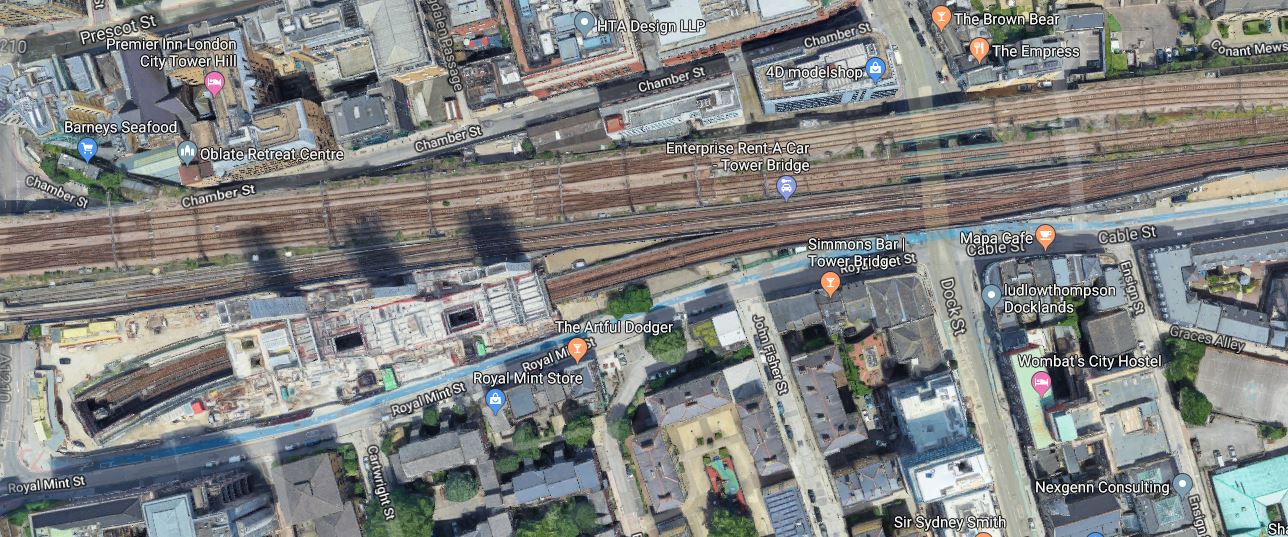
Note how the Docklands Light Railway splits into two to the East of the development.
- The Northern pair of tracks skirt the development to the North to go to Tower Gatewat DLR station.
- The Southern pair of tracks go underneath the development to go to Bank DLR station.
The new development has put the Bank branch in a concrete tunnel.
So in an area of the world, where land is a very expensive commodity, this area is being used twice at the same time.
Royal Mint Gardens On The BBC
BBC London television has been covering various aspects of the building of Royal Mint Gadens in local news for most of the day.
The developer, the architect, Network Rail and the reporter, all seemed very positive about what is being created.
The architect felt up to 250,000 houses could be created on similar sites across London.
How many houses could be built over rail lines in the rest of the UK?
Conclusion
Building over rail lines like this, will increasingly be seen as a way of adding new housing in densely populated cities.
Ban Gas Hobs And Heating In Six Years, Ministers Told
The title of this post is the same as that as an article on the front page of yesterday’s copy of The Times.
This is the first paragraph.
Gas boilers and cookers should be banned in new homes within six years to meet Britain’s legally binding emissions targets, the government’s climate change advisory body recommends today.
I don’t like gas, as I find that naked gas flames affect my health, so I cook electric.
In addition to its role in carbon dioxide production, I don’t like the safety problems with gas.
Would the Grenfell disaster have been so serious, if there had been no gas in the building?
The Hundred Mile City
I heard about The Hundred Mile City on the BBC London News
It will never happen!
- Can you imagine all London Boroughs agreeing to it?
- Negotiation would be like Brexit squared.
- Armies of Nimbys and the Council For The Fossilisation Of England would have a field day.
- Linear cities were proposed for Londonn to Southampton and Ipswich to Felixstowe in the 1960s.
On the other hand, as a child, I had dreams of a circular railway through where I lived in Cockfosters, as getting to Central London was fast, but getting to my friends and relatives in Edgware and Enfield was slow.
Note that the plans involve a circular monorail. Monorails are not very common, except at theme parks. That is an idea from well into the last century.
Today, we would use tram-trains, as they are so much more functional and easily extended.
Building Under The Wires At Barking Riverside
I went to Barking Riverside yesterday, where they are building over 10,000 housing units and took these pictures where the EL1 buses from Barking station turn round.





As the pictures show, there are a lot of high voltage cables running over the site.
The East London Transit
The EL1, EL2 and EL3 buses of the East London Transit connect the area to Barking station.
When I last came to this area, the buses weren’t to the high standard of New Routemasters.
Towers At Lewisham Station – 2nd February 2019
Lewisham station is becoming increasingly surrounded by tower blocks.





With the Bakerloo Line Extension planned to reach the new station around 2030, surely it is time to rebuild the station with more blocks over the tracks.
Kidbrooke Village
Kidbrooke Village is a new housing estate next to Kidbrooke station. Previously, the site was occupied by the Ferrier Estate.








The estate has over five thousand units and several towers.
I think we’re going to see a lot more developments like this.
- Good quality housing (Hopefully!)
- Local employment.
- Shops
- Parkland
I think that a railway station with a frequent well-connected service is essential. Kidbroke has a train every ten minutes in both directions, with a choice of three London terminals.
Developers like a rail service, as it makes units easier to sell or rent and the amount of car parking can be reduced.
Hopefully Kidbrooke will be turned into a thriving community.
Can Abandoned Mines Heat Our Future?
The title of this post, is same as that of the title of a public lecture I attended at The Geological Society this afternoon.
This page on the Geological Society web site, gives a summary of the lecture and details of the speaker; Charlotte Adams of Durham University.
The Concept
The basic concept is simple.
- Abandoned coal mines had their pumps turned off when they are closed and the worked areas have flooded with water, that is now at temperatures of around 12 to 20°C.
- As fifteen billion tonnes of coal have been extracted from UK coalfields, that is a lot of space to flood. An estimate of around two billion cubic metres is given.
- This means that the water holds somewhere between 27.9 and 46.5 GWH of energy in the form of heat.
- Heat pumps would be used to upgrade the temperature of this water, to provide hot water at useful temperatures for space heating.
For those unfamiliar with the concept of a heat pump, Wikipedia gives a good explanation, of which this is the first paragraph.
A heat pump is a device that transfers heat energy from a source of heat to what is called a heat sink. Heat pumps move thermal energy in the opposite direction of spontaneous heat transfer, by absorbing heat from a cold space and releasing it to a warmer one. A heat pump uses a small amount of external power to accomplish the work of transferring energy from the heat source to the heat sink.
In connection with this project, the heat source is the warm water in the mines and the heat sink is the water that is circulated to heat the buildings.
Wikipedia goes on to say this.
In heating mode, heat pumps are three to four times more effective at heating than simple electrical resistance heaters using the same amount of electricity. However, the typical cost of installing a heat pump is also higher than that of a resistance heater.
Wikipedia also has a section, which descries the use of heat pumps in district heating.
It should also be noted, that as with lots of technology, heat pumps are much improved, from the one I installed in a swimming pool in the 1980s.
Gas Is Replaced By Renewable Energy
The electricity to drive the heat pumps could be derived from renewable sources such as hydroelectric, solar, wave or wind.
Effectively, the system is using intermittent sources of electricity to create a constant source of heat suitable for space heating.
Would The Mines Run Out Of Heat Or Water?
As I understand it, the water in the mine will continue to be heated by the heat in the mines. The father of a friend, who came with me to the lecture was a coal miner and my friend confirmed it was hot in a coal mine.
The water will of course continue to flood the mine and the water pumped to the surface will probably be returned.
So the system will continue to supply heat for space heating.
How Long Will The System Supply Heat?
The system has the following characteristics.
- It is electro-mechanical.
- It is powered by electricity.
- Water is the heat transfer medium.
- Additives like anti-freeze will probably be applied to the water used for heat transfer.
There is no reason the system can’t be designed, so that it supplies heat for many years with regular maintenance and updating.
How Does The System Compare To Bunhill 2 Energy Centre?
In Bunhill 2 Energy Centre, I described Islington’s Bunhill 2 Energy Centre which uses heat generated in the Northern Line of the London Underground to provide district heating.
I am fairly sure that a lot of similar technology will be used in both applications.
This page on Wikipedia is entitled London Underground Cooling.
There is a section, which is entitled Source Of The Heat, where this is said.
The heat in the tunnels is largely generated by the trains, with a small amount coming from station equipment and passengers. Around 79% is absorbed by the tunnels walls, 10% is removed by ventilation and the other 11% remains in the tunnels.
Temperatures on the Underground have slowly increased as the clay around the tunnels has warmed up; in the early days of the Underground it was advertised as a place to keep cool on hot days. However, over time the temperature has slowly risen as the heat sink formed by the clay has filled up. When the tunnels were built the clay temperature was around 14ºC; this has now risen to 19–26ºC and air temperatures in the tunnels now reach as high as 30ºC.
So one big difference is that the Underground is warmer than the mine and this should make it a better heat source.
I feel that engineers on both projects will benefit from the ideas and experience of the others.
Would Infrastructure Funds Back This Technology?
In the UK, there are several infrastructure funds set up by companies like Aberdeen Standard, Aviva, Gresham House and L & G.
In World’s Largest Wind Farm Attracts Huge Backing From Insurance Giant, I explained why Aviva had invested nearly a billion pounds in wind farms to support pensioners and holders of their insurance policies.
Comparing the risk of using abandoned mines to heat buildings and that of offshore wind turbines generating electricity, my engineering knowledge would assign a greater risk to the turbines, providing both were built to the highest possible standards.
It’s just the onshore and offshore locations and the vagaries of the weather!
I think it is true to say, that infrastructure funds will back anything, where there is an acceptable long-term income to be made, commensurate with the costs and risk involved.
But then Government or any public or private company or organisation should not pay over the odds for the energy delivered.
Conclusion
Charlotte Adams in her lecture, asked if abandoned mines can heat our future.
The answer could well be yes, but there are other sources of heat like the London Underground, that can also be used.

