A Radical Government Would Consider Making Bus Travel Free
The title of this post is taken from the sub-title of the first leading article in today’s Times.
This is the last paragraph.
This is an opportunity for the government to be bold and help those deprived northern areas that voted Conservative for the first time. It should raise spending on buses and force the mainly private companies to provide many more services and routes. It should also encourage them to use electric or hydrogen-powered vehicles. But if it really wants to encourage a better quality of life and improved economic prospects for the north and other regions, it should consider making bus journeys free. At present millions of elderly people and children benefit from free bus passes . Why not extend this to all? That would send a message that this really is a people’s government.
The Times has a point. In fact it has several.
Toyota Fuel Cell Buses Expected To Be Big Seller Of Hydrogen At 2020 Tokyo Olympics
The title of this post is the same as that of this article on Hydrogen Fuel News.
This is the first paragraph.
Toyota fuel cell buses are likely to be the clean transportation to take center stage at the upcoming Summer Olympic Games in Tokyo. The Japanese automaker intends to roll out 100 of these buses at the event to shuttle visitors between venues.
It would appear to be an exercise to publicise their technology.
If you read the Wikipedia entry for hydrogen fuel cell buses, no-one has yet built and deployed a fleet as large as Toyota’s for the Olympics.
The UK has two major deployments of hydrogen fuel cell double deck buses, under development, that I wrote about in the following posts.
- London To Have World-First Hydrogen-Powered Double-Decker Buses
- New Facility To Power Liverpool’s Buses With Hydrogen
In 2012, I went to a lecture about the New Routemaster Bus at the Institute of Mechanical Engineers, which I wrote about in The Development of the New Bus for London.
Wrightbus had obviously done their research and I got the impression, that designers can put heavy and bulky components all over the place in a modern double-decker bus.
On the New Routemaster components are placedas follows.
- The single traction motor is under the floor.
- The battery is under the front stairs.
- The Cummins diesel engine is half-way up the back stairs.
As the New Routemaster is based on a specially-designed chassis and not a standard one from Volvo or Mercedes, I wonder if to be successful, a hydrogen-powered bus needs a custom-designed chassis, to properly accommodate the various components.
- Traction motor
- Hydrogen tank
- Hydrogen fuel cell
- Battery
It certainly looks like Toyota have gone down this route. But then they can afford to for the Tokyo Olympics.
London To Have World-First Hydrogen-Powered Double-Decker Buses
The title of this post, is the same as that of this article in the Guardian.
This is the first three paragraphs.
London will have the world’s first hydrogen-powered doubledecker buses on its streets next year, as the capital steps up attempts to tackle its polluted air.
Transport for London (TfL) has ordered 20 of the buses, which cost around £500,000 each and only emit water as exhaust.
As well as cutting polluting exhaust emissions, the buses will run on green hydrogen produced via North Kent offshore wind farms, according to TfL.
After the announcement of the Alexander Dennis hydrogen buses for Liverpool, that I wrote about in New Facility To Power Liverpool’s Buses With Hydrogen, I wondered how long it would take Wrightbus to respond?
It appears to be less than a month.
This is also said about the buses.
The buses will also feature amenities such as USB charging points, and promise a smoother, quieter ride. They will operate first on three routes in west London and to Wembley, which served over 10 million passenger journeys last year.
I will add these comments.
USB Charging Points
I’ve only ever used USB charging points three times on the move.
- On a Vivarail Class 230 train.
- On a newly-refurbished Scotrail Class 158 train.
- In a LEVC TX electric black cab.
All installations were under a few years old and it is definitely the way passenger transport is going.
London Overground’s new Class 710 trains will be fitted with USB charging points and wi-fi.
Smoother, Quieter Ride
I have ridden in the following electric or hydrogen-powered vehicles
- A battery-electric Vivarail Class 230 train
- A battery-electric Class 379 train
- Several battery-electric and hydrogen-powered buses in London.
- A hydrogen-powered Alstom Coeadia iLint train.
- An LEVCC TX electric black cab.
With the exception of the iLint train, which has a mechanical transmission, all are smooth and quiet.
So I have no reason to disbelieve this claim in The Guardian article.
Three Routes In West London
This article in Air Quality News gives more details on the routes.
The vehicles will be introduced on routes 245, 7 and N7, with people travelling to Wembley Stadium, or from west London to the West End.
- Route 7 runs between East Acton and Oxford Circus.
- Route 245 runs between Alperton Sainsburys and Golders Green station.
Both are operated by Metroline from Perivale East garage, where they appear to be the only routes served from the garage, which has a capacity of forty buses.
This Google Map shows a 3D picture of Perivale East garage.
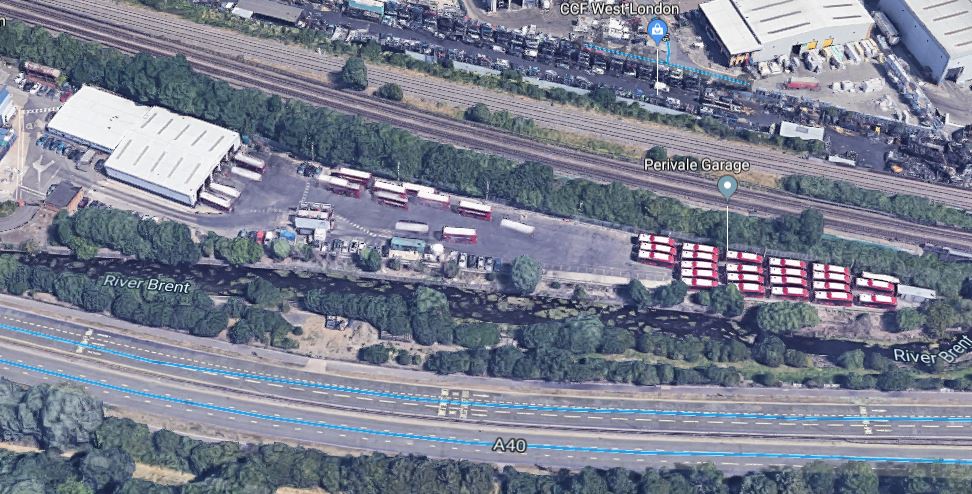
The garage is squeezed into a triangle of land between the Acton-Northolt Line, the Central Line and the six-lane A40 road.
- It’s not near any houses.
- It’s surrounded by trees and industrual units.
- Is the site large enough to generate hydrogen on site?
- Could hydrogen be brought in by rail?
- It could easily hold the twenty hydrogen buses and a few others.
I can certainly see why Transport for London have chosen to use hydrogen buses on routes 7, 245, N7, based at Periavale East garage.
Design
This is a paragraph from the Air Quality News article.
TfL says they are investing £12m in the new buses and the fuelling infrastructure with Northern Ireland firm Wrightbus as the manufacturer, which uses a fuel cell from Ballard to power a Siemens drivetrain.
Wikipedia says this about the transmission of a New Routemaster bus, that was built by Wright.
Hybrid diesel-electric in series; 18 kW] Microvast Lithium Titanate battery,Microvast LpTO, Siemens ELFA2 electric traction motor.
I should point out that it appears that originally, the New Routemaster had a larger 75 kWh battery. Has the technology improved?
Is the transmission and the chassis based on the Wright-designed New Routemaster chassis and transmission, substituting a Ballard fuel cell for the Cummins diesel engine?
The Cummins diesel engine in the New Routemaster is rated at 185 hp or 138 kW.
This page on the Ballard web site is the data sheet of Ballard’s FCveloCity family of fuel cells.
- The fuel cells come in three sizes 60, 85 and 100 kW
- The largest fuel cell would appear to be around 1.2 m x 1 m x 0.5 m and weigh around 400 Kg.
- The fuel cell has an associated cooling subsystem, that can provide heat for the bus.
It strikes me that this fuel cell is smaller and weighs less than a typical diesel engine fitted to a double-decker bus.
With a larger battery, regenerative braking and a clever transmission would a 100 kW fuel-cell provide enough power for the bus?
Wright have obviously solved the problem and found space for the hydrogen tank, otherwise they wouldn’t have received the order.
Drawing on their experience with the New Routemaster and adding the proven fuel cell technology of Ballard looks at first glance to be a low-risk route to a hydrogen-powered bus.
Conclusion
Wright Group and Transport for London appear to have designed a well-thought out solution to the problem of providing zero-emission buses for London and delivering the first buses next year!
We now have two hydrogen double-decker bus projects under way.
- London and Wright Group
- Liverpool and Alexander Dennis
Both appear to be fully-integrated projects, which include the supply of hydrogen to the buses.
When both are proven, there could be very keen competition between the two companies to sell systems all over the UK and the wider world.
It should be noted, that double-decker buses are not that common outside of the UK, Ireland, Hong Kong and Singapore.
But could these two zero-emission projects open up the rest of the world, to these most British of products?
New Facility To Power Liverpool’s Buses With Hydrogen
The title of this post is the same as that of this article on Air Quality News.
These are the first three paragraphs.
Arcola Energy will build a facility to develop hydrogen and fuel cell technology for buses near Liverpool.
The company has secured 15,000 sq. ft of newly-built premises in Knowsley which will house the company’s manufacturing, installation and maintenance facilities.
The manufacturing area of the new site will be used to produce and install hydrogen fuel systems into a fleet of double-decker buses for the Liverpool City Region, after the city region was awarded £6.4m for the project by the Office for Low Emission Vehicles.
The article says this about the design of the buses.
The buses have been developed through a partnership between Arcola and Alexander Dennis, the world’s largest double-decker bus manufacturer.
Arcola Energy‘s Head Office is just round the corner from where I live, by the Arcola Theatre in Dalston.
The Dutch Plan For Hydrogen
The Dutch Plan For Hydrogen
I have cut this out of The Train Station At The Northern End Of The Netherlands, so don’t read if if you’ve read it before.
Searching Google for hydrogen around Groningen, I found this document on the Internet, which is entitled Green Hydrogen Economy In The Northern Netherlands.
It is a fascinating read about what you can do with hydrogen generated from wind and biomass.
This is a sentence from the document.
Large scale green hydrogen product.ion together with harbor transport and storage facilities will be located at Eemshaven, with green chemicals production in Delfzijl
It is an ambitious statement.
Eemshaven
It also appears that Eemshaven will be the main connection point for electricity from offshore wind farms. This is said.
In the Eemshaven an offshore electricity cable from Norway, the NorNed cable with a capacity of 700 MW, comes on land. The Cobra cable, with a capacity of 700 MW, from Denmark is foreseen to connect at the Eemshaven to the onshore grid. The Gemini wind farm is connected to the grid in the Eemshaven with a capacity of 600 MW. Within 10 years it is foreseen that another 4.000 MW offshore wind will have their electricity cable to the Eemshaven.
Does all this explain, the building of a station at Eemshaven? Delfzijl station was built in 1883 and has its own connection to Groningen.
The following proposed actions are from the document
Build A 1,000 MW Electrolysis Plant
This is an extract from the of the document.
A 1.000 MW electrolysis plant that runs 8.000 hours a year, uses 8 billion kWh and 1,5 million m3 pure water to produce 160 million kg Hydrogen. A reverse osmosis plant has to produce the 1.5 million m3 pure water, using sea water or surface water as input. If an electricity price of 2‐2,5 €ct/kWh and a total investment between 500 million and 1 billion Euro with a 10 year life time is assumed, a green hydrogen cost price around 2‐3 €/kg will be the result. This is about competitive with present hydrogen prices, produced from natural gas by steam reforming.
How much energy is contained in a Kg of hydrogen?
This page on IdealHY says the following.
Hydrogen is an excellent energy carrier with respect to weight. 1 kg of hydrogen contains 33.33 kWh of usable energy, whereas petrol and diesel only hold about 12 kWh/kg.
At three euros for a kilogram of hydrogen, that works out at nine euro cents for a kWh.
Build A 1000 MW Biomass Gasification Plant
The title is a section in the document and this is an extract from the section.
Green hydrogen can be produced by electrolysis using green electricity, but can be produced also from biomass via gasification. Biomass gasifiers use solid biomass as an input and deliver a green syngas, a mixture of hydrogen, carbon‐monoxide (CO) and carbon‐dioxide (CO2), and char as an output. The CO could be used, together with water (H2O), to produce extra hydrogen. The resulting products from biomass gasification are green hydrogen and CO2. However, from CO2 and green hydrogen every chemical product could be produced. Therefore, the combination of green hydrogen and CO2 or green syngas creates the opportunity for a fully green chemical industry in the Northern Netherlands.
The process is still being developed. My first question, is can you use animal manure as a feedstock? It should be noted that The Netherlands used to have a very large and smelly manure problem.
Offshore Hydrogen Production From Far Offshore Wind Farms
The title is a section in the document and this is an extract from the section.
Offshore wind farms produce electricity which can be brought onshore via an electricity cable. Such an offshore electricity cable is expensive. The farther offshore the wind farm is located the more expensive the electricity cable cost. At the North Sea, an alternative solution for these wind farms is to convert the electricity into hydrogen at an existing oil/gas platform and to transport this hydrogen eventually mixed with gas via an existing gas pipeline. Onshore the hydrogen is separated from the natural gas and cleaned to be transported via pipeline, ship or truck to the markets.
I think that the technology and existing infrastructure could be made to work successfully.
- Europe has over fifty years experience of handling offshore gas networks.
- Recent developments have seen the emergence of floating wind turbines.
- Would it be easier to refurbish redundant gas platforms and use them to collect electricity and create hydrogen, rather than demolish them?
- Hydrogen is only produced when the wind blows.
- There is no need to store electricity and we’ve been storing gas since the Victorians.
There will be problems, like the integrity of an ageing pipeline, but I suspect that the expertise to solve them exists.
Will there be a North Sea, where every part has a large wind farm?
Note that the Hornsea Wind Farm has an area of 1830 square miles and could generate around 6 GW, when fully developed.You could fit 120 wind farms of this size into the North Sea. Even if only a small proportion could be developed, a sizeable amount of hydrogen could be produced.
A Market For 300,000‐tonnes Green Methanol + 300,000‐tonnes Green Ammonia
The title is a section in the document and this is an extract from the section.
Hydrogen (H2) and Carbon‐dioxide (CO2) can be used in chemical processes to produce a wide variety of chemical products. Two of the main building blocks in chemistry are methanol and ammonia. Methanol can be produced from H2 and CO2. Ammonia is produced from H2 and nitrogen (N2), captured from the air.
Wind power and biomass have been used tp create the basic chemicals for the petro-chemical industry.
The Construction Of Green Hydrogen Fuel Cell Balanced Data Centres
The title is a section in the document and this is an extract from the section.
Google builds a very large data center in the Eemshaven, see picture below. The reasons for Google to choose for the Eemshaven are the existence of an offshore data cable, enough space and green electricity. Google as well as other companies that install and operate data centers wants to run on green electricity. Therefore, Google has signed a power purchase agreement with Eneco to buy green electricity for 10 years. For this reason, Eneco builds an onshore wind farm nearby. On a yearly average this wind farm produces enough electricity to meet the data center demand.
However, supply and demand are not at every time in balance. At moments that there is no wind, other power plants must take over the electricity supply. Now, these are fossil fired power plants.In future, these power plants will be closed and supply and demand needs to be balanced in another way. And of course, that needs to be done with renewable electricity. This can be done by fuel cells fueled with green hydrogen. Fuel cells can follow demand and supply variations very fast with high efficiencies. Fuel cells are quiet and have no emissions, except very clean, demineralized, water.
I like this concept.
Surely, we could build a few data centres in places like Lincolnshire.
Build A Pipeline To Rotterdam And Germany
The Dutch have ambitious plans to export the hydrogen.
Other Ideas
The report is full of clever ideas and I suggest you take the time to read it fully!
Hydrogen Trains In The Northern Netherlands
The document says this about trains powered by hydrogen fuel cells.
In the Northern Netherlands, 50 diesel trains are daily operated on non‐electric lines. These trains, operated by ARRIVA have two or three carriages and a power of 450‐600KW supplied by Diesel‐Electric engines. Fuel cell‐electric hydrogen trains could replace these diesel trains. Alstom is a company that builds these fuel cell hydrogen trains and will perform a test next year on the line Groningen‐Bremen. Because the depreciation time for trains is 25 years, not all trains will be bought new. Some trains may need to be retrofitted with fuel cell‐electric power supply, which is technically feasible. When all these 50 diesel trains are replaced an investment in new and retrofitted trains of about …? Million Euros is needed. The total hydrogen consumption of these trains is about 5,000 ton.
These points are shown in a table.
- Total (diesel) trains in the Northern Netherlands is 50 units
- Hydrogen consumption approximately 25 kg H2/100km
- Train operations average 6 days per week. Train is operated approximately 1.200 km per day, based on two times per hour per trajectory of 50km.
- Train operations average 6 days per week. 330 days per year.
- Capital expenditure per train approximately …. ? 50 Units …? Million Euro
- 50,000 tonnes of hydrogen will be needed.
- The fuel bill at three euros a Kg will be 150 million euro.
Would this be economic?
From various comments, I suspect that Stadler are working on a hydrogen-powered GTW.
But failing that, as Stadler are developing a diesel/electric/battery Flirt for the South Wales Metro and some of the routes from Groningen are only about 30 km, I wouldn’t be surprised to see diesel/electric/battery GTWs running across the flat lands of the North.
Battery trains could be fitted with pantographs and recharge in Groningen, where most of the platforms are electrified.
There are a lot of possibilities and engineers will come up with the best solution with regards to operation and economics.
Conclusion
Thr Dutch have big plans for a hydrogen-based economy in the North of the Netherlands.
Where is the UK Government’s master plan for hydrogen?
Riding On A Battery-Electric Double-Deck Bus
This morning I rode on a battery-electric double-deck bus.
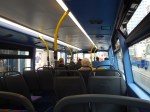
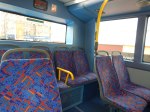


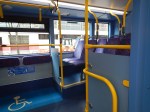



Some of these buses are russing on route 98 between Holborn and Willesden Garage, which includes a run down Oxford Street.
There’s more on the buses in this page on the Metroline web site.
I went upstairs and the experience was little different to that of a normal hybrid bus.
My Thoughts
My thoughts in various areas.
Design
It is a well-designed bus, that is easy to use for this seventy-year-old.
Passenger Experience
Travelling along Oxford Street, the passenger experience was equal to that of a New Routemaster, without the occasional low noise of the engine.
Performance Of The Bus
As we proceeded along Oxford Street, the performance of the bus, was very much in line with current hybrid buses.
The bus wasn’t full on the upper deck, but I suspect that the total weight of the passengers is very much lower than the weight of the battery, so this might mean that a full bus performs well compared with an empty bus.
Limited Space On The Lower Deck
There is one obvious problem and that is that the size of the battery reduces the number of seats downstairs.
As I said earlier, I doubt the weight of the passengers is a problem, but the available space, where they sit and stand could be.
Economics Of The Bus
The bus will obviously be expensive to purchase and to run, as batteries are expensive and need to be replaced every few years.
Coupled with the fact that capacity is smaller than current hybrid buses, which probably means more buses are needed to perform the required service, the economics of the buses may not be suitable for many routes.
I also wonder, if a battery-electric double-deck bus has better economics than a single-deck bus, as the extra weight of the top deck and the extra passengers is small compared to the weight of the battery.
But the economics will get better with improved battery technology.
The Marketing Advantages
BYD and Metroline could be big winners here, as corporate videos and marketing material showing buses in Central London, can’t be a bad thing!
The Competition From Diesel Hybrid Buses
I believe that one competitor to the battery-electric bus will be the next generation of diesel hybrid buses.
Take the current modern hybrid buses like a New Routemaster or any other hybrid bus built in the last couple of years. These have a battery that can power the bus for perhaps a couple of miles.
As the battery is smaller, it can be squeezed into an unlikely space. On a New Routemaster, the diesel engine is under the back stairs and the battery is under the front stairs.
A technique called geo-fencing can be retro-fitted, which forbids the use of the buses diesel engine in sensitive areas, based on GPS technology.
So a route like London’s route 98 could work through the ULEZ on battery power and charge the battery between Edware Road station and Willesden Garage.
The Competition From Hydrogen Hybrid Buses
This will surely be similar to that from diesel hybrid buses.
- Battery size will probably be as for a diesel hybrid bus.
- As hydrogen doesn’t give out noxious emissions, this will be an advantage and you won’t need the geo-fencing.
- But you will need to store the hydrogen.
As hydrogen technology improves, I feel that the hydrogen hybrid bus could become a formidable competitor.
The Competition From Converting Old Diesel Buses To Diesel Hybrid Buses
I talked about this in Arriva London Engineering Assists In Trial To Turn Older Diesel Engine Powered Buses Green.
Never underestimate good engineers with a good idea, that has a good financial payback.
Conclusion
There is going to be a lot of competition between the various technologies and the passengers, bus operators, London and London’s air will be big winners.
As all of this technology can be applied anywhere, other parts of the UK will benefit.
The Wind Of Change Blowing All Over The UK
This has nothibg to do with Brexit or even politics, but the UK and in addition our friends in Denmark, Germany, Ireland and The Netherlands seem to be investing to reap the wind.
To many of my generation, Hornsea is a town on the Yorkshire coast famous for dull ethnic pottery. But now it will the name of the Hornsea Wind Farm, which will have a generating capacity of up to 4 GigaWatt or 4,000,000 KiloWatt. It will be sited around 40 kilomwtres from the nearest land.
To put the size into context, Hinckley Point C, if it is ever built will have a power output of 3.2 GigaWatt.
You may day that wind is unreliable, but then Hornsea will be just one of several large offshore wind farms in the UK.
- Dogger Bank(4.8 GW),
- Greater Gabbard(504 MW)
- Gwynt Y Mor(576 MW)
- London Array(630 MW)
- Race Bank(530MW
- Thanet(300 MW)
- Yriton Knoll(600-900 MW)
- Walney Extension (659 MW).
The electricity produced can be used, stored or exported.
Storage will always be difficult, but then there are energy consumptive industries like aluminium smelting, creating steel from scrap or the electrolysis of water to produce hydrogen, oxygen and ither gases, that could probably be based around an interruptible supply backed-up by a biomass or natural gas power station.
Hydrogen As A Fuel
Hydrogen could be the fuel of the cities for buses, taxis and delivery vehicles. Suppose they were hybrid, but instead of a small diesel engine to xharge the battery, a small hydrogen engine or fuel cell were to be used.
Remember that the only product of burning hydrogen is water and it wouldn’t produce any pollution.
Each bus garage or hydrogen station could generate its own hydrogen, probably venting the oxygen.
Enriched Natural Gas
We can’t generate too much hydrogen and if because of high winds, we have hydrogen to spare it can be mixed with natural gas, ehich contains a proportion of hydrogen anyway.
London’s Hydrogen Buses
London has a few hydrogen-powered buses that run on route RV1 from Tower Gateway to Covent Garden via the South Bank of the Thanes.

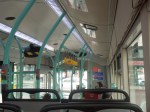


I used this route to get back to North of the Thames, so I could get home, after visiting the Tate Modern.
There’s more about the technology between these hydrogen buses here. The buses would appear to be powered by fuel cells from Canadian company, Ballard, running on a Volvo chassis with a body by Wrightbus from Northern Ireland. There’s a lot of independent hybrid vigour there to go with the conservative bit from Volvo.
 The Anonymous Widower