Investors Hit The Gas On Hydrogen Producers
The title of this post is the same as that of this article on the FT.
The sub headline is.
Hydrogen producers leap on hopes of fossil fuel death.
The article then shows three share price graphs for ITM Power, PowerCell and Ballard Power Systems.
All prices are rising steeply.
A a small investor in the first company, I am pleased and I certainly got that call right!
Note that, the companies are British, Swedish and Canadian respectively.
Green Hydrogen ‘Cheaper Than Unabated Fossil-Fuel H2 by 2030’: Hydrogen Council
The title of this post is the same as this article on Recharge.
This is the introductory paragraph.
Clean hydrogen derived from renewable energy will be cost-competitive with highly polluting grey hydrogen within 5-10 years, says new report.
Points about or contained in the article.
- The report is by respected consultants; McKinsey.
- Currently grey hydrogen produced by steam reforming produces 9-12 tonnes of carbon dioxide for every tonne of hydrogen produced, at a cost of $1.5 per Kg.
- Green hydrogen produced by electrolysis using renewable energy, has a cost of $6 per Kg.
- In certain parts of the world, like Chile, Australia and Saudi Arabia, with strong winds and sunshine, prices for green hydrogen could drop to $1.20 per Kg.
- The article also talks about blue hydrogen, where the carbon dioxide is capyured and stored.
I suggest you read the article.
If you can’t be bothered just digest this paragraph.
The report adds that the blue and green hydrogen will be the cheapest options for many types of transport by 2030 — outperforming fossil fuels and battery power. These include long-distance buses, heavy- and medium-duty trucks, taxi fleets, regional trains and large passenger vehicles such as SUVs.
I can also envisage hydrogen being shipped around the world from the three countries named and others to countries like Germany,China and Japan, that need to decarbonise, in massive ships. Powered by hydrogen of course.
Delivering Hydrogen For Vehicles
In Friday’s copy of The Times, there is an article entitled Hydrogen Lifts Off: An Old Fuel Showing New Promise.
The article talks about Shell’s plans to create a network of filling stations for hydrogen-powered vehicles.
This is a paragraph.
A potential alternative is electrolysis, the method that Shell’s partner ITM Power is using to produce hydrogen at the Gatwick site. There, in a yard behind the refuelling pump, temporary buildings house equipment that purify tap water and convert AC electricity from the grid to DC current. This is used to split the water through electrolysis into hydrogen and harmless waste oxygen, which is vented out.
Note.
- Electrolysis is an alternative to the use of steam reforming of methane, which produces a lot of carbon dioxide.
- If the electricity is from renewables like solar, wind or tidal, then the hydrogen produced can be considered green.
- They is also a quote from Shell, which says that as renewable power gets cheaper and electrolysis more efficient, this will be the standard way to produce hydrogen.
It does seem to me that we could see hydrogen stations all over the place, as each is stand-alone and only needs tap water, an electricity feed and customers.
Who is iTM Power?
iTM Power are a company based in Sheffield.
Read more about them on their Wikipedia entry or their web site.
They claim to have the world’s largest PEM electrolyser factory.
They are also developing a network of hydrogen filling stations.
Currently opened include.
- Beaconsfield Services Hydrogen Station
- Gatwick Refuelling Station
- Rainham Solar Hydrogen Station, Essex
- Rotherham Wind Hydrogen Station
- Shell Cobham Services Hydrogen Station
- Swindon Hydrogen Station
- Teddington Hydrogen Station
And these are currently planned.
- Birmingham Bus
- Birmingham Passenger Vehicle
- Pau Bus, France
Note.
- Some as you can see are to support hydrogen buses.
- Some are powered directly by renewable electricity.
- Birmingham’s two stations are co-located.
- Two; Beaconsfield and Cobham are at motorway service areas.
- Pau is probably to support the hydrogen-powered busway that is being created in the town. There is more on that in this article on rfi, which is entitled Amid Transport Chaos, France Rolls Out World-First Hydrogen Bus Fleet.
It’s looks to me that iTM are working to a sensible plan.
- They can supply a system for a range of purposes.
- They can be placed on fairly small sites.
- They don’t need connection to a hydrogen grid.
- Is it sensible to put one in for a fleet of buses, trucks or vans first?
- Systems for buses and other vehicles can be co-located.
I can see in a few years, that everyone will be within sensible reach of a hydrogen filling station.
As the range of a hydrogen-powered car is in the hundreds of miles. it looks to me that the range anxiety of battery vehicles will be overcome.
I don’t drive or have a car, but if I needed one, I’d buy hydrogen over battery, when there was a filling station in my part of London.
The Times Had A Hydrogen Saturday
The Times had a feature on Saturday about converting our gas grid to hydrogen and especially about using hydrogen boilers in our homes.
I believe that perhaps in ten years, our gas grid will be full of hydrogen and our central heating boilers will be powered by hydrogen.
The carbon emissions saved with be massive
I don’t know about cooking, but my Michelin-starred Scottish friend and chef, says that we’ll all cook on an electric induction hob.
A Large Collateral Benefit?
I think there will be a large collateral benefit.
At present there are only two feasible methods to power a vehicle without producing carbon emissions; battery or hydrogen.
- Battery vehicles need to be recharged and we need an enormous number of charging stations.
- Hydrogen vehicles need to be filled up from a hydrogen filling station.
It should be noted that the current Hyundai ix35 FCEV has a range of 369 miles on hydrogen.
But as you have a hydrogen gas supply to your house, could you fit a compressor in your garage to pump up your car’s hydrogen tank, when it needs it?
The technology is well-proven.
The only problem, that I can see, is that how will the Government tax it?
The future’s not orange it’s hydrogen.
How I Became A Convert To Hydrogen
The title of this post is the same as that on this article on the Sydney Morning Herald.
I think that this article is significant, as it is written by Dr.Alan Finkel, who is Australia’s Chief Scientist.
It is a well-written article about the production of hydrogen with an Australian slant and is a definite must-read.
A Radical Government Would Consider Making Bus Travel Free
The title of this post is taken from the sub-title of the first leading article in today’s Times.
This is the last paragraph.
This is an opportunity for the government to be bold and help those deprived northern areas that voted Conservative for the first time. It should raise spending on buses and force the mainly private companies to provide many more services and routes. It should also encourage them to use electric or hydrogen-powered vehicles. But if it really wants to encourage a better quality of life and improved economic prospects for the north and other regions, it should consider making bus journeys free. At present millions of elderly people and children benefit from free bus passes . Why not extend this to all? That would send a message that this really is a people’s government.
The Times has a point. In fact it has several.
Hyundai, Nikola And Toyota Start To Build The Hydrogen Highway
The title of this post, is the same as that of this article on Trucks.com.
It is a must-read article.
Hydrogen Fuel Cell Company Shares Take Off After 4 Decades Of Declines
The title of this post is the same as that of this article on Hydrogen Fuel News.
Ballard Power Systems, is the company referred to in the article.




This London bus has a hydrogen fuel cell from Ballard.
Tesla Has A Rival In New Hyundai Hydrogen-Powered Semi-Truck Concept
The title of this post, is the same as that of this article on designboom.
This is the introductory paragraph.
hyundai has revealed two new hydrogen-powered concepts – a fuel cell electric semi-truck and refrigerated trailer. both vehicles are part of the automaker’s fuel cell electric vehicle 2030 vision, which includes the widespread use of hydrogen-powered fuel cell technology in vehicles.
The concept looks to be aimed at large countries like Australia, Canda and the United States, but surely one scaled to the United Kingdom market, would be a very useful truck.
- It would be a very efficient motorway cruiser, with those aerodynamics..
- It would be zero-emission with no pollution, so could operate in cities.
- The cab could be designed to meet all present and future driver visibility regulations.
- It might not be liable for extra charges in cities like London.
- Would battery trucks have enough range?
These trucks will be seen on UK roads in the next few years, as I believe that there is no other way to decarbonise heavy road transport.
Eight-Wheeler Trucks
If I walk two hundred metres from my house to the Balls Pond Road or the Kingsland High Road, the most common truck, that I see is an eight-wheeler heavy truck, that is transporting building materials, cement and spoil to and from the myriad building sites around where I live.


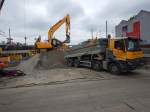


The pictures show typical eight-wheeler trucks working during the installation of the subway at Hackney Wick station.
Note the space under the truck between the front and rear axles. Surely, those clever Koreans can fit all the hydrogen gubbins under and in the truck.
- Many of these trucks are in large fleets, which return to a depot, that is close to the city centre on a regular basis, so refuelling should be easy to arrange.
- These trucks would probably need less fuel per day, than a large artic.
- I doubt they would pay any access charges.
- As they would be pollution-free, zero-carbon and probably a lot quieter, would they be able to work near sensitive sites like hispitals, schools and transport hubs?
They could be a very good economic proposition in a large city of urban conurbation.
Other Trucks
I also believe that hydrogen would be a sensible fuel for several classes of other trucks.
- Four-wheel box vans.
- Refuse trucks
- Skip lorries
- Larger vans
Hydrogen buses already seem to be running successfully in several cities.
The Missing Hydrogen Vehicle
I have chatted with black cab drivers in London, about the use of hydrogen as a fuel for taxis. Black cabs are getting larger and I believe that hydrogen could be their ideal fuel.
Conclusion
I believe that hydrogen will play a big part in decarbonising transport in the next few years and especially in urban areas.
Hydrogen Safety: Busting The Myth That Hydrogen Is More Dangerous Than Gas
The title of this post is the same as that of this article on Hydrogen Fuel News.
It is a must read. Especially for hydrogen sceptics!
 The Anonymous Widower