Cerulean Winds Submits 1 GW Aspen Offshore Wind Project In Scotland (UK)
The title of this post, is the same as that of this article on enerdata.
These first two paragraphs add more details.
Floating wind developer Cerulean Winds has submitted an offshore consent application for its 1 GW Aspen floating wind project to the local authorities in Scotland (UK). The application was submitted to the Scottish Marine Directorate Licensing Operations Team and is supported by an Environmental Impact Assessment (EIA) of the project. The Aspen project is comprised of 72 wind turbines to be installed 100 km off the coast in the Central North Sea to deliver 1 GW of renewable energy, expecting to start operations before 2030. The development is expected to attract a total investment of GBP11bn (€12.6bn) across a 50-year lifespan.
Cerulean Winds is partnering on the project’s delivery with NOV, Siemens Energy, Bilfinger and Ocean Installer. The company plans to develop three floating offshore wind projects in the Central North Sea (Aspen, Beech and Cedar), which are expected to be comprised of over 300 wind turbines in total.
This wind farm along with its sisters ; Beech and Cedar doesn’t appear to have been added to Wikipedia’s master list of offshore wind farms.
From a Cerulean infographic on this page, it appears that Aspen, Beech and Cedar are all 1008 MW wind farms, that are planned to be operational in 2028, starting in 2028 and starting in 2028. It would be good for the ambitions of Ed Miliband, if these three wind farms were fully operational by the end of 2030.
Ørsted, Simply Blue, Subsea7 Submit Application For 100 MW Scottish Floating Wind Farm
The title of this post, is the same as that of this article on offshoreWIND.biz.
This is the sub-heading.
Ørsted, Simply Blue Group and Subsea7, through their joint venture partnership in Scotland, have submitted an offshore consent application for the proposed 100 MW Salamander floating offshore wind farm, one of the 13 projects selected in Scotland’s Innovation and Targeted Oil and Gas (INTOG) leasing round.
The article starts with a map that shows the location of the Salamander floating offshore wind farm and it shows how the sea is getting very crowded 35 kilometres off Peterhead.
This map shows the various ScotWind leases, around the North of Scotland.

The numbers are Scotwind’s lease number in their documents.
These are the Scotwind wind farms to the North-East of Scotland.
- 1 – BP Alternative Energy Investments – 859 km² – 2.9 GW – Fixed
- 2 – SSE Renewables – 859 km² – 2.6 GW – Floating
- 3 – Falck Renewables Wind – 280 km² – 1.2 GW – Floating
- 4 – Shell – 860 km² – 2.0 GW – Floating
- 5 – Vattenfall – 200 km² – 0.8 GW – Floating
- 6 – DEME – 187 km² – 1.0 GW – Fixed
- 9 – Ocean Winds – 429 km² – 1.0 GW – Fixed
- 10 – Falck Renewables Wind – 134 km² – 0.5 GW – Floating
- 11 – Scottish Power Renewables – 684 km² – 3.0 GW – Floating
- 12 – BayWa r.e. UK – 330 km² – 1.0 GW – Floating
Note.
- Salamander is located to the South of wind farms 10, 11 and 12 and to the North-West of wind farm 5.
- These windfarms total up to 16 GW.
- 4.9 GW are fixed foundation wind farms.
- 11.1 GW are floating wind farms.
These are my thoughts.
The Salamander Project
In the big scheme of things, the 100 MW Salamander wind farm, is rather a tiddler of a wind farm.
On the Salamander wind farm web site, a section gives the Project Goals.
- Our innovative pre-commercial stepping-stone concept will use novel floating foundations to (i) maximise Scottish content, (ii) enable the Scottish supply chain to gear up for the future floating offshore wind commercial opportunities in ScotWind and (iii) reduce the financial, environmental and technology risks of floating offshore wind.
- The Salamander project will contribute to the Scottish Government and UK Government net-zero targets. The project can contribute to the Scottish government’s target of 11 GW of installed offshore wind by 2030, as well as the UK government’s target of 5 GW of operational floating offshore wind by the same date.
- We are dedicated to developing a sustainable and transformative project, working with the oceans, and enabling communities to benefit from Project Salamander. Therefore, we commit to having a continuous and strong stakeholder and community engagement.
It appears to me, that the Salamander project will be a pathfinder for the 11.1 GW of floating wind farms to be built off Peterhead.
Bringing The Electricity South
National Grid are building four interconnectors between Eastern Scotland and Eastern England.
- Eastern Green Link 1 – Torness and Hawthorn Pit
- Eastern Green Link 2 – Peterhead and Drax
- Eastern Green Link 3 – Westfield and Lincolnshire
- Eastern Green Link 4 – Peterhead and Lincolnshire
Note.
- All interconnectors are 2 GW.
- All interconnectors are offshore for a long part of their route.
- It also appears that National Grid are burying much of the onshore sections.
But the 4 GW of interconnectors will only be able to bring a quarter of the offshore electricity generated in the Peterhead area to the South.
What Will Happen To The Excess Electricity?
Consider.
- There could be 16 GW of planned offshore wind power around Peterhead and North-East Scotland.
- There is only 4 GW of interconnector capacity between Peterhead and Eastern England.
- There is another 6.8 GW of electricity around North-West Scotland.
- There is 2.8 GW of electricity being developed to the East of Shetland.
- The Crown Estate is thinking of increasing the size of some offshore wind farms.
It is likely, that other wind farms will be built in the seas around the North of Scotland.
It appears that the North of Scotland could have at least 20 GW of excess electricity.
Possible solutions would include.
- Developing energy intensive industries like metal refining.
- More interconnectors to Denmark, England, Ireland and Norway.
- Storage of the electricity in giant pumped storage hydroelectric power stations.
- Creation of green hydrogen for export.
Note.
- Aluminium refining has been developed in the North of Scotland before.
- More interconnectors are a possibility, especially as Scotland is developing cable manufacturing capacity.
- Some maps show extra interconnectors between West Scotland and Merseyside.
- At least 70 GWh of pumped storage hydroelectric power stations are being developed along the Great Glen.
- I suspect that the pumped storage hydroelectric power stations could be connected to the wind farms, by cables under the waters of Loch Ness.
But surely, production of green hydrogen for export would be a very good way to go.
- Extra electrolysers could be added as required.
- Because of the interconnectors down both East and West Coasts, electrolysers could be built in England, where there is a large need for hydrogen.
- Hydrogen would be exported initially by tanker ships.
- At some point in the future, it might be viable to build a hydrogen pipeline to connect to the growing European hydrogen network.
The giant pumped storage hydroelectric power stations and the hydrogen electrolysers would be sized to make sure, that no wind power is never wasted.
Conclusion
The 100 MW Salamander floating wind farm may only be small, but it will prove the technology, the manufacturing and the supply chains, so that Scotland can have a second energy boom from the North Sea.
But this boom will certainly last longer than a hundred years.
Europe’s First Commercial-Scale Floating Offshore Wind Farm Secures All Planning Approvals
The title of this post, is the same as that of this article on offshoreWIND.biz.
This is the sub-heading.
Flotation Energy and Vårgrønn, a joint venture between Plenitude (Eni) and HitecVision, have obtained the offshore planning approval for the Green Volt floating wind farm offshore Scotland.
This is the first paragraph.
With onshore consent announced earlier this month, Green Volt has now received all its planning approvals and remains on track to be the first commercial-scale floating offshore wind farm in Europe.
Note.
- This is the Green Volt web site.
- Capacity will be between 300 and 560 MW.
- It should be fully operational by 2029.
- It is an INTOG wind farm designed to decarbonise offshore oil and gas fields.
It will also have the side effect of bringing more gas ashore in the UK, instead of burning it to power the platforms.
The Invisible £20 Billion North Sea Project
I introduced Cerulean Winds in the two posts What Is INTOG? and Cerulean Winds Is A Different Type Of Wind Energy Company.
They have now expanded their page on the North Sea Renewables Grid.
It is well worth a look!
Flotation Energy, Vårgrønn Seal Exclusivity Agreements For 1.9 GW Scottish Floaters
The title of this post, is the same as that of this article on offshoreWIND.biz.
This is the sub-heading.
Vårgrønn, a joint venture between Plenitude (Eni) and HitecVision, and Flotation Energy have signed exclusivity agreements for two floating offshore wind developments under Crown Estate Scotland’s Innovation and Targeted Oil and Gas (INTOG) leasing round.
These two paragraphs give more details.
Once completed, the floating offshore wind farms, with up to a total of 1.9 GW capacity, will provide renewable electricity to oil and gas platforms, aiming to reduce carbon emissions from the assets they supply.
In addition, Green Volt and Cenos projects will also provide electricity to the UK grid.
Note.
I can’t see a loser with these wind farms.
- The wind farms provide zero-carbon electricity to oil and gas platforms.
- These platforms cut their emissions, by not using fossil fuels to generate the electricity they need for their operation.
- Some platforms use gas to generate the electricity, so this gas can be delivered to the shore for the UK gas network.
- Any spare electricity will be available for using in the UK electricity grid.
- Crown Estate Scotland will be paid for the lease for the wind farm.
There will be no carbon emissions from the platforms, but there will be extra onshore emissions from any gas that is currently used to power the platforms, if it is burnt onshore in power stations and industrial processes, or used for heating.
But increasingly gas in the UK will be used in applications, where the carbon emissions can be captured for use or storage.
It will be very interesting to see how as offshore operations are decarbonised our total carbon emissions change.
Scottish Project To Explore Tugdock Tech Application To Accelerate Floating Wind Development
The title of this post, is the same as that of this article on offshoreWIND.biz.
This is the sub-heading.
The joint venture behind the Salamander floating wind project and the UK developer of marine buoyancy technology, Tugdock, have signed a memorandum of understanding (MOU) to collaborate on research and innovation related to the development of technologies and supply chain for floating wind energy in Scotland.
This is the introductory paragraph.
The 100 MW floating wind farm, developed jointly by Simply Blue Group and Ørsted, and Subsea7 as a minority partner, is one of the 13 projects selected in Scotland’s Innovation and Targeted Oil and Gas (INTOG) leasing round and one of the five INTOG innovation projects which signed exclusivity agreements with Crown Estate Scotland in May.
There is more about Tugdock on their web site.
I like the concept, but then I did a lot of simulation of floating structures in the 1970s, which I wrote about in The Balaena Lives.
Seabed Power Grid To Link North Sea Wind Turbines
The title of this post, is the same as that of this article on the BBC.
This is the sub-heading.
A vast power grid on the seabed of the central North Sea is being planned as part of a £20bn project to power oil and gas platforms with green electricity.
Points in the article include.
- There could be more than 400 offshore turbines.
- If they were 15 MW turbines, that would be at least 6 GW.
- The plan could involve 10,000 jobs, many of which could be in the supply chain in Scotland.
- The plan is for three connected large sea areas in the central North Sea covering nearly 400 square miles.
- Infrastructure could be in place by 2028.
- Scotland was among the most investable countries in the world for floating wind farms.
- Partners include experienced companies like NOV, Siemens Gamesa, Siemens Energy, DEME and Worley.
- Nearly a third of the world’s current order pipeline for floating wind is destined for Scottish waters.
In Cerulean Winds Is A Different Type Of Wind Energy Company, I said, the project is privately-funded. and will need no government subsidy .
This article on offshoreWIND.biz is entitled Cerulean North Sea Renewables Grid To Power Oil & Gas Platforms With Floating Wind finishes with this paragraph.
Cerulean has agreed on an approach with its industrial partners early to de-risk the project in the same way other large-scale infrastructure developments are initiated, the company said. In total, the three wind farms could contribute over GBP 12 billion GVA to the UK’s economy.
Do you believe in magic money trees?
The Original Cerulean Press Release
This press release on the Cerulean Wind web site, gives more details.
Read it and you might get some measure of the ambition of the company.
Questions And Thoughts
In Cerulean Winds Is A Different Type Of Wind Energy Company, I answer a few questions at the end of the post, and come to this conclusion.
It looks like Cerulean Winds are a very different energy company.
If you have any more questions, put them in the comments and I’ll answer them, as best as I can in the related post.
ESB Invests In Floating Offshore Wind Mooring Tech
The title of this post, is the same as that of this article on offshoreWIND.biz.
This is the sub-heading.
Ireland’s Electricity Supply Board (ESB) has announced that it will invest in Dublin Offshore Technology (DOT), a company specialising in floating offshore wind mooring technology
These three paragraphs, outline the new relationship.
DOT has developed a technology solution for floating offshore wind mooring systems which provides significant design improvements for the wind farm, the company said.
The optimised mooring system delivers these benefits using locally-sourced materials tried and tested in the offshore environment with no degradation over the full lifetime of the wind farm, according to the Irish energy company.
By partnering with DOT, ESB will be able to leverage its expertise and resources to accelerate the development and delivery of its floating wind project portfolio.
In 13 Offshore Wind Projects Selected In World’s First Innovation And Targeted Oil & Gas Leasing Round, I wrote about how ESB and DOT were working together on Malin Sea Wind.
This update on the Dublin Offshore web site describes the Malin Sea Wind project.
In the early days of North Sea oil and gas, I saw relationships like these form and blossom. You could argue that the success of the project management system; Artemis, that I wrote, benefitted from close relationships with major oil companies and large international engineering companies.
History is just repeating itself.
UK Launches GBP 160 Million Floating Wind Funding Round, Industry Not Satisfied With Investment
The title of this post, is the same as that of this article on offshoreWIND.biz.
This is the sub-heading.
The UK Government has announced that up to GBP 160 million in grant funding will be made available for certain investments for the floating offshore wind sector
These three paragraphs outline the scheme,
The Department of Energy Security and Net Zero (DESNZ) has established the Floating Offshore Wind Manufacturing Investment Scheme (FLOWMIS) to distribute GBP 160 million in funding to support critical port infrastructure that could enable the delivery of floating offshore wind.
Through this scheme, the government hopes to enable the delivery of the country’s 5 GW 2030 deployment ambition by securing additional suitable port capacity necessary to scale up and accelerate floating offshore wind deployment in the UK, as well as to increase capability in the UK floating wind supply chain, drive cost reduction, and the commercialisation of floating offshore wind technology.
In addition, the government hopes that this scheme will deliver industrial growth and associated regional economic and social benefits (for example, quality jobs and increased GVA).
Note.
- The scheme is called FLOWMIS.
- It seems to be geared to improve port infrastructure.
- It looks like some of these projects will be needed to support ScotWind and INTOG.
- This page on the Government web site, gives the latest state of FLOWMIS.
FLOWMIS could bring forward some interesting projects.
Further Thoughts On BP’s Successful INTOG Bid
I have been searching the web and I feel BP’s successful INTOG bid may be different.
In 13 Offshore Wind Projects Selected In World’s First Innovation And Targeted Oil & Gas Leasing Round, I decided that BP’s bid, which only was for 50 MW of offshore wind would generate hydrogen and send it to shore through the Forties Pipeline System, which is owned by INEOS.
My reasons for feeling that it would generate hydrogen were as follows.
- In the wider picture of wind in the North Sea, BP’s proposed 50 MW wind farm is a miniscule one. SSE Renewables’s Dogger Bank wind farm is over a hundred times as large.
- A cable to the shore and substation for just one 50 MW wind farm would surely be expensive.
- BP Alternative Energy Investments are also developing a 2.9 GW wind farm some sixty miles to the South.
- It would probably be bad financial planning to put large and small wind farms so close together.
I still believe for these and other reasons, that there is no reason to believe that the proposed 50 MW wind farm is a traditional wind farm and most likely it will be paired with an appropriately-sized electrolyser producing around twenty tonnes of hydrogen per day.
But instead of being sent ashore by using the Forties Pipeline System, could this hydrogen be sent directly to the coast near Aberdeen, in its own personal hydrogen pipeline?
- Using a variety of maps, I have estimated the distance at only around twenty miles.
- With all the experience from BP and their suppliers, there must be a solution for a relatively short hydrogen pipeline.
I also found this scientific paper on ScienceDirect, which is entitled Dedicated Large-Scale Floating Offshore Wind To Hydrogen: Assessing Design Variables In Proposed Typologies, which talks about three different layouts.
- Centralised Onshore Electrolysis
- Decentralised Offshore Electrolysis
- Centralised Offshore Electrolysis
All would appear to be feasible.
There is a lot of information in the scientific paper and it leads me to the conclusion, that hydrogen could be generated offshore and transferred by pipeline to storage on the shore.
The paper shows a design for a submarine hydrogen pipeline and schematics of how to design a system.
I believe that BP’s proposed system could deliver around twenty tonnes of hydrogen per day to the shore.
The system could be as simple as this.
- A few large floating wind turbines would be positioned offshore, perhaps twenty miles from shore.
- Perhaps 5 x 10 MW, 4 x 12 MW turbines or 3 x 16 MW could be used. Deciding would be one of those calculations, that combines accountancy, data, engineering and finance, which are great fun.
- The offshore distance would be carefully chosen, so that complaints about seeing them from the shore would be minimised.
- The generated electricity would be collected at a floating electrolyser, where hydrogen would be created.
- The hydrogen would be pumped to the shore.
- The floating electrolyser could also contain hydrogen storage.
I think there is large scope for innovation.
- I can imagine drones and helicopters delivering equipment and personnel to service the electrolyser.
- Underwater hydrogen storage could be developed.
- A standard system could be developed for rolling out anywhere.
- It could be placed in the sea, by a steelworks or other large hydrogen user.
In its own right the concept would develop new markets, which is one of the wind farm’s aims.
Could This Be The Route To Create Affordable Hydrogen For All?
BP would be failing their customers, employees and shareholders, if they weren’t developing a zero-carbon alternative to diesel and petrol.
Offshore hydrogen electrolysers strategically placed along the coastline, could provide a reliable hydrogen supply to a that sizeable proportion of the world’s population, who live near to the coast.
Could The Technology Be Adapted To Motorway And Large Service Stations?
This document on the UK Government web site, gives the mileage statistics of lorries (HGVs) and has this sub-heading.
In 2019 lorries travelled 17.4 billion vehicle miles, remaining broadly stable (increasing slightly by 0.3%) compared with 2018.
It breaks this figure down, by the class of road.
- Motorways – 8.0 – 46 %
- A Roads – 6.3 – 36 %
- Rural Minor Roads – 0.9 – 5 %
- Urban A Roads – 1.5 – 9 %
- Urban Minor Roads – 0.7 – 4 %
Note that 82 % of HGV mileage is on Motorways or A roads. Anybody, who has ever driven a truck bigger than a Ford Transit over a distance of upwards of fifty miles, knows that trucks and vans regularly need to be fuelled up on the road. And that applies to the drivers too, who also by law must take a break, away from the cab.
Charging an electric truck could be a lengthy business and would require service stations to be connected directly to the nation grid and be fitted with a substantial number of heavy duty chargers.
One thing, that would be difficult with an electric truck, would be a Splash-and-Dash, if a truck was nearing the destination and needed a small amount of charging to meet delivery schedules.
Because of the distances involved, the driving rules, the often tight schedules and the fast filling, I am convinced that there will be a large proportion of hydrogen-powered trucks and vans on the road and these will need a network of service stations where hydrogen is available.
Look at these overhead view of South Mimms Services, where the M25 and the A1(M) cross to the North of London.
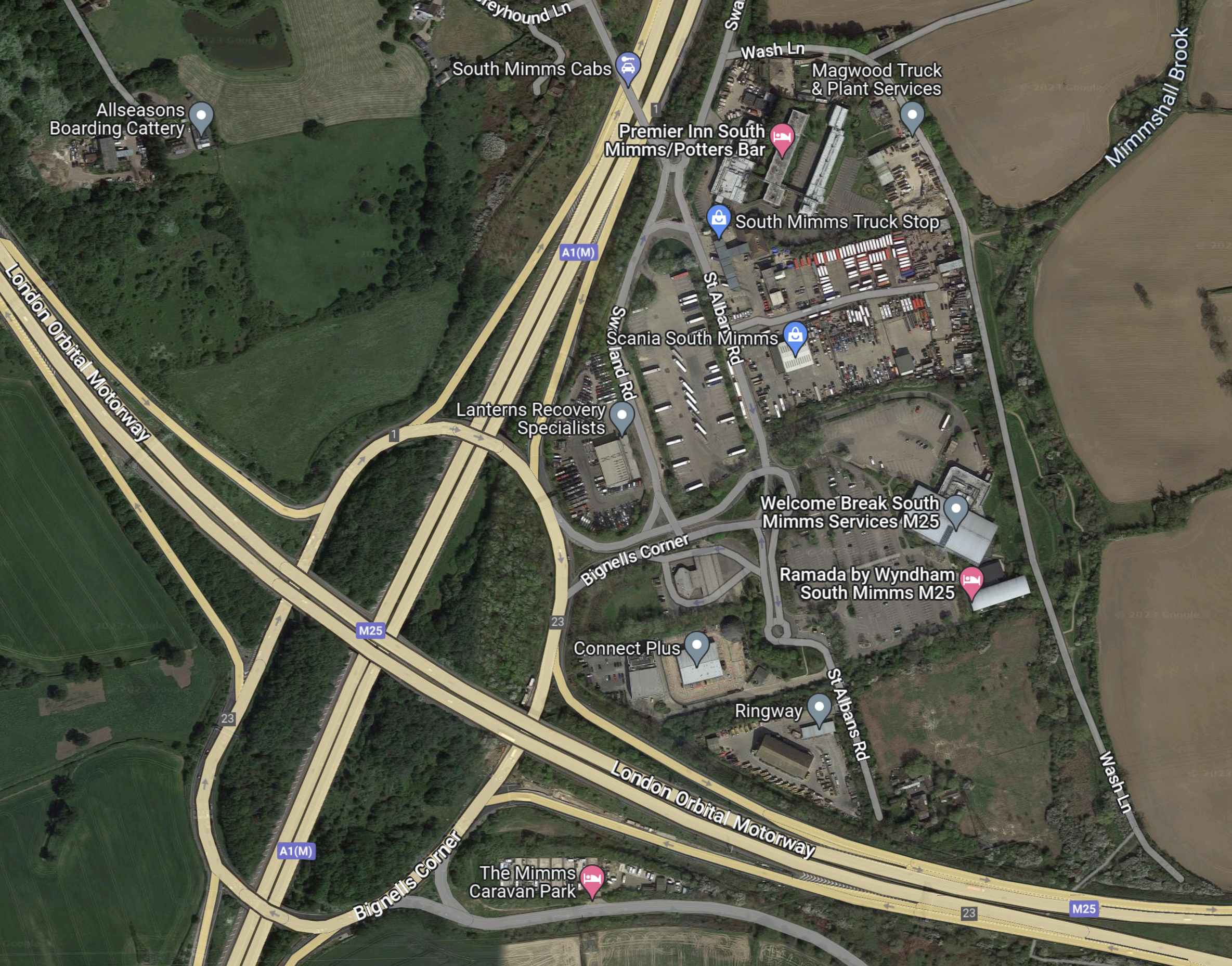
I would envisage that at least four 10 MW wind turbines, which have a rotor diameter of around 160-190 metres could be dotted around and inside the site including inside the roundabout.
- The electrolyser would be slightly smaller than that which would be used at Aberdeen.
- Perhaps fifteen tons per day of hydrogen could be generated.
- No hydrogen needed on the site would ever be brought in by truck.
- Wind-generated electricity could also power the hotels, restaurants and the service station.
- As the percentage of vehicles running on fossil fuels decreased, the air quality in the area of the service station, should increase.
- How many people, who lived locally would switch to a hydrogen-powered runabout and fill it up perhaps once a week, when they passed?
Much of the technology needed to add a hydrogen option to a typical large service station has already been developed and some would also be needed to build BP’s 50 MW offshore wind farm with an electrolyser.
 The Anonymous Widower