TfL Mulls DLR And Overground Extensions To Thamesmead
The title of this post is the same as that of this article on IanVisits.
Overground
TfL’s plan for the Overground would appear to be an extension under or over the River Thames to a single station at Thamesmead and a possible connection to the North Kent Line at Plumstead, Abbey Wood or Belvedere stations.
DLR
The plan for the DLR involves more stations, including a possible one on the North Bank of the Thames. It also serves a proposed massive Peabody housing development, which will provide up to 11,500 new homes.
What Goes East Must Go West
Nothing is said in Ian’s report about train services to Thamesmead.
Overground
On the Overground, there will be four trains per hour (tph) between Gospel Oak and Barking Riverside stations.
There are problems with increasing frequency and capacity, which could be necessary.
- The terminus at Gospel Oak station is only a single platform.
- The Gospel Oak to Barking Line is used by an increasing amount of electrically-haled freight trains.
- There is little space on the line for an additional bay platform to turn trains.
- Trains can’t continue along the North London Line at Gospel Oak, as that line is busy as well.
The only alternative Western terminals are.
- Barking – A bay platform could possibly be squeezed in.
- Enfield Town – Sounds crazy, but there is a chord between Seven Sisters and South Tottenham stations.
- Fenchurch Street – Busy and possibly could be made larger with redevelopment.
- Liverpool Street – Busy and only a slight possibility.
There would also need to be platform lengthening to incorporate trains that are longer than four cars.
Although, it might be possible to run five-car trains using selective door opening on the last car.
DLR
Currently, the DLR has a Peak service of 7.5 tph between Tower Gateway and Becton calling at Shadwell, Limehouse, Westferry, Poplar, Blackwall, East India, Canning Town, Royal Victoria, Custom House, Prince Regent, Royal Albert, Beckton Park, Cyprus, Gallions Reach.
The extension to Thamesmead would branch off around Gallions Reach and the current service has the following connections.
- Shadwell – London Overground
- Canning Town – Jubilee Line
- Royal Victoria – Emirates Air-Line
- Custom House – Crossrail
Will there be enough capacity on this section of the DLR?
- Tower Gateway is a single-platform station and would need to be upgraded to handle more than 7.5 tph.
- Thirty tph run through Shadwell, Limeshouse and Westferry station in the Peak.
- Can stations be lengthened to use longer trains?
It does look to me that the only way to increase capacity would be to extend the DLR to the West, as I outlined in The Bank Station Upgrade And The Western Extension Of The DLR.
This map from TfL shows the possible extension.
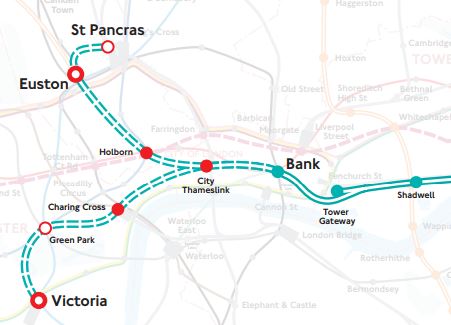
What would be the cost of this extension?
Conclusion
The logic and economics of extending either the Overground or the DLR to Thamesmead are sound for that area of South-East London, but does The Mayor have the budget to complete the other end of the transport links?
Beggars On The London Overground
Beggars on the London Overground are becoming a nuisance.
Today, as I returned home, I saw this notice at Dalston Junction station.
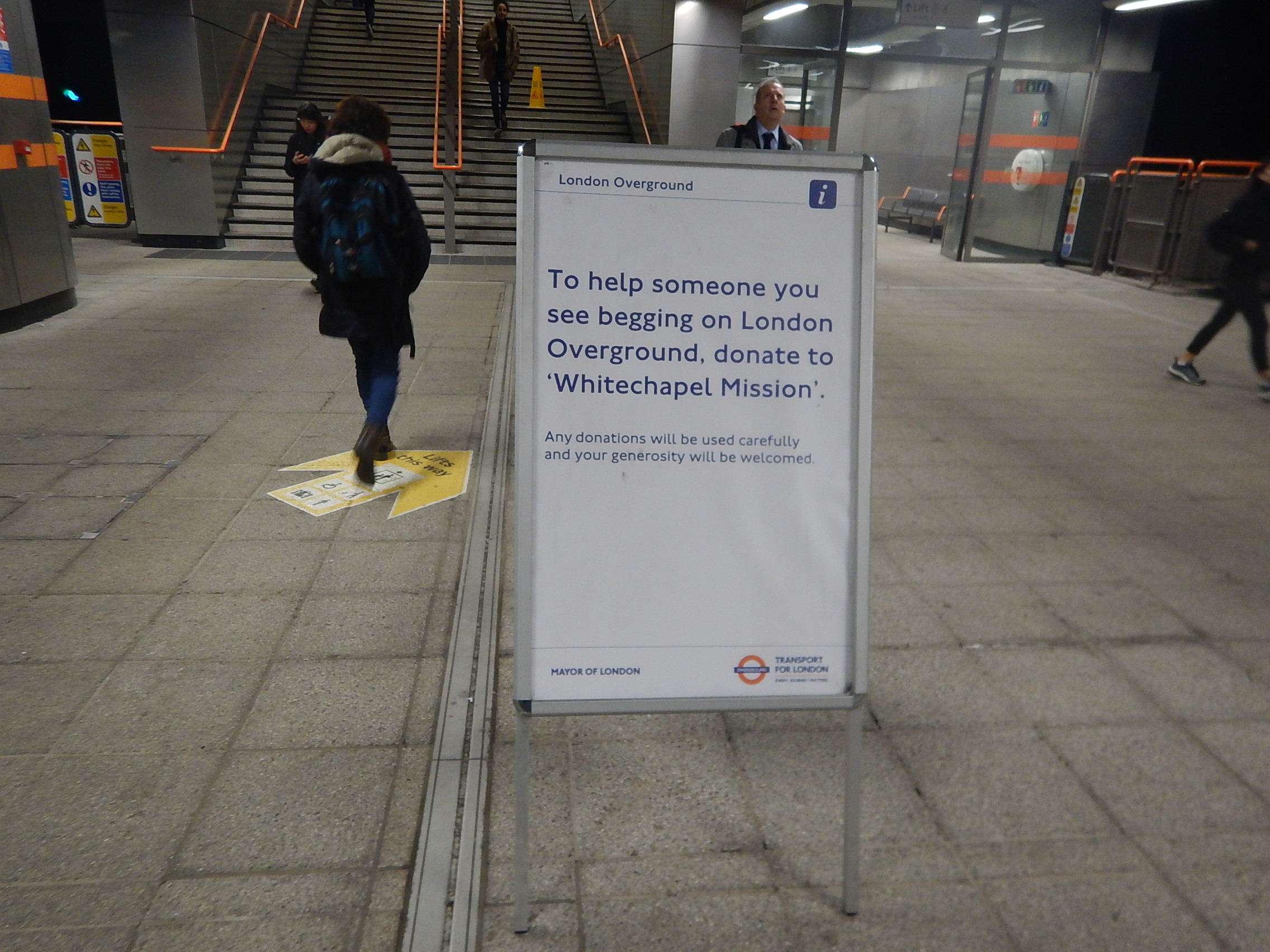
So I made a small donation to the Whitechapel Mission.
Let’s hope it helps.
Has The Canonbury Cross-Over Become More Difficult?
In The Canonbury Cross-Over, I described how it was possible at Canonbury station to change easily from a Westbound train on the North London Line to a Southbound-train on the East London Line.
Services through Canonbury station on the East London Line in trains per hour (tph) are.
- Four tph between Highbury & Islington and Crystal Palace stations.
- Four tph between Highbury & Islington and West Croydon stations.
This means that eight tph call in Platform 2 at Canonbury station.
Services through Canonbury station on the North London Line used to be.
- Four tph between Richmond and Stratford stations.
- Two tph between Clapham Junction and Stratford stations.
This means that six tph call in Platform 3 at Canonbury station.
Since the December 2018 Timetable Change, two tph have been added to the Clapham Junction service.
So now both services calling at Platform 2/3 have the same frequency of eight tph.
So Why Does The Canonbury Cross-Over Appear To Be More Difficult?
Today, I was coming from Stratford on a Richmond train and was changing to the East London Line to Dalston Junction station, from where I can get a bus from outside the station to my house.
It takes a bit longer, but I was carrying my weekend shopping and as Dalston Junction station has lifts, if you need them and Dalston Kingsland station doesn’t, A lot of passengers, seem to use the Canonbury Cross-Over, when they are going from Stratford to stations on the East London Line.
As my train arrived at Canonbury station, in Platform 3, a Southbound-train was leaving Platform 2. So I had a wait of seven minutes in the rain for the next train to Dalston Junction station.
Since the Timetable Change, it appears that I am having to wait for several minutes a lot more.
Look at these times from the 6th of February. The time is when a train on the North London Line calls in Platform 3 and the integer is the number of minutes before the train calls on the East London Line in Platform 2.
- 1150 – 7
- 1157 – 0
- 1205 – 7
- 1212 – 0
- 1220 – 7
- 1227 – 0
- 1235 – 7
- 1242 – 2
- 1250 – 7
- 1257 – 0
- 1305 – 7
- 1312 – 0
- 1320 – 7
- 1327 – 0
- 1335 – 7
- 1342 – 0
- 1353 – 4
- 1357 – 0
- 1405 – 7
- 1312 – 0
In some cases two Southbound trains call between two Westbound ones.
Quite frankly, it’s crap!
Why?
I am no expert on railway timetabling, but if I look at the timetable, it appears that the two trains often seem to be timetabled to arrive at the same time.
As Southbound trains on the East London Line have only come one stop from Highbury & Islington station, are they more likely to be on time, than North London Line trains that have come all the way from Stratford station.
So like today, do North London Line trains arrive after the East London Line train has departed?
Conclusion
The timetable needs to be improved.
Would it be possible to timetable the East London Line trains a couple of minutes after those on the North London Line?
The Shape Of Things To Come On The Gospel Oark To Barking Line
Since modernisation in 2010, the service on the Gospel Oak To Barking Line has been run using six two-car diesel Class 172 trains.
Today was the first weekday, when one of the diesel trains had been replaced by a four-car electric Class 378 train.
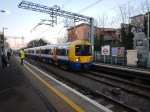
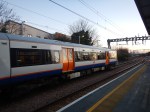
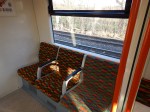
I was able to ride on a Class 378 train between Harringay Green Lanes and Gospel Oak stations. I then doubled back and travelled all the way East to Barking station.
These are a few observations.
Electric Trains
Riding the electric Class 378 trains is a very different experience to riding the diesel Class 172 trains.
- There is a lot less noise and vibration.
- You sit longitudinally in London Undergound fashion, as opposed to transversely.
- There was more capacity in the four cars of the electric train, as opposed to the two-car diesel trains.
I also got the impression that the Class 378 trains accelerated faster and cruised at a higher speed, than the Class 172 trains. I will check this out.
Train Capacity
I said in the previous section, that physical capacity is doubled from two to four cars.
- I actually went from Harringay Green Lanes to Gospel Oak twice in the morning Peak; once in a Class 172 and once in a Class 378.
- The former was jam-packed and the second was very comfortable, with only a few stansdees.
- The Class 172 train has 120 seats in a 47 metre train, which works out as 2.6 seats per metre.
- The Class 378 train has 136 seats in a 80 metre train, which works out at 1.7 seats per metre.
The lower seat density and the wide central isle, probably explains, why the electric train was more comfortable.
Note that in a few months, the Class 378 trains will be replaced with Class 710 trains, which will likely have a similar passenger capacity to the Class 378 trains.
So the capacity and passenger ambience of the Class 378 trains can probably be read across to the internally-similar Class 710 trains.
Platform Length Issues
I did my usual trick of riding in the last car and looking at where the end of the train came on the platform.
The line has been built, so that all platforms fit the standard British Rail four-car length of eighty metres, which applies to both four-car Class 378 and Class 710 trains.
The Possibilities Of Five-Car Trains
London Overground run five-car trains through four-car stations at Shadwell, Wapping, Rotherhithe and Canada Water on the East London Line, by allowing the last car to overhang the platform.
They get away with it without any trouble because.
- The Class 378 trains have selective door opening and a walk-through interior, with large lobbies.
- The announcements on the train are high-quality and advise passengers in the last car to move forward at short platforms.
- East Enders quickly learn how to get in and out of the train with little fuss
So could five-car trains be run the Gospel Oak to Barking Line?
- Barking station has a long platform.
- Some stations like Woodgrange Park, Wanstead Park, Leytonstone High Road, Leyton Midland Road and Upper Holloway originally had longer platforms and these could probably be extended.
- Other stations like Gospel Oak, South Tottenham and Blackhorse Road are probably at maximum length and would use selective door opening.
I suspect that if the demand needed the extra capacity, that the new trains could be lengthened from four to five cars, which would give a twenty-five percent increase in capacity.
Typical Passengers
I have a feeling that the Gospel Oak to Barking Line doesn’t have well-defined typical passengers, like a lot of routes do.
Using the train in the Peak, you notice that many passengers just hopped a couple of stops on the line.
One guy was going from Harringay Green Lanes to Shoreditch High Street, with changes at Gospel Oak and Canonbury.
This journey is probably a reflection on the badly-designed bus routes in the area it serves.
Gospel Oak To Barking Line Connectivity
The line is well-connected to the Underground, especially if you are up for a ten-minute walk.
- District and Hammersmith & City Lines at Barking
- Crossrail at Wanstead Park
- Victoria Line at Blackhorse Road
- Piccadilly Line at Harringay Green Lanes
- Northern Line at Upper Holloway
- North London Line at Gospel Oak
There are also good connections to North-South buses at several stations.
Will Electric Trains Attract More Passengers?
I suspect London Overground will be looking at the passenger statistics on the route with considerable interest, during the period, when some trains are two-car diesels and the others are four-car electrics.
This may well give the answer to my question.
I have a feeling that the reduced crowding on the route will mean that more passengers are attracted.
The new Class 710 trains will have wi-fi and USB charging points, so I wonder how many passengers this will attract.
But as I said earlier, a twenty-five percent increase in capacity may be possible by adding another car to the trains.
Conclusion
I have a very strong feeling that the upgrade to the Gospel Oak to Barking Line and the new electric trains, will change North-East London for the better.
As the London Overground lines to Cheshunt, Chingford and Enfield Town are also getting new trains, I would suspect that the effects will be bigger and more widespread than anybody has predicted.
- Trains will get crowded.
- New stations will be added to the network.
- Existing stations will be upgraded with step-free access
We could even see a serious outbreak of London Overground Syndrome.
Future Additions
These are projects that will or could happen along the Gospel Oak to Barking Line.
- Extension to the new Barking Riverside station.
- Five trains per hour in the Peak
- A new station at Cann Hall.
- A direct link between Walthamstow Queens Road and Walthamsow Central stations, when the latter is upgraded.
- South Tottenham station will be on Crossrail 2 and could be on a future Enfield Town-Stratford service.
- Harringay Green Lanes station could be connected to the Piccadilly Line underneath.
- Reopening of Junction Road station with a link to the Northern Line.
At present only the first two will happen.
A Central Londoner’s View Of Thameslink
The Thameslink route, which runs North-South across London is used by different purposes, by different passengers.
- To many, who live close to its outer reaches it is a commuter railway into London.
- It serves two airports at Gatwick and Luton.
- Londoners use it to explore the delights of the South Coast of England.
But to those who live in Central London like me, it is a useful rail line.
Kings Cross And London Bridge
I regularly use Thameslink for this route, as compared to the Northern Line.
- The trains are more spacious and are generally less crowded.
- It is less walking at Kings Cross.
- The trains are air-conditioned.
- The trains have toilets.
- I have a convenient bus or taxi home from both end stations.
I suspect, I use this route a couple of times a week.
Access To Tate Modern
I like the Tate Modern and the gluten-free egg sandwiches are good.
There is also restaurants in the area; Leon and Carluccio’s for a start, that are good places for lunch or dinner.
So sometimes, I’ll use Thameslink to Blackfriars to visit the Tate Modern and then after my visit, I’ll walk over the Wobbly Bridge and take a bus home.
Thameslink is also an easy way to visit St. Paul’s and in a few years, the new Museum of London will be accessed from Farringdon station.
Access to Gatwick And Luton Airports
I haven’t used Luton Airport in years, as getting there by train is a bit tedious.
But I regularly use Gatwick Airport, usually by getting a bus to and from London Bridge station and then using Thameslink.
West Hampstead Thameslink
West Hampstead station on the Overground has recently been rebuilt and regularly I come home by changing between Thameslink and the Overground.
There is also a Marks & Spencer by the station, which helps too.
The area is becoming a major interchange and if the West London Orbital Railway is created, the Overground will be taking over or adding a platform at West Hampstead Thameslink station.
Does Thameslink Cater For All Passengers?
I say this deliberately, as I think that Thameslink concentrates more on the longer distance and airport passengers, rather than those, who use it as another North-South line across London.
Thameslink Will Run At Rapid Transit Frequencies
In the central core section between Blackfriars and St. Pancras International stations, the trains will run at a frequency of 24 trains per hour (tph) or a train every two and a half minutes.
Trains will run automatically at a frequency, that is higher than many rapid transit systems in the world.
Thameslink Is Part Of London’s Oyster/Contactless Ticketing Zone
From Gatwick Airport in the South to Elstree & Borehamwood and Hadley Wood in the North, Thameslink is part of London’s Oyster/Contactless Ticketing Zone.
In Oyster Card Scheme Extension Agreed, I wrote about how the zone is being extended to Luton Airport Parkway and Welwyn Garden City.
So increasingly, Thameslink will be covered by London’s ticketing, that is increasingly used by residents, commuters and visitors.
Thameslink Has Interchanges With The Underground And Overground
Thameslink has several interchange stations with the Overground and Underground.
These include.
- Blackfriars
- Denmark Hill
- Elephant & Castle
- Farringdon
- Finsbury Park
- Kentish Town
- London Bridge
- Peckham Rye
- St. Pancras Thameslink
- West Hampstead Thameslink
- Wimbledon
In addition East Croydon, Mitcham Junction and Wimbledon are interchanges with Tramlink and Blackfriars and London Bridge are interchanges with the river buses.
Thameslink Is Not On The Tube Map
This is a bone of contention with many! Including myself!
According to the Wikipedia entry for the Tube Map, Thameslink was shown on the map between 1977 and 1998.
So why was it removed?
Some Thameslink Stations Don’t Have Tube Maps On The Platforms
I was on the platform at City Thameslink station and needed a Tube Map.
There wasn’t one!
Why not?
Conclusion
Thameslink is very much part of London’s rail network.
It should be treated as such, by doing the following.
- Extending Oyster/Contactless ticketing to all Thameslink stations.
- Adding all or part of Thameslink to the Tube Map.
- Putting a Tube Map on all station platforms in the London area.
But this mess has existed for twenty years, since Thameslink was removed from the Tube Map.
How Will Class 710 Trains Access Willesden TMD?
This map from carto.metro.free.fr shows the track layout around Willesden TMD, where the Class 710 trains for the Gospel Oak to Barking Line (GOBLIN) will be stabled.
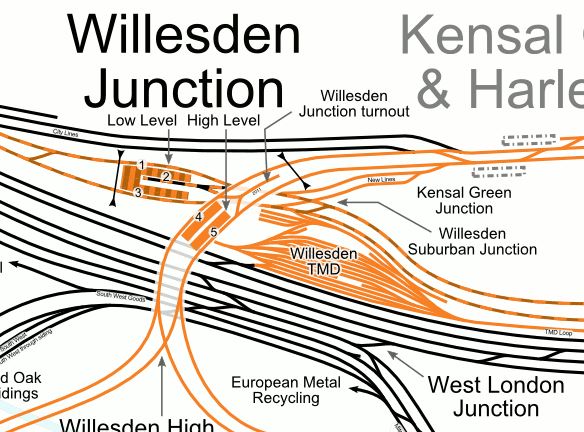
Note the following lines around Willesden TMD.
North London Line
The North London Line goes through platforms 4 and 5 at Willesden Junction station.
South of the station it splits, with the North London Line continuing to Richmond and the West London Line going to Clapham Junction.
North of the station the line continues to the East and at Gospel Oak station, the GOBLIN branches away.
The Bakerloo Line And Watford DC Line
The shared tracks of the Bakerloo Line and the Watford DC Line, which are shown in black/orange go through platforms 1 and 3 at Willesden Junction station.
To the East the tracks go towards Euston and to the West, they go towards Watford.
There is also a bay platform 2 in Willesden Junction station, which is shown in these pictures.

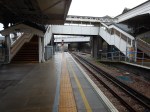
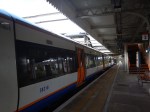
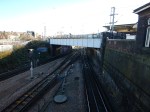
Note that is long enough to take a five-car Class 378 train and that it is also electrified with London Underground’s four-rail electrification.
Platform 2 To The North London Line to the East
Two tracks give a direct route from Platform 2 at Willesden Junction station to the Eastbound North London Line. greatkingrat says they are labelled “New Lines”
Looking from the train this morning, I don’t think this pair of tracks is electrified, so it doesn’t allow Platform 2 to be used to turn electric trains running on the North London Line.
I have seen Platform 2 used as a terminus, but the trains must use the electrified route via Primrose Hill.
After greatkingrat’s comment, I went back and had a second look.
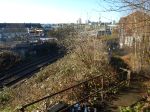
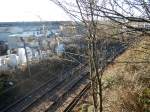
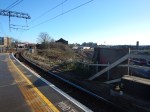
Note.
25 KVAC overhead electrification can be seen at the North London Line end of the tracks.
There is 750 VDC third-rail electrification at the Willesden
This Google Map shows, where the connecting tracks join the Bakerloo/Watford DC Line.
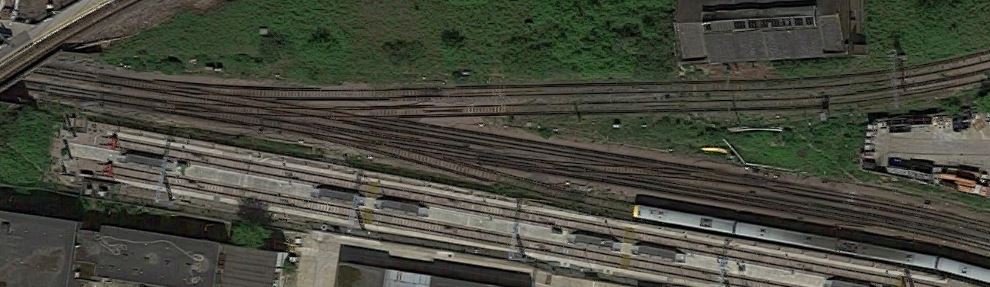
It does appear that the third-rail and a couple of gantries are visible.
- Trains leaving Platform 2 should be able to use third-rail electrification until they are under the overhead wires, when they would change over.
- Trains arriving at Platform 2 would use overhead wires, as far as they could and then swap to third-rail.
If this route is to be used by new Class 710 trains, I’m sure it will get more than adequate testing.
Entering Or Leaving Willesden TMD
I am not sure, how Class 378 trains working the Watford DC Line service transfer to and from Willesden TMD, but it does appear there are some convenient crossovers.
I have looked at Real Time Trains and early in the morning of the 9th of January, these trains called at Platform 2 at Willesden Junction station, that originated at Willesden TMD.
- 05:02 – Willesden TMD to Barking
- 05:15 – Willesden TMD to Upper Holloway
- 05:23 – Willesden TMD to Stratford via Primrose Hill
- 05:56 – Willesden TMD to Kensal Green
- 06:17 – Willesden TMD to Euston
There were also other services, which appeared to be going between Euston and Stratford.
It looks to me that trains were being positioned to start service and that the bay platform 2 at Willesden Junction station is used to reverse trains, coming out of the depot.
It also appears that some trains use the electrified route to the East via Primrose Hill.
The 05:02 and 05:15 are Class 172 trains going to the GOBLIN, and as they are diesel trains, they use the pair of direct tracks, that connect to Platform 2.
How Will Class 710 Trains Go Between the GOBLIN And Willesden TMD?
As the Class 710 trains will be dual voltage trains, they should be able to take the direct route, which has both types of electrification and requires a change at some point.
They can also take a roundabout route possibly via Primrose Hill and using Platform 2 at Willesden Junction station to access the depot.
But I suspect Class 710 trains will have battery power.
This would enable them to take the same short cut, but without using the electrification, between Platform 2 and the North London Line, that the Class 172 trains use currently.
Dual-voltage Class 378 trains should be able to use the short route.
Conclusion
Fitting batteries to Class 710 trains, would make their operation on the GOBLIN, a lot easier, as they could use the batteries to get in and out of Willesden TMD.
Could it be that the software that handles power and charges and uses the batteries, is the unreliable software?
This article on Rail Magazine is entitled Gospel Oak-Barking Fleet Plan Remains Unclear.
This is a paragraph.
London Overground was due to put new Bombardier Class 710 electric multiple units into traffic on the route from March 2018, with a full rollout by May. However, problems with the Train Control Management System (TCMS) has so far prevented this.
I also think that for a train to work the GOBLIN and be stabled at Willesden TMD, it must be a dual-voltage train or have a capability to run on batteries.
Gospel Oak-Barking Fleet Plan Remains Unclear
The title of this post is the same as that of this article on Rail Magazine.
In the article, there is a picture of 378232 at Barking station.
According to the Wikipedia entry for Class 378 trains, this unit is listed as being four-cars and TBA (To Be Allocated?)
So is it a spare train, that is used for driver and staff training and route proving?
It was certainly doing the latter at Barking.
The Situation On The Gospel Oak To Barking Line Is Critical
This page on the Barking-Gospel Oak Rail User Group web site is their latest newsletter, which was issued on the 14th of January.
These are the headlines on the newsletter.
- Train Service On Brink Of Collapse
- Not Enough Trains For Viable Service
- TfL Has No Idea When New Trains Will Be Fit For Service
- Rail Users Demand Mayor Takes Action To Restore Reliable Train Service Now
- Rail Users Demand Compensation After Years Of Misery
It’s all strong stuff.
Trains that work are urgently needed to replace the diesel Class 172 trains, which will all leave by the end of April or even March.
Possible Replacement Trains
These types of trains have been touted as replacement trains.
Class 315 trains
TfL has started to send some Class 315 trains, made redundant by TfL Rail, for scrapping.
Could some of these be held back for use on the Gospel Oak to Barking Line?
- They should fit the route.
- London Overground already runs these trains to Cheshunt, Chingford and Enfield Town.
- The expertise and driving experience must be there to run a service.
But, as there have been no reports of any Class 315 trains on the route, I suspect that there’s a reason, why these trains can’t fill the gap.
Could it be the disability regulations, which kick in at the end of 2019?
The proposed Class 710 rains ordered for both Gospel Oak to Barking Line and the Watford DC Line are dual voltage.
As the Willesden TMD was built to handle trains with the ability to use third-rail electrification, is this ability needed to access the depot?
But Class 315 trains are 25 KVAC only, so this could mean they are unsuitable.
Class 365 Trains
Class 365 trains got ScotRail out of trouble, but like the Class 315 trains, they are 25 KVAC only, so may have the same stabling issues.
They would also be a new train class for London Overground.
Class 319 Trains
Class 319 trains are dual-voltage and could probably be used on both routes, but they would need a refurbishment and would also be a new train class for London Overground.
Class 378 Trains
Class 378 trains already work the Watford DC Line and after the test of a four-car unit to Barking, London Overground probably know how difficult, it would be for four-car trains to work the route.
The trains are dual-voltage and London Overground’s strategy of basing trains for both routes at Willesden TMD would probably be possible.
Drivers and other staff know them very well, as do the passengers.
I am drawn to the conclusion, that of the trains available in the event of non-delivery of Class 710 trains, the Class 378 trains are the best choice.
How Many Trains Are Needed For The Gospel Oak To Barking Line?
The full service was run by a fleet of eight Class 172 service.
As the same number of Class 710 trains have been pencilled in for the route, I must assume that this is the number of trains required. I think six trains are needed for the service, with two in reserve or maintenance.
How Many Class 378 Trains Are Needed For A Full Overground Service?
If I go through the routes of the original Overground, I find the following.
Dalston Junction And Clapham Junction
Trains take 46 minutes to go South and 44 minutes to come North and a round trip would take two hours.
This means thatthe current four trains per hour (tph) service would need eight trains.
Dalston Junction And New Cross
Trains take 22 minutes both ways and a round trip would take an hour.
This means that the current four tph service would need four trains.
Highbury & Islington And Crystal Palace
Trains take 44 minutes to go South and 43 minutes to come North and a round trip would take two hours.
This means that the current four tph service would need eight trains.
Highbury & Islington And West Croydon
Trains take 52 minutes both ways and a round trip would take two hours.
This means that the current four tph service would need eight trains.
Euston And Watford Junction
Trains take 47 minutes to go South and 50 minutes to come North and a round trip would take two hours.
This means that the current three tph service would need six trains.
Stratford And Richmond/Clapham Junction
Between Stratford and Richmond, trains take 59-64 minutes to go West and 62 minutes to come East.
Between Stratford and Clapham Junction, trains take 62 minutes to go West and 64 minutes to come East.
The round trip times are very similar and are around two and a half hours.
This means that the current eight tph service would need twenty trains.
Summarising, these services gives.
- Dalston Junction and Clapham Junction – 8 trains
- Dalston Junction and New Cross – 4 trains
- Highbury & Islington and Crystal Palace – 8 trains
- Highbury & Islington and West Croydon – 8 trains
- Euston and Watford Junction – 6 trains
- Stratford and Richmond/Clapham Junction – 20 trains
This gives a total of 54 trains. As there are fifty-seven Class 378 trains, this means there are three spares to cope for maintenance and breakdowns.
London Overground have plans to increase frequencies and they are detailed in this table.
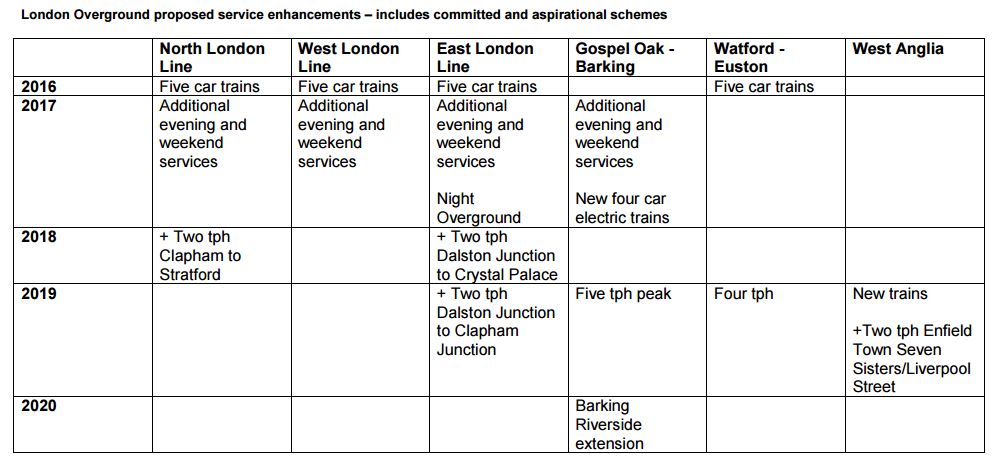
Note that four extra services are planned for the East London, North London and Watford DC Lines.
- Two extra tph between Stratford and Clapham Junction, which has already been implemented.
- Two extra tph between Dalston Junction and Clapham Junction. This would mean that twelve trains would be needed for this service.
- Two extra tph between Dalston Junction and Crystal Palace. This would mean that twelve trains would be needed for this service.
- One extra tph between Euston and Watford Junction. This would mean that eight trains would be needed for this service.
Summarising again gives.
- Dalston Junction and Clapham Junction – 12 trains
- Dalston Junction and New Cross – 4 trains
- Highbury & Islington and Crystal Palace – 12 trains
- Highbury & Islington and West Croydon – 8 trains
- Euston and Watford Junction – 8 trains
- Stratford and Richmond/Clapham Junction – 20 trains
This gives a total of 64 trains.
As London Overground only has 57 Class 378 trains, this proposed timetable is impossible without some new Class 710 trains.
London Overground plan to use some of the Class 710 trains to release Class 378 trains from the Watford DC Line, to reinforce East London Line services.
So it looks like the late delivery of the Class 710 trains has also scuppered London Overground’s plans to increase services on the East London Line.
How Many Class 378 Trains Could Be Scraped Together?
This table shows the number of Class 378 trains needed for the current service.
- Dalston Junction and Clapham Junction – 8 trains
- Dalston Junction and New Cross – 4 trains
- Highbury & Islington and Crystal Palace – 8 trains
- Highbury & Islington and West Croydon – 8 trains
- Euston and Watford Junction – 6 trains
- Stratford and Richmond/Clapham Junction – 20 trains
This gives a total of 54 trains. With just three trains spare.
As the Gospel Oak to Barking Line needs eight trains to run a full service, this is not enough.
What strategies can be applied to increase the number of trains available?
Reduce The Stratford And Clapham Junction Service To Two tph
The Stratford and Clapham Junction service was two tph until recently, when it was raised to four tph.
Reducing it back to two tph, would reduce the number of trains required on Stratford and Clapham/Richmond services by five.
This would give eight spare trains, which would be almost enough to run a full service on the Gospel Oak to Barking Line.
Provided of course, that there was a hundred percent availability, which is rather an impossible dream.
Introduce The Class 710 Trains On The Watford DC Line
The Class 710 trains for the Gospel Oak to Barking Line are dual-voltage trains, which will also run on the Watford DC Line. So would it be a sensible idea to introduce these trains first on the Watford DC Line?
- The third-rail electrification on the line is at least fifty years old, so must be fully tested.
- The drivers have extensive route knowledge of running electric trains on the route.
- Willesden TMD, where the Class 710 trains are stabled, is on the Watford DC Line.
- The route is only shared with the Bakerloo Line.
- The route is to be equipped with six Class 710 trains anyway.
Every Class 710 train introduced will release a Class 378 train.
But if the Class 710 trains don’t work, this is no help!
Introduce The Class 710 Trains On The North London Line
Running on the North London Line is more complicated than the Watford DC Line, but five-car Class 710 trains, are planned for this route.
They could be introduced to release Class 378 trains.
The Four-Car Train Problem
Every four-car train created means that a trailer car is removed from a five-car Class 378 train.
I would assume that it is most likely, these spare cars will be put into store until the, the new Class 710 trains finally enter service.
Or would they be added to other Class 378 trains to create six-car trains, which would then be run on the North or West London Lines, where the platforms could be almost long enough? Selective door opening on the trains could also be used at short platforms.
Conclusion
I feel if the London Overground swap trains around and perhaps reduce the Stratford and Clapham Junction service to its old level of 2 tph, then enough Class 378 trains would be available to run a full four-car service on the Gospel Oak to Barking Line.

