North Sea Oil Group Equinor Scales Back Investment In Renewables
The title of this post, is the same as that of this article in The Times.
This is the sub-heading.
Equinor, which is attempting to develop one of the largest untapped oilfields in UK waters, also raised its fossil fuel production targets
This is the first paragraph.
The Norwegian state-backed oil company that is attempting to develop one of the largest untapped oil fields in UK waters, has dramatically scaled back its investment in renewables and raised its fossil fuel production targets, becoming the latest of the world’s energy giants to row back on the push towards green power.
A quiet revolution is happening that will change our use of natural gas very much for the better.
- In Rhodesia, which is a suburb of Worksop, a 24 MW Rolls-Royce mtu diesel peaker power plant, that runs on natural gas, but is also hydrogen-ready, has been installed to boost the electricity supply. The diesel engine is fitted with carbon capture and produces food-grade CO2, which is sold for food and engineering uses.
- Most of the excellent British tomatoes and soft fruit, we have been eating this winter, is grown in greenhouses, heated by natural gas-powered combined heat and power units, where the CO2 produced is captured and fed to the plants.
- HiiROC is a start-up from Hull, who are backed by Centrica, who use a plasma process to split any hydrocarbon gas including waste gas from a chemical plant, biomethane from a sewage works or natural gas into pure hydrogen and carbon black, which is needed to manufacture tyres and other products, and also to improve soil.
- In the last few months, a HiiROC device has been installed at Brigg power station, to generate zero-carbon electricity from natural gas.
- Imagine a housing or factory estate, a farm or perhaps a large country house, that wants to decarbonise. The gas feed to the property would be fitted with a HiiROC device and all gas appliances and boilers would be converted to hydrogen.
- I also believe that houses and other premises could have their own hydrogen pumps to fill up cars, ride-on mowers and other vehicles.
- Avnos is a company from the US, that captures CO2 from the air. What makes Avnos unique is that for every ton of CO2 it captures, it captures five tons of pure water.
More ideas like these are being developed.
What is wrong in using natural gas, to generate heat and electricity, if it doesn’t emit any CO2 into the atmosphere?
I suspect, that Equinor believe there will be a market for natural gas for years, as more and more clever ways to use it and turn it into hydrogen are developed.
Cold Snap Leaves Britain With Less Than A Week’s Worth Of Gas
The title of this post, are the same as that of this article on The Times.
This is the sub-heading.
The closure of Russian pipelines through Ukraine and recent weather conditions have left gas stores ‘concerningly low’
These are the first two paragraphs.
Britain has less than a week of gas supplies in storage, the country’s largest supplier has warned after plunging temperatures and high demand.
Centrica, the owner of British Gas, said the UK’s gas storage was “concerningly low” after coming under pressure this winter.
The two largest gas storage facilities in this country are both in the Humberside area.
- Aldbrough is in salt caverns North of Hull and is owned by SSE.
- Rough is under the North Sea and is owned by Centrica
Both are being converted to store hydrogen.
Some might thing that is a bit stupid if we’re short of storage, but we need the hydrogen storage for four reasons.
- To store hydrogen created by electrolysers on Humberside, which will enable heavy gas users in the area to decarbonise.
- The hydrogen will also be burnt in a 1 GW hydrogen-fired power station at Keadby to back up the wind turbines, with zero-carbon electricity.
- The hydrogen will also be sold to the Germans to replace Putin’s blood-stained gas. It will be sent to Germany in a pipeline called AquaVentus, which will also deliver Scottish hydrogen across the North Sea. Hopefully, the Germans will pay a good price for the hydrogen.
- The hydrogen will be used for transport.
The mistake the Government is making is not to develop smaller gas fields, so that domestic gas users can continue to use natural gas, until the technology to replace it with zero-carbon sources is fully developed.
Aberdeen’s Exceed Secures Centrica Rough Contract
The title of this post, is the same as that of this article on Energy Voice.
This is the sub-heading.
Well and reservoir management firm Exceed has secured a contract with Centrica Energy Storage for the redevelopment of the Rough gas storage field.
This is the introductory paragraph.
Exceed said its role in the initial stages of the project, which is exploring converting the Rough field into a hydrogen storage facility, could create more than 30 jobs.
In Wood To Optimise Hydrogen Storage For Centrica’s Rough Field, I talked about changing Rough from a gas to a hydrogen store, so it looks like Centrica are going to create a vast hydrogen storage facility.
This all fits with my belief, that Centrica’s Rough facility and SSE’s nearby Aldbrough storage facility, will at sometime in the future be connected to the Germany hydrogen pipeline; AquaVentus to perform backup to hydrogen produced in the North Sea.
I also feel that the hydrogen trading will be of benefit to Centrica and SSE.
The last section of the Energy Voice article is entitled Rough Hydrogen Storage Concerns.
The following facts are given.
There are currently eight geological gas storage sites across Great Britain, containing approximately 3.1bcm in capacity and maximum deliverability rates of 124mcm/day.
Five of these gas storage sites are in salt caverns while the remaining three are depleted oil and gas fields, with the Centrica’s Rough field in the North Sea the only site located offshore.
The British Geological Survey estimates the UK could store up to 3,000 TWh of hydrogen.
Currently, we use the following energy in a year.
- 263 TWh of electricity
- 705 TWh of natural gas
So we use a total of 968 TWh of energy.
3,000 TWh of hydrogen would keep the UK going for three years. So we should be fine!
Centrica Business Solutions Delivers Significant Energy Savings For The Pirbright Institute
The title of this post, is the same as that of this press release from Centrica.
These three paragraphs outline the project.
Centrica Business Solutions has partnered with The Pirbright Institute to deliver sustainable on-site technology that will help reduce its net energy use by more than 10 per cent by 2026.
Centrica installed a new Combined Heat and Power Plant (CHP), which will provide around 75 per cent of Pirbright’s future power needs. The CHP uses natural gas to generate electricity and hot water at the site, with its exhaust gases also used to feed into a heat recovery generator to provide steam. It means CHP technology is over twice as efficient as conventional power sources and can lower organisational reliance on the Grid.
The Institute, which is dedicated to the study of infectious diseases of farm animals, has already devised an energy plan which has introduced energy-saving upgrades across the Surrey campus, including the closure of energy-inefficient buildings, the introduction of efficient lighting and a programme to raise staff awareness of energy consumption.
The system is still powered by natural gas.
Liverpool University
I was an undergraduate at Liverpool University and according to this page on their web site, which is entitled Sustainability, they seem to be following a similar route to the Pirbright Institute.
With a heading of Energy And Carbon, this is the mission statement.
The University’s ambition is to be a climate-resilient campus, that has minimal negative and maximum positive environmental impact, achieving net zero carbon by 2035. We monitor energy and carbon across the entire University as part of the Climate plan and in support of the Sustainability Strategy and Strategy2026 net zero carbon targets.
One section of the page has a title of The Green Recovery with Clarke Energy at the University’s Energy Centre, where this is said.
The University of Liverpool generates up to 90% of its campuses electricity needs on site in the Energy Centre, through CHP. Clarke Energy help the University operate CHP in the most efficient way, keeping us on track with technological developments, such as how the CHP can be adapted to take different fuel blends.
Although there is a nod to different fuel blends, I suspect that the system, like that at Pirbright, is currently powered by natural gas.
Clarke Energy, is headquartered in Liverpool and is a division of Kohler.
Centrica And HiiROC
CHP systems are becoming more common and like these two systems, they are generally powered by natural gas.
In Plans Submitted For Hydrogen Pilot Plant At Humber Power Station, I describe how Hull-based start-up; HiiROC are going to help fuel a gas-fired power station with a hydrogen blend.
This is a paragraph from this article on Business Live, which describes Centrica’s relationship with HiiROC.
It comes as the owner of British Gas has also increased its shareholding in the three-year-old business to five per cent. Last November it was one of several investors to pump £28 million into HiiRoc alongside Melrose Industries, HydrogenOne, Cemex, Hyundai and Kia, who joined existing strategic investors Wintershall Dea and VNG.
HiiROC’s system can take any hydrocarbon gas from biomethane, through chemical plant waste gas to natural gas and convert it to hydrogen and carbon black.
Carbon black has a large number of manufacturing uses and can also be used in agriculture to improve soil.
It looks to me, that HiiROC’s systems will be a simple way to convert natural gas-powered CHPs to zero carbon.
RWE’s Welsh Offshore Wind Project Powers Ahead
The title of this post, is the same as that of this article on offshoreWIND.biz.
This is the sub-heading.
Natural Resources Wales has awarded marine licences for RWE’s Awel y Môr offshore wind project off the North Wales Coast.
These two paragraphs outline the project.
The offshore wind farm, which could power more than half of Wales’ homes, has secured all of its necessary planning approvals with the award of its marine licences from Natural Resources Wales, RWE said.
The marine licences have been awarded on behalf of Welsh Government ministers following the granting of a Development Consent Order in September.
With all the wind action in the East, we tend to forget that the Liverpool Bay area has a lot of wind.
- Awel y Môr – 500 MW – Before 2030
- Barrow – 90 MW – 2006
- Burbo Bank – 90 MW – 2007
- Burbo Bank Extension – 258 MW – 2017
- Gwynt y Môr – 576 MW – 2015
- Mona – 1500 MW – 2029
- Morecambe – 480 MW – 2028
- Morgan – 1500 MW – 2029
- North Hoyle – 60 MW – 2003
- Ormonde – 150 MW – 2012
- Rhyl Flats – 90 MW – 2009
- Walney – 367 MW – 2010
- Walney Extension – 659 MW – 2018
- West Of Duddon Sands – 389 MW – 2014
Note.
- This is a total of 6709 MW to be delivered before 2030.
- All the wind farms have fixed foundations.
- RWE have an interest in three of the Welsh wind farms.
The Times today has this article which is entitled Energy Minnow Sees Pathway To Irish Sea Gasfield Via London IPO, where these are the first three paragraphs.
An energy minnow that is seeking to develop a gasfield in the Irish Sea is planning to list on Aim, the junior London stock exchange, in an attempt to buck the downturn in initial public offerings.
EnergyPathways has announced its intention to float, seeking to raise at least £2 million.
It owns the rights to Marram, a small gasfield discovered in 1993 about 20 miles offshore from Blackpool. It is seeking permission from the government for its plan to develop the field in the Irish Sea quickly by connecting it with existing infrastructure that serves the already-producing gasfields in Morecambe Bay. It aims to be producing gas as soon as 2025.
This gasfield should produce enough gas until the large Liverpool Bay wind farms come on stream at the end of the decade.
Biggest Untapped UK Oil Field, Rosebank, Approved By Regulators
The title of this post, is the same as that of this article on the BBC.
This is the BBC’s summary so far.
- The UK’s largest untapped oil field has been approved by regulators
- Rosebank, 80 miles west of Shetland, is estimated to contain 500 million barrels of oil
- The UK government welcomes the decision, saying it will raise billions of pounds and “make us more secure against tyrants like Putin”
- But Scotland’s First Minister Humza Yousaf says he’s “disappointed”, while the Green Party calls the decision “morally obscene”
- Regulators said net zero considerations had been taken into account
This is my summary.
I have been reading Equinor’s web site on Rosebank.
Production will use what is known as a Floating Production Storage and Offloading Vessel or FPSO, which means, when they’ve finished, it can just sail away.
The FPSO will also be electrification-ready, so that all operations on the vessel will probably be powered by green electricity from a nearby wind farm, instead of by a gas turbine engine on the vessel, which burns gas.
This means that the offshore operations will be as carbon-free as is reasonably possible. But importantly, we will pipe the maximum amount of gas from the field for either our own use or selling to the gas-thirsty Germans.
We will need the gas for some time to back up wind and solar with gas-fired power stations.
But what about the emissions from the power stations?
Capturing carbon dioxide from a power station is getting easier, but more importantly, researchers are finding more and more innovative ways of using the carbon dioxide.
H & M and Zara are even selling clothes made from captured carbon dioxide.
Ways are also being developed using plasma electrolysis to strip the carbon out of natural gas to leave useful hydrogen.
Natural gas will be our friend for many decades yet, if we can turn it into a zero-carbon fuel, which I believe we can!
Centrica Signs UK Biomethane Agreement With Yorkshire Water And SGN Commercial Services
The title of this post, is the same as that of this news item from Centrica.
These three paragraphs outline the story.
Yorkshire Water, an essential water and wastewater services provider for the Yorkshire Region, and Centrica Energy Trading, have today announced signing a 15-year agreement to offtake biomethane production and manage shipping, trading, and balancing of production from two plants developed by SGN Commercial Services.
SGN, a leading manager of natural gas and green gas distribution networks in Scotland and the south of England will design, develop and operate the biomethane gas-to-grid sites, which once operational, will produce approximately 125GWh of biomethane annually — enough to heat more than 10,000 UK households.
Biogas will be produced as a by-product of Yorkshire Water’s sewage wastewater treatment processes, where Centrica will offtake production from the site and subsequently manage shipping, trading, and balancing of the green gas. Biomethane will be injected into the UK grid to displace natural gas, providing cleaner and more resilient gas supplies that reduces dependency on outside energy imports.
SGN Commercial Services are a wholly-owned subsidiary of SGN.
This mission statement is on the home page of their web site.
Our safety-first culture provides bespoke commercial solutions and green gas services to our clients, allowing them to better meet their business needs today and in the future.
In an energy market which is prioritising de-carbonisation and net-zero solutions, we can help navigate a clear pathway for your business to achieve its goals both responsibly and cost-effectively.
It looks to me, that SGN Commercial Services will design, develop and operate the biomethane gas-to-grid sites, so that the biomethane from the sewage works can be fed into Centrica’s main UK gas grid.
You could argue, that every sewage works and landfill producing large amounts of methane, should have one of these connections.
What would be the repercussions if SGN Commercial Services were asked to connect all these sites to the gas grid?
- How much gas would be collected?
- How many houses could be heated?
- How much of the greenhouse gas; methane would not be released into the atmosphere?
This is a cunning plan, that is worthy of Baldrick at his best.
Over a period of time, domestic gas consumption will fall as houses are fitted with heat pumps and other green methods for heating.
Could this mean, that as time goes on, more and more of our domestic consumption of gas is satisfied by net-zero gas from waste sources?
Does HiiROC Fit In Anywhere?
This article on UKTN is entitled Meet HiiROC, The Startup Making Low-Cost Hydrogen Free From Emissions.
There is a section, which is called How Does HiiROC Work?, where this is said.
The company’s hydrogen generation units use feedstock gases such as methane, flare gas or biomethane at high pressure and with a very high electrical field between an anode and cathode.
This dissembles the tightly bound molecules into hydrogen and carbon atoms, with both coming out as a plasma (like a gas). The carbon is instantly cooled and solidified as pure carbon, which means no carbon dioxide is formed, in a quenching process to stop it from reforming back into the input gas.
The end product is hydrogen and carbon black, a material used in rubber tires, inks and paint.
It’s a material that has wide industrial use, but current production methods create large amounts of CO2 and other environmentally harmful biproducts.
“Our process is emission-free,” says HiiROC co-founder and CEO Tim Davies. “Because all you’ve got is hydrogen and solid carbon – they are the two products.”
For every kilogram of hydrogen produced using HiiROC units, you’re left with three kilograms of carbon black. This, however, is a potentially valuable, clean solid by-product and does not contribute to global warming unlike processes that create carbon dioxide gas.
Read the full article on UKTN, as it is full of very interesting information.
It says this about distributing hydrogen to a number of industries.
Lots of industries need hydrogen, which means HiiROC has a broad range of potential customers.
Their smallest machine can produce up to 100 kilograms of hydrogen per day. But due to their modular design and small size, they can easily be stacked up to increase output, making them scalable for businesses requiring large-scale industrial hydrogen production.
So at one end of the scale, it could support a hydrogen filling station, or a farmer wanting to use hydrogen to go carbon-free and at the other, it could support an energy intensive process like hydrogen steelmaking. All that is needed is a suitable hydrocarbon gas feed.
Last night on the BBC, a program called What They Really Mean For You, was about electric cars.
The program flagged up a shortage of graphite for making the batteries for electric cars.
So seeing that HiiROC hydrogen systems, could be producing tonnes of carbon black could this be converted into battery-grade graphite?
Google says yes!
This article on Sciencing is entitled How To Turn Carbon Into Graphite.
Conclusion
As Centrica own a substantial portion of HiiROC and are lending the company a gas-fired power station for full scale trials, I believe that Centrica is up to something, that will have three strong benefits for the British public.
- They will be able to keep their gas boilers for longer.
- Hydrogen supplied by HiiROC’s devices will provide hydrogen in the required quantities to where it is needed.
- The carbon black produced by HiiROC’s devices, when turned into graphite will be a valuable feedstock for giga-factories making batteries.
Engineering is the science of the possible, whereas politics is dreams of the impossible.
Grain LNG Launches Market Consultation For Existing Capacity
The title of this post is the same as that of this press release from National Grid.
This is the sub-heading.
Grain LNG, the largest liquefied natural gas (LNG) terminal in Europe, is pleased to announce the launch of a market consultation for the auction of 375 Gwh/d (approx. 9 mtpa) of existing capacity. The initial consultation phase for the Auction of Existing Capacity will commence on 14 June and run until 26 July.
These paragraphs detail what Grain LNG, which is a subsidiary of National Grid are offering.
GLNG has used the positive feedback received from the recent ‘Expression of Interest’ exercise and subsequent market engagement to offer three lots of capacity:
- Each lot will be entitled to 42 berthing slots, 200,000 m3 of storage and 125GWh/d (approx. 3 mtpa) of regasification capacity from as early as January 2029.
- This product is specifically designed for parties who wish to acquire a substantial stake in a major terminal in Northwest Europe, at a reduced cost and with shorter contract lengths when compared to new-build projects.
- As the terminal’s capacity already exists, parties involved will not be subjected to the FID approvals or potential delays that can arise from construction issues commonly associated with new build terminals.
Simon Culkin, Importation Terminal Manager at Grain LNG, said: “We are really pleased with the high level of interest shown by the market at a time of significant geo-political influence on our energy markets. It has allowed us to engage with potential customers and shape our offering to best meet their needs, whilst optimising access to this strategic asset. “
Reading the Wikipedia entry for the Grain LNG Terminal, it looks like it gets used as a handy store for natural gas.
About Phase 1 (2002–05), Wikipedia says this.
The new facilities enabled the Grain terminal to become a base supply to the NTS, with the ability to deliver gas continuously when required. The cost of the Phase 1 project was £130m. A 20-year contract with BP / Sonatrach enabled Grain LNG to import LNG on a long-term basis from July 2005.
About Phase 2 (2005–08), Wikipedia says this.
The development provided an additional five million tonnes of capacity per annum. All this capacity was contracted out from December 2010. Customers included BP, Iberdrola, Sonatrach, Centrica, E.ON and GDF Suez.
Under Current Facilities, Wikipedia says this.
Grain LNG Ltd does not own the LNG or the gas that it handles but charges for gasifying it. Current (2016) users include BP, Centrica (British Gas Trading), Iberdrola (Spain), Sonatrach (Algeria), Engie (France), and Uniper (Germany).
National Grid must be pleased that some customers seem loyal.
I feel that National Grid’s basic plan is to carry on with more of the same.
But will they develop more storage and other facilities on the site.
There are certainly other projects and interconnectors, that make the Isle of Grain and energy hub connecting the UK, Netherlands and Germany.
- In Did I See The UK’s Hydrogen-Powered Future In Hull Today?, I mentioned, that I thought that the Isle of Grain could be a location for an electrolyser and a hydrogen store.
- In EuroLink, Nautilus And Sea Link, I talk about new interconnectors, if which Nautilus might come to the Isle of Grain.
- In UK-German Energy Link Reaches Financial Close, I talk about NeuConnect, which will be an interconnector between the Isle of Grain ans Wilhelmshaven in Germany.
- The Isle of Grain is the landing point for the BritNed undersea power cable between The Netherlands and the UK.
I could also see National Grid building an East Coast interconnector to bring power from the wind farms off the East Coast of England to the Isle of Grain for distribution.
These are major wind farms South of the Humber.
- Dudgeon – 402 MW
- East Anglia 1 – 714 MW
- East Anglia 1 North – 800 MW
- East Anglia 2 – 900 MW
- Galloper – 504 MW – RWE
- Greater Gabbard – 504 MW
- Gunfleet Sands – 174 MW
- Hornsea 1 – 1218 MW
- Hornsea 2 – 1386 MW
- Hornsea 3 – 2852 MW
- Humber Gateway – 219 MW
- Lincs – 270 MW
- London Array – 630 MW
- Lynn and Inner Dowsing – 194 MW
- Race Bank – 580 MW
- Scroby Sands – 60 MW
- Sheringham Shoal – 317 MW
- Triton Knoll – 857 MW – RWE
- Dogger Bank A – 1235 MW
- Dogger Bank B – 1235 MW
- Dogger Bank C – 1218 MW
- Dogger Bank D – 1320 MW
- Dogger Bank South – 3000 MW RWE
- East Anglia 3 – 1372 MW
- Norfolk Boreas – 1396 MW
- Norfolk Vanguard – 1800 MW
- Outer Dowsing – 1500 MW
- North Falls – 504 MW – RWE
- Sheringham Shoal and Dudgeon Extensions – 719 MW
- Five Estuaries – 353 MW – RWE
Note.
- These figures give a total capacity of 28,333 MW.
- Five wind farms marked RWE are owned by that company.
- These five wind farms have a total capacity of 5618 MW.
- Will RWE export, their electricity to Germany through NeuConnect?
I can certainly see National Grid building one of the world’s largest electrolysers and some energy storage on the Isle of Grain, if an East Coast Interconnector is built.
N-Sea To Connect German Offshore Wind Farm To Dutch Gas Platform
The title of this post, is the same as that of this article on offshoreWIND.biz.
This is the sub-heading.
Dutch upstream oil and gas company, ONE-Dyas, has awarded N-Sea with a contract to install a subsea power cable between the Riffgat offshore wind farm in the German North Sea and the new, to-be-built N05-A gas production platform.
At a first look it appears that wind power is being used to power the gas production platform.
Other points from the article include.
- The distance of the connecting cable is ten kilometres.
- The Dutch government approved the scheme in June 2022.
- A final investment decision was made in September 2022.
I have some thoughts and further information.
Borkum, Rottumerplaat and Schiermonnikoog
The article says this about the position of the gas platform.
The N05-A platform will be installed some 20 kilometres north of the islands of Borkum, Rottumerplaat and Schiermonnikoog, and approximately one and a half kilometres from German waters.
This Google Map shows the three islands.
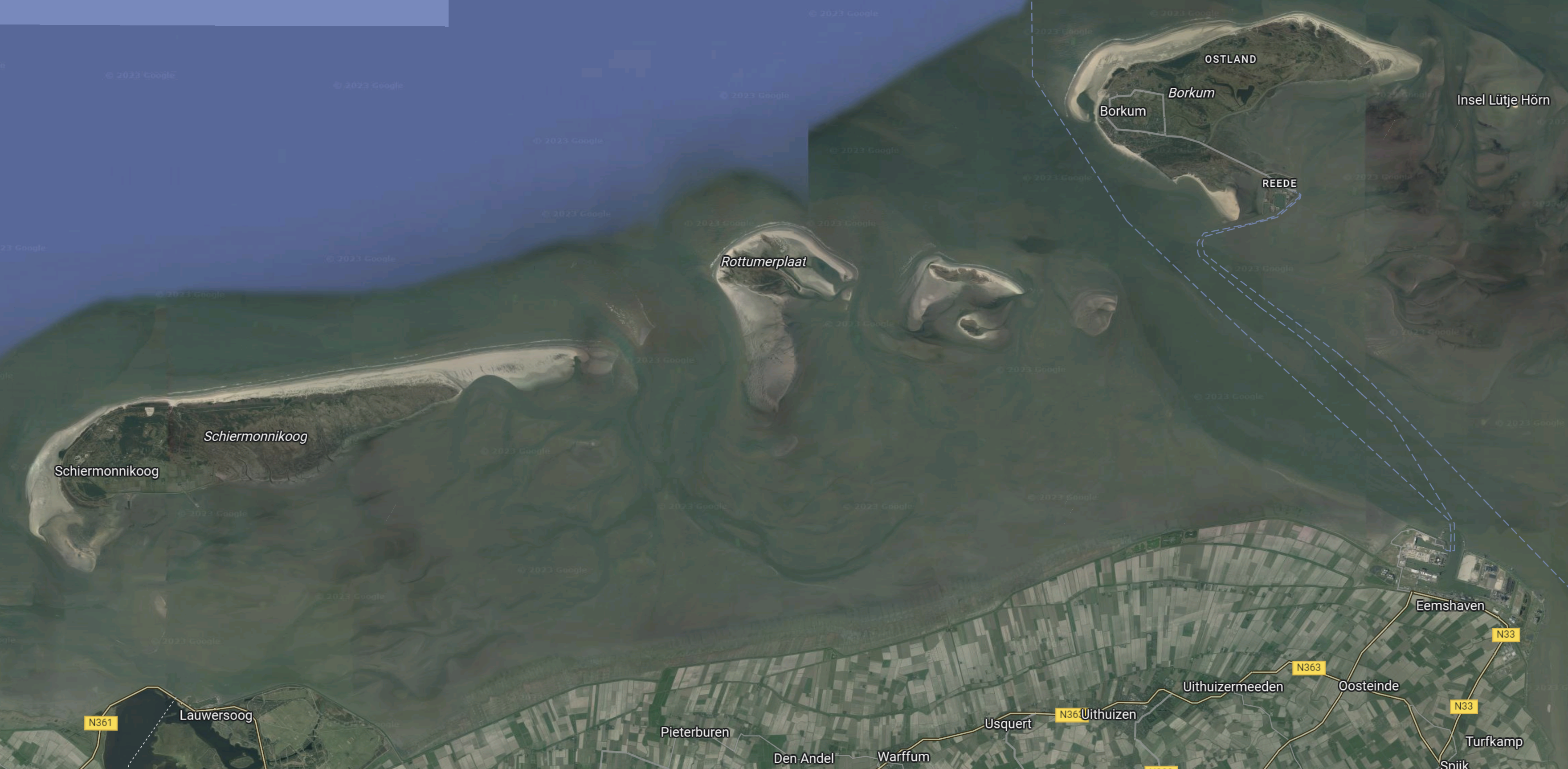
Note.
- Borkum is the horseshoe-shaped German island in the North-East corner of the map.
- Schiermonnikoog is the long and thin island in the West.
- Rottumerplaat is the larger of the two Dutch islands in middle map.
- Eemhaven, which I wrote about in The Train Station At The Northern End Of The Netherlands, is in the South-East corner of the map.
Shipping routes run up the River Ems and German-Dutch border in the East of the map
Riffgat Wind Farm
This web page on the EWE web site, gives this description of the wind farm.
EWE has built the first commercial wind farm in the German North Sea in summer 2013 with Riffgat. The modern wind farm has a total capacity of 108 megawatts of power and can supply around 120,000 households with environmentally friendly electricity. In just 14 months of construction, the 30 wind turbines of the 3.6 megawatt class have been installed 15 kilometers off the north seas of Borkum. The rotor diameter of the units is 120 meters, while the hub height is 90 meters, which corresponds to the height of the Bremen dome. Overall, the plants are 150 meters high from the water surface to the top rotor blade tip. They are founded on 70 meter long steel foundations (monopiles), 40 meters deep in the sea bottom. The water depth in the wind farm is between 18 and 23 meters. In addition to the wind power plants, Riffgat also consists of a substation which transports the generated electricity to a better transportable voltage level.
It looks a pretty standard 100 MW wind farm with fixed foundations.
The N05-A Platform
The article says this about the N05-A project.
The N05-A project is part of the so-called GEMS area, an area approximately 20 to 80 kilometres north of the Ems estuary. ONE-Dyas, together with partners Hansa Hydrocarbons and EBN, aims to extract natural gas from the N05-A field as well as surrounding fields in the German and Dutch North Sea.
The GEMS area has a web site with a URL with a .co.uk extension.
It has an informative video, which I don’t think would go down with Dutch chapter of Just Stop Oil.
The North Sea’s First Gas Platform To Run Entirely On Wind Power
The article says this about the N05-A project.
While the N05-A platform will not be the first in the North Sea to run on wind energy, it will be the first to do so entirely.
Hywind Tampen floating wind farm will be the first.
Conclusion
This looks like a good pragmatic solution to me.
I can see more connections between offshore wind farms and oil and gas facilities all over the world.
Coal Sales Could Lose Tens Of Millions For Consumers
The title of this post, is the same as that of this article on The Times.
These two paragraphs outline the story.
A huge stockpile of coal bought for emergency use in power stations this winter is due to be resold at a loss of tens of millions of pounds to consumers.
National Grid funded the procurement of hundreds of thousands of tonnes of coal as part of a deal to keep open five coal-fired units this winter. The estimated £368 million cost of the “winter contingency contracts”, which includes an undisclosed sum for the coal purchases, is being recouped via energy bills.
Note.
- None of the coal has been burned, as the weather was warmer than expected,
- It is now sitting in various places around the country.
- It will probably sell at a loss and there will be transport costs.
I will look at the mathematics of disposal.
Burning Fossil Fuels
On the Internet, I have found these figures.
- If you burn a kilogram of natural gas you create 15.5 KWh of electricity and 2.75 kilograms of carbon dioxide.
- If you burn a kilogram of coal you create 2.46 KWh of electricity and 2.38 kilograms of carbon dioxide.
This means that natural gas and coal create 0.18 and 0.97 kilograms of carbon dioxide respectively for every KWh generated.
I believe these figures say, that if we have to use a fossil fuel, gas will be much better than coal for climate change reasons.
The Size Of The Problem
We are talking about 130,000 tonnes of coal for EDF and 400,000 for Drax. Uniper’s figure is not stated. Let’s say they make the coal pile up to 600,000 tonnes.
Burning this pile will generate 1,476,000 KWh or 1.476 GWh of electricity and create 1428,000 tonnes of carbon dioxide.
Effect On Total UK Carbon Dioxide Emissions
According to government figures on the Internet in 2021 we emitted 107.5 million tonnes of carbon dioxide.
Burning all that coal in a year, would add less than 1.5 % to our carbon dioxide emissions. Perhaps we should burn it strategically over a number of years, when there are energy supply problems, as it is after all a crude form of energy storage.
What Would I Do With The Savings?
The money saved on the transport and making loss-making sales could be spent on other ways to save carbon emissions, like converting surplus wind energy into hydrogen and blending it with the gas.
I discussed the mathematics of hydrogen blending in UK – Hydrogen To Be Added To Britain’s Gas Supply By 2025.
If we put 2 % hydrogen in our natural gas, this would save nearly 2.5 million tonnes of carbon dioxide emissions in a year. This figure is much bigger than the 1428,000 tonnes of carbon dioxide, that would be created by burning all the coal.
At a level of 2 %, most appliances, boilers and industrial processes would work without change. But a good service would help.
 The Anonymous Widower