Norway Has Room For 338 GW Of Offshore Wind, New Analysis Finds
The title of this post, is the same as that of this article on offshoreWIND.biz.
This is the sub-heading.
Norway has the potential to develop up to 338 GW of offshore wind in areas with a low level of conflict, according to a new analysis performed by Multiconsult and commissioned by the industry organisation Norwegian Offshore Wind, Equinor, Source Galileo, Hafslund and Deep Wind Offshore.
These two paragraphs are the main findings of the report.
The report, issued on 14 April, maps 28 areas as suitable for floating wind and 18 areas for fixed-bottom offshore wind, estimating the total potential installed capacity to be 241 GW at 5 MW/km2 and 338 GW at 7 MW/km2.
Of this, floating wind could account for 156 GW and up to 219 GW, while fixed-bottom capacity is between 85 GW and 119 GW.
So how does that figure look for the UK?
Consider.
- The UK has an Exclusive Economic Zone of 773,676 sq. kilometres.
- But if you include overseas territories, the UK’s area is 6,805,586 sq. kilometres and is the fifth largest in the world.
- Norway has an Exclusive Economic Zone of 2,385,178 sq. kilometres.
So taking the 338 GW figure for Norway and ignoring overseas territories, we could generate 109.6 GW.
World’s First Unmanned HVDC Offshore Platform Installed At World’s Largest Offshore Wind Farm
The title of this post, is the same as that of this news item from the Dogger Bank wind farm web site.
These are the two bullet points.
- Dogger Bank Wind Farm will be first UK High Voltage Direct Current (HVDC) connected offshore wind farm
- 70% reduction in topside weight per MW for offshore platforms
These are my thoughts.
High Voltage Direct Current
Wikipedia has an excellent entry on high voltage direct current, which is commonly referred to as HVDC.
The news item says this about how the electricity is brought ashore from the Dogger Bank wind farm.
The innovative offshore platform has a lean design and is the first unmanned HVDC platform which will be operated from shore and accessed only by a Service Operations Vessel. The platform will receive 1.2GW of AC power from Dogger Bank A’s 95 offshore wind turbines and convert it to DC, which will then be sent ashore to an onshore convertor station near Beverley in East Riding of Yorkshire.
Fitted with Hitachi Energy’s latest generation HVDC converter technology, Dogger Bank will be the first offshore wind project in the UK to use this technology to transmit the electricity produced back to shore, ensuring that the electricity is transmitted efficiently over long distances while minimising losses.
Note.
- Wind turbines generate AC.
- There will be conversion to DC on the substation and conversion back to AC onshore.
- It should also be noted, that large undersea interconnectors are generally built around HVDC technology.
Wikipedia says this about the advantages of DC transmission.
A long-distance, point-to-point HVDC transmission scheme generally has lower overall investment cost and lower losses than an equivalent AC transmission scheme. HVDC conversion equipment at the terminal stations is costly, but the total DC transmission-line costs over long distances are lower than for an AC line of the same distance. HVDC requires less conductor per unit distance than an AC line, as there is no need to support three phases and there is no skin effect.
Depending on voltage level and construction details, HVDC transmission losses are quoted at 3.5% per 1,000 km (620 mi), about 50% less than AC (6.7%) lines at the same voltage. This is because direct current transfers only active power and thus causes lower losses than alternating current, which transfers both active and reactive power.
It looks like cost is a big factor.
My knowledge of grid systems and AC power is limited, as I was more of a Control Engineering and Electronics student at university.
But could HVDC-connected wind farms have advantages, when it comes to providing a reactive power capability to the grid, as I wrote about in Dogger Bank C In UK Offshore Wind First To Provide Reactive Power Capability.
Extra income is another good reason to choose something.
Lightweight Platforms
I’ve always been a fan of lightweight structures and it does seen that the engineers of the Dogger Bank Wind Farm have gone down that route.
This is a paragraph from the news item.
The platform will be controlled from shore and by removing the need for personnel to stay on the platform meant it has been possible to eliminate elements such as the living quarters, helideck and sewage systems, resulting in a 70% reduction in weight (per megawatt) of the topside compared to previous platforms installed, and cost savings of hundreds of millions of pounds.
Again costs are being reduced and profits increased.
We should never rule out the importance of the finances of a project. Once by simulating a chemical process on the computer for ICI, I knocked ten metres off the height of a chemical plant. I got a nice little bonus for that!
If they have made a substantial reduction in substation weight, this surely means that the supporting structure can probably be smaller and less costly.
Conclusion
I suspect, a lot more wind farms will follow the Dogger Bank example.
Seaway7 Installs Final Foundation At Seagreen Offshore Wind Farm
The title of this post, is the same as that of this article on offshoreWIND.biz.
This is the sub-heading.
Seaway7 has installed the final wind turbine foundation on Seagreen Offshore Wind Farm, off the coast of Angus, Scotland, concluding the 18-month installation campaign.
Note.
- As 114 foundations have been installed in eighteen months or just over six installations in a month.
- According to Deepest Ever Fixed-Bottom Wind Turbine Foundation Stands Offshore Scotland, each foundation weighs two thousand tonnes.
- Some are also the deepest ever turbine foundations with a depth or is that height of nearly sixty metres.
- The Seagreen web site, says that phase 1 will be complete in the second quarter of this year.
- The first phase will generate 1075 MW.
We should raise a few cheers for the companies involved.
Mingyang Building Fish Farm-Equipped Offshore Wind Jacket Foundation
The title of this post, is the same as that of this article on offshoreWIND.biz.
This is the sub-heading.
Chinese wind turbine manufacturer Mingyang Smart Energy revealed on 17 April that it started the construction of a jacket foundation that also features a net cage system for fish farming, which will be installed at the Mingyang Qingzhou 4 offshore wind farm in the South China Sea later this year.
The picture in the article, looks like something out of Baldrick’s book of cunning plans.
This paragraph gives more details.
The jacket is typhoon-resistant and the aquaculture system, which will raise up to 150,000 fish in 5,000 cubic metres of water, will have remote functions such as automated feeding, monitoring, detection, and collection, according to Mingyang.
Mingyang also state that the Qingzhou 4 offshore wind farm will also produce hydrogen.
Does that mean that in the next phase of the development, they’ll be putting a fish and chip shop on top?
N-Sea To Connect German Offshore Wind Farm To Dutch Gas Platform
The title of this post, is the same as that of this article on offshoreWIND.biz.
This is the sub-heading.
Dutch upstream oil and gas company, ONE-Dyas, has awarded N-Sea with a contract to install a subsea power cable between the Riffgat offshore wind farm in the German North Sea and the new, to-be-built N05-A gas production platform.
At a first look it appears that wind power is being used to power the gas production platform.
Other points from the article include.
- The distance of the connecting cable is ten kilometres.
- The Dutch government approved the scheme in June 2022.
- A final investment decision was made in September 2022.
I have some thoughts and further information.
Borkum, Rottumerplaat and Schiermonnikoog
The article says this about the position of the gas platform.
The N05-A platform will be installed some 20 kilometres north of the islands of Borkum, Rottumerplaat and Schiermonnikoog, and approximately one and a half kilometres from German waters.
This Google Map shows the three islands.
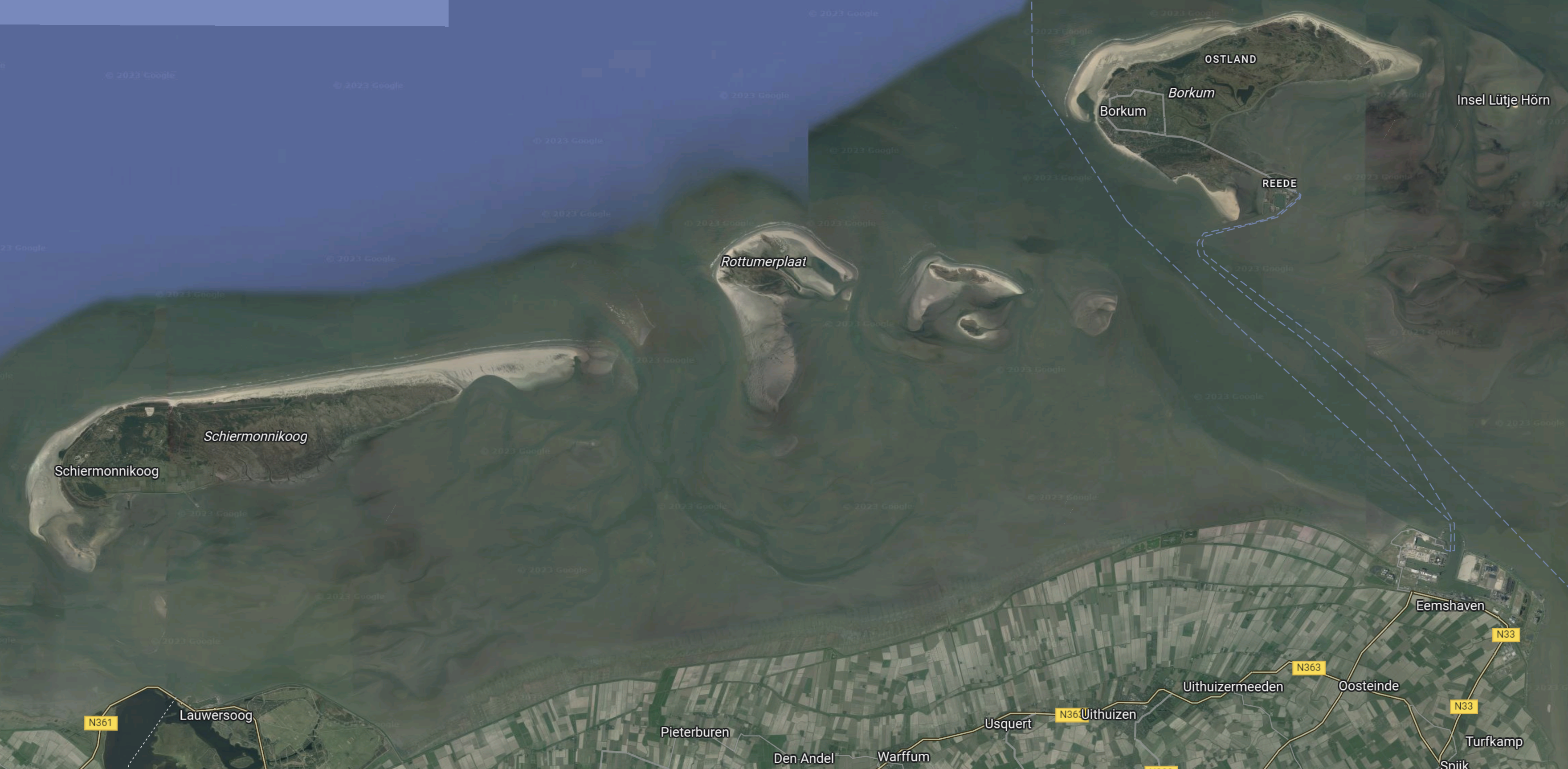
Note.
- Borkum is the horseshoe-shaped German island in the North-East corner of the map.
- Schiermonnikoog is the long and thin island in the West.
- Rottumerplaat is the larger of the two Dutch islands in middle map.
- Eemhaven, which I wrote about in The Train Station At The Northern End Of The Netherlands, is in the South-East corner of the map.
Shipping routes run up the River Ems and German-Dutch border in the East of the map
Riffgat Wind Farm
This web page on the EWE web site, gives this description of the wind farm.
EWE has built the first commercial wind farm in the German North Sea in summer 2013 with Riffgat. The modern wind farm has a total capacity of 108 megawatts of power and can supply around 120,000 households with environmentally friendly electricity. In just 14 months of construction, the 30 wind turbines of the 3.6 megawatt class have been installed 15 kilometers off the north seas of Borkum. The rotor diameter of the units is 120 meters, while the hub height is 90 meters, which corresponds to the height of the Bremen dome. Overall, the plants are 150 meters high from the water surface to the top rotor blade tip. They are founded on 70 meter long steel foundations (monopiles), 40 meters deep in the sea bottom. The water depth in the wind farm is between 18 and 23 meters. In addition to the wind power plants, Riffgat also consists of a substation which transports the generated electricity to a better transportable voltage level.
It looks a pretty standard 100 MW wind farm with fixed foundations.
The N05-A Platform
The article says this about the N05-A project.
The N05-A project is part of the so-called GEMS area, an area approximately 20 to 80 kilometres north of the Ems estuary. ONE-Dyas, together with partners Hansa Hydrocarbons and EBN, aims to extract natural gas from the N05-A field as well as surrounding fields in the German and Dutch North Sea.
The GEMS area has a web site with a URL with a .co.uk extension.
It has an informative video, which I don’t think would go down with Dutch chapter of Just Stop Oil.
The North Sea’s First Gas Platform To Run Entirely On Wind Power
The article says this about the N05-A project.
While the N05-A platform will not be the first in the North Sea to run on wind energy, it will be the first to do so entirely.
Hywind Tampen floating wind farm will be the first.
Conclusion
This looks like a good pragmatic solution to me.
I can see more connections between offshore wind farms and oil and gas facilities all over the world.
BP And EnBW Hire Kent For 2.9 GW Scottish Offshore Wind Project
The title of this post, is the same as that of this article on offshoreWIND.biz.
This is the sub-heading.
Engineering and design service provider Kent has been awarded a contract by EnBW and BP to carry out pre-Front End Engineering Design (FEED) studies for the 2.9 GW Morven offshore wind project in Scotland.
Morven offshore wind farm would appear to be on its way.
According to Wikipedia’s list of UK offshore wind farms, the water depth in the Morven wind farm is between 65-75 metres.
- Total power is given as 2907 MW, which indicates that 14 MW turbines could be used.
- Siemens Gamesa 14 MW turbines have a blade length of 108 metres and their 10 MW have a blade length of 94 metres.
- This would seem to indicate that the wind turbine will be as much as 160 to 185 metres above the sea-bed.
A radical design of fixed foundation will be needed.
In Entrion Wind Wins ScotWind Feasibility Deal For Its 100-Metre Depth Foundation Tech, I look at technology that might work.
I also say this about work I did in Cambridge in the early 1970s.
The structures, I mathematically-modelled were for a company called Balaena Structures, that had been started by two Cambridge University engineering professors. The structures were about a hundred metres high and perhaps thirty metres in diameter.
They would have been built horizontally in the sort of dock, where you would build a supertanker and would have been floated into position horizontally. Water would then be let in to the cylinder and they would turn to the vertical. From that position, they would be lowered to the sea-bed by adjusting the water in the cylinder. They had a method of holding the Balaena to the seabed, which relied mainly on the weight of the structure and what they called the gum-boot principle.
Sadly, they never sold any platforms and the company folded.
Until recently, you could find the expired patents on the Internet.
I believe that a development of the Balaena design could be the solution to deep water fixed foundations.
Deepest Ever Fixed-Bottom Wind Turbine Foundation Stands Offshore Scotland
The title of this post, is the same as that of this article on offshoreWIND.biz.
This is the sub-heading.
The world’s deepest fixed-bottom wind turbine foundation has been installed at what will be Scotland’s largest offshore wind farm – Seagreen – off the coast of Angus.
This is the first paragraph.
On Friday, 7 April, the jacket foundation was transported to the project site on a barge operated by the main contractor, Seaway 7, where it was met by the Saipem 7000 – the semisubmersible crane vessel which is used to lift each of the 2,000-tonne turbine foundations into place.
It is obviously, a very worthwhile engineering achievement.
But two thousand tonnes of steel and a giant crane to lift it into place seems a bit of an overkill to me.
I believe that there must be a better method.
I feel that Entrion Wind’s idea of a FRP monopole, which I talked about in Entrion Wind Wins ScotWind Feasibility Deal For Its 100-Metre Depth Foundation Tech, could be a better bet.
ESB Invests In Floating Offshore Wind Mooring Tech
The title of this post, is the same as that of this article on offshoreWIND.biz.
This is the sub-heading.
Ireland’s Electricity Supply Board (ESB) has announced that it will invest in Dublin Offshore Technology (DOT), a company specialising in floating offshore wind mooring technology
These three paragraphs, outline the new relationship.
DOT has developed a technology solution for floating offshore wind mooring systems which provides significant design improvements for the wind farm, the company said.
The optimised mooring system delivers these benefits using locally-sourced materials tried and tested in the offshore environment with no degradation over the full lifetime of the wind farm, according to the Irish energy company.
By partnering with DOT, ESB will be able to leverage its expertise and resources to accelerate the development and delivery of its floating wind project portfolio.
In 13 Offshore Wind Projects Selected In World’s First Innovation And Targeted Oil & Gas Leasing Round, I wrote about how ESB and DOT were working together on Malin Sea Wind.
This update on the Dublin Offshore web site describes the Malin Sea Wind project.
In the early days of North Sea oil and gas, I saw relationships like these form and blossom. You could argue that the success of the project management system; Artemis, that I wrote, benefitted from close relationships with major oil companies and large international engineering companies.
History is just repeating itself.
IberBlue Plans To Install 18 MW Floating Wind Turbines On Spanish-Portuguese Atlantic Ocean Border
The title of this post, is the same as that of this article on offshoreWIND.biz.
This is the sub-heading.
IberBlue Wind has announced plans to build two floating wind farms on the North Atlantic border between Spain and Portugal. The projects, planned to be installed off the coasts of Baixo Miño in Pontevedra and Viana do Castelo, would have a total of 109 turbines of 18 MW and a combined capacity of up to 1.96 GW.
These two later paragraphs also describe two other offshore wind farms being developed by IberBlue in Spain and Portugal.
Since then, IberBlue has already announced two floating offshore wind projects of 990 MW capacity each, one in Spain and one in Portugal.
In Spain, the joint venture is developing the Nao Victoria floating wind farm, planned to be built off the coasts of Cadiz and Malaga, in the Alboran Sea, the westernmost part of the Mediterranean Sea. The wind farm is planned to comprise 55 floating wind turbines, also with a nominal output of 18 MW per turbine.
It does look as if IberBlue have defined that for the seas around the Iberian peninsular, 18 MW floating wind turbines will be their standard.
As these giants could have a 20 % increase in capacity compared to 15 MW turbines for the same number of turbines, I think that developers will seriously look at the costs and performance pf the larger turbines and could install them more widely.
3GW Green Hydrogen Project To Power Heavy Industry With Surplus Scottish Wind Energy
The title of this post, is the same as that of this article on the Institute of Mechanical Engineers web site.
I have covered the Kintore Electrolyser before, but this is a professional description of the project from a respected institution, who should know what they are talking about.
I can see several other giant electrolysers being built, in places like Humberside, Merseyside, Teesside, where there are large amounts of wind power and heavy energy users in the cement, chemicals and steel industries.
There could also be one in Norfolk or Suffolk to use the masses of offshore wind power being developed.

