Chance For Rail To Distribute Hydrogen And Use It As Alternative Power Supply
The title of this post, is the same as that of this article on Rail Magazine.
These are the first three paragraphs.
Hydrogen can have a future in logistics as well as being an alternative power source for traction.
Speaking at RAIL Live, Mark Downing, Head of Industrial Energy at Heavy Haul Rail, argued that rail was best suited for the transport of hydrogen.
“Energy has always moved by rail. You’ve got coal, you’ve got fuel, this is the next energy process that can be put onto rail at scale,” he said.
Mark Downing talks a lot of sense.
The article has a heading picture of a HydroFlex or Class 799 train,which is a hydrogen-hybrid train that can be powered by electrification or an onboard hydrogen fuel cell.
I’d certainly like to see a Class 799 train running services on an appropriate branch line. The article suggests the West of Wales, or the North of Scotland.
Charles Calvert, Chief Innovation Officer at Vanguard Sustainable Transport Solutions, gives this view. “I would love to see at least one of those routes get decarbonised by any other measure in the next five years.”
Google AI says this about the range of a HydroFlex train.
The HydroFLEX train, developed by Porterbrook and the University of Birmingham, has a potential range of over 300 miles on a single fill of hydrogen.
The long range would probably allow the refuelling point to be developed at a safe point on the route, where hydrogen could be delivered by rail.
The Birmingham International and Aberystwyth route could be a possible hydrogen route.
- It has a total length of 132.3 miles
- There is no electrification between Aberystwyth and Shrewsbury, which is a distance of 111.2 miles.
- As Aberystwyth station has the Vale of Rheidol steam railway, I suspect that Aberystwyth station would not be an ideal refuelling point.
- But Machynlleth Maintenance Depot could be, although it is 20.7 miles and 35 minutes from Aberystwyth.
- The Aberystwyth and Pwllheli services split and join at Machynlleth station, so could refuelling be combined with the split and join?
- Pwllheli and Machynlleth are 57.8 miles and 150 minutes apart.
The most promising of the English stations would be Birmingham International station, which is shown in this Google Map.
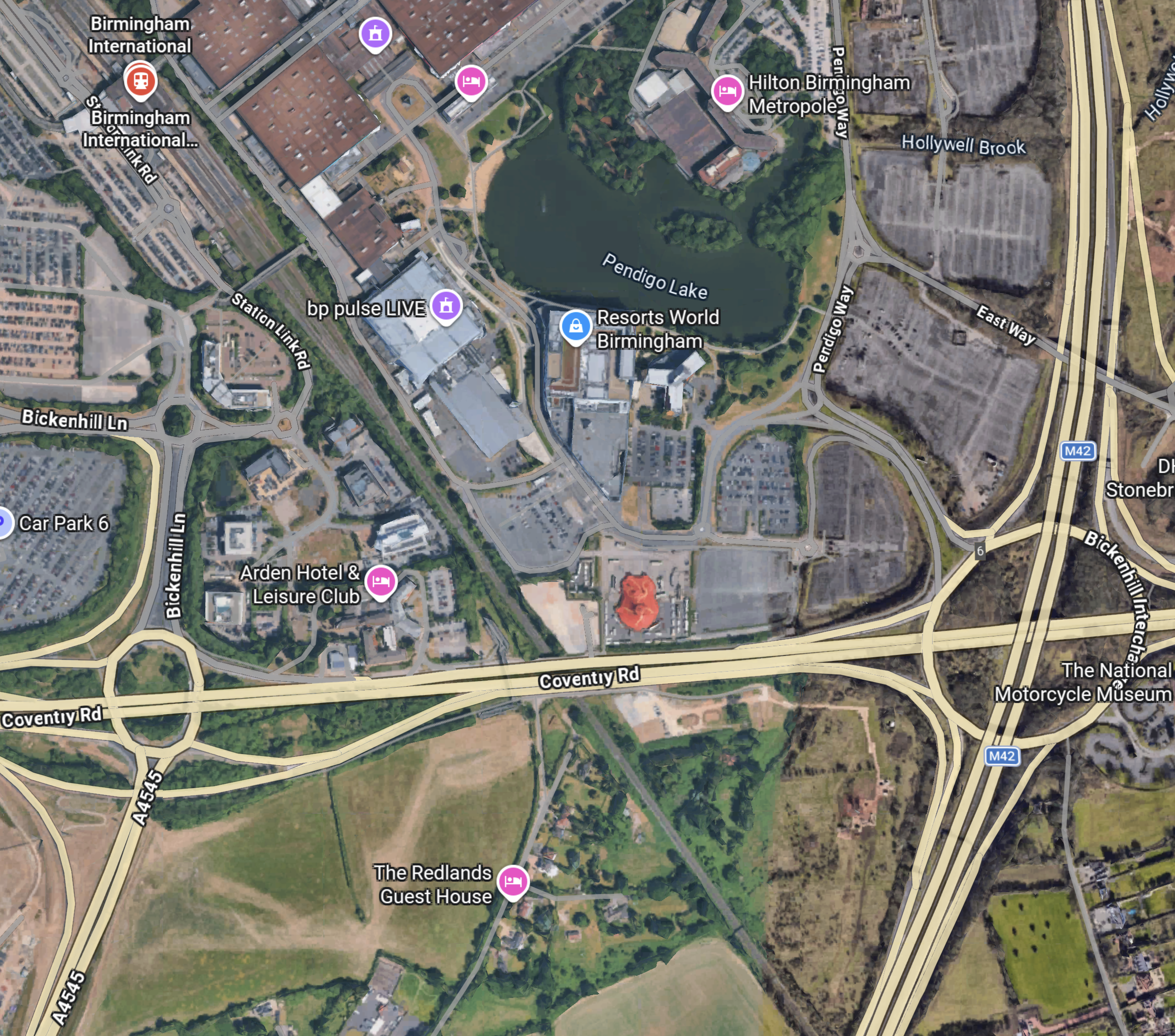
Note.
- Birmingham International station is in the North-West corner of the map.
- The electrified Rugby, Birmingham and Stafford Line runs diagonally through the map.
- In addition to their Aberystwyth/Pwllheli service, there is also a Llandudno Junction service that terminates at Birmingham International.
- I wonder, if there is space South of Coventry Road, to build a combined charging and hydrogen refuelling station, that could refuel all trains terminating at Birmingham International.
As the section without electrification is 111.2 miles on the Aberystwyth service, 148.3 miles on the Pwllheli service and 116.5 miles on the Llandudno Junction service , I suspect that these services could be too far for battery-electric trains, without charging at the Western end.


When Birmingham International was built, provision was made for two extra platforms and track between it and the NEC. This is clearly visible.
There is a blank wall on the foot bridge linking the station to the NEC for a future lift shaft and steps to new platforms. Could these be used for hydrogen refuelling, which could take a few minutes?
Comment by Chris Reynell | July 24, 2026 |
It’s a possibility.
Hydrogen isn’t as dangerous as it proved in the Hindenburg.
ICI and now INEOS transport it all over the country by truck and I’ve not heard of a serious accident.
One thing that happens, is if you get a small leak, because it is so light it just goes up into the atmosphere.
And it is not a greenhouse gas.
Comment by AnonW | July 24, 2026 |
Good points.
Someone once said when the Hindenburg caught fire, there was no explosion. Apparently the fabric covering and aluminium added to the fire. The airship was on a mooring high off the ground, if it was on the ground everyone on board could have walked away and survived.
A hydrogen car can be refilled in 8 seconds!
As you pointed out, it is probably safer than diesel and petrol, where millions of people pump these flammable liquids into vehicles without training certificates or supervision!
Comment by Chris Reynell | July 24, 2026 |