Offshore And Nearshore Survey Work Complete For 2 GW Scottish Wind Project
The title of this post, is the same as that of this article on offshoreWIND.biz.
This is the first paragraph.
The developers of the West of Orkney Windfarm have completed its 2022 offshore and nearshore surveys for the project area, located around 25 kilometres off the Sutherland coast in Scotland.
Note.
- Surveys were on time and on budget.
- Consent applications are expected next year.
- Both fixed and floating turbines are being considered.
The West of Orkney wind farm has its own web site, with this proud mission statement.
Designed For Delivery, Driven By Scale
The West of Orkney Windfarm has the potential to power more than two million homes and deliver long-term economic benefits to communities across the north of Scotland.
The web site says that the target for first power generation is 2029.
In How Long Does It Take To Build An Offshore Wind Farm?, I said that it typically takes between six and eight years to for consent to commissioning for an offshore wind farm.
So with consent in 2023, commissioning in 2029 could be possible.
Norwegians Developing Monopile Foundation For 100-Metre Depths
The title of this post, is the same as that of this article on offshoreWIND.biz.
Monopile foundations are a common fixed foundation for offshore wind farms.
The article starts with this paragraph.
Norway’s Entrion Wind and Techano AS have signed a Memorandum of Understanding (MoU) through which Techano AS will join the ongoing development and test project planned to take place in Kristiansand, Norway for the patent-pending fully restrained platform (FRP) offshore wind foundation technology said to extend the operating depth of the monopile technology to up to 100 metres.
It does seem that the Norwegians are intending to take this type of foundation to new heights. Or is it new depths?
A picture in the article shows a tall monopole held in position by three wires securely anchored in the sea-bed. It reminds me slightly of the sort of flag-poles, that we used to build in Scout camps in the 1960s, using Scout staves, ropes and tent pegs.
But seriously in the 1970s, I did the calculations for a company called Balaena Structures, who were trying to develop a reusable oil and gas platform.
- The company had been started by two Engineering professors from Cambridge University.
- The platforms were formed of a long steel cylinder, which would have been built horizontally in the sort of ship-yards, that were used to build supertankers.
- They were to be floated out horizontally and then turned upright.
- Weight and the gumboot principle would have kept them, in place.
The design also included a square platform on the top end. Originally, they were planning to put the platform on top after erection, but I showed that, it would be possible to erect cylinder and platform, by just allowing water to enter the cylinder.
The project had a somewhat unfulfilling end, in that they never sold the idea to an operator and the company closed.
But I still believe something similar has a future in the offshore energy industry.
It could be a foundation for a wind turbine or possibly as I indicated in The Balaena Lives, it could be used to clear up oil field accidents like Deepwater Horizon.
Could This Be A Design For A Hundred Metre Plus Monopole Foundation?
Construction and installation would be as follows.
- A long cylinder is built in a ship-yard, where supertankers are built.
- One end, which will be the sea-bed end after installation, is closed and has a skirt a couple of metres tall.
- The other end is profiled to take the transition piece that is used as a mount for the wind turbine.
- A float would be added to the top end for tow-out. This will help the cylinder to float and erect.
- Water would be added into the cylinder and, if the dimensions are correct, it will turn through ninety degrees and float vertically.
- It would be towed to a dock, where a large crane on the dock would remove the float and install the turbine.
- The turbine and its foundation would then be towed into place and by adding more water lowered to the sea-bed.
- The float would be reused for the next turbine.
Note.
- The float is needed to nudge the cylinder to turn vertically.
- If the Cambridge professors were right, the skirt and the weight of water would hold it in place.
- Traditional moorings could be added if required.
- No heavy lifts are performed at sea.
- The concept would surely work for a floating turbine as well.
But then what do I know?
I was just a twenty-five year old engineer, mathematician and computer programmer, who did a few calculations and a dynamic simulation fifty years ago.
RWE Looking for Innovators To Boost UK’s Offshore Wind Supply Chain
The title of this post, is the same as that of this article on offshoreWIND.biz.
RWE appear to be looking for innovators in three areas.
- Autonomous solutions and the best way to integrate them into wind farm site investigations, construction, and operations and maintenance (O&M) is the first challenge for which RWE is looking for responses.
- The second challenge is about solutions to measure and reduce the environmental impacts of offshore wind farm construction and operations on birds.
- The last challenge focuses on ideas and innovations in cable monitoring and protection, aiming to secure a reduction in offshore wind farm cable failures.
As sums of around £25,000 are talked about in the article, it could be worth applying, if you have a relevant idea.
Is it slightly flattering to the UK’s skills, that a German company is backing British innovation?
But then I was involved in a British invention, which was also backed by the Germans and made me a reasonable amount of money.
BayWa r.e. Unveils Subsidy-Free Floating Wind Project Offshore Portugal
The title of this post, is the same as that of this article on offshoreWIND.biz.
This is the first paragraph.
BayWa r.e. has officially applied to secure the rights for an exclusive use of the seabed for a commercial-scale floating offshore wind project in Portugal, which the company said will be the first subsidy-free floating wind farm in the world.
Note.
- BayWa are a German company headquartered in Munich.
- The windfarm will have a 600 MW capacity in total, in a dedicated zone off the coastline of Viana do Castelo.
- It will be a floating wind farm.
- Viana do Castelo is situated at the mouth of the Lima River and is about 74 km. to the North of Porto.
But surely the most significant fact about this project is that it is subsidy-free.
BayWa And Subsidy-Free Wind Farms
This page on the BayWa web site is entitled BayWa r.e. Sells UK’s First Subsidy-Free Wind Farm.
This is the first paragraph.
BayWa r.e. has reached a milestone for itself and the UK renewable energy sector with the completion and sale of the country’s first subsidy-free windfarm to James Jones & Sons Ltd and London-based specialist asset manager, Gresham House Asset Management.
Note.
- This is the first time, I’ve seen Gresham House associated with wind farms.
- BayWa appear to have a fifteen year agreement with Tesco for the generated electricity.
The whole page is a must read.
Conclusion
Does this mean, that we will be seeing subsidy-free floating wind farms around the UK?
Get the engineering, manufacturing and financial support right for floating wind farms in the UK and wind farms could be bumper-to-bumper around these islands.
Plans Emerge For 8 GW Of Offshore Wind On Dogger Bank
Wikipedia has an entry, which is a List Of Offshore Wind Farms In The United Kingdom.
The totals are worth a look.
- Operational – 13279 MW
- Under Construction – 4125 MW
- Proposed Under The UK Government’s Contracts For Difference Round 3 – 2412 MW
- Proposed Under The UK Government’s Contracts For Difference Round 4 – 7026 MW
- Exploratory Phase, But No Contract for Difference – Scotland – 24,826 MW
- Exploratory Phase, But No Contract for Difference – England – 14,500 MW
Note.
- That gives a Grand Total of 66,168 MW or 66.168 GW.
- The government’s target is 50 GW of offshore wind by 2030.
- The typical UK power need is around 23 GW, so with nuclear and solar, we could be approaching three times the electricity generation capacity that we currently need.
The figures don’t include projects like Berwick Bank, Cerulean Wind, Norfolk Vanguard or Northern Horizons, which are not mentioned in Wikipedia’s list.
I regularly look at the list of wind farms in this Wikipedia entry and noticed that the number of Dogger Bank wind farms had increased.
They are now given as.
- Dogger Bank A – 1200 MW – Completion in 2023/24
- Dogger Bank B – 1200 MW – Completion in 2024/25
- Dogger Bank C – 1200 MW – Completion in 2024/25
- Dogger Bank D – 1320 MW – No Completion Given
- Dogger Bank South – 3000 MW – No Completion Given
Note, that gives a Grand Total of 7920 MW or 7.920 GW.
This article on offshoreWIND.biz is entitled BREAKING: SSE, Equinor Plan 1.3 GW Dogger Bank D Offshore Wind Project.
It was published on the October 6th, 2022 and starts with this summary.
SSE Renewables and Equinor are looking into building what would be the fourth part of Dogger Bank Wind Farm, the world’s largest offshore wind farm, whose three phases (A, B and C) are currently under construction. Surveys are now underway at an offshore site where the partners want to develop Dogger Bank D, which would bring Dogger Bank Wind Farm’s total capacity to nearly 5 GW if built.
Obviously, there are a few ifs and buts about this development, but it does look like SSE Renewables and Equinor are serious about developing Dogger Bank D.
More Dogger Bank Gigawatts for UK As RWE Moves Forward With Two 1.5 GW Projects
This subheading describes, the 3 GW wind farm, that I listed earlier as Dogger Bank South.
These three paragraphs describe the projects.
RWE is now moving forward with two new offshore wind farms in the Zone, each with a 1.5 GW generation capacity, after the company obtained approval from the UK Secretary of State for Business, Energy and Industrial Strategy (BEIS) to enter into an Agreement for Lease with The Crown Estate this Summer, following the Round 4 leasing process.
The wind farms will be built at two adjacent sites located just southwest of the Dogger Bank A offshore wind farm and are dubbed Dogger Bank South (DBS) East and Dogger Bank South (DBS) West.
RWE has also started with geophysical seabed surveys within the wind turbine array areas for its two new projects.
It appears that they have already got the leasing process started.
When Will Dogger Bank D And Dogger Bank South Be Operational?
Consider.
- In How Long Does It Take To Build An Offshore Wind Farm?, showed that a lot of offshore wind farms have gone from planning permission to first operation in six years.
- I don’t think that there will be planning permission problems on the Dogger Bank.
- The two wind farms are a continuation of Dogger Bank A, B and C and the Sofia wind farms.
- A lot of the construction, would be more of the same.
With average luck, I can see Dogger Bank D and Dogger Bank South in full production before the end of 2028.
Is There A Virtuous Circle In The Installation Of Wind Farms?
Because we are developing so much offshore wind turbine capacity, this will result in two things.
- A big demand for steel for the foundations and floats for wind turbines.
- A large amount of electricity at a good price.
In my view the UK would be the ideal country to develop an integrated steel and wind turbine foundation/float capability.
There will also be a strong demand for deep water ports and sea lochs to assemble the floating turbines.
Our geography helps in this one. We also have Milford Haven, which is just around the corner from Port Talbot. Scunthorpe is on the River Trent, so could we assemble floats and foundations and take them by barge for assembly or installation.
We probably need an integrated capability in Scotland.
Conclusion
It looks to me, that there is a virtuous circle.
- The more offshore wind turbine capacity we install, the more affordable electricity we will have.
- This will in turn allow us to make more steel.
- If this steel was produced in an integrated factory producing foundations and floats for wind farms, this would complete the circle.
- It would also be inefficient to make the foundations thousands of miles away and tow them to UK waters.
Any improvements in costs and methods, would make the system more efficient and we would have more wind turbines installed.
It looks to be a good idea.
Do All Wind Turbines Have To Be Similar?
I feel this is a reasonable question to ask.
But do all wind turbines have to look like those in this picture?

Wikipedia lists three main types.
- Horizontal Axis – Those in the picture are of this type, as are all the large wind turbines I’ve seen in operation.
- Vertical Axis – Wikipedia shows several examples.
- Unconventional Types
Recently, I have come across some which would be placed in the last group.
Hybrid Offshore Wind And Wave Energy Systems
This article on the Journal of Physics is entitled Review of Hybrid Offshore Wind and Wave Energy Systems, is a study from serious academics.
This is the abstract.
Hybrid wind wave systems combine offshore wind turbines with wave energy on a shared platform. These systems optimize power production at a single location by harnessing both the wind and the waves. Wave energy is currently at an earlier development stage than offshore wind. Research in this area is focused in wave energy converters being used for platform motion suppression of floating offshore wind turbines. Wave energy converters can passively shelter offshore wind turbines from waves and can also be actively controlled to reduce the system loads. Additionally, a small amount of supplemental power may be generated, which can be used for offshore wind turbine local power needs. There may be future benefits to these hybrid systems, but at this stage wave energy may increase the project cost and risk of offshore wind turbines. Hybrid wind wave system research and development is discussed, with a focus on floating offshore wind turbines. Additionally, two ocean demonstration scale hybrid wind and wave systems are discussed as case studies: the Poseidon Wave and Wind system and the W2Power system. Hybrid wind wave systems show potential to be part of the future of offshore wind energy.
Note.
- Wave energy development is at an earlier stage than offshore wind.
- Wave energy converters can passively shelter offshore wind turbines from waves and can also be actively controlled to reduce the system loads.
- There is more about Poseidon on this page on the Tethys web site.
- There is more about W2Power on the Pelagic Power web site.
The last sentence of the abstract is significant and I believe that hybrid offshore wind and wave energy will play a significant part in the future of offshore energy.
Wind Turbines With Added Storage
Critics and cynics of wind power always ask, what happens, when the wind doesn’t blow.
It is generally accepted, that the best thing to do is to pair a wind farm with some form of energy storage.
Technologies and solar and/or wind farms with energy storage are starting to be proposed and/or installed.
- In Cleve Hill Solar Park, I wrote about a solar farm, a wind farm and a battery sharing a grid connection.
- In First Ever Gravity Green Energy Storage System Set For North Yorkshire Town, I wrote about a battery being installed where two massive wind farms connect to the grid.
- In How To Store Excess Wind Power Underwater, I describe a Dutch system called an Ocean Battery.
- In UK Cleantech Consortium Awarded Funding For Energy Storage Technology Integrated With Floating Wind, I wrote about adding Marine Pumped Hydro to offshore wind farms.
More energy storage will be added in the future in or near to wind and solar farms.
Twin Turbines
This document from the Department of Business, Industry and Industrial Strategy lists all the Contracts for Difference Allocation Round 4 results for the supply of zero-carbon electricity.
One of the projects allocated a Contract for Difference, was the 32 MW TwinHub wind turbine, which I wrote about in Hexicon Wins UK’s First Ever CfD Auction For Floating Offshore Wind.
A full scale twin turbine hasn’t been built yet, but it does seem promising and the visualisations are impressive.
Scroll down on the TwinHub home page to see a video.
World Wide Wind
I’ll let the images on the World Wide Wind web site do the talking.
But who would have thought, that contrarotating wind turbines, set at an angle in the sea would work?
This is so unusual, it might just work very well.
Conclusion
There will be other unusual concepts in the future.
Ørsted Signs Two ‘Industry First’ Monopile Contracts For Hornsea 3 Foundations
The title of this post, is the same as that of this press release from Ørsted.
This is the introductory paragraph.
Ørsted, the world’s most sustainable energy company, has signed two ‘industry first’ contracts for the fabrication of XXL monopile foundations for the Hornsea 3 offshore wind farm.
I have a few thoughts about the press release.
XXL Monopile Foundations
These four paragraphs describe Hornsea 3’s XXL monopile foundations.
Subject to Ørsted taking a Final Investment Decision on Hornsea 3, the contracts have been finalised with Haizea Wind Group, through its subsidiary Haizea Bilbao, and SeAH Wind Limited, a UK-based subsidiary of SeAH Steel Holdings (SeAH).
Ørsted will be the first major customer at SeAH Wind’s new monopile facility in Teesside, and the agreement with Haizea marks the company’s first XXL monopile contract with Ørsted.
The deal with SeAH represents the single largest offshore wind foundations contract secured by any UK company. Haizea’s agreement is the largest single contract ever secured by Haizea Wind Group.
Each of the huge foundation structures for Hornsea 3 will weigh between 1,300 and 2,400 tonnes and measure in at between 83 and 111 metres in length. Monopile production is expected to start in 2024.
Note
- These are huge steel structures.
- But then the water depth appears to be between 36 and 73 metres.
- It looks like the orders are shared between Spanish and Korean companies
This article on offshoreWIND.biz, is entitled Beyond XXL – Slim Monopiles For Deep-Water Wind Farms.
These are some points from the article.
- XXL-Monopiles have been successfully used for water depths of up to 40 metres. Now wind farm developers need monopiles “beyond XXL”.
- The extension of the range is needed, mainly to enable the use of larger turbines, deeper water, and harsher environmental situations.
- These monopiles will allow turbines of up to 15 megawatts with rotor diameters of up to 230 metres.
- This monopile design automatically induces the idea of design and fabrication optimisation to ensure that monopiles continue to lead the ranking of most economical foundation systems.
In the 1970s, I was involved with a Cambridge University spin-out company called Balaena Structures, who were using similar much larger structures to support oil and gas production platforms.
I was just doing calculations, but I do wonder if these XXL monopile foundations, owe things in their design to work done by structural engineers, like those I met at Cambridge fifty years ago.
Ørsted Completes 50% Stake Sale In Hornsea 2 To French Team
The title of this post, is the same as that of this article on Renewables Now.
This sale was outlined in this press release from Ørsted in March, where this is the first paragraph.
Ørsted has signed an agreement to divest a 50 % ownership stake in its 1.3 GW Hornsea 2 Offshore Wind Farm in the UK to a consortium comprising AXA IM Alts, acting on behalf of clients, and Crédit Agricole Assurances.
Insurance companies must like wind power, as Aviva backed Hornsea 1 wind farm. I wrote about this in World’s Largest Wind Farm Attracts Huge Backing From Insurance Giant.
It looks like the French feel the same way as Aviva about Ørsted’s Hornsea wind farms.
There is no safer mattress in which to stash your cash.
Accelerating The Delivery Of Offshore Wind Farms
It is one of Kwasi Kwarteng’s ambitions to accelerate the delivery of offshore wind farms.
In The Growth Plan 2022, these groups of wind farms are mentioned.
- Remaining Round 3 Projects
- Round 4 Projects
- Extension Projects
- Scotwind Projects
- INTOG Projects
- Floating Wind Commercialisation Projects
- Celtic Sea Projects
My thinking in this post, will probably apply to all of these groups.
These are my thoughts.
Accelerating Delivery Of A Wind Farm
This will have these positive effects.
- Electricity will be delivered earlier.
- Customers will have a more secure supply of electricity.
- The wind farm owner will start to be paid for their electricity.
- The Crown Estate will start to be paid for their leases. Although, these might start at signing.
- National Grid will be paid for the transmission of the electricity.
- An energy storage company could be paid for storing surplus electricity.
- Construction teams and engineers can move on to the next project.
- Expensive construction hardware like ship-mounted cranes will no longer be needed.
- I also suspect that the government will raise some taxes from the various companies involved.
It looks like it’ll be winners all round.
How Will Delivery Be Accelerated?
These are some thoughts.
Overall Project Time
In How Long Does It Take To Build An Offshore Wind Farm?, I came to these conclusions.
- It will take six years or less from planning consent to commissioning.
- It will take two years or less from the start of construction to commissioning.
I suspect that as we have been building offshore wind farms for some years, that it will be very difficult to reduce these times significantly.
But as some wind farms take quite a few years to progress from the initial proposal to planning consent, I suspect that improvements to the planning process may speed up the overall construction time of a wind farm.
Project And Resource Management
Good project and resource management will always help.
Better Design And Construction Methods
I always remember in the early days of North Sea Oil, being told by a very experienced project manager that construction of production platforms was accelerated by the availability of larger and more powerful cranes.
Are we approaching the design of the ultimate wind farm? I doubt it, as in the last few months, I’ve seen two very radical new designs.
In Hexicon Wins UK’s First Ever CfD Auction For Floating Offshore Wind, I show this image of one of their TwinHub turbine installations being towed into place.
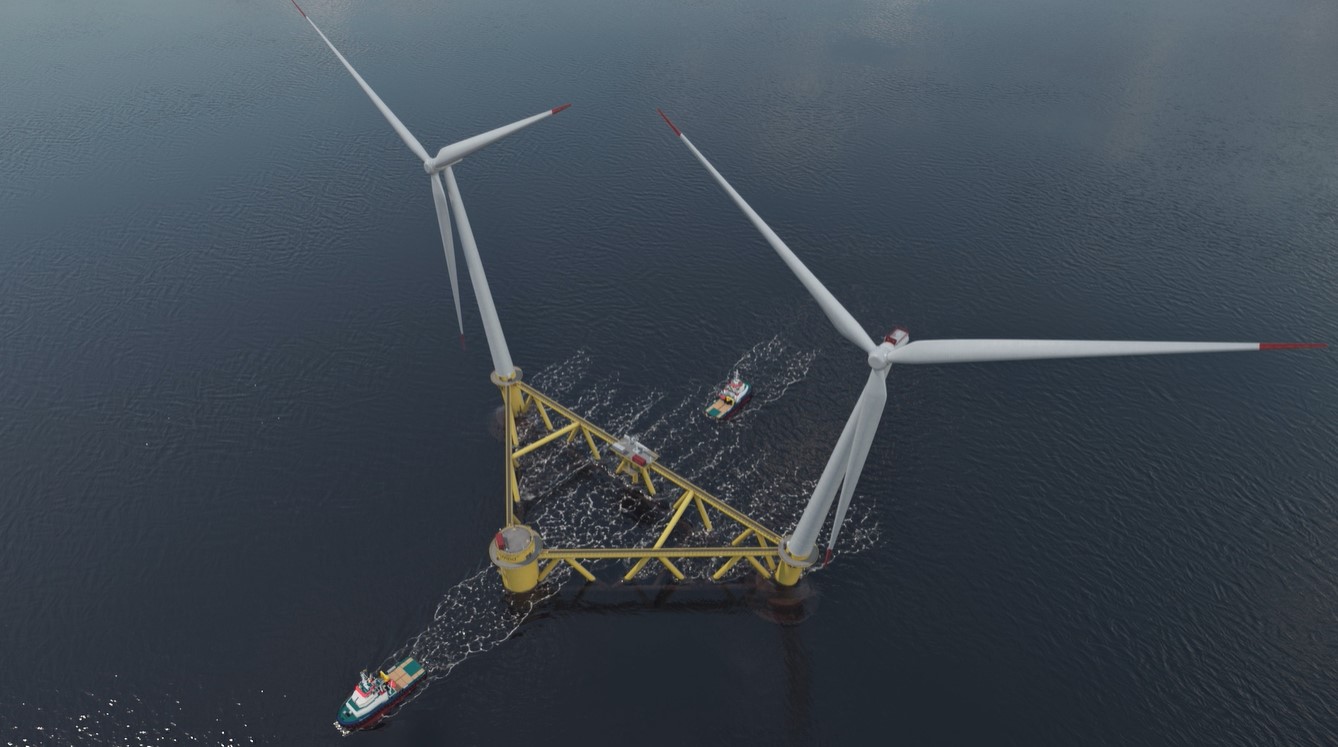
The TwinHub home page has a title of The First Floating Offshore Wind Project in The Celtic Sea.
This is the description on the page.
The TwinHub offshore wind demonstration project intends to prove how Hexicon’s innovative design with two turbines on one floating foundation can further reduce the Levelized Cost of Energy (also referred to as LCoE) before large scale commercialisation. The TwinHub project is a stepping stone to help kick-start floating wind in the Celtic Sea, an area identified as a hotspot for floating wind by the UK Government. It will pave the path for larger and larger projects to help support The Crown Estates’ ambitious target of 4GW of floating wind in the Celtic Sea.
Scroll the page down and there is a fascinating short video of a pair of wind turbines in operation.
- It appears that when there is no wind, it automatically goes into a safe parked mode.
- As the wind rises, one turbine starts up.
- The second turbine starts up and the float turns so they face the wind.
It appears to be a classic example of disruptive innovation.
I have a feeling that this type of installation might have generation, assembly and cost advantages over a single turbine mounted on a single float.
RCAM Technologies are also creating interesting designs for mounting turbines and energy storage using 3D-printed concrete.
What Ts The UK Government Doing To Accelerate Projects?
This article on offshoreWIND.biz, was published in late September 2022 and is entitled BREAKING: UK Puts Massive Amount Of New Offshore Wind Capacity On Fast Track and this is the first paragraph.
The UK will speed up planning and development consent processes for projects from the recently completed, currently ongoing, and upcoming (floating) offshore wind leasing rounds to bring new energy capacity online faster and facilitate economic growth and job creation.
The article is based on what Kwasi Kwateng said on the 23rd of September about speeding up projects in the 2022 Growth Plan.
A Quick Summary Of Our Wind Energy
The article has this paragraph, which summarises our wind energy.
For the UK, which currently has around 14 GW of offshore wind capacity in operation and 8 GW under construction, the projects from the listed auction rounds could bring well beyond the targeted capacity for 2030, which was recently raised to 50 GW.
I can see the target being raised again to at least 60 GW.
 The Anonymous Widower