Velocys Signs Agreement For Commercial-Scale Biomass-To-Jet Fuel In Japan
The title of this post, is the same as that of this article on the Chemical Engineer.
I am very hopeful about Velocys, who are a UK public company, that were spun out of Oxford University and do clever things in the area of chemical catalysts.
Velocys’ Fischer-Tropsch technology does seem to be a good way of creating sustainable aviation fuel from household rubbish and biomass.
Sarah Gilbert Is On Andrew Marr Today!
Sarah Gilbert is the leader of the team behind the Oxford AstraZeneca vaccine.
Should be a must-watch!
Oxford Vaccine Could Substantially Cut Spread
The title of this post, is the same as that of this article on the BBC.
This is the first two paragraphs.
The Oxford-AstraZeneca vaccine could lead to a “substantial” fall in the spread of the virus, say scientists.
The impact of Covid vaccines on transmission has been a crucial unknown that will dramatically shape the future of the pandemic.
The article also says you get this after one dose.
This study – on 17,000 people in the UK, South Africa and Brazil – showed protection remained at 76% during the three months after the first dose.
This rose to 82% after people were given the second dose.
It will be interesting to see, what figures drop out of the data, when millions have been vaccinated twice in the UK.
Conclusion
It looks like very good news to me!
A Way Out Of The AstraZeneca Vaccine Row With The EU
This article on the BBC is entitled Brexit: EU Introduces Controls On Vaccines To NI.
These are the introductory paragraphs of the article.
The EU is introducing controls on vaccines made in the bloc, including to Northern Ireland, amid a row about delivery shortfalls.
Under the Brexit deal, all products should be exported from the EU to Northern Ireland without checks.
But the EU believed this could be used to circumvent export controls, with NI becoming a backdoor to the wider UK.
The row involving AstraZeneca, the UK and the EU is now getting serious,
I think, the EU are missing an opportunity.
My Experience Of The AstraZeneca Vaccine
Yesterday, I received my first dose of the AstraZeneca vaccine, which I wrote about in Job Done – I’ve Now Had My First Covid-19 Vaccination.
As I am an engineer, who helped to finance a drug-delivery system, I know a bit about the subject of drug delivery.
My jab yesterday seemed to have been administered very quickly and painlessly, without fuss. I regularly have B12 injections as I’m coeliac and this AstraZeneca one was certainly less painful for me.
Have AstraZeneca designed the vaccine and its delivery system so that it will have application in mass vaccination situations like refugee camps, where thousands may need to be vaccinated quickly?
Consider.
- It can be transported and stored at easy-to-manage temperatures.
- I suspect that a skilled vaccinator can vaccinate more patients per hour, than with other vaccines.
- I didn’t feel a thing, which must help those with needle phobia.
- The vaccinator didn’t need to apply a plaster, just using a cotton wool pad and pressure. This must save time.
This looks to me, like disruptive innovation is at work.
Surely, though by streamlining the vaccination process, this will increase the number of patients vaccinated by a well-trained team. This will be what doctors ordered.
The Real Problem With The AstraZeneca Vaccine
I have worked a lot in the design of project management systems and very often, when projects go awry, it is due to a lack of resources.
It strikes me that the problem with the AstraZeneca vaccine, is that there are not enough factories to make the vaccine.
As it is easier to distribute and AstraZeneca are making it without profit, perhaps the EU should approach the UK about creating a couple of large factories to make the vaccine in suitable places across the UK and the EU.
A proportion of this increased production could be distributed to countries, that couldn’t afford a commercial vaccine or didn’t want to get ensnared by the Chinese in a Vaccines-for-Resources deal.
It should also be remembered that Oxford are at the last stages in the testing of a vaccine for malaria. That would surely be a superb encore for Oxford University and AstraZeneca. I suspect the UK will back it, but it would surely be better, if the EU backed it as well.
Coronavirus: Why Combining The Oxford Vaccine With Russia’s Sputnik V Vaccine Could Make It More Effective
The title of this post is the same as that of this article on The Conversation.
The Oxford–AstraZeneca COVID-19 Vaccine
This paragraph from the Wikipedia entry for the Oxford–AstraZeneca COVID-19 vaccine, gives the basic details of the vaccine.
The Oxford–AstraZeneca COVID-19 vaccine (codenamed AZD1222) is a COVID-19 vaccine developed by Oxford University and AstraZeneca given by intramuscular injection, using as a vector the modified chimpanzee adenovirus ChAdOx1. One dosing regimen showed 90% efficiency when a half-dose was followed by a full-dose after at least one month, based on mixed trials with no participants over 55 years old. Another dosing regimen showed 62% efficiency when given as two full doses separated by at least one month.
It puzzles me and I suspect it puzzles experts, that the two different vaccination regimes gave different answers.
The article on the Conversation says this.
This was intriguing. Why would giving people less of the vaccine lead to a more effective immune response? The answer to this may lie in the design of the vaccine, and could mean that there are ways to make this vaccine – and others that use the same design – more effective.
I will attempt to answer this question, in the rest of this post.
The Russian Sputnik V Vaccine
This paragraph from the Wikipedia entry for the Oxford–Russian Sputnik V vaccine, gives the basic details of the vaccine.
Gam-COVID-Vac, trade-named Sputnik V, is a COVID-19 vaccine developed by the Gamaleya Research Institute of Epidemiology and Microbiology, and registered on 11 August 2020 by the Russian Ministry of Health.
In most countries following guidelines of the World Health Organization, vaccine candidates are not approved for regular use until safety and efficacy data from Phase III trials are assessed and confirmed internationally by regulators. Gam-COVID-Vac was initially approved for distribution in Russia on the preliminary results of Phase I-II studies eventually published on 4 September 2020.
The quick approval of Gam-COVID-Vac was met with criticism in mass media and precipitated discussions in the scientific community whether this decision was justified in the absence of robust scientific research confirming the safety and efficacy of the vaccine.
In December 2020, interim analysis from 22,714 participants in a Phase III trial were published, claiming 91% efficacy with no unusual side effects.
Wikipedia says, that a medical citation is needed for the Phase III trial.
Both Vaccines Are Viral-Vector Vaccines
The Oxford vaccine is based around a modified chimpanzee adenovirus ChAdOx1, whilst the Russian vaccine is based on two human adenoviruses.
Adenoviruses are a family of viruses, that include the common cold.
The two shots of the Oxford vaccine are identical in composition, but the two shots of the Russian vaccine use a different adenovirus.
Both vaccines are what is known as viral vector vaccines.
Both vaccines would appear to deliver the same details of the spike protein of the virus to prime the body’s immune system to fight the real virus.
A Possible Problem With Viral-Vector Vaccines
This is a paragraph from the article on the Conversation, which talks of a problem with viral-vector vaccines.
When a person is given a viral-vector vaccine, as well as generating an immune response against the coronavirus’s spike protein, the immune system will also mount a response against the viral vector itself. This immune response may then destroy some of the booster dose when it is subsequently delivered, before it can have an effect. This has long been recognised as a problem.
It looks like a case of shoot the messenger to me.
The Russian Solution To The Problem
The Russian vaccine appears to get round the problem, by using two different adenoviruses in their two shots. There are fifty adenoviruses that affect humans, so they have a wide choice.
The first shot would only prime the immune system to the spike protein and one adenovirus, which could mean that the second and different adenovirus gets through without being attacked.
Co-Operation Between AstraZeneca And The Russians
This is the last sentence from the article on the Conversation.
This has now led to AstraZeneca testing a new hybrid vaccine schedule, comprising one dose of its vaccine and one of the Ad26-vector Sputnik V, to see if this makes the Oxford/AstraZeneca vaccine more effective.
I like the thinking behind this idea.
The priming for the immune system gets delivered by two totally unrelated delivery systems.
Conclusion
I wouldn’t be surprised to see this type of hybrid vaccine developed.
Surely, if we need to vaccinate every year against an ongoing Covid-19 threat, eventually, a succession of viral-vectors can be developed to fool the immune system.
The negotiation with the Russians could be tricky.
What Will Oxford Do For An Encore?
In the UK, I suspect nearly all of us have watched in admiration, as Oxford University have developed a Covid-19 vaccine for the world.
So what will be the University’s next big medical breakthrough.
Antibiotics
Today, this article on the BBC web site, which is entitled Oxford Research Tackles Threat Of Antibiotic Resistance, was published.
This was the introductory sub-heading.
Oxford University is opening a new research institute dedicated to tackling resistance to antibiotics.
To start the funding INEOS has chipped in a cool £100 million.
This paragraph summarises the project.
There will be 50 researchers working in the new Ineos Oxford Institute for Antimicrobial Resistance, addressing the “over-use and mis-use” of antibiotics, which the university warned could cause 10 million excess deaths per year by 2050.
To put that ten million excess deaths into perspective, the Covid-19 pandemic has so far killed 2.05 million worldwide.
It should be remembered that David Cameron warned of this problem back in 2014, as was reported in this article on the BBC, which was entitled Antibiotic Resistance: Cameron Warns Of Medical ‘Dark Ages‘.
This was the introductory paragraph.
The world could soon be “cast back into the dark ages of medicine” unless action is taken to tackle the growing threat of resistance to antibiotics, Prime Minister David Cameron has said.
Will the Ineos Oxford Institute for Antimicrobial Resistance, solve one of the most pressing problems facing the modern world?
Malaria Vaccine
Sometime, this week I either read in The Times or heard someone say on the BBC, that Oxford would soon be starting trials for a malaria vaccine developed by the same team, who developed the AstraZeneca vaccine for Covid-19.
This wasn’t the article in The Times, that I read, as it is dated the 5th of December 2020, but it does have a title of Malaria Vaccine Another Success Story For Jenner Institute Team Behind Covid Jab.
This is the first three paragraphs.
The Oxford team behind the coronavirus jab has taken a big step towards producing a cheap and effective vaccine for malaria.
The Jenner Institute said that it was due to enter the final stage of human trials with its vaccine, which it hopes could combat the almost half a million annual deaths, mainly in children.
“It’s going to be available in very large amounts — it works pretty well. And it’s going to be very low-priced,” Adrian Hill, director of the institute, said.
This looks to me, exactly what the world needs.
I’ve also found this page on the Oxford University web site, which is entitled Designer Malaria Vaccines.
This is the first two paragraphs on the page.
Malaria is one of the deadliest human diseases, killing a child in Africa every two minutes. A vaccine is urgently needed, but this is has proved extremely challenging because the malaria parasite is a master of disguise, able to change its surface coat to escape detection by the human body. However, structural biology is raising hopes for a vaccine against this killer parasite.
In order to replicate and develop, the malaria parasite must get inside human red blood cells – something that depends upon a malaria protein called RH5. Unlike the other variable malaria surface proteins, RH5 does not vary, making it more easily recognised and destroyed.
There is also this YouTube video.
From the video it looks like Oxford have used the Diamond Light Source to help develop the vaccine, just as the facility has been used to investigate Covid-19, as I wrote about in The Diamond Light Source And COVID-19.
I have added a new page called The Diamond Light Source And Malaria, which points to information on the Diamond Light web site.
There is also this Saturday Interview in The Times with Professor Adrian Hill, who is the Director of the Jenner Institute, at the University of Oxford.
This is the first two paragraphs.
Adrian Hill knew that this would be a big year. As head of Oxford’s Jenner Institute, this was the year, if all went well, he would announce a final large-scale trial into a vaccine to prevent a disease that was ravaging swathes of the planet. And this week, he did just that. Just not for the disease you’re thinking of.
A century after scientific research on the topic began, 30 years after he started working on it and eight years after this version was tried he has, he believes, an effective malaria vaccine. Now he is ready to try it at scale.
The interview is a must-read.
This paragraph from the article compares Covid-19 and malaria.
In the past 20 years, conventional public health investment has averted an estimated 1.5 billion malaria cases. Still, in an ordinary year it is one of the world’s biggest killers of children. “Malaria is a public health emergency. A lot more people will die in Africa this year from malaria than will die from Covid,” he says. “I don’t mean twice as many — probably ten times.”
The numbers show why a vaccine for malaria is so important.
Conclusion
Oxford University appears to have tremendous ambition, to see both these projects through to a successful conclusion.
I believe that their success with the Covid-19 vaccine will have major effects.
- People like Jim Ratcliffe and Bill and Melinda Gates, drug companies and charities like Wellcome Trust, will be prepared to fund more research.
- World-class researchers from all over the world will be drawn to work on Oxford’s projects.
- If Oxford or another group needs another powerful research tool, like the Diamond Light Source, the government will look favourably at the project.
People love to support winners! Just look at how kids follow the football team, at the top of the Premier League, when they first get interested in the game.
If the AstraZeneca vaccine is a success in the poorer countries of this world, that can’t afford the more expensive commercial vaccines, that this could change the world in bigger ways, than anybody imagines.
It could be extremely good not just for AstraZeneca, Oxford University and the UK, but the whole world. And not just in 2021, but in the future as well!
An Encore From The Team That Developed The Covid-19 Vaccine
This article on the Guardian is entitled Team Behind Oxford Covid Jab Start Final Stage Of Malaria Vaccine Trials.
This is the first two paragraphs.
The Oxford team that has produced a successful coronavirus vaccine is about to enter the final stage of human trials in its quest for an inoculation against malaria.
The Jenner Institute director, Prof Adrian Hill, said the malaria vaccine would be tested on 4,800 children in Africa next year after early trials yielded promising results.
This is obviously good news for those, who live in areas affected by malaria, where in Africa a child under five dies every two minutes.
But surely, if the Jenner Institute can crack malaria, they should have the expertise to modify the current Cobid-19 vaccine to handle any new variants.
Conclusion
In my view, this is doubly good news!
The Bell Tolls For Covid-19
I have just watched Sir John Bell; the Regius Professor of Medicine at the University of Oxford talking about the Pfizer vaccine and his emotional response to it, where he shouted “Yes, yes yes!” and threw his arms in the air on BBC Radio 4. Sir John and another Oxford academic; Melinda Mills are talking about multiple vaccines.
They certainly felt that we’re on our way back to normality.
Microwaves Could Turn Plastic Waste Into Hydrogen Fuel
This headline from this article in The Times could be the headline of the day!
Although thinking about it, it wouldn’t be a good idea to put all your plastic waste in the microwave and switch it on. It might catch fire or even worse create lots of hydrogen in your kitchen, which could be followed by a mini-Hindenburg disaster in the kitchen.
These are the introductory paragraphs.
From the yellowed bottles in landfill to the jellyfish-like bags clogging the oceans, plastics pollution is an apparently intractable problem.
Yet, chemists lament, it shouldn’t be. Within this waste there is something extremely useful, if only we could access it: hydrogen. Now a British team of scientists believes it has found a way to get at it, and do so cheaply, thanks to tiny particles of iron and microwaves.
If their system works at scale they hope it could be a way of cheaply converting useless plastic into hydrogen fuel and carbon.
Don’t we all want to believe that this impossible dream could come true?
Some Background Information
Some of the things I talk about will be technical, so I will have a bit of a preamble.
Hydrogen; Handling And Uses
Because of pre-World War Two airships, which tended to catch fire and/or crash, hydrogen has a bad reputation.
I used to work as an instrument engineer in a hydrogen plant around 1970. To the best of my knowledge the plant I worked in is still producing hydrogen in the same large building at Runcorn.
Hydrogen is one of those substances, that if you handle with care, it can be one of the most useful elements in the world.
It is a fuel that burns creating a lot of energy.
The only by-product of hydrogen combustion is steam.
It is one of the feedstocks for making all types of chemicals like ethylene, fertilisers, ammonia, pharmaceuticals and a wide range of hydrocarbons.
Hydrogen is a constituent of natural gas and in my youth, it was a constituent of town gas.
Hydrogen and hydrocarbons are involved in the manufacture of a lot of plastics.
In the future, hydrogen will have even more uses like making steel and cement, and powering railway trains and locomotives, and shipping of all sizes.
Hydrocarbons
According to Wikipedia, hydrocarbons are compounds consisting entirely of atoms of hydrogen and carbon.
In a kitchen, there are several hydrocarbons.
- If you cook by gas, you will probably be burning natural gas, which is mainly methane, which is a hydrocarbon
- Some might use propane on a barbecue, which is another hydrocarbon.
- I suspect you have some polythene or polyethylene, to use the correct name, in your kitchen. This common plastic is chains of ethylene molecules. Ethylene is another hydrocarbon.
- There will also be some polypropylene, which as the name suggests is made from another hydrocarbon; propylene.
Hydrocarbons are everywhere
Plastics
I used to work in two ICI divisions; Mond at Runcorn and Plastics at Welwyn Garden City
- The forerunners of ICI Mond Division invented polyethylene and when I worked at Runcorn, I shared an office, with one of the guys, who had been involved before the Second World War. in the development of polyethylene.
- Plastics Division used to make several plastics and I was involved in various aspects of research plant design and production.
One day, I’ll post in this blog, some of the more interesting and funnier stories.
Many plastics are made by joining together long chains of their constituent molecules or monomer.
- Ethylene is the monomer for polyethylene.
- Propylene is the monomer for polypropylene.
- Vinyl chloride is the monomer for polyvinylchloride or PVC.
So how are the chains of molecules built?
- Polyethylene was made by ICI. by applying large amounts of pressure to ethylene gas in the presence of a catalyst.
- They used to make polypropylene in large reaction vessels filled with oil, using another catalyst.
I suspect both processes use large quantities of energy.
Catalysts
A catalyst is a substance which increases the rate of a chemical reaction.
Judging by the number of times, I find new catalysts being involved in chemical reactions, the following could be true.
- There are processes, where better catalysts can improve yields in the production of useful chemicals.
- There is a lot of catalyst research going on.
Much of this research in the UK, appears to be going on at Oxford University. And successfully to boot!
Velocys
It should be noted that Velocys was spun out of Oxford University, a few years ago.
- The company appears to have improved the Fischer-Tropsch process.
- They are building a waste-to-aviation biofuel plant in Lincolnshire.
- They are backed by British Airways, Shell and UK plc.
This infographic shows their process.
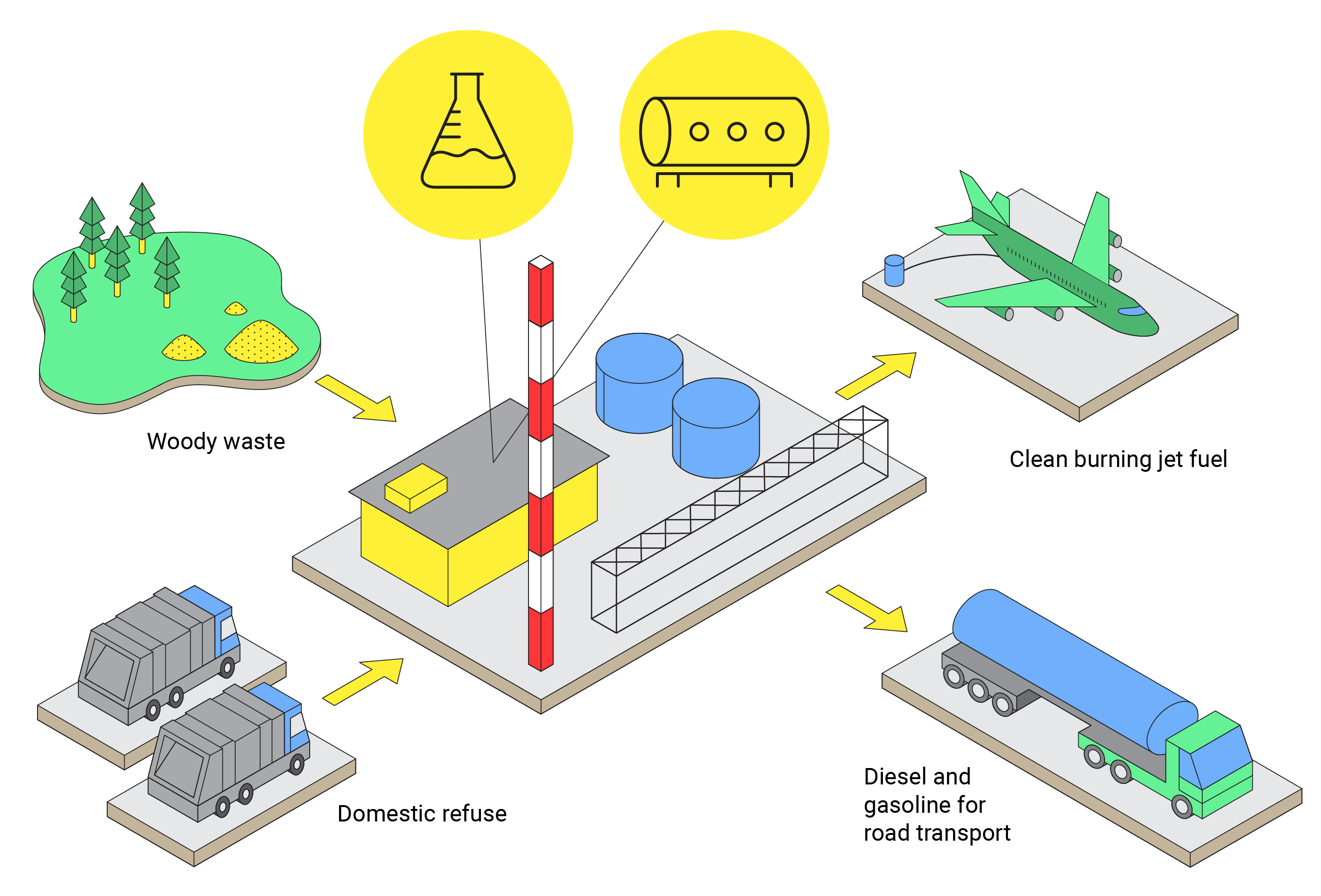
This could be a route to net-zero carbon aviation and heavy haulage.
The beauty is that there would need to be little modification to existing aircraft and trucks.
Oxford University’s Magic Process
These paragraphs from The Times article explain their process.
The clue came in research on particles of iron, and what happens when they get really small. “There’s a fascinating problem,” Professor Edwards said. “You take a bit of metal, and you break it into smaller and smaller bits. At what stage does it stop behaving like a copy of the bigger bit?”
When the particle gets below a critical size, it turns out it’s no longer a metal in the standard sense. The electrical conductivity plummets, and its ability to absorb microwaves does the reverse, increasing by ten orders of magnitude.
Professor Edwards realised that this could be useful. “When you turn on the microwaves, these things become little hotspots of heat,” he said. When he put them in a mix of milled-up plastic, he found that they broke the bonds between the hydrogen and carbon, without the expense and mess of also heating up the plastic itself.
What is left is hydrogen gas, which can be used for fuel, and lumps of carbon nanotubes, which Professor Edwards hopes might be of a high enough grade to have a use as well. The next stage is to work with industry to find ways to scale it up.
It sounds rather amazing.
Going Large!
This article from The Times on Friday, is entitled Plastic To Be Saved From Landfill By Revolutionary Recycling Plants.
These are the two introductory paragraphs.
Thousands of tonnes of plastic waste will be turned into new plastic in Britain rather than dumped in landfill sites, incinerated or sent overseas under plans for four new plants that will use cutting-edge recycling technology.
Up to 130,000 tonnes of plastic a year will be chemically transformed in the facilities, which are to be built in Teesside, the West Midlands and Perth.
It all sounds like technology, that can transform our use of plastics.
Conclusion
In the years since I left Liverpool University in 1968 with a degree in Electrical and control Engineering, it has sometimes seemed to me, that chemistry has been a partly neglected science.
It now seems to be coming to the fore strongly.
 The Anonymous Widower