Application Of Control Engineering Principles To The Calculation Of Pharmaceutical Drug Doses
Today, I was asked by an eminent cardiologist to give my opinion on this scientific paper in the Journal of the American Heart Association, which was entitled Personalized Antihypertensive Treatment Optimization With Smartphone‐Enabled Remote Precision Dosing of Amlodipine During the COVID‐19 Pandemic (PERSONAL‐CovidBP Trial).
This was the background to the study.
The objective of the PERSONAL‐CovidBP (Personalised Electronic Record Supported Optimisation When Alone for Patients With Hypertension: Pilot Study for Remote Medical Management of Hypertension During the COVID‐19 Pandemic) trial was to assess the efficacy and safety of smartphone‐enabled remote precision dosing of amlodipine to control blood pressure (BP) in participants with primary hypertension during the COVID‐19 pandemic.
These were the methods and the results.
This was an open‐label, remote, dose titration trial using daily home self‐monitoring of BP, drug dose, and side effects with linked smartphone app and telemonitoring. Participants aged ≥18 years with uncontrolled hypertension (5–7 day baseline mean ≥135 mm Hg systolic BP or ≥85 mm Hg diastolic BP) received personalized amlodipine dose titration using novel (1, 2, 3, 4, 6, 7, 8, 9 mg) and standard (5 and 10 mg) doses daily over 14 weeks. The primary outcome of the trial was mean change in systolic BP from baseline to end of treatment. A total of 205 participants were enrolled and mean BP fell from 142/87 (systolic BP/diastolic BP) to 131/81 mm Hg (a reduction of 11 (95% CI, 10–12)/7 (95% CI, 6–7) mm Hg, P<0.001). The majority of participants achieved BP control on novel doses (84%); of those participants, 35% were controlled by 1 mg daily. The majority (88%) controlled on novel doses had no peripheral edema. Adherence to BP recording and reported adherence to medication was 84% and 94%, respectively. Patient retention was 96% (196/205). Treatment was well tolerated with no withdrawals from adverse events.
These were the conclusions.
Personalized dose titration with amlodipine was safe, well tolerated, and efficacious in treating primary hypertension. The majority of participants achieved BP control on novel doses, and with personalization of dose there were no trial discontinuations due to drug intolerance. App‐assisted remote clinician dose titration may better balance BP control and adverse effects and help optimize long‐term care.
About Myself
I am a Graduate Control Engineer, who graduated from the University of Liverpool in 1968.
I then worked at ICI in Runcorn for eighteen months, before moving to ICI Plastics Division, because of the untimely death of my father-in-law.
One of my tasks at Welwyn, was to look at control algorithms for chemical plants. For this I often used a PACE 231-R analogue computer.

Note.
- These computers could solve up to a hundred simultaneous differential equations at one time.
- They were programmed by wiring the various amplifiers and potentiometers together to simulate the equations.
- There were only a few transistors in these powerful machines, as all electronics were thermionic valves.
- Two of these machines wired together, were used to calculate the trajectories of the Apollo missions.
They were the unsung heroes of bringing Jim Lovell and Apollo 13 home safely.
Determining Control Algorithms
In a typical problem, I would model the a section of a chemical plant and the control system around it.
This would then lead to recommendations, as to the design and operation of the plant, so that it performed as required.
It could be argued that the body of an animal, is a very complicated integrated chemical plant, with a sophisticated control system.
For instance, if sensors around the body, say you are slightly low on fluids, your brain determines you should have a drink.
Many control loops on a chemical plant are controlled by proportional–integral–derivative controllers, which are commonly known as three-term controllers.
This is the first two paragraphs of the Wikipedia entry for three-term controllers.
A proportional–integral–derivative controller (PID controller or three-term controller) is a control loop mechanism employing feedback that is widely used in industrial control systems and a variety of other applications requiring continuously modulated control. A PID controller continuously calculates an error value
PID systems automatically apply accurate and responsive correction to a control function. An everyday example is the cruise control on a car, where ascending a hill would lower speed if constant engine power were applied. The controller’s PID algorithm restores the measured speed to the desired speed with minimal delay and overshoot by increasing the power output of the engine in a controlled manner.
I wouldn’t be surprised that the app in the smartphone used in the PERSONAL‐CovidBP Trial contained a form of three-term controller.
These are some points about three-term control algorithms.
Changing Of External Factors
One that was the villain in a problem, I dealt with, also affects my body – the weather.
I was asked to look at the problem of a chemical reaction, that overheated in hot weather. But the plant operators solved it by better insulation and ventilation of the plant and the standard three-term controller adjusted itself automatically to the new conditions.
After my stroke, I am on Warfarin for life. I test my own INR with a Roche meter and I have noticed that atmospheric pressure affects my INR. I change my deose accordingly, using a simple algorithm, of my own design.
The More You Test The More Precise The Control
If you take the cruise control example used by Wikipedia, speed is monitored continuously, as I hope, it would be if you were driving yourself.
But obviously, in many systems, where you are using an input with discrete values to control a system, you can’t be as precise as the data you collect.
When my son was dying from pancreatic cancer, he was fitted with a morphine pump, that he could adjust himself to dull the immense pain he was enduring.
- His nerves and his brain ascertained the pain level.
- He then adjusted the morphine level.
- He could get very precise control of his pain, because he was measuring it continuously.
But he was only using simple one-term control (proportional).
Derivative Control Can Be Difficult To Get Right And Can Even Go Unstable
Derivative control is mainly to stop overshoot, but sometimes you will find that it can go unstable, so two-term(proportional+integral) controllers will be used.
How I Control My INR
As I said earlier, I am on Warfarin for life and test my INR with a Roche meter.
The NHS typically tests patients about once every six weeks, which in my opinion as a Control Engineer is too infrequent.
I usually test myself a couple of times a week.
But every so often, I evaluate what daily dose gives me an equilibrium INR level of 2.5.
For the last three years, I have found a dose of 3.75 mg keeps me more or less on 2.5.
- As Warfarin comes in 1, 3, 5 and 10 mg. tablets, I alternate 3.5 and 4 mg.
- Warfarin tablets are easily cut in half using a sharp knife.
- I record INR and dose in a spreadsheet.
I have been doing this now for over ten years.
Is This A Unique Property Of Warfarin?
In this time, I have had five medical procedures, where surgeons were worried, that as I was on Warfarin, I might bleed too much.
For the first, which was to remove a lump from my mouth, the private surgeon wanted to charge extra for an anaesthetist. In the end, I asked what INR he wanted and he said 2.1 should be OK!
- So I reduced the Warfarin level and tested every day.
- I judged it correctly and had an INR of 2.1 on the day of the operation.
- The operation went incredibly well and I went home on public transport.
- The lump turned out to be benign.
- I’ve not had another lump.
After the operation, I increased the Warfarin level and tested every day, until it regained a level of 2.5.
On analysing my doses through the date of the operation, I found that the total amount of Warfarin, I didn’t take to reduce my INR to 2.1, was the same as I took to bring it back up again to 2.5.
Is this a unique property of Warfarin?
Since then I’ve had two cataract operations performed in a private hospital, where the NHS paid. Interestingly, they wouldn’t trust my own INR readings, so I had to get my GP to take the measurement.
I’ve also had gallstones removed by endoscopy at the local Homerton NHS hospital.
- For cases like mine, the hospital hire in a surgeon from the posh Wellington private hospital for one day a week, who brings the specialist tools needed.
- I wrote about this in Goodbye To My Gallstones.
- As it was a more serious procedure, I reduced my INR to a requested 1.0.
Interestingly, I still have my gall bladder, but the surgeon put it on notice to behave.
Conclusion
I would totally agree with the conclusion given in the PERSONAL‐CovidBP Trial.
Personalized dose titration with amlodipine was safe, well tolerated, and efficacious in treating primary hypertension. The majority of participants achieved BP control on novel doses, and with personalization of dose there were no trial discontinuations due to drug intolerance. App‐assisted remote clinician dose titration may better balance BP control and adverse effects and help optimize long‐term care.
I would add some conclusions of my own.
- The app used in the PERSONAL‐CovidBP Trial, seems to have had a good algorithm.
- I suspect the app could also be Internet-based.
These are some general conclusions.
- If you are on Warfarin and have access to a Roche meter, it is possible to lower your INR to the value required by a surgeon for an operation or a procedure.
- Since starting to take Warfarin, I have had four operations or procedures, where others would have had anaesthetic or a sedative.
- In those four operations, I was able to go home on public transport. If I still drove a car, I could have driven home afterwards.
- Private hospitals like to use an anesthetist, as it pumps up the bill.
- Avoiding anaesthesia must save hospitals money.
Well designed apps, based on Control Engineering principles, that help the patient take the best dose of a drug will become more common.
Work Starts On World’s Largest Floating Solar Project, Part of RWE’s OranjeWind
The title of this post, is the same as that of this article on offshoreWIND.biz.
This is the sub-heading.
The Nautical SUNRISE consortium partners have commenced the project whose goal is to facilitate research and development of offshore floating solar systems and its components. The project aims to integrate a 5 MW offshore floating solar system within RWE’s OranjeWind, a wind farm to be built 53 kilometres off the Dutch coast.
These three paragraphs outline the project.
Research and development on the offshore floating solar (OFS) systems and its components of the EUR 8.4 million project, supported by EUR 6.8 million of the Horizon Europe programme, kicked off in December 2023.
The project will enable the large-scale deployment and commercialisation of offshore floating solar systems in the future, both as standalone systems and integrated into offshore wind farms.
The project aims to design, build, and showcase a 5 MW OFS system using the modular solution of the Dutch floating company SolarDuck.
Note.
- It’s only the fourth of March and this is the second floating solar project of the month.
- The first was SolarDuck, Green Arrow Capital And New Developments S.R.L. Sign Collaboration Agreement For A Grid-Scale Offshore Hybrid Wind-Solar Project In Italy.
- I can understand Italy, but surely a solar farm in the Dutch waters of the North Sea, is being at least slightly optimistic.
But the home page of the Oranjewind web site, does have a mission statement of Blueprint For The New Generation Of Offshore Wind Farms.
Under a heading of The Perfect Match, this is said.
RWE’s OranjeWind offshore wind farm will be located 53 kilometers from the Dutch coast. To tackle the challenges of fluctuating power generation from wind and flexible energy demand, RWE has developed a blueprint for the integration of offshore wind farms in the Dutch energy system.
A combination of smart innovations and investments will be used to realise this perfect match between supply and demand.
Under Innovations At OranjeWind, this is said.
In order to realise system integration and accelerate the energy transition, RWE is working together with a number of innovators on new developments in offshore wind farms. The company is realising and testing these innovations in the OranjeWind wind farm.These innovations include offshore floating solar, a subsea lithium-ion battery, LiDAR power forecasting system and a subsea hydro storage power plant off-site.
These technologies have their own sections, which give more information.
- Subsea Pumped Hydro Storage Power Plant (Ocean Grazer)
- Floating Solar (SolarDuck)
- Intelligent Subsea Energy Storage (Verlume)
- LiDAR-based Power Forecasting (ForWind, University of Oldenburg)
The web site also says this about knowledge from OranjeWind.
There is a lot to learn in an innovative project such as OranjeWind. While developing the wind farm, RWE started the OranjeWind Knowledge programme. This programme aims to generate and share knowledge to accelerate the energy transition.
In strong partnerships with TNO and Dutch universities, research is carried out in parallel to the development and operation of OranjeWind. By sharing research results, lessons learned, and relevant in-house expertise, RWE aims to close knowledge gaps and provide valuable insights in key focus areas for system integration. The generated knowledge will become openly available to educational and research institutes, governments and the market.
To ensure the dissemination of knowledge, RWE will actively partner with educational institutions of all levels across the Netherlands. These partnerships allow RWE to share its expertise and provide the future workforce with the knowledge and skills needed to enable the energy transition.
It certainly appears that RWE intends to get as much out of this project as they can.
I don’t think that they can be criticised for that objective.
Binge Drinking And Obesity Behind Bowel Cancer Surge In Under-50s
The title of this post, is the same as that of this article in The Times.
This is the sub-heading.
Deaths this year are set to be a third higher than in 2018 with biggest increase among young women
These three paragraphs introduce the article.
Obesity and binge drinking are causing a surge in bowel cancer among young British adults, research shows.
Deaths in those aged under 50 are set to be about a third higher this year than in 2018, with the highest increase in young women.
Bowel cancer is the third most common cancer in the UK, after breast and prostate cancers, and there are 43,000 new cases and 16,000 deaths a year. More than nine in ten cases are in those over 50, but the disease is increasingly being diagnosed in those under 50, in whom it is more likely to be aggressive and deadly.
I am coeliac and whenever, I see some illness that is more common in females, I wonder, if this is down to the fact, that female coeliacs are more common than males. This page on the NHS web site flags it up with this sentence.
Reported cases of coeliac disease are higher in women than men.
This could be because coeliac disease can cause complications in pregnancy, so more women get tested.
The NHS web site also links coeliacs with bowel cancer, but it does say this.
Once you’ve been following a gluten-free diet for some time, your risk of developing these types of cancer is the same as that of the general population.
My son was an undiagnosed coeliac, who worked in the music business. He lived on a diet of ciggies, cannabis and Subways and contracted pancreatic cancer, which killed him at just 37.
He should have got himself tested, as the NHS says, that if you have a first degree relative (Me!), who has coeliac disease, then you should get tested.
So if you think, you have a problem with gluten, get yourself tested!
If not for yourself for your family!
I am surprised that the Italian lead researcher doesn’t mention coeliac disease as Italy has lots of it! All that pasta and pizza!
Potato Waste Used In New Hydrogen Production Research In P.E.I.
The title of this post, is the same as that of this article on Hydrogen Fuel News.
This is the sub-heading.
UPEI researchers are looking for new ways to produce hydrogen.
These are the first three paragraphs.
University of Prince Edward Island (UPEI) researchers have cooked up new hydrogen production recipes that include waste products like potato peelings, sawdust and tunicate.
An assistant professor in the Faculty of Sustainable Design Engineering at UPEI, Yulin Hu is one of a group of researchers seeking novel ways to generate hydrogen to replace fossil fuels and combat the effects of climate change.
One hydrogen production research project is focused on extracting H2 from potato peelings. The potato waste idea is especially notable due to Prince Edward Island (P.E.I.) being the Canadian province known for its potatoes.
Note.
Do the Canadians get their King Edwards from Prince Edward Island?
The potato is named after Edward VII according to its Wikipedia entry.
Tunicates are marine invertebrates.
This paragraph summarises some of the research.
The project involving sawdust is looking at utilizing sawdust to capture carbon dioxide. As for the one focused on tunicate, the idea behind that project is to synthesize tunicate waste, taking the waste and converting it into bio fertilizer.
The Canadian government must be impressed as they have given a six-figure grant for the research.
Conclusion
There’s some wacky research out there and some of it might be worth pursuing.
Seratech’s Technology Explained
I first wrote about Seratech in Carbon-Neutral Concrete Prototype Wins €100k Architecture Prize For UK Scientists, after reading about this carbon-neutral concrete in the Architect’s Journal.
I have just received Seratech’s October 2023 Newsletter, which contains two must-read articles.
Olivine In The Age Of Climate Crisis
I’d never heard of olivine until I read about the architecture prize, that was won by Seratech.
This is the Wikipedia entry for olivine.
These are the first three paragraphs of Seratech’s article.
On the west coast of Norway, a few kilometres from the village of Åheim, is an open excavation pit – home to the largest commercial olivine deposit in the world.
This seaside quarry, run by Belgian industrial minerals company, Sibelco, works to extract olivine from the earth’s crust by drilling, blasting and crushing. A single blast (used to break up the rocks) removes up to 40,000 tonnes of olivine.
The site is predominantly powered by hydroelectricity and boasts a 4km conveyor system for transport which limits the need for heavy vehicle or double-handling of materials in a bid to reduce emissions.
This is Sibelco’s video of their impressive mining process.
Note.
The mining operation is fully-integrated with its own ort.
- The video does the mining operation justice.
- Sibelco aim to make the mining of olivine carbon-neutral.
Olivine has this Wikipedia entry, which gives more information.
This Google Map shows the port complex at Åheim.
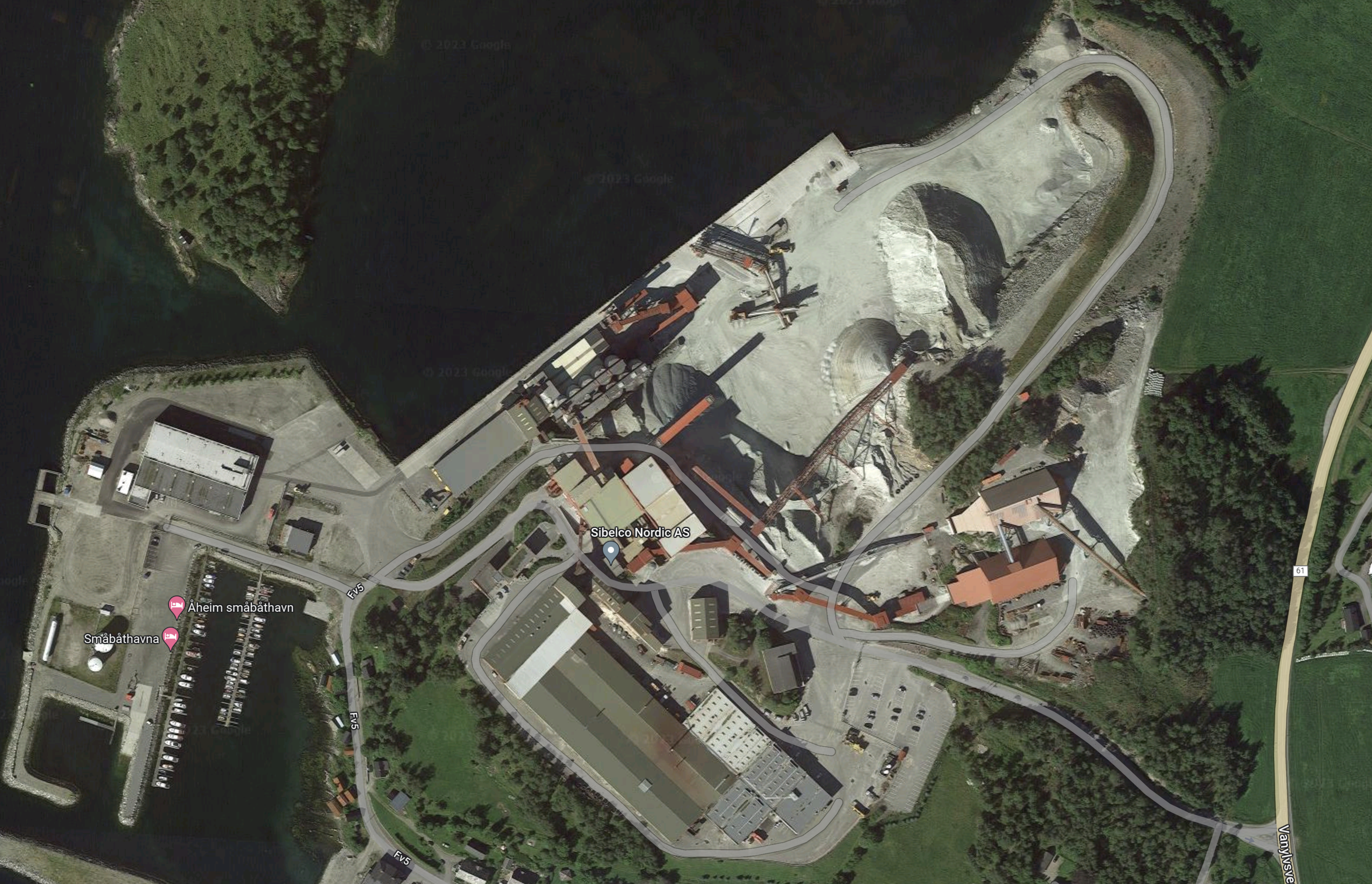
It looks like mine, processing and port all on one site.
The Big Interview With Mike Eberlin
This is the sub-heading.
Former Managing Director of Tarmac Cement & Lime and chair of MPA Cement, Mike Eberlin, became Seratech’s business advisor in June this year. He was intrigued by the novel technology Sam Draper and Barney Shanks had uncovered
These paragraphs are a summary of what Mike Eberlin said.
As we begin to talk, Mike is quick to point out there are two big advantages to Seratech: “They are using magnesium silicate as a starting material which produces silica as a cement replacement and magnesium oxide which can then absorb CO2”.
The CO2 absorption is what fascinates Mike as the type of magnesium carbonate Seratech produces is a “slightly unstable” version which when cured, becomes stable and reverts to the rock-like substance you would find in nature. “This came as a surprise because the chemistry wouldn’t indicate that was possible,” he explains.
Following this discovery, and as Seratech’s research progressed, it soon became apparent that the magnesium carbonate lends itself well as a binder and can be used in applications like building blocks and plasterboard: “It’s effectively carbon capture and use, not carbon capture and storage because you are mineralising the CO2 into a product.
“We end up in this clever situation whereby it’s not that we don’t emit the CO2, it’s better than that, we absorb CO2 and create two binders that replace cement”.
That’s what I call an endorsement.
Conclusion
I have this feeling that Seratech will be a very significant company in a couple of years.
Hospital Pioneers Cancer Service For Over 70s That Saves Lives And Money
The title of this post, is the same as that of this article in The Times.
This is the sub-heading.
Treatment is adapted to take into account age-related illnesses, such as heart disease, diabetes and dementia.
These three paragraphs outline, what the Christie Hospital is doing.
The Christie Hospital in Manchester is pioneering a specialist cancer service for elderly patients under plans to tackle a “silver tsunami” of cases.
More than 200 patients have been treated by the new team, which was set up to meet the more complex care needs of an ageing population.
The service has nearly halved the number of unplanned hospital admissions among older cancer patients, improving survival and quality of life.
But it’s the graph that follows that I find interesting.
It shows the cancer incidence rate (per 100,000 population) in 2020 by gender and age at diagnosis.
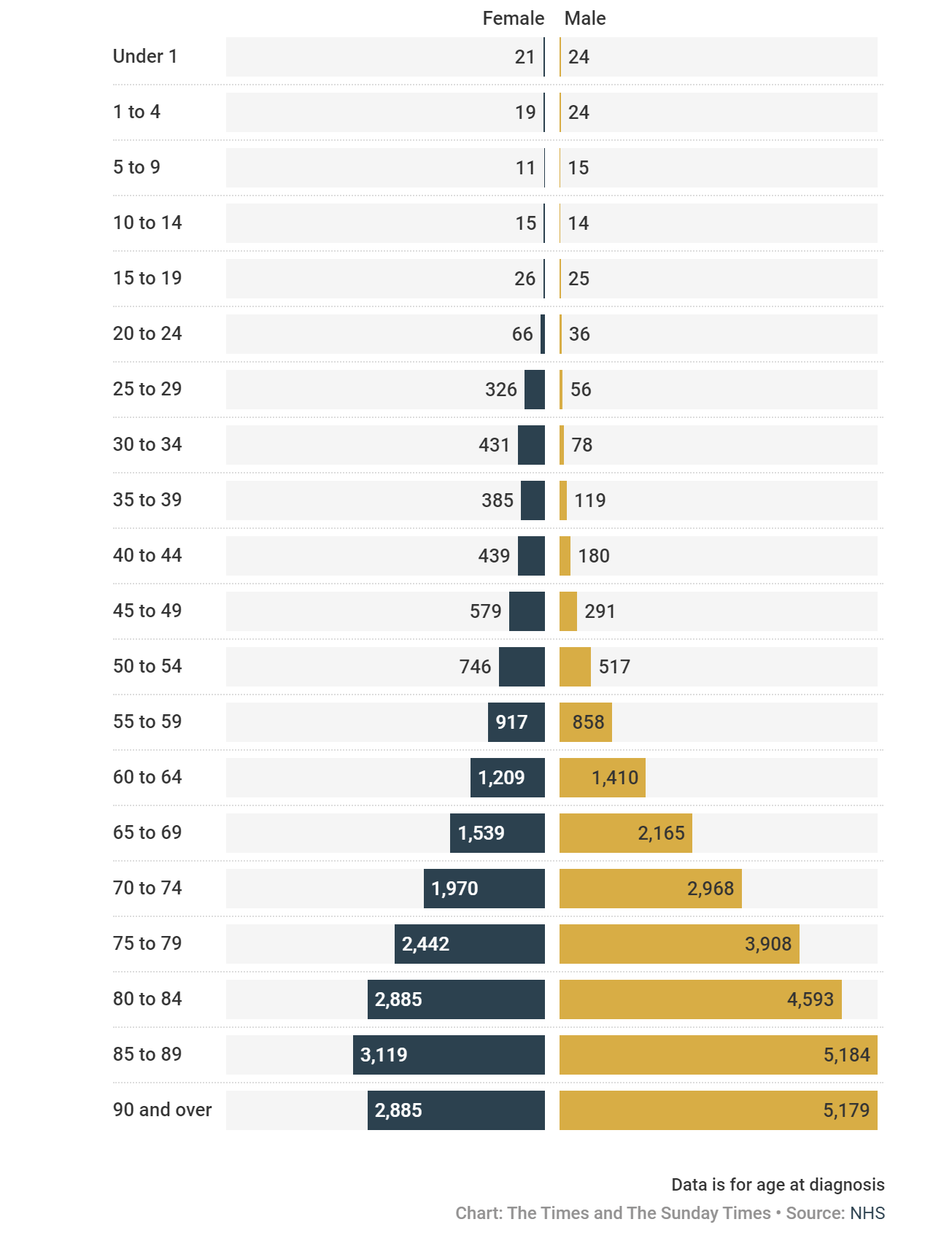
I am a control engineer and statistician and one of the most interesting things in a graph like this is the rate of increase or in this graph’s case the rate of decrease, as the graph effectively has the present at the top.
I have used an old trick and looked at the difference between the groups and the difference between the difference.
Note.
- It seems that the rate of increase of cancer diagnosis with age seems to increase with ages of 60-64 and 25-29.
- This would seem to correspond to those born before 1960 and those born before 1995.
- As a coeliac, I know that the first test for coeliac disease, which used endoscopy was introduced around 1960.
- The modern genetic test for coeliac disease was developed in the 1990s.
Is it coincidence, that the rate of increase of cancer diagnosis with age seems to increase, when a better diagnosis for coeliac disease was introduced?
These are my thoughts!
Coeliac Disease And Me
I am coeliac and I was born in 1947. I wasn’t diagnosed as coeliac until 1997.
I was an unhealthy child, with all sorts of avenues being chased, so in the end they just took my tonsils out.
- It should be remembered, that there was no test for coeliac disease in children until 1960.
- I’ve also only met one coeliac older than me and both her parents were GPs and she was diagnosed by food elimination.
- In fact, I never met a coeliac until I was about 25. He was the two-year-old son of one of C’s friends.
At fifty, an elderly locum gave me a present of a blood test to clear up my long-term health problems. The results showed that my body had very little Vitamin B12. Injections didn’t improve the level, so my GP sent me to Addenbrooke’s.
It was a Monday and all the consultant did was ask a nurse to take several vials of blood. He didn’t ask me any relevant questions or even touch me.
On the Wednesday morning, I got a letter from the hospital saying I was probably coeliac and it would be confirmed by endoscopy.
I must have been one of the first to have been diagnosed by a genetic test on a sample of blood.
Coeliac Disease And My Youngest Son
My youngest son was born in 1972 and after my diagnosis, my late wife felt he was coeliac, as physically he was so like me. But neither him nor our other two sons would get themselves tested.
I am now sure he was coeliac, as his daughter was born with a congenital hernia of the diaphragm and Swedish research says can happen with coeliac fathers. Luckily, she was born in the Royal London Hospital and thanks to heroic surgery at a few days old, she survived and is now in her first year at Southampton University.
Sadly my youngest son died of pancreatic cancer in 2011.
Coeliac Disease And Cancer
Nottingham University have shown that if you are coeliac and stick to a gluten-free diet, you are twenty-five percent less likely to suffer from cancer.
Cancer in the Over Sixties
The following is an extract from A Thought On Deaths Of The Elderly From Covid-19, which I wrote in April 2020.
How many undiagnosed coeliacs are there in those over seventy, who because they are coeliacs, have a compromised immune system?
I would be undiagnosed but for that elderly locum!
How many other coeliacs are there in the UK population?
- Age UK has a figure of twelve million who are over 65 in the UK.
- If 1-in-100, as stated by Coeliac UK, in the UK are coeliac, that is 120,000 coeliacs over 65, who are too old to have been diagnosed as a child, because no test existed.
Note that as of today 177,388 have been diagnosed with Covid-19.
Could the drop in the cancer rate of those born before 1960 be because of the availability of a test for coeliac disease, so that if they were a sickly child like me, they would be diagnosed? As I said earlier diagnosed coeliacs have a lower cancer rate than the general population.
Cancer in the Under Thirties
I was diagnosed in 1997 by a genetic blood test and there is no doubt that I have coeliac disease.
As the test is so simple, I wonder what proportion of coeliacs born since the Millennium have been diagnosed.
And how does this contribute to the drop in cancer cases?
More Research Needs To Be Done
It is obvious to me, that research needs to be done into the link between undiagnosed coeliacs and cancer.
It might be prudent to test every cancer patient for coeliac disease. My GP told me, that the test is not expensive and generally gives the right result.
Low-Carbon Concrete: Separating Greenwash From Reality
The title of this post is the same as that of this article from Construction Management.
This is the sub-heading.
Tales of low-carbon concrete abound, but what exactly does that mean? Kristina Smith looks at what’s in the mix.
This is a paragraph, which shows the scale of the problem.
The oft-quoted statistic is that cement contributes to 7% of the world’s carbon emissions. However, MPA says that in the UK concrete and cement account for just 1.5% of emissions. “From 1990 we have reduced our absolute emissions by 53%, which is faster than the overall economy, mainly by improving energy efficiency at the plants,” says Khosravi.
Noushin Khosravi, is sustainable construction manager at the Concrete Centre, which is part of Mineral Products Association (MPA).
Companies mentioned include.
- Capital Concrete with their Earth Friendly Concrete.
- CarbonCure Technologies, which I wrote about in Mote – World’s First Carbon Removal Plant Converting Wood Waste To Hydrogen.
- Seratech, which I wrote about in Carbon-Neutral Concrete Prototype Wins €100k Architecture Prize For UK Scientists.
I find the Seratech process amazing as it takes carbon dioxide straight from flues to make the cement.
Could we fit a Seratech cement process on the back of a gas-fired power station?
The article is a must-read summary of where the technology is with respect to low-carbon concrete.
UK’s Nuclear Fusion Site Ends Experiments After 40 Years
The title of this post, is the same as that of this article on the BBC.
I have followed fusion research since ZETA at Harwell was started up in 1957.
These first few paragraphs from the BBC article, sum up up fusion research.
For the next four decades, the European project pursued nuclear fusion and the promise of near-limitless clean energy.
But on Saturday the world’s most successful reactor will end its last test.
Nuclear fusion was “discovered” in the 1920s and the subsequent years of research focused on developing fusion for nuclear weapons.
In 1958, when the United States’ war research on fusion was declassified, it sent Russia, UK, Europe, Japan and the US on a race to develop fusion reactions for energy provision.
Fusion is considered the holy grail of energy production as it releases a lot of energy without any greenhouse gas emissions.
It is the process that powers the Sun and other stars. It works by taking pairs of light atoms and forcing them together – the opposite of nuclear fission, where heavy atoms are split apart.
Four decades of research, loads of money and some of the best brains in the world have produced very little, except about knowing what doesn’t work.
It doesn’t seem that anybody is getting any value from fusion research any more.
It’s almost as if, we’ve hit a brick wall and we can’t go any farther.
It must be terribly demoralising for everybody involved.
Would the scientists and engineers be better employed on other research?
I wouldn’t totally abandon fusion research, but put it more on a watching brief, so that if anything positive happens elsewhere, the UK might be able to take advantage.
Could we even do what we have recently done with High Speed Two and scrap it, before using the money on other energy projects?
My priorities would be.
Floating Wind Research
Because we are surrounded by sea, offshore floating wind is likely to be our major energy source by the end of the decade.
Energy Network Control Research
Our energy network will be getting more complex and we need better algorithms to control it.
Storage Research
We need lots of energy storage, that is affordable to install, that can be placed everywhere in the UK.
Project Management Research
I believe that some of the energy ideas will need advanced project management techniques, that may or may not have been invented yet.
Small Modular Reactor Research
SMRs are one way to go, but is the backup research in place?
Tidal Research
Places in the UK have high tidal ranges and we should exploit them.
The Government And Research
The government is funding a lot of energy research.
Much of the funding is going for short term projects, which is good in that we have an urgent need for improvement in our energy performance, but is bad in that it ignores the future.
Diamond 2
The Diamond Light Source has been an unqualified success. I am convinced that we need Diamond 2 in the North, which I wrote about in Blackpool Needs A Diamond.
New Rolls-Royce Engine For Hybrid-Electric Flight Completes Successful First Fuel Burn
The title of this post is the same as that of this press release from Rolls-Royce.
This is the sub-heading.
A new Rolls-Royce small gas turbine that has been specifically developed to power hybrid-electric flight has successfully completed its first fuel burn. The engine has been designed using novel combustion technology to produce ultra-low emissions and this significant achievement confirms the effectiveness of the compact, power-dense turbine that will be integrated into a light-weight turbogenerator system.
This first paragraph gives more details.
The complete turbogenerator system is being developed for the Advanced Air Mobility (AAM) market. This includes electrical vertical take-off and landing (eVTOL) or electric short take-off and landing (eSTOL) aircraft for Urban Air Mobility (UAM) and commuter aircraft applications up to 19 seats. The gas turbine under test also has potential applications within helicopter, auxiliary power unit (APU) and defense markets.
Looking at Wikipedia, it appears that a typical 19 seat airliner needs two engines with a power between 500 and 600 kW.
This would fit with the next paragraph of the press release.
The turbogenerator system will complement Rolls-Royce’s electrical propulsion portfolio by delivering an on-board power source with scalable power offerings between 500 kW and 1,200 kW enabling extended range on sustainable aviation fuels and later, as it becomes available, through hydrogen combustion. This will open up new, longer routes than electric battery powered aircraft can support today.
I can envisage electric 19-seat airliners powered by either two 600 kW engines or one 1200 kW engine.
But then the mind boggles at the applications for this range of engines.
AI Tech Tracking Seabirds At Aberdeen Bay Offshore Wind Farm
The title of this post, is the same as that of this article on offshoreWIND.biz.
This is the sub-heading.
Vattenfall, Norwegian AI technology start-up Spoor, and British Trust for Ornithology have teamed up on a project that will test AI technology in tracking 3D flight paths of seabirds flying near the wind turbine blades at the Aberdeen Bay Offshore Wind Farm in Scotland.
This is the first paragraph.
The project has already started, with four cameras already installed and collecting data on birds’ 3D flight paths throughout the wind farm and in the immediate vicinity of the turbine blades. Data on seabird movements has already started coming in and validation trials have been completed both offshore, with an observer present, and onshore, with a drone, according to Vattenfall.
This looks like a very neat piece of technology, that hopefully will solve how birds interact with wind turbines.
From my experience of landing and taking off light aircraft at the old Ipswich Airport, where there were a lot of seabirds, my money would be on that birds will learn to use their AI (Avian Intelligence) to avoid the blades of wind turbines.
 The Anonymous Widower