Could There Be An Elizabeth Line Extension To Grays?
This article on My London is entitled London Underground Tube Map: The Towns That Could Be Added To The Elizabeth Line As New Giant Loop Through London, Essex And Kent Is Proposed.
This paragraph described the proposal.
The proposal, which is part of its Vision 2050 local transport plan, would see the current Elizabeth line service from Romford take over the Overground branch to Emerson Park and Upminster, then join c2c services continuing via Chafford Hundred Lakeside to Tilbury. It would then head under a new tunnel beneath the Thames to Gravesend, connecting with the reintroduced Eurostar at Ebbsfleet International/Northfleet.
It’s certainly a bold idea and you can view the report to Thurrock Council here.
These are my thoughts.
The Frequency Of Trains
Currently, these services have a frequency of two trains per hour (tph) in both directions.
- Romford and Upminster.
- Upminster and Tilbury Town.
It would seem sensible that this frequency is preserved, thus giving every station on the loop four tph to and from the Eastern End of the Central Tunnel at Whitechapel station. Two tph would go via Romford and Stratford and two tph would go via Ebbsfleet and Abbey Wood.
What Would Be The Western Terminal?
It would probably be the two busiest terminals in the West.
I suspect that these will be Heathrow Terminal 4 and Heathrow Terminal 5
- Two tph would go between Heathrow Terminal 4 and Heathrow Terminal 5 via the loop.
- Two tph would go between Heathrow Terminal 5 and Heathrow Terminal4 via the loop.
- Two tph would go clockwise.
- Two tph would go anticlockwise.
I suspect the digital signalling can sort it out, just as it does the loop in Thameslink.
The Connection At Romford To The Romford and Upminster Line
Consider.
- The Romford and Upminster Line is single-track.
- A well-signalled single-track railway can handle two tph in both directions in an hour.
- Trains take five minutes to go between Romford and Emerson Park stations.
- Trains between Romford and Upminster will use Platform 5 at Romford station.
- Trains between Upminster and Romford will use Platform 4 at Romford station.
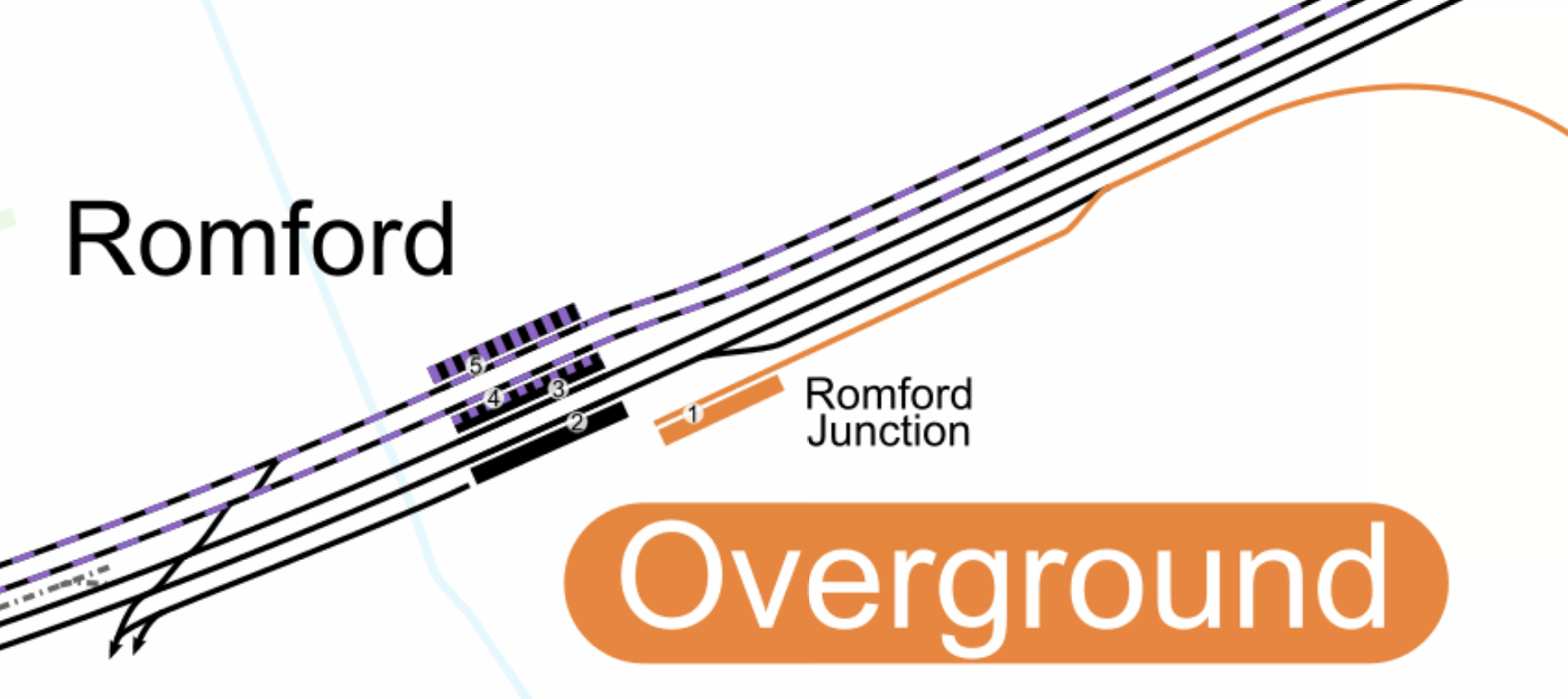
This map from cartometro shows the track layout at Romford station.
Note.
- The orange lines are the Overground tracks of the Romford and Upminster Line, which connects to Platform 1 in Romford station.
- The black and purple lines are the Elizabeth Line, which go through Platforms 4 and 5 at Romford station.
- The black lines are the fast lines of the Great Eastern Main Line, which go through Platforms 2 and 3 at Romford station.
- There is no connection between the Elizabeth Line and the Romford and Upminster Line.
I believe it is possible to build a single-track flyover or dive-under that connects both Platforms 4 and 5 at Romford station to the Romford and Upminster Line.
A similar double track flyover was built to connect the Barking Riverside branch to the main lines through Barking.
- But this track layout would only need to be single-track.
- I also suspect that there may not be enough space to put in a full double-track flyover.
- It would avoid the inconvenience and danger of using flat junctions to cross the fast lines of the Great Eastern Main Line.
As it only takes five minutes to go between Romford and Emerson Park stations, there is plenty of time to fit two tph in both directions in an hour.
Platform Extension In Platform 1 At Romford Station
Platforms 4 and 5 at Romford regularly take nine-car Class 345 trains, but I think that Platform 1 should be lengthened, to provide a bay platform on the route to help out when the service needs to recover.
Platform Extension At Emerson Park Station
The platform at Emerson Park station will need to be lengthened to take nine-car Class 345 trains.
Some commentators claim, that the passing loop at the station needs to be rebuilt. But I suspect, this isn’t needed as the expanded layout at Romford station effectively creates a passing loop.
The Connection At Upminster Between The Romford and Upminster Line And The Upminster And Tilbury Town Line
Consider.
- Both lines are single-track.
- But there is a passing loop at Ockenden station.
- There are three tracks between West Thurrock junction and Grays.
- Trains take five minutes to go between Emerson Park and Upminster stations.
- Trains take ten minutes to go between Upminster and Chafford Hundred stations.
- Trains take four minutes to go between Chafford Hundred and Grays stations.
- Trains take thirteen minutes to go between Upminster station and West Thurrock junction.
This map from cartometro shows the track layout at Upminster station.

Note.
- The orange lines are the Overground tracks of the Romford and Upminster Line, which connects to Platform 6 in Upminster station.
- The green lines are the District Line tracks that handle the services that terminate at Upminster station.
- The black lines are the c2c tracks between Fenchurch Street and Southend Central stations go through Platforms 1 and 2 at Upminster station.
- The Upminster and Tilbury Town Line leaves Upminster station in a South-Easterly direction.
- The Upminster and Tilbury Town Line connects to Platforms 1 and 2 at Upminster station.
I believe it is possible to build a single-track flyover or dive-under that connects both Platforms 1 and 2 at Upminster station to the Romford and Upminster Line.
This would connect the following.
- The Romford and Upminster Line to the the Upminster and Tilbury Town Line.
- The Romford and Upminster Line to the the Fenchurch Street and Southend Central Line.
Upminster station would be a much improved interchange.
Two tph Between Tilbury Town and Romford Stations
Consider.
- The route is fully electrified.
- The route is a mixture of single and double-track.
- There is a passing loop at Ockendon station.
- The platform at Emerson Park and possibly others may need to be extended to take nine-car Class 345 trains.
I believe single-track flyovers or dive-unders at Romford and Upminster stations would enable two tph on the route.
The only downside I can see, is that passengers going between Fenchurch Street and Chafford Hundred or Ockendon stations would need to change at Grays or Upminster stations.
Alternatively, they could take the Elizabeth Line, which would have a 4 tph direct service between the Central Tunnel of the line and Chafford Hundred and Ockendon stations.
Under The Thames
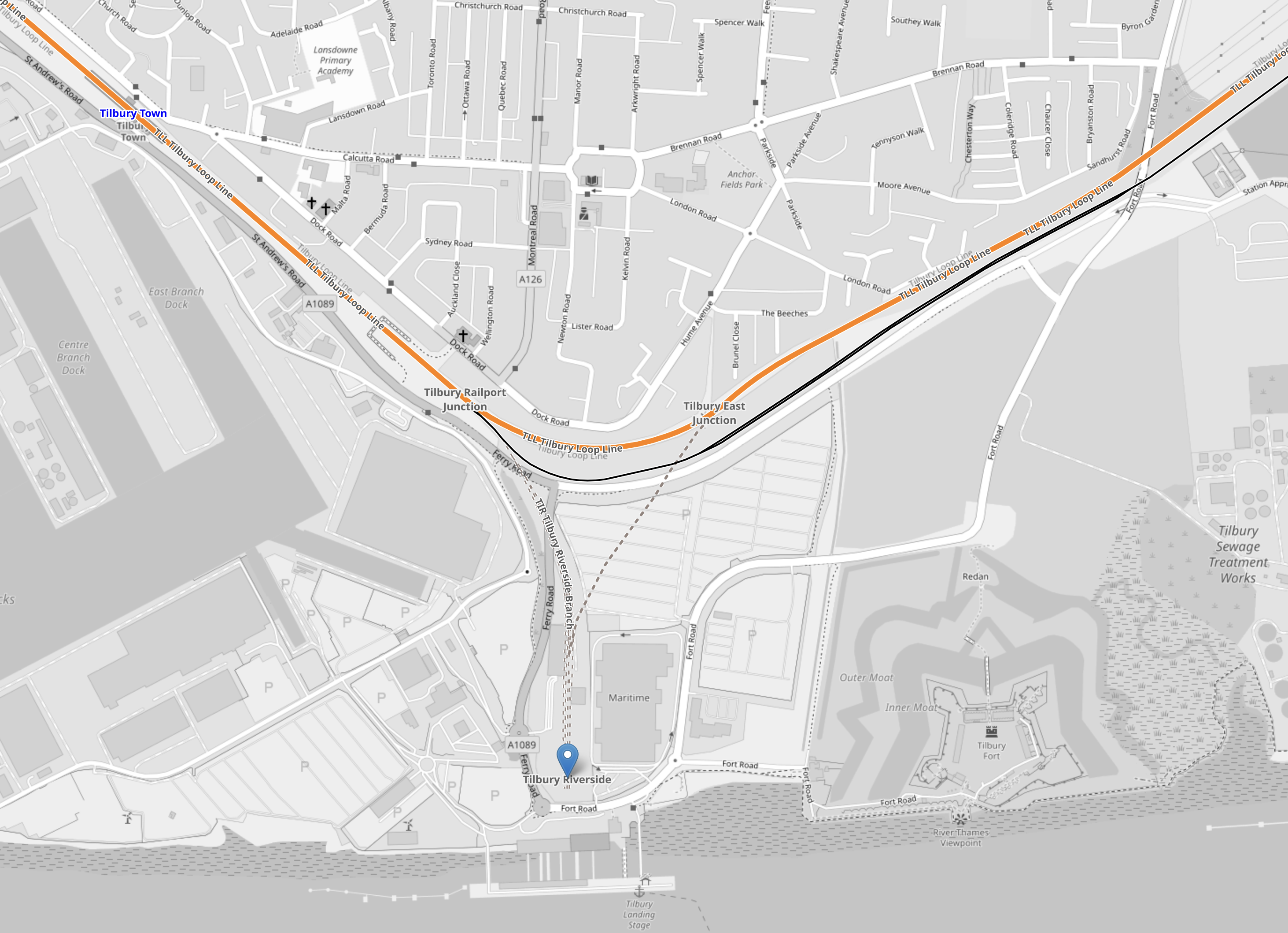
This map from OpenRailwayMap shows the lines on the North bank of the Thames.
Note.
- The orange line is the double-track Tilbury Loop Line between Fenchurch Street and Southend Central stations.
- Tilbury Town station is in the North-West corner of the map.
- There is a proposal for a Tilbury Fort station in the North-East corner of the map.
- The blue arrow at the bottom of the map indicates the former Tilbury Riverside station, which is next to the London International Cruise Terminal.
I believe the North portal of the tunnel under the river could be at the site of the former Tilbury Riverside station.
Would it be an idea to rebuild the station and connect it to the cruise terminal, so that passengers on the cruise ships would have excellent access to Central London, Ebbsfleet International station for High Speed One and Heathrow Airport?
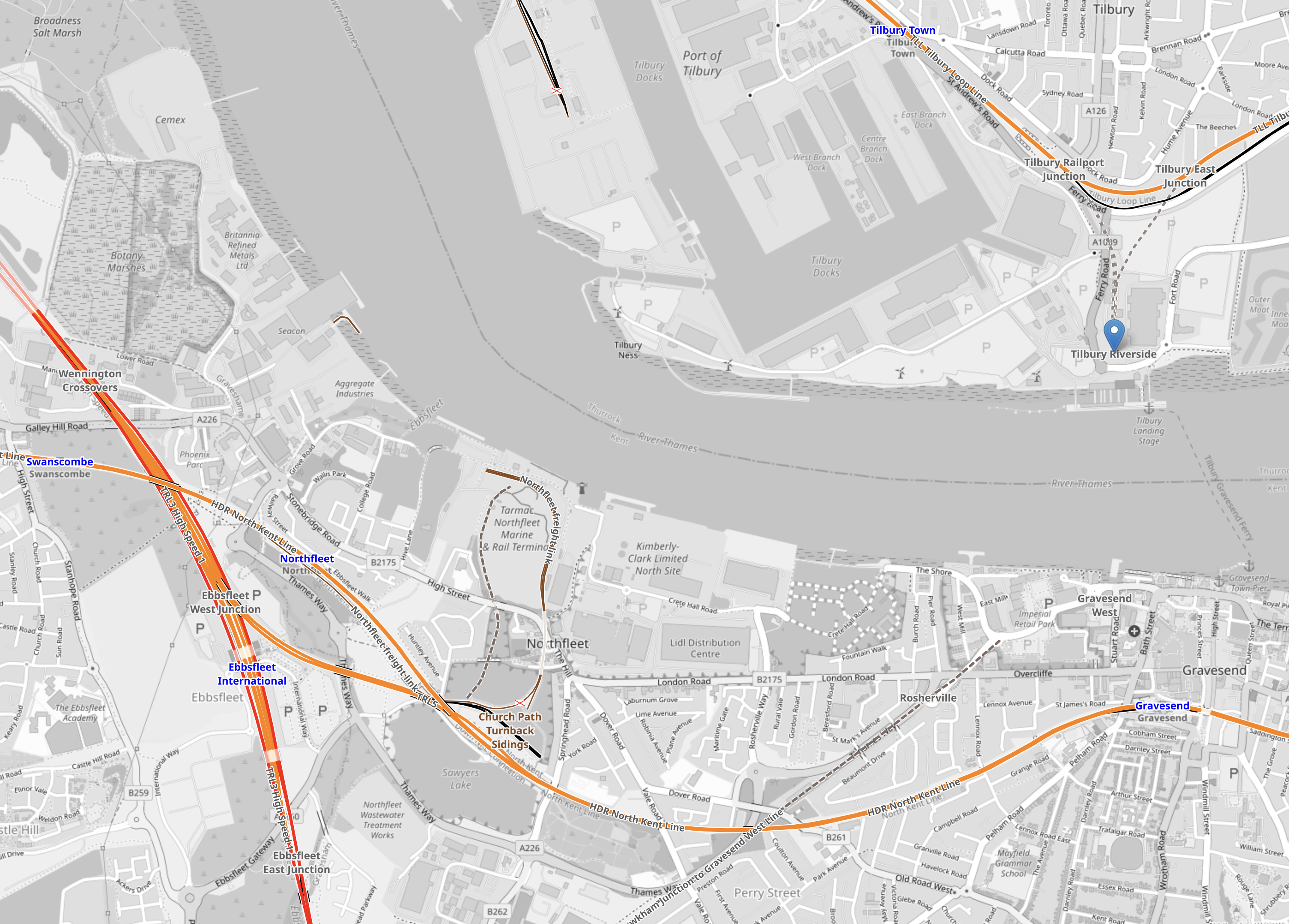
This map from OpenRailwayMap shows the lines on the South bank of the Thames.
Note.
- Tilbury Town station, the former Tilbury Riverside Riverside station and the Tilbury Loop Line are in the North-East corner of the map.
- Gravesend station is in the South-East corner of the map.
- The wide orange line going vaguely North-South at the Western side of the map is High Speed One going through Ebbsfleet International station.
- Connecting Gravesend and Ebbsfleet International stations is the North Kent Line.
I suspect it would be possible to bore a tunnel from Tilbury Riverside, that passed under Gravesend station and joined the North Kent Line to the West of the station.
How Would The River Crossing Connect To Gravesend Station?
The platform or platforms on the Elizabeth Line Loop would have to be underground, as there is not much space at Gravesend station as these pictures show.
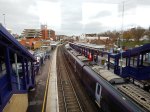
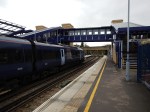
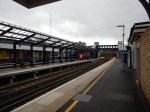
Note.
- Gravesend has SouthEastern HighSpeed services to St. Pancras International station and North-East Kent.
- The route to Gravesend has been safeguarded for the Elizabeth Line.
- The railway under the Thames could replace the Tilbury and Gravesend Ferry.
There also could be operational advantages in not terminating Elizabeth Line services at Gravesend.
Abbey Wood And Gravesend
In Elizabeth Line To Ebbsfleet Extension Could Cost £3.2 Billion, I looked at the Transport for the South East proposal for extending the Elizabeth Line to Kent.
This image from the Abbeywood2Ebbsfleet consultation, shows the proposal.
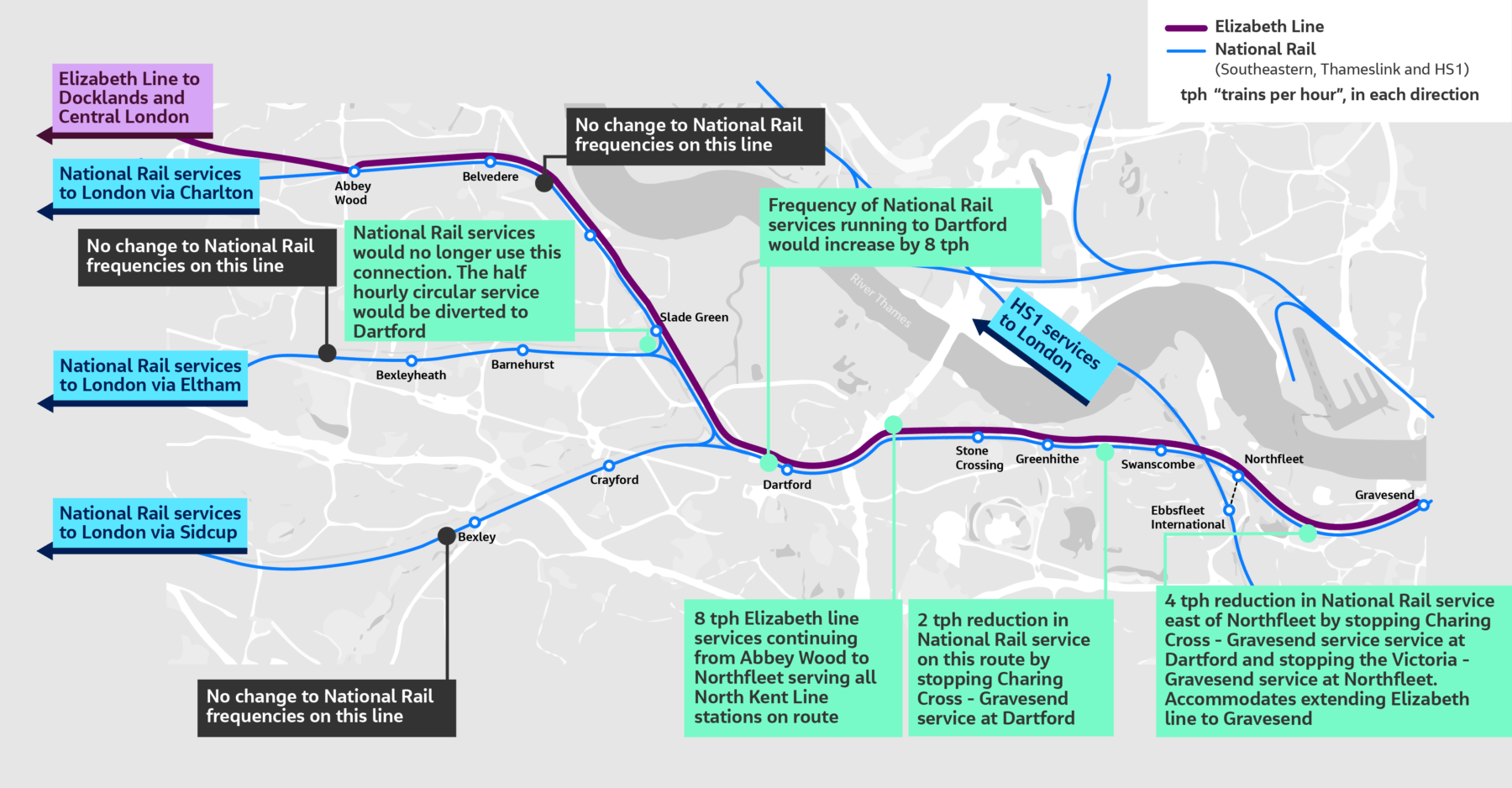
Note, that there doesn’t appear to be too much new infrastructure, except for a proper connection between Northfleet and Ebbsfleet stations. References on the Internet, say that the similar-sized Luton DART connection at Luton Airport, cost around £225 million, but we now know it was well upwards of that.
The TfSE proposal says that trains would terminate as follows.
- Abbey Wood – 4 tph
- Northfleet – 4 tph
- Gravesend – 4 tph
As space is limited at Gravesend and there is money for extending a railway service to a new Hoo station, I feel that proposing a two tph service to Hoo station would be a prudent action to take.
This would leave a handy two tph to take the loop back to Central London.
Could A Large Parkway Station Be Built Between Romford and Tilbury Riverside Stations?
Ebbsfleet International station, which is to the South-East of London, has 5,000 parking spaces and is the only large Park-and-Ride site around the capital.
Could another large Park-and-Ride site be opened on the Elizabeth Line North of the Thames?
One place could be at Chafford Hundred station and the nearby Lakeside Shopping Centre.
This Google Map shows the area.
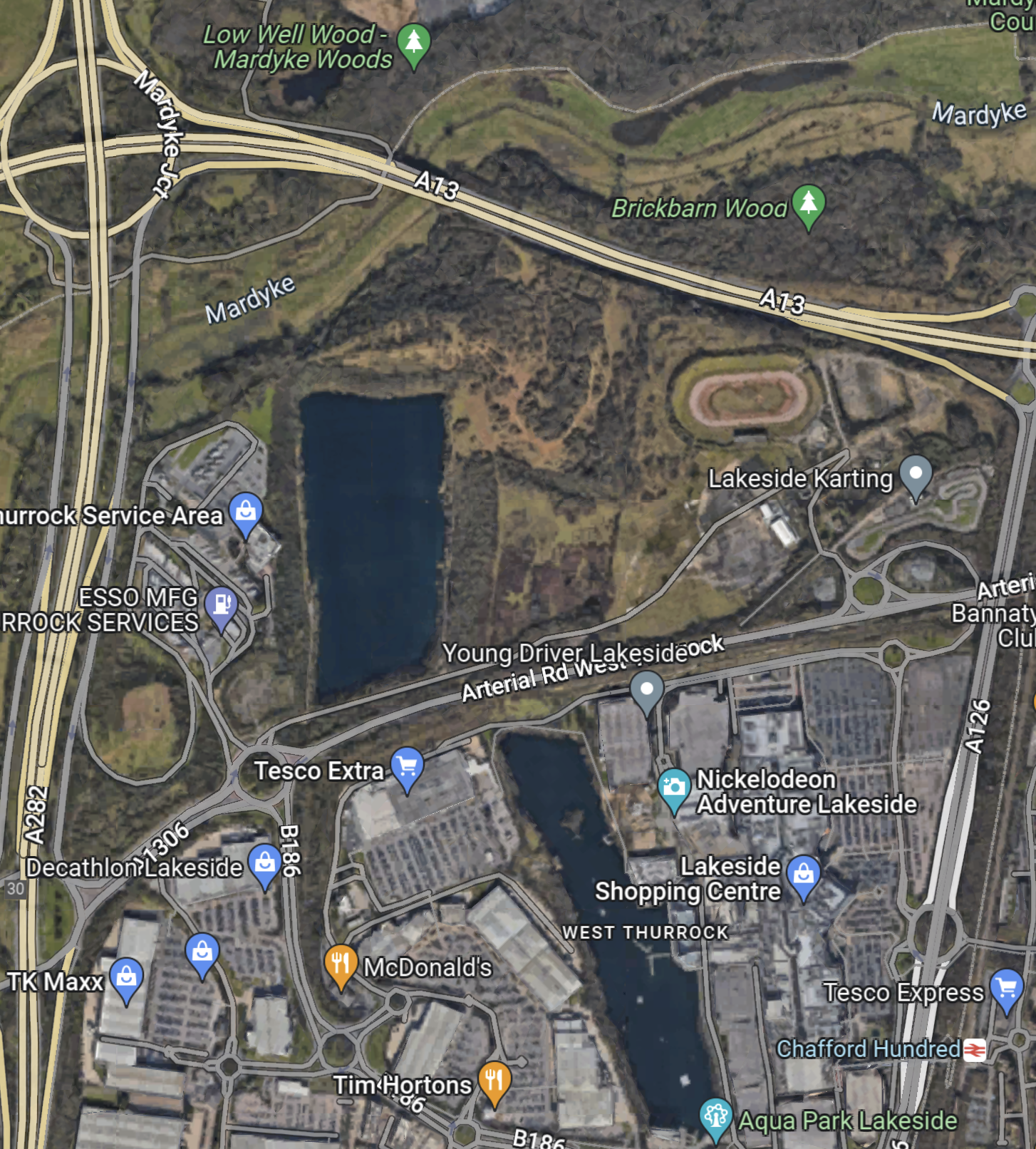
Note.
- The M25 runs North-South up the Western side of the map.
- Chafford Hundred station is in the South-East corner of the map.
- The shopping centre is next to the station.
Last time I went, Lakeside was looking tired.
Timings To And From Whitechapel
These are estimated timings to and from Whitechapel.
- Romford – 26 mins – 81 mins
- Emerson Park – 31 mins – 76 mins
- Upminster – 35 mins – 72 mins
- Ockendon – 41 mins – 66 mins
- Chafford Hundred – 45 mins – 62 mins
- Grays – 49 mins – 58 mins
- Tilbury Town – 52 mins – 55 mins
- Tilbury Riverside – 58 mins – 49 mins
- Gravesend – 62 mins – 45 mins
- Northfleet – 65 mins – 42 mins
- Swanscombe – 68 mins – 39 mins
- Greenhithe for Bluewater – 71 mins – 36 mins
- Stone Crossing – 73 mins – 34 mins
- Dartford – 81 mins – 26 mins
- Slade Green – 86 mins – 21 mins
- Erith – 88 mins – 19 mins
- Belvedere – 89 mins – 18 mins
- Abbey Wood – 92 mins – 15 mins
Note.
- The times between Tilbury Town and Gravesend are my best estimates.
- All other times are taken from current services.
- The first time is the time to Whitechapel via Romford.
- The second time is the time to Whitechapel via Abbey Wood.
It does appear that the best times from all stations are under an hour.
A First Ride On A Class 710 Train Between Upminster And Romford
This morning I went to Upminster and took the Class 710 train to Romford and back.

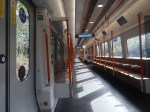
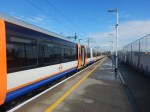
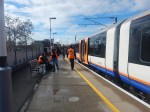
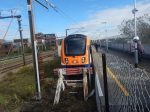


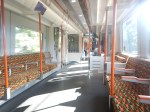
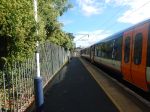

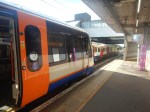
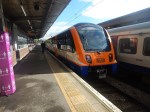

All went well and what a difference from yesterday, which I wrote about in A Last Ride On A Class 315 Train Between Upminster And Romford?
These are my thoughts.
Capacity Improvement
These pictures show the interiors of the Class 710 train and the Class 315 train.
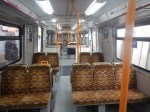

It looks like many more passengers can be squeezed into the Class 710 train, than the Class 315 train.
According to Wikipedia the Class 710 train can hold 189 seated and 489 standing passengers, whilst the Class 315 train has 318 seats.
Ride Improvement
I travelled along the route with a Transport for London engineer, who worked on the Crossrail trains.
We both felt the ride was a large improvement and we both felt that it Network Rail worked a bit of magic on the track, it would be a very good train service.
Could Four Trains Per Hour Be Possible?
My travelling companion had worked on the Docklands Light Railway, and we both felt that with a degree of automation, an increased frequency would be possible.
Consider.
- There is only one train on the line at any one time.
- No other trains use the line.
- The route is under 3.5 miles long.
- The acceleration and deceleration of the new trains is superior to those of the Class 315 trains.
- Do the Class 710 trains employ regenerative braking to battery technology?
- The current operating speed is just 30 mph.
- I’m sure Network Rail could improve the operating speed.
- My travelling companion told me, that Crossrail had successfully tested the automated auto-reverse feature on the Class 345 trains
All these points convince me, that, track improvements and simple automation, much less sophisticated, than that of the Victoria Line or the Docklands Light Railway, could run the service at a frequency of four trains per hour (tph).
There is one problem though.
This article on Time 107.5, is entitled New Train To Begin Running Between Romford And Upminster.
This is an extract.
From today, the new Overground train which has changes to certain features, will be implemented.
The key changes include a different colour at the front which has changed from yellow to orange.
Different LED lights have also been fitted to the train.
The new trains are also quieter so may sound different to the older trains.
As a result, Network Rail and Transport for London are reminding pedestrians using level crossings along the route to stay safe.
Network Rail and Transport for London seem to be worried about pedestrians on the level crossings.
I would think, it prudent, that before line speeds and the frequency of the service are increased, there should be a thorough period of testing to see how pedestrians cope with the new trains, at the level crossings.
What methods of automation could be used?
Borrow From Dear Old Vicky
The Victoria Line (aka Dear Old Vicky!) opened in 1968 and runs using a fully-automated system, at frequencies of up to 36 tph.
Under Service And Rolling Stock, in the Wikipedia entry for the Victoria Line, there is this description of the original automation system.
On opening, the line was equipped with a fixed-block Automatic Train Operation system (ATO). The train operator closed the train doors and pressed a pair of “start” buttons and, if the way ahead was clear, the ATO drives the train at a safe speed to the next station. At any point, the driver could switch to manual control if the ATO failed. The system, which operated until 2012, made the Victoria line the world’s first full-scale automatic railway.
The Victoria line runs faster trains than other Underground lines because it has fewer stops, ATO running and modern design. Train speeds can reach up to 50 miles per hour (80 km/h).
Note.
- The original ATO system worked for over forty years.
- The method of operation seemed to be very safe,
- But most remarkably, the electronics that controlled the trains, were 1960s technology and contained a lot of thermionic valves and relays
What would 50 mph running do for timings between Romford and Upminster?
By training I am a Control Engineer, and although, I’ve never worked on large-scale automation systems, I have worked with lots of people who have and firmly believe that a simple system based on Dear Old Vicky’s original design would work.
What sort of times could be achieved between Romford and Upminster?
- The route can be considered to be two legs; Romford and Emerson Park and Emerson Park and Upminster, both of which are about 1.75 miles long.
- The fastest way in a train between too stations, is to accelerate to cruising speed, cruise at that speed and then time the deceleration, so you stop neatly in the station.
- The Class 710 trains probably accelerate and decelerate at around 1 m/sec/sec.
- The acceleration and deceleration section of each leg will take 22.2 seconds and during that time the train will travel 0.15 miles.
- So that means the train will cruise at 50 mph for 1.45 miles, which will take 104 seconds.
- The two legs of the journey will take around 150 second or 2.5 minutes.
The time for a round trip from Romford to Upminster can now be calculated,
- Four legs between station 4 x 2.5 = 10 mins
- Two stops Emerson Park 2 x 1 mins = 2 mins
- One stop at Romford 2 mins = 2 mins
- One stop at Upminster 2 mins = 2 mins
Note.
- This is a total of 16 minutes
- The longer stops at Romford and Upminster are needed for the driver to change ends.
- I have repeated the calculations for a 60 mph cruise and it saves just 40 seconds.
But I do feel that improving the method of operation could allow four tph.
The Driver Could Control The Train From One End
Consider.
- Each cab could have a video screen showing the view from the other cab.
- There could also be video screens on the platforms giving detailed views of the train in a station, as there are on many platforms now!
Would these and perhaps extra automation allow the driver to control the train from one cab, as it shuttled back and forth?
I suspect it would be cab at the Upminster end, as the platform is longer at Romford.
I believe that it would be possible and should allow stops of a minute at the two termini, as the driver wouldn’t be changing ends.
One minute stops would reduce the round-trip time to fourteen minutes and allow four tph.
Full Automation With The Driver In Control
The Docklands Light Railway is fully automated, so why not use a similar system on the Romford and Upminster Line?
But instead of having the system controlled by an operator in a remote signalling centre, the driver on the single train on the route is in control of it all.
The automation would enable fast stops and the driver would not have to change ends.
This would mean that four tph would be able to run at all times.
The System Would Self-Regulate
With public transport, things do go wrong.
Supposing someone turned up in a wheel-chair and it took five minutes to load them onto the train, so it left late.
This would mean that the train would be running late for the rest of the day, unless it was decided to wait for a few minutes, so it had the time of the following service.
After the wait, all trains would be on time.
Put Two Drivers On The Train
This would also be possible.
The train would have a driver in each cab.
- The driver in the cab at the Romford end of the train would drive the train to Romford.
- The driver in the cab at the Upminster end of the train would drive the train to Upminster.
- At each terminus, they would swap over control, just as the two pilots do in an airliner.
There would probably need to be a simple interlock, so that only one driver could drive the train at the same time.
This should give the required four tph, as fast stops could be performed at all stations.
Using two drivers could be the ideal way to test out four tph and see whether it attracted more passengers.
Conclusion
The Romford and Upminster route has been markedly improved with the new Class 710 train.
I believe, that it is now possible to run four tph on this route, with some moderate extra expenditure or using two drivers.
A Last Ride On A Class 315 Train Between Upminster And Romford?
This morning I went to Upminster and took the Class 315 train to Romford.
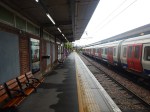
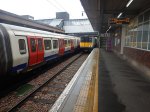
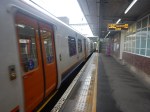
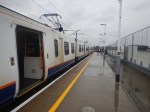
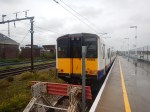
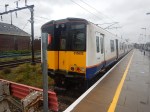
I added the question mark, as when I passed East Ham depot, there were two new Class 710 trains sitting there, covered in graffiti.
Could The Romford And Upminster Line Be Improved?
I see two possible simple improvements
Four Trains Per Hour
London Overground likes to run four trains per hour (tph).
Could this frequency be run on the Romford and Upminster Line?
Three years ago I wrote Could The Romford To Upminster Line Handle Four Trains Per Hour?, and came to this conclusion.
A seven minute trip would mean the train could perform the required four trips per hour.
It would still be tight.
I also investigated an automated shuttle train on the route in An Automated Shuttle Train Between Romford And Upminster, which I felt would be possible, to run a four tph service.
Extension Of The Service
There are various reasons, why the service could be extended from Upminster station, in the Grays direction.
- It would give travellers from South Essex much better access to Crossrail.
- It could give a shuttle between Romford and Grays via the Lakeside Shopping Centre
- Tilbury Riverside station could be a possibility.
- It could open up possibilities for more housing in the area.
- If the route were to be extended to a new station at London Gateway, it could make it easier for people to travel to work at the large port.
Obviously, it would have to be viable for the operator, but the big beasts of Crossrail, Lakeside Shopping Centre and London Gateway might make it possible.
Planning the route wouldn’t be that easy.
Consider.
- The connections to Romford and Grays are on different sides of the District Line, so a flyover or dive-under might be needed.
- Upminster and Grays is a single-track line with a passing loop at the two-platform Ockenden station.
- Upminster and Grays used to be worked by a shuttle service.
- The signalling appears to be able to handle four tph in both directions.
- The current service between Grays and Upminster is two tph in both directions.
- There is a bay platform 1A, at Upminster, which faces towards Grays.
It can certainly be said, that the extension of the service can’t be run at four tph.
I also think, that the current track layout at Upminster looks like one of British Rail efforts to stop any expansion of the railway.
This Google Map shows the layout of Upminster station.

Note.
- The platforms are numbered 1 to 6 from South to North.
- Platform 1A is the Southernmost platform, which is slightly at an angle.
- The main station footbridge is at the Western ends of the platforms.
- The station isn’t fully step-free.
Is an alternative approach possible?
Suppose the following were to be arranged.
- A four tph endless shuttle between Romford and Upminster stations.
- Full step-free access at Romford station is currently being installed.
- Full step-free access at Upminster station.
- A two tph shuttle between Platform 1a and Grays, London Gateway or wherever most passengers want. This service would be arranged to give four tph between Upminster and Grays, when combined with the current services.
- The two four tph services would be timed to give a convenient interchange at Upminster.
Could it be made to work?
It would only need improvements to Upminster station.
These pictures show Upminster station.
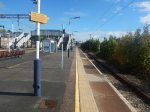
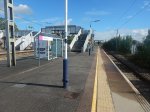

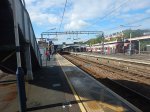
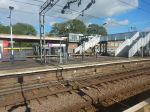
Note.
- Platform 1a is fully-electrified and long enough for a Class 710 train.
- The bridge at the Eastern end of the station is not step-free but could be updated.
- It might be possible to extend this bridge to Platform 6.
Platform 1a could certainly be used to operate a shuttle service to Grays to create a new service across South Essex.
An Automated Shuttle Train Between Romford And Upminster
The Romford-Upminster Line has the following features.
- It is 3.5 miles long.
- It is single-track.
- It is electrified with 25 KVAC overhead electrification.
- The maximum speed is only 30 mph.
- There is a single platform station at either end with one intermediate station.
- The service frequency is two tph.
- Trains take nine minutes to go between the two terminals.
- No other trains use the line.
To run the ideal four tph, trains would need to do the round trip between Romford and Upminster in fifteen minutes.
If we assume that the two end stops take one minutes and the two intermediate ones take thirty seconds, then that leaves just twelve minutes to cover the seven miles of the round trip.
This is an average speed of 35 mph.
As with the Greenford Branch, I think that an appropriate train would be able to run an automated shuttle, with a frequency of four tph.
The train (or tram-train) would have the following features.
- It would be able to use the 25 KVAC overhead electrification.
- It would have an operating speed of perhaps sixty mph.
- It would have fast acceleration and deceleration.
The only infrastructure works that would also be needed, would be to improve the line to allow higher speeds.
Batteries In Class 378 Trains Revisited
Two and a half years ago, I wrote Will London Overground Fit On-board Energy Storage To Class 378 Trains?.
This post effectively updates that post, with what we now know.
As far as I know, batteries have not been fitted to the Class 378 trains, but there have been other developments involving Bombardier since.
Aventras
The linked post was based on statements by Marc Phillips of Bombardier in this article in Rail Technology Magazine entitled Bombardier enters key analysis phase of IPEMU. He also said about Aventras.
Bombardier is also looking at battery options on new builds, including its Aventra platform.
I have stated several times including in Rail Magazine, that the Class 345 trains for Crossrail must have batteries and no-one has told me that I’m wrong.
Battery Train Applications
The Rail Technology article also says this.
Bombardier has started assessing potential customers for battery-powered trains, looking first at branch line applications. Batteries could be a solution allowing non-continuous electrified infrastructure, and emergency rescue and last-mile opportunities.
The article was written three and a half years ago and I suspect Bombardier have been busy researching the technology and its applications.
The High-Speed Bi-Mode Aventra With Batteries
This train was first reported to be in development in this article in Rail Magazine, which was entitled Bombardier Bi-Mode Aventra Could Feature Battery Power.
The article stated the following.
- Battery power could be used for Last-Mile applications.
- The bi-mode would have a maximum speed of 125 mph under both electric and diesel power.
- Bombardier’s spokesman said that the ambience will be better, than other bi-modes.
I very much believe that the key to the performance of this train is using batteries to handle regenerative braking in both electric and diesel modes.
In Mathematics Of A Bi-Mode Aventra With Batteries, I looked at how the train might operate.
Bombardier with better data and the latest mathematical modelling techniques have obviously extensively modelled the proposed trains and prospective routes.
No sane company listed on a Stock Exchange would launch such a product, if it didn’t know that the mathematics of the dynamics and the numbers for the accountants didn’t add up.
Voyagers With Batteries
In Have Bombardier Got A Cunning Plan For Voyagers?, I discuss a snippet found in the July 2018 Edition of Modern Railways, in an article entitled Bi-Mode Aventra Details Revealed.
In a report of an interview with Bombardier’s Des McKeon, this is said.
He also confirmed Bombardier is examining the option of fitting batteries to Voyager DEMUs for use in stations.
Batteries appear to be being proposed to make the trains more environmentally-friemdly and less-noisy.
Talent 3 With Batteries
Bombardier have launched a version of their Talent 3 train with batteries. This is the launch video.
Some of Bombardier’s points from the video.
- Emission-free
- The current range is forty kilometres
- The range will be extended to a hundred kilometres by 2020.
- Charging for forty kilometres takes between seven and ten minutes from overhead electrification.
This looks to be a serious train with orders from German train operators.
It would appear that Bombardier are very serious about the application of batteries to both new and existing trains.
Class 378 Trains And Batteries
What could batteries do for the Class 378 trains?
It looks like over the next few years, the Class 378 trains will be increasingly used on the East London Line, as they have the required evacuation capability for the Thames Tunnel.
Various documents indicate that to maximise capacity on the line, the following may happen.
- Some or all services may go to six trains per hour (tph)
- Trains may be lengthened to six-cars from five-cars.
Extra destinations might be added, but although this could be easy in South London, it would probably require a lot of station or platform development in the North.
Trains Required For The East London Line
If you look at the timing of the East London Line, you get the following journey times for the four routes.
- Highbury & Islington to West Croydon – 52-57 minutes
- Dalston Junction to New Cross – 24 minutes
- Highbury & Islington to Crystal Palace – 46 minutes
- Dalston Junction to Clapham Junction – 47-48 minutes
It could almost have been choreographed by Busby Berkeley.
This means that to run four tph on the routes needs the following number of trains.
- Highbury & Islington to West Croydon – 8 trains
- Dalston Junction to New Cross – 4 trains
- Highbury & Islington to Crystal Palace – 8 trains
- Dalston Junction to Clapham Junction – 8 trains
Which gives a total of 28 trains.
To make all these services six tph, would require the following number of trains.
- Highbury & Islington to West Croydon – 12 trains
- Dalston Junction to New Cross – 6 trains
- Highbury & Islington to Crystal Palace – 12 trains
- Dalston Junction to Clapham Junction – 12 trains
Which gives a total of 42 trains.
At present only the Crystal Palace and Clapham Junction routes have dates for the extra trains and if only these routes were increased in frequency, there would be a need for 36 trains.
Six-Car Trains
The trains might also go to six cars to increase capacity on the East London Line.
As I indicated in Will The East London Line Ever Get Six Car Trains?, cars could be used from the five-car trains not needed for the East London Line.
You would just end up with a number of three- and four-car Class 378 trains, that could be used on other routes with less passengers.
My conclusion in Will The East London Line Ever Get Six Car Trains? was this.
It will be interesting to see how London Overground, increase capacity in the coming years.
There are fifty-seven Class 378 trains in total, which have the following formation.
DMOS-MOS(B)-PTOS-MOS-DMOS
They can be lengthened and shortened, by adding or removing MOS cars.
As an extra MOS car was added to convert all trains from four-cars to five-cars a few years ago, I suspect it is not the most difficult of processes.
It should also be noted that the original three-car trains for the North London Line had the following formation.
DMOS-PTOS-DMOS
If all East London Line routes go to six tph, the required number of trains would be forty-two.
This would leave a surplus of fifteen trains to act as donors for lengthening.
To make all trains six-cars would require a further forty-two MOS cars.
Reducing the trains not needed for the East London Line to three-cars, would yield thirty MOS cars.
This could give the following fleet.
- Thirty six-car trains.
- Twelve five-car trains
- Fifteen three-car trains
To lengthen all trains needed for six-cars would require another twelve MOS cars to be obtained.
Some services could be run with five-car trains, but I don’t think that be a good idea.
I am inevitably led to the conclusion, that if the the Class 378 trains need to be extended to six-cars, then Bombardier will have to produce some more cars.
Adding Batteries To A Six-Car Class 378 Trains
Batteries would be added to Class 378 trains for all the usual reasons.
- Handling energy from regenerative braking.
- Health and safety in depots and sidings.
- Short movements on lines without electrification
- Emergency train recovery
But there might also be another important use.
The Thames Tunnel is under five hundred metres long.
As the only trains running through the tunnel are Class 378 trains, it might be possible and advantageous to run services on battery power through the tunnel.
I will estimate the kinetic energy of a six-car Class 378 train, as the batteries must be able to handle the energy of a full train, stopping from maximum speed.
- The empty train will weigh around 192 tonnes
- The maximum speed of the train is 75 mph.
- The train will hold 1050 passengers, who I will assume each weigh 90 Kg with baggage, bikes and buggies.
- This gives a fully loaded train weight of 286.5 tonnes.
Using the Omni Kinetic Energy calculator gives an kinetic energy of 45 kWh.
If four 100 kWh batteries can be fitted under a two-car Class 230 train, then surely a reasonable amount o capacity can be fitted under a six-car Class 378 train.
These pictures show the under-floor space on a dual-voltage Class 378/2 train.
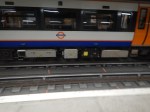
As a six-car train will have five motored cars, why not put one 50 kWh battery in each motored car, to give a capacity of 250 kWh.
In an article in the October 2017 Edition of Modern Railways, which is entitled Celling England By The Pound, Ian Walmsley says this in relation to trains running on the Uckfield Branch, which is not very challenging.
A modern EMU needs between 3 and 5 kWh per vehicle mile for this sort of service.
So how far would a six-car Class 378 train go with a fully-charged 250 kWh battery?
- 5 kWh per vehicle mile – 8 miles
- 4 kWh per vehicle mile – 10 miles
- 3 kWh per vehicle mile – 14 miles
- 2 kWh per vehicle mile – 20 miles
This is only a crude estimate, but it shows that fitting batteries to a Class 378 train with batteries could give a useful range.
Adding Batteries To A Three-Car Class 378 Trains
The same calculation can be performed for a three-car train created by removing the two MOS cars.
- The empty train will weigh around 96 tonnes
- The maximum speed of the train is 75 mph.
- The train will hold 525 passengers, who I will assume each weigh 90 Kg with baggage, bikes and buggies.
- This gives a fully loaded train weight of 143.3 tonnes.
Using the Omni Kinetic Energy calculator gives an kinetic energy of 22.4 kWh.
Unsurprisingly, the kinetic energy of the three-car train is around half that of a six-car train.
As a three-car train will have two motored cars, why not put one 50 kWh battery in each motored car, to give a capacity of 100 kWh.
Using the Ian Walmsley formula gives the following ranges.
- 5 kWh per vehicle mile – 7 miles
- 4 kWh per vehicle mile – 8 miles
- 3 kWh per vehicle mile – 11 miles
- 2 kWh per vehicle mile – 17 miles
When you consider that the length of the Greenford Branch Line is 2.5 miles, these ranges are very useful.
Routes For Three-Car Class 378 Trains With Batteries
I would suspect that these trains will have the following specification.
- Dual-voltage with ability to use either 25 KVAC overhead or 750 VDC third-rail electrification.
- A maximum speed of 75 mph
- Three cars
- Passenger capacity of 525 passengers.
- Range of between seven and fifteen miles
So for what routes would the train be suitable?
Brentford Branch Line
There have been various ideas for reopening the freight-only Brentford Branch Line to passenger traffic.
The simplest proposal would be to run a two tph shurttle train Southwards from Southall station.
As the branch is only four miles long, I believe that a three-car Class 378 train, which ran on battery-power and charged at Southall station could work the branch.
Greenford Branch Line
I’ve already mentioned the 2.5 mile long Greenford Branch Line.
The following work would need to be done before the trains could be used.
- Electrification of the bay platform at West Ealing with 25 KVAC overhead wires.
- Electrification of the bay platform at Greenford with 750 VDC third-rail.
- Minor lengthening of the bay platform at Greenford to allow sixty metre long trains.
- An extra crossover at the West Ealing end of the branch.
With these modifications it might be possible to run four tph on the branch.
Romford To Upminster Line
Currently, the Romford-Upminster Line uses a single train to shuttle the three miles at a frequency of two tph.
If the passing loop were to be reinstated, I believe that two trains could run a four tph service.
Using battery-power on the line and charging on the existing electrification at either end of the line might be a more affordable option.
It should be noted that increasing the current two x four-car tph to four x three-car tph, would be a doubling of frequency and a fifty percent increase in capacity.
West London Orbital Railway
The West London Orbital Railway is outlined like this in Wikipedia.
The West London Orbital is a proposed extension to the London Overground that makes use of a combination of existing freight and passenger lines including the Dudding Hill Line, North London Line, and the Hounslow Loop. The route runs for approximately 11 miles from West Hampstead and Hendon at the northern end to Hounslow at the Western end via Brent Cross West, Neasden, Harlesden, Old Oak Common, Acton and Brentford.
This is one of those plans, which ticks a lot of boxes.
- The tracks are already in existence.
- There is a proven need.
- Passenger numbers would support at least four tph.
- The route connects to Crossrail and HS2.
- Changing at Old Oak Common to and from Crossrail gives a quicker route to Heathrow for many in West London.
- There is electrification at both ends of the route, with only four miles without any electrification.
- At only eleven miles, it could be run by electric trains under battery power.
- The cost is quoted at around £250 million.
- Studies show it has a benefit cost ratio of 2.2:1.
As the route is now being promoted by the Mayor of London, I have a feeling this route will be created in time for the opening of HS2 in 2025.
If you want to know more about the proposals, this document on the Brent Council web site, which is entitled West London Orbital Rail, was written by consultants WSP to analyse the proposals and give a cost.
This is paragraph 5.4.38
At this stage we are assuming that the railway will be operated by diesel traction, or possibly battery or hybrid traction. While the Kew – Acton and Dudding Hill Line sections are not electrified, all the rest of the line is and battery technology may have developed sufficiently by the time of opening to be a viable option. Therefore, potential subsequent phases of the
enhancement plans could electrify the non-electrified sections.
The consultants go on to say, that stabling for diesel trains is more difficult to find in London than for electric..
The route would be suitable for Class 378 trains with batteries, but the consultants say that four-car trains will be needed.
So four-car Class 378 trains with a battery capability will be needed.
Alternatively, new four-car Class 710 trains, which I’m certain are built around a battery capability could be used instead.
A rough estimate says that for the full service of two four tph routes will need a total of eight four-car trains.
This is a much-needed route with definite possibilities.
Should A Battery MOS Car Be Designed?
If the Class 378 trains are lengthened to six cars, it looks like there will be a need for at least twelve new MOS cars.
I wonder, if it would be better to design a new BMOS car with batteries, that could either be created from an existing MOS car or newly-built.
The car would have the following specification
- It would be able to replace any current MOS car.
- It would contain the appropriate size of battery.
The advantages of a compatible new BMOS car are.
It would not require any modifications to the PTOS or DMOS cars, although the train software would need to be updated.
It would make it possible to easily create trains with a battery option with a length of four and five cars.
Could The PTOS Car Be Updated With Batteries?
This could be a logical way to go, if a battery of sufficient size can be fitted in the limited space available with all the other electrical gubbins under the floor of a PTOS car.
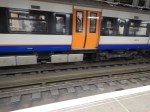
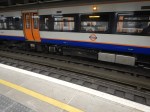
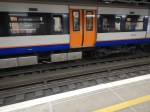
These pictures show a Class 378/2 PTOS car.
Modifying only the PTOS cars would give the following advantages.
- Only the PTOS car would need to be modified.
- PTOS cars for Class 378/1 trains would be 750 VDC only.
- PTOS cars for Class 378/2 trains, would be dual-voltage.
- Only PTOS cars for Class 378/2 trains would have a pantograph.
I will propose that the PTOS car is fiited a 100 kWh battery.
This would be sufficient for the six-car East London Line services, as all it would do was handle the regenerative braking energy, which has a maximum value of just 45 kWh. Battery range of the train would be between three and five miles, which would be enough to recover the train if power failed.
For three-car trains, the 100 kWh ranges would be as I calculated earlier.
- 5 kWh per vehicle mile – 7 miles
- 4 kWh per vehicle mile – 8 miles
- 3 kWh per vehicle mile – 11 miles
- 2 kWh per vehicle mile – 17 miles
Which is a very useful range.
If some four-car trains, were built by adding a new MOS car, the ranges on 100 kWh batteries would be.
- 5 kWh per vehicle mile – 5 miles
- 4 kWh per vehicle mile – 6 miles
- 3 kWh per vehicle mile – 8 miles
- 2 kWh per vehicle mile – 12.5 miles
As the Dudding Hill Line is only four miles long with electrification at both ends, these four-car Class 378 trains would be able to work the routes of the West London Orbital Railway.
Conclusion
Fitting batteries to Class 378 trains opens up a lot of possibilities.
One scenario could be.
- Forty-two six-car trains for the East and |South London Lines.
- One three-car train for the Brentford Branch Line
- Two three-car trains for the Greenford Branch Line.
- Two three-car trains for the Romford to Upminster Line.
- Eight four-car trains for the West London Orbital Railway.
There would be two spare three-car trains and another twenty MOS cars would be required.
.
Latest On The New London Overground Class 710 Trains
The August 2018 Edition of Modern Railways has a two-page article on the latest on the new Class 710 trains for the London Overground.
Seating Arrangement
Wikipedia says this about the seating.under Background And Specifications.
The units will be delivered in two sub-classes; an AC-only version with longitudinal and transverse seating (very similar to the S8 units on the Metropolitan line of the London Underground) for use on the West Anglia and Romford-Upminster services, and a dual-voltage version with longitudinal seating for the Watford DC and GOBLIN services.
But it now appears that all the seats on the trains will be longitudinal ones.
I use the current trains a lot to go to Walthamstow and I also use the Class 378 trains, which have longitudinal seats, frequently on the North and East London Lines of the Overground.
I probably aren’t bothered too much about longitudinal seats, but I suspect there will be others who will complain.
This discussion of RailForums is entitled Annoying Things About The Class 378. Search for “seat” and you don’t find many complaints about the longitudinal seating, which is also used on much of the Underground.
On the other hand, if all the trains have identical interiors, this must save on construction and maintenance costs.
If the interiors are basically similar to the Class 378 trains, it must also save on staff training costs.
I actually think, that the biggest complaint will not be about the new trains, but why don’t the older Class 378 trains have wi-fi and USB charging points!
Eight-Car Trains On West Anglia Routes
The article also states that services on West Anglia routes to Cheshunt, Chingford and Enfield Town stations will work as eight-car trains or a pair of four-car trains.
If they are always working in pairs, why not build them as eight-car trains in the first place?
In A Detailed Layout Drawing For A Class 345 Train, I said that the formation of a Class 345 train for Crossrail is as follows.
DMS+PMS+MS1+MS3+TS(W)+MS3+MS2+PMS+DMS
Note.that the train is composed of two identical half-trains, which are separated by the TS(W) car.
As the Modern Railways article says that these trains are to be the last to be delivered, would it not be sensible to fully understand the four-car units and then decide if instead of pairs of four-car units, they were built as eight-cars.
Consider.
- Trains would be formed of identical four-car half-trains.
- An eight-car Class 710 train would be nearly fifty metres shorter than a nine-car Class 345 train.
- Passengers would be able to walk through the whole train.
- Passengers can position themselves for their best exit at their destination station.
- Would passenger security be better on a train, where passengers could walk all the way through?
- I have seen drivers on Class 345 trains change ends inside the train
- Aventras and other modern trains are fitted with intelligent control systems, that determine the number and type of the intermediate cars in the train.
- Two Driving Motor Standard Cars (DMS) would be replaced with simpler Trailer Standard (TS) or Motor Standard (MS) cars.
- The choice of a TS or MS car would depend partly on performance issues, which could be tested with the earlier four-car trains.
- Building and maintenance cost savings by reducing the number of driving cars, must be possible.
- Capacity could be increased by adding cars in the middle, if platforms were long enough!
- Would providing overnight stabling for fifteen eight-car trains be easier than for thirty four-car trains?
It should also be noted, Cheshunt station has a very long platform without a roof. Passengers could walk to the front of the train inside a warm dry train. This already happens with the Class 378 trains at Highbury & Islington station.
Romford-Upminster Shuttle
The Modern Railways article says this about the service on the Romford-Upminster Line.
TfL is still considering whether to utilise a ‘710’ on the Romford to Upminster shuttle or to retain an older unit for the line.
I wrote about this in A Heritage Class 315 Train For The Romford-Upminster Line, after this article in London Reconnections, which is entitled More Trains for London Overground: A Bargain Never to be Repeated, said that it is possible that this line could be served by a Class 315 train, held back from the scrapyard.
I came to this conclusion.
If it is decided that a Class 315 train is to be used on the Romford to Upminster Line, I believe that the service could be marketed as a quirky heritage unit, that in conjunction with its main purpose of providing a public service, could also be used for other education, training, marketing, innovation and research purposes.
Eversholt Rail Group might even shift a few redundant Class 315 trains!
Why not?
Chingford Upgrades
The Modern Railways article says this.
A £7million investment has seen the stabling facility at Chingford upgraded, including the addition of an AVIS-scanner here as well.
These pictures show the investment.
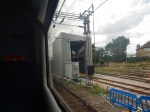



With the Automatic Vehicle Inspection System (AVIS), Chingford is becoming more than a stabling facility.
Note the large maintenance structure, so that trains can be worked on in the dry.
A Few Questions Of My Own
I have a few of my own questions.
If The Thirty Four-Car Trains For West Anglia Routes Are Converted To Eight-Cars, What Happens To The Spare Driving Motor Cars?
If the thirty four-car trains are converted to fifteen eight-car trains, it appears to me that Bombardier could have at best many of the long-lead components for thirty Driving Motor Standard (DMS) cars. At worst, they would have thirty DMS cars for Class 710 trains.
But London Overground will have need for a few more trains in a few years.
In Increased Frequencies On The East London Line, I showed this London Overground table of improvements.
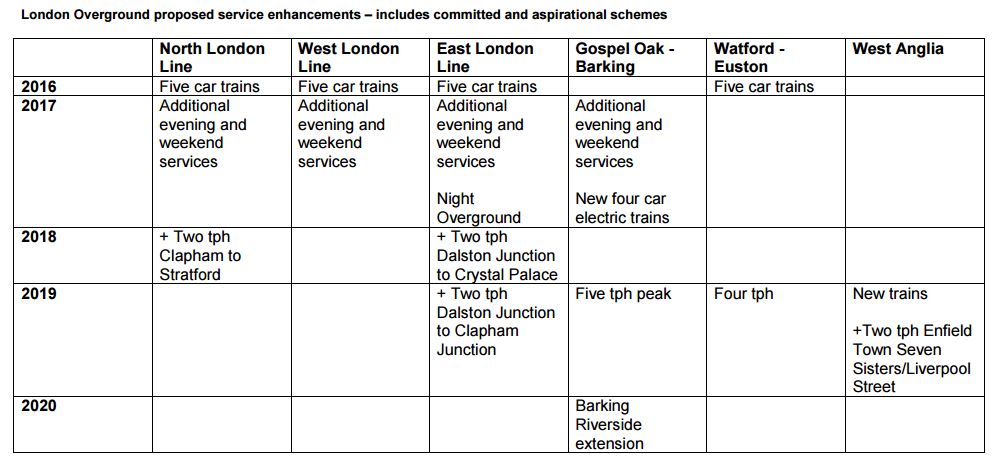
LO Improvements
Note that two extra tph are proposed on the Liverpool Street to Enfield Town service. I calculate, that this would need another two Class 710 Trains.
Similarly, to add two tph to the Liverpool Street to Cheshunt service, would appear to need another three trains.
The Mayor is also looking favourably at creating the West London Orbital Railway.
I estimate that the two proposed routes would need around four trains each to provide a four tph service, if they could be run using dual-voltage Class 710 trains with a range of perhaps ten miles on battery power.
What Is Happening About The Hall Farm Curve?
I heard from someone, who should know, that the Hall Farm Curve and the Coppermill Curve will be reinstated.
These curves would allow the following.
- A direct service between Chingford/Walthamstow and Stratford.
- Better access to the upgraded stabling at Chingford.
But I think these curves would be invaluable in maintaining services, during the construction of Crossrail 2.
Will A Bay Platform Be Developed At Lea Bridge Station?
I also wonder if a bay platform will be developed at Lea Bridge station, which would enable a four tph service to be run between Lea Bridge and Chingford stations, if Chingford Branch trains couldn’t get into Liverpool Street station, because of construction works.
I certainly feel that the curves connecting the lines at Coppermill Junction will have a major part to play in the development of East London’s railways.
Will London Overground Procure Some Class 230 Trains?
Transport for London has a cash flow problem caused by various factors.
- The reduction in grant from Central Government.
- A fall in bus revenue caused by traffic congestion.
- The freeze of fares by the Mayor.
- The need to add services to stimulate much-needed housing.
This article in Rail Magazine is entitled Vivarail’s D-Trains Confirmed For Bedford-Bletchley.
As West Midlands Trains have now confirmed the order for the Class 230 trains, does this mean that buying Vivarail’s innovative refurbished London Underground D78 Stock, is now a less-risky train purchase?
Battery Or Diesel Class 230 Trains?
Would Transport for London buy a diesel or battery version of the Class 230 train?
Transport for London will have an exclusively electric fleet in a few months, when they have passed the Class 172 trains to West Midlands Trains.
I can’t believe they’d want to buy a small number of diesel trains, so I suspect they’ll go for battery versions.
Advantages Of Class 230 Trains For Transport for London
The trains must have advantages for Transport for London.
- They are simple trains, built for remote servicing.
- In some applications, their short length of just two cars must help, in that expensive platform extensions will not be needed.
- I would suspect that one two-car train is designed to rescue another.
- Capacity can be increased by adding a third-car.
- Transport for London must also have a lot of expertise on how to get the most out of these trains.
Possible Routes
There are a handful of possible routes.
Greenford Branch Line
The Greenford Branch Line must be a prime candidate for running with two-car battery version of a Class 230 train.
Consider.
- Using a four-car train, like a Class 710 train would require the platform at Greenford to be lengthened.
- A Class 230 train would only need some form of simple electrification at Greenford and/or West Ealing stations.
- Class 230 trains, would probably fit all platforms easily and give level access for wheelchairs and buggies.
- Could London Overground’s third-rail engineers add suitable electrification to charge the batteries at Greenford station?
- The branch is only four kilometres long.
- The branch only has the two tph passenger service and the occasional freight train.
- All trains use the new bay platform at West Ealing station.
One train could obviously work the current two trains per hour (tph) timetable, but could two trains and a possible spare run a four tph service on the branch?
The advantages of using Class 230 trains over a more conventional approach using perhaps Class 710 trains would include.
- No electrification of the branch.
- No platform lengthening and possibly little platform modification.
- Only a short length of third-rail electrification would be needed to charge the batteries.
- A four tph service might be possible.
The big advantage would be that it would be a low-cost project.
Romford To Upminster Line
The Romford To Upminster Line is currently run by a single four-car Class 315 train, which was to be replaced by a new Class 710 train.
In the March 2018 Edition of Modern Railways, whilst discussing nine more Class 71 trains for the London Overground, it is said, that a Class 315 train will be retained for the Romford To Upminster Line.
Why not procure another Class 230 train and use that to shuttle along the branch?
Consider.
- The electrification can be removed from the line, to save maintenance costs.
- A short length of third-rail electrification can be used to charge the batteries at Upminster station.
- The trains could be stabled at Upminster Depot.
The line used to have a short passing loop between Romford and Emerson Park station, that could be long enough for a two-car Class 230 train. If this loop were to be reinstated without electrification, if might allow a four tph service.
It would be another low-cost project.
Bromley North Line
The Bromley North Line is currently served by Southeastern.
Reading Wikipedia for the line, I get the impression, that the line isn’t a major problem, but there are little annoyances.
- Services are not frequent enough at some times of the day and week.
- Connection to services to and from London aren’t always convenient.
- It is not the easiest branch to provide with trains and drivers.
In addition, Southeastern would appear to be amenable to pass the line to Transport for London.
The track layout for the line has the following characteristics.
- Double-track throughout.
- There is a single platform at Grove Park station.
- There are two platforms at Bromley North station.
- The intermediate station; Sundridge Park has two platforms.
It looks like the line was designed so that two trains can operate simultaneously.
- Two Class 230 trains could run a four tph service.
- Stabling and servicing could be in Bromley North station.
- Trains could be third-rail or battery.
- A spare train could be held ready if it was felt needed.
It would be a self-contained low-cost solution.
Epping To Ongar
The Epping to Ongar service on the Central Line is no more, but would it be viable now with a Class 230 train?
Brentford Branch Line
The Brentford Branch Line has been proposed for reopening.
Class 230 trains powered by batteries would be ideal rolling stock.
The trains would be charged in Southall station.
West London Orbital
This article on Global Rail News is entitled Commitment To West London Orbital rail line.
This is said.
A press release distributed by the office of London Mayor Sadiq Khan said: “This new line, delivered through TfL, the West London Alliance, boroughs and Network Rail, could potentially support the delivery of an additional 20,000 homes, as well as employment growth in west London.”
In this article on Ian Visits, this is said about the service on the proposed West London Orbital line.
Phase 1: 4 trains per hour from West Hampstead to Hounslow, calling at West Hampstead, Cricklewood, Neasden, Harlesden, OOC, Acton Central, South Acton, Brentford, Syon Lane, Isleworth, Hounslow.
Phase 2: additional 4 trains per hour from Hendon to Kew Bridge, calling at Hendon, Brent Cross/Staples Corner, Neasden, Harlesden, OOC, Acton Central, South Acton, Kew Bridge.
The track is all in place and with a new bay platform at Hounslow, Class 230 trains could work Phase 1 on batteries with ease.
The key to the intermediate stations is property development. At Neasden, Harlesden and Old Oak Common, there is a lot of spare land around the Dudding Hill Line, where the trains will run. Developers will be told to build an appropriate amount of housing with a new station underneath.
The West London Orbital could be built to the following specification.
- No full electrification.
- Battery trains.
- Platforms long enough for four-car Class 710 trains.
- Bay platforms with possible charging at West Hampstead, Hendon, Hounslow and Key Bridge stations.
- Four tph on both routes.
It lends itself to a very efficient way of building the railway.
- Build a platform on the freight line through West Hampstead Thameslink station.
- Build a bay platform that will accept a four-car train at Hounslow station.
- Establish a four tph shuttle service between West Hampstead Thameslink and Hounslow stations calling at Acton Central, South Acton, Brentford, Syon Lane and Isleworth.
- Stations could be built at Neasden, Harlesden and Old Oak Common, where there is a generous amount of brownfield land, with lots of space for housing above the tracks and platforms.
Note.
- Batteries would be charged between Acton Central and Hounslow using the existing third-rail electrification.
- About five miles of the route would not be electrified.
- Housing developments on top of a station are a property developers dream.
The service could be started using Class 230 trains, with the option to switch to four-car Class 710 trains, powered by batteries, when more capacity is needed and Bombardier have fully developed the battery Aventra.
Phase two of the project would need development of platforms at Hendon and Kew Bridge stations.
The beauty of the West London Orbital, is that the only costs for Transport for London are four new platforms, some track-work and a fleet of new trains.
Hopefully, the development of the intermediate stations would be down to property developers, as they will make a fortune out of the housing!
Conclusion
I think the answer to my original question posed in the title of this post is Yes!
A Heritage Class 315 Train For The Romford-Upminster Line
The Romford To Upminster Line is slated to get a brand-new Class 710 train to work the two trains per hour shuttle.
This article in London Reconnections, which is entitled More Trains for London Overground: A Bargain Never to be Repeated, says that it is possible that this line could be served by a Class 315 train, held back from the scrapyard.
This would mean a new Class 710 train could be deployed elsewhere, where its performance and comfort levels would be more needed.
Surely, a single Class 315 train, would be enough capacity for the line and a lot cheaper than a new Class 710 train! Provided of course, that it was reliable, comfortable and could maintain the current service.
A Heritage Unit
Why not market the train, as an updated heritage unit?
- It could be painted in British Rail livery from the 1980s.
- It would have wi-fi!
- It might have an information car, describing the history of the line and the area.
- It might even have a coffee kiosk!
It would be very much a quirky train to asttract regular passengers and even tourists.
But of course, it would be run as professionally as any other train on the network.
An Educational Purpose
I feel strongly, as do many in education, that not enough people are choosing subjects like engineering as a career.
Could it be used to show that engineering and particularly rail engineering could be a worthwhile career move?
Surely, it could also be used for training staff!
A Technology Or Capability Demonstrator
Eversholt Rail Group own sixty-one of these Class 315 trains, which although they are nearly forty-years old, don’t seem to feature much on BBC London’s travel reports.
They are reportedly destined for the scrapyard, but if they were to show they could still perform after a refurbishment, they might find a paying application somewhere.
Research
Regularly, innovations are suggested for the railway, but often finding somewhere to test them can be difficult.
However, as the Romford to Upminster Line is an electrified single-track line without signalling, the line is about as simple as you can get.
So supposing a company wanted to test how a sensitive electronic instrument behaved on a moving vehicle, this could be done without any difficulty.
Conclusion
If it is decided that a Class 315 train is to be used on the Romford to Upminster Line, I believe that the service could be marketed as a quirky heritage unit, that in conjunction with its main purpose of providing a public service, could also be used for other education, training, marketing, innovation and research purposes.
Eversholt Rail Group might even shift a few redundant Class 315 trains!
Could The Romford To Upminster Line Handle Four Trains Per Hour?
If you look at the current version of this page on Transport for London’s web site, which is entitled Track Closures Six Month Ahead, you will notice that there are the following closures on the Romford to Upminster Line.
- Sunday May 28th to Monday May 29th 2017.
- Sunday Aug 27th to Monday August 28th 2017.
- Saturday Oct 21st to Sunday October 22nd 2017.
It could be a periodic closure for track or station maintenance as the three closures are three months apart, but I’ve noticed closures on this line before.
I’ve also searched the Internet and can find no references to any ongoing work or improvements on the line or the intermediate station at Emerson Park..
But the entries got me thinking about whether services could be improved on this line.
Various factors will come into play.
The Crossrail Affect
From May 22nd 2017, the new Class 345 trains will start running through Romford station on Crossrail‘s initial service between Liverpool Street and Shenfield stations.
How will Crossrail affect usage of the Romford to Upminster Line?
A lot of journeys from c2c territory in South East Essex will be quicker or easier using Crossrail and the Romford to Upminster Line.
I’ll give Southend to Heathrow as an example.
c2c’s Ambitions
It should also be pointed out that c2c are an ambitious company with new Italian owners and I think they will add new destinations and routes to their network.
I can see a lot of commercial and residential property being built along the North Bank of the Thames at Tilbury and London Gateway.
But if c2c have a problem, it is that it has good connections to the City of London at Fenchurch Street station, but getting to some parts of London like Euston, Kings Cross, the West End and Heathrow Airport is not easy.
There are good onward connections across the City at Barking, Limehouse and West Ham stations, which will be improved with the electrification of the Gospel Oak to Barking Line.
c2c To Liverpool Street
c2c use Liverpool Street station at occasions on Saturdays and Sundays and I have read that they would like to open a second London terminal at Liverpool Street, as this would also allow services to serve Stratford station with the Eastfield Shopping Centre and the Olympic Park.
But I can’t see Greater Anglia and London Overground allowing another operator into the crowded Liverpool Street station.
Could c2c Have Direct Access To Romford?
In an ideal world, where the Romford to Upminster Line would be double-tracked feeding into adequate bay platform or platforms at Romford station, c2c would be able to run a direct service between Romford and Grays stations via Upminster, Ockendon and Chafford Hundred Lakeside, if they felt the service would be worthwhile.
It is one thing to run a four-car shuttle between Romford and Upminster, but look at this Google Map of Upminster station.

Note.
- The c2c lines are South of the District Lines.
- The Romford to Upminster Line goes off to the North-West.
A c2c train going between Romford and Grays would have to cross the busy District Lines, that terminate at Upminster station.
It would probably be possible, but only with the great expense of a massive fly-over or dive-under.
c2c’s Best Access To Crossrail
I would think that c2c’s best access to Crossrail would lie in a frequent service along the Romford to Upminster Line. The current two trains per hour is not enough, so could the branch handle three or even four trains per hour?
The Current Service On the Romford To Upminster Line
The single Class 315 train, that I saw today trundles along at 60 kph and takes a total of nine minutes to go between Romford and Upminster. Turnroumnd at Romford and Upminster take eight and four minutes respectively.
The single train does a round trip in thirty minutes, so it easily does two round trips in an hour.
Emerson Park Station
I went to Emerson Park station this afternoon to see if there was any evidence of improvements.
I found the following.
- The catenary appears to have been given a good refurbishment.
- The station has been tidied up.
- The station is now staffed.
- CCTV is being installed.
- An office is being built.
- New hand-rails are being fitted.
- The station couldn’t accept a train longer than four-cars.
I got the overall impression that London Overground are expecting a lot more passengers to be using Emerson Park station. Wikipedia says this about passenger usage at the station.
It has relatively low but fast-growing patronage for a suburban railway station, with 260,000 passenger entries/exits in 2015/16, compared to 82,000 five years prior and just 32,000 ten years prior.
Given the platform length restriction and the convenience of passengers, I am led to the conclusion that a higher frequency of trains would be beneficial to passengers and operator alike.
How Fast Could An Aventra Travel Between Romford And Upminster?
If you look at a typical three station run on the Overground, such as Dalston Junction-Haggerston-Hoxton, it can tqke between three and five minutes in a Class 378 train, which is probably marginally slower than the new Aventra.
But that is only part of the time, as the driver of the train has to change ends between trips. I walked the length of a Class 378 train today and it took me a minute, so with a well-designed cab and some degree of automation, I suspect that a driver could safely change ends in under two minutes.
As the Aventra will be optimised for fast trips like these, I can see no reason, why a train can’t travel between Romford and Upminster in seven minutes.
Conclusion
A seven minute trip would mean the train could perform the required four trips per hour.
One major problem would be if say there was an incident on the train, like a passenger becoming seriously unwell. The driver would call the emergency services and proceed to the next station. After dealing with the emergency and perhaps seeing the passenger safely in the care of paramedics, the driver would resume the timetable. As there is only one train on the line at all times, service recovery is just a matter of restarting.
c2c Signs The First Deal On Porterbrook’s Class 387 Trains
This article on Global Rail News is entitled C2c signs short-term lease for Class 387 EMUs to cope with “unprecedented” demand, which tells how c2c have decided to go for a stop-gap lease of six of the twenty Class 387/1 trains, that were ordered by Porterbrook, when they saw a gap in the market.
c2c’s Future Fleet Plans
At present c2c has a one-class fleet of seventy-four Class 357 trains, which I think are leased from Porterbrook. These trains, like the Class 387 trains, are Electrostars. Wikipedia, also says this about c2c’s future fleet.
As part of its new franchise, c2c has committed to leasing new trains to cope with rising passenger numbers, which were boosted especially by the opening of the DLR station at West Ham in 2011 and the rise of Canary Wharf as a financial centre, 17 new four-car trains will be introduced by 2019, followed by 4 more by 2022 and 4 more by 2024.
This would bring the fleet up to one short of a hundred four-car trains.
One curiosity about the Class 357 trains is that they are 100 mph units, but the maximum line speed of the London, Tilbury and Southend Railway is only 75 mph. So any new trains will have to be 100 mph units, in case the line speed is increased.
The Global Rail News article says this.
Porterbrook Leasing will supply 24 new Bombardier-built Class 387 carriages on a three-year lease. In November 2015, Porterbrook announced it would be ordering 80 additional Class 387 EMUs to meet the increasing demand for electric rolling stock.
The timing of delivery in the Autumn of this year fits, as Bombardier will have finished building the Class 387/2 trains for Gatwick Express.
The Class 387 trains will certainly do the job in the short term, but running a 110 mph train on a line with a maximum speed of 75 mph in the long term, might not be the best use of resources.
The Crossrail Effect
c2c has a problem in that, when Crossrail opens fully to Shenfield in 2019, this will mean that a lot more places will be easily accessible from South East Essex by changing to Crossrail.
But c2c has no easy connection to the new line.
- At Fenchurch Street, you could walk to Liverpool |Street.
- At West Ham, you could take the Jubilee Line to Stratford or Canary Wharf.
- At Upminster, you could take the Romford and Upminster Line to Romford.
- At Southend Central, you could walk to Southend Victoria and get a train to Shenfield.
To make matters worse, the current time of 65 minutes between Southend Central and Canary Wharf, could possibly be challenged by an improved link from Southend Victoria to Shenfield for Crossrail.
It all depends, where you want to go at the London end.
c2c must be thinking hard about how to improve their services.
I believe they’ll be looking at all or some of these.
- New services to and from new stations.
- Use of London-style contactless ticketing.
- Faster train services, making more use of the 100 mph capability of the trains.
- A viable link to Crossrail.
Whoever, is the operator to Southend Victoria will be doing the same.
It strikes me that the major winners will be passengers going between South East Essex and London.
Electrostar Or Aventra?
I wonder, if the extra train buying for c2c will follow a similar pattern to the London Overground.
The Overground has got a total of 57 Class 378 trains, which like c2c’s are Electrostars, but are ten years younger and five-cars.
I thought, when it was announced that Bombardier had won the order for more trains for the Overground to serve the Lea Valley Lines and Gospel Oak to Barking Line, that it would be more of the same Class 378 trains.
But London Overground added a fleet of Class 710 trains from the new Aventra family.
The Electrostar and the Aventra are both four-card electric multiple units and I suspect once inside, the average passenger won’t notice much difference, but under the skin, the Aventra will be a more efficient train.
Aventra IPEMUs For c2c?
One of the advantages of an Aventra over the Electrostar, is that the trains are wired to be fitted with on-board energy storage. The main reasons for fitting this and making the train an IPEMU include.
- Saving energy by enabling regenerative braking. Not needed as the lines are already enabled.
- Simplifying overhead wiring in depots. Only needed if the existing depots need to be extended.
- Running trains on branch lines without electrification. Not needed unless c2c opens new services to places like London Gateway and Tilbury Riverside.
Running services to London Gateway could be the clincher, as to whether Aventras with an IPEMU-capability are ordered.
I have a feeling that a few miles closer to London, that London Overground will be using similar Aventra IPEMUs to enable the new Barking Riverside Extension to be built without electrification. I wrote about this in Defining The GOBlin Extension To Barking Riverside.
Aventra IPEMUs could run the following route.
- The service would start on the current line to London Gateway, which is not electrified, at a new station, serving the important port and logistics area.
- After calling at East Tilbury, it would serve Tilbury Riverside, by reopening the old branch as a line without electrification.
- It would then use the existing line through Tilbury Town and Grays, before going to Upminster via the line through Chafford Hundred Lakeside.
- After stopping at Upminster, it would use the Romford to Upminster Line, to continue to Romford.
I would estimate that London Gateway to Romford via Tilbury Riverside would take under the hour and four trains could be needed to run a two trains per hour service.
Note the following.
- The Aventra IPEMUs would run normally on the electrified parts of the route, charging their on-board energy storage along the way.
- On the branches without electrification, trains would run on their stored energy.
- This service would connect London Gateway to Heathrow Airport via Crossrail and to Felixstowe via the Great Eastern Main Line.
- A service could be run from Shoeburyness and Southend to Romford, which would not need IPEMUs.
- The service to Romford also give c2c’s network a much-needed link to Crossrail.
- Calling at Tilbury Riverside would be for the cruise ships at the London Cruise Terminal and the Gravesend-Tilbury Ferry
- Calling at Chafford Hundred Lakeside would connect the Lakeside Shopping Centre to Crossrail.
- London Overground would lose responsibility for the Romford to Upminster Line.
- There would be some track adjustments at Upminster, but there would be no need to electrify the two new branches.
Given that the route connects several important commercial, leisure and housing areas, I think it could become a route, that exceeded its expectations, by a long way.
The one problem could be in linking the single track from Romford to Upminster to the single track through Chafford Hundred Lakeside.
Trackwork At Upminster
This Google Map shows Upminster station.
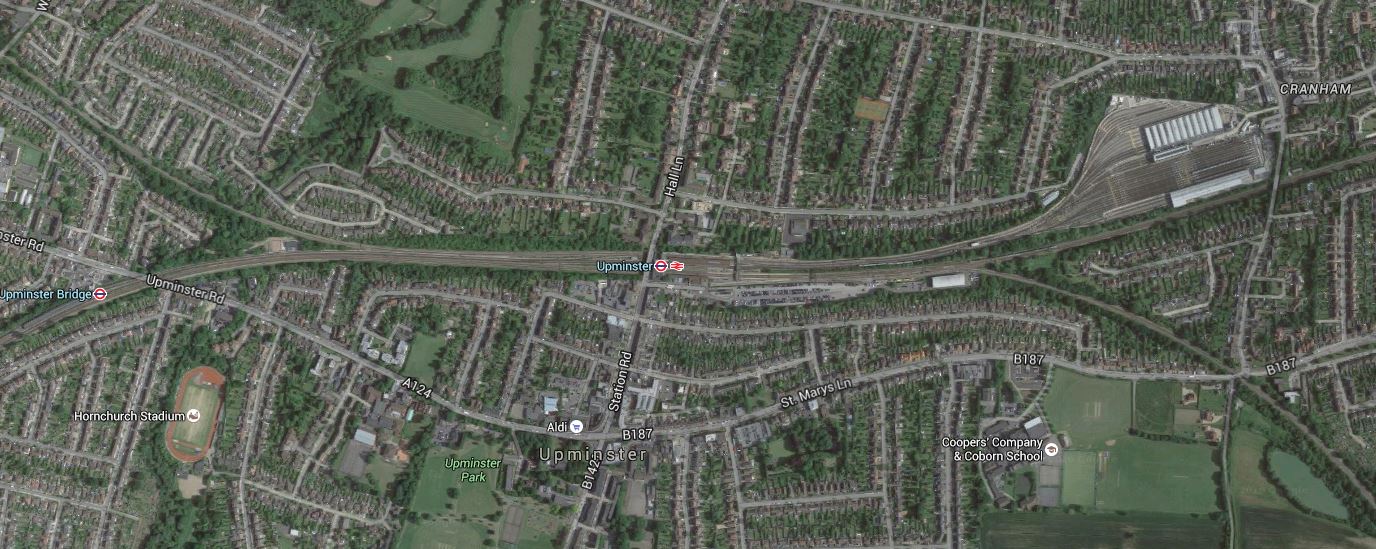
Upminster Station
Note.
- The line to Chafford Hundred Lakeside going off to the South East.
- The line to Romford going off to the North West.
- London Underground’s Upminster Depot to the North East of the station.
- The Romford to Upminster Line comes into a platform at the North side of the station.
I suspect that engineers have methods to get trains across the London Underground lines in a flat junction without building an expensive viaduct.
Conclusions
Obviously c2c have a plan for their new trains and extra services, all over South-East Essex. All will be revealed in the next few years!
But I do think that the Romford to Upminster Line is more use to c2c, than as an isolated single-train outpost for the London Overground.
I also think that the local authorities and the people of the area, would all like to see Crossrail, Lakeside Shopping Centre, London Cruise Terminal, London Gateway, Romford, Southend and Upminster connected together by frequent electric trains.
Aventra IPEMUs would enable the two new branches to London Gateway and Tilbury Riverside, to be added without electrification.
 The Anonymous Widower