SeaTwirl AB Signs Agreement To Explore Ehe Feasibility Of Electrification Of Aquaculture In Chile
The title of this post, is the same, as that of this press release from SeaTwirl.
This is the sub-heading.
SeaTwirl AB has entered into an agreement to carry out a feasibility study for electrification of fish farms together with a global industrial supplier. The intention of the collaboration is to assess the use of SeaTwirl’s floating vertical-axis wind turbines to provide renewable electricity to offshore-based equipment at aquaculture assets in Chile.
These three paragraphs add more details.
The feasibility study will cover a comprehensive scope, including energy demand and power system requirements, environmental site conditions, cost assessments, supply chain opportunities, and logistics in Chilean waters with the intention to reduce dependence on diesel. The study is expected to be completed during 2026, and the results will help determine next steps.
Chile is home to one of the largest aquaculture industries in the world, and the sector is pursuing ambitious sustainability goals including lower emissions, increased use of renewable power and reduced risk of spills. While the contractual value of the agreement is limited, at approximately SEK 0,8 million, the engagement will generate revenue and represent an important step in SeaTwirl’s commercialization effort.
“This collaboration marks an exciting step towards our purpose to enable floating wind power wherever it is needed, and to expand the use of floating wind technology beyond traditional grid-connected applications. The aquaculture industry has a clear need for offshore renewable energy, and we believe our technology can deliver a robust and cost-effective solution. It is also a major milestone to become involved in the southern hemisphere where many of the challenges we try to address, such as limited availability of cranes, vessels, and yard infrastructure, may be more challenging than in the north. We see significant potential in the aquaculture segment and look forward to beginning this journey in South America”, says Johan Sandberg, CEO of SeaTwirl.
I do find it strange, that the two vertical wind turbines, that both seem to be more than prototypes are both Scandinavian.
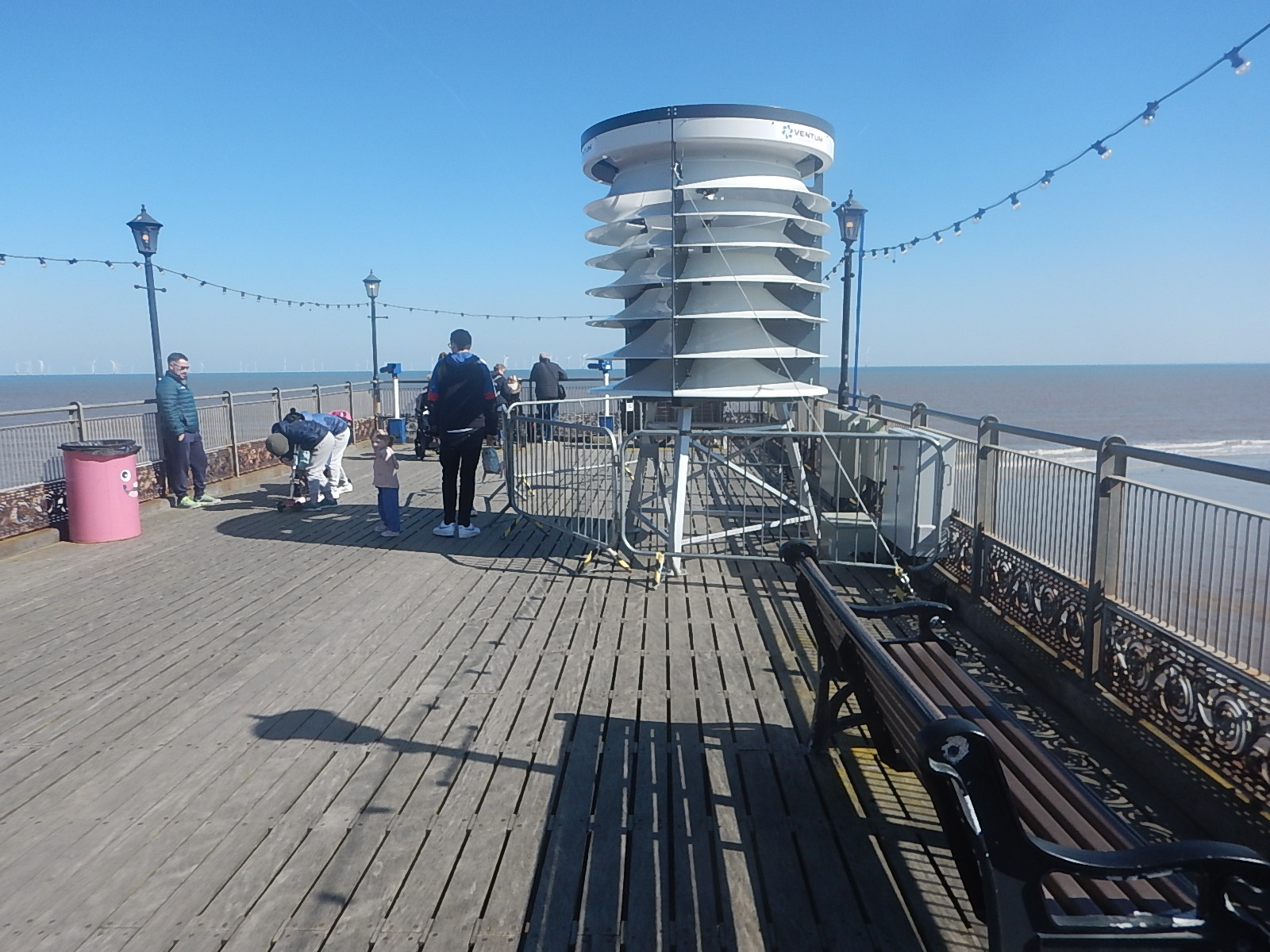
The Ventum Dynamics turbine, that I talked about in Are These Turbines An Alternative To Solar Panels? is Norwegian and this one is installed on Skegness Pier.
IKEA could sell these for DIY-enthusiasts to assemble and erect. On my stud, I used to have a barn, that could certainly have taken two of these 1.5 KW VX175 turbines.
This link is video of a dancing and swimming SeaTwirl.
If you follow, the SeaTwirl video to its conclusion, you’ll see one being erected in the sea. I can assure you that in the 1970s, my 25-year-old self, did the calculations for a reusable oil production platform called a Balaena, which erected on the same principle. So, I’m fairly certain, that SeaTwirls can be an alternative to traditional wind turbines.
SeaTwirl Partners With Local Firm To Bring Vertical-Axis Floating Wind Turbine To Japan
The title of this post, is the same as that of this article on offshoreWIND.biz.
This is the sub-heading.
Sweden-based SeaTwirl has signed a Memorandum of Understanding (MoU) with Sumitomo Corporation Power & Mobility (SCPM) to promote its vertical-axis offshore floating wind turbine in the Japanese market.
These two paragraphs detail the responsibilities.
Under the MoU, SCPM will be responsible for identifying, marketing, negotiating, and contracting potential clients.
The Swedish company will be in charge of promoting and offering the products and services to potential clients.
Note.
- In SeaTwirl And Verlume Join Forces To Drive Decarbonisation Of Offshore Assets, I talk about their MoU with Verlume.
- In SeaTwirl, Kontiki Winds To Explore Powering Oil & Gas Assets With Floating Wind, I talk about their MoU with Kontiki Winds.
SeaTwirl either likes using Memoranda of Understanding (MoU) or their technology is very good.
The article says this about the applicability of SeaTwirl to Japanese waters.
Japan has over 4,000 islands, and according to the Global Wind Energy Council (GWEC), it has approximately 128 GW of fixed-bottom offshore wind potential and 424 GW of floating offshore wind potential.
SeaTwirl said that its vertical-axis wind turbine is well-suited for the conditions in the Japanese offshore environment with its robust and flexible design and high serviceability.
That certainly looks to be a good match and I wonder, if this could end up as a three-way co-operation, with the inclusion of Verlume’s underwater batteries.
Will SeaTwirl and Sumitomo target other island nations or those with lots of islands like Croatia, Greece, the Caribbean, Italy, Micronesia and the Philippines?
SeaTwirl And Verlume Join Forces To Drive Decarbonisation Of Offshore Assets
The title of this post, is the same as that of this article on offshoreWIND.biz.
This is the sub-heading.
Swedish energy-tech company SeaTwirl and UK-based energy management and energy storage firm Verlume have signed a memorandum of understanding (MoU) to collaborate on the electrification of offshore assets and decarbonisation of the oil and gas industry.
This is the first two paragraphs.
The MoU will see the two companies identify and pursue potential opportunities for decarbonisation of offshore oil and gas and other associated offshore electrification opportunities using renewable energy, seabed-based energy storage, and intelligent energy management.
SeaTwirl and Verlume plan to develop systems for commercial sale, using combined technologies.
Note.
- This YouTube video introduces SeaTwirl.
- This YouTube video introduces Verlume.
This could be an MoU made in engineering heaven.
Verlume And Wave Power
The last two paragraphs of the article describe another project involving Verlume.
Aberdeen’s intelligent energy management specialists Verlume has developed a GBP 2 million (approximately USD 2.5 million) project linking the Blue X wave energy converter constructed by Mocean Energy with a Halo underwater battery storage system.
The industry-supported project, situated five kilometres east of Orkney Mainland, demonstrates the integration of green technologies to deliver consistent and sustainable low-carbon power and communication to subsea equipment.
Could Verlume, be the missing link that wave power needs?
SeaTwirl, Kontiki Winds To Explore Powering Oil & Gas Assets With Floating Wind
The title of this post, is the same as that of this article on offshoreWIND.biz.
This is the sub-heading.
The Sweden-headquartered SeaTwirl has signed a Memorandum of Understanding (MoU) with Kontiki Winds to identify and discuss the opportunities to electrify oil and gas assets and other offshore applications, with the use of SeaTwirl’s floating wind turbines.
And this is the first paragraph.
Under the MoU, the two companies will explore new opportunities in the market to implement offshore wind into new and existing oil and gas assets and microgrid applications such as the powering of fish farms, desalination plants and/or other small-scale applications that currently are based on fossil fuel electricity generation.
Note.
- The current turbines are only 1 MW.
- They appear to be mounted on a long monopole foundation.
- My mathematical modelling experience suggests to me, that these could be very stable devices.
- I suspect they could be built into specialist equipment like a buoy with a light to mark something.
I suspect that there will be large numbers of applications, especially if the manufacture and installation of Sea Twirl’s turbines is an efficient process.
Zero-Carbon Lighting Of Large Spaces
In Cockfosters Train Depot – 12th January 2023, I took a series of pictures of Cockfosters Train Depot, of which these are a selection.




Note, the lamp clusters on top of tall poles to light the area.
You see lots of these lights to illuminate play areas, car parks, rail sidings and truck depots.
Could a SeaTwirl or another vertical wind turbine be placed as high as possible up the pole, that supports the lights?
- A battery would be needed for when the wind doesn’t blow.
- A control system would be used to use the lights, when they are needed.
- The poles would be able to be laid down, like many lights can be, for servicing from the ground.
Cockfosters would be an excellent location for a test, as the wind is always blowing and the site has an altitude of nearly a hundred metres.
The Ultimate Bus Stop
London has very comprehensive bus stops as these pictures show.








Note.
- Most bus stops have a pole mounted roundel, that can be seen from a reasonable distance. In many cases, anybody with reasonable sight can see the roundel for the next stop.
- Where space permits, bus stops have a shelter with seats, maps and instructions on ticketing.
- Some stops have been extended into the road, so that it is a level step into and out of the bus.
- As shown in the pictures, so bus stops have displays showing the next ten buses, that will be arriving.
But I do think, they could be improved, with extra features.
Internet Connectivity
I feel strongly, that all bus stops should have good internet connectivity.
This could be 4G, 5G or just wi-fi, but I believe this could help with the safety of people on the street.
Comprehensive Lighting
To contribute to safety, I also feel that all bus stops should be well lit.
CCTV Issues
I also feel that all bus stops should have provision for CCTV, so if there was a need, it could be quickly fitted. But if the bus stop had good internet connectivity, then this shouldn’t be a problem.
Phone Charging
New buses have this feature, so why not at the stops?
Power Supply Issues
If we add all these features, we could be needed an uprated power supply.
- So could we see bus stops, with solar panels on the roof.
- Perhaps even a mini wind turbine?
- I think a vertical wind turbine, which was similar to a SeaTwirl, but smaller, could be ideal!
- Could it be called a StreeTwirl?
- A self-powered bus could be created with the addition of a battery.
Self-powered bus stops might be easier to install.
Conclusion
Bus stops will have more features in the future.
Another Renewable Power Idea From Sweden
I have posted some ideas from Sweden on this blog including.
- H2 Green Steel – H2 Green Steel Plans 800 MW Hydrogen Plant In Sweden
- HYBRIT – Sweden’s Grand Plan To Make Zero-Carbon Steel
- Minesto – Is This The World’s Best Renewable Energy Video?
- TwinHub – Hexicon Wins UK’s First Ever CfD Auction For Floating Offshore Wind
And now there’s the SEATWIRL, which the company says is the future of offshore wind.
In the Areas Of Use, there is a section with a heading of SeaTwirl For Niche Markets, where this is said.
SeaTwirl has now identified markets where wind turbines of the size of 1 MW can meet a clear market demand and sees a possibility to build a business aimed at these niche markets in parallel with its main target. That can mean revenues for the company sooner than was originally planned.
The niche markets that have been identified are islands and remote seaside villages, fish farms and desalination plants. These are business and places that today are run mainly on electricity from diesel generators, which is both expensive and emits CO2.
One of the places I would use these turbines, is on the apex of four-beam steel portal frame buildings. The original concept for these buildings had been developed at Cambridge University during World War Two and one of the team, had set up a business in Warwickshire, constructing these buildings for barns, factory units and other purposes.
He had programmed a simple computer program, which he ran on a time-shared computer system. I was hired to improve the computer program.
What surprised me was the strength of these buildings and I believe they could support vertical turbines like SeaTwirl along the apex.
I feel there are many other applications, especially if they are designed to be part pf a bigger system.
Conclusion
I like the concept of SeaTwirl.
 The Anonymous Widower