Rolls-Royce Supplies mtu On-Board Power Generators For Baleària’s Electric Ferries On The Route Between Europe And Africa
The title of this post, is the same as that of this press release from Rolls-Royce.
These are the three bullet points.
- Eight mtu emergency power generators ensure power supply on two fully electric, emission-free fast ferries operated by the shipping company Baleària
- Over 11,000 kW total output as backup for electric operation
- To be used on the route between Tarifa (Spain) and Tangier (Morocco) starting in 2027
These are the first two paragraphs.
Rolls-Royce’s Power Systems division is supplying a total of eight mtu emergency power generators for two fully electric fast ferries belonging to the Spanish shipping company Baleària. From 2027, the ships will cover the 18 nautical miles between Tarifa in Spain and Tangier in Morocco using electric power, thereby opening up the first “green corridor” between Europe and Africa.
The project is considered a milestone for CO2-neutral mobility at sea and is supported by an international network of partners consisting of shipping companies, shipyards, port authorities, energy suppliers, and other companies.
Note.
- The route is only 18 nautical miles.
- Each ferry can accommodate 804 passengers and 225 cars.
- The ferries have a cruise of 26 knots.
- The project is considered a milestone for CO2-neutral mobility at sea.
- Each ship will have an installed power of 11,000 kW on both electric and diesel.
- They should go into service in 2027.
I know little about ships, but these look to be the business and I can see them sneaking silently into ports everywhere.
But AI might, so I’ll ask a few questions.
How Will Baleraia’s New Fast Ferries Handle Rough Weather?
This was replied.
Baleària’s new fast ferries, such as the Eleanor Roosevelt and Margarita Salas, incorporate advanced stabilization and hull systems designed to improve comfort and reliability in adverse sea conditions. However, as with all maritime transport, sailings can still be cancelled or delayed due to severe weather for safety. reasons.
It certainly looks like the Spaniards are going for it.
SNP Ban On ‘Munitions’ Funds Puts Scottish Shipbuilding On The Line
The title of this post is the same as that of this article on The Times.
This is the sub-heading.
The president of Rolls-Royce submarines says plans for a world-class welding centre on the Clyde are at risk of being cancelled within days
These three paragraphs add more details to the story.
Ambitious plans to reverse a historic decline in Scottish shipbuilding are at risk after a £2.5 million taxpayer grant was axed due to an SNP ban on “munitions” funding.
A plan to build a specialist welding centre on the banks of the Clyde is now in grave doubt after Scottish Enterprise, the national economic development agency, was accused of reneging on a pledge to fund a building for the world-class facility.
Rolls-Royce, which is ready to support the project by providing £11 million worth of specialist equipment, expressed “dismay” at the news, saying the project had been classified as a “munitions” scheme solely on the basis that it would “support the construction of naval vessels”.
Given the experience of the Scottish Government in building ferries is documented in this Wikipedia entry, which is entitled Scottish Ferry Fiasco, the SNP must know something about how not to build ships.
The comments from readers of the Times Article are scathing, with many coming from those with Scottish names.
Welding And Nuclear Power
It doesn’t mention the other big use for welding in this article and that is in the manufacture of nuclear reactors. In fact one of the members of the Rolls-Royce consortium, that will build their small modular nuclear reactors is The Welding Institute – No prizes for guessing what they do!
Does that mean that Scotland won’t have anything to do with small modular nuclear reactors? Either in their manufacture or use.
This article in New Civil Engineer is entitled UK Plans New Nuclear Plant In Scotland Despite Scottish Government Opposition.
So if the Scottish Government wants nothing to do with making expensive, quality vessels for the nuclear industry, Rolls-Royce would surely be better building the welding centre in an area of the UK that would appreciate it.
Scots In High Positions Of Power
I like Scotland and the Scots and possibly, at one time, with all the North Sea Oil and Gas, I could have thought about relocating North of the Border. But I’m very glad I didn’t!
It does seem to me though, that when some Scots get to high positions of power, that they lose all sense of reason.
I would nominate.
- Fred the Shred
- The SNP
- That half-Scot, who was lucky enough to be elected US President twice.
There must be a few others.
Cummins Inc. Selected By The UK Department Of Transport For Its High-Horsepower Methanol Vessel Retrofit Project
The title of this post, is the same as that of this press release from Cummins.
This is sub-heading.
One of Only 10 Flagship Projects Chosen in the Multi-Million-Pound ZEVI Competition Enabling Decarbonization of the UK’s Maritime Sector
These three paragraphs outline the project.
Today, Cummins Inc. (NYSE: CMI) announced the selection of its proposal to jointly develop a Methanol Kit for its QSK60 engine as part of the Zero Emission Vessels and Infrastructure (ZEVI) competition, funded by the UK Government and delivered in partnership with Innovate UK. To be chosen as one of the top 10 projects, Cummins delivered a proposal to collaborate with a major UK port and operators to develop, deploy and operate clean maritime technology solutions on the path to decarbonization and reduction to the overall greenhouse gas footprint.
The £4.4M in total funding will be leveraged by Cummins and its fellow project stakeholders — Ocean Infinity, the Aberdeen Harbour Board, and Proman AG — in the deployment of a UK-designed and built methanol conversion kit for a high-horsepower marine internal combustion engine, offering the UK an important foothold in enabling the transition to cleaner maritime fuels.
Upon completion in the second quarter of 2025, the project targets a reduction in CO2 emissions of 50 percent for offshore operations of the vessel with NOx, SOx and PM at levels considerably below those emitted by conventional fuel. Furthermore, all retrofitted dual-fuel engines will achieve compliance with IMO Tier III emission standards.
They certainly aim to get a move on to complete by mid-2025.
I have some thoughts.
Methanol Fuel
The Wikipedia entry for methanol fuel, starts with this sentence.
Methanol fuel is an alternative biofuel for internal combustion and other engines, either in combination with gasoline or independently. Methanol (CH3OH) is less expensive to produce sustainably than ethanol fuel, although it produces more toxic effects than ethanol and has lower energy density than gasoline. Methanol is safer for the environment than gasoline, is an anti-freeze agent, prevents dirt and grime buildup within the engine, has a higher flashpoint in case of fire, and produces horsepower equivalent to that of super high-octane gasoline.
Methanol certainly seems to be an environmentally-friendly fuel, when compared to alternatives.
Production Of Green Methanol
This paragraph from the Wikipedia entry for methanol fuel, explains some of the routes to make green methanol.
Bio-methanol, also known as green-methanol, may be produced by gasification of organic materials to synthesis gas followed by conventional methanol synthesis. This route can offer renewable methanol production from biomass at efficiencies up to 75%. Widespread production by this route has a proposed potential to offer methanol fuel at a low cost and with benefits to the environment. Increasingly, methanol fuel has been produced using renewable energy and carbon dioxide as a feedstock. Carbon Recycling International, an Icelandic-American company, completed the first commercial scale renewable methanol plant in 2011. As of 2018, Enerkem has been producing biomethanol through the conversion and gasification of municipal solid waste at its Edmonton facility. As of July 2023, construction for the $1 billion Varennes Carbon Recycling Plant, which will produce biofuel such as methanol through non-recyclable and timber waste, is 30 percent complete.
Surely, if the C in CH3OH, which is the chemical formula for methanol, comes from captured carbon dioxide from the atmosphere or say a gas-fired power station, methanol can be a truly green fuel.
Funding Announced For First-In-Class Low-Carbon Installation Vessel For Floating Offshore Wind
The title of this post, is the same as that of this news item from Morek Engineering.
These two paragraphs outline the project.
The UK Government has awarded funding to a consortium led by Morek Engineering to design a new class of low-carbon installation vessel for the floating offshore wind market.
The consortium has won the funding through the UK Government’s Clean Maritime Demonstration Competition based on their proven track record in innovative vessel design and delivery of complex offshore operations. The consortium includes Morek Engineering, Solis Marine Engineering, Tope Ocean, First Marine Solutions and Celtic Sea Power.
Note.
- The design of the ship certainly seems to tick all the boxes.
- This is Morek’s web site.
Because of my experience of writing project management systems, I often wonder, whether some of my discarded ideas of the 1980s could be used in the deployment of floating offshore wind.
South Korean Team To Develop SMR-Powered Ships
The title of this post is the same as that of this article on Neutron Bytes.
This is the introductory paragraph.
Nine South Korean organizations have signed a memorandum of understanding (MoU) to cooperate on the development and demonstration of ships and offshore systems powered with small modular reactors (SMRs). The partners will also develop marine systems and the production of hydrogen using molten salt reactors (MSRs).
These points are listed about nuclear-powered ships.
- Over 160 ships are powered by more than 200 small nuclear reactors.
- Most are submarines, but they range from icebreakers to aircraft carriers.
- In future, constraints on fossil fuel use in transport may bring marine nuclear propulsion into more widespread use.
- So far, exaggerated fears about safety have caused political restrictions on port access.
Note.
- When as a child, I used to watch the large container ships at Felixstowe, I thought then, that they could be nuclear-powered.
- One engineering lecturer at Liverpool University in the 1960s, was talking about nuclear-powered tunneling machines.
- Rolls-Royce to name just one company must have the reactor technology.
I just wonder, when the Korean President and his wife visited the UK, just before Christmas, that nuclear-powered ships were discussed.
Lloyd’s Register Issues World’s First Rules For Hydrogen Fuel
The title of this post, is the same as that of this article on Hydrogen Central.
These are the first two paragraphs.
Lloyd’s Register issues world’s first rules for hydrogen fuel.
Liam Blackmore, Lead Specialist at Lloyd’s Register, is a busy man. He has led the technical policy writing of many of the class society’s decarbonisation rules. Horizons spoke to him in late April 2023, just a few weeks after LR had published the world’s first maritime rules covering hydrogen as a fuel.
This would appear to be a very sensible move by Lloyds Register, which sets down the rules for using hydrogen fuel on ships.
But surely, if you follow these rules, then you will able to get insurance for your ship.
Rolls-Royce Invests In Methanol Technology For Climate-Friendly Shipping
The title of this post, is the same as this press release from Rolls-Royce.
The press report starts with these bullet points.
- Rolls-Royce Power Systems to set standards in high-speed marine methanol engines
- New engines based on proven mtu technologies
- Methanol and synthetic diesel as key fuels of the future for climate-friendly engine operation
- Fuel cell another option on the way to climate-neutral ship operation
It then says this
Rolls-Royce is focusing on methanol as a fuel for climate-friendly shipping: Rolls-Royce business unit Power Systems is currently working on mtu engines for use with methanol. The new high-speed four-stroke engines, which are based on proven mtu technologies, are planned to be available to customers as soon as possible for use in commercial ships and yachts.
This paragraph gives the reasons, why Rolls-Royce is in favour of methanol.
Methanol offers a number of advantages for Rolls-Royce’s efforts to make shipping more climate-friendly and ultimately climate-neutral: The fuel can be produced in a CO2-neutral manner in the so-called power-to-X process, in which CO2 is captured from the air. The energy density of methanol is high compared to other sustainable fuels and, thanks to its liquid state, it can be easily stored and refuelled at ambient temperatures. Existing infrastructure can continue to be used in many cases. Unlike ammonia, methanol is not highly toxic and is environmentally safe. The combustion of methanol in a pure methanol engine can be climate-neutral with significantly reduced nitrogen oxide emissions, thus eliminating the need for complex SCR exhaust gas aftertreatment. Methanol tanks can be flexibly arranged in the ship and require significantly lower safety measures compared to hydrogen or ammonia. Besides the safety aspects and the lower complexity, the lower investment costs for users are a further upside of the methanol tank system.
Methanol seems to be a convenient and safe fuel, which is easier to incorporate into the marine environment, than hydrogen or ammonia.
Wikipedia says this about methanol’s use in shipping.
Methanol is an alternative fuel for ships that helps the shipping industry meet increasingly strict emissions regulations. It significantly reduces emissions of sulphur oxides (SOx), nitrogen oxides (NOx) and particulate matter. Methanol can be used with high efficiency in marine diesel engines after minor modifications using a small amount of pilot fuel (Dual fuel).
Rolls-Royce certainly seem to be keen to use the fuel. They also seem to have the technology.
Fortescue Future Industries To Convert Ship To Ammonia-Fuelled Propulsion Next Year
The title of this post is the same as that of this article on Ship and Bunker.
Andrew Forrest is at it again.
What Does 2.5 MW Look Like?
This press release on the Rolls-Royce web site is entitled Rolls-Royce Generator Delivered For Most Powerful Hybrid-Electric Propulsion System In Aerospace.
This Rolls-Royce picture shows the generator installed on a test bed.
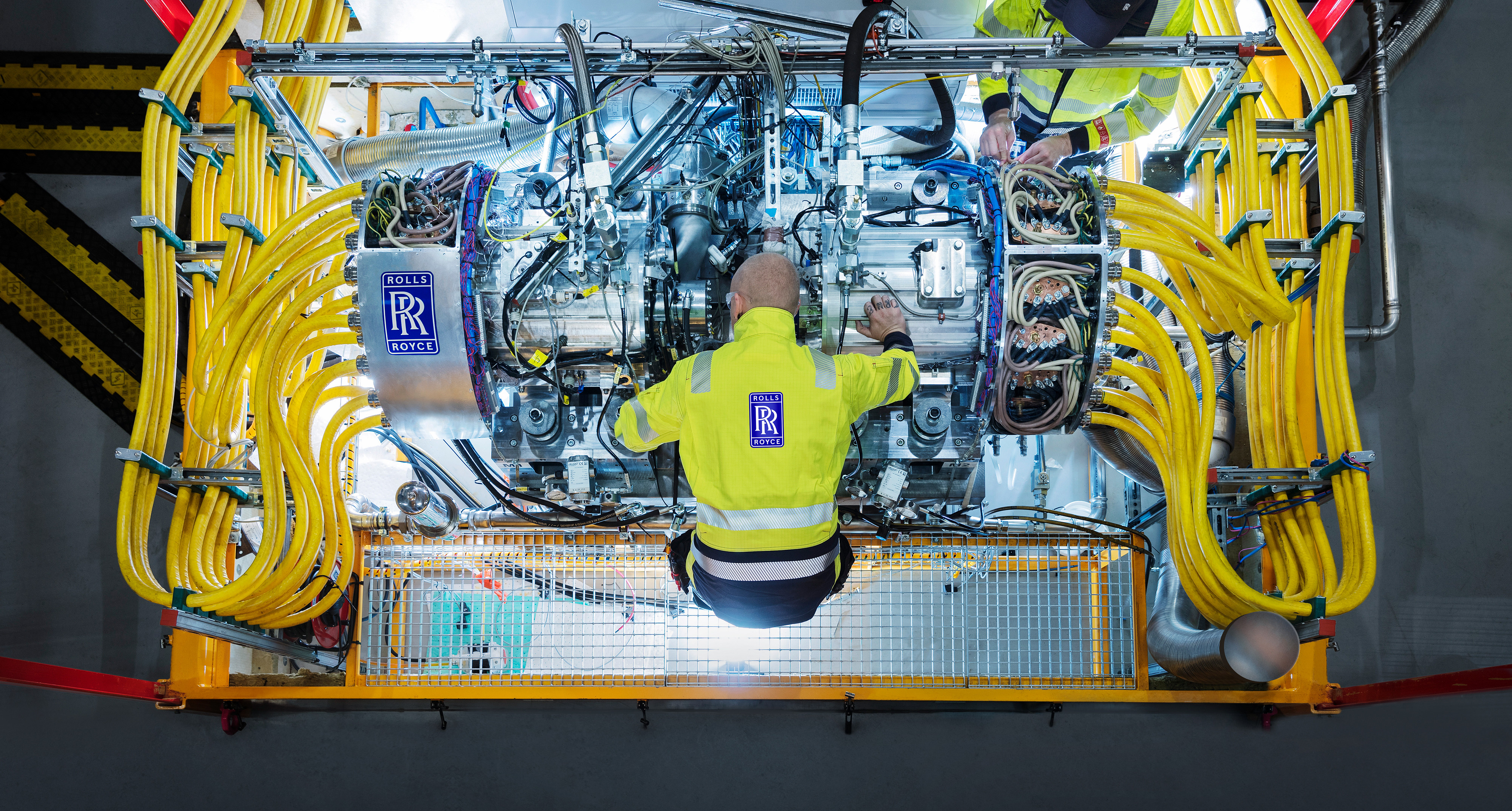
These are the first three paragraphs of the press release.
The generator that will be at the heart of the most powerful hybrid-electric aero power and propulsion system in aerospace has arrived for installation at our specialist testbed.
The generator, and related power electronics, was delivered to the newly-renovated Testbed 108 in Bristol, UK, from the Rolls-Royce facility in Trondheim, Norway, having completed an extensive development test programme. It will form part of the 2.5 megawatt (MW) Power Generation System 1 (PGS1) demonstrator programme, for future regional aircraft. In addition to hybrid-electric propulsion, the generator could also be used as part of a “more-electric” system for larger aircraft or within future ground or marine applications.
PGS1 forms an important element of our sustainability strategy, which includes developing innovative electrical power and propulsion systems.
I must say that as an engineer this 2.5 MW generator really excites me, as I see so many possibilities.
- I am fairly certain, that the generator can be powered by hydrogen, to create a true zero-carbon power generator.
- Rolls-Royce mention aerospace, ground and marine applications.
- The physical size must be an advantage, when it comes to some applications.
- The gas-turbine technology at the heart of the generator has been well-proven in the Lockheed Super Hercules.
But I do note in the press release that there is no mention of hydrogen or rail for which the generator must be eminently suitable.
- Rolls-Royce subsidiary; mtu are one of the leading companies, who power large rail locomotives.
- 2.5 MW is ideal for many rail locomotives.
- The small size must help integration into a rail locomotive.
- My calculations show that the generator and a hydrogen tank could be fitted into a typical modern rail locomotive.
- As electric transmissions can be used, the locomotive could also use electrification.
A lot of these arguments would also apply to the very large trucks used in the mining industries and ships of various sizes.
Conclusion
This Rolls-Royce 2.5 MW Generator will have lots of applications.
Biggest Mobile Hydrogen Fuel Cell In The World To Power Sergey Brin’s Mysterious Airship
The title of this post, is the same as that of this article on Hydrogen Fuel News.
This is the introductory paragraph.
LTA Research and Exploration, the secretive and mysterious airship company owned by Google co-founder and former Alphabet President Sergey Brin, will use the biggest mobile hydrogen fuel cell in the world to power its disaster relief airship.
The size of the fuel cell appears to be 1.5 MW according to the Hydrogen Fuel News article.
The company has a web site with a title of The Future Off 21st Century Airships.
The web site talks about vision, focus and their response to Covid-19, so it is certainly not vapourware, although it seems to be more about building the team.
Conclusion
Sergey Brin has his heart in the right place
But he is ploughing a furrow, that has been attempted many times and sadly most attempts have ended in failure.
 The Anonymous Widower