Foresight, Island GP To Build 700 MW Of Zero-Subsidy Solar In UK
The title of this post, is the same as that of this article on Renewables Now.
This is the two opening paragraphs.
UK infrastructure and private equity investment manager Foresight Group LLC has set up a joint venture (JV) with solar project developer Island Green Power to work together on a UK pipeline of close to 700 MW.
The companies plan to jointly develop five projects in England and Wales, Foresight said on Thursday. The schemes will be implemented without any subsidies.
Surely, what is significant, is that this joint venture, appears to be viable without subsidy.
Who’d have thought that the UK would be able to have this amount of solar power, without government or taxpayer support?
The cost of solar must be dropping like a stone!
The Power Of Community In A Crisis
The title of this post, is the same as that of this article on Business Green.
This is the introductory paragraph.
OVO’s Kate Weinberg reflects on a hugely eventful year since the energy giant debuted its ground-breaking Plan Zero strategy
I have been using OVO for some years now and have not had the smallest quibble in that time.
They salso handle the Feed-In Tariff for my solar panels.
$15mn Solar Plant Funded By UAE’s ADFD Gets Capacity Boost To 15MW
The title of this post, is the same as that of this article on Utilities Middle East.
This is the sub-title.
Financing part of the Fund’s commitment of $350 million to support renewable energy uptake in developing countries.
I have read the whole article and it puzzles me. There is no mention, as to what Abu Dhabi gets in return.
Solar To Hydrogen Efficiency Record Broken By Australian National University Researchers
The title of this post, is the same as that of this article on Hydrogen Fuel News.
The traditional route to produce green hydrogen from solar panels, is to create electricity and then use electrolysis to create the hydrogen.
This process goes direct and an improvement in efficiency of 17.6 %.
Germany Builds The World’s First Hydrogen Train Filling Station
The title of this post, is the same as that of this article on electrek.
Hydrogen Trains In Germany
The hydrogen filling station for trains is described under this heading.
This is the introductory paragraph.
The town of Bremervörde in Lower Saxony, Germany, has broken ground on the world’s first hydrogen filling station for passenger trains. Chemical company Linde will construct and operate the hydrogen filling station for the Lower Saxony Regional Transport Company.
It will provide approximately 1600 Kg of hydrogen per day.
The Supergroup Of ‘Green Energy’
This is a second section, which I find an interest sting concept.
These are the introductory paragraphs.
Oil giant Shell and Dutch utility Eneco have won the tender to build a super-hybrid offshore wind farm in the Netherlands. It will consist of two sites located 11.5 miles (18.5 km) off the west coast, near the town of Egmond aan Zee.
The Shell/Eneco consortium, CrossWind, will build the Hollandse Kust (noord) project. They will pair the offshore wind farms with floating solar facilities and short-duration batteries. It will also generate green hydrogen via an electrolyzer, according to GreenTech Media.
It will be operational in 2023 and have an output of 759 MW.
Rail Solar Projects Pave The Way For Renewables
The title of this post, is the same as that of this article on Engineering and Technology.
This is the introductory sub-title.
Electric trains could provide a huge guaranteed market for renewables, but it will need some railway-specific power equipment.
The article then goes on to describe how Riding Sunbeams are developing and sourcing the equipment to connect both 750 VDC and 25 KVAC electrification directly to solar panels.
It is not as easy, as you might think!
61GW Renewables And Storage Pipeline Could Bring In £125bn To Economy
I did think about calling this post something like.
- Do You Like Large Numbers?
- My Calculator Just Blew Up!
- I Don’t Believe It!
- No Wonder Rishi Sunak Has A Smile On His Face!
But I’ll use my normal introduction for this type of post!
The title of this post, is the same as that on this article of Current News.
This is the introductory paragraph.
The UK currently has a pipeline of 61GW of renewables and storage that if developed could bring in £125 billion to the UK economy.
The article also says that this pipeline could provide 200,000 jobs.
So where will this massive 61 GW of electricity come from?
- Off-shore Wind – 31.7 GW
- On-shore Wind – 11.9 GW
- Solar PV – 8.6 GW
- Storage – 8.5 GW
Where is the Nuclear Option?
iThe article also says that 18 GW of these projects are Shovel-Ready.
The figures come from UK trade association; Regen, whose Chief |Executive is the appropriately named; Merlin Hyman.
The page on the Regen web site, which is entitled Unlock Renewables For A Green Recovery, is the original document on which the Current News article is based.
Regen want three things from the Government, in return for creating all this renewable electricity capacity.
- Publish an Energy White Paper putting the UK on course for a flexible power system based on renewables and storage.
Commit to annual Contracts for Difference auctions to give investors confidence.
End the anti onshore wind policies in the English planning regime.
Some will not like the third condition.
I must go now, as I must go down the Chinese-owned Lucky Electronics Shop on Dalston Kingsland High Street to get a calculator with more digits to replace the one that blew up!
Exeter City Council Builds Its First Solar And Battery Storage Project
The title of this post, is the same as that of this article on Energy Live News.
This paragraph describes the scheme.
The plant, which had its preparatory work finished recently, will be built on an inactive landfill site and will comprise of a 1.2MW array of 3,702 solar photovoltaic (PV) modules, two battery storage containers and an electrical switch room.
I do think, this is a superb use for a old landfill site.
As I believe that some landfill sites still give off methane for many years, if this is the case, this can surely continue.
The scheme will also include a 1 MW/2 MWh battery and will be geared to providing power to a council operation’s facility and in the future to supporting an electric fleet.
This is a superb example of how to turn an unwanted toxic liability into a green asset, with several benefits.
I have not heard of something like this before, but by searching the list of solar and energy-from-waste power sites in the UK, I found a cluster around the M5 to the North of the village of Puriton.
This Google Map shows the area.
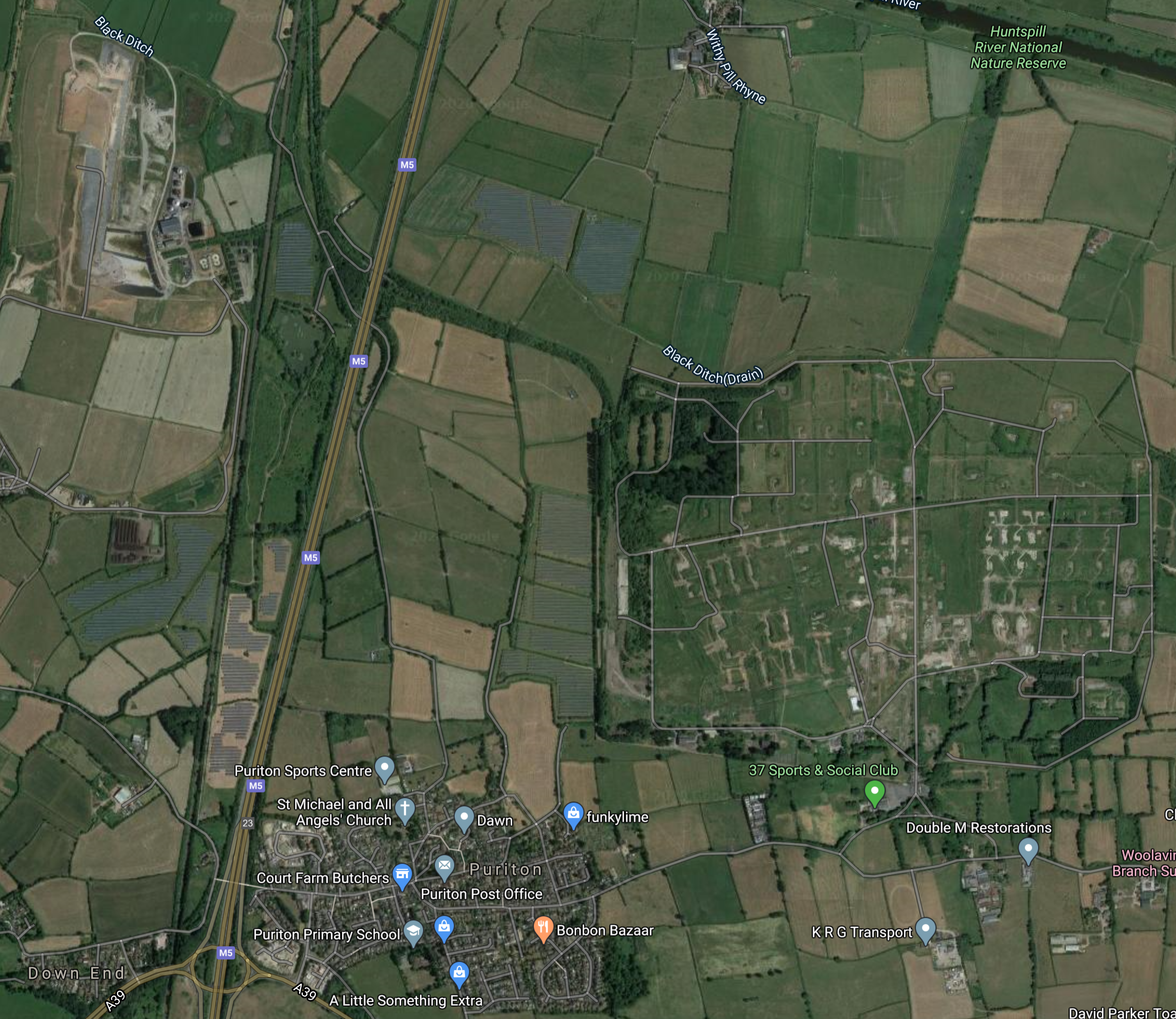
Note.
- The village of Puriton to the East of the Junction 23 of the M5, which is a forest of blue dots.
- The various solar farms showing as a blue-violet field. I can count fourteen separate fields.
In total, there are about half-a-dozen renewable energy producers in the area generating up to 25 MW of electricity.
The area to the North-East of the village with all the white dots, just above the green one, is the former Royal Ordinance Factory Bridgewater, which I’m sure solar farmers would like to get their hands on.
Would this become a modern version of swords into ploughshares?
Developer 8minute Says More Than 24GWh Of Batteries Included In Its US Solar-Plus-Storage Pipeline
The title of this post, is the same as that of this article on Energy Storage News.
What caught my eye was the 24 GWh!
When you consider that the biggest battery in the UK is Electric Mountain, which has a capacity of 9 GWh, 24 GWh of batteries is a large number!
It will need a lot of solar panels to keep that amount of batteries brim-full.
This is a sentence from the article.
The company’s projects include the Eland Solar & Storage Center, which will comprise 400MWac of PV and 300MW / 1,200MWh of battery energy storage, currently under construction in California’s Mojave Desert.
Those are big numbers against the UK’s largest solar park at Shotwick in Wales, which is just 72.2 MW.
Portugal’s Delayed 700MW Solar Tender With Storage Option Launches
The title of this post, is the same as that of this article on Energy Storage News.
According to the Wikipedia entry for Solar Power in Portugal, Portugal had 828 MW of installed solar power in 2018.
So 700 MW will almost double the capacity.
Note that if they had the same amount of installed solar power per square mile as the UK, Portugal would have 3 GW or 3,000 MW of installed solar power.
 The Anonymous Widower