Welcoming GB Energy And Its Mission To Make Britain A Clean Energy Superpower
The title of this post, is the same as that of this press release from SSE.
This is the sub-heading.
Making Britain a clean energy superpower by 2030 is one of the new government’s five missions. The UK Government and Crown Estate have announced plans to join forces to create a new publicly owned energy firm. GB Energy will invest in homegrown, clean energy.
These are the first two paragraphs of SSE’s response to the announcement.
We welcome the focus of GB Energy on earlier stage technologies, such as carbon capture and storage (CCS), where the Government can de-risk projects and help accelerate the clean energy transition.
In areas such as offshore wind, where industry is already delivering mission-critical infrastructure, the biggest impact will be on delivering policies that speed up the build out of these essential projects.
It looks like SSE, see Great British Energy as a positive development.
3 GW Dogger Bank South Offshore Wind Farms Reach New Development Stage
The title of this post, is the same as that of this article on offshoreWIND.biz.
This is the sub-heading.
The UK Planning Inspectorate has accepted into the examination phase the Development Consent Order (DCO) application for the Dogger Bank South (DBS) Offshore Wind Farms developed by RWE and Masdar.
The first two paragraphs give a brief description of the wind Farm.
The DBS East and DBS West offshore wind farms, which could provide electricity for up to three million typical UK homes, are located in shallow waters on the Dogger Bank over 100 kilometres off the northeast coast of England. The acceptance of the DCO application moves the projects into the pre-examination phase, which will become subject to a public examination later in 2024.
Together, the projects will have up to 200 turbines with a combined estimated capacity of 3 GW. Investment by RWE and Masdar during development and construction is predicted to deliver an economic contribution (Gross Value Added) to the UK of almost GBP 1 billion, including GBP 400 million in the Humber region.
There is a detailed map in the article on offshoreWIND.biz.
The Next Steps
These are given in the article.
The next steps for the projects, following a successful Development Consent Order, would be to secure Contracts for Difference (CfD), followed by financing and construction, the developers said.
It certainly looks like the 3 GW Dogger South Bank Wind Farm is on its way.
These are my thoughts about the project.
The Turbines To Be Used
The article says this about the turbines.
Together, the projects will have up to 200 turbines with a combined estimated capacity of 3 GW.
This means that the turbines will be 15 MW.
In RWE Orders 15 MW Nordseecluster Offshore Wind Turbines At Vestas, I said this.
Does this mean that the Vestas V236-15.0 MW offshore wind turbine, is now RWE’s standard offshore turbine?
This would surely have manufacturing, installation, operation and maintenance advantages.
There would surely be advantages for all parties to use a standard turbine.
It’s A Long Way Between Yorkshire And The Dogger Bank
The article says it’s a hundred kilometres between the wind farm and the coast of Yorkshire.
Welcome To The Age Of Hydrogen
This is the title of this page of the RWE web site.
The page starts with this paragraph.
RWE is actively involved in the development of innovative hydrogen projects. The H2 molecule is considered to be an important future building block of a successful energy transition. RWE is a partner in over 30 H2 projects and is working on solutions for decarbonising the industry with associations and corporations like Shell, BASF and OGE. Hydrogen projects are comprehensively supported in the separate Hydrogen department of the subsidiary RWE Generation.
AquaVentus
I also suggest, that you read this page on the RWE web site called AquaVentus.
The page starts with this RWE graphic.
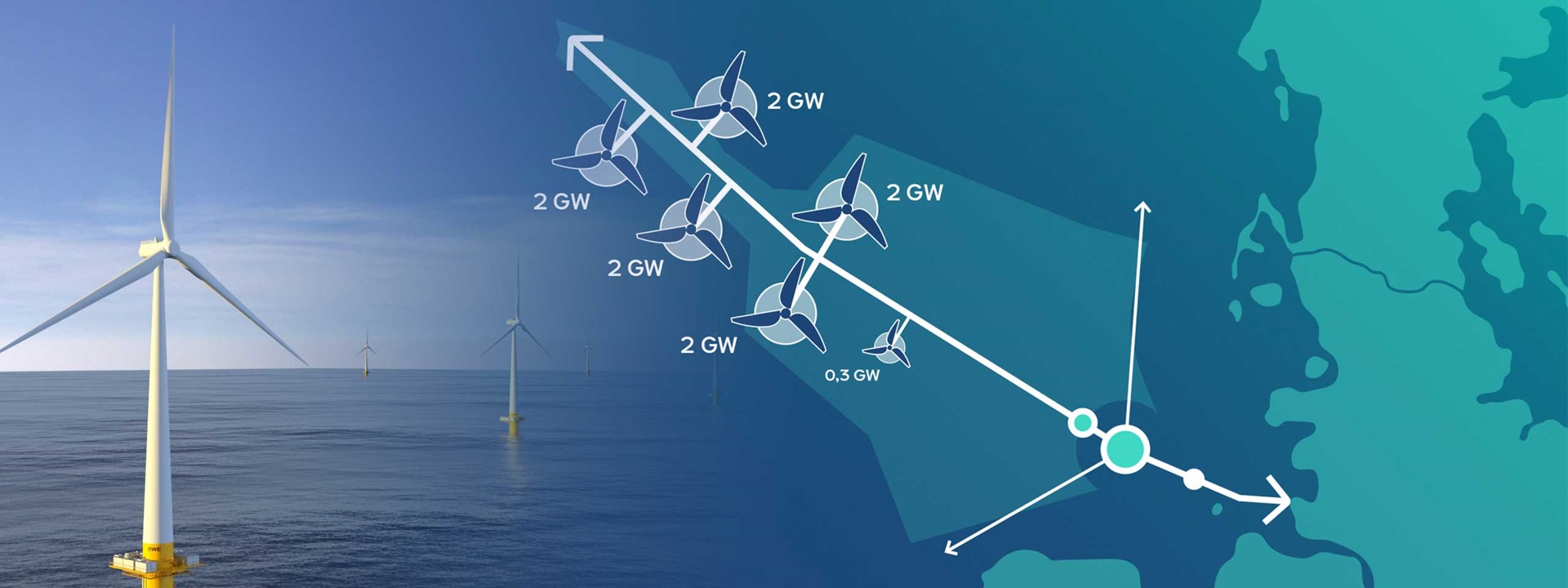
It appears that 10.3 GW of hydrogen will be created by wind farms and piped to North-West Germany.
These two paragraphs outline the AquaVentus initiative .
Hydrogen is considered the great hope of decarbonisation in all sectors that cannot be electrified, e.g. industrial manufacturing, aviation and shipping. Massive investments in the expansion of renewable energy are needed to enable carbon-neutral hydrogen production. After all, wind, solar and hydroelectric power form the basis of climate-friendly hydrogen.
In its quest for climate-friendly hydrogen production, the AquaVentus initiative has set its sights on one renewable energy generation technology: offshore wind. The initiative aims to use electricity from offshore wind farms to operate electrolysers also installed at sea on an industrial scale. Plans envisage setting up electrolysis units in the North Sea with a total capacity of 10 gigawatts, enough to produce 1 million metric tons of green hydrogen.
The page also gives these numbers.
- Total Capacity – 10 GW
- Tonnes Of Green Hydrogen – 1 million
- Members – 100 +
The web site says this about commissioning.
Commissioning is currently scheduled for early/mid 2030s.
The Germans can’t be accused of lacking ambition.
AquaVentus And The UK
This video shows the structure of AquaVentus.
I clipped this map from the video.

Note.
- There is a link to Denmark.
- There appears to be a undeveloped link to Norway.
- There appears to be a link to Peterhead in Scotland.
- There appears to be a link to just North of the Humber in England.
- Just North of the Humber are the two massive gas storage sites of Aldbrough owned by SSE and Brough owned by Centrica.
- There appear to be small ships sailing up and down the East Coast of the UK. Are these small coastal tankers distributing the hydrogen to where it is needed?
In the last century, the oil industry, built a substantial oil and gas network in the North Sea. It appears now the Germans are leading the building of a substantial hydrogen network.
AquaVentus And Aldbrough And Rough Gas Storage
Consider.
- In The Massive Hydrogen Project, That Appears To Be Under The Radar, I describe the Aldbrough Gas Storage.
- In Wood To Optimise Hydrogen Storage For Centrica’s Rough Field, I describe Centrica’s plans to turn Rough Gas Storage into the world’s largest hydrogen store.
- There is a small amount of hydrogen storage at Wilhelmshaven.
It looks like the East Riding Hydrogen Bank, will be playing a large part in ensuring the continuity and reliability of AquaVentus.
Dogger Bank South And AquaVentus
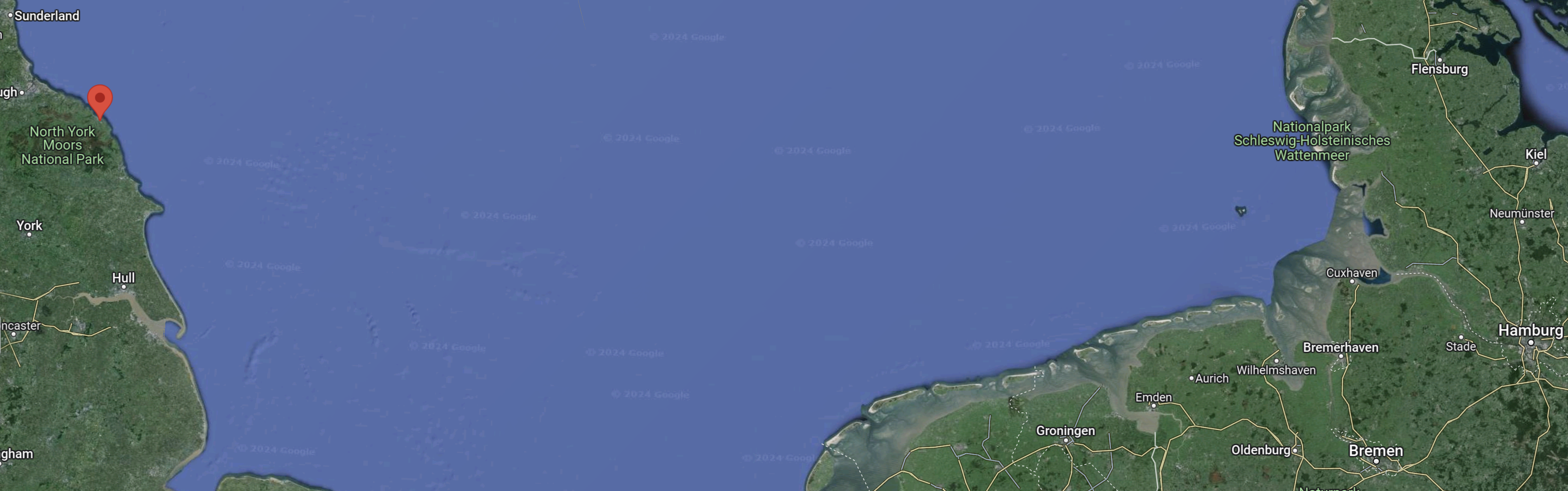
This Google Map shows the North Sea South of Sunderland and the Danish/German border.
Note.
- Sunderland is in the top-left hand corner of the map.
- A white line in the top-right corner of the map is the Danish/German border.
- Hamburg and Bremen are in the bottom-right hand corner of the map.
If you lay the AquaVentus map over this map, I believe that Dogger Bank South wind farm could be one of the three 2 GW wind farms on the South-Western side of the AquaVentus main pipeline.
- Two GW would be converted to hydrogen and fed into the AquaVentus main pipeline.
- One GW of electricity would be sent to the UK.
But this is only one of many possibilities.
Hopefully, everything will be a bit clearer, when RWE publish more details.
Conclusion
I believe, that some or all of the Dogger Bank South electricity, will be converted to hydrogen and fed into the AquaVentus main pipeline.
I also believe, that the hydrogen stores in the East Riding of Yorkshire, will form an important part of AquaVentus.
How Clean Energy Will Help Deliver UK Economic Growth
The title of this post, is the same as this press release from SSE.
This is the sub-heading.
How To Actually Deliver UK Economic Growth
This press release appears to have been written by Alistair Phillips-Davies, who is Chief Executive of SSE.
These three paragraphs introduce the press release.
Prior to the election Labour had committed to tackling the planning system head on in order to unlock economic growth and get Britain building again.
If Rachel Reeves’ first speech as Chancellor is anything to go by, winning a commanding majority has only galvanised that intent.
The challenge is for policymakers to deliver at pace across the whole of the UK, including in Scotland where reform is devolved but is also urgently needed.
Alistair Phillips-Davies seems impressed.
Why We Need Planning Reform Urgently
Under this heading, he says this.
Let me give you two examples of how planning acts as a drag on economic growth and jobs.
It currently takes around 12 years to deliver a large offshore wind farm in UK waters. But only two or three years of that is the construction phase.
And when it comes to electricity grids that span the country it only takes one local authority in Scotland to object to a project for it to go to a public inquiry, adding costs and years of delay.
No-one wants to avoid appropriate scrutiny and proper engagement with communities but allowing decision making to drag on for years suits nobody and setting a reasonable 12-month limit is surely sensible for everyone involved, as is giving ministers greater discretion where projects are clearly deemed to be in the national interest.
I very much agree with what he says.
I also suspect that what he says, applies to England, Wales and Northern Ireland, just as much as Scotland.
Declaring His Ambitions
The next two section declare Alistair Phillips-Davies’s ambitions.
- Making The UK The Easiest Place In The world To Invest And Actually Build Projects
- Creating Good Jobs Here In The UK
They are certainly sections that need a full read.
We Need To Get A Move On
This is his final section, which I’ll insert in full.
Having worked in the energy industry for almost 30 years I have never been more excited about the prospects for this country.
As one of the largest investors in the UK, SSE alone has a current investment programme of more than £20bn, but we are ready to go further and many others in the industry will join us.
Britain has no shortage of opportunities. But we need to make them happen. If we can deliver on the clean energy mission, the growth will come. There’s a long way to go, but unblocking the planning gridlock is the right place to start.
I was there at the start of North Sea Oil and Gas, writing project planning software in a Suffolk attic.
Hopefully, I’ll see North Sea Energy turn full circle to renewables.
Fifth Hydro Project Proposed At Loch Ness
The title of this post. is the same as that of this article on the BBC.
This is the sub-heading.
The local community is to be asked for its views next week on plans for a new hydro-electric scheme at Loch Ness.
These three paragraphs introduce the new scheme.
Glen Earrach Energy’s, external (GEE) pumped storage hydro project is the fifth hydro scheme proposed for the Loch Ness area.
The company said its project on Balmacaan Estate would create clean energy while protecting the environment, and create 600 on-site jobs.
But concerns have been raised about the number of planned schemes, with Ness District Salmon Fishery Board worried about the effect on wild fish.
The project has a web site, which has a section entitled About The Project, where this is said.
Glen Earrach Energy, which means “Valley of Spring” in Gaelic, stands at the forefront of energy innovation. The Pumped Storage Hydro (PSH) project, located at Balmacaan Estate, Scotland, is a critical component for achieving a net-zero grid by 2030.
The project prioritises environmental preservation and biodiversity enhancement while achieving outstanding efficiency in energy storage and generation.
This ensures a healthier and more sustainable balance between harnessing natural energy resources and the maintenance and reinforcement of the surrounding ecosystem.
Note.
- It doesn’t say, but it looks like Glen Earrach Energy aim to complete the project by 2030.
- Glen Earrach Energy also seem to be playing a strong environmental card.
But nothing is said about the size of the project.
This article on Business Insider, which is entitled £3 billion Loch Ness Hydro Project Plans Unveiled, does give some details.
- Potential Investment – More than £2 billion
- Output – 2 GW
- Storage Capacity – 30 GWh
- The project could create at least 600 on-site construction jobs in Scotland over a six-year period, plus many thousands more locally in the supply chain.
It is larger, than SSE’s flagship Coire Glas pumped storage hydroelectric power station, which is planned to be a 1.5 GW/30 GWh station, at the other end of the Great Glen.
I have some thoughts.
The Existing Hydro Schemes On Loch Ness
According to the BBC article, there are two existing hydro schemes on Loch Ness.
- Foyers is described on this web site and is a reasonably modern 305 MW/6.3 GWh pumped storage hydroelectric power station, that was built by SSE Renewables in the last fifty years.
- Glendoe is described on this web site and is a modern 106.5 MW conventional hydroelectric power station, that was built by SSE Renewables in the last twenty years.
Foyers and Glendoe may not be the biggest hydroelectric power stations, but they’re up there in size with most solar and onshore wind farms. Perhaps we should look for sites to develop 100 MW hydroelectric power stations?
The Proposed Hydro Schemes On Loch Ness
According to the BBC article, there are four proposed hydro schemes on Loch Ness.
- Coire Glas is described on this web site and will be a 1.5GW/30 GWh pumped storage hydroelectric power station, that is being developed by SSE Renewables.
- Fearna is described on this web site and will be a 1.8GW/37 GWh pumped storage hydroelectric power station, that is being developed by Gilkes Energy.
- Loch Kemp is described on this web site and will be a 600MW/9 GWh pumped storage hydroelectric power station, that is being developed by Statera.
- Loch Na Cathrach is described on this web site and will be a 450MW/2.8 GWh pumped storage hydroelectric power station, that is being developed by Statktaft.
In addition there is, there is the recently announced Glen Earrach.
- Glen Earrach is described on this web site and will be a 2GW/30 GWh pumped storage hydroelectric power station, that is being developed by Glen Earrach Energy.
Note.
- The total power of the seven pumped storage hydroelectric power stations is 4.76 GW.
- The total storage capacity is 85.1 GWh.
The storage capacity is enough to run all turbines flat out for nearly five hours.
Could Glendoe Be Updated To Pumped Storage?
The Wikipedia entry for the Glendoe Hydro Scheme mentions pumped storage several times.
In Glendoe Hydro Power Station, I estimate that a Glendoe pumped storage scheme could be perhaps 50 % bigger than the system at Foyers.
I feel that if more storage capacity is needed in the Highlands, then Glendoe could be converted to pumped storage.
Coire Glas Exploratory Tunnel 70% Complete
The title of this post, is the same as that of this article in Ground Engineering.
This is the sub-heading.
A tunnel to investigate ground conditions at SSE Renewables’ Coire Glas project to build a pumped hydro scheme in the Scottish Highlands is 70% complete, as wider ground investigations come to an end.
These are the first three paragraphs.
Coire Glas on the shores of Loch Lochy in Great Glen is the first large scale pumped hydro storage scheme to be developed in the UK for more than 40 years.
It would take excess energy from the grid and use it to pump water 500m up a hill from Loch Lochy to a vast reservoir where it would be stored. This will be done through a tailrace tunnel, underground cavern power station, high pressure tunnel and low-pressure headrace tunnel.
SSE Renewables has started exploratory works on the scheme. This has involved building an up to 1km long and 4m wide tunnel to investigate the ground conditions in which the powerhouse will be built.
All the information gathered will be used in the detailed design of the 1,5GW/30 GWh pumped storage system, which is expected to be a £1.5 billion capital investment.
The Wikipedia entry for Coire Glas power station, says this about the current status and completion.
In December 2023, the exploratory tunnel had reached 720m in length.
A final investment decision will depend on UK government assurances about how the regulated electricity market would reward storage schemes. SSE hope to make that £1.5Bn decision in 2024, in which case the scheme could be completed in 2031.
I suspect that as this is one of the largest green energy projects in the UK, that there’ll be a lot of media coverage of the construction of this power station.
SSE Partners With Bord na Móna On 800MW Onshore Wind JV In Ireland
The title of this post, is the same as that of this press release from SSE.
These four bullet points, act as sub-headings.
- Leading low-carbon energy companies SSE Renewables and Bord na Móna continue to progress their respective portfolios in Ireland, by partnering to develop new onshore wind energy projects across the Midlands.
- More than €1 billion could be invested by the joint venture partnership to develop up to 800MW of new renewable energy projects, enough to provide power to over 450,000 homes.
- Onshore wind farm projects to be developed as part of the portfolio will include Lemanaghan Wind Farm in north-west Offaly, Littleton Wind Farm in Tipperary, and Garryhinch Wind Farm on the Laois Offaly border.
- The partnership has the potential to support hundreds of jobs across the Midlands during construction and operation of the onshore wind projects.
Note.
- It is a 50:50 project between SSE Renewables and Bord na Móna.
- It will deliver 800 MW of onshore wind energy.
These link to the three web sites for the wind farms.
- Lemanaghan Wind Farm will be 80-100 MW
- Littleton Wind Farm will be 60-80 MW
- Garryhinch Wind Farm will be 60-80 MW
These must be the first phases, as they are nowhere near 800 MW.
There is an interesting comparison to be made here.
- As I said in Wind Farm: Yorkshire Moors Could Get England’s Biggest Wind Farm, it looks like a 304 MW wind farm on England will be controversial.
- The 539 MW Whitelee Wind Farm near Glasgow is the largest onshore wind farm in the UK.
- The republic of Ireland is building three schemes totalling 800 MW in the Irish Midlands.
So why does England object?
Consultation On Plans For Keadby Hydrogen Power Station To Begin
The title of this post, is the same as that of this press release from SSE.
These four paragraphs outline the project
SSE and Equinor will consult on plans for a new hydrogen-fired power station in North Lincolnshire which would provide vital new reliable and flexible capacity to the electricity system.
Keadby Hydrogen Power Station is a proposed 900MW plant which could be operational from 2030 – bolstering security of supply and supporting the UK’s long-term decarbonisation by providing back-up low-carbon power to variable renewable generation.
The project will enter environmental scoping in April before SSE and Equinor launch a public consultation ahead of a full planning application being made in due course.
Under plans, the new power station will be designed to run on 100% hydrogen. The ambition is that this would be the case from inception, with Government already committed to deploying low-carbon infrastructure in the Humber – the UK’s most carbon intensive cluster.
Note.
- The hydrogen for this power station will be produced by electrolysis or one of the new turquoise methods.
- It will be stored in Aldborough or Rough gas storage.
- This will be the fourth power station at Keadby after Keadby 1 (734 MW), Keadby 2 (893 MW) and Keadby 3 (910 MW)
- Keadby 3 will be fitted with carbon capture.
- These total up to 3.4 GW.
The Keadby cluster of power stations will make good backup to the wind farms in the North Sea.
SSE Renewables Partners With Fluence And OCU Energy To Deliver Its Battery Storage Project At Fiddler’s Ferry
The title of this post, is the same as that of this press release from SSE Renewables.
This is the sub-heading.
*The 150MW / 300MWh battery energy storage system will be built on the site of the former SSE-owned coal fired power station*
These four paragraphs give full details of the project.
SSE Renewables has announced its principal contractor and battery supplier for its 150MW battery storage project at Fiddler’s Ferry, Warrington.
OCU Energy – who are Stockport-based and are currently working with SSE Renewables on its Ferrybridge battery storage project – will be the principal contractor at Fiddler’s Ferry.
Fluence, a global leader in energy storage technology, digital solutions and services, has been selected as the supplier of the battery-based energy storage system.
Construction is set to begin at the site in the coming weeks after SSE Renewables took a final investment decision back in December 2023.
Note.
- This will be a two-hour battery.
- Good to see a press release with both battery output and battery capacity shown in the appropriate units.
It’s also good to see, SSE adding to the fleet of the UK’s battery storage.
This page on the SSE Renewables web site is entitled About Solar And Battery.
This is the sub-heading.
SSE Renewables is progressing a 1.2GW secured pipeline of utility-scale solar and battery projects across the UK and Ireland and a further 1.3GW of other prospective sites under development. These assets complement SSE’s existing portfolio of other low carbon infrastructure such as wind and hydro.
This is the first paragraph.
Our solar projects will be capable of harnessing the abundant power of the sun to bring renewable power onto the grid, while our battery projects will be able to store renewable power when the sun doesn’t shine or the wind doesn’t blow. The delivery of these projects is part of our commitment to a net zero transition.
What follows is a job advert.
As an electrical and control engineer, who has enjoyed over fifty years exploring the mathematics of big engineering projects, I don’t regret the choice of career I made.
Price Framework Paves Way For Vast Electricity Storage Scheme
The title of this post, is the same as that of this article on The Times.
This is the sub-heading.
SSE welcomes step forward in plans to build the £1.5bn Coire Glas hydroelectric project
These two paragraphs outline the article.
Ministers have provisionally agreed to a power pricing framework that could pave the way for more pumped storage hydroelectricity projects in Britain, including a gigantic £1.5 billion scheme from SSE that is starting to take shape in the Scottish Highlands.
The Department for Energy Security and Net Zero said it intended to develop a “cap and floor” pricing mechanism that would advance the Coire Glas storage project being developed by SSE, the energy company, and could unlock further pumped storage power stations.
Coire Glas will be one of the largest renewable power projects ever built in the UK.
- It will have a power output of 1.5 GW, which is comparable with some of the large wind farms in the North Sea or four gas-fired power station or Rolls-Royce SMRs.
- It will be able to store 30 GWh of electricity and provide 1.5 GW for twenty hours.
- Coire Glas has a web site.
- Coire Glas will more than double pumped storage hydroelectric capacity in the UK.
Bath County Pumped Storage Station in Virginia, US claims to be the world’s largest battery, but Coire Glas will be able to store more electricity.
You wait decades for one of these monsters to come along in the UK and SSE also have another on the way.
- Loch Sloy hydroelectric power station is the largest conventional hydroelectric power station in the UK.
- It has an output of 152 MW.
- It opened in 1950 and was largely built by German and Italian prisoners-of-war.
SSE plan to convert Loch Sloy power station into a pumped storage hydroelectric power station.
- It will be able to store 25 GWh of electricity.
- Loch Sloy will be the upper lake.
- Loch Lomond will be the lower lake.
- The existing dam, upper lake, pipes and powerhouse will be retained.
- The developments have a web page.
The project is aimed at a commissioning date of 2028.
This paragraph explains how the ‘cap and floor’ mechanism works.
In the scheme, operators would be guaranteed a minimum level of revenue, while consumers would be protected by a price ceiling, above which surplus revenue would be returned to them.
And these two paragraphs give SSE’s reaction.
Finlay McCutcheon, 46, director of onshore Europe at SSE, said the pricing framework was welcome news. He said that a deal for Coire Glas was needed by the end of this year to secure a firm investment decision by early 2026. Planning for the project started in 2007.
“Given the time taken to reach this point, much work is now needed to ensure an effective mechanism is finalised and put in place as early as possible to enable Coire Glas to take final investment decisions and move into construction,” he said.
I believe that the negotiations between the Government and SSE will lead to a monster on Loch Lochy and another one on Loch Lomond.
Conclusion
There are also these pumped storage hydroelectric schemes under development.
- Balliemeanoch Pumped Hydro – 1.5 GW/45 GWh
- Balmacaan Pumped Hydro – 600 MW/15-20 GWh
- Corrievarkie Pumped Hydro – 1.5 GW/14.5 GWh
- Fearna Pumped Hydro – 1.8 GW/37 GWh
- Glenmuckloch Pumped Hydro – 400 MW/1.6 GWh
- Loch Earba Pumped Storage Hydro – 900MW/33 GWh
- Loch Kemp Pumped Storage Hydro – 300MW/9 GWh
- Loch Na Cargeach/Red John Pumped Storage Hydro – 450 MW/2.8 GWh
These total up to 7.4 GW/100+ GWh.
This page on the Strathclyde University web site, gives these GWh figures for the possible amounts of pumped-storage that can be added to existing schemes.
- Errochty – 16
- Glasgarnock – 23
- Luichart – 38
- Clunie – 40
- Fannich – 70
- Rannoch – 41
- Fasnakyle – 78
- Tummel – 38
- Ben Lawers – 12
- Nant – 48
- Invermoriston – 22
- Invergarry – 41
- Quoich – 27
- Sloy – 20
That is a total of 514 GWh.
Scotland will be the Saudi Arabia of energy storage.
SSE Comments On COP28
The title of this post is the same as that of this press release from SSE.
SSE Chief Executive, Alistair Phillips-Davies, said:
“We knew going into COP28 that the world wasn’t moving fast enough to decarbonise. The commitment to triple renewables by 2030 is welcome, as is the inclusion, for the first time, of explicit language on the need to transition away from fossil fuels.
“Codifying and securing international endorsement for ambitions like these is very welcome; however, the challenge now is to deliver the tangible actions needed to make them a reality.
“In the power sector, this means speeding up policy and decision-making so that it is easier to invest and build the infrastructure we need to actually deliver net zero, from offshore wind farms to electricity grids and flexible power plants.
“At COP28 there was no shortage of businesses willing to invest but there was a common frustration at the pace of progress on the ground, and this is something we need to address for all our sakes.”
I would agree with what he said.
- Especially about speeding up policy and decision-making and delivering more electricity grids.
- The last paragraph probably applies to a lot of countries.
Surprisingly, energy storage is not mentioned.
Could that be because SSE are going down the route, where hydrogen is created and that is either used in gas-guzzling industries to reduce their carbon-emissions or stored until needed?
 The Anonymous Widower