Are There Some People Who Lose Their B12 Very Quickly?
Many years ago in Suffolk, I was sure, that my three-monthly B12-injection wasn’t done correctly.
It was by a trainee, so I told my GP and she may have repeated the injection. Perhaps the trainee missed the muscle or something?
I’m not sure, but I may have had a repeat injection.
I had another B12 injection about ten days ago and twice in the last two days, I have had symptoms that could be low B12 levels.
Yesterday at one point, I thought I was having a stroke, but a hot bath seemed to improve things.
I then found a Marks & Spencer Liver & Bacon meal-for-one and cooked it, but just eating the Liver & bacon.
I seemed to do the trick.
Today, coming home with shopping, my left leg was painful and so I asked Dr. Google AI for some advice.
I asked if “If low B12 is connected to red feet” and received this answer.
Low vitamin B12 is strongly connected to foot issues, primarily causing peripheral neuropathy that manifests as burning sensations, numbness, tingling (“pins and needles”), and sometimes, color changes like redness, purple, or white due to reduced blood flow or nerve damage. It causes nerve damage, which can lead to painful or “burning” feet.
Key Connections Between B12 Deficiency and Foot Symptoms:
Peripheral Neuropathy: A, the lack of B12 damages the myelin sheath covering nerves, resulting in burning, numbness, or tingling in the feet.
Reduced Blood Flow/Color Changes: Deficiency can lead to, significantly colder feet that may appear red, white, or purple due to impaired circulation.
Painful Sensations: Often described as a burning feeling, which can make feet feel hot or tender.
Muscle Issues: Weakness, cramping, and poor coordination can affect mobility.
Note:
- I certainly had pins and needles in my hands, yesterday.
It certainly, looked to me that I might have had low B12.
Trump May Have Alzheimer’s, Says Niece
The title of this post, is the same as that of this article in The Times.
This is the sub-heading.
Mary Trump said the president appeared to have developed a ‘deer-in-the-headlights look’ that reminded her of his late father, Fred Trump.
These three paragraphs add detail to the story.
President Trump’s niece has suggested her uncle could be suffering from Alzheimer’s based on a “deer-in-the-headlights” expression that reminds her of the president’s father.
Mary Trump, a longtime critic of her uncle, said she saw flashes in him of Fred Trump, her grandfather, who she witnessed struggle with the degenerative disease before his death aged 93 in 1999.
“Sometimes it does not seem like he’s oriented to time and place,” Mary Trump, 60, told New York Magazine of her uncle. “And on occasion, I do see that deer-in-the-headlights look.”
Fifteen years ago, my consultant at Addenbrooke’s said I should go on Warfarin (rat poison) to thin my blood. But my GP said I should stick to a small aspirin every day.
The result was that I had a serious stroke on holiday in Hong Kong.
Luckily, I made a remarkable recovery and I am now testing a Warfarin replacement drug, which is two pills a day and no testing, except by the doctors every three months.
My current cardiologist has even used the GP’s actions in a lecture to students on how not to behave.
Trump is playing with fire!
Surely he should at least be taking Warfarin and being tested frequently.
If any cardiologists are reading this, they should note, that I am coeliac and for the last twenty-eight years, I have been having regular B12 injections.
As B12 injections are used in Trumpland to help stroke patients recover, but not in the UK, from observations of my own recovery, by several doctors, I am tempted to believe that B12 injections may help stroke recovery.
Any sensible offer to help in research will be considered.
From my own experience, an affordable drug, like B12 injections could have a place in stroke recovery.
To get a second opinion, I asked Google AI, this question. – “Do Vitamin B12 Injections Help With Stroke Recovery?”
I received this answer.
Vitamin B12 injections may aid stroke recovery, particularly for individuals with a deficiency, by supporting nerve function, reducing homocysteine levels, and enhancing neurological rehabilitation. Research indicates that adequate B12 levels are crucial for protecting the brain after an ischemic stroke.Key findings regarding Vitamin B12 and stroke recovery:
- Neuroprotection: Vitamin B12 aids in maintaining myelin sheaths, which are essential for nerve repair and protecting the central nervous system after a stroke.
- Reduced Damage: Studies suggest that B12 can help reduce cerebral injury and improve long-term neurobehavioral function.
- Correcting Deficiency: People with B12 deficiencies often have worse stroke outcomes, making correction via injections crucial.
- Homocysteine Control: B12 helps lower homocysteine, a risk factor for vascular damage and recurrent stroke.
- Efficiency of Injection: For those with absorption issues (e.g., older adults or those with GI issues), injections bypass the digestive system to ensure maximum absorption.
The NHS will face a lot of resistance, if they want to take away my B12 injections.
Do B12 Injections Help Stroke Recovery?
A friend, who thinks I’ve made a good recovery from a stroke, asked me if there is anything I could recommend, for another of his friends, who has just had a stroke.
As a coeliac, am I in a group with a higher risk of a stroke?
So, I asked Google AI, the question, if this were true and received this answer.
- Initial Higher Risk: Some studies suggest a slightly increased risk of stroke (roughly a 10-15% increased likelihood). This risk is highest in the first year after diagnosis.
- Effect of Gluten-Free Diet: After 5 years on a strict, gluten-free diet, the risk of stroke for people with coeliac disease is virtually the same as that of the general population.
- Overall Risk: While some studies have suggested a link, others, including a 2023 UK Biobank study, found no clear evidence of an association between coeliac disease and stroke, although they did find an overall increased risk of cardiovascular disease (27% higher).
- Mechanism: The potential for a higher risk is likely due to the chronic inflammation associated with untreated coeliac disease, rather than traditional risk factors like high blood pressure or smoking.
- Children: A 2023 study found that coeliac disease plays a minimal role in the risk of stroke in children, but recommended that doctors consider it a potential factor in cases of stroke with unknown causes.
Conclusion:
While untreated coeliac disease may slightly increase the risk of stroke due to chronic inflammation, adhering to a gluten-free diet helps manage this risk.
This study by coeliacUK and Oxford University, was the source of the findings by Google AI.
Do B12 Injections Help Stroke Recovery?
For nearly thirty years, ever since I was diagnosed as coeliac, I have had regular three-monthly B12 injections. So ever since my stroke in 2011, I have had B12 injections.
So now AI is available, I felt I should ask Google AI to see if it says anything useful.
This is the answer I received.
- Nerve Repair & Axonal Growth: B12 aids in repairing damaged nerve fibers (axons) and regenerating nerve cells, vital for restoring lost function after a stroke.
- Reduces Inflammation: It helps calm the harmful inflammatory response (neuroinflammation) in the brain after an ischemic stroke, notes this ScienceDirect article.
- Improves Brain Communication: B12 supports neurotransmitter production, allowing brain cells to communicate more effectively and speeding up healing, according to this Flint Rehab article.
- Lowers Stroke Risk: By reducing homocysteine levels, an amino acid linked to stroke, B12 can help prevent recurrent strokes, reports this Flint Rehab article and this NIH article.
- Supports Microglia Function: It helps functionalize microglia (brain immune cells) to reduce injury and promote recovery, states this ScienceDirect article.
- To Boost Recovery: For those with moderate deficiencies, injections or supplementation can improve neurological function, notes this NIH article.
Conclusion
B12 injections seem to have done me no harm.
I also have them on the NHS, at no cost to myself.
If the NHS said I couldn’t have them, I’d pay for them.
Can A Broken Humerus Affect Your Hand And Wrist Long Term?
Sixty-four years ago, my left humerus was broken at school and I don’t think the local hospital fixed it too well. I also don’t think I had the best of physiotherapy, after some of my experiences with physios since my stroke, which have been of a generally very high-quality, from both the NHS and private physiotherapists.
The wrist has not been misbehaving itself recently, so I asked Google AI, the question in the title of this post and received this reply.
Yes, a broken humerus can affect your hand and wrist long-term, especially if a nerve like the radial nerve is injured during the fracture or surgery. This can cause temporary issues like wrist drop, which is the inability to extend the wrist and fingers, often improving with therapy. In rare cases, if nerve recovery is incomplete, surgical procedures may be necessary to restore function, though most fractures have an excellent long-term outlook with proper rehabilitation.
Note.
- I certainly didn’t have proper rehabilitation in 1961 at Highlands Hospital in Winchmore Hill.
- I wonder if I have actually suffered from wrist drop in recent years.
- I suspect that now there are better treatments available.
Google seem to have scraped the article from the respectable Cleveland Clinic.
Why Has My Left Humerus Got Worse In The Last Few Months?
I wonder, if it is new BYD buses on route 141.
- I always sit or stand downstairs, as at 78, I don’t want too risk climbing the stairs.
- The buses are more pokey and the seats are narrower than say a Routemaster or other British bus.
- On Routemasters and other British buses, I usually sit on the far-right seat to protect the humerus.
- It is getting increasingly knocked if I sit in the left-hand seat of a right-sided pair, by peoples’ backpacks.
- The seats are narrow on the BYD buses, and if sitting in a left-hand seat of a left-sided pair, my left humerus rubs against the outside wall of the bus. This is worse with a large person in the right seat.
- If I sit in the right-hand seat of a left-sided pair, it’s usually better, but if there’s a large person in the left seat, because of the narrow seats, the arm get knocked.
- On the BYD buses, there are no forward facing seats downstairs on the right side.
- There are some forward facing seats at the right side at the back, but they are difficult for me to climb into.
- The corridor from the front to the back in the bus is narrow and I sometimes bump the left humerus.
- I met a lady with a pram, who finds the corridor narrow for her pram.
- The step-up and down into the bus is higher and puts strain on my knees, unless I get it right.
I do wonder if the BYD buses were designed around smaller oriental people.
I certainly never had these problems, when I was riding on on Routemasters and other British-designed buses.
For the next few works, I will avoid travelling on the BYD buses unless I can sit in the right-hand seat of a pair, by myself.
I can also stand, if the bus isn’t too full. Looking back, I feel, I don’t mind standing on the buses.
I will now be forwarding this post to those that know me well.
Did I Have A Funny Turn Caused By Dehydration This Morning?
I followed my usual Sunday morning routine today
- I took my drugs with a large mug of tea.
- I had a deep bath with emollient in the water.
- I put my head under the water and opened my eyes, to clear the massive amount of sleep, I get overnight in my eyes.
- I then went to Leon in Hanover Square for a good Full English gluten-free breakfast.
Unusually, Leon made a mistake and didn’t put any milk in my tea, so I didn’t drink it. So was I low on fluids?
A Transformer Is Being Moved Tonight
This press release from National Grid is entitled National Grid Prepares For Two Major Supergrid Transformer Deliveries In London.
The first one is to be moved into Redbridge substation tonight, so I went to have a look after breakfast.
- It was easy to get to the site, as it is close to Redbridge station on the Central Line.
- Out of the Underground, it was quite hot.
- By the time, I got to Redbridge station, I was feeling slightly unwell and felt my balance was poor.
- So I immediately turned around and came home using the Central and Lizzie Lines to Moorgate, where I took a bus home.
- I was certainly feeling better in the air-conditioned atmosphere of the Lizzie Line.
Since I’ve been home, I have been continuously drinking Adnams 0.5 % Alcohol Ghost Ship and I feel that I am now back to normal.
I asked Google AI “Can being dehydrated affect your balance?” and got this answer.
Yes, dehydration can definitely affect balance. It can lead to dizziness and a feeling of unsteadiness, which can make it harder to maintain balance. This is because dehydration can disrupt the fluid balance in the inner ear, which plays a vital role in balance.
I can remember an incident in my thirties, when I fell down the escalator at Oxford Circus station and went round to the Middlesex Hospital to be cleaned up.
Did Dehydration Play A Part In My Serious Stroke?
I had my stroke during breakfast in the Mandarin Oriental Hotel in Hong Kong. I’d had two or possibly three very small strokes early in the morning before and I know from measuring my weight, that I can lose up to a kilo overnight.
So I asked Google AI “Can dehydration cause strokes?” and got this answer.
Yes, dehydration can increase the risk of stroke. When the body lacks sufficient fluids, blood volume decreases, potentially leading to thicker blood and reduced blood flow to the brain. This can exacerbate existing blockages in blood vessels or make it more difficult for blood to reach the brain, potentially causing an ischemic stroke.
My late wife drunk a lot more fluids that I do and perhaps, I should have followed her example more, of always having water handy?
My Family And Lunchtime Naps
Consider.
- My father was a great one for a lunchtime nap of perhaps thirty minutes after his sandwiches and a cup of tea in his print works in Wood Green.
- I can still see him sitting there on a wartime Utility dining-chair fast asleep.
- As my paternal grandfather was a professional alcoholic, I suspect he slept a lot. But whether he took naps, I do not know.
- I’ve always been prone to fall asleep, but as I’ve got older, I seem to do it more often.
- My middle son, also had a nap after Christmas Lunch last year. But was that just coincidence.
These are questions, that I’ve asked Google AI.
Are There Any Medical Benefits Of The Spanish Siesta?
Google AI said.
Yes, there are potential medical benefits associated with the Spanish siesta, which is a short afternoon nap. Studies suggest that siestas can improve cognitive function, mood, and cardiovascular health. A well-timed and appropriately short siesta can help reduce stress, improve memory consolidation, and even lower blood pressure.
That seems fairly positive.
Will A Spanish Siesta Help Atrial Fibrillation?
I ask this question, as I have atrial fibrillation and I was told, it caused my stroke.
Google AI said.
Spanish siesta, or daytime napping, is not a guaranteed or recommended treatment for atrial fibrillation (AFib). While some studies suggest a link between napping and AFib risk, the relationship is complex and depends on nap duration and individual factors. Short naps (15-30 minutes) may be associated with a lower risk, while longer naps could potentially increase the risk, especially in those with hypertension.
As I don’t have hypertension, it could be positive for me!
Does Atrial Fibrilation Run In Families?
Google AI said.
Yes, atrial fibrillation (AFib) can run in families, meaning it can be inherited. While many cases of AFib are linked to lifestyle factors, age, and other medical conditions, a significant portion of individuals with AFib, especially those with no clear cause, have a family history of the condition. Studies suggest that up to 30% of people with AFib of unknown cause have a family history of the condition.
As my father’s medical history seems fairly similar to mine, I wouldn’t be surprised if he had had it.
Is there A Connection Between Atrial Fibrilation And Coeliac Disease?
Google AI said.
Yes, there is an association between atrial fibrillation (AF) and celiac disease (CD), with studies indicating an increased risk of AF in individuals with CD. This connection is thought to be linked to the inflammatory nature of both conditions.
I have both and I suspect my father did too. We both had a serious stroke at around sixty.
My father had a second, which killed him a few years later. Modern pharmaceuticals have probably kept me alive.
Can You Measure Blood Pressure At The Ankle?
Consider.
- As long, as I can remember my left foot has always been larger than my right.
- Over the last few years increasingly, my left foot has often been a stronger shade of red, than my right.
- I also know, that after my stroke a specialist physiotherapist found that my left leg was stronger than my right.
I also know that I have a strange leaky skin.
- I had my stroke in 2010 in Hong Kong and was looked after in a private Chinese hospital.
- They were very strict and measured all the bodily fluids, that I passed.
- They didn’t collect any urine, so they accused me of throwing all my water away.
- I was not guilty, as I was drinking it all.
So they fitted me with a catheter and guess what? They still didn’t collect anything.
It was evidence that my skin is not good at holding water.
So why do I want to measure the blood pressure at my ankle? Or in fact both ankles.
In my ICI days in the 1960s and 1970s, I was helping chemical engineers to understand chemical plants and reactions, by looking at flows and pressures in the various pipes of the plant or experimental rig.
But I do wonder, if the red nature of my left foot, is due to some sort of irregularity in the blood flow to my left leg.
Mind The Step At Warren Street Station
This warning message is at Warren Street station.
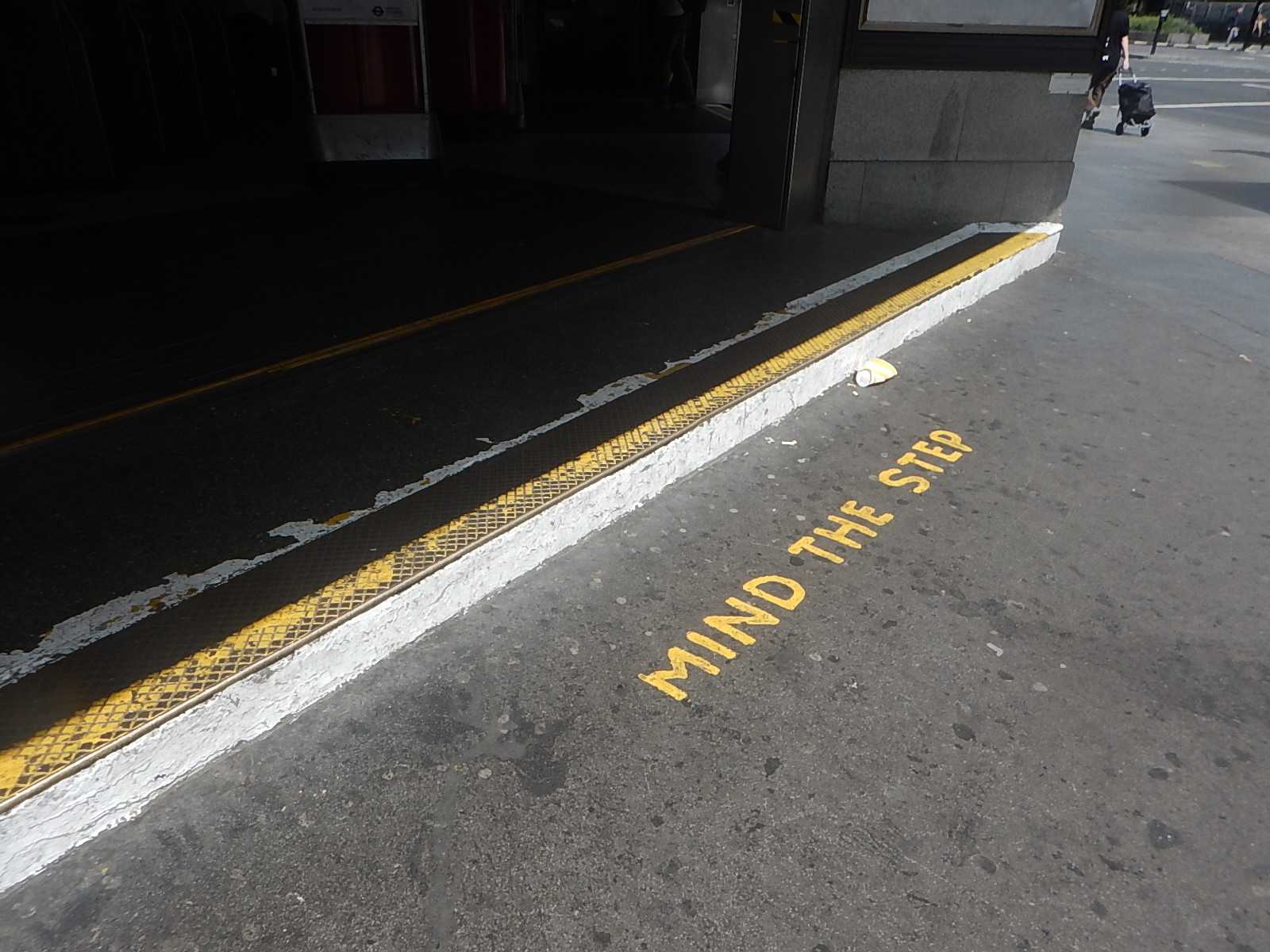
I sometimes miss these single steps due to my poor eyesight from my stroke, but the message alerted me, as I was coming out of the station.
I find it funny, that I will more usually trip going down stairs, rather than up.
But then rabbits and hares are more likely to take a tumble going downhill.
They also tend to run uphill, when they sense danger.
Alzheimer’s Expert Was Treated Like A Heretic Until Now
The title of this post, is the same as that of this article in The Times.
This is the sub-heading.
For decades Professor Ruth Itzhaki believed there was a link between Alzheimer’s and the virus that causes shingles, and has just been vindicated
These two paragraphs outline an amazing story.
Ruth Itzhaki does not, she says, refer to it as her time “in the wilderness”. When she reflects on the decades investigating — often almost alone — whether Alzheimer’s could be triggered by viruses, she prefers a different term. “I’d call it, ‘repeated burning as a heretic at the stake’. ” For much of her career she was treated “contemptuously”.
Today, as yet another study finds that the shingles vaccine appears to cut dementia risk, that has changed. At a stage in life when most researchers are retired, Itzhaki, an emeritus professor at Manchester University, finds herself reviewing studies from around the world. She is treated with contempt no more. But, she says, it has not been fun. “I just have to stop myself from being bitter.”
Sad to say, it is not an unusual story.
This was the comment, I appended to the Times web site.
There was a wonderful BBC Panorama about a Glasgow Veterinary professor, who believed the messenger of the body was an oxide of nitrogen, at least twenty years ago.
He was ostrasised for being a heretic.
Eventually, he was proved to be right.
I might have exposed how a simple treatment for stroke is ignored in the UK.
I was found to be coeliac at fifty and Addenbrooke’s hospital said that I should have B12 injections every three months.
In my sixties, I had a serious stroke and if I lived in the States, I would have been given B12 injections to aid my recovery. But that simple treatment is not used here, as it is considered American quackery.
However, several doctors have said, I have made a remarkable recovery. Was that because of the B12 injections, I still have?
More research needs to be done and I’ll travel anywhere to help any doctor, who is doing serious research.
It could just be, that as a London Mongrel, I have more survival genes, than a small field of Japanese Knotweed.
I should add, that as the date of my next B12 injection approaches, I can almost feel, the various parts of my body fighting for what little I have left.
But what do I know? I’m just a slightly crazy engineer/scientist and mathematician, with no medical training, who has been given an unusual body to investigate.
To Norbiton For A Plate Of Lovely Liver
I seem to need a lot of Vitamin B12.
- I am coeliac, which probably means I don’t absorb enough out of my food.
- Although, when my gallstones were removed, the surgeon had a look and said everything was good.
- When Homerton Hospital found my Uncomplicated Pancolonic Diverticular Disease, that I talked about in I’ve Got Uncomplicated Pancolonic Diverticular Disease, they also said everything else was good.
- In the United States, Vitamin B12 is given to stroke patients to help recovery.
- I’ve had Vitamin B12 injections for nearly thirty years, since they were prescribed by Addenbrooke’s hospital.
Certainly, I find that a Vitamin B12 injection doesn’t seem to have the same effect, it had twenty years ago. So, is my brain saying, I’ll have that, when I have an injection?
When I lived in Suffolk and I felt my Vitamin B12 was low, I’d go down the pub or carluccio’s in Cambridge or Bury and have a plate of liver.
But liver is rare in London restaurants and Carluccio’s don’t serve it any more.
A guy in the reader’s comments in The Times told me of a restaurant called the Trattoria Calabrese, that sold liver in sage butter yesterday. So today, I took a train to Norbiton to get myself some extra Vitamin B12.
These pictures describe my first visit to Norbiton.











The short walk to the restaurant from Norbiton station was very much worth it. I shall go back!
 The Anonymous Widower