My 78-Year-Old Legs Are More Reliable Than The New Chinese Buses On London’s 141 Bus Route
So we all know what we’re talking about, here’s a few pictures.
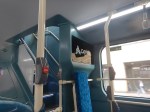
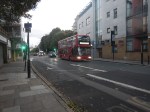
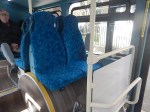
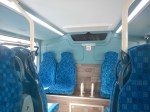
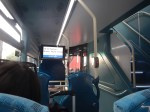
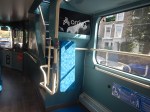
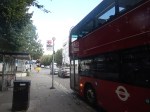
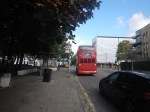
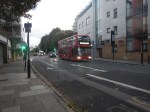
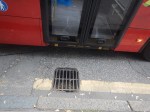
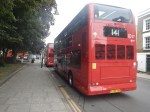
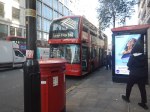
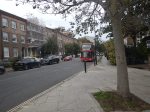
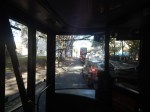
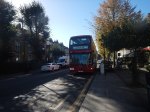
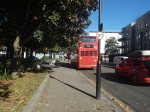
Note.
- The buses seem to have no serious faults from a passenger point of view.
- One middle-aged lady on the plump side, said she didn’t like the buses.
- The aisle between the front seats doesn’t seem to be built for large people.
- The seats are reasonably comfortable.
- One morning, I stood on a long journey and I felt the road-holding wasn’t as good as a New Routemaster.
- On several buses, the interior route display has not been working.
- As I don’t wear a watch, I find a non-working display annoying.
- I haven’t been upstairs yet.
- As picture numbers three and four show, the bus looks a bit pokey at the back downstairs.
But I am very suspicious about the buses’s reliability or ability to handle the route, which is fairly long.
Take this morning, when I was coming home from London Bridge station.
- There was only a 43 bus at the shared stop with the 141 bus.
- As the routes are identical until Old Street station, I took the 43 bus to Moorgate station.
- At Moorgate station, I took a 76 bus, which gets me within walking distance of where I live.
- Someone said, that a 141 bus would mean a wait of ten minutes.
- In the end my 78-year-old legs delivered be home.
I didn’t see a 141 bus going my way on my journey.
I have seen behaviour like this several times, since some Chinese electric buses were introduced on to the route.
As a graduate Electrical and Control Engineer, it looks to me, that there is one of two problems with these buses.
- The batteries aren’t large enough for the route.
- Not enough time is allowed for charging the batteries at the end of the route.
This page on the Wrightbus website is entitled Wrightbus Electroliner ‘Most Efficient Double-Deck Battery-Electric Bus’, and it contains this paragraph, which probably explains their philosophy and ambition.
We have already gained a strong reputation for our hydrogen double deck but we want to lead the world in zero-emissions full stop. Wrightbus has the best brains in the business when it comes to technology and our StreetDeck Electroliner puts us squarely at the front of the pack. We haven’t weighed the bus down with a high battery volume just so we can say it’s got the most power or range; instead, we’ve made it the most efficient vehicle on the road by combining optimum power with a class-leading rapid charge, meaning our electric bus spends more time on the road than any other.
It also probably sets a very high bar, which the Chinese can only achieve by adding battery volume and making their buses pokey.
To be fair to the buses, the 141 route is probably nearly 20 miles long.
In Sutton Station To Gatwick Airport By Hydrogen-Powered Bus, I wrote about what it says in the title.
In that post, I said this about hydrogen buses running on the 141 route.
Wrightbus Hydrogen Buses For My Local Bus Route 141
Consider.
- The 141 bus route is my local bus, which gets me to Moorgate, Bank, London Bridge and Manor House.
- The length of the full route is twenty miles and it takes about an hour to go from London Bridge station to Palmers Green.
- The route is currently run by older Wrightbus hybrid diesel-electric buses.
- I suspect that modern hydrogen buses could last almost all day on one fill of hydrogen, with perhaps a top-up at lunchtime.
They would have no difficulty handling the route and would greatly increase the customers current rock-bottom satisfaction.
I am sure, they would improve the horrendous reliability of the route.
I also wonder, if Wrightbus have another solution.
In UK Among Tri-Axle Zero-Emission Wrightbus StreetDeck Prospects, I talk about Wrightbus’s new Tri-Axle Zero-Emission Wrightbus StreetDeck bus and how it would be ideal for the 141 bus route.
- The 141 bus route is the old 641 trolleybus route, so all clearances are generous.
- The tri-axle design can probably carry a better-optimised battery.
- There used to be two bus routes on the route and now there is only one, so more capacity is needed.
- The 141 bus route bridges the gap between the Northern section of the Piccadilly Line and the Elizabeth Line, Bank and London Bridge.
- The new air-conditioned Piccadilly Line trains, will increase the passengers on the line.
- There will be a lot more housing built in Enfield, at the Northern end of the Piccadilly Line and more bus capacity will be needed between Manor House and the City of London.
Some of TfL’s rerouting of buses in North London, was a crime against mathematics.
UK Among Tri-Axle Zero-Emission Wrightbus StreetDeck Prospects
The title of this post, is the same as that of this article on routeone.
This is the sub-heading.
Orders for new product ‘already lined up’ in Europe and the Far East, the manufacturer has said
These are the first two paragraphs.
Wrightbus sees UK sales opportunity for its new tri-axle zero-emission StreetDeck double-deck bus platform in addition to core Far Eastern markets for that class of vehicle, it says.
That was noted by CEO Jean-Marc Gales (pictured) when debuting prototype examples of the 6×2 bus that it says are “simultaneously” coming off production lines in Northern Ireland and Malaysia. The manufacturer adds that orders are “already lined up” for the product in Europe and the Far East.
I seem to remember that London’s electric trolleybuses used to have three axles.
So I asked Google AI if London’s trolleybuses did have three axles and got this reply.
Yes, London’s trolleybuses were predominantly three-axle vehicles. To accommodate their length and the power of their electric motors, most London trolleybuses, designed to replace trams, were built with three axles. This design allowed them to be larger and carry more passengers, similar to the trams they replaced.
So my memory was correct.
Where I live in De Beauvoir Town, the main North-South bus route is the 141 between London Bridge and Palmers Green.
- They are ten-year-old diesel hybrid buses.
- The route is busy and the buses are far too small.
- During my childhood, the route was the 641 trolleybus, which I used regularly.
- Southgate Road, where the trolleybuses ran is wider than most roads in London.
It would be ironic, if our inadequate 141 buses were to be replaced by new three-axle buses following some of the design rules of trolleybuses.
Is A Three-Axle Bus Better At Climbing Hills Than A Two-Axle?
In the UK, Bradford, Brighton and Sheffield are cities with hills.
If a three-axle bus is better at climbing hills, then this could be a big selling point.
The Chinese Won’t Be Pleased
This is said in the article.
The manufacturer adds that orders are “already lined up” for the product in Europe and the Far East
The Chinese won’t like Wrightbus stealing their markets.
 The Anonymous Widower