Battery-Electric Power Rides The Rails
The title of this post, is the same as that of this article on Power Progress.
These two introductory paragraphs, outline the project.
In late October 2023, transportation solution provider Wabtec and its launch customer Roy Hill, an Australia-based iron ore mining company, celebrated the debut of the FLXdrive locomotive – a production model unit that Wabtec described as the “world’s first 100% battery-powered, heavy-haul locomotive for mainline service.”
The debut was the culmination of more than a decade of R&D that started at a time when battery technology and density were far more limited. Rogerio Mendonca, president, Freight Equipment, Wabtec, labeled the company’s earliest project as “more of a science pilot than anything else.”
I feel that this conversion of a diesel locomotive to a 7MWh battery-electric locomotive will be a significant milestone in freight haulage.
In the UK, we have 480 Class 66 locomotives.
Not all are used for heavy freight and you regularly see a single locomotive hauling a load that a lowered-powered battery electric locomotive could handle.
I suspect that if Roy Hill find this a capable locomotive, that we’ll see some Class 66 locomotives converted to battery-electric operation.
The article is well worth a full read.
Wabtec And Roy Hill Unveil The First FLXdrive Battery Locomotive
The title of this post, is the same as that of this press release from Wabtec.
This is the sub-heading.
World’s first 100% battery-powered, heavy-haul freight locomotive for mainline service
This is the first three paragraphs.
Wabtec and its launch customer, Roy Hill, a leading iron ore miner majority owned by Australia’s most successful private company, Hancock Prospecting, have celebrated the debut of the FLXdrive battery locomotive, the world’s first 100% battery-powered, heavy-haul locomotive for mainline service. The ceremony unveiled the unique, striking pink-colored locomotive at Wabtec’s design and development center in Pennsylvania in front of employees, customer executives, and government and community officials.
“This FLXdrive locomotive represents a major step in the journey to a low-to-zero-emission future in the rail industry,” said Rafael Santana, President & CEO of Wabtec. “The FLXdrive is driven from within by our battery technology and the innovative spirit of our employees. Roy Hill is an ideal customer to partner with given their leadership and excellent operational record.”
Roy Hill’s FLXdrive battery-electric locomotive will feature an energy capacity of 7 megawatt hours (MWh). Based on the route and company’s rail operations, the FLXdrive is anticipated to provide a double-digit percentage reduction in fuel costs and emissions per train. Once Wabtec completes the final battery installations and track testing, the locomotive will begin its 17,000-kilometer (10,500-mile) journey in 2024 for delivery to its new home in the Pilbara region of Western Australia, one of the world’s premier mining precincts.
These further two paragraphs outline the operation of the locomotive.
The FLXdrive locomotive represents not only a first for the Pilbara, but a first for the mining industry. The technological smarts that have gone into the development of the loco makes it well suited for our rail network. By using regenerative braking, it will charge its battery on the 344 kilometer (214 mile) downhill run from our mine to port facility and use that stored energy to return to the mine, starting the cycle all over again. This will not only enable us to realise energy efficiencies but also lower operating costs.”
Today, Roy Hill uses four Wabtec ES44ACi “Evolution Series” diesel-electric locomotives in a consist to pull trains that are typically 2,700 meters (1.6 miles) in length carrying more than 33,000 tonnes of iron ore. The addition of the FLXdrive will form a hybrid locomotive consist with Wabtec diesel-electric locomotives, and recharge during the trip through regenerative braking. The FLXdrive manages the overall train energy flow and distribution through its state-of-the-art energy management software. It is also designed with a unique battery thermal management system using liquid cooling to withstand the Pilbara heat, where temperatures can reach 55°C (130°F).
I have some thoughts.
Could Class 66 Locomotives Be Converted Into Battery-Electric Locomotives?
I answered this question fully in Could Class 66 Locomotives Be Converted Into Battery-Electric Locomotives? a couple of years ago and came to this conclusion.
I am not a lover of the smelly, noisy and polluting diesel Class 66 locomotives, but it does look it could be possible to convert some into battery-electric locomotives.
I wouldn’t be surprised to see Wabtec convert some Class 66 locomotives into battery-electric locomotives.
I also believe, that conversion of Class 66 locomotives to battery-electric operation could be the most affordable way to help decarbonise rail freight.
Note.
- Class 68 locomotives could probably also be converted.
- The battery-electric locomotives would either be used singly or in conjunction with diesel-electric locomotives as Roy Hill propose to do.
After the launch of Wabtec’s first production locomotive, I wouldn’t be surprised to find that some of the UK’s freight operators are talking to Wabtec.
Could A Battery-Electric Class 66 locomotive Work With An Electric Locomotive?
This picture shows, what could be an experiment by Freightliner at Shenfield.
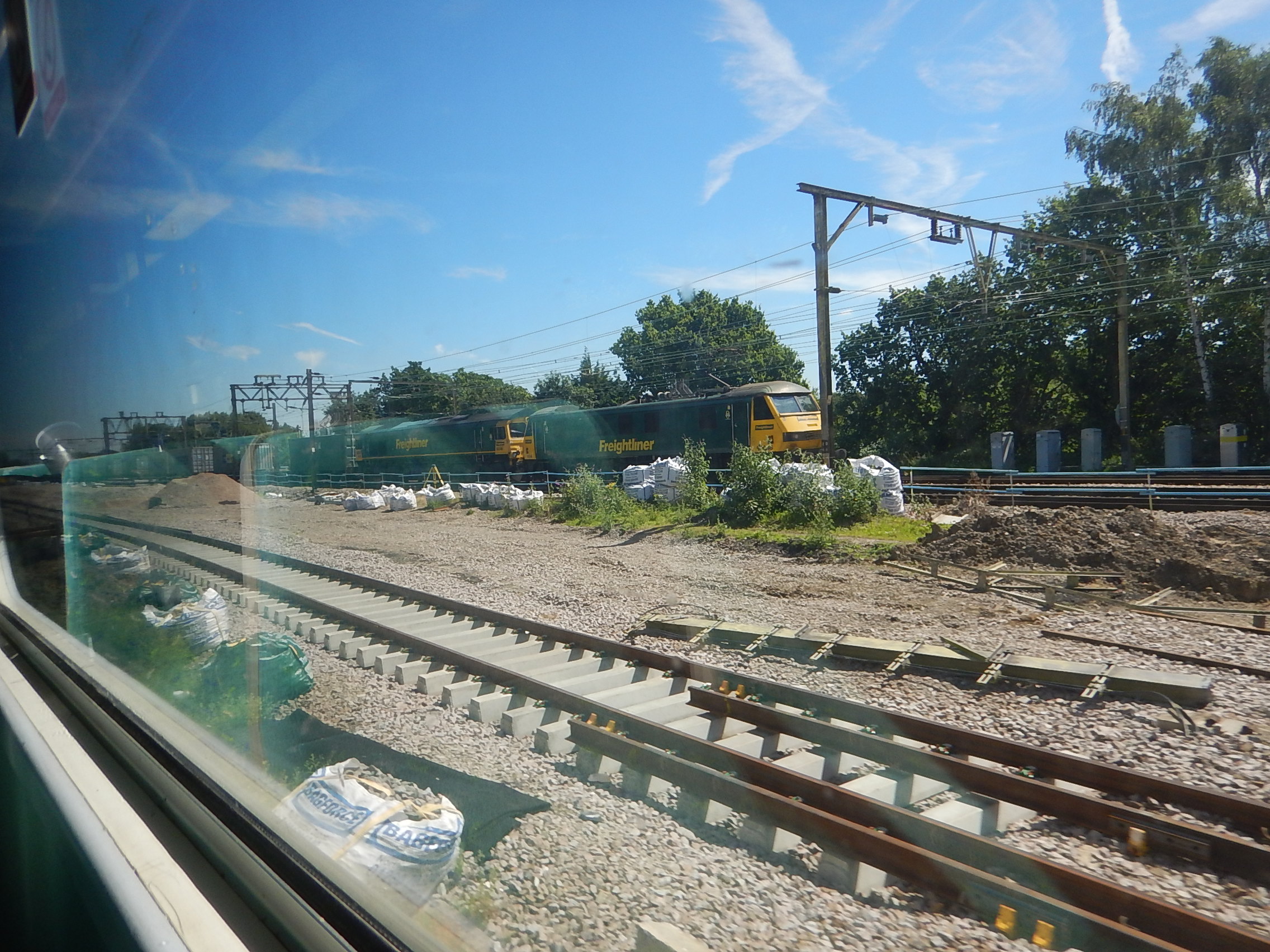
Unfortunately, I didn’t have a chance to ask the driver, if the Class 66 locomotive was running dead-in-train or helping the Class 90 locomotive with a very heavy load.
The picture shows, that the electric and diesel locomotives can work together, at the front of a train.
Consider.
- The battery-electric locomotive would be used, where there is no electrification.
- The battery-electric locomotive could be charged by the electric locomotive or regenerative braking.
It could be an interesting way to handle some freight routes in the UK.
Wabtec Planning For Transition From Diesel
The title of this post, is the same as that of this article on trains.com.
It has this sub-title.
At InnoTrans, company looks at role of batteries, hydrogen in railroading’s future.
It is very much a must-read, that gives a road-map of their plans to decarbonise rail freight, by the use of both battery and hydrogen power.
Zero Emission Powering of Auxiliary Loads In Stations
This project was one of the winners in the First Of A Kind 2022 competition run by Innovate UK.
In this document, this is said about the project.
Project No: 10038972
Project title: Zero Emission Powering of Auxiliary Loads In Stations
Lead organisation: WABTEC UK LIMITED
Project grant: £59,921
Public description:
This project provides a solution to substantially reduce emissions including NOx and PM when diesel passenger trains are idling.
There are over 3,500 passenger rail vehicles in the UK currently fitted with a diesel engine, the large majority of these would significantly benefit from emissions reduction, especially in and around stations, where diesel engines currently continue to idle, or elevated idle whilst stationary, sometimes for up to 30 minutes at a terminal station. This is a significant contributor to local air quality issues from NOx, PM emissions etc.
Brecknell Willis aim to further develop their existing current collection product portfolio by producing
a low-cost, automated shore supply for powering the auxiliary loads of each vehicle and enabling
the diesel engines to be disabled while stationary.
This project will enable several key cost and decarbonisation benefits to the railway.
- It shall enable zero emissions, including NOx and PM, in and around the station, by
enabling a DMU to dwell at any enabled station or depot with the engine switched off
through an automated shore supply. - It shall enable a proportional average reduction in all emissions, through reduced fuel consumption due to not using the diesel engine whilst the vehicle is stationary.
- It shall enable reduced operating costs for the train operator through fuel saving.
- It will not require any modification to the existing diesel engines or drivetrain and will compliment any other decarbonisation initiatives.
- It shall provide a substantially lower cost and risk solution when compared to any other previous or current hybrid solutions.
My Thoughts And Conclusions
Axle Mounted Motor For Retrofit To DMU’s To Enable Zero Emissions In Stations
This project was one of the winners in the First Of A Kind 2022 competition run by Innovate UK.
In this document, this is said about the project.
Project No: 10038683
Project title: Axle Mounted Motor For Retrofit To DMU’s To Enable Zero Emissions In Stations
Lead organisation: WABTEC UK LIMITED
Project grant: £59,450
Public description: This project provides a solution to substantially reduce emissions including NOx and PM when
diesel passenger trains are idling.
There are over 3,500 passenger rail vehicles in the UK currently fitted with a diesel engine, the
large majority of these would significantly benefit from emissions reduction, especially in and
around stations, where diesel engines currently continue to idle, or elevated idle whilst stationary,
sometimes for up to 30 minutes at a terminal station. This is a significant contributor to local air
quality issues from NOx, PM emissions etc.
Furthermore, rail vehicles require large amounts of energy and power to accelerate (and therefore
contributing more emissions), and yet, on the approach to stations significant amounts of energy
are “lost” through “braking”.
This project will address both issues by recovering the braking energy during deceleration and reusing it for auxiliary loads in station and traction to accelerate out of station, this will enable diesel
engines to be isolated in and around stations, whilst also reducing the average emissions such as
PM and NOx over a complete drive cycle by up to 35% and operational costs by up to 30%.
Our objective is to develop and integrate a small, low mass, yet high peak torque and peak power,
axle mounted motor, for retrofit and upgrade for DMU/DEMU passenger vehicle applications. This
motor shall enable kinetic energy recovery during the braking application and also provide power to
the trailer bogie wheels whilst accelerating.
This project will enable several key cost and decarbonisation benefits to the railway.
- It shall enable zero emissions, including NOx and PM, in and around the station, by
enabling a DMU to approach, dwell and depart from a station with the engine switched off. - It shall enable a proportional average reduction in all emissions, through reduced fuel consumption resulting from the electrical energy recovery from regenerative braking and re-deployment through auxiliary and traction use.
- It shall enable less brake wear thus reducing particulate emissions from brake pads especially around stations.
- It shall enable reduced operating costs for the train operator through fuel saving, engine/transmission maintenance savings and brake pad saving.
- It will not require any modification to the existing diesel engines or drivetrain and will compliment any other decarbonisation initiatives.
- It shall provide a substantially lower cost and risk solution when compared to any other previous or current hybrid solutions.
My Thoughts And Conclusions
This is a classic simple solution, that could have big benefits.
I suspect, it can also be paired with Wabtec’s other proposal; Zero Emission Powering of Auxiliary Loads In Stations.
Research And Development Agreement Signed For Hydrogen Combustion Trains In US
The title of this post, is the same as that of this article on H2-View.
This is the opening paragraph.
Hydrogen combustion engine-powered trains are set to be at the centre of a collaborative research and development agreement between Argonne and Oak Ridge National Laboratories and Wabtec in a bid to decarbonise US rail.
The US is certainly calling up the heavy brigade in Argonne National Laboratory, Oak Ridge National Laboratories and Wabtec.
This appears to be the main objective.
It is hoped the team will be able to design train engines that will deliver the same power, range, and cost-effectiveness as current diesel technology.
The article states that there are 25,000 diesel locomotives in the United States, but because of exports to large parts of the world, including the UK, this research could clean up a lot more than just the United States.
The omens are good, in that both Cummins and Rolls-Royce mtu, who are two of the world’s big diesel engine manufacturers have successfully launched hydrogen combustion engines.
Wabtec Signs $600M MoU With Kazakhstan Railway Company
The title of this post, is the same as that of this article on Seeking Alpha.
This is the introductory paragraph.
Wabtec announced Tuesday signing of a $600M memorandum of understanding with Kazakhstan Temir Zholy for 150 FLXdriveTM battery-electric shunters and modernization work to transform the mainline fleet into NextFuelTM liquid natural gas-powered (LNG) locomotives.
Note.
- It is for 150 shunting locomotives, which is not a small number.
- A lot of the work will be done in Kazakhstan.
- Wabtec certainly seem to be getting their FLXdrive technology about.
- Obviously LNG locomotives must be a good route to reduce carbon emissions for diesel locomotives.
- The Kazahks seem pleased with the deal for economic and decarbonisation reasons.
But what surprises me about this deal, is that it has not gone to Russia. Does this say something about Putin’s lack of friends.
Fortescue Unveils World-First Electric Train Using Gravity To Recharge
The title of this post, is the same as that of this article on InnovateAus.
These two paragraphs summarise the project.
Fortescue has announced the development of an electric train that recharges itself using gravity, as the Australian resources giant finalises its acquisition of UK-based Williams Advanced Engineering.
Fortescue is dedicating $50 million, in partnership with Williams Advanced Engineering (WAE), for research and development on the Infinity Train, which fully recharges its battery using gravitational energy when it descends.
Note.
- Most of Australia’s iron ore is mined in the Pilbara region of Western Australia.
- There are at least four railways in Pilbara leading to the coast.
- As the mines are higher than the coast, the heavily loaded trains will be going downhill, whereas the empties will be going uphill.
- There would certainly appear to be scope for charging going to the coast and coming back on a full battery with the empties.
- 94 % of Australia’s iron ore exports are transported by train from Pilbara to the coast.
There are hundreds of locomotives used for transportation of Iron ore from Pilbara to the coast.
Will Williams Convert Existing Locomotives?
I suspect they will as this is route that Wabtec is taking with their FLXdrive locomotives.
Will Williams Convert Locomotives For Other Pilbara Companies?
I suspect what Andrew Twiggy Forest wants he gets.
Could Williams Convert Other Diesel Electric Locomotives
I suspect they could and I wouldn’t rule out seeing a battery-electric Class 66 locomotive.
I laid out my thoughts in Could Class 66 Locomotives Be Converted Into Battery-Electric Locomotives?.
Union Pacific Railroad Makes Largest Investment In Wabtec’s FLXdrive Battery-Electric Locomotive
The title of this post, is the same as that of this press release from Union Pacific.
This is the first three paragraphs.
Union Pacific Railroad (NYSE: UNP) today announced the purchase of 10 FLXdrive battery-electric locomotives from Wabtec Corporation (NYSE: WAB). The order, which marks the largest investment in battery technology by a North American railroad, will upgrade Union Pacific’s rail yard infrastructure and support its commitment to significantly reduce greenhouse gas emissions.
“As an industry leader, Union Pacific is pioneering a major application of battery power in its rail yards,” said Rafael Santana, President and CEO for Wabtec. “Battery power is an ideal solution to reduce the environmental impact and costs of yard operations. Using the FLXdrive in the rail yard can significantly improve local air quality, as well as reduce noise by up to 70% for neighboring communities.”
The approximately 2.5-MWh locomotives are each powered solely by 7,000 battery cells, providing Union Pacific a zero-emission solution for its yard operations. The 10 FLXdrives will enable the railroad to eliminate 4,000 tons of carbon annually from its rail yards, the equivalent of removing 800 cars from the highway. The new locomotives will be manufactured in the United States with the first units being delivered to Union Pacific in late 2023.
It would appear that the major use will be in their rail yards.
There is also this second press release from Union Pacific, which is entitled Union Pacific Railroad To Assemble World’s Largest Carrier-Owned Battery-Electric Locomotive Fleet.
This is the first paragraph.
Union Pacific Railroad (NYSE: UNP) today announced plans to purchase 20 battery-electric locomotives for testing in yard operations. The combined purchases and upgrades to yard infrastructure are expected to exceed $100 million, representing the largest investment in battery-electric technology by a U.S. Class I railroad. The locomotives will be acquired from Progress Rail, a Caterpillar company, and Wabtec Corporation (NYSE:WAB), two companies at the forefront of locomotive innovation, and will be the world’s largest carrier-owned battery-electric locomotive fleet in freight service.
The press release also says that Union Pacific will be netzero by 2050.
Conclusion
All of this action in the United States and Australia with battery-electric locomotives, from two manufacturers; Progress Rail and Wabtec, leads me to the conclusion, that proposals to create battery-electric locomotives from Class 66 or Class 68 locomotives in the UK, will soon be being discussed by the owners of the locomotives and Wabtec and Stadler.
 The Anonymous Widower