Government Announces £25m Brexit High-Speed Medicines Train
The title of this post is the same as that of this article on Rail Technology Magazine.
It’ll be interesting to see what happens to this proposal!
First Trenitalia Awarded West Coast Partnership
The title of this post is the same as this article on Railway Gazette.
There is all the usual good things about more seats and services, but little of the plans for the trains except these two paragraphs.
A new fleet of 13 electro-diesel and 10 electric trainsets will be introduced from 2022. These would replace the Bombardier-built Class 221 Super Voyager tilting DEMUs used by Virgin Trains, which will get an intermediate ‘refresh’ by the end of 2020. The new bimode units would be used on services between London and North Wales, while the electric sets would provide capacity for the additional services to Liverpool. Eliminating diesel operation on the electrified sections of the route is expected to reduce CO2 emissions by 61%
First Trenitalia will invest £117m to refurbish the current fleet of 56 Alstom Class 390 Pendolino trainsets, providing ‘more comfortable’ standard class seats and additional luggage space, along with improved passenger information systems and enhanced toilets. More than £70m has been committed to providing free on train wi-fi and 5G capability.
This is all to be expected, as the replacement of the Class 221 trains has been indicated and the Pendelinos or Class 390 trains are now
I will look at what this train order means.
West Coast Rail
There is now a Wikipedia entry for West Coast Rail, which will be the operating name of the new company.
The New Fleet
West Coast Rail are introducing a new fleet of thirteen electro-diesel and ten electric trains will be introduced from 2022.
I would suspect the following.
- Both types of trains will be the same length and will appear identical.
- Performance of both types of train will be identical.
- Electro-diesel trains can probably stand in for the electric versions.
- The trains could be faster, have better acceleration and braking and be able to make faster station stops, than the current Class 390 trains.
- The trains will be ready for digital signalling.
Hitachi must be the front-runner to supply the trains, as they have sold lots of trains to First Group and some of the trains are built in Italy.
The lengths and seating capacity of the various trains are as follows.
- Nine-car Pendelino – 217.5 metres with 469 seats.
- Elrven-car Pendelino – 265.3 metres with 589 seats.
- LNER Nine-car Class 801 – 234 metres with 637 seats
Note
- The Hitachi Class 801 train is only seventeen metres longer than a nine-car Pendelino, but has 36% more seats.
- The Class 801 train is also shorter than an eleven-car Pendelino, but has 8% more seats.
From personal experience, the LNER Class 801 trains appear less cramped than a Pendelino.
London and Liverpool Services
I will look at the direct Virgin services between Euston and Liverpool Lime Street stations
- Northbound trains leave at XX:07 and take two hours and 12-14 minutes for the journey.
- Trains wait for 26-28 minutes in the platform at Liverpool Lime Street station.
- Sorthbound trains leave at XX:47 and take two hours and 12-16 minutes for the journey.
- Trains wait for 4-8 minutes in the platform at Euston station.
It looks to me, that Virgin are using the platform at Lime Street station to balance the service. It does mean that trains probably keep more reliably to the timetable, but it hogs the platform at Liverpool Lime Street
The round trip time is five hours, so for an hourly service five trains are needed.
This frequency could need a second platform at Liverpool Lime Street station, but the station has now been remodelled and at least one extra platform has been added.
A second train to Liverpool in an hour, will need another five trains or a total of ten trains.
So does this mean that Euston and Liverpool service gets a dedicated fleet of new trains?
- Liverpool Lime Street station used to have length issues, so are the trains the maximum length for the station.
- Will the trains have better performance that the Pendelinos?
- Will the trains be able to run at 140 mph on in-cab signalling?
- The current journey times, probably date from before Norton Bridge Junction was improved.
- The current journey time is two hours and twelve minutes.
A new timetable is coming in December 2022! Will this timetable and the new trains and improvements enable a Euston and Liverpool round trip of four hours?
This would mean.
- A time between London and Liverpool of around one hour and fifty minutes, with a ten minute turnround time.
- Two tph would need just eight trains, or only three more trains than the present.hourly service.
- A clockface timetable.
- A more than doubling of capacity between London and Liverpool.
- It might also be possible to run all services into the same platforms at both ends of the route!
If the last point is is correct, West Coast Rail will need one less platform at both Euston and Liverpool Lime Street stations. It should be noted that platform space at Euston is at a premium.
It would also mean that passengers will always go to the same platform at Euston and Lime Street, so this should reduce the scrum at Euston.
Will All The New Electric Trains Be Assigned To London And Liverpool Services?
The new electric trains will probably be faster, have better acceleration and shorter station dwell times than the Pendelinos, so will be able to go between London and Liverpool in a shorter time.
- In a mixed fleet of new trains and Pendelinos, some trains would be slower.
- The new trains have more capacity than the Pendelinos.
- If a Pendelino had to replace a new electric train, it would most likely be late and would cause problems for the booking system.
- A mixed fleet on a route, would probably increase the cost of staff and their training.
- If eight trains are needed for the two tph service, a fleet of ten new trains would allow for one in maintenance and a spare.
For these reasons, I feel that the London and Liverpool services will get the whole fleet of new electric trains, thus releasing the five current bog-standard Pendelinos on the route, to strength other services.
London and Manchester Services
If the London and Liverpool services could be speeded up, I suspect that the same could happen to London and Manchester services.
- At the present time trains can do the round trip in four hours and forty minutes, so fourteen trains are needed for the current three tph.
- The current Class 390 trains are probably capable of doing a round trip in four hours and thirty minutes, but this doesn’t fit a three tph timetable very well.
- But it does fit a four tph service and it would need eighteen trains to run the service.
- Manchester would get a thirty-three percent increase in capacity to and from London.
So if the five Class 390 trains released by the new trains on London and Liverpool services are moved to London and Manchester services, these services can be increased to four tph.
There is nothing to say it will happen, but it is pathetically possible and West Coast Rail will have enough Class 390 trains.
The addition of a fourth service will be driven by passenger numbers and perhaps a need to introduce a better service to and from the intermediate stops of Milton Keynes Central, Stoke-on-Trent, Crewe, Macclesfield, Wilmslow and Stockport
London And Blackpool Services
Currently, Virgin Trains run four trains per day between Euston and Blackpool North stations, with two Class 390 trains used for the service.
The Wikipedia entry for West Coast Rail, says that some of the new trains will be used on the Blackpool service.
This may happen, but the new trains will certainly release some Class 390 trains from the London and Liverpool service to reinforce the Blackpool service.
Alternatively, better performance of the new trains, may enable two trains on the Blackpool route to run to a much more passenger-friendly timetable.
London And Birmingham Services
The Wikipedia entry for West Coast Rail, says that some of the new trains will be used on the Birmingham service.
I can’t see this happening, although all current diesel services, through Birmingham will be replaced by Class 390 trains or the new bi-mode trains.
Class 221 Train Replacement
The Railway Gazette article says this about the replacement of theClass 221 trains.
These would replace the Bombardier-built Class 221 Super Voyager tilting DEMUs used by Virgin Trains, which will get an intermediate ‘refresh’ by the end of 2020. The new bimode units would be used on services between London and North Wales. Eliminating diesel operation on the electrified sections of the route is expected to reduce CO2 emissions by 61%.
Currently, there are twenty Class 221 trains.
- They are five-car trains
- They are 116 metres long
- They can operate at 125 mph
- They have a tilting capability.
These paragraphs from Wikipedia describe their Operation.
Virgin Trains (West Coast) uses the Class 221 units primarily from London Euston to Scotland via Birmingham New Street (despite the route being electrified throughout) and, from London Euston to Shrewsbury and, London Euston to Chester and North Wales. They are also used by a few London Euston to West Midland services.
The trains to and from Scotland often operate as double units and alternate between Glasgow Central and Edinburgh Waverley (in turn alternating with TransPennine Express trains to and from Manchester Airport). When longer trains are needed for some of the busier services, a Pendolino will run through from and to London Euston, and the Super Voyager then fills in for it on the London to West Midlands route.
The trains on the North Wales route sometimes operate as double units. They run from London Euston and Chester and terminate at any of Chester, Holyhead, Bangor or Wrexham.
Note that they normally run as double units, which are 232 metres long.
As a nine-car Hitachi Class 800/801/802 train is 234 metres long, they would probably be able to call at any station, where a pair of Class 221 trains can operate.
If the trains are always assumed to run in pairs, then this means that there are ten operational ten-car trains.
So it looks like West Coast Rail will be ordering three additional bi-mode trains, as cover or to develop new routes.
London And Chester Services
I doubt there will be a major improvement in train timings between Euston and Chester, unless the new trains will be able to run at 140 mph using in-cab signalling between Euston and Crewe on the West Coast Main Line.
I also think, that as the new trains will be bi-modes and will run between Euston and Crewe using the electrification, that the chances of electrifying between Crewe and Chester will have decreased.
Extra Services
The Wikipedia entry for West Coast Rail does give some details on extra services under Services.
Conclusion
With some rigorous mathematics and the addition of ten new electric trains, I believe West Coast Rail will be able to offer the following improved services.
- London and Liverpool – two tph in perhaps one hour and fifty minutes.
- London and Manchester – four tph in under two hours.
Will there be any other service improvements on this scale?
Tram-Trains To Hale Station
In Manchester Metrolink Extensions In A Sentence, I quoted this sentence from the Manchester Evening News.
It includes tram extensions to Port Salford, Middleton and Stalybridge, plus ‘tram trains’ to Hale, Warrington, Gorton and Glossop.
How would tram-trains from Hale join the current Metrolink network?
Hale Station
Hale station, is located in a busy and important village, in the middle of Cheshire’s footballer suburb, if you believe the tabloids.


The station has some problems.
- The station needs a refurbishment.
- The station needs step-free access.
- The level crossing needs removing.
But the biggest problem is that there is only an hourly service serving the station, that runs between Manchester Piccadilly and Chester stations. To make matters worse the train is only two cars. My train was a Pacer, as the pictures show.
Onward To Knutsford, Northwich, Middlewich and Sandbach
In Business Case Requested For Middlewich Reopening, I looked at the opening of Middlewich station on the Northwich to Sandbach Line, which is just a dozen miles to the West of Hale station.
I’m certain in other parts of the UK, like East London, Nottingham and East Lancashire, that the provision of a train service between Middlewich and Manchester would be heavily patronised.
Or is it that the people in Cheshire too posh to use trains?
The Wikipedia entry for Middlewich station, says this about the initial service, when the station opened. in 1868.
The basic train service for passengers was from Crewe via Sandbach to Middlewich and Northwich. Some trains reversed at Northwich and then continued to Hartford and Greenbank and then along a short stretch of the West Coast Main Line (WCML) to Acton Bridge.
If the Northwich and Sandbach Line is ever reopened, surely one possibility for a train service is between Crewe and Manchester via Sandbach, Middlewich, Northwich, Hale and Altrincham.
- Such a service would allow passengers between Althincham and Sandbach to have a handy connection to Crewe with its famed connectivity.
- It would be a very useful commuter service to and from Manchester.
- If it had a frequency of two trains per hour (tph) it would give a substantial increase to train services between Northwich and Altrincham.
- It could possibly ease the overcrowding on the Styal Line.
By 2030, it would even provide a link to High Speed Two at Crewe, in addition to the connection in Manchester.
The Class 399 Train-Train
The Class 399 tram-train is a cross between a tram and a train.
- They are members of the Stadler Citylink family of tram-trains.
- In the UK, they are already running successfully between the centre of Sheffield and Rotherham Parkgate Shopping Centre.
- In Sheffield, they work as trams and drivers have told me, they are powerful trams, that cope with Sheffield’s hills extremely well.
- The tram-trains have step-free access between tram-train and platform.
- On the National Rail lines to Rotherham, they cruise happily at 100 kph, which is almost as fast as a Class 156 train.
- They can run on both 25 KVAC and 750 VDC overhead electrification.
- Trains for Wales have ordered thirty six similar Class 398 tram-trains, that can run on battery power, where electrification has not been erected.
This is one of Sheffield’s Class 399 tram-trains at Rotherham Parkgate.
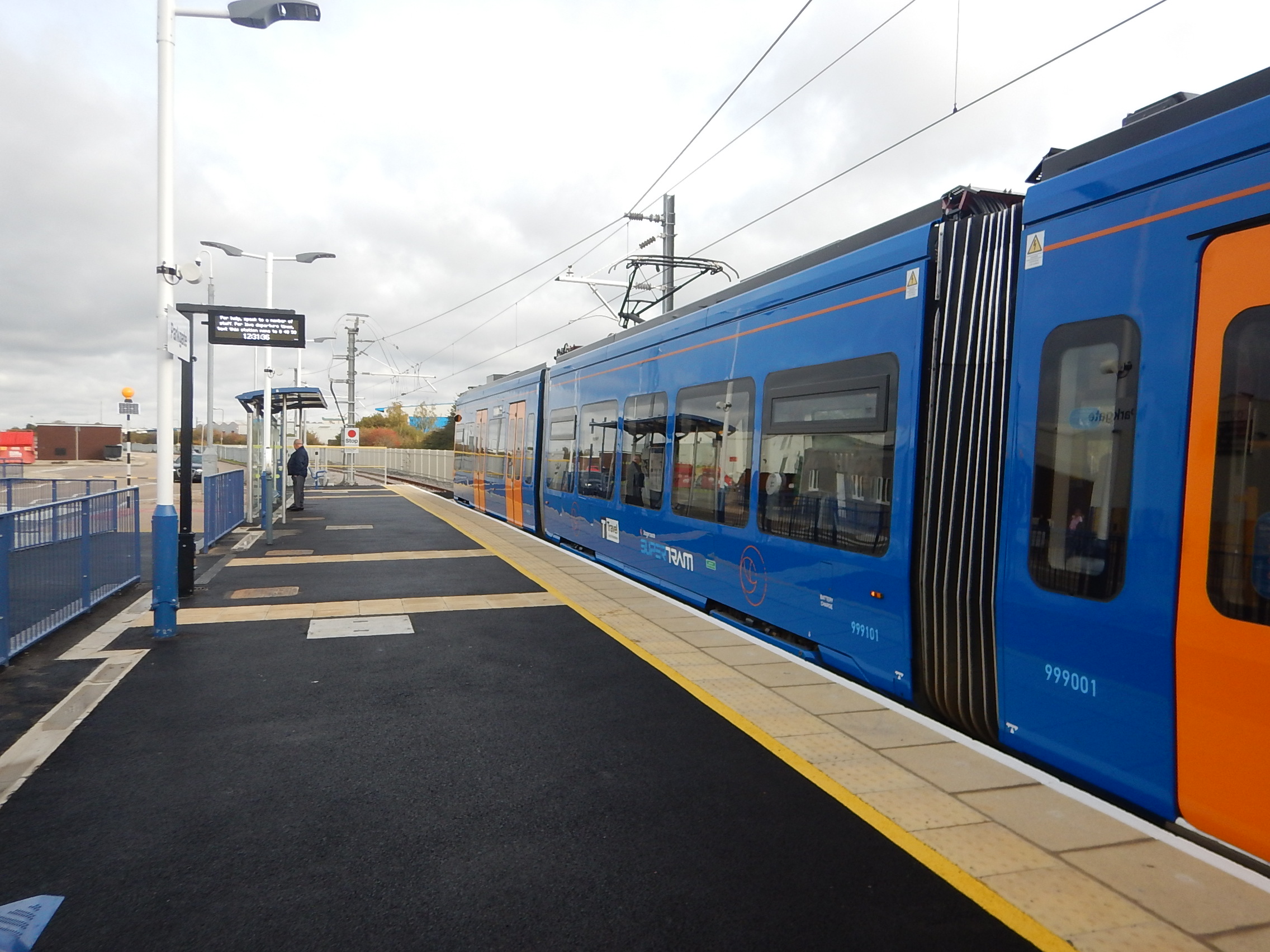
Note the step-free access.
They are a very versatile tram or train, depending on where they are running.
I would suspect the following will happen in the next few years.
- Sheffield are planning to replace their ageing tram fleet and they will look seriously at more Class 399 tram-trains, as they perform well as trams and the region needs more tram-trains.
- Manchester have stated that they are looking seriously at tram-trains and Class 399 tram-trains will surely be considered.
- Other tram networks are looking at tram-trains and they won’t ignore the Class 399 tram-train.
I feel we can expect to see more of these tram-trains in the UK.
Manchester Metrolink Needs More Trams
Manchester Metrolink will need more trams in the next few years and I wouldn’t be surprised that the new ones have a tram-train capability.
Testing Tram-Trains On The Manchester Metrolink
On the Sheffield Supertram, the new tram-trains were first tested as trams on the existing network.
This approach could be taken on the Manchester Metrolink, to both full test the tram-trains and train the staff.
Improving Navigation Road
Navigation Road station has two platforms, one of which is used for the Metrolink and the other for National Rail.
The station could be configured, so that the Western platform would be for Northbound services and the Eastern platform would be for all Southbound services.
There would be two pairs of tracks leading away from the Northern end of the station; one pair for Metrolink services and the other for National Rail services.
The current two pairs of tracks South of Navigation Road station would be used as follows.
- The Western pair would be for any Metrolink tram services terminating in Altrincham station.
- The Eastern pair would be for National Rail services and Metrolink tram-train services going beyond Altrincham station.
Tram-trains running past Altrincham station, would either need the tracks to be electrified or the tram-trains to be fitted with batteries.
Possible Tram-Train Routes To Hale
These are possible routes.
A Metrolink Extension From Altrincham
This is the simplest option, where tram-trains would replace some or all of the service on the Atrincham and Bury and Altrincham and Piccadilly Metrolink services.
The tram-trains would use new electrification or onboard batteries South of Navigation Road.
A Northward Extension From Manchester Victoria Station
In Could A Class 399 Tram-Train With Batteries Go Between Manchester Victoria And Rochdale/Bury Bolton Street/Rawtenstall Stations?, I looked at the possibilities of a Northward extension of the Metrolink, using tram-trains, that had been suggested by an article in the February 2019 Edition of Modern Railways.
I have included it here, as it would be a good destination for a cross-city tram-train service, that started at Hale.
A Southward Extension From Altrincham To Middlewich
If the Sandbach and Northwich Line were to be reopened to traffic with a station at Middlewich, this would be a possible Southern terminus for the route.
The distance would probably be too far for battery operation, so there would be a need to electrify the extension using either 25 KVAC main line or 750 VDC tramway electrification.
As the route has been used by Virgin’s Euston and Chester services as a diversion route, and the Crewe and Chester Line has a high priority for electrification, there is a chance that lines in the area will be electrified.
This could mean the tram-trains could easily run from Altrincham as far as Crewe, as the route could be fully electrified.
Tram-Train Between Manchester Piccadilly and Hale Via Stockport
On the route between Manchester Piccadilly and Hale station via Stockport, there are only two stations between Stockport and Hale station; Navigation Road and Altrincham.
Would it be feasible or worthwhile to convert this route into tram-train operation by perhaps adding 750 VDC overhead electrification?
- There is typically one or two freight trains and one Chester and Manchester Piccadilly service in each direction in every hour, so two tram-trains per hour in each direction should be possible.
- Stops could be added at convenient places.
- Between Stockport and Manchester Piccadilly stations, the existing 25 KVAC electrification would be used.
It would not be the largest project.
The Refurbishment Of Hale Station
Hale station needs a refurbishment and a step-free bridge.
In Winner Announced In The Network Rail Footbridge Design Ideas Competition, I wrote how the competition was won by this bridge.
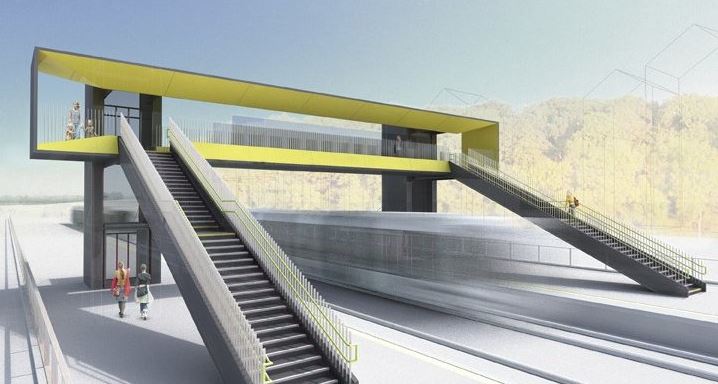
So could a factory-built bridge like this be installed at Hale station?
This Google Map shows Hale station.
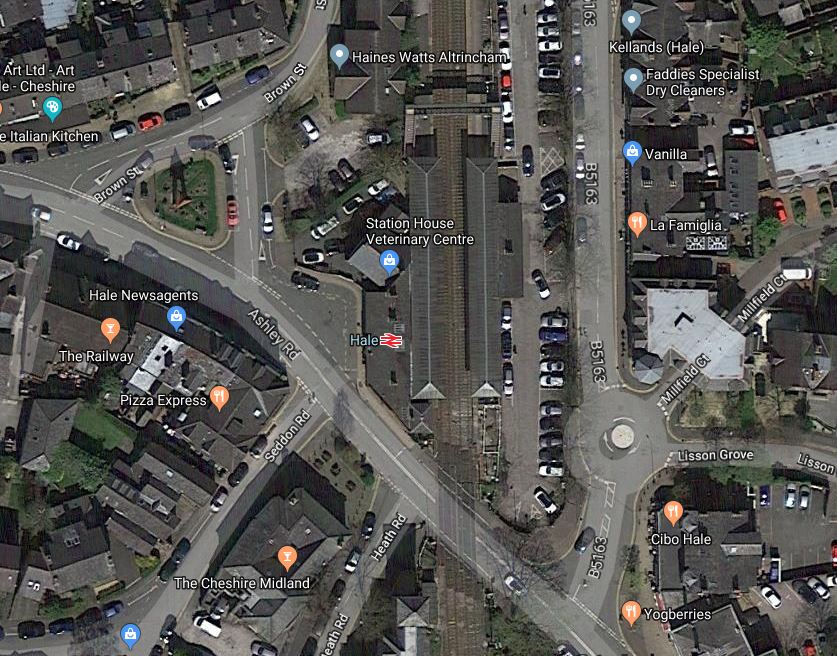
I think a new bridge could be installed at the Northern end of the station, if it were to be decided that the current one couldn’t be fitted with lifts.
The Electrification And Bi-Mode Alternative
As I said earlier the Crewe and Chester Line could be electrified, which would enable electric trains to run between London and Chester.
However, since the award of the West Coast Partnership to First Trenitalia, I now think it is unlikely the Crewe and Chester Line will be electrified in the near future, as new bi-mode trains will be ordered for North Wales services.
But I don’t reject the notion, that Northern will run bi-mode Class 769 trains between Manchester Piccadilly and Chester.
These trains could use the electrification between Stockport and Manchester Piccadilly stations.
Conclusion
These are my conclusions.
- Tram-trains can deliver a capacity improvement through Navigation Road station.
- Tram-trains could be extensively tested on the existing Manchester Metrolink network.
- Tram-trains could be used to build a simple extension to Hale station from Altrincham.
- The Manchester and Chester service via Stockport, Navigation Road and Altrincham stations could be run by tram-trains.
A comprehensive network of tram-trains could be developed between, through and beyond Altrincham, Crewe and Chester.
Nespresso
Just heard the CEO of Nrdpresso defending his product, where seventy-two percent of the product goes into landfill.
Ridiculous!
My tea-bag goes straight into the food composting bin!
So much more environmentally-friendly!
 The Anonymous Widower