Centrica Really Can’t Lose At Sizewell
The title of this post, is the same as that of this article in The Times.
This is the sub-heading.
Centrica’s £1.3 billion investment in Sizewell C guarantees substantial returns, even with cost overruns.
These two-and-a-half paragraphs explain the funding.
Now we know what Ed Miliband means by his “golden age of nuclear” — golden for the companies putting their money into Sizewell C. Yes, reactor projects have a habit of blowing up private investors. But maybe not this one. It looks more like an exercise in transferring risk to consumers and the taxpayer.
Sure, nobody builds a £38 billion nuke on a Suffolk flood plain without a frisson of danger. But the energy secretary and his Treasury chums have done their bit to make things as safe as possible for the companies putting in equity alongside the government’s 44.9 per cent stake: Canada’s La Caisse with 20 per cent, British Gas-owner Centrica (15 per cent), France’s EDF (12.5 per cent) and Amber Infrastructure (7.6 per cent).
For starters, nearly all the debt for the 3.2 gigawatt plant, three-quarters funded by loans, is coming from the state-backed National Wealth Fund. It’s bunging in up to £36.6 billion, with £5 billion more guaranteed by a French export credit agency.
It looks to me that between them the British and French governments are providing £41.5 billion of loans to build the £38 billion nuke.
These are my thoughts.
Hydrogen And Sizewell C
This page on the Sizewell C web site is entitled Hydrogen And Sizewell C.
Under a heading of Hydrogen Buses, this is said.
At Sizewell C, we are exploring how we can produce and use hydrogen in several ways. We are working with Wrightbus on a pilot scheme which, if successful, could see thousands of workers transported to and from site on hydrogen double decker buses. You can read more about the pilot scheme in our press release
Firstly, it could help lower emissions during construction of the power station. Secondly, once Sizewell C is operational, we hope to use some of the heat it generates (alongside electricity) to make hydrogen more efficiently.
This would appear to be a more general statement about hydrogen and that the following is planned.
- Hydrogen-powered buses will be used to bring workers to the site. A press release on the Sizewell C web site, talks about up to 150 buses. That would probably be enough buses for all of Suffolk.
- Hydrogen-powered construction equipment will be used in the building of the power station.
- It also talks about using the excess heat from the power station to make hydrogen more efficiently. I talk about this process in Westinghouse And Bloom Energy To Team Up For Pink Hydrogen.
This is a substantial investment in hydrogen.
Centrica And Electricity From Sizewell C
The article in The Times, also says this.
Even so, there’s a fair bit of protection for the likes of Centrica, which has also agreed a 20-year offtake deal for its share of Sizewell’s electricity. The price of that is not yet known.
Nothing is said in the article about the size of Centrica’s electricity offtake.
- If they get 15 % of Sizewell C, that would by 480 MW.
- If they get 15 % of Sizewell B + C, that would by 660 MW.
If they use their share to generate hydrogen, Suffolk would have a massive hydrogen hub.
To power the buses and construction of Sizewell C, Sizewell B could be used to provide electricity to create the hydrogen.
How Would The Hydrogen Be Produced?
Centrica, along with other companies, who include Hyundai and Kia, are backers of a company in Hull called HiiROC, who use a process called Thermal Plasma Electrolysis to generate hydrogen.
On their web site, they have this sub-heading.
A Transformational New Process For Affordable Clean Hydrogen
The web site also describes the process as scalable from small modular units up to industrial scale. It also says this about the costs of the system: As cheap as SMR without needing CCUS; a fraction of the energy/cost of water electrolysis.
If HiiROC have achieved their objective of scalability, then Centrica could grow their electrolyser to meet demand.
How Would The Hydrogen Be Distributed?
Consider.
- Currently, the Sizewell site has both road and rail access.
- I can still see in my mind from the 1960s, ICI’s specialist articulated Foden trucks lined up in the yard at Runcorn, taking on their cargoes of hydrogen for delivery all over the country.
- As that factory is still producing hydrogen and I can’t remember any accidents in the last sixty years, I am fairly sure that a range of suitable hydrogen trucks could be developed to deliver hydrogen by road.
- The road network to the Siewell site is being updated to ensure smooth delivery of workers and materials.
- The rail access to the Sizewell site is also being improved, for the delivery of bulk materials.
I believe there will be no problems delivering hydrogen from the Sizewell site.
I also believe that there could be scope for a special-purpose self-propelled hydrogen tanker train, which could both distribute and supply the hydrogen to the vehicles, locomotives and equipment that will be using it.
Where Will The Hydrogen Be Used?
I have lived a large part of my life in Suffolk and know the county well.
In my childhood, there was quite a lot of heavy industry, but now that has all gone and employment is based on agriculture, the Port of Felixstowe and service industries.
I can see hydrogen being used in the following industries.
Transport
Buses and heavy trucks would be powered by hydrogen.
The ports in the East of England support a large number of heavy trucks.
Large Construction Projects
Sizewell C is not the only large construction project in the East of England, that is aiming to use low-carbon construction involving hydrogen. In Gallagher Group Host Hydrogen Fuel Trial At Hermitage Quarry, I talked about a hydrogen fuel trial for the Lower Thames Crossing, that involved JCB and Ryse Hydrogen.
Hydrogen for the Lower Thames Crossing could be delivered from Sizewell by truck, down the A12.
Rail
We may not ever see hydrogen-powered passenger trains in this country, but I do believe that we could see hydrogen-powered freight locomotives.
Consider.
- The latest electro-diesel Class 99 locomotives from Stadler have a Cummins diesel engine.
- The diesel engine is used, when there is no electrification.
- Cummins have developed the technology, that allows them to convert their latest diesel engines to hydrogen or natural gas power, by changing the cylinder head and the fuel system.
- Access to the Port of Felixstowe and London Gateway needs a locomotive with a self-powered capability for the last few miles of the route.
A Class 99 locomotive converted to hydrogen would be able to run with out emitting any carbon dioxide from Felixstowe or London Gateway to Glasgow or Edinburgh.
Ports
Ports have three main uses for hydrogen.
- To power ground-handing equipment, to create a pollution-free atmosphere for port workers.
- To fuel ships of all sizes from the humblest work-boat to the largest container ships.
- There may need to be fuel for hydrogen-powered rail locomotives in the future.
There are seven ports with excellent road and/or rail connections to the Sizewell site; Felixstowe, Great Yarmouth, Harwich, Ipswich, London Gateway, Lowestoft and Tilbury.
The proposed Freeport East is also developing their own green hydrogen hub, which is described on this page on the Freeport East web site.
Airports
Airports have two main uses for hydrogen.
- To power ground-handing equipment, to create a pollution-free atmosphere for airport workers.
- In the future, there is likely to be hydrogen-powered aircraft.
There are three airports with excellent road and/or rail connections to the Sizewell site; Norwich, Southend and Stansted.
Agriculture And The Rural Economy
Agriculture and the rural economy would be difficult to decarbonise.
Consider.
- Currently, most farms would use diesel power for tractors and agricultural equipment, which is delivered by truck.
- Many rural properties are heated by propane or fuel oil, which is delivered by truck.
- Some high-energy rural businesses like blacksmiths rely on propane, which is delivered by truck.
- Electrification could be possible for some applications, but ploughing the heavy land of Suffolk, with the added weight of a battery on the tractor, would probably be a mathematical impossibility.
- JCB are developing hydrogen-powered construction equipment and already make tractors.
- Hydrogen could be delivered by truck to farms and rural properties.
- Many boilers can be converted from propoane to run on hydrogen.
I feel, that hydrogen could be the ideal fuel to decarbonise agriculture and the rural economy.
I cover this application in detail in Developing A Rural Hydrogen Network.
Exports
Consider.
- Sizewell B and Sizewell C nuclear powerstations have a combined output of 4.4 GW.
- A rough calculation shows that there is a total of 7.2 GW of wind farms planned off the Suffolk coast.
- The East Anglian Array wind farm alone is said in Wikipedia to be planned to expand to 7.2 GW.
- The Sizewell site has a high capacity connection to the National Grid.
Nuclear plus wind should keep the lights on in the East of England.
Any excess electricity could be converted into hydrogen.
This Google Map shows the location of Sizewell B in relation to Belgium, Germany and The Netherlands.
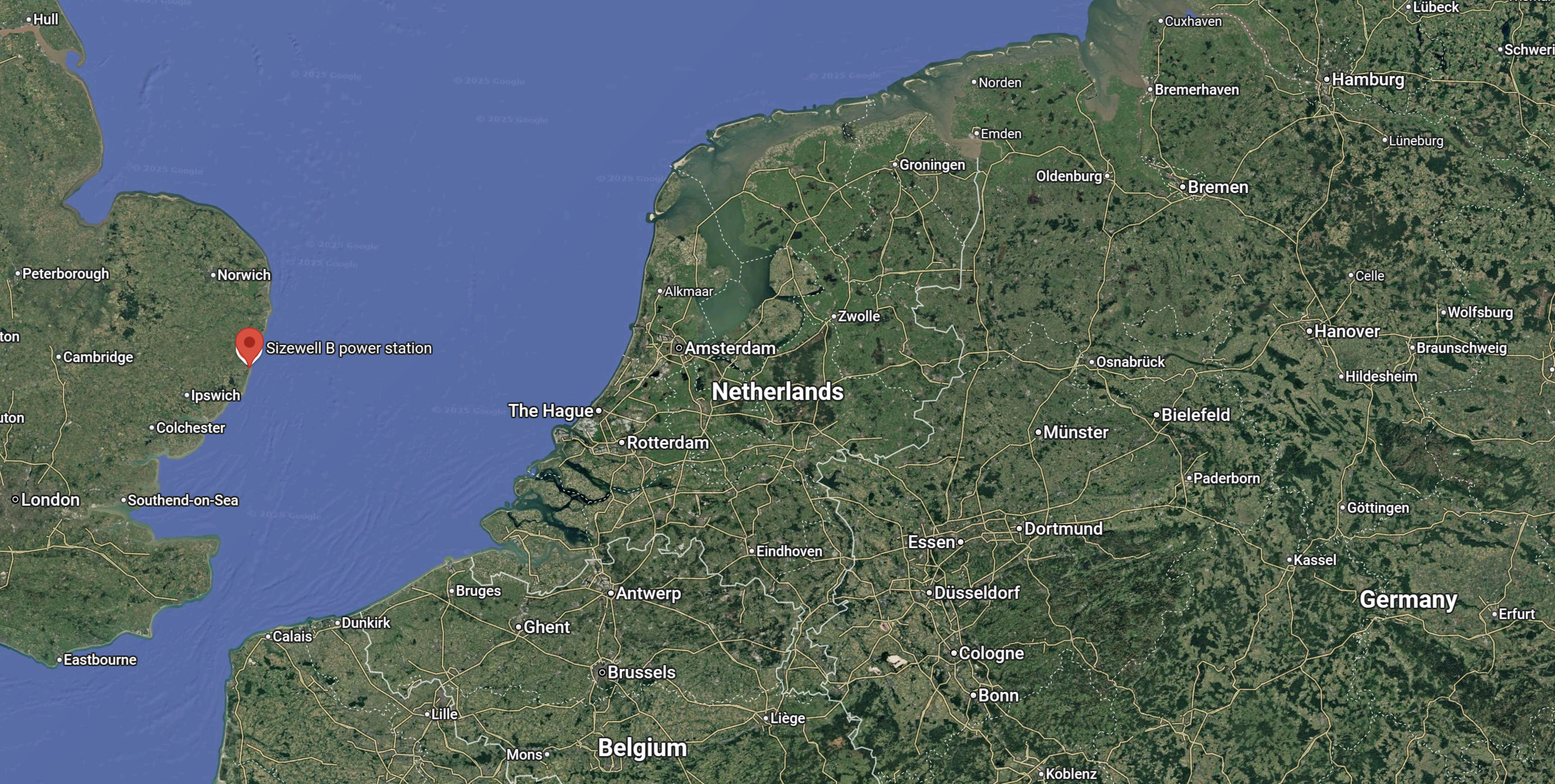
The Sizewell site is indicated by the red arrow.
The offshore oil and gas industry has used technology like single buoy moorings and coastal tankers to collect offshore natural gas for decades.
I don’t see why coastal hydrogen tankers couldn’t export excess hydrogen to places around the North Sea, who need the fuel.
It should be born in mind, that Centrica have a good reputation in doing natural gas trading. This expertise would surely be useful in hydrogen trading.
Conclusion
I believe that a hydrogen hub developed at Sizewell makes sense and I also believe that Centrica have the skills and technology to make it work.
 The Anonymous Widower
[…] Centrica Really Can’t Lose At Sizewell, I looked at Centrica’s involvement in Sizewell C and in particular the financing of the nuke […]
Pingback by British Gas Owner Mulls Mini-Nuke Challenge To Rolls-Royce « The Anonymous Widower | July 27, 2025 |