Greater Anglia: First Class Seats Scrapped On Most Trains
The title of this post, is the same as that of this article on the BBC.
This is the first three paragraphs.
First class travel is being scrapped on all Greater Anglia trains except intercity services from January 2020, the firm has announced.
The rail operator said it was also bringing in new longer trains from the end of next year.
Both measures would provide 20% more standard seats, it said.
I travel on Greater Anglia a lot and generally travel in the Off Peak.
I always buy a Standard Class ticket, although sometimes on Saturday or Sunday, I’ll add a Weekend First Upgrade on the InterCity train, which I buy onboard.
Why anybody would use First Class on their Class 321 or Class 360 trains, I can’t understand.
The InterCity trains are worth a selective upgrade to First, when they are busy, but the long-distance suburban trains are just a bigger seat and of a standard well below Standard on some excellent Standard Class services.
Now, that Greater Anglia are bringing in new trains, hopefully Standard Class will be up there with the best!
I wonder if Disgusted- in-Frinton will be complaining!
Could Metropolitan Line Trains Run Between Uxbridge In The West And Barking/Upminster In The East?
I read somewhere in Wikipedia, that Transport for London (TfL) were thinking of extending Uxbridge Branch trains on the Metropolitan Line from Aldgate to Barking and/or Upminster stations.
Current Frequencies Between Wembley Park And Upminster Stations
These are the Off Peak frequencies on the various sections of the route in trains per hour (tph)
Wembley Park To Baker Street
- 2 tph – Amersham to Aldgate
- 2 tph – Chesham to Aldgate
- 8 tph – Uxbridge to Aldgate
- 4 tph – Watford to Baker Street
This gives a total of 16 tph
Baker Street To Liverpool Street
- 2 tph – Amersham to Aldgate
- 2 tph – Chesham to Aldgate
- 8 tph – Uxbridge to Aldgate
- 6 tph – Hammersmith to Barking
- 6 tph – Circle Line
This gives a total of 24 tph
Aldgate East to Barking
- 6 tph – Hammersmith to Barking
- 6 tph – Richmond to Upminster
- 6 tph- Ealing Broadway to Upminster
- 3 tph – Wimbledon to Barking
This gives a total of 21 tph
Barking to Upminster
- 6 tph – Richmond to Upminster
- 6 tph – Ealing Broadway to Upminster
This gives a total of 12 tph
Current Frequencies Between Hammersmith And Baker Street
I’ll add this, in case I need it later.
- 6 tph – Hammersmith to Barking
- 6 tph – Circle Line
This gives a total of 12 tph
Current District Line Frequencies Between Hammersmith And Upminster
These are the Off Peak frequencies on the various sections of the route.
Hammersmith to South Kensington
- 6 tph – Richmond to Upminster
- 6 tph – Ealing Broadway to Upminster
This gives a total of 12 tph
South Kensington to Tower Hill
- 6 tph – Richmond to Upminster
- 6 tph – Ealing Broadway to Upminster
- 3 tph – Wimbledon to Barking
- 6 tph – Circle Line
This gives a total of 21 tph
Aldgate East to Barking
- 6 tph – Hammersmith to Barking
- 6 tph – Richmond to Upminster
- 6 tph- Ealing Broadway to Upminster
- 3 tph – Wimbledon to Barking
This gives a total of 21 tph
Barking to Upminster
- 6 tph – Richmond to Upminster
- 6 tph – Ealing Broadway to Upminster
This gives a total of 12 tph
Four Lines Modification
The Four Line Modification is a project to upgrade the following lines.
- Circle Line
- District Line
- Hammersmith & City Line
- Metropolitan Line
New S7 and S8 Stock trains have been delivered and new track and drainage has been installed, but the biggest change will be in the new signalling. TfLsays this abut the new signalling.
Work to install a new signalling and control system began in summer 2016. This will eventually allow the trains to be driven automatically, with a train operator in the cab to open and close the doors. The train operator will be responsible for managing customer information and safety.
Similar technology introduced in recent years on the Jubilee and Northern lines improved performance. The new signalling system allows trains to be run closer together, meaning a more frequent service and shorter waiting times, allowing more people to be carried. This new technology will enable us to reduce delays and improve reliability.
If 32 tph can be run on sections of the four lines, it is an impressive upgrade of capacity.
Currently the frequencies are.
- Wembley Park to Baker Street – 16 tph
- Baker Street to Liverpool Street – 24 tph
- Aldgate East to Barking – 21 tph
- Barking to Upminster – 12 tph
For completeness these frequencies will be added.
Hammersmith to Baker Street – 12 tph
Note
- The frequencies are all at least eight tph below the maximum future operating frequency.
- The busiest section is between Baker Street and Liverpool Street stations.
- The frequency on the two end sections of the Northern East-West section between Hammersmith and Upminster stations is only 12 tph.
It looks like TfL have scope to increase the capacity on the four lines.
Are The Circle/District Line Platforms At Edgware Road Station At Maximum Capacity?
Currently, the following services terminate at Edgware Road station.
- Six tph on the Circle Line.
- Six tph on the District Line from Wimbledon station.
As there are only two platforms to turn the twelve tph, I wouldn’t be surprised if someone told me, that Edgware Road station was at maximum capacity.
If this is the case, then no more trains can be run on the Circle Line, without reducing the frequency to Wimbledon, unless the station were to be rebuilt.
This Google Map shows the station.

And this map from carto.metro.free.fr shows the lines through Edgware Road and Baker Street stations.
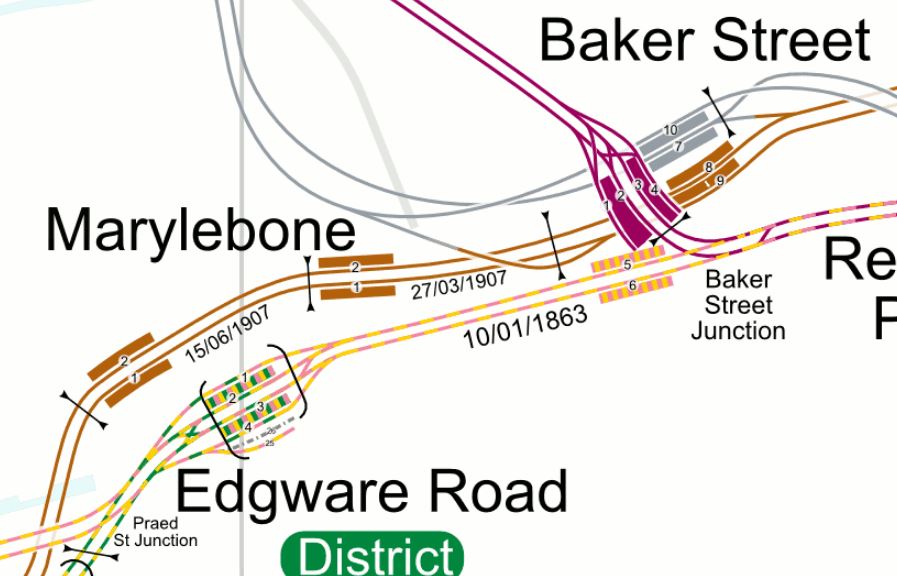
Edgware Road station lies in a cutting, in the midst of some very expensive real estate.
- It is not step-free.
- According to the carto.metro.free.fr map, there used to be or still is a siding or platform to the South of the current four platforms.
- The junctions to the West of the stations are complicated.
- As trains often wait for a few minutes in the station, I suspect it is not operationally efficient.
Could at some time in the future, the station be rebuilt?
- The East-West services might go straight through in two Northern platforms.
- The junction to the West of the station would be simplified, with no crossing of tracks.
- Three terminal platforms could be built for trains coming from the South, which would allow an increase in services.
- Hopefully, the East-West and terminating services could be separated and wouldn’t cross each other.
- Development of tower blocks over the top would provide some funds for the new station.
Would it be possible to increase Circle Line services to ten tph?
Frequencies along the route would be as follows.
- Baker Street to Liverpool Street – 28 tph
- Tower Hill to South Kensington – 25 tph
- High Street Kensington to Edgware Road – 16 tph
My scheduling nous says yes! I also feel, that using good project planning, the station could be built without disrupting services.
Baker Street Issues
Is Aldgate Station At Maximum Capacity?
Currently, the following services terminate at Aldgate station.
- 2 tph from Amersham
- 2 tph from Chesham
- 8 tph from Uxbridge
As there are only two platforms to turn the twelve tph, I wouldn’t be surprised if someone told me, that Aldgate station was at maximum capacity.
This map from carto.metro.free.fr shows the lines at Aldgate station.
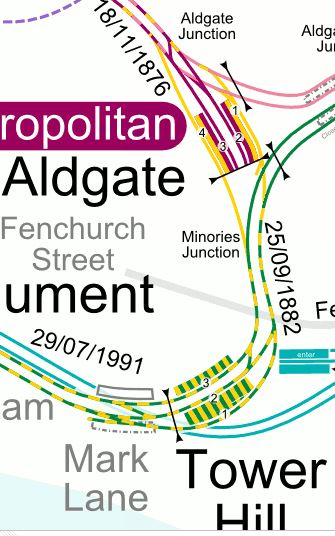
Note
- The two platforms at Aldgate station are sandwiched between the two Circle Line tracks.
- The platforms are curved, which makes step-free access difficult.
I suspect fitting in three straight platforms and full step-free access in the existing station will be very difficult.
This Google Map shows the general area around Aldgate station.

Certainly South of Aldgate High Street, there seems to be a site that could be ripe for development.
Are the District and Circle Lines underneath?
In a comment to this post, Melvyn says that the station could be redeveloped. He said this.
I did read a proposal to make Aldgate accessible linked to property development so this would mean a redesign of the station which could lead to removal of one of the terminal tracks.
I think I will conclude, that whatever happens at Aldgate station, there is no way, the station can handle more than twelve tph.
Could Extra Trains Be Turned At Barking?
This map from carto.metro.free.fr shows Barking station and the sidings to the East.
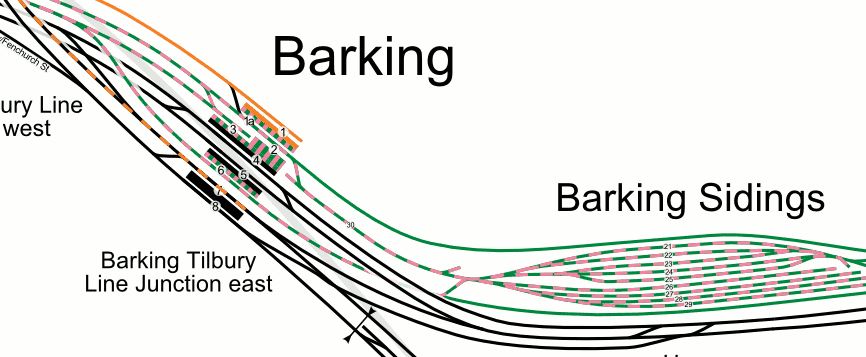
If the eight tph from Uxbridge turned back at Barking, that would mean that seventeen tph would need to be handled at the station.
I’m fairly certain, that this number of trains could be turned at Barking.
It is also worth noting in the map, the cross-platform interchange with c2c.
Could Extra Trains Be Turned At Upminster?
Upminster station has a depot with an impressive maze of sidings to the East.
As the station also has three platforms for District Line trains, I believe the station can handle more than the twelve tph, that it does now!
Increasing The Core Frequency
Suppose extra trains were to be run between Baker Street and Liverpool Street stations.
Ideally, eight extra tph would need to be run to use the maximum capacity of the route.
Where Would The Extra Trains Go In The West?
Extra trains could possibly be run to Hammersmith station, as the three-platform station can probably handle more trains than the twelve tph it does now.
If Edgware Road station is at maximum capacity, then no more Circle Line trains could be run.
But with a rebuild of Edgware Road station in the future, would allow perhaps up to an extra four tph on the Circle Line.
But there could be a few more Hammersmith & City Line services.
There would also be the possibility of more Metropolitan Line services to Amersham, Chesham Uxbridge and Watford stations.
Where Would The Extra Trains Go In The East?
Consider.
- There are four bay platforms at Moorgate station,but are they currently the wrong side of the important Liverpool Street station.
- Moorgate station is being rebuilt for Crossrail and this may open up possibilities for using the bay platforms.
- Aldgate station is at full capacity.
- Extra trains can’t take the Circle Line as Edgware Road station is at frill capacity.
- With a rebuild of Edgware Road station, it might be possible to add four tph to the Circle Line.
So I come to the conclusion, that some extra services must go on to Barking and/or Upminster.
A Possible Timetable
If I assume the extra eight tph go all the way between Wembley Park and Upminster, this gives the following frequencies along the line.
- Wembley Park to Baker Street – 24 tph
- Baker Street to Liverpool Street – 32 tph
- Aldgate East to Barking – 29 tph
- Barking to Upminster – 20 tph
The terminals of the various services could be shared between Aldgate and Upminster.
I also suspect, that the new signalling will allow twelve tph instead of the current eight tph to be terminated at Baker Street station.
Uxbridge To Barking/Upminster Timings
These are the timings for various section of the route.
- Uxbridge to Baker Street – 38 minutes
- Baker Street to Liverpool Street – 13 minutes
- Liverpool Street to Barking – 25 minutes
- Barking to Upminster – 18 minutes
This means that Uxbridge to Upminster could take 94 minutes, with Uxbridge to Barking taking 76 minutes.
These may translate into the following round-trips.
- Uxbridge and Upminster – Four hours, which would need 32 trains.
- Uxbridge and Barking – Three hours, which would need 24 trains.
The current service between Uxbridge and Aldgate has a round trip of two hours, which needs 16 trains.
It would appear that if Uxbridge services go to an alternative terminal, then Barking would be a better choice.
Conclusion
It looks like, that it is very likely, that Metropolitan Line trains will run as far as Barking and/or Upminster stations.
Aberdeen Standard Backs Controversial £1bn Bid For Crossrail Fleet
The title of this post, is the same as that of this article on City AM.
This has been mooted for some time and I believe that Transport for London are taking a sensible action to help get round their funding crisis, caused by three factors.
- The loss of Government subsidy.
- The lateness of Crossrail.
- Sadiq Khan’s bribe to the electorate of a fare freeze.
I also think, that this will be advantageous to London in the long term.
This is a paragraph in the article.
TfL would be able to terminate the 35-year lease in 2020, 2025 and 2030, through a break clause, with an ability to acquire the fleet for just £1 in 2044. TfL will announce the winner at the beginning of next year.
Depending on how TfL’s finance progress in the next few years, the break clause may allow them to cancel and acquire new trains, if they felt it best.
But all these trains need a rebuilding at someyime around twenty years old and this will surely be the responsibility of the leasing company.
Testing Of New Greater Anglia Trains Underway
The title of this post is the same as that of this article on Rail Magazine.
This is the first paragraph.
The first Stadler bi-mode unit for Greater Anglia made its main line debut in the early hours of December 15, when it ran between Diss and Trowse Junction (near Norwich).
I looked on Real Time Trains and found that the train did five trips between Diss and Trowse Junction. After the last trip, the train went back to Crown Point Depot.
It does seem that Greater Anglia have a plan to do the testing.
A Video Of The Alstom Coradia iLint
This video of the Alstom Coradia iLint has been uploaded to YouTube.
I must go and get a ride!
Ballard Receives Order From Porterbrook for Fuel Cell Module to Power UK HydroFLEX Train
The title of this post is the same as this article on Cision.
The article says that the copy has been provided by Ballard.
This is the first paragraph.
VANCOUVER and DERBY, U.K., Dec. 13, 2018 /CNW/ – Ballard Power Systems (NASDAQ: BLDP; TSX: BLDP) today announced that it has received a purchase order from Porterbrook Leasing Company Limited (“Porterbrook”; http://www.porterbrook.co.uk), a leading participant in the rail leasing market, for an FCveloCity®-HD fuel cell module and related support to power a HydroFLEX train in the U.K.
The article says this about the HydroFLEX train.
The HydroFLEX will be the U.K.’s first fully sized hydrogen demonstrator train. It will showcase how hydrogen can be used to power a train that retains the ability to operate across existing electric routes, on either 3rd rail or 25kV overhead power. Testing and demonstration runs are planned for the summer of 2019 at RailLive, which will take place at Long Marston in Warwickshire.
That sounds like it could be a date for my diary.
Strictly A Demonstrator
In this article on Rail Engineer, which is entitled Hydroflex – The Next Iteration Of The Flex Concept,there is a section entitled Strictly A Demonstrator, from which this was taken.
In response to Rail Engineer’s questions, BCRRE said that the demonstrator version focuses on delivering an electric/hydrogen bi-mode to UK gauge.
So the HydroFLEX is more about research., which I believe is a good route.
- My feelings on seeing the Alstom Coradia iLint in Germany, was that they had launched too early!
- Getting a University to run a demonstrator might show up the smaller problems associated with a complex project.
- Birmingham University may also have access to better mathematics and computing.
- The interior of the train can be used for test equipment and hydrogen tanks.
I also suspect that a well-designed demonstrator could help with the repurposing of Porterbrook’s extensive fleet, by doing appropriate research.
The Fuel Cell
The Ballard fuel cell is a HD variant of their FCveloCity family.
This page on the Ballard web site is the data sheet.
- The fuel cells come in three sizes 60, 85 and 100 kW
- The largest fuel cell would appear to be around 1.2 m x 1 m x 0.5 m and weigh around 400 Kg.
- The fuel cell has an associated cooling subsystem, that can provide heat for the train.
It would appear that mounting the fuel cell under the train floor would be a feasible proposition. I would assume that the cell would be placed under one of the driver cars.
If you search the Internet, you’ll find there is a lot of fuel cell companies out there innovating like crazy and fighting for market share.
I don’t think there will be any problem with the fuel cell in the HydroFLEX train.
The Electrical System
The electrical system of the Class 319 train is simple.
- There is a 750 VDC busbar, which connects to all four cars.
- The busbar is fed by the 25 KVAC overhead or 750 VDC third-rail electrification.
- One of the middle cars has the pantograph and the other has four 247.5 kW traction motors, which power the whole train.
- There is no regenerative braking capability.
- The two driver cars are only differentiated, by the seats installe by the operator.
It looks to me that this was a sensible piece of 1980s engineering by British Rail to create a low-cost dual-voltage train.
I do wonder, if the originator of this system is still hale and hearty. I suspect they are, as they certainly know how to design for a long life.
When Porterbrook commissioned the Class 769 train, the two diesel generators under the driver cars were connected into this busbar.
They didn’t add any energy storage to the train, although as I said in Brush Traction Signs Contract With Skeleton Technologies For Modules For Class 769 Trains, they have added SkelStart capacitors to start the diesel generators.
Effectively, the Class 769 train is an electric or diesel train, just like the Class 319 train is an overhead or third-rail electrificsation train.
Will the fuel cell of the HydroFLEX train be connected to the electrical system of the train in the same way?
Or will energy storage, be added to the drive train?
In a more advanced design, batteries or capacitors could be in the motored car.
- They would be charged from the busbar.
- They would power the traction motors.
If the traction motors, were to be changed to modern ones, that could perform regenerative braking, then this energy could be used to recharge the battery.
The Fuel Tank
I suspect as the train is for research, that a standard off-the-shelf hydrogen tank will be used.
This page on the Fuel Cells And Hydrogen Joint Undertaking, is entitled Improved Hydrogen Tanks For Fuel Cell Cars Of The Future.
This is the first paragraph.
The EU funded COPERNIC project, supported by the Fuel Cells and Hydrogen Joint Undertaking (FCH JU), succeeded in improving the quality of materials and design of hydrogen storage tanks for cars. It also made the manufacturing of these tanks more cost efficient, helping to make hydrogen cars a more viable and competitive option.
I think it is highly likely, that a well-designed hydrogen tank, could probably share the space under the driver car with the fuel cell.
If it can’t then as it’s a research project a few seats can be taken out.
Harry Redknapp And Stacey Dooley
With Harry Redknapp winning I’m A Celebrity … Get Me Out Of Here and Stacey Dooley winning Strictly Come Dancing are we seeing a reaction to the gloom that pervades everyday life and especially politics.
I’ve never met either, but both seem likeable characters, to whom not many would object.
The Problem With Britain’s And Probably Other Older Railways
This post on IanVisits is entitled West Hampstead Overground Station’s New Footbridge.
Ian had intended to report on the finish of a station rebuilding project at West Hampstead station.
But like many other projects it is running several months late.
Ian says this.
It’s reported that the delay stems from an unexpected massive slab of concrete that was added to the bridge that runs over the railway tracks, and supports the old station entrance.
Plans to pull the old building back and release more space on the pavement may now need to be revised as that would require the pavement to be reinforced to the same level as the road, in case a heavy lorry were to swerve onto the pavement by accident.
The old Edwardian era station building was due to be turned into a “retail opportunity”, although that may now be in doubt if the pavement issue proves intractable.
How many of us have renovated old buildings to find that what is actually there, has little relation to what the surveyors/architects believed was there?
Years ago, I was rebuilding a Listed house and the Listed Building Inspector from English Heritage was very practical. When she asked the Council Planner, if he thought that the house should be like it was built in the 1840s, he said yes!
To which she replied, “So you think there should be outside toilets?”
Everybody except one laughed!
A couple of months later, she came back to see the work and told me of a very rich man, who was rebuilding a Grade II Listed Building, that was several times over budget. Her advice at the time had been knock it down or move, as she felt preservation was impossible. But the neighbours and the wider area, felt that the building should be saved.
I suspect that, if Transport for London had known what they know now, they would have demolished the inadequate station. I don’t think the station is Listed!
Conclusion
We have a preserve all buildings regardless of the cost attitude in this country and it exists in other countries as well.
Look at my post Stuttgart Hauptbahnhof, which outlines the problems there.
Imagine Crossrail with lots of tunnel construction problems and angry protestors!
Palm Oil Giant Wilmar International To Combat Deforestation Using Satellite Monitoring Of Suppliers
The title of this post is the same as that of an article on The Independent.
This is the first three paragraphs.
The world’s largest trader in palm oil has unveiled plans to use satellite monitoring to prevent further destruction of rainforests.
Wilmar International is backing a project by sustainability consultancy Aidenvironment to draw up a comprehensive mapping database of suppliers in countries such as Indonesia and Malaysia.
It has pledged to immediately suspend groups involved in deforestation or development on peatland, while also working with them to improve their operations.
Both the Independent and The Times, quote Kiki Taufik of Greenpeace, as the announcement being a potential breakthrough.
The Times also says, that Mondelez, who own Cadbury, have backed Wilmar’s palm oil plan.
Vivarail And Hoppecke Announce Long-term Supply Of Batteries For Class 230s
The title of this post is the same as that of a press release from Vivarail.
Some extracts.
A 3-car Class 230 can run for 65 miles between charges which means they are more than able to operate numerous routes throughout the UK, and active conversations are taking place with interested operators. Battery trains enable emission-free rail travel in areas where electrification is either non- or only partially existent. The trains are particularly suited to urban routes where authorities wish to eliminate pollution caused by traditional DMUs as well as scenic lines where the natural environment needs protecting.
A Sixty-five mile range is very respectable and a good start.
Currently Vivarail is building a fleet of diesel/battery hybrids to operate the Wrexham-Bidston line for Transport for Wales, where the diesel gensets will be used to charge the batteries not to power the train. This power variant gives the range of a diesel train, the performance of an EMU (with acceleration of 1m p/s/s up to 40 miles per hour) and combines it with emission-free travel. As well as using the genset to charge the batteries the train also has regenerative braking – as do all the battery trains.
The acceleration is up there with a Class 345 train.
Hoppecke’s Lithium Ion batteries are ideally suited for the Class 230s by providing the rapid charging needed for battery trains. Simulations and performance data show that many non-electrified routes can be operated by the Class 230 battery trains and to make this possible in the short-term Vivarail has designed and patented an automatic charging system and battery bank. This means that costs of both infrastructure upgrades and daily operation are hugely minimised – in some cases by millions of pounds.
The batteries will probably be fairly traditional, but reading about Hoppecke on the web, they seem to be a company that believes in service. They also seem to supply back-up power supplies for critical infrastructure like telecommunications and computing.
Note too, that Vivarail have patented their charging system.
Designs for other types of hybrid trains exist including the use of existing OHL with a pantograph and transformer and 3rd rail with shoegear. Additionally, a new hydrogen variant is being developed which, similarly to the diesel hybrid, will exceed the pure battery train’s range of 65 miles.
Other power sources could be added, when they are invented.
A Serial Hybrid Train
The Class 230 trains for Wales are actually serial hybrids, just like one of London’s Routemaster buses. As the Press Release says, the generator set charges the batteries and these drive the train.
In the Press Release the following methods are mentioned for charging the batteries.
- Diesel generators on the train.
- Static charging systems at stations.
- Regenerative braking.
- 25 KVAC overhead line electrification.
- 750 VDC third rail electrification.
- Hydrogen fuel cells.
I wouldn’t be surprised to find that Vivarail have split the control systems into two-more or-less independent systems; one keeps the batteries charged up in an optimal manner and the other links the batteries to the train’s systems and traction motors.
I also suspect that Bombardier’s proposed 125 mph Aventra With Batteries is a serial hybrid.
Conclusion
Is there anything recycled London Underground trains can’t do?
I have read somewhere, that Vivarail have talked about on-board self-service coffee machines!
 The Anonymous Widower