David Versus Goliath Or ARM Versus Intel
I have just read this article in the Motley Fool about David or ARM Holdings taking on Goliath or Intel.
The article has been given the title The Reason ARM Holdings Is Dominating Intel, but interestingly the web page is called Why ARM Holdings Destined Destroy Intel. This name is chosen by the blogging software, from the first title used for the article taking out the short connecting words, like is and to. Look at the title and web address of this post.
But I suppose someone in management at The Motley Fool felt it was a bit provocative.
I don’t, as I think Intel is doomed.
As we need to process and store more and more data, one of the biggest limitations will be the amount of power needed.
As an example look at the average smart phone. It may have lots of features and processing power, but this often comes at the price of a short period of operation before the phone needs recharging. Now virtually all smart phones are built around ARM chips, as the Intel chips use too much power. This power consumption of ARM chips is one of the main reasons they are dominant in portable devices like smart phones and tablets.
The vast server farms have a similar problem and I’ve read that about ten percent of the world’s electricity consumption could be used to power them in the future. So a low-power route would be to everybody’s advantage. And ARM is the low power processor, although Intel are starting to design processors that are more efficient. Intel might be able to put up a strong fight, but I believe there’s one big reason, why it won’t.
Intel is a conservative company, that sticks to a philosophy that has worked for years. And getting companies with a vast investment in a proven philosophy to change, when the writing appears on the wall is not easy! Especially, when you are selling product to equally conservative companies, who don’t want to change their philosophies.
Let’s say you are a server manufacturer like Hewlett-Packard. You know you have to go with lower powered processors to maintain your market share.
You have two choices; wait for Intel’s product to arrive or design your own low-power processors around the ARM technology and get them manufactured by any one of a number of companies.
The second approach is probably the one with the lowest risk, so you at least have to try it. If it fails, you can still go with Intel’s new low power chips.
If you don’t succeed, then it is absolutely certain that someone else will develop a low power server using ARM technology. So your traditional market will go bang anyway!
It also has the great advantage, that if you do it successfully, Intel will start to worry, that you’ll go down the same route with all the other chips you buy from them. so you may get better prices for the other chips.
If you don’t succeed, then it is absolutely certain that someone else will develop a low power server using ARM technology. So your traditional market will go bang anyway!
The main loser in either scenario is Intel.
You have to remember how dominant IBM was in the 1960s. They had a philosophy that worked well, but where are they now! They’re just a shadow of their former selves where hardware is concerned. Smaller and more innovative companies chipped away at their market.
I would also throw in a view on how hardware designers and programmers think. Basically, ninety percent are anarchists, who believe in destroy and rebuild much better, so they will always decry the architecture of companies like Intel and go for something that appeals to their dark side.
ARM was that forbidden fruit that only a few companies used. But now it is so mainstream, you can satisfy your own preferences and those of management as well.
In five or ten years time, they’ll be writing articles about how the new processor on the block is going to destroy ARM.
The Man Who Outsourced Himself
This curious tale shows the power of the Internet. an obviously intelligent employee in the US, got a consulting firm in China to do his job, using the Internet.
I bet he’s not the only one who’s doing this!
And Now The iPotty!
I didn’t believe it, when I heard this on the radio.
But the iPotty is here.
I think it’s one of those ideas that might work for girls, but boys tend to spray everything in front, after the experience of our three sons. Or in some cases stand up and poo on the floor in front. I wonder, what that would do to an iPad!
Wi-Fi In London Stations
Wi-fi is available on several tube stations through Virgin Media.

Wi-Fi In London Stations
You can read about it here.
It would appear that if you’re not a customer of Virgin Media, EE or Vodafone, you’ll have to pay. I’m not, but then I don’t think connecting will give me much advantage.
Free Wi-Fi In Marks And Spencer
I had a cup of tea in the new Marks and Spencer in New Change in the City today and they have free wi-fi.
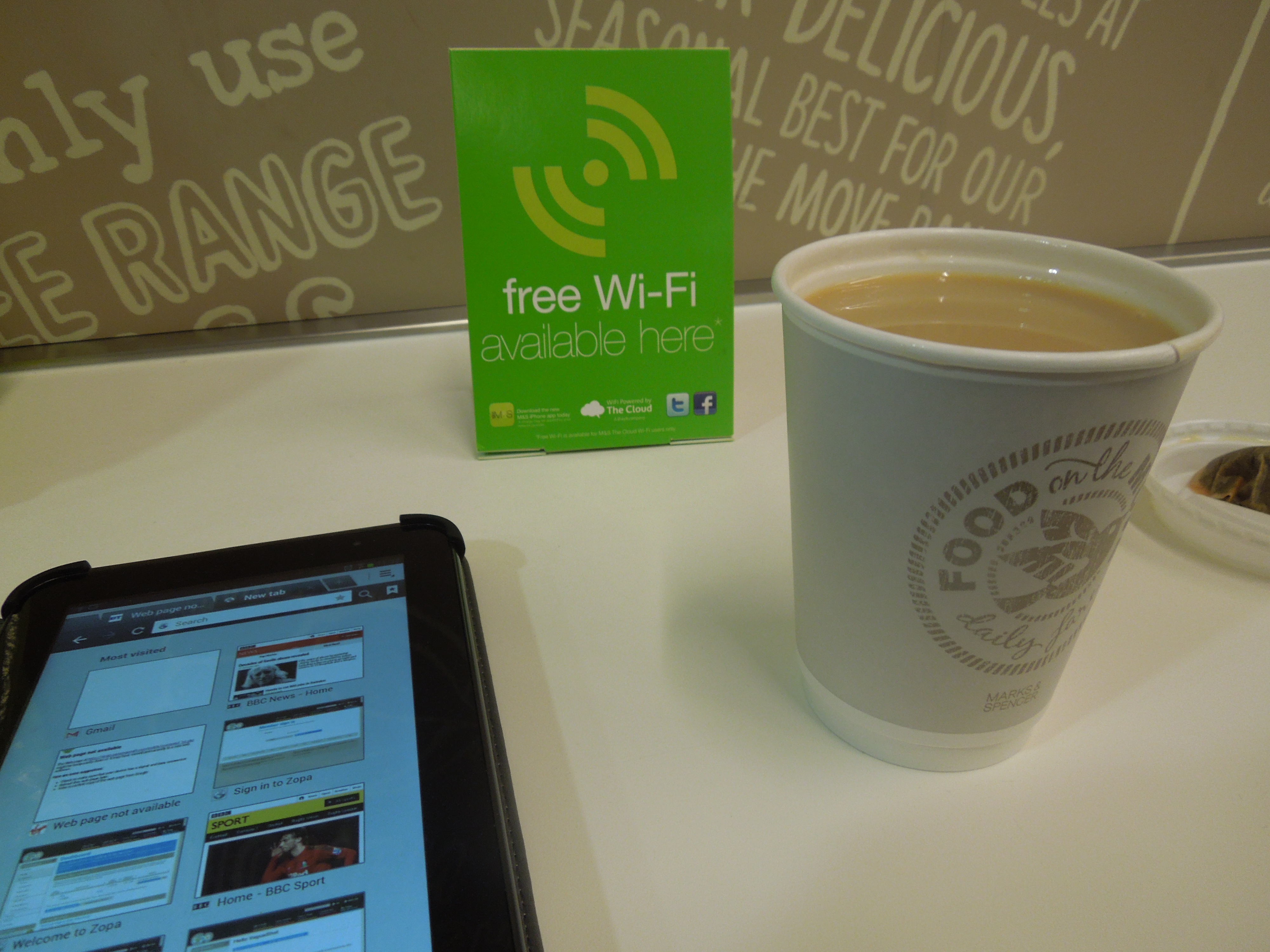
Free Wi-Fi In Marks And Spencer
Although, you do need to sign up to something called The Cloud. I just did on my home machine and it doesn’t seem to onerous.
The Onward March of ARM
I’ve always kept a watching brief for ARM Holdings. Partly because it was local to where I lived, but mainly because one of the founders was Robin Saxby, who was in my year at Liverpool University.
I have just read this report in Forbes. There are some facts in that report, that will shape the world. Consider this abstract.
East (The ARM CEO) notes that by some estimates IT equipment now suck down 10% of the world electric power already; he also notes that there are estimates that in the next few years that the amount of data creates could increase 100x, or maybe 1000x. Even at 10x, he notes, we’re going to run out of power at the current consumption rates. “They are going to switch to ARM because it is all about the power,” he says. “The digital world is not going to become a reality unless servers and network infrastructure is designed in a different way….ARM is a tool in the toolbox for making this stuff more sustainable.”
Generation of electricity is one of the causes of global warming, as so much is generated by fossil fuels. So a small company in Cambridge will become a major player in the fight, just because its chip designs are so much more efficient.
Reading the Forbes article, says to me, that ARM can only get an awful lot bigger. But it is all about brain power and not about manufacturing in the traditional sense. On the other hand, ARM has been and will continue to be a company, whose technology enables other companies to start up in innumerable fields.
Do I Need A Smart Phone?
I’ve recently bought a Samsung Tab 2 7. This is the seven inch screen or the small one.
I can keep it in my pocket and use it to send e-mails and surf the Internet. I checked my Zopa and bank details on Saturday and even entered a small post to this blog.
I’ve only a wi-fi version, which proved excellent on the train on Saturday. But then we are seeing more and more free wi-fi hotspots in pubs and cafes everywhere.
So quite frankly, I’ll stick to my Nokia 6310i for phone calls and text messages.
Who needs a smart phone?
Why Has Google News Got Worse?
When I want details on something, say like Dalston Junction station, I will use Google to search for it. Then for any news, there used to be a simple button, which repeated the search on just the news.
That seems to have disappeared and now in most cases I have to open up Google News and start the search again. I supose, it’s an improvement setup by some idiot just out of nappies.
I also find that it always wants me to sign in to my GMail account to store my alerts there. But I prefer them on my standard e-mail, which has nothing to do with GMail.
I suppose they are annoying me, so I use my GMail account, which can then be processed to send me all sorts of spam for products I don’t want.
As they don’t pay enough tax in the UK, I think I might look for another search engine, that does pay the proper rate.
The Dyslexic Spammer
I’ve just had two copies of this simple spam message.
Do you need a laon
As it was headed Dear Sir/Madam and both copies were sent to the same male e-mail address, he or she is pretty stupid as well.
Ministry Of Justice Deals It Out to Claims Firms.
This article on the BBC web site, says that the Ministry of Justice has shut down 209 rogue claims firms in the last six months.
This is good news. But I wonder how many people have been involved in more than one firm.
I also would love to see a database published of all those involved. It would be an interesting analysis.

