Are Bodies Cleverer Than We Think?
Because, I had a serious stroke thirteen years ago, I am on Warfarin for life to thin my blood, so that I don’t have another stroke.
INR is short for International Normalized Ratio, which diverts on Wikipedia to the Wikipedia entry for Prothrombin Time, where these is the first two paragraphs.
The prothrombin time (PT) – along with its derived measures of prothrombin ratio (PR) and international normalized ratio (INR) – is an assay for evaluating the extrinsic pathway and common pathway of coagulation. This blood test is also called protime INR and PT/INR. They are used to determine the clotting tendency of blood, in such things as the measure of warfarin dosage, liver damage, and vitamin K status. PT measures the following coagulation factors: I (fibrinogen), II (prothrombin), V (proaccelerin), VII (proconvertin), and X (Stuart–Prower factor).
PT is often used in conjunction with the activated partial thromboplastin time (aPTT) which measures the intrinsic pathway and common pathway of coagulation.
That is very technical and complicated, but what does it mean practically?
Those on Warfarin to thin their blood are generally supposed to keep their INR between 2 and 3.
I test the INR myself with a Coaguchek meter from Roche and have done so for nearly ten years.
Every, so often, I discuss the level of Warfarin with my GP and we adjust the level accordingly.
Typically, NHS patients on Warfarin have their INR checked every few weeks.
But as I am a Graduate Control Engineer, who has written control strategies for chemical plants, I feel this checking every few weeks, is not enough.
At times, I have checked at a higher frequency.
Four times, I have had minor operations.With the first operation, I agreed with the surgeon, that I would lower my INR to 2.1 for the operation and raise it back to 2.5 after the operation.
It all went well and I repeated the exercise for the three other minor operations.
I have checked daily since about the beginning of April, before which, I generally tested on Mondays and Thursdays.
There were two reasons for the change of frequency.
- Regular storms seemed to roll in and for some reason, they tended to lower my INR.
- I also wrote Do Thunderstorms Cause Strokes?, after reading a paper from the United States about the relationship between thunderstorms and strokes.
So I took the prudent decision to test my INR daily.
Then on the 30th May, disaster struck.
My Coaguchek meter found out it had the wrong firmware and Roche implored me to change it.
But I am not a hardware person, so I was left unable to check my INR.
Luckily, I remembered a story from the 1960s about one of ICI’s chemical plants.
This plant was one of the first fully-digitally controlled plants controlled by an IBM 1800 computer.
It also ran 24 hours a day, seven days week.
So in the middle of the night, the plant operators got out all the computer printouts, which showed how the computer had set all the valves and controllers.
One-by-one they reset all the controls on the plant to the settings that the computer had used for the last few days.
Using, this computer-assisted mode the plant was kept running, until engineers could fix the computer.
On the 30th May, my INR was a little bit high at 2.9 and I was using a dosage of Warfarin of 4 mg. one day and 3.5 mg. the next.
The strange dosage was one, that I know from experiment over time produces an INR of 2.5.
My actual average Warfarin dose was 3.73 over the last thirty days and my INR, as measured most days was 2.6 over the same period.
So, I did what the engineers did on the chemical plant, kept calm and carried on.
Yesterday my son fixed the Coaguchek meter and I was able to take my first reading for 17 days. It was 2.7 and only 0.1 higher than the 30-day average on the 30th May.
I had successfully jumped the gap in the readings.
Conclusion
Most systems have an equilibrium. Make sure you know it.
Where’s The Windows Calculator Gone?
My current computer runs Windows 10.
I used to run the calculator by searching for it.
But it suddenly isn’t available.
How can M$ , do this to me, as I use a simple calculator all the time?
Rule one of software design, is never give customers any surprises.
They might just go elsewhere and never return.
At least the one in my phone seems to be still working!
An Early General Election
One thing that worries me about an early election, is it gives Putin less time to plan and execute his dirty work.
So he might do something a lot more extreme!
So make sure your cybersecurity is up to date!
Thoughts On The NHS Infected Blood Scandal
In the early 1970s, I was working with the Chief Management Accountant of a retail bank, writing a computer system to analyse and compare the performance and costs of all their branches.
We used scatter diagrams and other graphical techniques to show all the branches on single sheets produced by line printers on a powerful time-shared computer. It would be so much easier today.
Any branch not following the rules was often found sitting alone away from the mass of branches on the graphs.
I remember one branch had costs, that were much higher than expected. It turned out it was the Stevenage Branch, where the premises were rented rather than owned freehold.
Expanding The System To Other Industries
The Accountant, who had also been Chief Accountant of a FTSE 500 company, felt that the techniques we had developed had other applications in the management and auditing of large companies and organisations.
Sadly my partner in crime, died of cancer and I went on to other things.
From my own generally good family experiences of the NHS, I feel that this sort of analysis used rigorously could give early warning of some of the scandals we’ve seen in the NHS.
Around the turn of the century, I used similar techniques to improve the manufacturing quality in a diesel engine factory.
Conclusion
Perhaps we need an independent Office of NHS Responsibility?
Gluten Sensitivity And Epilepsy: A Systematic Review
Yesterday, The Times published this article, which was entitled ‘Game-Changing’ NHS Laser Therapy To Prevent Epileptic Seizures.
One reader had made this comment.
Be ace too if they can tweak to help migraine.
I used to suffer from something like migraine about thirty years ago. But after being found to be coeliac and going gluten-free, what ever it was seemed to disappear from my life.
Type “Coeliac Disease and Migraine” into Dr. Google and there are lots of references.
This indicates to me that serious scientists and doctors, must believe there could be a link.
There certainly is with me and going gluten-free eased my migraine-like symptoms.
I then typed “Coeliac Disease and Epilepsy” into Dr. Google and found this paper, which was entitled Gluten Sensitivity And Epilepsy: A Systematic Review.
This information is from the Abstract of the paper
Objective
The aim of this systematic review was to establish the prevalence of epilepsy in patients with coeliac disease (CD) or gluten sensitivity (GS) and vice versa and to characterise the phenomenology of the epileptic syndromes that these patients present with.
Methodology
A systematic computer-based literature search was conducted on the PubMed database. Information regarding prevalence, demographics and epilepsy phenomenology was extracted.
Results
Epilepsy is 1.8 times more prevalent in patients with CD, compared to the general population. CD is over 2 times more prevalent in patients with epilepsy compared to the general population. Further studies are necessary to assess the prevalence of GS in epilepsy. The data indicate that the prevalence of CD or GS is higher amongst particular epileptic presentations including in childhood partial epilepsy with occipital paroxysms, in adult patients with fixation off sensitivity (FOS) and in those with temporal lobe epilepsy (TLE) with hippocampal sclerosis. A particularly interesting presentation of epilepsy in the context of gluten-related disorders is a syndrome of coeliac disease, epilepsy and cerebral calcification (CEC syndrome) which is frequently described in the literature. Gluten-free diet (GFD) is effective in the management of epilepsy in 53% of cases, either reducing seizure frequency, enabling reduced doses of antiepileptic drugs or even stopping antiepileptic drugs.
Conclusion
Patients with epilepsy of unknown aetiology should be investigated for serological markers of gluten sensitivity as such patients may benefit from a GFD.
My Thoughts
These are my thoughts.
Coeliacs Prior To 1960
Consider.
- Even if my excellent GP; Doctor Egerton White, felt I was coeliac, there was no test until 1960 for coeliac disease.
- And the test that was developed using endoscopy wasn’t anywhere near to the endoscopies of the present day.
- My late wife, who was a family barrister, likened the test to child abuse on a young child.
- I have heard some terrible horror stories of doctors looking for coeliac disease in young children in the 1950s.
- But there were some successes. A friend of mine, who is in her eighties, was successfully diagnosed by her parents using food elimination. But they were both GPs.
- Recently, I’ve met two elderly ladies, who only in the last couple of years have been diagnosed as coeliacs.
Luckily, I was never tested until 1997 and I was diagnosed in 48 hours, by gene testing.
Methodology
The methodology was based on a systematic computer-based literature search of the PubMed database.
This has these advantages.
- The rules for the search can be published and peer-reviewed.
- Its Wikipedia entry says PubMed is a free database including primarily the MEDLINE database of references and abstracts on life sciences and biomedical topics.
- The technique can surely be applied repeatedly, to see how results are changing with time.
- The search can be modified to analyse any topic, drug or condition, that appears in the PubMed database.
- The analysis could surely be applied to other databases.
As a writer of data analysis software, developing this sort of software, would be really enjoyable.
Could London Drivers Be Charged On A Cost Per Mile Basis?
This article on CarWow is entitled Transport for London Investing £150 million In Technology Capable Of Enforcing Pay-Per-Mile Road Charging.
These reasons are given for the new system.
- Transport for London developing new ANPR technology
- Set to be used for Ulez and congestion charging for now
- Could be expanded in the future to include pay-per-mile road charging
- Estimated project cost of £150 million
In addition, this paragraph gives another reason.
A new platform for existing road user charging schemes, such as Ulez and the Congestion Charge, is being developed by Transport for London to replace the outsourced system currently in place as the contract is due to expire in 2026.
I can understand, that if it is brought in house, that this might create more jobs in London, rather than somewhere far away.
Speeding
If you read the article on CarWow, nothing is said about speeding.
But surely, if a sophisticated computer system knew you were at A and B at certain times, it could calculate your speed.
Coupled with a 20 mph speed limit, it could be a big money earner.
It also gets Sadiq Khan off the hook with pay-per-mile charging. He just introduces fines for people, who break the law by speeding.
Conclusion
I don’t drive, so it doesn’t bother me.
But I would advise anyone, who does, to think long and hard about who they vote for.
Thoughts On Alstom At Derby
In the 1970s, I worked at ICI Plastics in Welwyn Garden City in a section called Computer Techniques.
We had a unique mandate from the Divisional Board, that allowed us to stick our nose into anybody’s business.
We certainly weren’t short of computing power, as in addition to the Division’s IBM 360 and dial-up services to GEISco, we had one of the handful of PACE 231R analogue computers in the UK.

Note.
- These machines didn’t use many semiconductors.
- These beasts could solve up to a hundred simultaneous differential equations and display the answers as graphs on the printers.
- Other UK companies and institutions with a PACE 231 R, included BMC, British Rail Research and Cambridge University.
- Two were linked together and these did the calculations for the Apollo flights.
- Their finest hour would surely have been to use their flexibility and power to bring home the stricken Apollo 13.
I got an interesting introduction to the industrial world in my three years at Welwyn.
One of our problems, was recruiting enough specialist engineers and programming staff.
So in the end, at one of our Monday morning meetings, we wrote our own advert for the Sunday Times.
We got all the staff we needed, but they weren’t the sort of recruits, you’d normally expect in the 1970s. Two were Indian and two were American, but all were recent immigrants. But they were certainly good enough to solve our problems.
I don’t think the Personnel Department were amused at our independent recruitment exercise.
I sometimes wonder if Bombardier (now Alstom) in Derby has a similar recruitment problem.
I am a Control Engineer and all these hybrid systems, that will power the transport of the future, be they trains, planes or automobiles, need lots of engineers with similar skills to myself and those of computer programmers. So do local companies; Rolls-Royce, JCB and Toyota, who probably have their own skill shortages in these areas, nick the best from Alstom.
It should be noted that in the railway press, it has been said that the Aventras from Derby were late because of software problems.
Smart Train Lease Aims ‘To Make Renting Trains As Easy And Simple As Renting A Car’
The title of this post, is the same as that of this article on Railway Gazette International.
These four paragraphs outline the scheme.
Siemens Mobility has established a leasing subsidiary that would enable train operators to use its Mireo Smart battery, hydrogen and electric multiple-units without needing to make long-term investment commitments.
Smart Train Lease GmbH would make available at short notice multiple-units already approved for operation. These could be short or medium-term leases, with services such as maintenance available as part of the package. The aim is to provide operators with an economical way to quickly and flexibly expand their fleets and try out more sustainable traction technologies.
‘We want to make renting trains as easy and simple as renting a car, and thus help accelerate the mobility transition’, the leasing company’s CEO Benjamin Dobernecker explained on February 14.
Smart Train Lease will initially operate in Germany, although it plans to expand throughout Europe in the medium term.
I like this idea and I think it will work.
Metier Management Systems And Artemis
When four of us started Metier Management Systems in 1977 to sell our mini-computer-based project management system; Artemis, we generally rented or leased our systems, although we did sell some as the years progressed.
- For a fixed fee per month, a company got a project management computer and all the software.
- The fixed fee included installation, first line support, training and software updates.
- We could also supply extra training and project management consultancy at appropriate rates.
- The only extra costs to the client were the electricity to power the hardware and the paper to put in the printer.
- We also allowed clients to convert leases into outright sales.
This simple sales model appealed to a lot of our clients.
- The cost of the system was easy to budget.
- Many of our clients were happy with leasing or renting computer equipment.
- As the system was desk-sized, it easily fitted the average office.
But the leasing model was very advantageous to us.
- Most of our clients were large high-value quality organisations like big oil companies, nationalised industries and engineering consultancies.
- Our Finance Director and our Bank Manager at Lloyds Bank devised a plan, whereby we bundled a number of high-quality leases together and sold the bundle to Lloyds Bank’s leasing company.
The money we received gave us a healthy cash flow.
- The cash flow was then used to fund Research and Development and to finance more sales.
- If say someone like BP or Shell should phone up or send a fax, wanting a system immediately, we were generally able to fulfil their request.
I am sure that Siemens Mobility will be using a similar model.
They will aim to have trains in stock to fulfil clients needs.
So if Deutsche Bahn phone up saying have you got a three-car battery-electric train that works with 15 KVAC and has a range of 100 kilometres for next Monday, Siemens Mobility can generally say yes.
What helps is that the modular Mireo Smart multiple unit comes in battery, hydrogen and electric versions.
Extras could include full servicing a driver.
So Siemens Mobility will plug the train together and deliver it.
How Would Siemens Use The Leasing Model In Great Britain?
Consider.
- There are a lot of routes that need to be decarbonised in Great Britain.
- Many of these routes have electrification at one or both ends.
- Often these routes terminate in a bay platform.
- On most of these routes a two-, three-, four- or five-car train will be sufficient capacity.
- In the Desiro City, Siemens have a train, that is acceptable to Great Britain.
- If routes in Great Britain are to be electrified, they must be electrified with 25 KVAC overhead wires.
- Trains would be 100 mph, so they wouldn’t be limited as to routes.
- A Mireo-B has a range of between 80-100 kilometres or 49.7-74.6 miles.
I am sure Siemens Desiro City or its European equivalent; Mireo can be developed into a family of trains suitable for GB!
- The basic train would be two driving cars.
- Length would be increased by coupling trailer cars between the two driving cars.
- Hydrogen power would be in one of the trailers.
- Batteries would be under an appropriate number of cars.
Battery trains would be able to use a simple automatic charger, similar to the one, that I described in GWR Trialling Transformative Ultra-Rapid Charging Train Battery.
An Example – Mid-Cornwall Metro
This map shows the Mid-Cornwall Metro.

Consider.
- Newquay and Par is 20.8 miles.
- Falmouth Docks and Par is 30.8 miles.
- Newquay and Falmouth Docks is 51.6 miles.
- The maximum speed between Par and Newquay is around 30 mph
- The maximum speed between Par and Falmouth Docks is around 50-70 mph
- There are twelve intermediate stations.
- There is a reverse at Par station.
- Charging would be easy to install at Falmouth Docks, Newquay and Par.
- In Par Station – 10th February 2024, I suggested that Par station could be fully-electrified, so that expresses could have a Splash-and-Dash on their way to London and Penzance. If all platforms at Par were electrified the Mid-Cornwall Metro trains could charge from the electrification, as they reversed.
There are two main ways that the Mid-Cornwall Metro might operate.
- There would be chargers at Newquay and Falmouth Docks and trains would shuttle the 51.6 miles between the two stations.
- There would only be charging at Par and trains would after charging at Par go alternatively to Newquay and Falmouth Docks.
The first might need smaller batteries and the second would only need one charger.
An Example – Uckfield Branch
The Uckfield branch is in Southern England.
- It is not electrified between Hurst Green Junction and Uckfield, which is 24.7 miles.
- There are eight intermediate stations.
- The line can accommodate ten-car trains.
There is space at Uckfield station for a charger.

Charging would be at Uckfield station and North of Hurst Green Junction, where it will use the existing electrification.
Conclusions
This leasing/rental model will surely encourage train operators to replace diesels with appropriate zero-carbon alternatives on routes that need to be decarbonised.
Striking Train Drivers Want Extra Pay For Using Tablets
The title of this post, is the same as that of this article on The Times.
These four paragraphs explain the impasse.
Striking train drivers are demanding extra pay for using tablet devices at work.
The tablets, which are similar to iPads, are designed to send announcements to drivers and notify them of temporary speed limits on routes.
However, union chiefs are demanding so-called “technology payments” for members expected to use such devices.
Train companies usually have to rely on noticeboards to communicate with drivers. Messages, including safety instructions, are still placed at the end of platforms for drivers to see from their cabs.
Mark Harper, the transport secretary, i quoted as saying: “Aslef continues to stand in the way of vital reforms needed to safeguard the future of the railways.”
Are we in the 21st or the 19th centuries?
But the article leaves the best to last.
It has previously been reported that rail workers were given paid time off if they had to use a microwave at work. The rule from 1980 states:
All staff working with microwave ovens shall be permitted to take time off from work, with pay, for a medical check of any effects on them from the microwave ovens. Such checks shall be made at not less than six monthly intervals on request.
Does your partner demand similar rewards for putting your ready meal in the microwave?
There is also this comment from a reader.
I did 19 years as a driver, mainly with Southern. I remember when we were issued with mobile phones and later iPads there was a few dinosaurs who refused to charge them at home. Pathetic really. The iPad was great but only got 1 GB of mobile data. I destroyed that watching Tour du France when ‘spare’ and didn’t have any work allocated.
The worst Spanish practices mainly revolve around the facility time ASLEF reps get, and routinely abuse. At my depot 2 reps were released all day to scrutinise bank holiday diagrams. There were 7 diagrams to check. These diagrams are produced by software to make sure comply with regulations but need reps to sign off. No more than 5 minutes work but off all day. That’s 2 drivers, 8 or 9 times a year. These are the T&Cs changes that ASLEF won’t accept, under RDG offer diagram scrutiny would be taken away from reps.
Priceless! And all passengers and taxpayers are paying.
That Was Close!
I took this picture in Liverpool Street station on the Elizabeth Line.
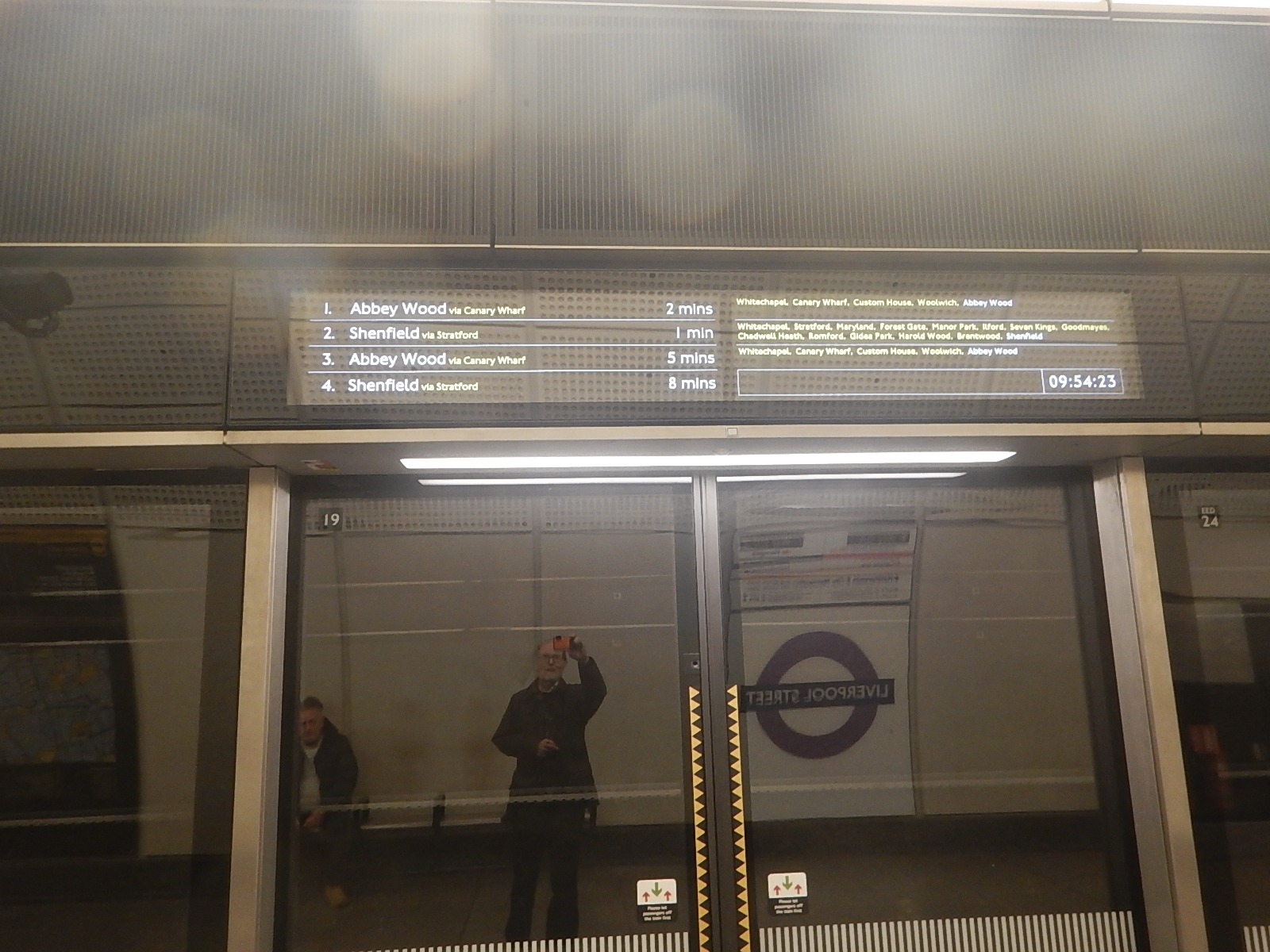
Note.
- The timings of the first two trains.
- The Shenfield train did arrive before the one for Abbey Wood.
How did it manage that? It looks like a another Fujitsu moment in the display to me!
 The Anonymous Widower