FirstGroup Adds Leeds-based J&B Travel To Growing Coach Portfolio
The title of this post, is the same as that of this article on Route One.
These two paragraphs add more detail.
J&B Travel of Leeds is the latest coach business to be acquired by FirstGroup.
The operator, which has been established for more than 40 years, has a fleet of 15 vehicles, with work including home-to-school, private hire and FlixBus contracts.
But in some ways, the most significant thing not mentioned is that FirstGroup have now acquired seven coach firms.
- AndersonTravel in London
- EnsignBus in London
- J & B Travel in Leeds
- Matthews Coaches in County Monaghan, Ireland
- Tetley’s Coaches in Leeds
- York Pullman in Harrogate, Hull, Leeds and York
Note.
- MatthewsCoaches are about halfway between Dublin and Belfast.
- Three of the English acquisitions are in Yorkshire and two are in London.
- Leeds isn’t far off being halfway between London and Central Scotland.
This looks like the first part of a master plan.
- Leeds and County Monaghan could be ideal refuelling points for zero-carbon coaches.
- Ferrybridge, just South of Leeds is getting a hydrogen-fired power station.
- Ferrybridge is a big site with a motorway service station on the M1.
- Wrightbus are building an electrolyser at Ballymena, which is 81 miles from Matthews Coaches.
- Wrightbus have said that Dublin and Cork would be an ideal route for a hydrogen coach.
- Wrightbus have said that Heathrow and Gatwick would be an ideal route for a hydrogen coach.
This plan could be built-on with routes to various cities and attractions.
I have some further sorts and questions.
Could The First Obvious Routes Be Run By Hydrogen Coaches?
From what Wrightbus have indicated, I would rate the obvious routes as.
- Dublin and Belfast – 103 miles or 206 miles round trip
- Dublin and Cork – 107 miles or 340 miles round trip
- Leeds and Glasgow – 224 miles or 448 miles round trip
- Leeds and Edinburgh – 222 miles or 444 miles round trip
- Leeds and London – 197 miles or 396 miles round trip
- Heathrow and Gatwick – 40 miles or 80 miles round trip
Note.
The longest route is 714.5 km.
It would appear that, if the hydrogen-powered coach had a range of 1,000 km. all routes would be possible.
How Far Would A Hydrogen Coach Get On A Tankful From London?
A thousand kilometres is 621.4 miles.
These are the distances from Scottish cities to London.
- Aberdeen – 537 miles
- Dundee – 472 miles
- Dunfermline – 430 miles
- Edinburgh – 410 miles
- Glasgow – 404 miles
- Inverness – 561 miles
- John O ‘Groats – 678 miles
- Perth – 451 miles
- Stirling – 418 miles
I’ve added John O’Groats for completeness, but all cities would be reached.
How Far Would A Hydrogen Coach Get On A Tankful Going West From London?
These are the distances from Western towns and cities to London.
- Aberystwyth – 236 miles
- Fishguard – 255 miles
- Holyhead – 289 miles
- Lands End – 310 miles
- Penzance – 307 miles
I’ve added Lands End for completeness, but all towns and cities would be reached.
John O’Groats And Lands End In A Hydrogen Coach
I asked Google AI how far the journey was and received this answer.
The distance from Land’s End to John o’ Groats varies by transport: about 837-874 miles (1347-1407 km) by road, roughly 600 miles (970 km) as the crow flies, and around 1,200 miles (1900 km) for an off-road walking route, with cyclists typically taking 10-14 days and walkers 2-3 months.
So it looks, like there will be a need for a refuel, but that would give 2,000 kilometres, which is more than the 1,347-1,407 kilometres needed.
Ferrybridge Could Be An Ideal Refuelling Point
I suspect, even in fifty years you could name the places in the UK, where you will be certain of refuelling any hydrogen vehicle on the fingers of one hand.
The list would include.
- Ferrybridge in Yorkshire, where SSE are building a hydrogen-fired power station.
- Felixstowe Docks in Suffolk, where there will be a need to fuel hydrogen trucks.
- Keadby in Lincolnshire, where SSE are building a hydrogen-fired power station.
- Kintore in Aberdeenshire, where an electrolyser is being built.
- Runcorn in Cheshire, where there was an electrolyser in 1968, when I worked there.
This web site lists all the UK hydrogen projects.
This Google Map shows the location of the Ferrybridge hydrogen-powered power station site in relation to Barnsley, Doncaster, Leeds and other towns and cities of Yorkshire.

Note.
- The red arrow indicates the former coal-fired power station site.
- Leeds is in the North-West corner of the map.
- Barnsley and Stocksbridge are in the South-West corner of the map.
- The city of Sheffield is to the South-West of Stocksbridge.
- Doncaster is in the South-East corner of the map.
Last September I wrote Visiting The Consultation For Ferrybridge Next Generation Power Station At Knottingley.
In that post, I wrote about supplying both the power station and the motorway services with hydrogen and felt that it could use one of two methods.
- A pipeline from the hydrogen storage in East Yorkshire.
- Some form of train from a hydrogen production site.
Recently, Network Rail have been conducting tests on the movement of hydrogen by train, which I wrote about in Network Rail’s Test Track Take Centre Stage As Hydrogen Is Delivered By Rail For The First Time.
The Ferrybridge Site Has most things needed.
This map shows the site.
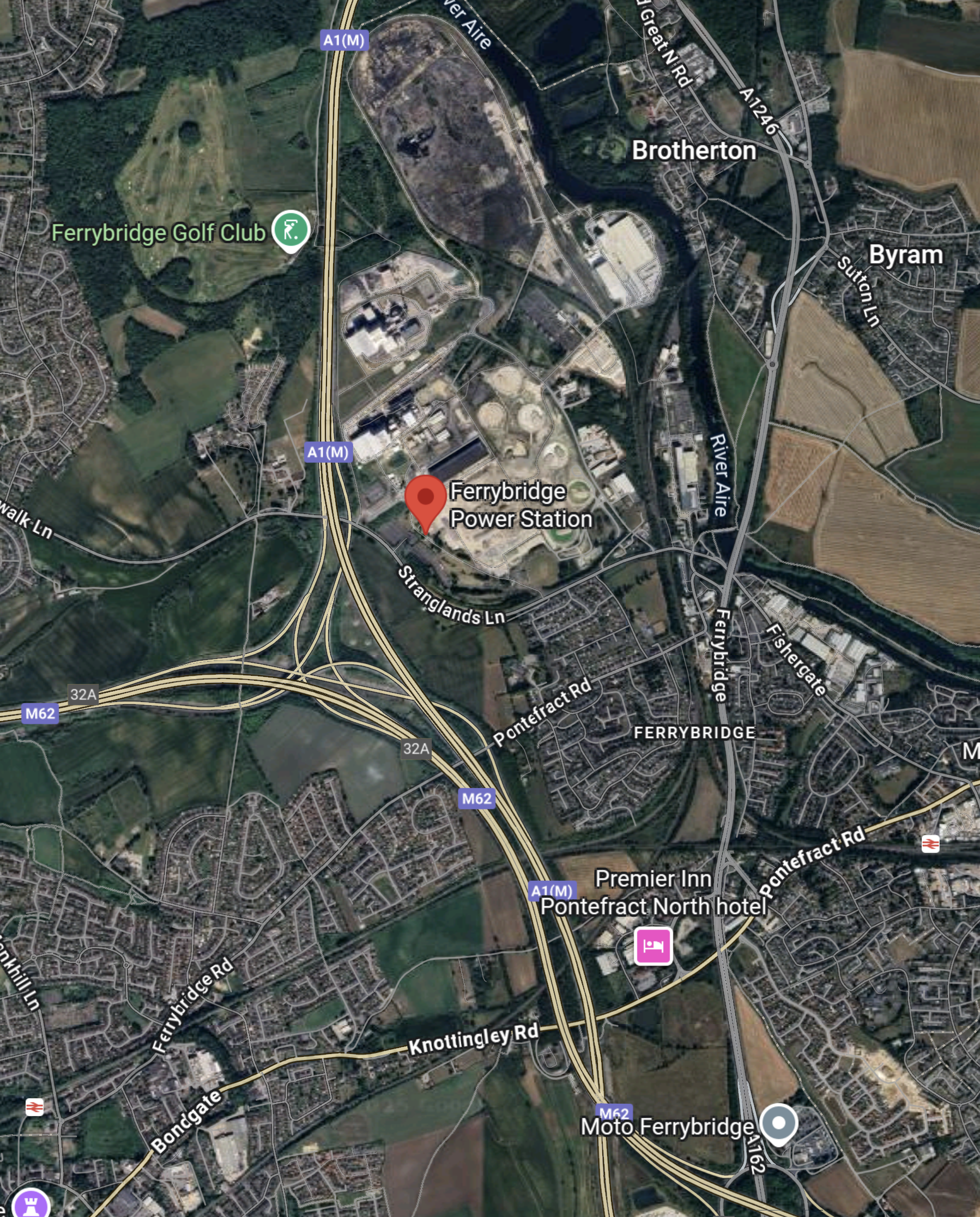
Note.
- The impressive motorway junction, where the North-South M1 crosses the East-West M62.
- Liverpool and Manchester are to the West.
- Leeds, Newcastle and Scotland is to the North.
- Hull is to the East.
- London is to the South.
- There is a Moto Services.
- There is a Premier Inn.
There is even two railway stations on the map.
This reply from Google AI gives the details of the distance between Ferrybridge and the South-West.
The driving distance from Ferrybridge, Yorkshire, to Land’s End is roughly 470 to 500 miles, taking about 8-9 hours, primarily via motorways like the M1, M5, and A30, though exact times and routes vary by real-time traffic and specific starting/ending points.
I am absolutely certain, that if you have a vehicle like a hydrogen coach and you want to go anywhere between A to B on the UK mainland, then if there is hydrogen-refuelling at Ferrybridge, you will be able too do the journey with a refuel at Ferrybridge.
Back To The Future With BYD Double-Deck Buses
Arriva run the 141 bus route for transport for London and today they must have been short of buses, as this older Wrightbus on a heritage number plate had been pressed into service.




The four pictures of an older Wrightbus hybrid bus, were taken on Moorgate this morning, when it was substituting for a newly-delivered BYD battery-electric bus on route 141.
As I tapped in, I made a remark to the driver about reliability of the Chinese buses and he smiled a knowing smile.
As an engineer and designer, I would list the design faults on the BYD double-deck buses as follows.
- The batteries don’t give the buses a long enough range.
- The buses don’t handle cold weather very well.
- The step into and out of the bus is too high for elderly people and is not the same as other London buses.
- The seating is more comfortable in AlexanderDennis, Evo-Seti and Wrightbus buses.
- The seats are also too narrow.
- The seats at the back downstairs are pokey, because of the position of the batteries.
- There is no rear view downstairs, which makes using the Mayor’s promoted Hopper Fare, which lets you take unlimited bus and tram journeys for £1.75 within one hour of your first tap-in, more difficult.
- The stop displays are unreliable.
- The buses don’t have enough seats for the 141 route.
But perhaps most importantly, few passengers have a good word for the buses.
Life-Saving Baby Incubators Uused In Ukraine Pass The NHS Test
The title of this post, is the same as that of this article from The Times.
This is the sub-heading.
The devices made by Mom Incubators weigh a fraction of existing models, making them highly mobile and perfect to use on maternity wards.
The incubator was developed as a final year student project.
- James Roberts founded Mom Incubators in 2014.
- Backers include Sir James Dyson and Holly Branson.
- The incubators have been used in England, Haiti, India, Kenya, the Philippines, Scotland, Uganda, Ukraine, US and Tanzania.
- This is a really wonderful story, which shows the value of good design and keeping the weight down.
James Roberts intends to repeat the excercise with other medical devices.
Major Revamp Of Wales’ Busiest Station Gets Go-Ahead
The title of this post, is the same as that of this article on the BBC.
This is the sub-heading.
Plans for a major revamp of Wales’ busiest railway station have received final approval.
These three paragraphs add more details.
The £140m upgrades to Cardiff Central – including a new brick arch rear entrance, larger concourse and improved waiting areas – aim to support passenger growth and reduce overcrowding.
Better accessibility for people with reduced mobility and additional retail and cycle facilities are also among the changes.
Work is due to start in the middle of next year with the aim of completing most of it within three years.
Note.
- The new entrance on the south side of the station, was opened in September 2015.
- A new Platform 8 was added in 2017, which allows sixteen local trains per hour to run between Cardiff Central and Cardiff Queen Street stations, to serve the twenty railway stations in the city.
- All platforms are bi-directional, which surely improves the flexibility of the rail network in Cardiff City centre.
- Access from the station to the Principality Stadium has improved greatly in recent years.
- The station will remain open during the works.
Cardiff’s railways are a comprehensive mix of local and inter-city trains.
I have some thoughts on Cardiff Station.
The Cardiff & Valleys Day Ranger
This very useful ticket, is the ideal way to explore the Cardiff and Valleys area and I’ve used it several times.
- I usually buy it from one of the two ticket offices in Cardiff Central station, but in one case, I did buy it in Paddington to save time.
- According to Transport for Wales, you can buy it on a local train from the conductor.
- It costs about £16 for an adult, but railcard apply.
I actually find taking a train up the valleys, is a good way to clean out my lungs.
Sights To See On The Cardiff & Valleys Lines
Google AI makes these suggestions.
The Cardiff & Valleys Lines offer historic castles (Cardiff, Caerphilly, Castell Coch), world-class museums (St Fagans, National Museum Cardiff, Big Pit), industrial heritage (Rhondda Heritage Park, Royal Mint Experience), and stunning nature in Bannau Brycheiniog National Park, with scenic railway journeys connecting these sites for history, culture, and outdoor adventure.
Hopefully, when the new Stadler trains and tram-trains are fully operational on the Cardiff & Valleys Lines, someone will write a full guide.
SeaTwirl AB Signs Agreement To Explore Ehe Feasibility Of Electrification Of Aquaculture In Chile
The title of this post, is the same, as that of this press release from SeaTwirl.
This is the sub-heading.
SeaTwirl AB has entered into an agreement to carry out a feasibility study for electrification of fish farms together with a global industrial supplier. The intention of the collaboration is to assess the use of SeaTwirl’s floating vertical-axis wind turbines to provide renewable electricity to offshore-based equipment at aquaculture assets in Chile.
These three paragraphs add more details.
The feasibility study will cover a comprehensive scope, including energy demand and power system requirements, environmental site conditions, cost assessments, supply chain opportunities, and logistics in Chilean waters with the intention to reduce dependence on diesel. The study is expected to be completed during 2026, and the results will help determine next steps.
Chile is home to one of the largest aquaculture industries in the world, and the sector is pursuing ambitious sustainability goals including lower emissions, increased use of renewable power and reduced risk of spills. While the contractual value of the agreement is limited, at approximately SEK 0,8 million, the engagement will generate revenue and represent an important step in SeaTwirl’s commercialization effort.
“This collaboration marks an exciting step towards our purpose to enable floating wind power wherever it is needed, and to expand the use of floating wind technology beyond traditional grid-connected applications. The aquaculture industry has a clear need for offshore renewable energy, and we believe our technology can deliver a robust and cost-effective solution. It is also a major milestone to become involved in the southern hemisphere where many of the challenges we try to address, such as limited availability of cranes, vessels, and yard infrastructure, may be more challenging than in the north. We see significant potential in the aquaculture segment and look forward to beginning this journey in South America”, says Johan Sandberg, CEO of SeaTwirl.
I do find it strange, that the two vertical wind turbines, that both seem to be more than prototypes are both Scandinavian.
The Ventum Dynamics turbine, that I talked about in Are These Turbines An Alternative To Solar Panels? is Norwegian and this one is installed on Skegness Pier.
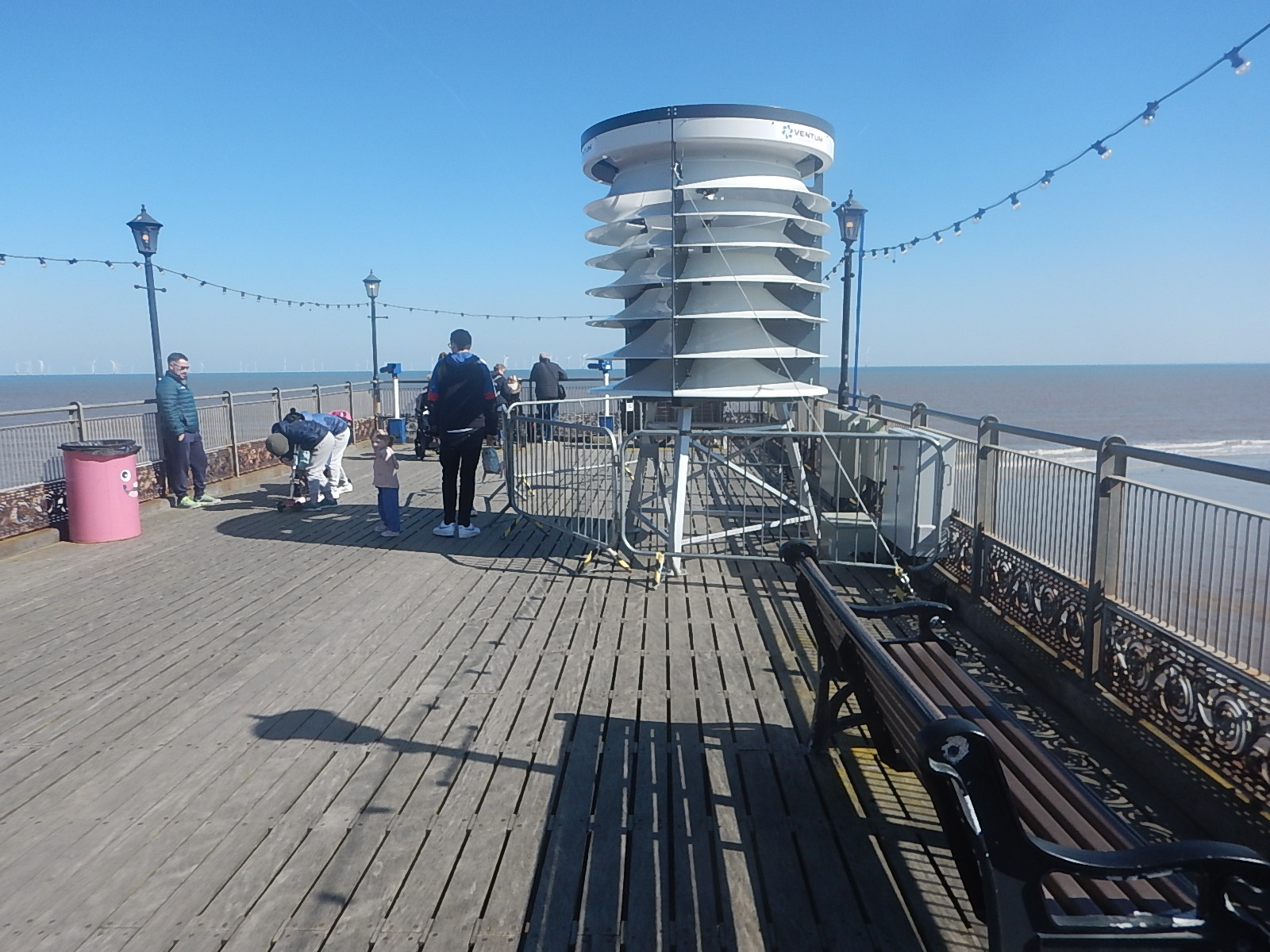
IKEA could sell these for DIY-enthusiasts to assemble and erect. On my stud, I used to have a barn, that could certainly have taken two of these 1.5 KW VX175 turbines.
This link is video of a dancing and swimming SeaTwirl.
If you follow, the SeaTwirl video to its conclusion, you’ll see one being erected in the sea. I can assure you that in the 1970s, my 25-year-old self, did the calculations for a reusable oil production platform called a Balaena, which erected on the same principle. So, I’m fairly certain, that SeaTwirls can be an alternative to traditional wind turbines.
EDF Developing Offshore Wind-Powered Hydrogen Production Project In French EEZ
The title of this post, is the same as that of this article on offshoreWIND.biz.
This is the sub-heading.
EDF Power Solutions has invited applications for a tender for Environmental Impact Assessment (EIA) services and hazard studies as part of a project to develop an offshore hydrogen production station in France’s Exclusive Economic Zone (EEZ).
This is the first paragraph.
The project, dubbed HYODE (HYdrogen Offshore DunkerquE), will produce green hydrogen by coupling offshore wind farms with an offshore electrolyser near Dunkirk, France, and is planned to also include storage and transport by ship to port, forming what EDF describes as an “innovative solution” to help scale green hydrogen production.
I asked Google AI, if there are any operational offshore hydrogen electrolysers and received this answer.
Yes, there are operational offshore electrolyser projects, though large-scale, dedicated offshore hydrogen platforms are still in development. The first operational offshore production on an existing gas platform is planned for late 2024 with the PosHYdon project. Additionally, a pilot project in the UK is testing the full integration of a hydrogen electrolyser onto an existing offshore wind turbine, with another project in the Netherlands installing an offshore hydrogen production and storage platform.
But, I did get this page on page on the Ramboll web site, which is entitled The Rise Of Offshore Hydrogen Production At Scale, which has this introductory paragraph.
The stage is set for producing green hydrogen from offshore wind and desalinated seawater. Building on existing and proven technology, offshore wind farms have the potential to become future production hubs for green hydrogen production at scale to meet increasing demand.
That sounds very promising, especially, if proven technology is borrowed from the offshore oil and gas industry.
It’s
DeepForm
On Wednesday I went to the TDAP Wave 8 Demo Day, which was organised by the Advanced Propulsion Centre.
One of the cohort of companies there was DeepForm, who were described like this.
DeepForm is transforming sheet metal pressing with its patented cold-shear press design, which reduces blank sizes by up to 45 % and trimming waste by up to 85%. This drop-in technology lowers material costs and embodied CO2 in existing press lines without compromising performance, quality or speed. Spun out of the University of Cambridge in 2022, DeepForm enables OEMs and Tier 1 suppliers to adopt the breakthrough through IP licensing, simulation and design support.
The company have an impressive web site, which deserves a very full read.
In their presentation, they showed two products, that could benefit from their innovation; a large steel component for Jaguar Land Rover and a humble aluminium drink can.
As I walked home ntoday, I saw this advert displayed on a bus stop.
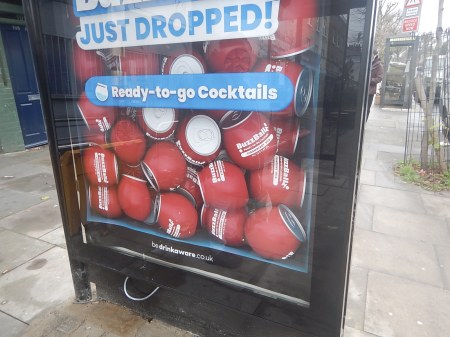
The cans for BuzzBallz are also shown on the company’s web site.
But these products are are only the start.
For instance, I can see lots of small plastic items and components, that can’t be recycled, could be made from aluminium, which is easy to be recycle.
I also think companies like IKEA will love the design freedom, the technology will give.
Offshore Wind Developer Gets DNV Concept Certification for Floating Foundation Design
The title of this post, is the same as that of this article on offshoreWIND.biz.
This is the sub-heading.
BayWa r.e. has received concept certification from DNV for its BayFloat floating wind semi-submersible concrete substructure and mooring system design. The design was validated using the 22 MW generic reference turbine “IEA-22-280-RWT”
These three introductory paragraphs give a few more details.
The certification process was conducted in accordance with DNV-SE-0422:2021-09 “Certification of floating wind turbines” scheme, including DNV-ST-0119:2021-06 “Floating wind turbine structures” as the governing standard, BayWa r.e. says.
The assessment concluded that the BayFloat concrete floating substructure, including the mooring system design, is feasible for further development and qualifies for DNV concept-level certification.
BayWa r.e. collaborated with the engineering company Ramboll on the design and certification process, with Ramboll providing design services, expert insights and engineering advice.
Note.
- Certification must be a good thing.
- If you are unfamiliar with DNV, then their Wikipedia entry, is a good place to start.
- As I was doing the calculations for a floating oil platform in the 1970s, I don’t see why floating wind turbines won’t work!
- Especially, as floating wind turbines, seem to have a higher capacity factor than fixed.
- Concrete also worked for oil and gas platforms, so why won’t it work for wind?
In fact I quite like this design.
These are some other thoughts and information.
The Buchan Wind Farm
Baywa r.e. are also developing the 960MW Buchan floating wind farm about 75 km North-East of Fraserburgh.
The Buchan Wind Farm web site says this about the technology to be used.
The project has identified BW Ideol’s patented Damping Pool® floating substructure as its preferred foundation option, with BW Ideol working actively to establish a manufacturing centre at the Ardersier Energy Transition Facility being developed at the former oil and gas fabrication yard on the Moray Firth.
Perhaps, Baywa r.e. are seeing if they can do better.
The Original Article
The original article also links to several designs of floating wind float design, so it is well worth a full read.
But then, each have their advantages in materials used, ease of construction, methods of assembly, ease of tow-out and erection and most importantly; cost!
Can A Broken Humerus Affect Your Hand And Wrist Long Term?
Sixty-four years ago, my left humerus was broken at school and I don’t think the local hospital fixed it too well. I also don’t think I had the best of physiotherapy, after some of my experiences with physios since my stroke, which have been of a generally very high-quality, from both the NHS and private physiotherapists.
The wrist has not been misbehaving itself recently, so I asked Google AI, the question in the title of this post and received this reply.
Yes, a broken humerus can affect your hand and wrist long-term, especially if a nerve like the radial nerve is injured during the fracture or surgery. This can cause temporary issues like wrist drop, which is the inability to extend the wrist and fingers, often improving with therapy. In rare cases, if nerve recovery is incomplete, surgical procedures may be necessary to restore function, though most fractures have an excellent long-term outlook with proper rehabilitation.
Note.
- I certainly didn’t have proper rehabilitation in 1961 at Highlands Hospital in Winchmore Hill.
- I wonder if I have actually suffered from wrist drop in recent years.
- I suspect that now there are better treatments available.
Google seem to have scraped the article from the respectable Cleveland Clinic.
Why Has My Left Humerus Got Worse In The Last Few Months?
I wonder, if it is new BYD buses on route 141.
- I always sit or stand downstairs, as at 78, I don’t want too risk climbing the stairs.
- The buses are more pokey and the seats are narrower than say a Routemaster or other British bus.
- On Routemasters and other British buses, I usually sit on the far-right seat to protect the humerus.
- It is getting increasingly knocked if I sit in the left-hand seat of a right-sided pair, by peoples’ backpacks.
- The seats are narrow on the BYD buses, and if sitting in a left-hand seat of a left-sided pair, my left humerus rubs against the outside wall of the bus. This is worse with a large person in the right seat.
- If I sit in the right-hand seat of a left-sided pair, it’s usually better, but if there’s a large person in the left seat, because of the narrow seats, the arm get knocked.
- On the BYD buses, there are no forward facing seats downstairs on the right side.
- There are some forward facing seats at the right side at the back, but they are difficult for me to climb into.
- The corridor from the front to the back in the bus is narrow and I sometimes bump the left humerus.
- I met a lady with a pram, who finds the corridor narrow for her pram.
- The step-up and down into the bus is higher and puts strain on my knees, unless I get it right.
I do wonder if the BYD buses were designed around smaller oriental people.
I certainly never had these problems, when I was riding on on Routemasters and other British-designed buses.
For the next few works, I will avoid travelling on the BYD buses unless I can sit in the right-hand seat of a pair, by myself.
I can also stand, if the bus isn’t too full. Looking back, I feel, I don’t mind standing on the buses.
I will now be forwarding this post to those that know me well.
UK, French, And Irish Ports Join Hands In Global Floating Wind Collaboration
The title of this post, is the same as that of this article on offshoreWIND.biz.
This is the sub-heading.
The UK’s Associated British Ports (ABP) has teamed up with France’s BrestPort and Ireland’s Shannon Foynes Port to establish the Global Floating Offshore Wind Ports Alliance (FLOW Ports Alliance) to help bring together major floating offshore wind ports across the world and unlock the technology’s full potential.
These first two paragraphs add more detail.
The FLOW Ports Alliance aims to recruit ports in Europe to collaborate on FLOW port design, standardisation, and best operational practices.
It plans to strengthen and accelerate compliant knowledge and experience exchange between ports, share best practices as they emerge through demonstration projects, and share innovations to the benefit of the global FLOW network.
Surely, a global network of ports that can handle construction, operation and maintenance of a range of floating wind platforms, is an excellent idea.
 The Anonymous Widower