The Shape Of Solar Farms To Come
This article on Renew Energy is entitled Gannawarra Battery-Integrated Solar Farm – Australia’s Largest – Officially Opened.
These are the first two paragraphs.
The Gannawarra solar and energy storage project near Kerang in western Victoria has had its official launch on Friday, to mark the largest pairing of a solar farm and a grid-scale battery system in Australia.
State energy minister Lily D’Ambrosio officially anointed the landmark project, which has combined 60MW of PV panels and a 25MW/50MWh battery system – Tesla’s second-biggest battery in the country so far.
Form the video in the areticle, it appears that there are 120 hectares of solar panels and the farm provides enough electricity for 25,000 homes.
It is an interesting concept and I’m sure it will be repeated around the world.
Ausralia has lots of sun, but there is no reason, why a similar system can’t be developed with tidal, wave or wind power.
Heathrow Plans Runway Over M25 In 30-Year Expansion
The title of this post, is the same as that of an article in Saturday’s copy of The Times.
This picture, which I downloaded from this page on the Heathrow web site, shows the proposed expansion.

For comparison this Google Map shows the Airport recently.

These are some of my thoughts.
The Position Of The Third Runway
As can be seen, the new third runway is to the North-West of the North Runway.
- It will extend all the way to the M25.
- The M25 will be lowered and the new runway and two parallel taxiways will cross the road on a series of bridges.
This enlargement from the first image shows the crossing of the M25 and two other roads.

Note.
- The runway is on the left, which increases the spacing with the North Runway
- How openings between the runway and the taxiways will allow natural light onto the motorway.
- In the picture you can see five angled taxiways joining the runway from the two taxiways. Does this design mean that aircraft spend a minimum of time queuing for take-off? Similar but not so extreme layouts can also be seen on the two existing runways.
What intrigues me, is what looks to be a hole in front of the ends of the taxiways.
Could it be rail or road access to the airport?
This map from Network Rail shows the route of the proposed Western Rail Approach To Heathrow.
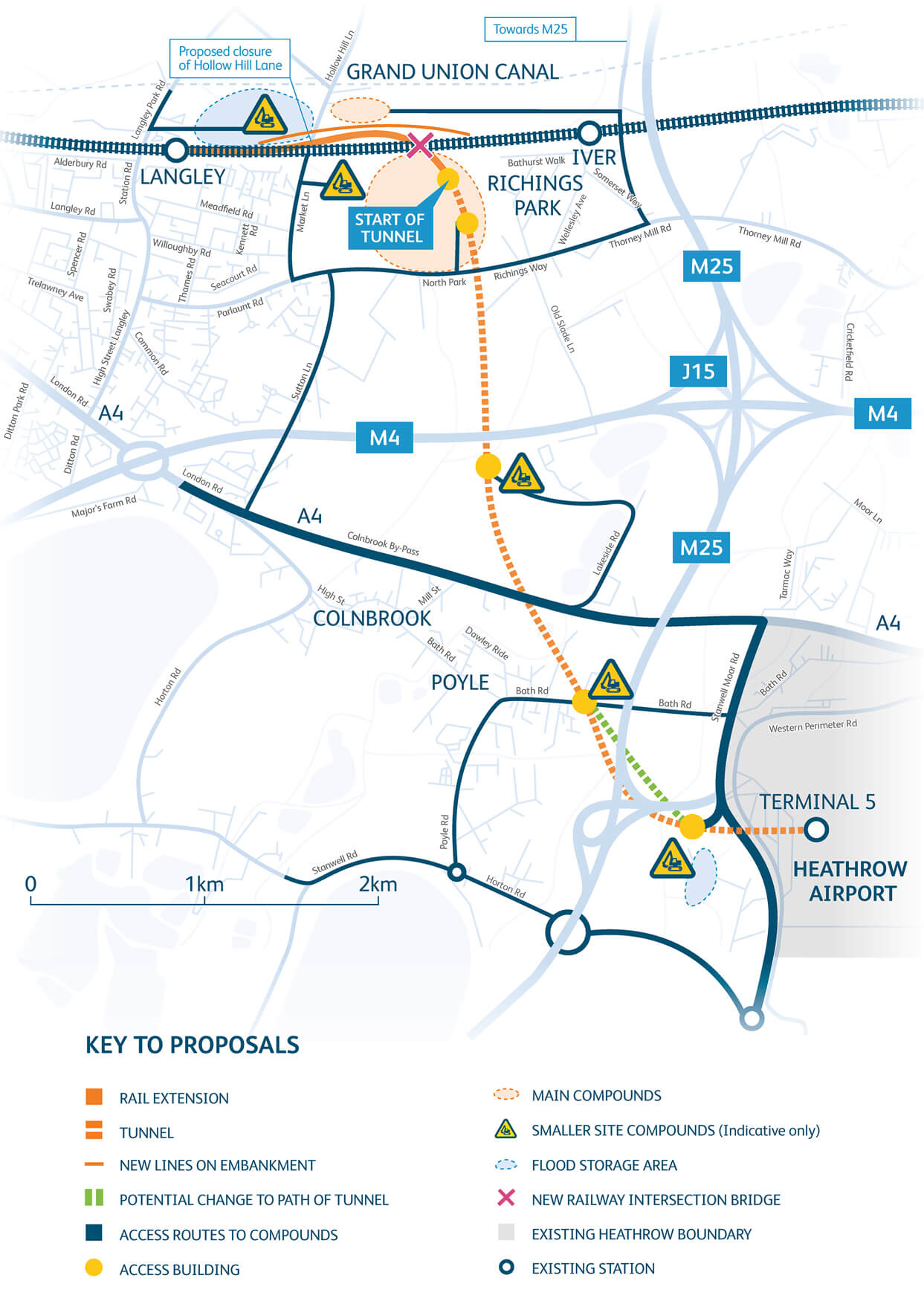
It looks like the dark holes could be the railway, between Langley and Terminal 5.
This section of the rail link is supposed to be in tunnel, but I wonder if costs could be saved if it is in a buttressed cutting, designed in cooperation between Heathrow and Network Rail.
Obviously, it will need to be in tunnel to cross under the M25.
I think that rather cleverly, the runway has been slotted in with the best use of the limited land available.
A Phased Construction Program
The Times says this about the construction program.
Only the runway would be built by the opening date of early 2026.
Other facilities such as new terminals, car parks, hotels and transit systems would open from 2030, with an expansion of Terminal 5 the priority
This means that the extra runway capacity can be used initially to better accommodate the same number of flights.
If Heathrow get it right passengers. should see the following.
- They would suffer less from construction.
- Fewer taxi delays on the ground.
- Less long fuel-burning taxiing between gate and runway.
- More flights leaving on time.
It might also enable air traffic controllers to allocate aircraft noise in a fairer manner.
Car Psrking
Two huge new car parks are to be built North and South of the Airport, which in conjunction with new hotels would be connected to the terminals by an underground transit system.
This article on International Airport Review is entitled Heathrow To Launch First Airport Ultra Low Emission Zone.
So doesn’t the building of large car parks contradict this policy.
It would unless, the car parks are designed for the future.
- Electric cars only.
- Intelligent chargers for every parking space.
- Whilst the cars are parked and connected, they would be a massive energy storage battery for the National Grid.
When you arrived back to your car after a week in Greece, there would be enough power in the battery for your next journey.
By 2030, there will be a substantial need for parking for electric cars at railway stations and airports. Parking solutions like this will help reduce the carbon footprint of airports.
Conclusion
2030 is ten years away and Heathrow will have to work hard to build an airport fit for those times.
Toshiba Unveils Tri-Mode Locomotive Demonstrator
The title of this post is the same as that of this article on Railway Gazette.
This is the first two paragraphs.
Toshiba Railway Europe unveiled a electric-diesel-battery hybrid traction technology demonstrator locomotive at the Transport Logistic trade show in München on June 4.
The company has a contract to supply 50 diesel-battery centre cab locomotives to DB Cargo from 2021, TRE Managing Director Hinrich Krey told Railway Gazette. The demonstrator is intended to showcase the company’s design work to date as well as highlighting future development options.
It is based on the frame and bogies of a heavy shunting locomotive.
- There are two MAN 471 kW gensets.
- The diesel engines are compatible with EU Stage V emissions regulations.
- There are two SCiB 62 kWh lithium titanate oxide traction batteries.
- Battery life is quoted as up to ten years.
- The design is modular, so that a diesel engine can be replaced with another battery pack.
- A pantograph working with common European voltages can provide electric power.
The locomotive is aimed at heavy shunting and light freight.
Conclusion
The power of the locomotive is probably about 1MW, which is less than half the power of a Class 66 locomotive. But locomotives like the Class 66 are often used for tasks, where a smaller locomotive could do an excellent job.
The low pollution of the Toshiba locomotive probably means it could work in sensitive areas or close to a workforce.
The locomotive appears to be a well-designed locomotive for an important niche market.
If this design and others like the Stadler Class 93 locomotive succeed it will lead nearer to the ultimate goal of a high performance heavy freight zero-carbon locomotive to replace the polluting diesel locomotives, that are so common on the railways of the world.
Better Storage Might Give Hydrogen The Edge As Renewable Car Fuel
The title of this post is the same as that of this article on an Australian blog called Create.
This paragraph summarises the article.
Professor David Antonelli from Lancaster University has recently discovered a material that he says could allow existing tank sizes to fuel four times their current range.
Take the time to read the article in full!
If this is developed successfully, then coupled to improved battery technology, that will surely increase the practical range of hybrid hydrogen-battery cars, trucks, buses and trains.
Whilst politicians vanish up their backsides discussing the irrelevant Brexit, engineers and scientists will get on developing ideas, that will make everybody’s lives better.
What Is The Kinetic Energy Of A Class 710 Train?
I finally got a good look at a Class 710 train at Gospel Oak station this morning.
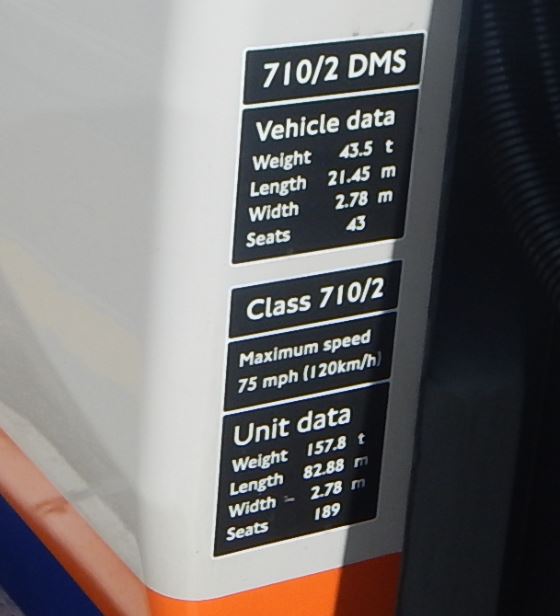
The picture shows the plate on the end of a DMS car.
- The weight of the train is 157.8 tonnes. Note that the four-car Class 378 trains weigh 172.1 tonnes.
- 700 passengers at 90 Kg each with baggage, bikes and buggies would be 63 tonnes.
- That would be a total weight of 220.8 tonnes.
- The operating speed is shown as 75 mph., which is the same as the Class 315 train, that many Class 710 trains will replace.
Using the Omni Kinetic Energy Calculator gives a kinetic energy of 34.5 kWh.
For completeness these are the figures for different speeds.
- 50 mph – 15.3 kWh
- 60 mph – 22.1 kWh
- 90 mph – 49.4 kWh – Operating speed of a Crossrail Class 345 train.
- 100 mph – 61.3 kWh – Operating speed of many electric multiple units.
Note that the amount of energy is proportional to the square of the speed.
What Do The Kinetic Energy Figures Show?
These are a few of my thoughts.
What Is Regenerative Braking?
A full Class 710 is travelling along at 75 mph, ihas 34.5 kWh of kinetic energy. Whenit needs to stop at a station, this energy has to be dissipated.
With normal friction brakes, the energy will be converted into heat and wasted.
But with regenerative braking, the traction motors are used in reverse to generate electricity.
This electricity is generally handled in one of three ways.
- It is passed through resistors on the roof of the train and turned into heat and wasted.
- It is fed back into the electrification and used by nearby trains. This needs special transformers feeding the electrification.
- It is stored in a battery or other energy storage device on the train.
The last method is the most efficient, as the stored energy can be used to help restart the train and regain line speed.
Can The Lea Valley Lines Electrification Handle Regenerative Braking?
This question must be asked, as if the lines can’t then running trains with batteries could be the best way to handle regenerative braking and improve efficiency and reduce the electricity bill.
It should be noted, that the Chingford and Enfield Town routes are not shared with any other trains, so running Class 710 trains on these routes may have advatages in the maintenance of the electrification, if the trains handle the regenerative braking.
On the Cheshunt route, there are also some Greater Anglia services, but these will generally be run by Class 720 trains, which are also Aventras.
On the other hand, the electrification on the Gospel Oak to Barking Line has probably been installed to handle the reverse currents.
Do Class 710 Trains Have Regenerative Braking?
Search the Internet for “Class 710 train regenerative braking” and you find little in addition to my ramblings.
But other Aventras, like Crossrail’s Class 345 trains have been stated to have regenerative braking.
I also repeated my views in an article in Rail Magazine, which I described in I’ve Been Published In Rail Magazine.
No-one has told me that they disagree with my views and I was talking rubbish!
So I will assume that Class 710 trains do have regenerative braking!
The Aventra’s Electrical Systems
In this article in Global Rail News from 2011, which is entitled Bombardier’s AVENTRA – A new era in train performance, gives some details of the Aventra’s electrical systems. This is said.
AVENTRA can run on both 25kV AC and 750V DC power – the high-efficiency transformers being another area where a heavier component was chosen because, in the long term, it’s cheaper to run. Pairs of cars will run off a common power bus with a converter on one car powering both. The other car can be fitted with power storage devices such as super-capacitors or Lithium-ion batteries if required.
This was published eight years ago, so I suspect Bombardier have refined the concept.
But even in 2011, Bombardier were thinking about energy storage on the train.
How Much Storage Would A Class 710 Train Need?
As I said earlier, I train would need sufficient energy storage to store the kinetic energy of a train.
As my calculations show that a full train travelling at the maximum speed of 75 mph, then the energy storage for this version of a Class 710 train must be able to store at least 34.5 kWh, at all times.
The size of the on board energy storage could be around 40-50 kWh, which is readily available in a lithium ion battery, that has been designed for transport use.
Where Would The Energy Storage Be Placed?
The extract above says that two cars hold the electrical systems.
These pictures show the pantograph car and driver car next to it.

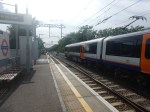
Note that underneath the pantograph car is a transformer.
So are these, the pair of cars, the extract describes? They certainly could be!
This is a selection of pictures of the underneath of the driver car.




Note.
- There are two large boxes with latches under both driver cars.
- Next to these boxes is a smaller box. At the pantograph end of the train, it is open and looks like a cooling system for the two boxes
- At the other end of the train, the smaller box appears to have a blanking plate, so perhaps the boxes are empty.
The only sensible use I can think of for the boxesis to store the batteries or capacitors.
I
I would estimate that each of the four large boxes.
- Is about a metre wide.
- Is about 0.3 metres high.
- Is sized to fit within the 2.7 metre width of the train. Perhaps 2.5 metres.
These give a column of 0.75 cubic metres.
Bombardier used to manufacture a Primove 50 kWh battery, which was built to power trams and trains, that had the following characteristics.
- A weight of under a tonne.
- Dimensions of under two x one x half metres.
Were these boxes under the floor of the driver cabs of the Class 710 train designed to hold a Primove 50 kWh or similar battery?
Four batteries could give the train as much as 200 kWh of energy storage.
But surely for trundling along the Gospel Oak to Barking Line. a smaller battery capacity would be sufficient. I suspect that you fill the boxes with how many batteries you need and the computer does the rest.
Perhaps, just one 50 kWh battery would be enough! This could explain, why the cooling system appears to be blanked off at one end of the train.
Could The Batteries Be Used To Power The Class 710 Train?
In an article in the October 2017 Edition of Modern Railways, which is entitled Celling England By The Pound, Ian Walmsley says this in relation to trains running on the Uckfield Branch, which is not very challenging.
A modern EMU needs between 3 and 5 kWh per vehicle mile for this sort of service.
So a 50 kWh bsttery would give the following ranges with these consumption rates for a four-car Class 710 trains.
- 3 kWh – 4.2 miles
- 4 kWh – 3.1 miles
- 5 kWh – 2.5 miles
It looks to me, that battery power would be possible over the extension to Barking Riverside station, which is about a mile long.
Battery power would also other uses.
- Moving the train to a safe place for passenger evacuation, when the overhead electrification fails.
- Moving the train in a depot or sidings, without overhead power.
- Running innovative on-board services for maintenance and train preparation, when the train is parked overnight.
Reliable battery power has a lot of uses on a train.
West London Orbital Railway
The West London Orbital Railway would have less than ten miles of lines without electrification, with several electrified miles on either side.
I believe that Class 710 trains with the right amount of batteries could bridge the gap and make a massive difference to rail transport in North and West London.
I think that jumping a gap of a few miles on battery power, may well be easier than doing an Out-and-Back service..
A Flexible System
As it appears, each Class 710 train has got four battery boxes, I suspect that batteries can be installed as to the needs of the route.
- Standard operation on Gospel Oak to Barking, Watford DC Lines and Lea Valley Lines could be one or two batteries to handle regenerative braking.
- Out-and-Back to Barking Riverside station ,might need two batteries.
- West London Orbital services might need three or four batteries.
These battery boxes also could be designed to allow an easy and quick change of battery, as batteries on buses have given Transport for London trouble in the past.
Conclusion
Bombardier’s design of the Aventra has been designed with battery operation in mind, which opens up lots of possibilities!
A Different Energy Storage Technology
Recently, two articles on the web have been caught in my Google alerts.
- This article on Energy Storage News, which is entitled ‘Flow Machine’ Maker RedT Gets £3.2m Funding Needed To Power Projects
- This article on Mining Review Africa, which is entitled Bushveld Minerals: A Large-Scale Battery Storage Contender
Both articles are about energy storage using a Vanadium Redox Flow Battery.
This is a paragraph from the Bushveld article.
The project will be implemented in two phases for a total of 1 400 MWh of energy storage capacity – 800 MWh in Phase 1 and an additional 600 MWh in Phase 2.
When you consider that with lithium-ion technology battery capacity is normally talked about in kWH, these are impressive amounts of stored energy.
Reading the Wikipedia post shows that the batteries rely on toxic chemicals like sulphuric acid and vanadium oxide, which would probably rule out mobile applications.
Conclusion
Having read all the two articles and the Wikipedia entry, I wouldn’t be surprised to see some form of technology like this emerge for large scale energy storage to back up intermittent power sources like solar, wind and wave.
Is Cambridge Going To Save The World From Global Warming?
Watch this video!
And then visit Superdielectrics web site.
It does appear to be a bunch of mad scientists in Cambridge, who’ve come up with the bizarre idea of using the material in soft contact lenses as an energy storage medium.
Link Up With Rolls-Royce
And then there’s this press release on the Rolls-Royce-Royce web site, which is entitled Rolls-Royce Links Up With UK-based Superdielectrics To Explore Potential Of Very High Energy Storage Technology.
Conclusion
I have been observing technology since the 1960s.
This is either one of those scientific curiosities , like cold fusion, that appear from time-to-time and then disappear into the scientific archives or become a game-changer.
I suspect we’ll know in a couple of years.
But even if it is isn’t the solution to affordable and massive energy storage,, that will save the world, I believe that one of the teams of men and women in white coats, somewhere in the world will crack the problem.
UK Listed Energy Storage Fund Seeks 182MW Battery Project Pipeline
The title of this post is the same as that of this article on Energy Storage News.
This is the first paragraph.
UK investment management firm Gresham House has confirmed it is to launch a fresh fund raising drive as it sets its sights on a new, 182MW pipeline of battery storage projects.
It is my belief as a Control Engineer, that if we move to renewable energy, like geothermal, hydro, solar, tidal, wave and wind, that the generating capacity must be backed up with large massive of energy storage.
- The energy storage captures excess electricity when nobody needs to use it and feeds it back when consumption exceeds supply.
- I suspect that the National Grid have done extensive simulations of the UK’s energy needs and that they have a model of how much energy storage is needed to support particular mixes and capacities of renewable energy.
- Most of the storage will be lithium-ion or perhaps some of the newer developments, that are creeping into the renewable dictionary.
- The cost of storage, its working life and performance must be well-known, which means that the investors can get a return, that satisfies their needs to fund pensions and insurance policies.
So it would appear that Gresham House have done their sums and come up with a mathematical model, where all are winners.
- UK industry and consumers get enough electricity for their needs.
- Insurance companies and pension funds get a return to fulfil their contractual commitments.
- UK pensioners get a reliable pension.
- UK taxpayers don’t have to fund the much-needed energy storage.
- Our electricity will increasingly be generated by renewables.
- I do suspect that Gresham House will take an appropriate fee.
There may even be an opportunity for the public to invest directly in the future.
For all these winners, there will be losers.
- Oil companies. In Writing On The Wall For Oil Say Funds, I wrote about the opinion of fund managers on oil companies.
- Despots, dictators and religious maniacs, who control much of the world’s oil resources.
I shall cry not one tear for the second group!
I’ll be very interested to see the way that these energy storage funds develop!
Conclusion
These funds will develop in parallel with renewable energy and the energy storage it needs.
As the demand for energy storage will grow significantly, these funds will grow as well to provide the capacity needed to keep the lights on.
Battery Storage Backers Energized By Prospect Of New Tax Credit
The title of this post is the same as that of this article on Bloomberg Tax
- Thirty percent tax relief would be provided for energy storage.
- It might also stand a chance of becoming law in the US.
Read the article and question as I did, that tax relief may be the best way to get investors to build energy storage to keep the lights on, when the wind’s not blowing and the sun’s not shining.
How Many Welshmen And Welshwomen Can You Fit In A Million Pound Park-And-Ride?
This article on Insider Media, which is entitled Work On £1m Park-And-Ride Site Completes.
The Park-and-Ride facility is at Abercynon station, which is the station, where the Merthyr Line splits into two branches to Metryr Tydfil and Aberdate stations.
- The facility has 310 parking spaces.
- It has been built in six months after a November start.
- Bus access will be provided at the original car park.
- I hope they’ve increased cycle capacity for the Geraint Thomas effect.
My only worry is that with eight trains per hour to start between Abercynon and Cardiff in 2023, will the facility be big enough?
Economics
This is obviously and a much-needed scheme and each parking space has cost around £3,000. If on 250 working days, each generate around five pounds in revenue, that must mean that the car park should be viable.
Conclusion
If this Park-and-Ride facility has been built so quickly and should be viable, why is it that so few similar parking schemes are proposed for railway stations?
Especially, where at Abercynon station, there will be a massive improvement in capacity and quality of the train service.
- A doubling of frequency
- Faster, electric tram-trains.
- Trains that can hold more passengers.
How many other stations are getting this improvement?
as to finance, I think this could be the sort of investment, infrastructure funds, run by the like of L & G and Aviva will be looking at..
- Not a large investment.
- Could be constructed to n efficient design.
- Guaranteed return.
But in the future, when electric vehicles make up say half of all those on the road, it could become a large energy supply and storage facility.
 The Anonymous Widower