Welcoming GB Energy And Its Mission To Make Britain A Clean Energy Superpower
The title of this post, is the same as that of this press release from SSE.
This is the sub-heading.
Making Britain a clean energy superpower by 2030 is one of the new government’s five missions. The UK Government and Crown Estate have announced plans to join forces to create a new publicly owned energy firm. GB Energy will invest in homegrown, clean energy.
These are the first two paragraphs of SSE’s response to the announcement.
We welcome the focus of GB Energy on earlier stage technologies, such as carbon capture and storage (CCS), where the Government can de-risk projects and help accelerate the clean energy transition.
In areas such as offshore wind, where industry is already delivering mission-critical infrastructure, the biggest impact will be on delivering policies that speed up the build out of these essential projects.
It looks like SSE, see Great British Energy as a positive development.
SSE And Gilkes Energy Announce Joint Plans To Progress Loch Fearna Pumped Storage Hydro Project
The title of this post, is the same as that of this press release from SSE Renewables.
These five paragraphs from the press release outline the scheme.
SSE has announced plans to progress a new pumped storage hydropower scheme at Loch Fearna in Scotland’s Great Glen, in a 50:50 development joint venture with a consortium led by Gilkes Energy.
The proposed co-development is located at the western end of Glengarry around 25km west of Invergarry and adjoins SSE Renewables’ existing Loch Quoich reservoir in the Great Glen hydro scheme.
SSE Renewables already operates the largest fleet of hydro-electric power and pumped storage hydro assets in Scotland. It is now progressing development plans for new pumped storage hydropower projects in the Highlands to complement its existing fleet and deliver the large-scale, long-duration electricity storage (LDES) needed as part of Britain’s future energy mix.
The Fearna Pumped Storage Hydro (PSH) project envisages the development of tunnels and a new power station connecting SSE Renewables’ existing reservoir at Loch Quoich with an upper reservoir at Loch Fearna.
Under the terms of the joint venture being announced today, Gilkes Energy will lead the project’s development under a development services agreement with SSE Renewables.
I wrote about the Great Glen hydro scheme in Repurposing The Great Glen Hydro-Electric Scheme, where I included this map, from the SSE Renewables web site shows the layout of the dams and power stations.
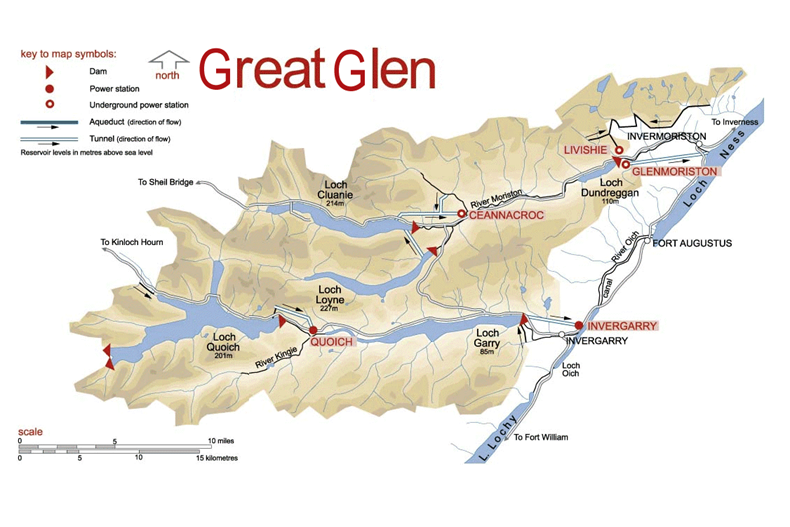
The sizes of the power stations in the scheme are as follows.
- Ceannacroc – 20 MW
- Livishie – 15 MW
- Glenmoriston- 37 MW
- Quoich – 18 MW
- Invergarry – 20 MW
- Mucomir – 1.7 MW
This gives a total power of 112.7 MW.
This five paragraph from the press release details the size of the scheme.
It is envisaged the proposed development would be up to 1.8GW in generating capacity and capable of producing around 37GWh of stored energy capacity. The project has already secured a grid connection offer totalling 1,795MW.
The 1.8 GW/37 GWh Fearna pumped hydro scheme will dwarf the Great Glen hydro scheme.
it is now seventy years since some of these hydro-electric systems were built in Scotland.
As an engineer, I wouldn’t be surprised to a see a fair amount of updating in the Highlands to upgrade Scotland’s hydro-electricity.
UK Company Unveils Mooring Solution For Floating Offshore Wind
The title of this post, is the same as that of this article on offshoreWIND.biz.
This is the sub-heading.
UK-based Blackfish Engineering has unveiled a mooring system, called C-Dart, which eliminates the direct handling of heavy mooring lines by operational personnel. The system is designed to rapidly connect various floating structures and assets, including wave and tidal energy converters, offshore wind, floating solar platforms, aquaculture, and more, according to the company.
These three paragraphs give a few details.
By utilising the principles of gravity, buoyancy, and rope tension, the C-Dart system facilitates a contact-free, automated connection process that secures equipment securely and swiftly, Blackfish said.
The system’s rapid connect and disconnect capability is said to cut down the time typically required for offshore operations which is vital in reducing the overall operational costs and downtime, particularly in the high-stakes environment of renewable energy projects.
Constructed from high-tensile, corrosion-resistant materials, the C-Dart system could withstand harsh oceanic environments, extending its service life while minimising maintenance requirements.
There is also this excellent video.
These are my thoughts.
The Companies Involved
The companies, organisations involved are listed on the C-Dart product page.
Skua Marine Ltd, Morek Ltd, Flowave, Underwater Trials Centre, Offshore Simulation Centre, National Decommissioning Centre, Bureau Veritas, Queen Mary University, The Waves Group, KML, Alex Alliston, Arnbjorn Joensen
Note.
- Blackfish Engineering are in Bristol.
- Bureau Veritas is a French company specialized in testing, inspection and certification founded in 1828.
- Queen Mary University is in London.
- The Underwater Trials Centre is in Fort William.
- The National Decommissioning Centre is in Aberdeen.
- The Offshore Simulation Centre, is in Norway.
Funding came from the Scottish Government.
Good Design And Improved Safety
It does look in this product that good design and improved safety go together.
Conclusion
This peoduct could be a real winner.
ILI Group Progresses Plans For 1.5GW Pumped Storage Hydro Project
The title of this post, is the same as that of this article on Power Technology.
This is the sub-heading.
The company has submitted a Section 36 planning application to the Scottish government.
These three paragraphs give more details.
The Intelligent Land Investments (ILI) Group has submitted a Section 36 planning application to the Scottish government for its 1.5GW Balliemeanoch pumped storage hydro project in Argyll and Bute.
The initiative will boost the UK’s renewable energy capacity and supply electricity to 4.5 million homes.
With an anticipated connection date of 2031, the project is strategically aligned with the UK’s long-term energy strategy.
Note.
- It will have a storage capacity of 45 GWh.
- It will be by far, the largest pumped storage hydroelectric power station in the UK. The under development Coire Glas pumped storage system is 24 GWh.
When the UK or Europe needs more power after completion of Balliemeanoch and Coire Glas, the Highlands of Scotland will provide the power.
3 GW Dogger Bank South Offshore Wind Farms Reach New Development Stage
The title of this post, is the same as that of this article on offshoreWIND.biz.
This is the sub-heading.
The UK Planning Inspectorate has accepted into the examination phase the Development Consent Order (DCO) application for the Dogger Bank South (DBS) Offshore Wind Farms developed by RWE and Masdar.
The first two paragraphs give a brief description of the wind Farm.
The DBS East and DBS West offshore wind farms, which could provide electricity for up to three million typical UK homes, are located in shallow waters on the Dogger Bank over 100 kilometres off the northeast coast of England. The acceptance of the DCO application moves the projects into the pre-examination phase, which will become subject to a public examination later in 2024.
Together, the projects will have up to 200 turbines with a combined estimated capacity of 3 GW. Investment by RWE and Masdar during development and construction is predicted to deliver an economic contribution (Gross Value Added) to the UK of almost GBP 1 billion, including GBP 400 million in the Humber region.
There is a detailed map in the article on offshoreWIND.biz.
The Next Steps
These are given in the article.
The next steps for the projects, following a successful Development Consent Order, would be to secure Contracts for Difference (CfD), followed by financing and construction, the developers said.
It certainly looks like the 3 GW Dogger South Bank Wind Farm is on its way.
These are my thoughts about the project.
The Turbines To Be Used
The article says this about the turbines.
Together, the projects will have up to 200 turbines with a combined estimated capacity of 3 GW.
This means that the turbines will be 15 MW.
In RWE Orders 15 MW Nordseecluster Offshore Wind Turbines At Vestas, I said this.
Does this mean that the Vestas V236-15.0 MW offshore wind turbine, is now RWE’s standard offshore turbine?
This would surely have manufacturing, installation, operation and maintenance advantages.
There would surely be advantages for all parties to use a standard turbine.
It’s A Long Way Between Yorkshire And The Dogger Bank
The article says it’s a hundred kilometres between the wind farm and the coast of Yorkshire.
Welcome To The Age Of Hydrogen
This is the title of this page of the RWE web site.
The page starts with this paragraph.
RWE is actively involved in the development of innovative hydrogen projects. The H2 molecule is considered to be an important future building block of a successful energy transition. RWE is a partner in over 30 H2 projects and is working on solutions for decarbonising the industry with associations and corporations like Shell, BASF and OGE. Hydrogen projects are comprehensively supported in the separate Hydrogen department of the subsidiary RWE Generation.
AquaVentus
I also suggest, that you read this page on the RWE web site called AquaVentus.
The page starts with this RWE graphic.
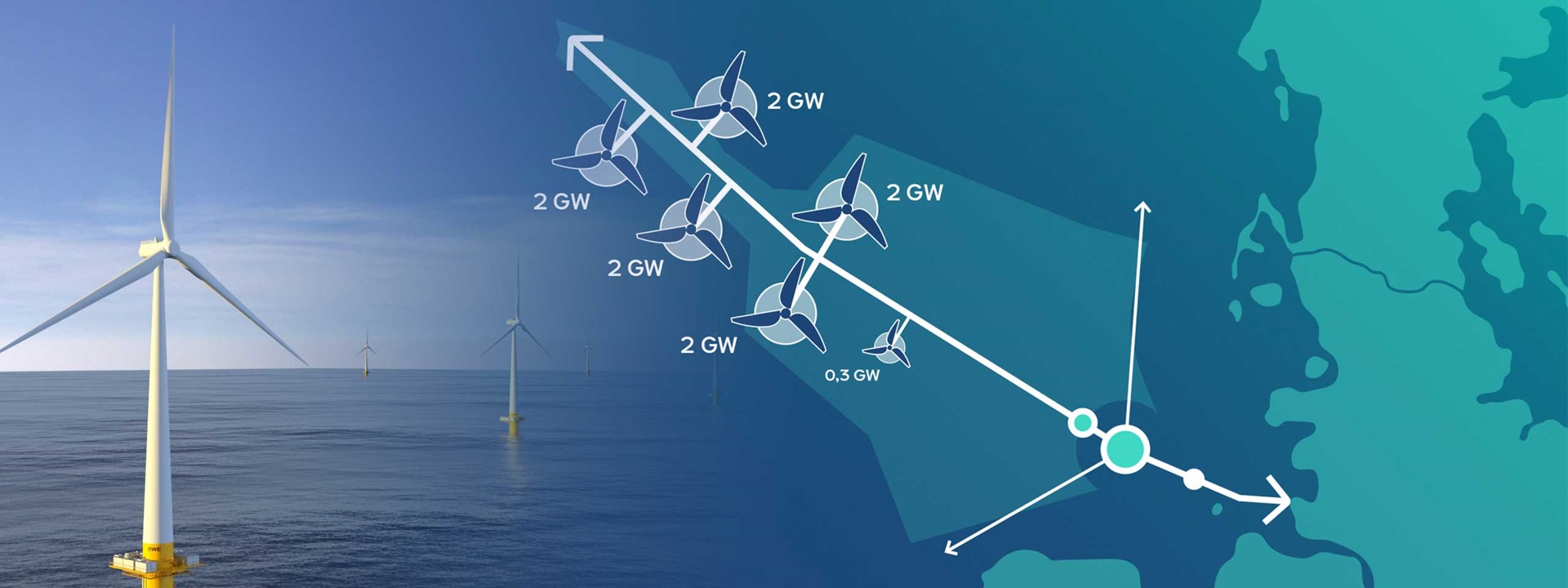
It appears that 10.3 GW of hydrogen will be created by wind farms and piped to North-West Germany.
These two paragraphs outline the AquaVentus initiative .
Hydrogen is considered the great hope of decarbonisation in all sectors that cannot be electrified, e.g. industrial manufacturing, aviation and shipping. Massive investments in the expansion of renewable energy are needed to enable carbon-neutral hydrogen production. After all, wind, solar and hydroelectric power form the basis of climate-friendly hydrogen.
In its quest for climate-friendly hydrogen production, the AquaVentus initiative has set its sights on one renewable energy generation technology: offshore wind. The initiative aims to use electricity from offshore wind farms to operate electrolysers also installed at sea on an industrial scale. Plans envisage setting up electrolysis units in the North Sea with a total capacity of 10 gigawatts, enough to produce 1 million metric tons of green hydrogen.
The page also gives these numbers.
- Total Capacity – 10 GW
- Tonnes Of Green Hydrogen – 1 million
- Members – 100 +
The web site says this about commissioning.
Commissioning is currently scheduled for early/mid 2030s.
The Germans can’t be accused of lacking ambition.
AquaVentus And The UK
This video shows the structure of AquaVentus.
I clipped this map from the video.

Note.
- There is a link to Denmark.
- There appears to be a undeveloped link to Norway.
- There appears to be a link to Peterhead in Scotland.
- There appears to be a link to just North of the Humber in England.
- Just North of the Humber are the two massive gas storage sites of Aldbrough owned by SSE and Brough owned by Centrica.
- There appear to be small ships sailing up and down the East Coast of the UK. Are these small coastal tankers distributing the hydrogen to where it is needed?
In the last century, the oil industry, built a substantial oil and gas network in the North Sea. It appears now the Germans are leading the building of a substantial hydrogen network.
AquaVentus And Aldbrough And Rough Gas Storage
Consider.
- In The Massive Hydrogen Project, That Appears To Be Under The Radar, I describe the Aldbrough Gas Storage.
- In Wood To Optimise Hydrogen Storage For Centrica’s Rough Field, I describe Centrica’s plans to turn Rough Gas Storage into the world’s largest hydrogen store.
- There is a small amount of hydrogen storage at Wilhelmshaven.
It looks like the East Riding Hydrogen Bank, will be playing a large part in ensuring the continuity and reliability of AquaVentus.
Dogger Bank South And AquaVentus
This Google Map shows the North Sea South of Sunderland and the Danish/German border.
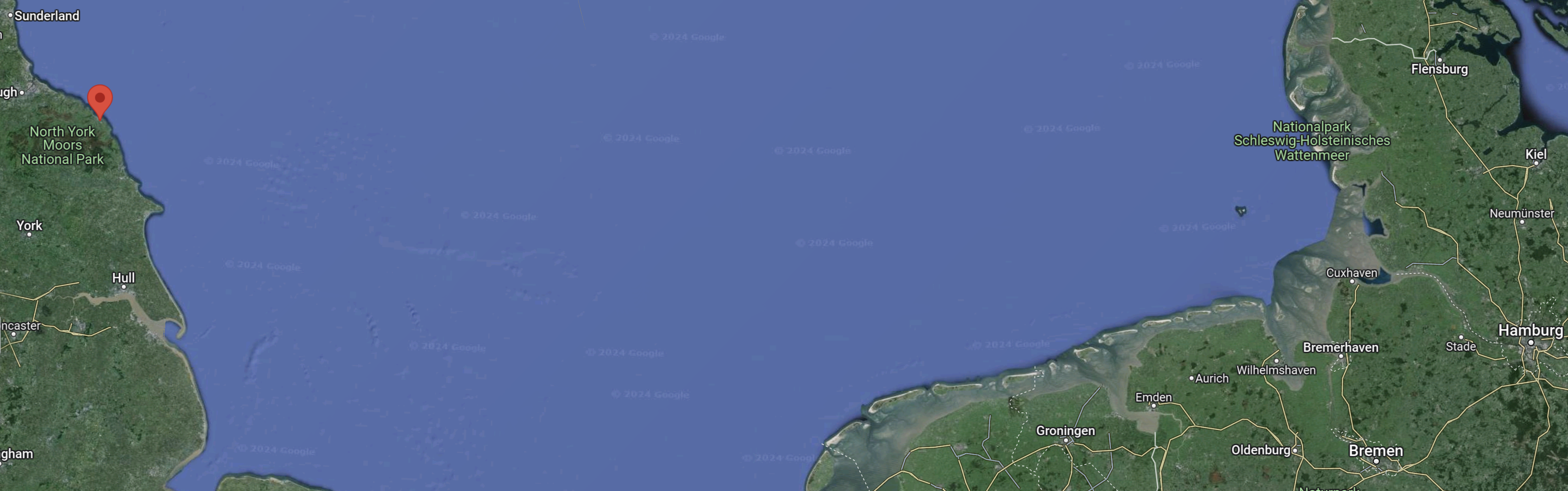
Note.
- Sunderland is in the top-left hand corner of the map.
- A white line in the top-right corner of the map is the Danish/German border.
- Hamburg and Bremen are in the bottom-right hand corner of the map.
If you lay the AquaVentus map over this map, I believe that Dogger Bank South wind farm could be one of the three 2 GW wind farms on the South-Western side of the AquaVentus main pipeline.
- Two GW would be converted to hydrogen and fed into the AquaVentus main pipeline.
- One GW of electricity would be sent to the UK.
But this is only one of many possibilities.
Hopefully, everything will be a bit clearer, when RWE publish more details.
Conclusion
I believe, that some or all of the Dogger Bank South electricity, will be converted to hydrogen and fed into the AquaVentus main pipeline.
I also believe, that the hydrogen stores in the East Riding of Yorkshire, will form an important part of AquaVentus.
How Clean Energy Will Help Deliver UK Economic Growth
The title of this post, is the same as this press release from SSE.
This is the sub-heading.
How To Actually Deliver UK Economic Growth
This press release appears to have been written by Alistair Phillips-Davies, who is Chief Executive of SSE.
These three paragraphs introduce the press release.
Prior to the election Labour had committed to tackling the planning system head on in order to unlock economic growth and get Britain building again.
If Rachel Reeves’ first speech as Chancellor is anything to go by, winning a commanding majority has only galvanised that intent.
The challenge is for policymakers to deliver at pace across the whole of the UK, including in Scotland where reform is devolved but is also urgently needed.
Alistair Phillips-Davies seems impressed.
Why We Need Planning Reform Urgently
Under this heading, he says this.
Let me give you two examples of how planning acts as a drag on economic growth and jobs.
It currently takes around 12 years to deliver a large offshore wind farm in UK waters. But only two or three years of that is the construction phase.
And when it comes to electricity grids that span the country it only takes one local authority in Scotland to object to a project for it to go to a public inquiry, adding costs and years of delay.
No-one wants to avoid appropriate scrutiny and proper engagement with communities but allowing decision making to drag on for years suits nobody and setting a reasonable 12-month limit is surely sensible for everyone involved, as is giving ministers greater discretion where projects are clearly deemed to be in the national interest.
I very much agree with what he says.
I also suspect that what he says, applies to England, Wales and Northern Ireland, just as much as Scotland.
Declaring His Ambitions
The next two section declare Alistair Phillips-Davies’s ambitions.
- Making The UK The Easiest Place In The world To Invest And Actually Build Projects
- Creating Good Jobs Here In The UK
They are certainly sections that need a full read.
We Need To Get A Move On
This is his final section, which I’ll insert in full.
Having worked in the energy industry for almost 30 years I have never been more excited about the prospects for this country.
As one of the largest investors in the UK, SSE alone has a current investment programme of more than £20bn, but we are ready to go further and many others in the industry will join us.
Britain has no shortage of opportunities. But we need to make them happen. If we can deliver on the clean energy mission, the growth will come. There’s a long way to go, but unblocking the planning gridlock is the right place to start.
I was there at the start of North Sea Oil and Gas, writing project planning software in a Suffolk attic.
Hopefully, I’ll see North Sea Energy turn full circle to renewables.
Gresham House Energy Storage Reaches 1 Gigawatt Of Capacity
The title of this post, announcing a major milestone for Gresham House Energy Storage Fund appears on several web pages.
Many grid batteries are designed to give full power for two hours, so applying that rule to the Gresham House Energy Storage fleet, will mean that the total fleet would be a 1 GW/2 GWh battery.
Consider.
- In Centrica Business Solutions And Highview Power, I showed how Highview Power’s batteries could be used, instead of lithium-ion batteries.
- Highview Power’s largest battery is 200 MW/2.5 GWh, which compares well with the largest lithium-ion batteries, in the UK fleet.
- The Ffestiniog Power Station is a 360 MW/1.44 GWh pumped-storage hydroelectric power station in Wales. It is slightly smaller than Highview Power’s largest battery.
- Moss Landing Power Plant in California is proposing to have a 1,500 MW / 6,000 MWh lithium-ion battery.
- Other GWh-scale systems are under trial.
It would appear that battery systems are widening the sizes of where they can be employed.
This hopefully, will mean more competition and keener prices for battery systems.
Sunak’s Terrible Decision To Call The Election
As a control engineer and mathematical modeller, whose software planned many of the world’s major projects in the last thirty years of the last century, I feel that Rishi Sunak’s decision to call the election, when he did, was one of the worst political decisions of a UK Prime Minister in the last century.
Consider.
- Inflation was coming down and it was likely interest rates could fall soon.
- The Rwanda plan could have started to work.
- A new round of wind farm Contracts for Difference for wind farms are due to be announced soon and signs, that there could be a large amount of wind to add to the future pipeline could be a record. I wrote about it in UK Can Secure Record Number Of Offshore Wind Farms In This Year’s Auction For New Projects.
- There is 4 GW of new offshore wind to be commissioned in the next eighteen months.
When, he called the election, I believed Sunak had a very large rabbit to pull out of a hat. But there was none!
I wrote Where’s The Plan, Rishi?, because I felt these must be something more to come.
Conclusion
Now Starmer and the Labour Party, will reap all the benefits of selling Europe and principally, the Germans, the electricity and hydrogen they need.
Site Investigations Underway At RWE’s Three Norfolk Offshore Wind Project Sites
The title of this post, is the same as that of this article on offshoreWIND.biz.
This is the sub-heading.
RWE has kicked off geophysical and geotechnical site investigations at the Norfolk Boreas, Norfolk Vanguard East, and Norfolk Vanguard West offshore wind project sites in the UK, rights to which the German company acquired from Vattenfall earlier this year.
All three projects in RWE’s 4.14 GW wind farm off the Norfolk coast, at last seem to be making progress.
According to the Wikipedia entry for the List Of Offshore Wind Farms In The United Kingdom, this is the last status.
Norfolk Boreas
Owner: RWE
Turbines: Vestas
Status: Contract for Difference – Round 4
Commissioning Date: 2027
Norfolk Vanguard East
Owner: RWE
Turbines: Vestas
Status: Early Planning
Commissioning Date: Before 2030
Norfolk Vanguard West
Owner: RWE
Turbines: Vestas V236-15.0 MW
Status: Early Planning
Commissioning Date: Before 2030
Note.
- All three Norfolk wind arms, will be using Vestas turbines.
- The data for Norfolk Vanguard West shows that Vestas V236-15.0 MW turbines will be used.
- In SeAH To Deliver Monopiles For Vattenfall’s 2.8 GW Norfolk Vanguard Offshore Wind Project, I discussed the monopiles for the Norfolk wind farms. Will these be standardised across the Norfolk wind farms?
- In RWE Orders 15 MW Nordseecluster Offshore Wind Turbines At Vestas, I speculated that RWE had standardised on these large turbines for their North Sea wind farms, which would surely be a sensible action to take.
Using the same large turbines and monopiles for a number of wind farms, will surely give advantages in manufacture, installation, operation and and servicing for RWE, SeAH Wind and Vestas.
The finances should also be more beneficial.
These are my thoughts.
Will The Norfolk Wind Farms Produce Hydrogen For Germany?
Consider.
- As Hornsea 4 wind farm makes landfall in Norfolk, Norfolk should have enough renewable electricity.
- The Norfolk Nimbies will object to more electricity transmission lines across Norfolk.
- H2ercules, which is the large German hydrogen network will need lots of green hydrogen.
- Wilhelmshaven, which will be the main hydrogen feed point for H2ercules, is just across the North Sea at Wilhelmshaven.
- There are no Houthis roaming the North Sea.
- Hydrogen could be transported from the Norfolk wind farms to Wilhelmshaven by pipeline or coastal tanker.
- German companies are building the Norfolk wind farms.
I believe that there is a good chance, that the Norfolk wind farms will produce hydrogen for Germany.
This will have the following benefits.
- Germany will get the hydrogen it needs.
- The hydrogen link will improve energy security in Europe.
- The UK government will receive a nice cash flow.
The only losers will be the dictators, who supply Europe with energy.
UK’s First Offshore Hydrogen Production Trials Kick Off in South Wales
The title of this post, is the same as that of this article on offshoreWIND.biz.
This is the sub-heading.
After six years of development, sustainability consultancy ERM has launched offshore trials to test its Dolphyn Hydrogen process which combines electrolysis, desalination, and hydrogen production on a floating wind platform, marking the first time hydrogen has been produced from seawater in a marine environment in the UK.
These are the first three paragraphs.
The trials conducted in Pembroke Port, South Wales, through July 2024 are said to represent an important step forward in enabling the UK to produce low-carbon hydrogen safely, reliably, and at scale.
In ERM’s Dolphyn Hydrogen process, hydrogen is transported to shore via a pipeline and it can be used directly for power generation, transport, industrial purposes, and heating.
The development of the Dolphyn Hydrogen process has been supported by the UK Government’s Department for Energy Security and Net Zero, through the Low Carbon Hydrogen Supply 2 Competition in the GBP 1 billion (approximately USD 1.2 billion) Net Zero Innovation Portfolio (NZIP). It has been awarded funding of over GBP 8 million (about USD 10.13 million) to date and has also been championed by devolved Governments in Wales and Scotland.
There’s more about Dolphyn Hydrogen on their web site.
Conclusion
This self-contained floating hydrogen factory could be very useful operating either singly or as a small fleet.
It would help if Dolphyn Hydrogen disclosed some hydrogen production capacities.
This is said in a press release.
The pilot project at Vattenfall’s Offshore Wind Farm in Aberdeen Bay will have an output of 8.8MW and will be able to produce enough hydrogen every day to power a hydrogen bus to travel 24,000km.
That looks about right.
I shall be following Dolphyn Hydrogen.
 The Anonymous Widower