US Offshore Wind Developer Sues Gov’t Over Stop-Work Order
The title of this post, is the same as that of this article on offshoreWIND.biz.
This is the sub-heading
Dominion Energy has filed a federal lawsuit challenging the Trump administration’s stop-work order issued on 22 December that directed all major US offshore wind projects under construction to pause while federal agencies review alleged national security risks, AP and US media report.
This paragraph adds more detail.
In its complaint filed in the US District Court for the Eastern District of Virginia on 23 December, Dominion argues the Bureau of Ocean Energy Management (BOEM) order is “arbitrary and capricious” and violates constitutional and statutory limits on executive action.
I’m no lawyer, but I did have some excellent executive active with my late lawyer wife, so I get the gist of what is hinted.
I would not be happy, if I was an American citizen, who had to pick u[ the costs of Trump’s misdemeanours.
Google AI Is Using This Blog
This is a screen-shot from Google.
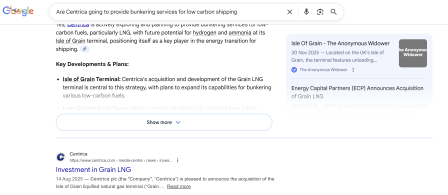
I had asked Google AI this question “Are Centrica going to provide bunkering services for low carbon shipping?”
Google AI gave me this answer.
Yes, Centrica is actively exploring and planning to provide bunkering services for low-carbon fuels, particularly LNG, with future potential for hydrogen and ammonia at its Isle of Grain terminal, positioning itself as a key player in the energy transition for shipping.
Key Developments & Plans:
- Isle of Grain Terminal: Centrica’s acquisition and development of the Grain LNG terminal is central to this strategy, with plans to expand its capabilities for bunkering various low-carbon fuels.
- Low-Carbon Fuels Focus: While currently handling LNG, Centrica sees future opportunities for hydrogen and ammonia bunkering at the terminal, aligning with the maritime sector’s shift away from heavy fuel oil.
- Strategic Investment: Centrica views LNG as a crucial transition fuel and is investing in infrastructure to support its role in energy security and decarbonization, including for shipping.
- Bio-LNG Involvement: Through its stake in Gasrec, Centrica is also supporting renewable LNG for road transport, indicating broader interest in sustainable gas fuels.
US Government Sends Stop Work Order To All Offshore Wind Projects Under Construction
The title of this post, is the same as that of this article on offshoreWIND.biz.
This is the sub-heading.
The US Department of Interior has paused the leases and suspended construction at all large-scale offshore wind projects currently under construction in the United States, citing ”national security risks identified by the Department of War in recently completed classified reports.”
The wind farms named are.
- Coastal Virginia Offshore Wind-Commercial – 2,600 GW
- Empire Wind 1 – 810 MW
- Revolution Wind – 704 MW
- Sunrise Wind – 924 MW
- Vineyard Wind 1 – 806 MW
Note.
- These five wind farms total 5,844 MW or 5.8 GW.
- The Empire Wind development is being led by Equinor, who are Norwegian.
- The Revolution Wind and Sunrise Wind developments are being led by Ørsted, who are Danish.
- The Vineyard Wind development is being led by Iberdrola, who are Spanish and Copenhagen Infrastructure Partners, who are Danish.
- Coastal Virginia Offshore Wind project uses 176 Siemens Gamesa SG 14-222 DD (Direct Drive) offshore wind turbines.
- Empire 1 Wind is using Vestas V236-15MW offshore wind turbines.
- Revolution Wind is using 65 Siemens Gamesa SG 11.0-200 DD offshore wind turbines.
- Sunrise Wind is using Siemens Gamesa wind turbines, specifically their 8.0 MW models (SG 8.0-167).
- Vineyard 1 Wind is using General Electric (GE) Haliade-X 13 MW offshore wind turbines.
- Some of the components for the Siemens wind turbines will be manufactured in Virginia.
- Coastal Virginia Offshore Wind has a budget of $11.2-3 billion.
- Empire 1 Wind has a budget of $5 billion.
- Resolution Wind has a budget of $4 billion.
- Sunrise Wind has a budget of $5.3 billion.
- Vineyard 1 Wind has a budget of $4 billion.
There will only be one winner in this new round of the ongoing spat between Trump and the wind industry, that he hates so much – the 1.3 million active lawyers in the United States,which is a figure from according to Google AI.
UK Gov’t Tweaking CfD Rules Ahead Of 8th Allocation Round, Proposes ‘Other Deepwater Offshore Wind’ Category
The title of this post, is the same as that of this article on offshoreWIND.biz.
This is the sub-heading.
The UK government has launched a consultation on proposed refinements to the Contracts for Difference (CfD) scheme ahead of Allocation Round 8 (AR8) and future rounds, including targeted changes to the terms concerning offshore wind and floating wind projects.
These two paragraphs add more details.
The consultation, published by the Department for Energy Security and Net Zero, seeks industry feedback on contractual and eligibility adjustments, some of which are intended to reflect the increasing scale and complexity of offshore wind developments, specifically floating and other deepwater projects.
For floating offshore wind, the government is proposing changes to CfD contract terms to better align with the technology’s development timelines. These include a proposed extension of the Longstop Period to give floating wind projects more time to commission and avoid termination of their CfD contract.
The government also wants to lower the Required Installed Capacity (RIC) threshold for floating offshore wind projects.
Currently, all CfD technologies are required to deliver a minimum of 95 per cent of the capacity they have contractually agreed to install, except for (fixed-bottom) offshore wind, whose RIC is set at 85 per cent to reflect the construction risks, such as encountering unsuitable seabed conditions after work has commenced. As floating wind projects, which were so far in the range of 100 MW, have grown in scale and complexity, the government plans to apply the same RIC requirement as for fixed-bottom offshore wind.
The CfD scheme currently supports two categories of offshore wind technology: fixed-bottom offshore wind and floating offshore wind, with the regulations in use (Allocation Regulations 2014) considering only the foundation designs that float to be floating offshore wind. With the ODOW category, the government wants to make room for the novel hybrid foundation designs, “which may be suitable for deepwater deployment but do not technically float and would therefore not be considered eligible as ‘floating foundations’ under the existing legal definition of ‘floating offshore wind’.”
This last paragraph sums up the reasons for the changes.
The proposed refinements are intended to ensure the CfD scheme remains fit for purpose as offshore wind technologies evolve, while maintaining investor confidence and supporting timely project delivery.
Hopefully developments at ports like Belfast, East Anglia, Inverness & Cromarty FreePort,Lowestoft and Tyne will encourage to develop wind farms around the shores of the UK.
The Liquid Air Alternative To Fossil Fuels
The title of this post, is the same as that of this article on the BBC.
This is the sub-heading.
An overlooked technology for nearly 50 years, the first liquid air energy storage facility is finally set to power up in 2026. It’s hoping to compete with grid-scale lithium batteries and hydro to store clean power, and reduce the need to fall back on fossil fuels.
These three introductory paragraphs add more details.
s the world’s use of renewable electricity soars, surpassing coal for the first time, the need to store that energy when the Sun isn’t shining and the wind isn’t blowing is growing in step. While some turn to grid-scale lithium batteries and others to pumped hydro, a small but growing industry is convinced there’s a better solution still: batteries that rely on air.
Near the village of Carrington in north-west England, the foundations are being laid for the world’s first commercial-scale liquid air energy storage facility. The site will eventually become an array of industrial machinery and a number of large storage tanks, filled with air that has been compressed and cooled so much it has become a liquid, using renewable energy surplus to demand. The stored energy can be discharged later when demand exceeds supply.
If the project succeeds, more will follow. The site’s developers Highview Power are confident that liquid air energy storage will make it easier for countries to replace fossil fuels with clean renewable energy – though at present, the technology is expensive. But as the need for clean energy storage surges, they’re betting the balance will tip in favour of liquid air.
Where this article about Highview Power is different, as it gives various details on the efficiency, return and of liquid air energy storage systems.
CIP’s UK Offshore Wind Project Granted Development Consent
The title of this post, is the same as that of this article on offshoreWIND.biz.
This is the sub-heading.
The UK Secretary of State for Energy Security and Net Zero has approved the Development Consent Order (DCO) for the Morecambe offshore wind farm in the Irish Sea, owned by Copenhagen Infrastructure Partners (CIP).
The article also shows this map from Copenhagen Infrastructure Partners.
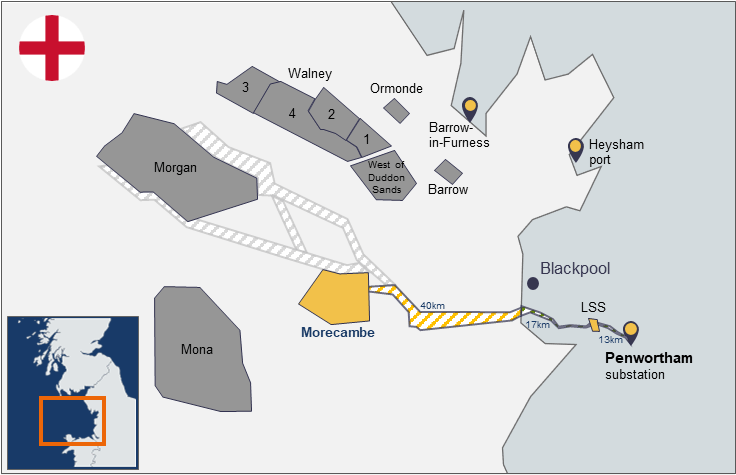
Note.
- The 480 MW Morecambe wind farm is shown in yellow.
- The 1.5 GW Morgan wind farm received its DCO in August 2025.
- The 1.5 GW Mona wind farm received its DCO in July 2025.
- Both Morgan and Mona wind farms are being developed by a consortium of EnBW and JERA Nex bp.
- Morgan and Morecambe wind farms will connect to the grid at Penwortham substation.
- Mona wind farm will connect to the grid at Bodelwyddan National Grid substation in Denbighshire, North Wales.
- Morgan and Morecambe wind farms appear to be being developed jointly.
I must admit, I’m a bit surprised that Mona doesn’t connect to Penwortham substation.
French Companies Unite On Superconducting Cable Project For Distant Offshore Wind Farms
The title of this post, is the same as that of this article on offshoreWIND.biz.
This is the sub-heading.
Air Liquide, CentraleSupélec, ITP Interpipe, Nexans, and RTE have joined forces to develop a project that connects distant offshore wind farms to shore via a High Voltage Alternating Current (HVAC) superconducting transmission system.
This introductory paragraph adds some detail.
The SupraMarine demonstrator project will study the electrical connection between offshore wind farms and the coastline using High-Temperature Superconducting (HTS) cables. Cooled by liquid nitrogen, the cables are said to transport electricity with near-zero energy loss.
Note.
- No details of the target distances are indicated.
- There is a detailed exploratory diagram.
It is certainly an ambitious project, but I feel it could have substantial uses.
I have a few thoughts and questions.
Can Sodium Metal Be Used For High Voltage Electrical Underground Cables?
Google AI answers this question as follows.
Yes, sodium metal was investigated and used in trial runs for high-voltage underground electrical cables in the late 1960s and early 1970s, as a potentially cheaper and more flexible alternative to copper and aluminum. However, it is not in common use today due to safety concerns and unfavorable lifecycle economics compared to aluminum.
When I was at ICI around 1970, they were researching the use of sodium for high voltage power cables.
- ICI had access to large amount of sodium chloride in Cheshire.
- The sodium metal can be obtained by electrolysis.
- Renewable electricity for electrolysis will be plentiful.
- Someone told me that their prototype cable was a polythene pipe with Sodium metal in the middle.
- I’ve read somewhere that sodium cables have interesting safe overload properties.
- I can understand the safety concerns and unfavorable lifecycle economics, especially where water is concerned.
Perhaps, French technology has improved in the sixty years?
Will Sodium Metal Be Used In The French Superconducting Cable?
Nothing has been disclosed!
But the office chat at ICI from those, who knew their sodium and their polythene, as they’d been working at ICI Mond Division for decades, was of the opinion that sodium/polythene cables were possible!
From The Diagram, It Looks Like Power Is Needed At Both Ends Of The Superconducting Cable
The diagram shows wind turbines at one end and the grid at the other end of the cable.
So will a battery or some other form of stabilisation be needed for when the wind isn’t blowing?
Will The French Superconducting Cable Have A High Capacity?
The basic capacity of a cable depends on three properties.
- The resistance of the cable.
- The cross-section area of the cable.
- The design of the cable must also be able too conduct away the heat generated by electricity flowing through.
Will The Technology Work For Interconnectors?
I don’t see why not!
US Judge Overturns Trump’s Ban On Wind Energy Project Permits
The title of this post, is the same as that of this article on offshoreWIND.biz.
This is the sub-heading.
A federal judge has struck down the US President Donald Trump’s indefinite halt of all federal approvals and permitting for new wind energy projects.
Trump is obviously very strong in his opposition to wind power, as he issued the ”Wind Order” on his first day back in office.
He received this robust reply from Oceantic Network CEO Liz Burdock.
Today’s decision is welcome news, not just for the thousands of American workers and businesses across 40 states supporting offshore wind in the U.S., but also for the critical relief the wind industry will provide to lower skyrocketing electricity prices for millions of American families with reliable, affordable power.
Overturning the unlawful blanket halt to offshore wind permitting activities is needed to achieve our nation’s energy and economic priorities of bringing more power online quickly, improving grid reliability, and driving billions of new American steel manufacturing and shipbuilding investments. We thank the Attorneys General and the Alliance for Clean Energy New York for taking this case forward to protect American business interests against the politicization of our energy sector.
I don’t think we’ve heard the last of this legal argument.
Is Carbon Black Used To Make Offshore Electrical Cable?
I asked Google AI, the answer to this question and received this answer.
Yes, carbon black is extensively used to make offshore electrical cables. It serves two primary functions: providing electrical conductivity to specific components and offering UV protection to outer jacketing materials.
That seems a positive answer.
It also could be a very complementary one.
HiiROC have a process that splits any hydrocarbon gas including natural gas, chemical plant off gas and biomethane, into turquoise hydrogen and carbon black.
Two methods of bringing energy to the shore from an offshore wind farm are electricity and hydrogen, through a cable or pipe respectively.
This looks to me, that there could be a possibility to use one of Baldrick’s cunning hybrid plans to bring energy onshore using both hydrogen and electricity.
Effectively, the transmission and use of the system, would use both the hydrogen and carbon black produced by HiiROC.
SeaTwirl AB Signs Agreement To Explore Ehe Feasibility Of Electrification Of Aquaculture In Chile
The title of this post, is the same, as that of this press release from SeaTwirl.
This is the sub-heading.
SeaTwirl AB has entered into an agreement to carry out a feasibility study for electrification of fish farms together with a global industrial supplier. The intention of the collaboration is to assess the use of SeaTwirl’s floating vertical-axis wind turbines to provide renewable electricity to offshore-based equipment at aquaculture assets in Chile.
These three paragraphs add more details.
The feasibility study will cover a comprehensive scope, including energy demand and power system requirements, environmental site conditions, cost assessments, supply chain opportunities, and logistics in Chilean waters with the intention to reduce dependence on diesel. The study is expected to be completed during 2026, and the results will help determine next steps.
Chile is home to one of the largest aquaculture industries in the world, and the sector is pursuing ambitious sustainability goals including lower emissions, increased use of renewable power and reduced risk of spills. While the contractual value of the agreement is limited, at approximately SEK 0,8 million, the engagement will generate revenue and represent an important step in SeaTwirl’s commercialization effort.
“This collaboration marks an exciting step towards our purpose to enable floating wind power wherever it is needed, and to expand the use of floating wind technology beyond traditional grid-connected applications. The aquaculture industry has a clear need for offshore renewable energy, and we believe our technology can deliver a robust and cost-effective solution. It is also a major milestone to become involved in the southern hemisphere where many of the challenges we try to address, such as limited availability of cranes, vessels, and yard infrastructure, may be more challenging than in the north. We see significant potential in the aquaculture segment and look forward to beginning this journey in South America”, says Johan Sandberg, CEO of SeaTwirl.
I do find it strange, that the two vertical wind turbines, that both seem to be more than prototypes are both Scandinavian.
The Ventum Dynamics turbine, that I talked about in Are These Turbines An Alternative To Solar Panels? is Norwegian and this one is installed on Skegness Pier.
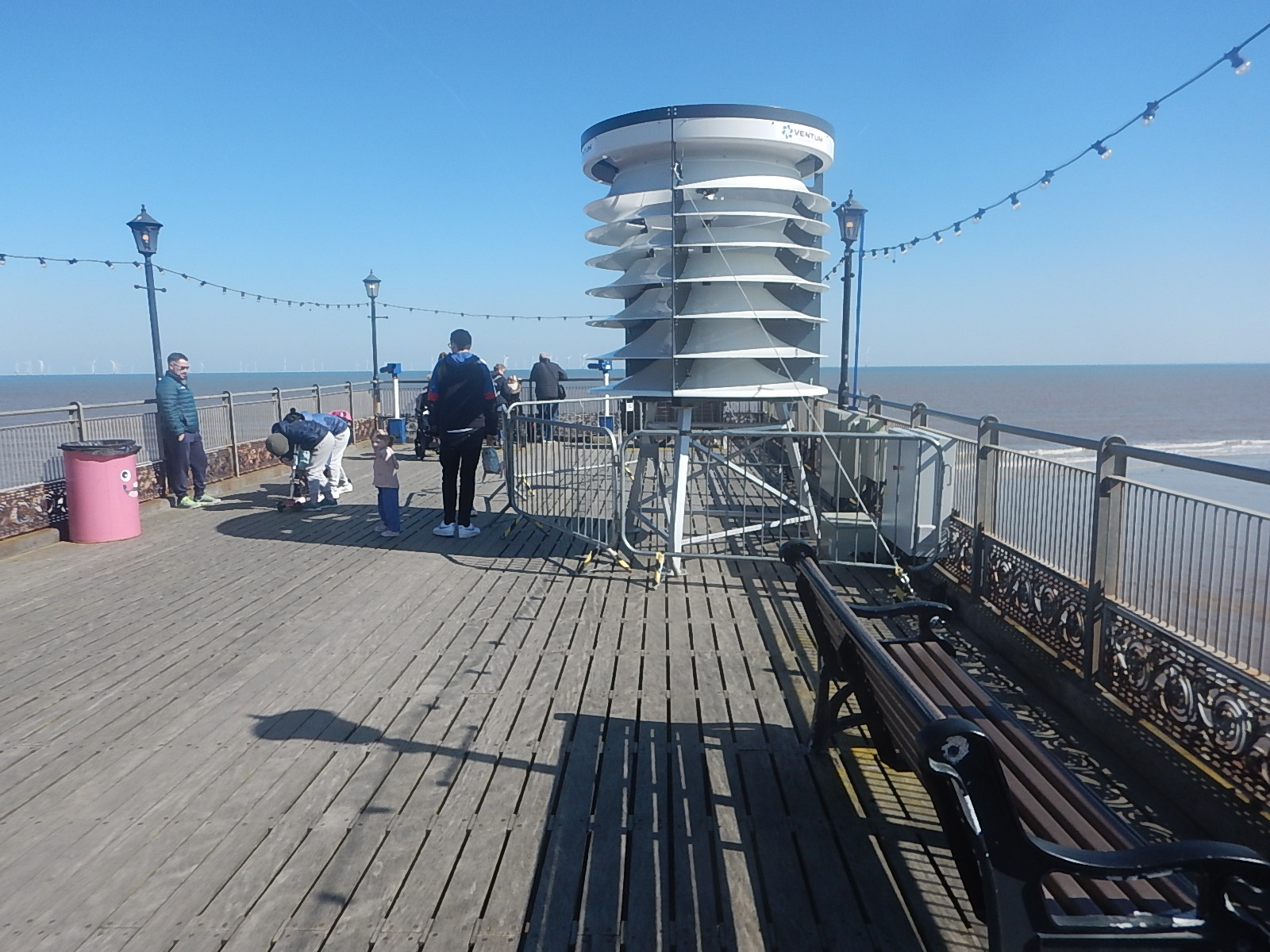
IKEA could sell these for DIY-enthusiasts to assemble and erect. On my stud, I used to have a barn, that could certainly have taken two of these 1.5 KW VX175 turbines.
This link is video of a dancing and swimming SeaTwirl.
If you follow, the SeaTwirl video to its conclusion, you’ll see one being erected in the sea. I can assure you that in the 1970s, my 25-year-old self, did the calculations for a reusable oil production platform called a Balaena, which erected on the same principle. So, I’m fairly certain, that SeaTwirls can be an alternative to traditional wind turbines.
 The Anonymous Widower