Encomara’s Floating Wind Installation Technology Gets ABS Design Approval
The title of this post, is the same as that of this article on offshoreWIND.biz.
This is the sub-heading.
Encomara’s floating wind installation technology, Squid, has received Product Design Assessment (PDA) certification from the American Bureau of Shipping (ABS)
These three paragraphs add more details.
The PDA follows an Approval in Principle (AiP) granted by ABS in November 2025 and moves the system a step closer to commercial deployment, according to Encomara, as it advances the technology along its qualification pathway towards Technology Readiness Level assessment and market adoption.
The technology is developed by Encomara and manufactured by Aurora Energy Services (AES), which acquired the Aberdeen-based company in 2025.
Squid integrates pre-installed mooring lines and electrical connections into a single subsea unit, enabling floating wind turbines to be connected using a “plug-and-play” approach.
In some ways the project reminds me of a floating oil and gas production platform, on which I did the calculations.
But the Balaena Structures design never sold a platform and the company, which was based in Cambridge, folded.
Encomara have a web site, which is well worth a visit.
Does Floating Wind Power Have A Higher Capacity Factor Than Fixed Foundation Wind Power?
I asked Google AI the question in the above sub-title and received this answer.
Yes. Floating wind power typically achieves higher capacity factors than fixed-foundation wind power.
The main reasons for this performance edge include:
Stronger, More Consistent Winds: Floating platforms allow turbines to be placed much further offshore, where wind speeds are higher, steadier, and less turbulent.
Access to Deeper Waters: Over 80% of deep-water offshore wind resources exist in waters too deep for fixed-bottom structures.
Performance Comparisons: Fixed offshore wind turbines typically see capacity factors ranging between 45% and 60% (depending on the location), whereas floating installations can push past 60%. For instance, the Hywind floating wind farm in Scotland achieved a capacity factor exceeding 65% in its first months of operation.
Despite this higher generation yield, floating wind technology is generally more complex and features higher installation and capital costs than fixed-bottom turbines.
I also believe that some of the floating wind technology, lends itself to advanced production and installation methods.
Offshore Wind Could Help Create ‘Electric Shipping Highway’ Across Europe, Study Says
The title of this post, is the same as that of this article on offshoreWIND.biz.
This is the sub-heading.
Offshore wind farms, energy islands, ports and proposed “Offshore Power Zones” could together form the foundation of an integrated maritime energy system capable of supporting large-scale vessel electrification across Northern Europe, according to a study by Maersk’s Stillstrom, Baltic Energy Island and the Port of Roenne.
This is a map from the report.
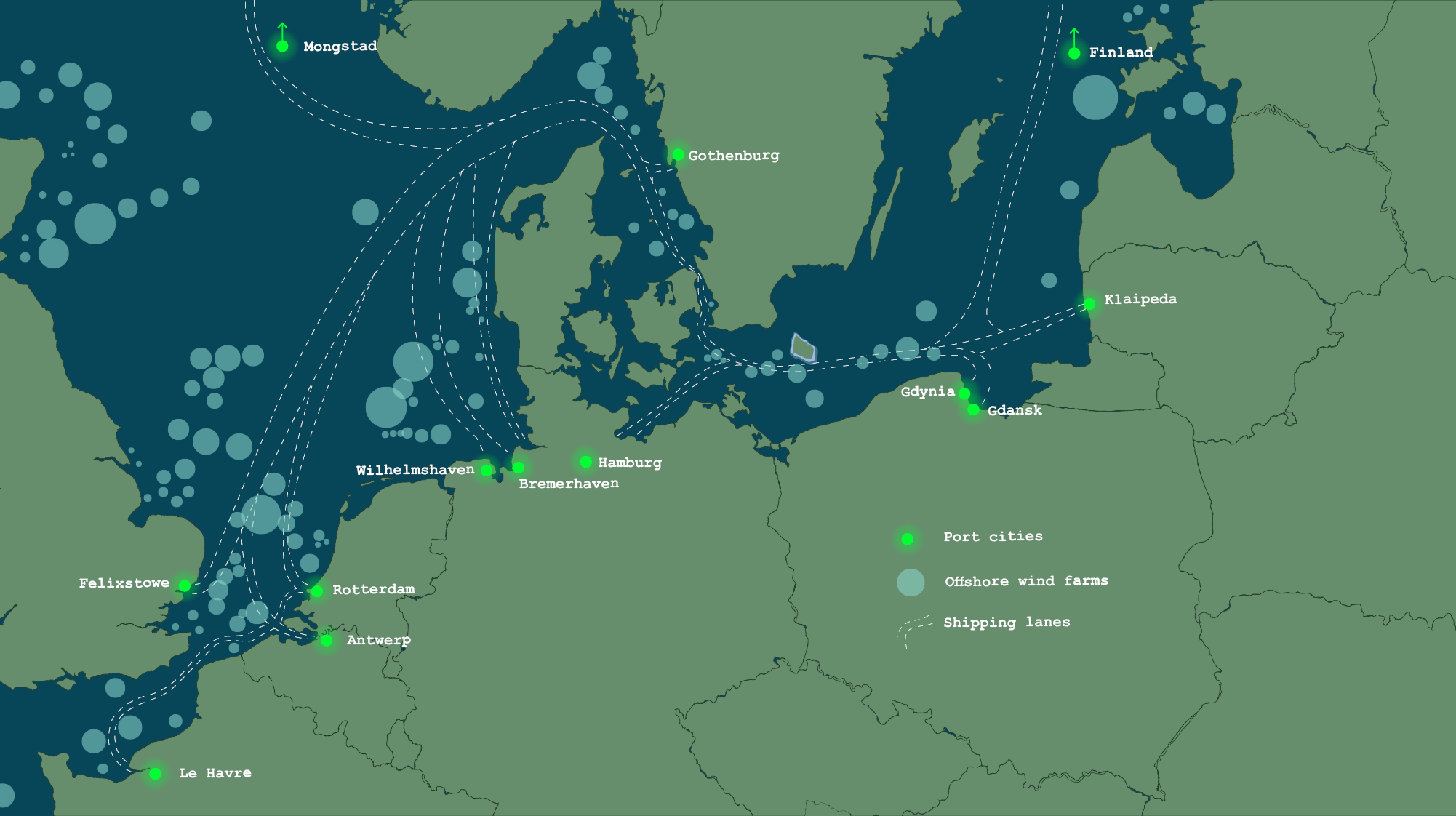
Note.
- In Investment in Grain LNG, I talked about Centrica and Grain LNG Terminal, Centrica’s plans for the terminal, which include bunkering.
- London Gateway and Immingham are two substantial ports on the East side of England.
Are English ports, except for the notable exception of Felixstowe, not shown on the map, because of Brexit?
These two paragraphs add some detail.
According to the findings, it is estimated that around 37,000 cargo vessels pass Bornholm each year, consuming approximately 3 million tonnes of marine fuel and emitting around 10 million tonnes of CO₂ annually. Full electrification of this traffic is estimated to require about 17 TWh of electricity per year, potentially replacing roughly EUR 2 billion in fossil fuel imports with domestically generated renewable power.
The whitepaper also introduces the concept of Offshore Power Zones (OPZs), developed by Stillstrom, which involves vessels accessing offshore wind-generated electricity at sea for battery charging or hotel loads. The report sees these zones linked with electrified ports to form an “electric shipping highway” stretching from the English Channel through the North Sea into the Baltic Sea.
Note that Bornholm is between Sweden and Germany.
Trump Administration Withdraws Appeal, Leaving Wind Energy Leasing And Permitting Freeze Vacated
The title of this post, is the same as that of this article on offshoreWIND.biz.
This is the sub-heading.
The Trump Administration has withdrawn its appeal of a federal court ruling that vacated the section of its January 2025 Presidential Wind Memorandum that halted federal leasing and permitting activities for onshore and offshore wind projects, leaving the court’s decision in place and the wind permitting and leasing freeze overturned.
These two paragraphs add more details.
The US Court of Appeals for the First Circuit has granted the federal government’s motion to voluntarily dismiss its appeal of a December 2025 ruling by the US District Court for the District of Massachusetts, which found the challenged section of the Presidential Wind Memorandum unlawful and vacated it in its entirety.
With the dismissal, the district court’s ruling remains in force, meaning the indefinite nationwide pause on wind energy leasing and permitting activities can no longer be enforced.
To quote one of my favourite accountants and a very good friend.
Trump has been screwed, glued and tattooed.
Thankfully, he also has appeared to have given up fairly quickly and has stopped throwing good money after bad.
GWEC Calls For Faster Offshore Wind Deployment As Global Capacity Nears 100 GW
The title of this post, is the same as that of this article on offshoreWIND.biz.
This is the sub-heading.
The Global Wind Energy Council (GWEC) has called on governments worldwide to accelerate offshore wind deployment and treat offshore wind projects as critical energy infrastructure, warning that a faster build-out is necessary to strengthen energy security and reduce exposure to future energy market shocks
These two paragraphs add some more detail.
The industry is approaching a major milestone of 100 GW of installed offshore wind capacity globally, according to GWEC’s 2026 Global Offshore Wind Report, released on 9 June at the APAC Wind Energy Summit in Hanoi, Vietnam.
The report shows that 9.3 GW of new offshore wind capacity was grid-connected worldwide in 2025, a 16 per cent increase compared to the previous year and the third-highest annual total on record. Global installed offshore wind capacity reached 92.5 GW by the end of 2025.
These are some points from the article.
- China remained the world’s largest offshore wind market in 2025, commissioning 6.6 GW of new capacity and increasing its total installed offshore wind capacity to 48.4 GW.
- Europe added nearly 2 GW across the UK, Germany and France, with the UK accounting for just over 1 GW of new installations.
- Despite the positive outlook, GWEC said project development continues to be hindered by permitting delays, grid constraints, supply chain bottlenecks and shortcomings in auction design.
- The average size of offshore wind turbines installed in 2025 exceeded 10 MW for the first time, reaching 10.3 MW.
It certainly looks like offshore wind power is going well.
Is The UK Developing Sea-Drones To Protect Wind Farms?
I asked Google AI the question in the title of this post and received this answer.
Yes, the UK is actively developing and utilizing sea-drones (and autonomous boats) for its offshore wind farms. This technology is being used to protect the farms by patrolling subsea infrastructure, inspecting underwater turbine foundations, and delivering heavy equipment to mitigate human risk.
Here is a look at how sea drones and autonomous systems are being developed and used for the UK’s offshore energy sector:
Subsea Security and Patrolling: The UK and NATO are highly focused on protecting critical subsea cables and wind networks from adversarial interference. Firms like Aberdeen-based Honuworx have been contracted to develop autonomous underwater vehicles capable of prolonged remote operation for defense and infrastructure surveillance.
Underwater Structure Inspection: Projects like the UNITE program (led by Heriot-Watt University and supported by the National Robotarium) are testing AI-controlled underwater robots to operate in turbulent seas and maintain offshore wind infrastructure. Meanwhile, Beam (an offshore wind services company) successfully deployed the world’s first AI-driven autonomous underwater drone at Scotland’s Seagreen wind farm, cutting inspection times in half.
Sailing Drones & Remote Operations: Energy companies like Vattenfall are controlling uncrewed surface vessels (USVs) and sailing drones from remote operation centers in Aberdeen to patrol and keep North Sea wind farms safe and efficient.
Heavy-Lift Cargo Drones: Beyond sea drones, energy giant Ørsted has utilized giant autonomous drones to deliver heavy equipment—like 70kg boxes of safety gear—directly to the tops of offshore wind turbines in the UK, removing the need for ships and cranes in rough seas
We should fight fire with innovation.
Can A ‘Secret Sauce’ Help Store Renewable Energy?
The title of this post, is the same as that as this article on the BBC.
This is the sub-heading.
The US-Israel war with Iran has led to higher electricity bills and put the issue of energy security back in the spotlight.
These two paragraphs add more detail to the story.
Now a pilot project inspired by a 100-year-old idea aims to store renewable energy.
Those behind the high density hydro demonstrator scheme near Plymouth say the technology can “turn small hills into giant batteries”, as part of the transition away from fossil fuels.
This is one of those stories, that could only emerge in the UK.
If you have the time, click on the link to the BBC article and read it in full.
I have a feeling, that the world will be hearing a lot about RheEnergise.
I asked Google AI, “How Much Energy Can A RheEnergise Battery Store”, and received this reply.
A RheEnergise system acts like pumped-storage hydro, using a dense fluid instead of water to store energy.
Planned commercial facilities are designed to store 2 to 16 hours of energy capacity, offering between 10 MW and 50 MW of power generation.
The exact energy storage figures for their deployments scale depending on the site requirements.
The breakdown of how these installations store and yield energy includes:
Commercial-Scale Capacity: A standard commercial site ranging from 10 MW to 50 MW will yield between 20 MWh and 800 MWh of total energy output (based on operating at full capacity for 2 to 16 hours).
The “Secret Sauce”: The system uses a proprietary fluid called R-19, which is 2.5 times denser than water.
This density allows the system to generate 2.5× more power and energy from the same physical footprint and vertical drop compared to traditional water-based facilities.
Real-World Pilot: The company operates a 500 kW demonstrator project at Cornwood near Plymouth, UK. This smaller test-bed, if run continually, generates energy equivalent to powering about 400 homes for an entire year.
Zero Seasonal Losses: Unlike chemical batteries (like lithium-ion) that degrade and lose charge over time, pumped hydro setups suffer virtually zero energy loss while the fluid sits idle.
Sizewell B Nuclear Plant To Get Life Extension
The title of this post, is the same as that of this article on Energy Live News.
This is the sub-heading.
Power station was slated to close in 2035 but could have its life extended by two decades
These two paragraphs add detail to the story.
EDF and Centrica are preparing to invest around £800 million to keep Sizewell B generating for another 20 years, according to reports.
The Suffolk nuclear plant is currently due to close in 2035 but the companies are in talks with the UK Government over a deal that could extend operations to 2055.
These are also some facts from Wikipedia and other sources.
- Sizewell B was commissioned in 1995.
- It has a capacity of 1.2 GW.
- It provides three percent of the UK’s power.
- According to Google AI, Sizewell B has had an excellent safety record.
- Sizewell A is the only UK nuclear power plant that I have visited and I was very impressed how they managed the annual shutdowns.
Incidentally, according to Google AI, Sizewell A generated electricity for forty years and only had one alarming problem during decommissioning.
How Many Similar Nuclear Plants Are There In The World Like Sizewell B?
I have to ask this question, as when you are running old machines of any type, the more operational examples you have the better.
I asked Google AI and received this answer.
Sizewell B is the UK’s only commercial Pressurized Water Reactor (PWR). Its nuclear core is based on the Westinghouse 4-loop SNUPPS (Standardized Nuclear Unit Power Plant System). While hundreds of PWRs operate worldwide, only two exact global clones share this foundational design, alongside heavily adapted reactors.
The Exact SNUPPS Clones (2 in the world)
Sizewell B’s “nuclear island” is fundamentally based on the SNUPPS model developed in the 1970s.
Only two other plants share this exact base design:
Callaway Nuclear Generating Station (Missouri, USA)
Wolf Creek Generating Station (Kansas, USA)
Note: While Sizewell B utilizes this base architecture, it features significant UK-specific modifications, such as heavily diversified safety systems and an Emergency Boration System.
Similar 4-Loop Westinghouse PWRs
If you are looking at the broader Westinghouse 4-loop PWR family—the wider technological class that Sizewell B belongs to—there are dozens of similar reactors spread across the globe.
These operate in countries like the United States, France, South Korea, and China.
I have been over four PWRs of various makes in the United States and only one gave me any cause for concern.
My training at ICI taught me, that if you have a complicated and possibly dangerous plant or factory, you must keep it tidy, as that lowers the risk of accidents.
This nuclear power plant was the most untidy industrial plant I’d ever seen. Since I visited in the 1980s, it has been decommissioned and demolished.
Would I Be Happy To See Sizewell B Carry On Generating?
Obviously, I’d be guided by the various authorities and information from around the world.
But Sizewell has the Leiston factor. Leiston is the nearest town to the Sizewell site.
This is a paragraph from Leiston’s Wikipedia entry.
Leiston thrived in the late 19th and early 20th centuries as a manufacturing town, dominated by Richard Garrett & Sons, owners of Leiston Works, which boasted the world’s first flow assembly line, for the manufacture of portable steam engines. The firm also made steam tractors and a huge variety of cast and machined metal products, including munitions during both world wars. The works closed in 1981 and the site was reused as a mixture of housing, flats and industrial sites. The Long Shop Museum, showing the history, vehicles and products of the works, remains as a heritage tourist attraction.
Did the engineering heritage of the area contribute to the good safety records of the first two Sizewell nuclear power stations?
I also lived near the nuclear site at Sizewell for thirty years and the feeling of Suffolk people about the power stations is more one of pride, rather than fear.
An Extreme Day Out – Bedlington And Northumberland Park Stations
This OpenRailwayMap shows the Northumberland Line and the Eastern part of the Newcastle Metro.
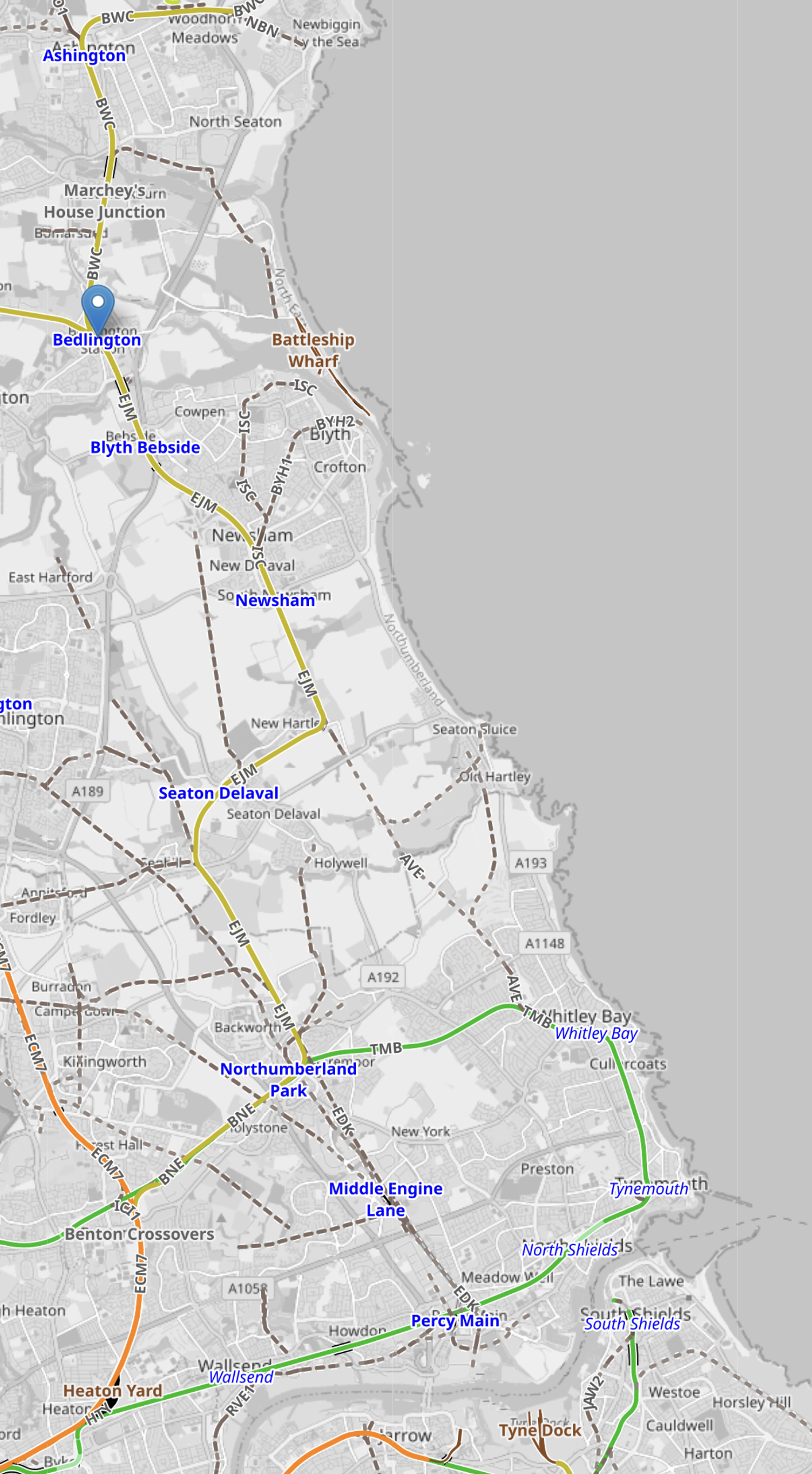
Note.
- The yellow track is the Northumberland Line.
- It terminates in the North at Ashington in the top-left corner of the map.
- Bebington station is indicated by the blue arrow.
- It terminates in the South at Newcastle station.
- The green track is the Newcastle Metro.
- There is now an interchange between the two lines at Northumberland Park station.
In the following sections, I’ll describe my trip.
King’s Cross And Newcastle Return For £66.35
I bought my two long distance tickets on a walk-up basis at King’s Cross and Newcastle stations from the machines.
- I traveled North on a Lumo service to Glasgow for £27.20.
- I did indulge myself with a tea for £2.60.
- I traveled South on an LNER service for £36.55.
- One of the reasons, I buy tickets on a walk-up basis, is that with my uncomplicated pancolonic diverticular disease, I might decide to cancel at the last minute, so it avoids the hassle of getting refunds.
Both services were within a few minutes of the timetable, although LNER had said they would be late, due to signalling problems.
My Route In Northumberland For £2.60
I bought a return ticket at Newcastle station for Ashington, which is the current terminus of the Northumberland Line.
- I actually didn’t go past Bedlington station, where I turned round and had a drink.
- As there are two trains per hour on the Northumberland Line, waits are not generally not too long.
- I only came back as far as Northumberland Park, where I swapped to the Metro for Newcastle station.
If I had had more time, I would have stopped at Seaton Delaval station to have a gluten-free dinner, which I wrote about in Seaton Delaval Station – 30th March 2025.
From Newcastle to Bedlington Station
I took these pictures going to Bedlington station.















I would have taken more pictures, but the train was rather full.
Bedlington Station And Bedlington
I took these pictures at and around Bedlington station.
















Note.
- Although it is a completely rebuilt station, it has a level crossing.
- But is the signal box keeping a watchful eye over trains and the road?
- Bedlington station appears to be step-free using ramps and the level crossing.
- Just to the North of the station, the tracks split to Ashington and Morpeth.
In my forty minutes or so in Bedlington, I didn’t see a terrier.
Are Any Bedlington Terriers Still Bred At Or Near Bedlington?
I had to ask Google AI, this question and I received this reply.
Yes, Bedlington Terriers are still bred in and around their namesake town in Northumberland, UK. While they are a relatively rare breed overall, the historic North East region remains one of the primary strongholds for these distinct “lamb-like” dogs.
Northumberland Park Station
I took these pictures at Northumberland Park station.















Note.
- The Northumberland Line uses a single bi-directional platform on the North side of the station.
- The Newcastle Metro uses an island platform on the South side of the station.
- Both platforms have steps and lifts.
- There are around 400 parking spaces and a Sainsbury’s Superstore at the station.
At 78, after a stroke, I didn’t find the change between the two lines difficult. But I did use the lifts!
What Are The Future Plans For The Northumberland Line?
I couldn’t resist asking Google AI this question and I received this answer.
With the Bedlington and Northumberland Park stations fully operational, the core phase of the Northumberland Line connecting Ashington to Newcastle is complete. Future plans now focus on route extensions, additional stops, and increasing capacity to handle high passenger demand.
Key Future Plans
Extension to the Coast: The North East Combined Authority is actively funding the development of an extension to Newbiggin-by-the-Sea, utilizing existing freight tracks. Planning submissions for this expansion are targeted for 2028.
New Station Proposals: Proposals are being explored to build an additional stop serving the Wansbeck General Hospital and to replace the long-closed Choppington station.
Increased Capacity: Operator Northern Rail is in ongoing discussions with transport partners to lengthen train services (which are currently constrained to two to four coaches) to help accommodate massive patronage on the line.
Integrated Ticketing: The Northumberland County Council is exploring integrated ticketing with the Tyne and Wear Metro to allow for seamless travel between the two networks at stations like Northumberland Park.
From my observations on the line over the last few years, I would go along with Google AI’s recommendations.
These are some specific thoughts.
Extension To Newbiggin-by-the-Sea
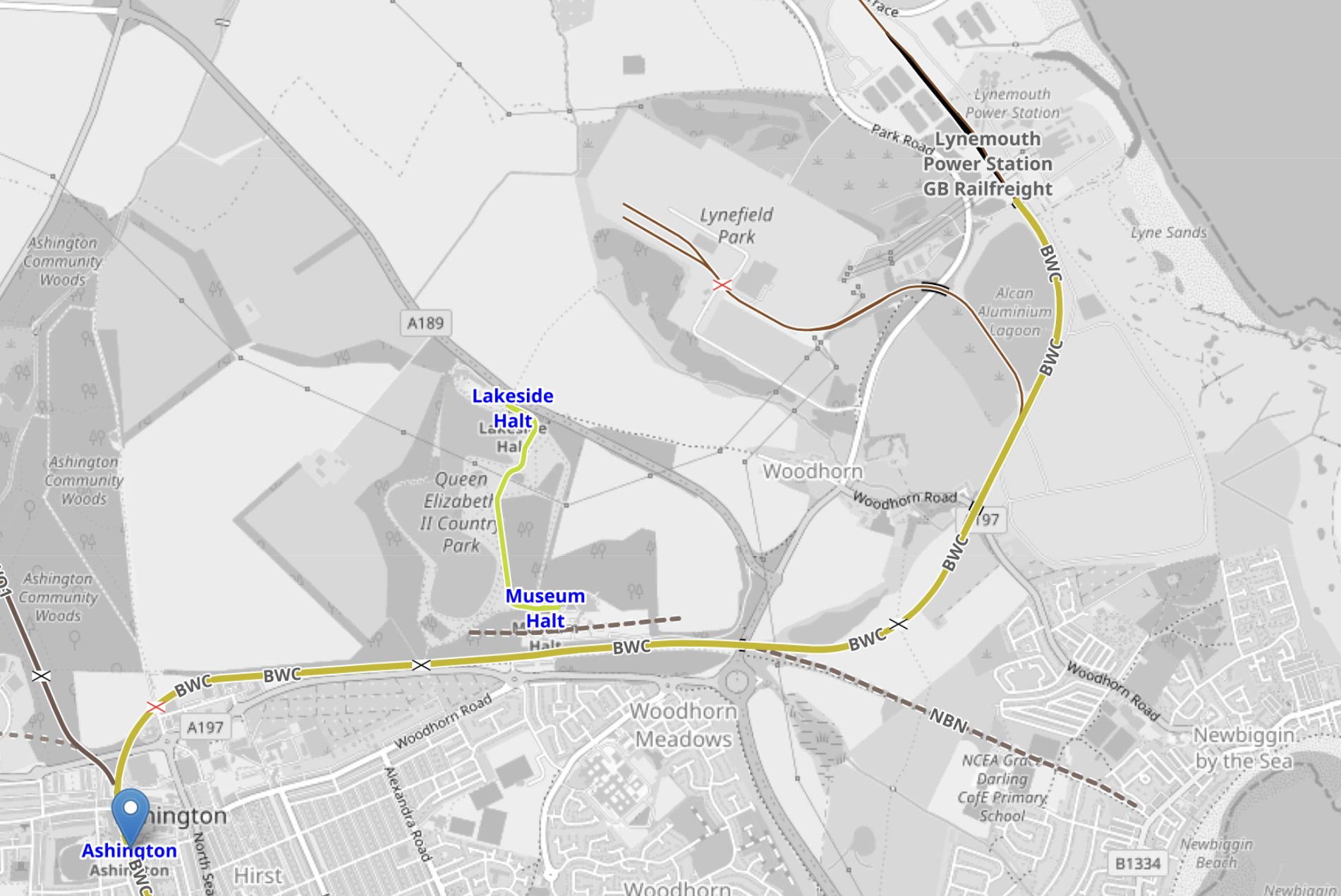
This OpenRailwayMap shows the tracks that used to exist between Ashington and Newbiggin-by-the-Sea.
Note.
- Ashington station is in the South-West corner of the map.
- A freight line exists, which is shown in yellow, all the way to Lynemouth power station, which is a 420 MW biomass power station.
- Lynemouth powerstation was originally built to power an aluminium smelter.
- Running South-East from the Northumberland Line, is a disused railway alignment labelled NBN, which leads into Newbiggin-by-the-Sea.
This Wikipedia section describes the history of railway connection of the town.
Situated on the west side of Front Street (now the B1334), the station opened on 1 March 1872 as a terminus of the Blyth and Tyne Railway (now known as the Northumberland Line). The station had a long island platform onto which the station building faced. There were sidings on both sides of the station which handled goods traffic, controlled by a signal box. The station closed to both passengers and goods traffic on 2 November 1964. With the reopening of the Northumberland Line, Provisions have been made, especially at Ashington so that the line could be extended to Newbiggin. As of the end of 2025, there were calls to extend the railway by 1.6km (1 mile) into the centre of Newbiggin-by-the-Sea. This will require new track and is all subject to a feasibility study. A formal bid was launched in December 2025 for this.
In Formal Bid To Extend Railway Line, I wrote about the latest progress in January 2026, based on a BBC article.
The Northumberland Line Needs A Focus Other Than Commuting
Several of the stations have large car-parks, which is good for commuting, but the railway needs to serve more places for leisure and other activities.
- Seaton Delaval Hall is Grade 1 Listed and is just 10 minutes in a bus from the station with the same name.
- If the Northumberland Line is connected to Newbiggin-by-the-Sea, that could bring in those, wanting a day by the sea.
- The extended Northumberland Line would also connect to Woodhorn, which is a museum, described in this Wikipedia entry.
QTS are also developing an AI data centre at Cambois, which surely will generate commuter traffic from all over the North East.
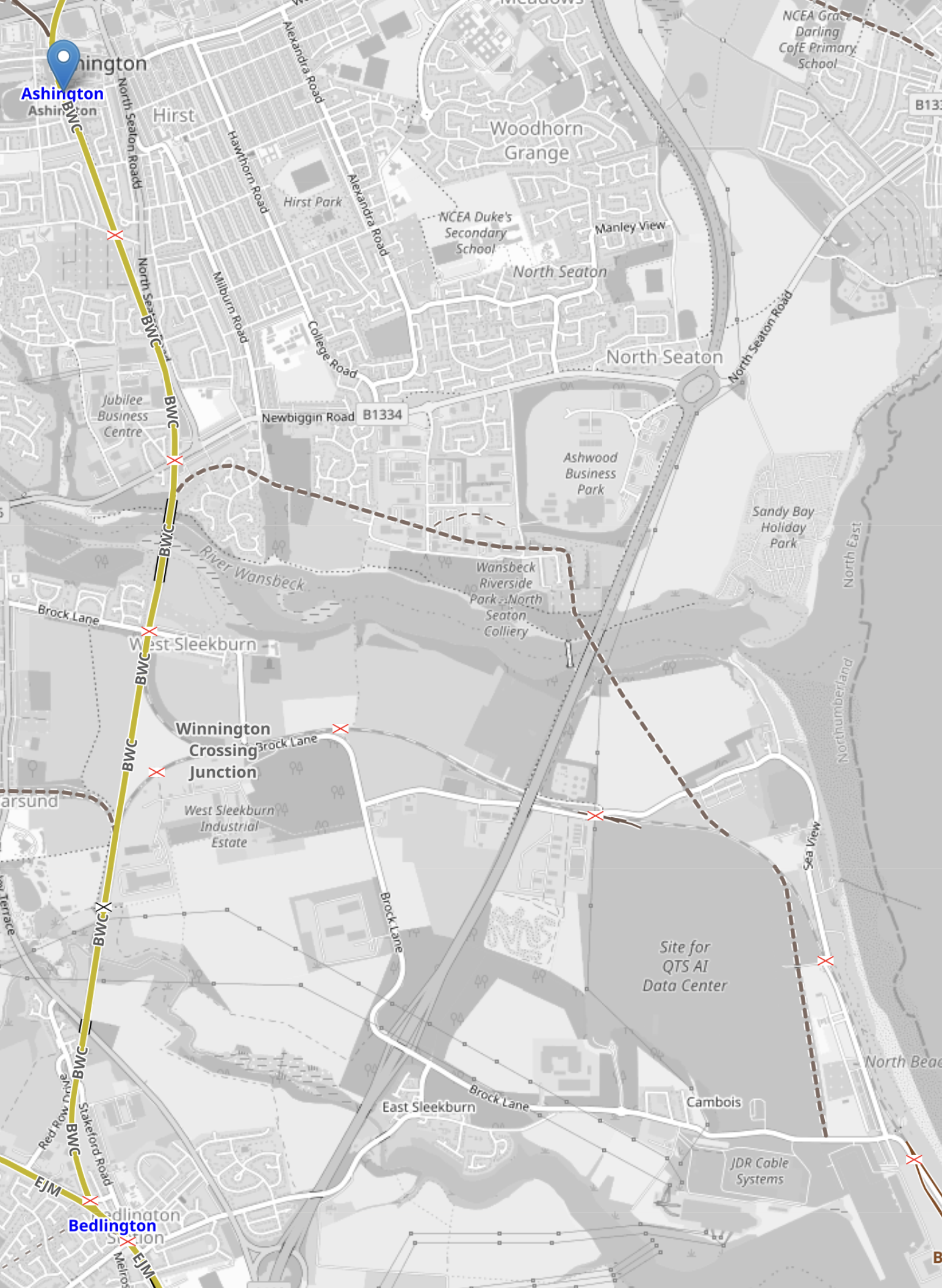
This OpenRailwayMap shows the location of the QTS AI Data Centre.
Note.
- Ashington station is indicated by a blue arrow.
- The yellow track is the Northumberland Line, which now terminates at Ashington station.
- Bedlington station is in the South-West corner of the map.
- The trapezoidal grey box to the East of Bedlington is labelled as Site for QTS AI Data Centre.
- As the site, was that of Blyth coal-fired power station, before QTS acquired it, there is a disused railway line that connects the site to the Northumberland Line.
I suspect there are powerful economic arguments about whether or not, the Northumberland Line is extended to the QTS AI Data Centre site.
How Much Power Will QTS Cambois Data Centre Need?
I couldn’t resist asking Google AI this question and I received this answer.
The proposed QTS Cambois data centre in Northumberland is expected to require between 620MW and 720MW of critical IT power capacity, with an initial proposal capacity of up to 1.1GW.
Details on the planned power infrastructure include:
Power Capacity: The facility will support up to 720MW of critical IT capacity across ten planned buildings, though some council estimates cite an expected total power capacity of 620MW.
Backup Power: To guarantee uptime and handle power outages, the campus will rely on nearly 600 diesel-powered generators, requiring up to 58 generators per data hall.
Site Details: Located on the former Blyth Power Station site in Cambois, the £10 billion development will span 540,000 square metres.
My views on this are.
- There is the 1.4 GW North Sea Link from Blyth to Norway, that I wrote about in UK To Norway Sub-Sea Green Power Cable Operational.
- The 4.1 GW Berwick Bank wind farm is planned to send 1.8 GW to Blyth.
- To help if QTS need more power, there is the 1.4 GW Sofia wind farm.
- So 1.1 GW should be manageable, as Blyth is blessed with more power than Niagra Falls.
I also believe that Centrica and Delta have a much better backup solution, that I described in Delta And Centrica Launch Scalable Off-Grid Fuel Cell Power Solution. Hydrogen could come by pipeline or rail.
How Would The Northumberland Line Connect To Wansbeck Hospital?
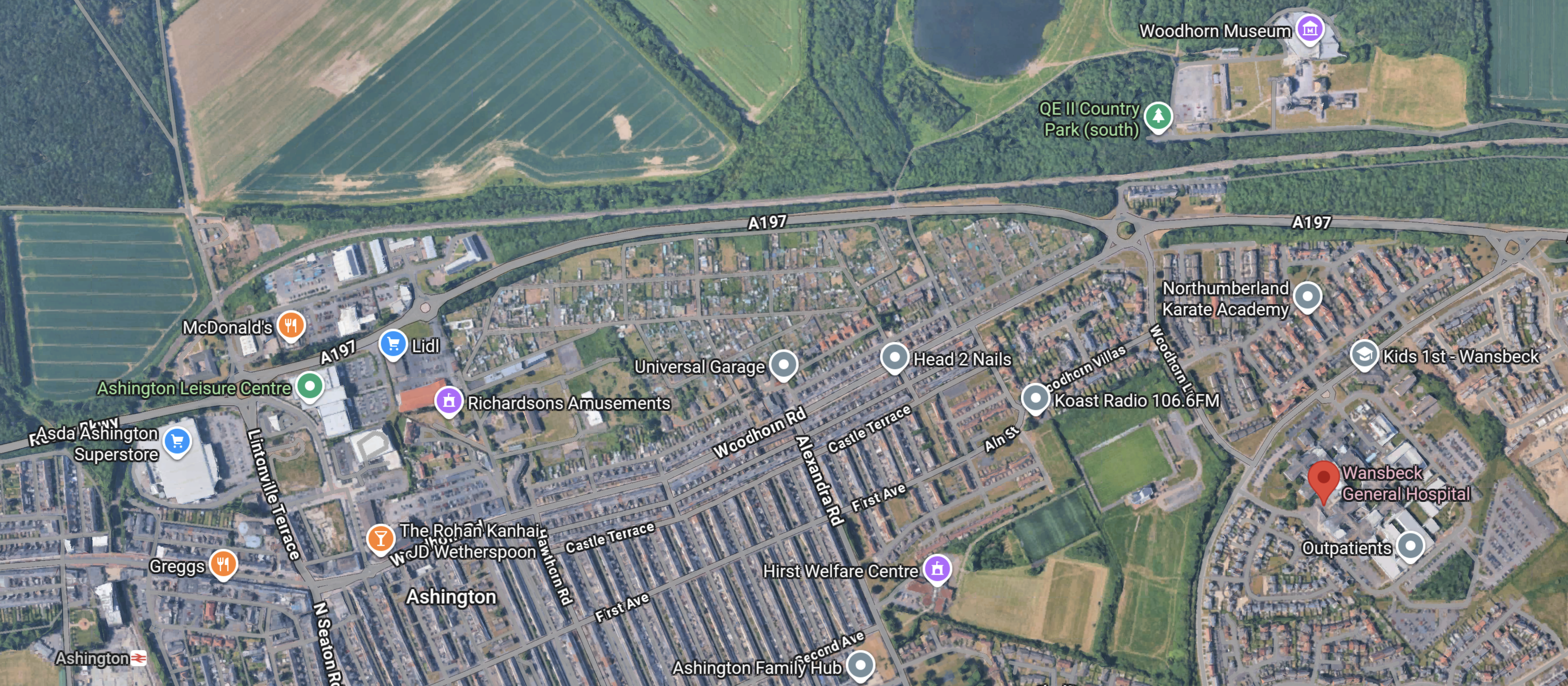
This Google Map, shows the location of Wansbeck General Hospital with respect to Ashington station.
Note.
- Ashington station in the South-West corner.
- Woodhorn museum is in the North-East corner.
- Wansbeck General Hospital is indicated by a red arrow.
- The Northumberland Line runs East-West to the South of the museum and then curves round to reach the station.
Perhaps the station could go between the museum and the hospital and an innovative shuttle would connect all three locations.
How Would The Northumberland Line Connect To Choppington?
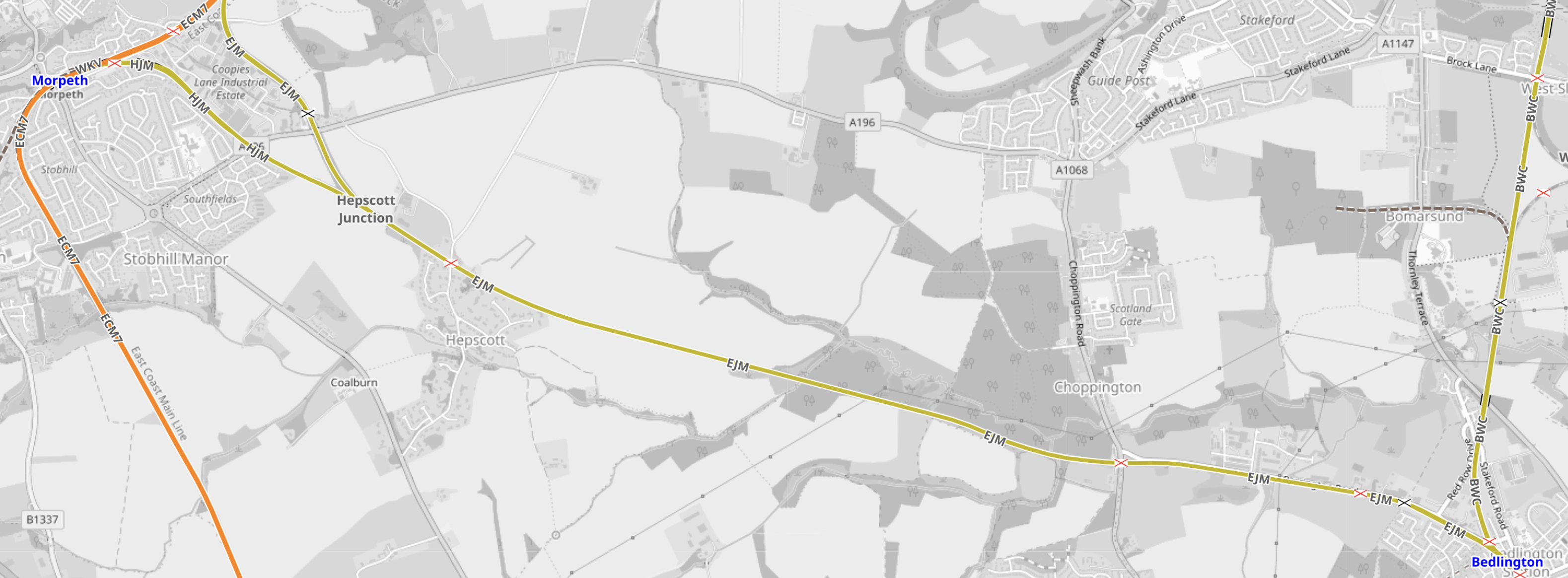
This Google Map, shows the location of Choppington, with respect to Morpeth and Bedlington stations.
Note.
- The orange track on the West side of the map is the East Coast Main Line.
- Morpeth station is in the North-West corner of the map.
- Bedlington station is in the South-East corner of the map.
The Eastern end of the Bedlington and Morpeth Line can be seen in this picture to the left of Bedlington North signal box at the Northern ends of the the platforms.
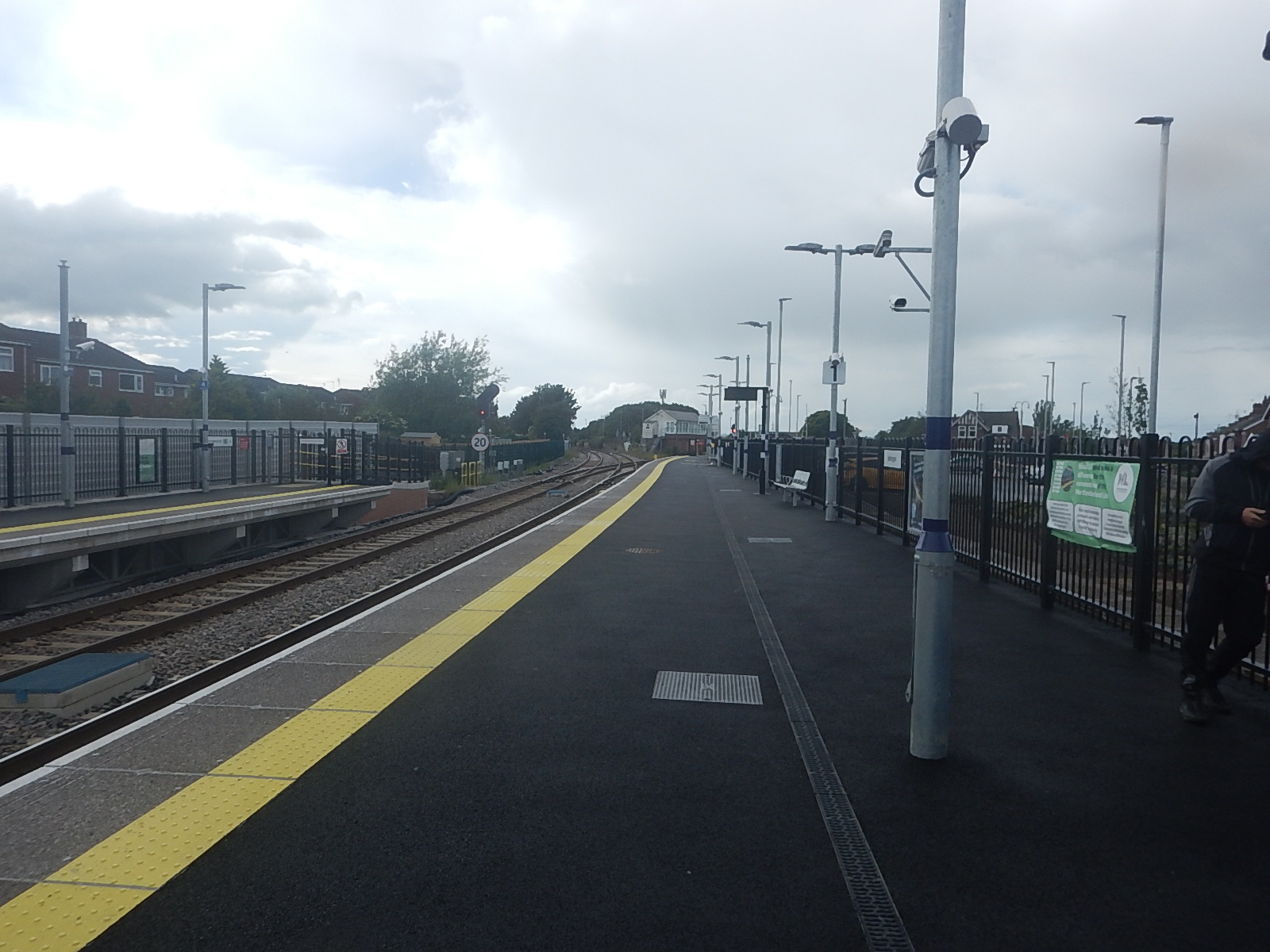
Note.
- Bedlington North signal box has a communication mast behind it.
- The track to the left of the box goes to Morpeth.
- The track to the right of the box goes to Ashington.
This OpenRailwayMap shows Choppington Road, which crosses the Bedlington and Morpeth Line at the only level crossing between Bedlington station and Hepscott junction.
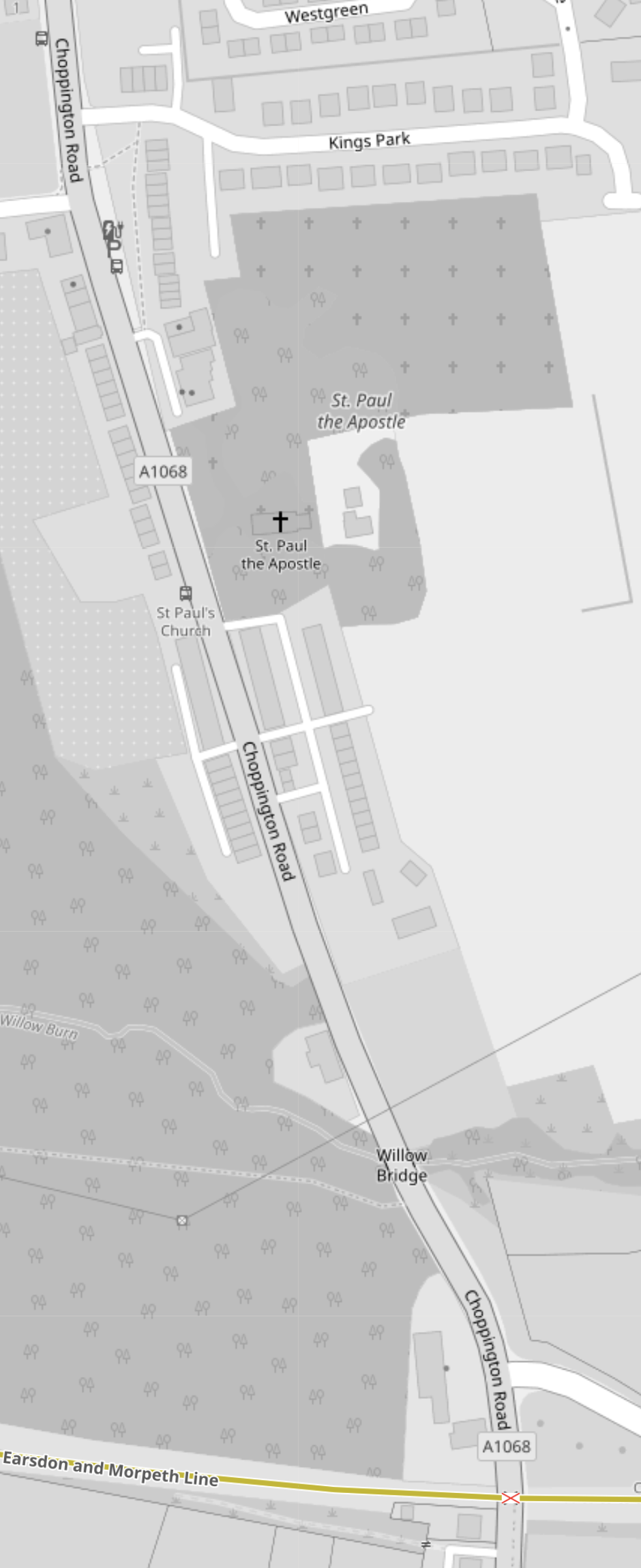
Note.
- Choppington Road, which runs North-South on the map.
- The yellow tracks are the Morpeth and Bedlington Line, which runs East-West across the map.
- Where they cross, a red cross indicates a level crossing.
- The Wikipedia entry of Choppington station shows a level crossing.
As the level crossing on the map is the only one shown, this must be the location of Choppington station.
H2DO Launches Offshore Wind-to-Hydrogen Study In Dutch North Sea
The title of this post, is the same as that of this article on offshoreWIND.biz.
This is the sub-heading.
Hydrogen of Dutch Origin (H2DO) and its partners have launched a feasibility and concept study for a 30–50 MW offshore green hydrogen project linked to offshore wind generation in the Dutch North Sea.
These two paragraphs add more details.
The project will examine the development of an offshore hydrogen production installation designed to convert electricity generated by offshore wind farms into hydrogen at sea and transport it to shore via pipeline infrastructure.
The study follows H2DO securing support in 2025 under the Dutch government’s Topsector Energie (TSE) programme, which funds energy innovation and green industrial development projects in the Netherlands.
I am sure this is a good way to develop hydrogen production.
I can envisage a time, when hydrogen is needed close to a windy coast, where a standard platform with a large wind turbine on top is erected in a suitable place and a pipe is run to the shore.
- The largest wind turbine is currently 26 MW.
- There are electrolysers, that can use sea water.
- I also suspect that a lot of gas technology can be repurposed to bring hydrogen ashore.
I certainly wish H2DO best of luck in their venture and I’ll be watching their progress.

