UK Army Commissions 1.7GWh/year Solar Project At Larkhill Garrison
The title of this post, is the same as that of this article on the Solar Power Portal.
This is the sub-heading.
The installation spans 2.5 hectares and comprises more than 4,000 PV panels.
These three paragraphs give a few more details.
The project forms part of the Army’s Project Prometheus programme, which is deploying rooftop and ground-mounted solar PV systems across suitable sites on the Army estate. It was delivered by Aspire Defence Services on behalf of the Defence Infrastructure Organisation (DIO).
The Ministry of Defence is also partnered with Great British Energy to deploy solar across its sites.
The commissioning follows an expansion of solar capacity at Larkhill this year through the addition of the ground-mounted array and four rooftop PV installations.
Note.
- Larkhill has a Wikipedia entry.
- Larkhill is part of the Salisbury Plain Training Area, which also has a Wikipedia entry.
- The Salisbury Plain Training Area takes up 11 % of the County of Wiltshire and is as large as the Isle of Wight.
There certainly would appear to be plenty of space for 4,000 solar panels.
Does The Army’s Project Prometheus Programme Include Batteries?
I asked Google AI, the question in the title of this section and received this reply.
The British Army’s Project Prometheus primarily focuses on generating renewable energy through solar PV systems, though specific related net-zero initiatives on the defense estate incorporate separate energy storage components like batteries.
Project Prometheus Overview
Core focus: Deploying ground-mounted and rooftop solar photovoltaic (PV) arrays across the military estate.
Main goal: Increase green energy supply, cut carbon emissions, and reduce grid electricity dependency.
Integration with Energy Storage
Solar focus: Primary Project Prometheus installations route generated electricity directly to local military buildings or export surpluses back to the national grid.
Associated storage: While standalone solar arrays under Prometheus distribute power dynamically, separate broader sustainability and pilot schemes across the military net-zero portfolio—such as Project Taurus or thermal storage trials—run alongside it to evaluate localized battery storage capabilities.
Project Prometheus would appear to be a typical well-designed solar power programme.
Project Taurus
Project Taurus has been mentioned and Google AI gave me this overview.
Project Taurus in the UK Ministry of Defence refers to a sustainable energy initiative by the British Army to construct solar-powered carports featuring electric vehicle (EV) charging ports and battery storage, starting at Army Headquarters in Andover.
It looks to me, that Project Taurus could have applications outside the military.
Comet Ridge Lands Gladstone Gas Deal
It is obviously Highview Power’s day, as this project in Queensland, Australia gets five mentions in my Google Alert for Highview Power.
The title of this post, is the same as that of this article on Industry Queensland.
This is the sub-heading.
Mahalo gas hub developer Comet Ridge has reached a deal with Highview Power to supply the large-scale electricity project it is planning to build at the Aldoga State Development area near Gladstone.
These four paragraphs give a summary of the project.
The volume of gas targeted is 3.6 PJ/a (10 TJ/d) for a minimum of five years.
Highview’s Central Queensland Energy Storage Project is to be constructed in two phases.
Phase 1 consists of a 400MW four-hour battery energy storage system, two 200MW open-cycle gas turbines, a 370MVA synchronous condenser, and associated substations and transmission lines.
Phase 2 will be the build-out of a 200MW 12-hour liquid air energy storage system.
It looks like Highview Power’s battery is one of their larger systems and is a 200 MW/2.4 GWh version.
On Highview Power’s Projects page, this is said under a header of Australia.
Highview is developing a series of base‑load renewable energy power stations in Australia, with planning now underway for three major programmes. In Gladstone, Central Queensland, and Townsville, North Queensland, we are progressing large scale projects combining LDES and short-term battery storage. On the Darwin–Katherine network in the Northern Territory, plans are advancing for an integrated scheme incorporating solar generation, LDES and battery. Together, these initial developments will help Australia meet its target of halving carbon emissions by 2030 and achieving net zero by 2050.
Gladstone is named in this story and on Highview Power’s web site.
Could Highview Power be making a breakthrough in process engineering after Sumitomo’s success at the LNG Terminal at Hiroshima.
INTERVIEW – Combining Geothermal Power With Minerals Key To Viability, says GEL CEO
The title of this post, is the same as that of this article on Renewables Now.
These three paragraphs introduce, this very much a must-read article.
Producing critical minerals such as lithium alongside geothermal electricity generation could make deep geothermal projects economically viable, according to Ryan Law, founder and chief executive of UK deep geothermal firm Geothermal Engineering Ltd (GEL).
Electricity generation on its own is quite challenging economically, but combining that baseload power with commodity pricing from the minerals seems to get these projects relatively easily funded, he told Renewables Now.
Law also pointed out that geothermal electricity generation began in Italy more than 100 years ago, but the geothermal wells there were initially used to extract boric acid. “It’s just interesting that the story started with geothermal power as a sort of mineral extraction process,” he noted
It certainly looks like we’ve gone round in a large virtuous circle.
These are some points from the article.
There Have Always Been Minerals In Geothermal Fluids
But because they were cheap and no-one bothered about them coming from China, nobody thought about mining them.
Oil And Gas Expertise Helps The Geothermal Sector
This is a sentence.
Law emphasised that the geothermal sector needs a lot of equipment and skills from the oil and gas industry, which currently in the UK are concentrated in Aberdeen. He said the UK will need a strong oil and gas industry until geothermal becomes large enough to absorb those jobs.
Law said we mustn’t disband that sector too quickly.
The US Appears To Be Backing The Sector
These are two paragraphs.
Law said he could see the sector scaling significantly within a decade, driven largely by developments in the US. He pointed to a number of big financial raises in the US recently.
“And also that the US government is very behind the mineral production,” Law remarked.
Conclusion
Geothermal energy paired with the mining of rare earth minerals could be a surprising winner in a decarbonising world.
UK’s Largest Onshore Wind Farm To Be Rebuilt With Fewer, Larger Turbines
The title of this post is the same as that of this article on the BBC.
This is the sub-heading.
One of Europe’s biggest onshore wind farms is to be flattened and rebuilt with fewer, taller turbines, its owner has announced.
These three paragraphs add more detail to the story.
Whitelee Windfarm has been producing electricity for about 20 years on a stretch of moorland near Eaglesham, south of Glasgow, but is reaching the end of its life.
Scottish Power Renewables says the existing 215 turbines will be replaced in three phases with around 124, each of which will be about 110m (361ft) taller.
The £1.5 billion “repowering” project will take 10 years to complete and will double the electricity output from 539 megawatts to 1 gigawatt, which is enough to power about 650,000 homes.
I asked Google AI,”Will there be any objectors to the repowering of Whitelee Wind Farm” and received this reply.
While there are no formal objectors on record yet, opposition to the repowering of Whitelee Wind Farm is highly anticipated. The developer, ScottishPower Renewables, officially filed their proposal with the Scottish Government in July 2026, but the formal planning application is not expected to be submitted until December 2027.
Anticipated objectors and their concerns typically include:
Campaign Groups & Environmentalists: Organisations like Scotland Against Spin generally challenge large-scale onshore wind projects over landscape dominance, ecological impacts, and the sheer scale of the new turbines.
Visual and Height Concerns: The repowering plan proposes replacing the existing 215 turbines with roughly 124 much larger machines. Each new turbine will stand roughly 110m taller than the current ones, which is expected to draw objections from those concerned about the visual alteration of the moorland.
Aviation and Radar Issues: Taller turbines and longer blades frequently raise fresh concerns and potential clearance objections from civil aviation and military radar stakeholders.
The BBC article finishes with this paragraph.
The work at Whitelee is expected to generate about £330m for the Scottish economy.
How many Scottish jobs will a third of a billion pounds sustain?
Four Of The Largest Grid Batteries From Fidra
Fidra have made a big splash as they enter the UK’s Long Duration Energy Storage market, with three grid batteries.
Bicker Fen 1 and 2
Capacity – 1.20 GW/2.40 GWh
Web site
Commission Date – BF1-2028, BF2-2029
Thorpe Marsh
Capacity – 1.45 GW/2.90 GWh
Commission Date – Q1-2027
West Burton C
Capacity – 500 MW/1 GWh
Commission Date – Q4-2027
Note.
- All are two-hour batteries.
- Each battery has some drone footage of the site.
Will Andy Burnham Take The Highview Road To Lower Energy Bills?
Has Andy Burnham Ever Said He’d Like Energy Bills To Come Down?
I asked Google AI, the question in the title of this section of this post, and received this reply.
Yes, Andy Burnham has explicitly stated he wants to bring energy bills down, making it a central priority upon becoming UK Prime Minister in July 2026. He has pledged to give voters “breathing room” on the cost of living and is considering radical market overhauls to reduce household costs.
But has he looked at radical engineering solutions, that would also help to push energy bills down.
This morning, I wrote Molten Salt And Human Sweat: The Weird Batteries That Could Store Renewable Energy, which is based on a must-read article in today’s Guardian.
The Guardian article shows Andy Burnham with Highview Power’s engineers and managers at the ground breaking ceremony of Highview Power’s 50MW/300 MWh liquid-air grid battery at Carrington in Andy Burham’s feifdom of Greater Manchester, where he was mayor for nine years.
In Andy Burnham and Highview Power, I asked Google AI about their relationship and Andy Burnham came over as an enthusiastic supporter of Highview Power.
In UK Wind Risks ‘Exponentially Rising’ Curtailment Without Energy Storage, I discuss using Highview’s batteries to avoid shutting wind turbines down, when we have too much electricity.
I believe that if Andy Burnham, were to experdite up to 20 of Highview’s largest 300 MW/3.2 GWh batteries around the UK, this would have the right effect on energy bills.
I would hope that Andy Burnham is watching the progress of the Carrington battery closely.
Molten Salt And Human Sweat: The Weird Batteries That Could Store Renewable Energy
The title of this post is the same as that of this article in The Guardian.
This is the sub-heading.
From Nevada to Manchester, developers are trialling innovative solutions to clean energy’s biggest challenge
These first three paragraphs give a taste of what is to come.
In the deserts of the United Arab Emirates a sprawling clean energy project, stretching across an area roughly the size of 12,600 football fields, will play host to a breakthrough allowing solar energy to power the equivalent of half a million homes through the night.
The Gulf state has been steadily combining 5.2GW of solar power capacity with 19GWh of battery storage to create the largest battery scheme in the world.
Meanwhile, about 7,500 miles away, at the US’s National Renewable Energy Laboratory facility in Colorado, researchers and engineers are making some of the smallest batteries the world has ever seen. A fraction of the size of the grid-scale lithium-ion batteries used to store renewable energy, they have been designed to power electronic tags that will track the 3in-long (about 7.5cm) young from salmon and eel species.
And seeing, that they used to be the Manchester Guardian and that Andy Burnham is surely the man-of-the-day for other reasons, Highview Power’s 50 MW/300 MWh at Carrington in Manchester gets a big mention under a section heading of Liquid Air, with Burnham in hi-vis jacket and hard hat.
This picture, which is courtesy of The Guardian, shows the groundbreaking ceremony of the Carrington battery.
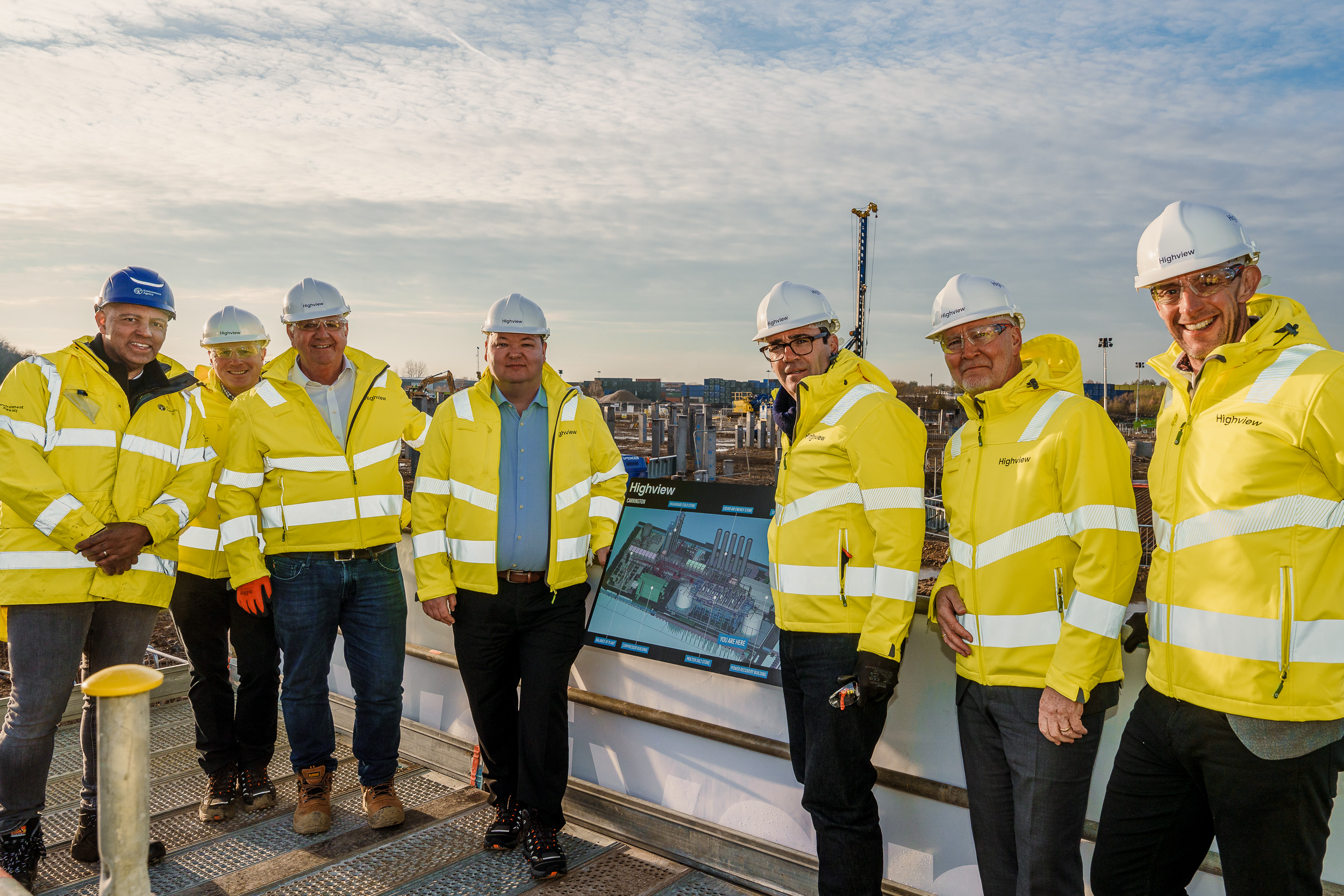
Andy Burnham is third from the right.
The Guardian article is very much a must read, that features projects from the United Arab Emirates, Colorado, Finland, Manchester, Nevada and Japan.
UAE Building New Port To Bypass The Strait Of Hormuz
The title of this post, is the same as that of this article on The Times.
This is the sub-heading.
New facility on the Emirates’ east coast is past the tip of the strait but would still be vulnerable to Iranian drone and missile attacks.
These three paragraphs add more details.
The United Arab Emirates is building another port in an attempt to bypass the Strait of Hormuz, having already expedited the construction of a new oil pipeline.
The new port would join an existing facility in Fujairah along the country’s eastern coastline and past the tip of the strait that Iran closed to shipping during the war with the United States.
This Google Map shows the Eastern side of the Arabian Peninsular.
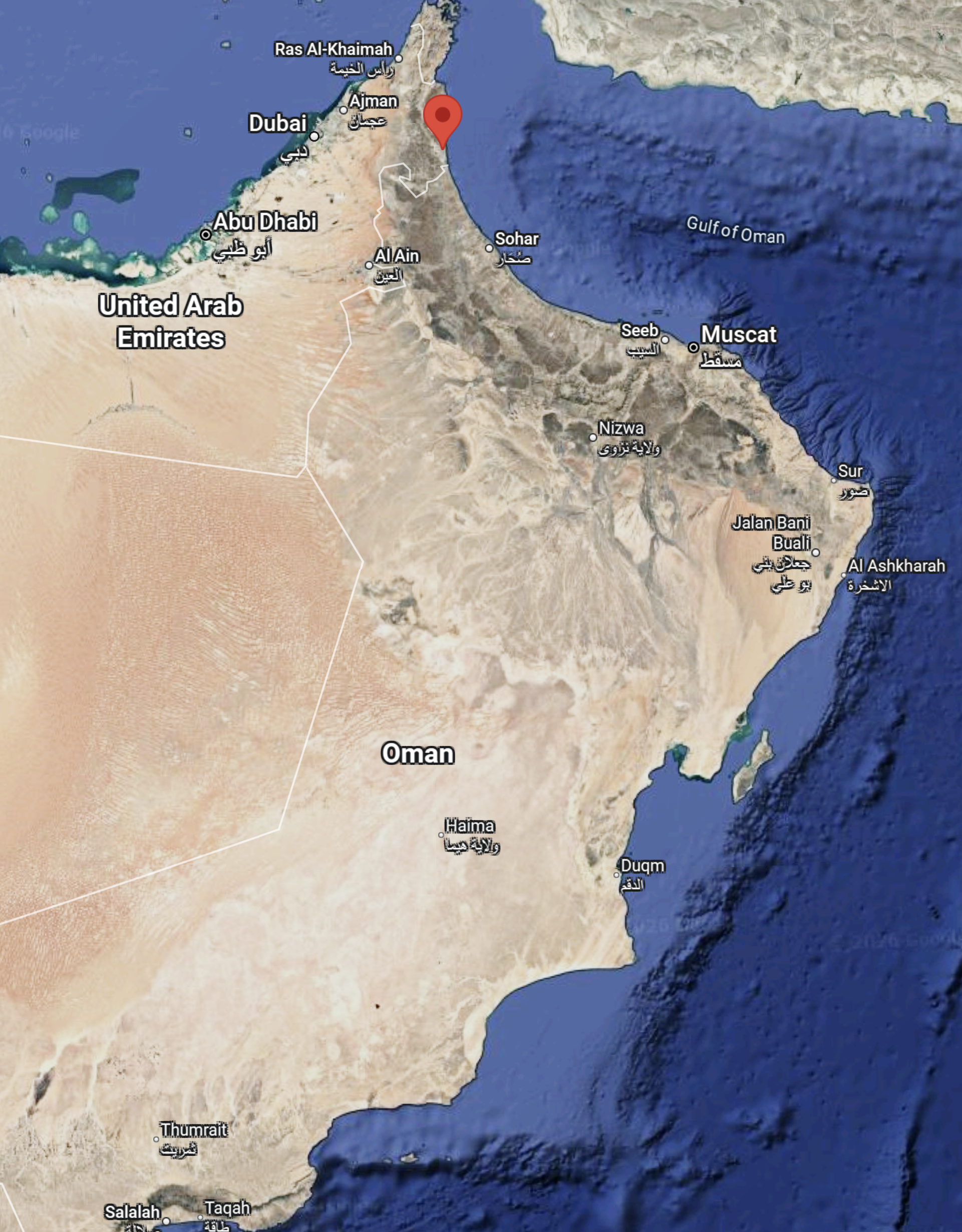
Note.
Fujairah is indicated by the red arrow.
Iran is the land mass in the North-East corner of the map.
The Strait of Hormuz is between the Arabian Peninsular and Iran.
As you come South from Fujairah, you pass through Muscat and then Iran.
Oman has two deep water ports at Duqm and Salalah.
This second Google Map shows the Port of Fujairah and the Strait of Hormuz.
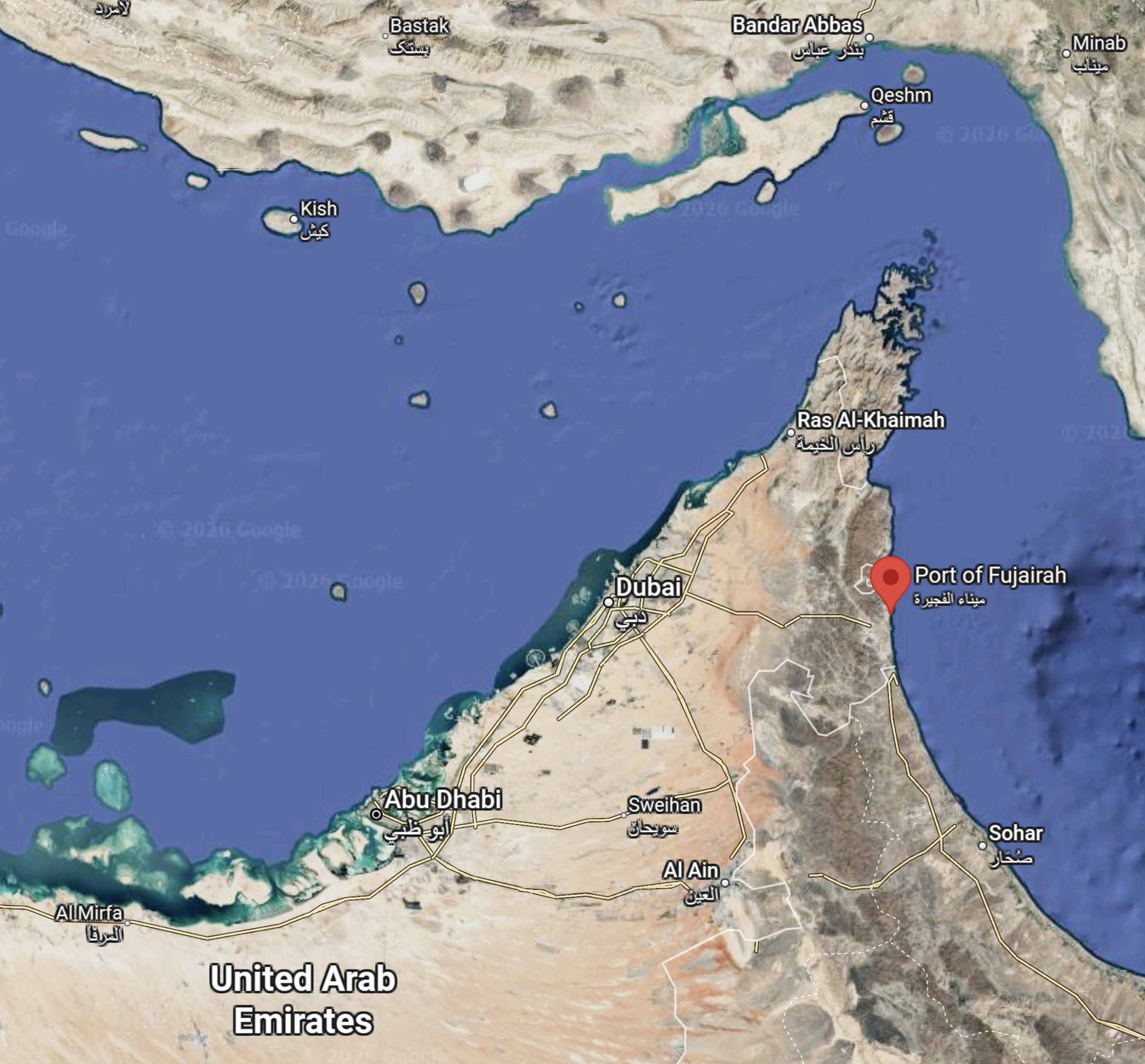
Note.
- The Port Of Fujairah is indicated by the red arrow.
- Dubai and Abu Dhabi are indicated on the map.
- The Strait of Hormuz is between the United Arab Emirates and Iran.
- There is a passenger train between Fujairah and Abu Dhabi that opened recently and takes an hour and 45 minutes.
This OpenRailwayMap shows the route of Etihad Rail.
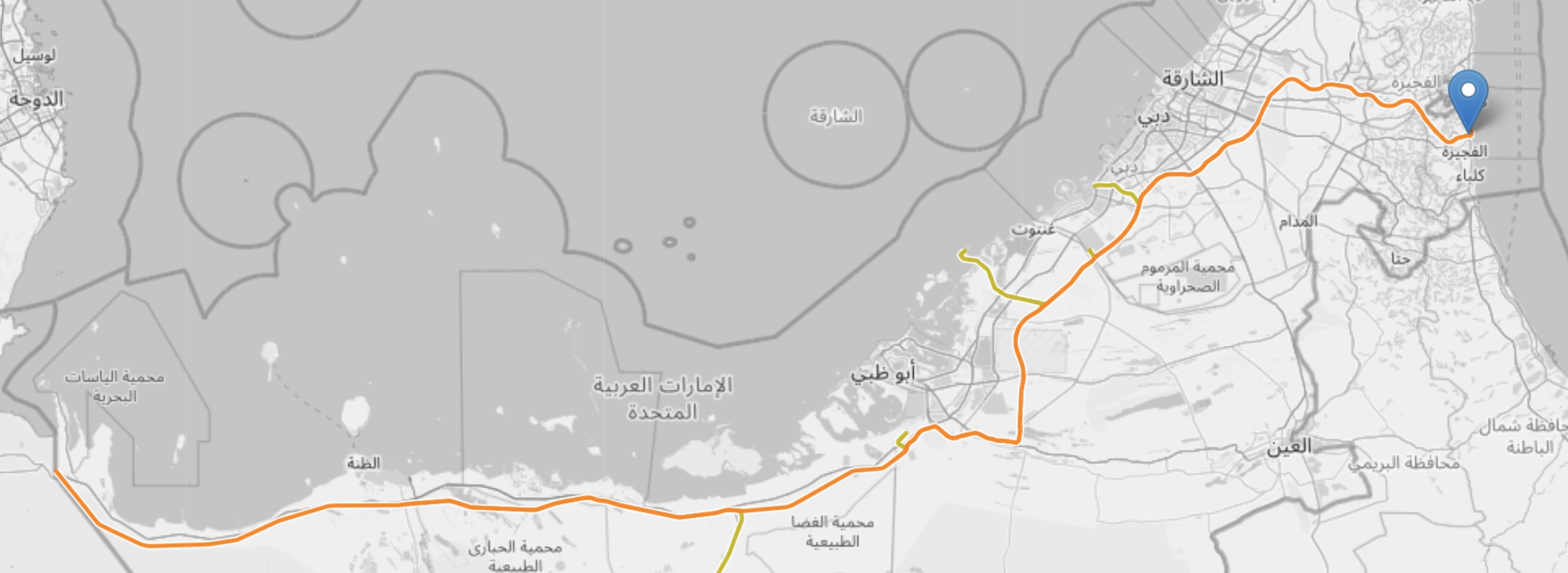
Note.
- The Port Of Fujairah is indicated by the blue arrow.
- Dubai and Abu Dhabi are on the Western coast.
- Etihad Rail has a Wikipedia entry.
- Etihad Rail has a web site.
- It is both a passenger and freight railway.
- It is 559 miles long.
It is planned to be extended to Saudi Arabia.
I can see Etihad Rail being very successful.
Could Duqm And/Or Salalah In Oman Be Developed As Oil And Gas Ports To Bypass Hormuz?
This REPEATED Google Map shows the Eastern side of the Arabian Peninsular.
The deep-water ports of Duqm and Salalah are shown on this map.
When I put the question in the title of this section to Google AI, I received this answer.
Yes, the Port of Duqm and the Port of Salalah are uniquely positioned to serve as critical oil and gas export hubs that bypass the Strait of Hormuz. Both deep-water ports are located on Oman’s open Arabian Sea coast, entirely avoiding the narrow maritime chokepoint.
Developing these ports into massive oil and gas export hubs is highly feasible but presents logistical and financial challenges:
Pipeline Corridors: Bypassing Hormuz would require constructing extensive, multi-billion dollar cross-border pipeline networks spanning over 1,800 kilometers from oil-producing hubs in Iraq, Kuwait, Saudi Arabia, and the UAE to the Omani coast.
Cost & Timeline: Estimates suggest a twin-pipeline project terminating in Duqm and Salalah—capable of moving 10 million barrels per day—would cost upwards of $50 billion and take up to seven years to complete.
Liquefied Natural Gas (LNG): Qatar and other nations could also route gas to the Omani coast, though doing so would require building multibillion-dollar liquefaction and export terminals on the Arabian Sea.
Regional Alliances: Projects at this scale require deep cross-border energy integration and substantial political consensus among the Gulf states.
Although, this route would be expensive, it would keep oil and gas for countries like China, India, Japan and Korea well away from Iran and their partners in crime the Houthis.
The Times article finished with this paragraph.
Plans now include pipelines that could run through Israel, Turkey and Syria to the Mediterranean and Europe, securing supplies to western countries but creating longer shipping times to China and India — both major consumers of Middle East oil.
Conclusion
The one common factor in all these plans is that Iran is sidelined.
And also alternative infrastructure must be better than the destructive US-Iran War.
European Commission Greenlights France’s EUR 63 Billion Aid Scheme To Build 11 Offshore Wind Farms
The title of this post, is the same as that of this article on offshoreWIND.biz.
This is the sub-heading.
The European Commission has approved a EUR 63 billion French scheme to support the construction and operation of eleven offshore wind farms, in line with the objectives of the Clean Industrial Deal.
These three paragraphs add more detail.
The scheme was approved under the Clean Industrial Deal State Aid Framework (CISAF) adopted by the Commission on 25 June 2025.
France notified the Commission, under the CISAF, a scheme to support offshore wind energy to contribute to the objectives of the Clean Industrial Deal. The scheme will run for 25 years and has a maximum budget of EUR 63 billion.
The wind farms, located in the North Sea, the Atlantic and the Mediterranean, are expected to have a combined capacity of up to 11.1 GW and to generate up to 47.8 TWh of renewable electricity per year, or around 10.6 per cent of France’s annual electricity consumption.
I have highlighted this article, as it gives a lot of true figures about the cost of offshore wind farms in France.
The scheme costs in subsidy € 227027/GW/year.
Poland Receives Its First Electricity from Offshore Wind As Baltic Power Starts Delivering
The title of this post, is the same as that of this article on offshoreWIND.biz.
This is the sub-heading.
Electricity generated by the Baltic Power offshore wind farm has entered Poland’s national power grid, marking the first time the electricity generated by offshore wind turbines is added to the country’s energy mix.
This first paragraph gives more details of the project.
54 of 76 turbines have already been installed at Poland’s first offshore wind farm, with the first now generating electricity. Construction is scheduled for completion this autumn, ORLEN and Northland Power, the owners of the project, said.
When complete, the Baltic Power wind farm will generate up to 1.2 GW.
How Much Offshore Wind Does Poland Have Planned?
I asked Google AI, the question in the title of this section and received this reply.
Poland has massive offshore wind plans in the Baltic Sea.
The country targets 5.9 GW by 2030 and 18 GW by 2040. To meet these goals, the government is pursuing two primary development phases to transition the national grid away from coal.
A breakdown of Poland’s offshore wind rollout includes:
Phase I (Advanced Projects): Includes 5.9 GW of capacity.
Baltic Power: Poland’s first offshore wind farm (1.2 GW), developed by Orlen and Northland Power, officially connected to the national grid in July 2026.
Bałtyk 2 & 3: Equinor and Polenergia have finalized financing for an additional 1.4 GW, slated for commercial operation around 2028.
Phase II (Auction-Backed): Poland recently allocated over 3.4 GW in new capacity through competitive offshore wind auctions, pushing development well into the next decade.
Long-Term Outlook: Industry groups estimate the total technical potential in Poland’s portion of the Baltic Sea could reach up to 33 GW.
Will Poland Be Welcoming Any Invading Germany Wind Farms?
In New Study Shows How North Sea Offshore Wind Can Yield More While Costing Less, I talked about how Germany doesn’t have enough sea in which to place the wind farms it needs to generate the green electricity and hydrogen it needs.
This map from Wikipedia shows Exclusive Economic Zones in the North Sea, but it also shows who has control of the sea in the Baltic.
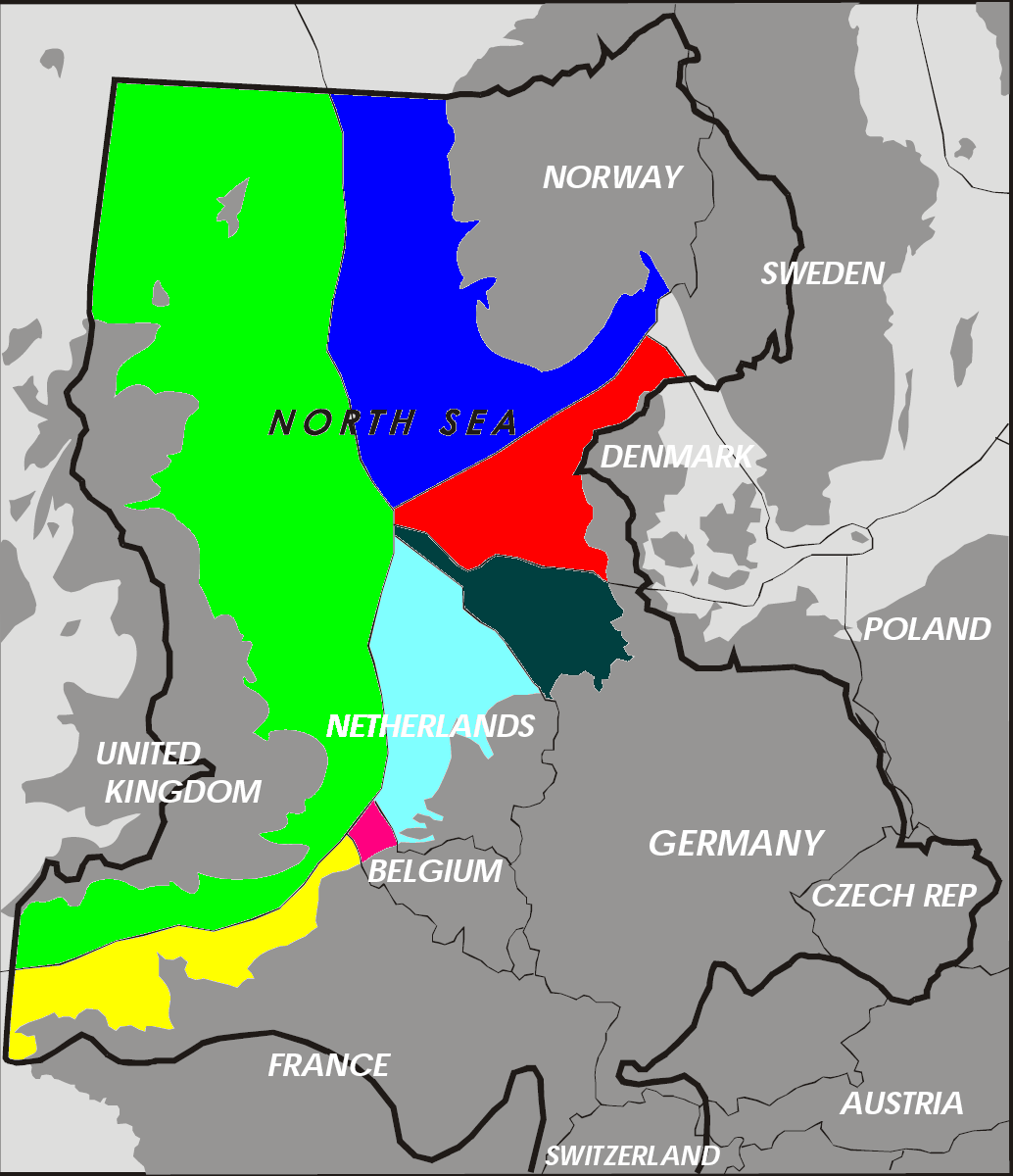
Note.
- Yellow is France.
- Mauve is Belgium, who drew the short straw.
- Light Blue is The Netherlands.
- Black is Germany, who despite their large land area, don’t have as much sea as the UK.
- Red is Denmark.
- Dark Blue is Norway.
- Green is The UK.
- Germany and Poland seen to share the Southern Baltic.
I wouldn’t be surprised to see Germany and Poland co-operating to maximize the wind power capacity of the Southern Baltic.
A Visit To Poland’s Coal Capital
On one of my trips to Poland, I went to Katowice, which is in Poland’s coal-mining region. I wrote about it in An Excursion In Katowice.
Google AI produced this snapshot of Katowice.
Katowice is historically known as the “Polish Coal Capital” and served as the absolute backbone of the region’s heavy industry. First transforming into an industrial powerhouse in the mid-19th century due to rich local coal and metal reserves, the city’s economy and rapid growth were entirely reliant on coal mining and steel.
While coal and heavy industry historically anchored its identity, the city of Katowice has aggressively transformed into a modern cultural, technological, and business hub. The wider Silesia region remains heavily tied to coal mining, but the municipality itself has shifted its focus to avoid reliance on it.
My visit to Katowice was an excellent pit-stop on a train ride between Krakow and Prague, when I did my Home Run From Krakow.
If you like your food and like me, you’re coeliac, I would certainly recommend Poland for a few days away.
Strangely, the language is not a problem, as if you get three Poles together, one will speak English better than what you do.

