GE’s Recently Unveiled 18 MW Wind Turbine To Spin Offshore Japan
The title of this post, is the same as that of this article on offshoreWIND.biz.
This is the sub-heading.
The three consortia that Japan’s Ministry of Economy, Trade, and Industry (METI) selected in the country’s second round of offshore wind auctions will use some of the biggest and most powerful wind turbines on/coming to the market – Vestas V236-15 MW and GE’s 18 MW Haliade-X.
Wind farms under construction or in pre-construction in the UK, as I write this post, include.
- Neart Na Gaoithe – 8 MW x 54 – 450 MW
- Sofia Offshore Wind Farm – 14 MW x 100 – 1400 MW
- Dogger Bank A – 13 MW x 95 – 1235 MW
- Moray West – 15 MW x 60 – 882 MW
- Dogger Bank B – 13 MW x 95 – 1235 MW
- Dogger Bank C – 14 MW x 87 – 1218 MW
- East Anglia Three – 14 MW x 95 – 1372 MW
- Hornsea Three – xx MW x 231 – 2852 MW
Note.
- I can’t find the turbine size for Hornsea Three.
- This article on The Telgraph is entitled Ørsted Asks For More Government Cash Amid Doubts Over Flagship Wind Farm Project, says that Ørsted and Claire Coutinho are talking.
- The total power is 10644 MW.
- There are a total of 817 turbines.
- This is an average turbine size of almost exactly 13 MW.
There would appear to be scope to increase the size of these wind farms by using the new larger turbines.
Just uprating the turbines to 15 MW would increase capacity by 15 %.
The frequency of stories like these are increasing.
Crown Estate Mulls Adding 4 GW Of Capacity From Existing Offshore Wind Projects
Vattenfall Boosts Capacity For Norfolk Offshore Wind Zone
Three Steps To Unlocking The Potential Of High-Power Wind Turbines
Ossian Floating Wind Farm Could Have Capacity Of 3.6 GW
Developers are seriously thinking of building or upgrading wind farms with larger turbines and other capacity-increasing technology.
Floating Solar Not Yet Up to Par To Be Brought Into Offshore Wind Tenders, Says BP’s Benelux Head Of Offshore Wind
The title of this post, is the same as that of this article on offshoreWIND.biz.
This is the sub-heading.
System integration is what is needed for the next leap in offshore wind, however, not all technologies that can integrate with offshore wind farms have the same starting point. Floating solar still has some way to go in becoming more resilient to harsh offshore conditions. On the other hand, hydrogen is a more ready option with plenty of support from the industry, but it needs to be included and clearly defined in offshore wind tenders.
These two paragraphs describe the views of Frank Oomen, Head of Offshore Wind Benelux at BP.
This is according to Frank Oomen, Head of Offshore Wind Benelux at BP, who discussed financial and qualitative criteria in offshore wind auctions during the Offshore Energy Exhibition & Conference 2023 (OEEC 2023).
Speaking about recently joining BP from the renewables industry, Oomen pointed out that, with offshore wind becoming larger scale, it needs to move in the direction of system integration and become an integrated energy business itself.
I had a lot of my engineering education, in ICI’s world of integrated chemical plants and I believe that Frank Oomen’s views are heading in the right direction.
If we take Frank Oomen’s views to their logical conclusion, we will see the following.
- Clusters of wind farms far from land in productive wind power areas.
- A nearby electrolyser will be producing hydrogen.
- The hydrogen will be taken to the shore by pipeline or tanker.
- BP with their oil and gas heritage, have been doing this for decades.
BP might even have some redundant gas infrastructure they can repurpose.
SSE Comments On COP28
The title of this post is the same as that of this press release from SSE.
SSE Chief Executive, Alistair Phillips-Davies, said:
“We knew going into COP28 that the world wasn’t moving fast enough to decarbonise. The commitment to triple renewables by 2030 is welcome, as is the inclusion, for the first time, of explicit language on the need to transition away from fossil fuels.
“Codifying and securing international endorsement for ambitions like these is very welcome; however, the challenge now is to deliver the tangible actions needed to make them a reality.
“In the power sector, this means speeding up policy and decision-making so that it is easier to invest and build the infrastructure we need to actually deliver net zero, from offshore wind farms to electricity grids and flexible power plants.
“At COP28 there was no shortage of businesses willing to invest but there was a common frustration at the pace of progress on the ground, and this is something we need to address for all our sakes.”
I would agree with what he said.
- Especially about speeding up policy and decision-making and delivering more electricity grids.
- The last paragraph probably applies to a lot of countries.
Surprisingly, energy storage is not mentioned.
Could that be because SSE are going down the route, where hydrogen is created and that is either used in gas-guzzling industries to reduce their carbon-emissions or stored until needed?
SSE Thermal Acquires 50% Stake In H2NorthEast Hydrogen Project
The title of this post is the same as that of this press release from SSE Thermal.
These are the first three introductory paragraphs.
SSE Thermal has become joint owner of a blue hydrogen project in Teesside which is set to play a major role in supporting a reliable decarbonised power system by 2035 and accelerating industrial decarbonisation.
The partnership with Kellas Midstream will see the companies jointly develop H2NorthEast, a hydrogen production facility with carbon capture and storage that could help to kickstart a hydrogen economy in the Tees Valley. The agreement is for an initial consideration of <£10m to Kellas Midstream with further contingent consideration due should the project reach a financial investment decision.
In its first phase, H2NorthEast could deliver up to 355MW of blue hydrogen production capacity from 2028 with plans to scale up to more than 1GW. Offtakers would include heavy industry and power generation, either through blending into existing assets or in new hydrogen-fired plants.
Note.
- Production of 355 MW of hydrogen could start in 2028.
- Several existing processes have been converted from gas-firing to hydrogen-firing or a blend of natural gas and hydrogen firing. See Lime Kiln Fuelled By Hydrogen Shown To Be Viable.
- Teesside has quite a few industries, like steel and chemicals that theoretically could be converted to hydrogen or a hydrogen blend.
I have some thoughts.
Carbon Capture And Storage
This paragraph in the press release talks about the carbon capture and storage.
With an anticipated minimum carbon capture rate of 97%, H2NorthEast meets both UK and EU low-carbon standards. Specifically, the hydrogen produced via H2NorthEast would be fully compliant with both the UK’s Low Carbon Hydrogen Standard and is expected to be aligned with the EU Taxonomy for sustainable activities.
If the plant can achieve a carbon capture rate of 97 %, that is very good and it appears to meet the required standards.
- I also feel, that if it is of a high purity, then that could be a bonus, as it could be used in food manufacturing and other processes, where high purity is needed.
- I feel SSE should endeavour to use as much of the carbon dioxide, as it can to produce valuable by-products, which could include cement substitutes, building blocks, plasterboard and animal feed.
- Carbon dioxide can also be fed to soft fruit, salad vegetables, tomatoes, flowers and other plants in giant greenhouses or vertical farms.
- Polyester yarn can also be made from carbon dioxide.
It is my belief that this list of products will grow in the next ten years and carbon dioxide of a high purity will become an important chemical feedstock.
Replacement of Blue Hydrogen With Green
If SSE Renewables were to build an electrolyser near to H2NorthEast, they could use that to replace the blue hydrogen.
- From an offtaker’s point of view green and blue hydrogen would be identical.
- It’s just that the green hydrogen doesn’t produce any carbon dioxide.
- I can see the complex being run to produce enough carbon dioxide to supply the users that need it and producing blue and/or green hydrogen accordingly.
Hopefully, the more uses that can be found for the carbon dioxide, the less of it will need to use long-term storage.
Expanding The Plant
As blue and green hydrogen plants create an identical product, the decision of whether to add an extra blue hydrogen or green hydrogen plant can be taken solely on financial grounds.
Conclusion
This looks like it could be a very sensible decision by SSE.
Siemens Gamesa And Vestas Collaborate To Standardise Equipment For Transportation Of Wind Turbine Towers
The title of this post, is the same as that of this article on offshoreWIND.biz.
This is the sub-heading.
Building on a previous collaboration focused on tower foundations and lifting guidelines, Siemens Gamesa and Vestas, facilitated by Energy Cluster Denmark, have signed a new partnership agreement to increase standardisation within the wind industry.
Surely standard sizes and similar designs will help any industry. Look at how containerisation has helped freight transportation.
These four paragraphs illustrate the problem and detail the solution.
Initially, the partners will standardise equipment for the transportation of wind turbine towers.
“Currently, whenever a wind turbine tower is shipped out for offshore installation, the manufacturer welds a box onto the installation vessel to which the tower is then clamped. The process is costly in terms of tons of iron and labour on the quayside. Once installation offshore is completed, all the equipment is removed from the vessel, which is again costly in terms of hours, money and the green transition,” said Jesper Møller, Chief Engineer in Offshore Execution at Siemens Gamesa.
The new partnership agreement comprises a series of projects involving equipment for and the storage of huge components produced by wind turbine manufacturers.
The first project focuses on sea fastening, involving securing towers, blades, and nacelles to installation vessels.
The article finished with statements about why standardisation is important.
First German Zero-Subsidy Offshore Wind Farm Starts Taking Shape
The title of this post, is the same as that of this article on offshoreWIND.biz.
This is the sub-heading.
Offshore installation work has started at the 913 MW Borkum Riffgrund 3, the first subsidy-free offshore wind farm in Germany to reach this development phase, Ørsted, the developer of the project, said.
These two paragraphs introduce the project.
The first of the 83 monopile foundations have now been installed at the site some 53 kilometres off the island of Borkum in the German North Sea by Jan De Nul’s Lez Alizés.
The installation directly follows the foundation work in the adjacent 253 MW Gode Wind 3 project, which is being built in parallel by Ørsted in the North Sea.
Ørsted’s web site gives this history of Borkum Riffgrund 3.
Borkum Riffgrund 3 is expected to be fully commissioned in 2025. It comprises three offshore wind projects which were originally awarded to Ørsted in auctions in 2017 and 2018 under the names of Borkum Riffgrund West 1, Borkum Riffgrund West 2 and OWP West. The three projects were renamed in September 2019 and will be built as one joint project under the name of Borkum Riffgrund 3.
Borkum Riffgrund 3 was awarded without subsidies to Ørsted. A number of companies across IT, retail and the chemicals industry have signed corporate power purchase agreements for Borkum Riffgrund 3.
If Ørsted is doing this in Germany, how come, we are not seeing more subsidy-free wind farms in Europe?
These two paragraphs from the article give a partial explanation.
After commissioning in 2025, a large part of the electricity generated by the wind farm will be used for the decarbonization of the industry – through the so-called Corporate Power Purchase Agreements (CPPAs). For the project, long-term power purchase agreements were concluded with the companies Covestro, Amazon, the Energie-Handels-Gesellschaft/REWE Group, as well as BASF and Google.
Shares for Borkum Riffgrund 3 were also sold to an institutional investor well before construction. In October 2021, Nuveen signed an agreement with Glennmont Partners to sell 50 percent of the shares in Borkum Riffgrund 3.
The article also states that Borkum Riffgrund 3 will be the largest offshore wind farm in Germany to date.
This Google Map shows the location of the German Borkum island to the North of the Dutch city of Groningen.
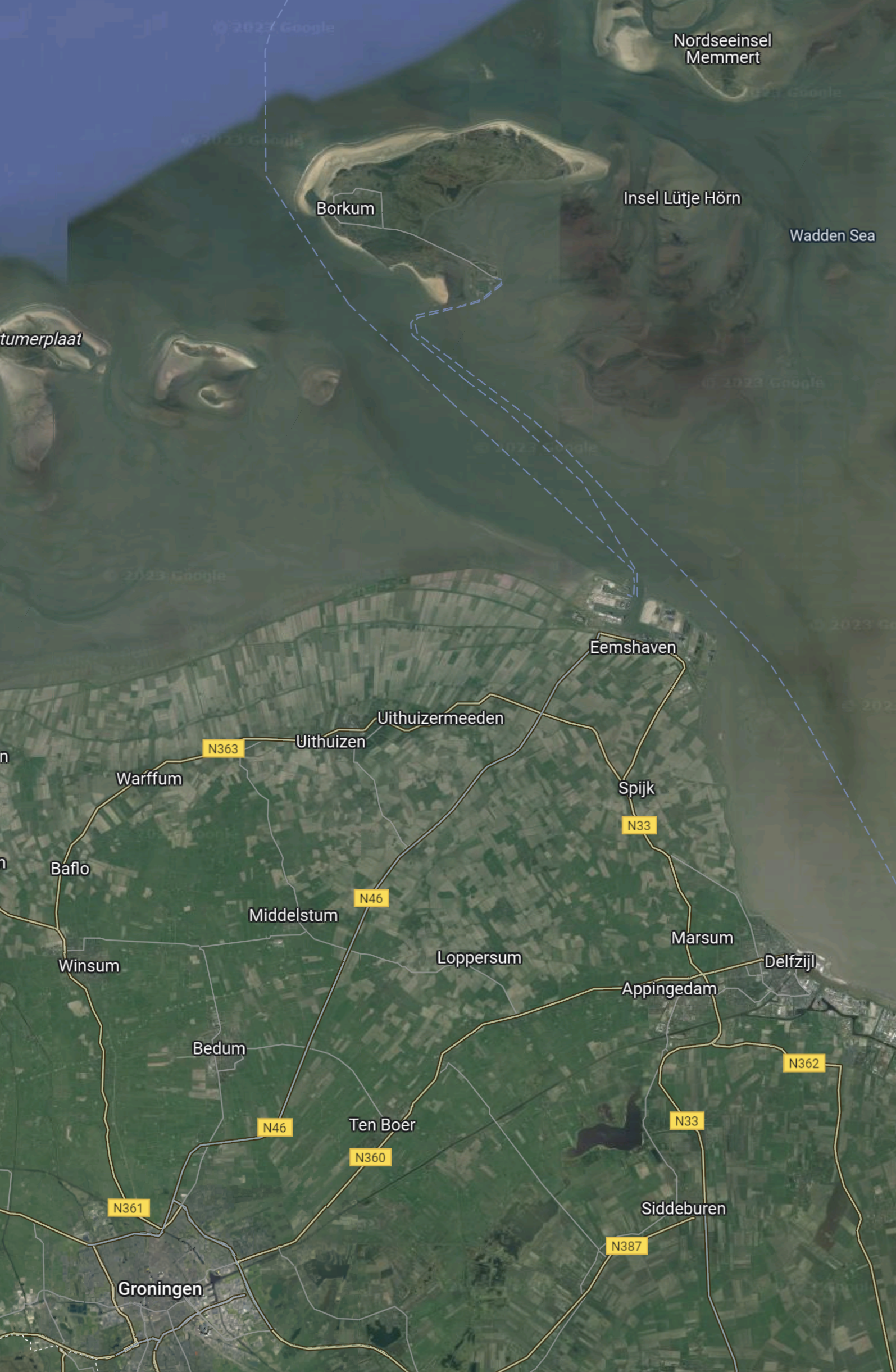
Note.
- Groningen is the city in the South-West corner of the map.
- Borkum is the horseshoe-shaped island at the top of the map.
There are a cluster of wind farms to the North of Borkum, which includes Borkum Riffgrund 1, 2 and 3.
BW Ideol, ABP To Explore Serial Production Of Floating Wind Foundations At Port Talbot
The title of this post, is the same as that of this article on offshoreWIND.biz.
This is the sub-heading.
BW Ideol and Associated British Ports (ABP) have signed a memorandum of understanding (MOU) that will see the manufacturer of concrete floating wind foundations and ABP investigating the feasibility of serial production at Port Talbot. The MOU has been signed in preparation for the Celtic Sea leasing round, BW Ideol said on Monday (11 December).
These two paragraphs outline the plans of BW Ideol and ABP have for Port Talbot.
According to the company, Port Talbot is the only Celtic Sea port with the scale and technical capabilities to fully maximise the Celtic Sea supply chain opportunity and is ideally located as a manufacturing base since it lies 120-140 kilometres from the floating offshore wind areas outlined by The Crown Estate for the upcoming leasing round.
The news on the MOU between ABP and BW Ideol comes shortly after ABP announced plans to invest around GBP 500 million (approximately EUR 573 million) to upgrade a site in Port Talbot and turn it into a major floating offshore wind hub.
This Google Map shows Port Talbot Port.

Note.
- It also looks like there is a Heidelberg Cement facility at the South side of the port.
- Port Talbot also has a Tata steelworks.
- The railway and the M4 Motorway are nearby.
- There’s certainly a lot of water.
The port appears well-placed for raw materials and there is quite a bit of free space to build and launch the concrete floaters.
This page on the BW Ideol web site describes their Floatgen demonstrator.
The first section is headed by BW Ideol’s First Floater In Operation, where this is said.
Built around a European consortium of 7 partners, Floatgen is a 2MW floating wind turbine demonstrator installed off the coast of Le Croisic on the offshore experimentation site of the Ecole Centrale de Nantes (SEM-REV). This project is being supported by the European Union as part of the FP7 programme. Floatgen is France’s first offshore wind turbine. 5 000 inhabitants are supplied with its electricity.
It looks like it is or almost is a proven system.
The page talks of two large benefits.
- Innovation at all levels.
- The highest local content of any floating wind turbine.
For the second, the following is said
In comparison to other steel floating foundations, which are imported from abroad, the use of concrete for BW Ideol’s floating foundation allows the construction to be located as close as possible to the deployment site. Construction at the Saint-Nazaire port was therefore a natural and optimal solution and has created a lot of local content. Additionally, the mooring system was manufactured by LeBéon Manufacturing in Brittany. For the majority of all other components or logistical activities, the Floatgen partners have also opted for suppliers within the Saint-Nazaire region.
Note.
- Will ABP and BW Ideol use a similar philosophy at Port Talbot?
- Will low-carbon concrete be used to construct the floaters?
I can certainly see the logic of BW Ideol and ABP getting together at Port Talbot.
Energy Storage Outranks Solar In Company Investment Plans
The title of this post, is the same as that of this article on Reuters.
These two paragraphs outline the findings of a survey.
Rising renewable energy capacity and the deployment of electric vehicles will make energy storage the priority technology for energy transition investments in the coming years, according to the 2023 Reuters Events Energy Transition Insights report.
Batteries are spearheading growth in energy storage but a wider range of technology types will be deployed commercially in the coming years.
580 energy professionals were surveyed in Q1 2023.
I am not surprised at these findings, as storing surplus renewable energy must be beneficial.
UK Sees Cleanest Power Grid In Q3 As Renewables Grow, Drax Report Says
The title of this post, is the same as that of this article on Renewables Now.
These are the first two paragraphs.
Renewables supplied over 40% of Britain’s electricity demand, the highest ever for the third quarter, helping the country achieve its cleanest power grid on record, according to the Drax Electric Insights report.
In the third quarter carbon dioxide (CO2) emissions from the generation mix were an average of 143 grams per kWh, for the first time below 150 g per kWh over the quarter, says the report, which is commissioned by biomass power generator Drax and prepared by a team from Imperial College London.
We’re certainly getting somewhere!
Building Inside Mountains: Global Demand For Pumped Hydroelectric Storage Soars
The title of this post, is the same as that of this article on Construction-Europe.
This is the sub-heading.
Pumped hydroelectric storage plants around the world have been secretly storing electricity in remote mountain lakes for the last century. But the switch to renewable energy sources is prompting a surge in new construction.
These two paragraphs introduce the article.
Looking out over the ragged beauty of the Scottish Highlands, Coire Glas, a horseshoe-shaped valley holding a clear mountain lake above the shores of Loch Lochy, seems like an unlikely spot to build a megaproject.
In this remote location, surrounded by clumps of pine trees, a team of construction workers from contractor Strabag are tunnelling their way through the rock which they hope will form part of a vast new power storage facility.
The article is a must-read that talks about pumped storage hydroelectricity in general and SSE Renewables’s 1500MW/30 GWh Coire Glas power station in particular.
The Future Of Pumped Hydroelectric Storage
These two paragraphs from the article give a glimpse into the future.
According to the International Energy Agency, global pumped storage capacity is set to expand by 56% to reach more than 270 GW by 2026, with the biggest growth in India and China.
Current pumped storage megaprojects currently in construction include the Kannagawa Hydropower Plant near Minamiaki in Japan which when fully completed in 2032 is expected to have a total installed capacity of 2,820MW; and Snowy Hydro 2.0 in New South Wales, Australia, which is currently expected to complete in 2028.
Note.
- I can count two Indian and ninety Chinese systems under construction. All have a capacity of upwards of one GW.
- The Kannagawa Hydropower Plant appears to be the largest with a capacity of 2.82 GW. The Japanese are keeping quiet about the storage capacity.
- The Snowy Hydro 2.0 has a capacity of 2 GW and a storage capacity of 350 GWh.
- The Wikipedia entry for Snowy Hydro 2.0 states that it is the largest renewable energy project under construction in Australia.
Against this onslaught of massive systems, SSE Renewables are pitching the 1500MW/30 GWh Coire Glas and the 252MW/25 GWh Loch Sloy systems.
Pumped hydroelectric storage will have a big part to play in decarbonising the world. Even in little old and relatively flat UK.

