Gilkes Reveals 900MW Scottish Pumped Storage Plan
The title of this post, is the same as that of this article on renews.biz.
This is the sub-heading.
Earba project would be ‘largest in the UK’ in terms of energy stored
And this is the introductory paragraph.
Gilkes Energy has unveiled scoping plans for its 900MW Earba Pumped Storage Hydro Project in Scotland.
These are a few more details.
- It will have a capacity of 33 GWh.
- Loch a’ Bhealaich Leamhain is proposed to be the upper reservoir.
- Lochan na h-Earba is proposed to be the lower reservoir.
- There will be a three kilometre tunnel between the reservoirs.
- The 900 MW power station will be on the shore of Loch Earba.
- Construction is expected to take between 3 and 4 years.
This Google Map shows the location of the site.
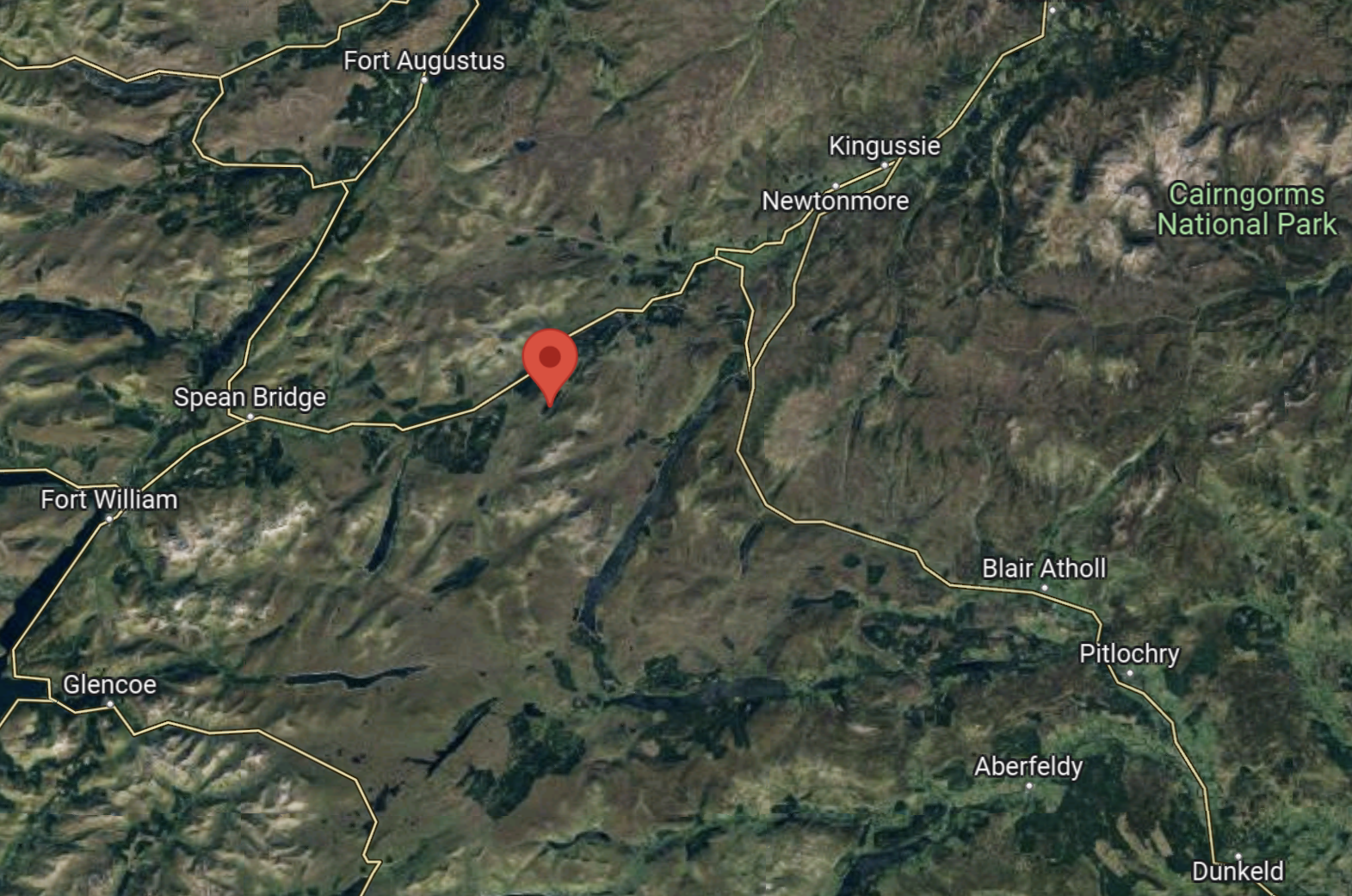
And this Google Map shows the site.

Note.
- Lochan na h-Earba, which will be the lower reservoir is clearly marked, in the North-West corner of the map.
- Loch a’ Bhealaich Leamhain, which will be the upper reservoir is in the South-East corner of the map.
- Much of Loch a’ Bhealaich Leamhain appears to be frozen, with only a small triangular area of water visible.
- There doesn’t seem to be too many roads.
- There is a detailed map on the Earba Storage web site.
This looks like it could be extreme construction, at it’s most extreme.
Conclusion
With a power output of 900 MW and a storage capacity of 33 GWh, this pumped storage hydroelectric power station will have the largest storage capacity of any energy storage in the UK.
Amazon Finances First-Ever Commercial-Scale Seaweed Farm Located Between Offshore Wind Turbines
The title of this post, is the same as that of this article on offshoreWIND.biz.
This is the sub-heading.
Multinational technology company Amazon is funding the world’s first commercial-scale seaweed farm located between offshore wind turbines
This paragraph details the project.
The North Sea Farm 1 will be located in a wind farm off the coast of the Netherlands, designed to test and improve methods of seaweed farming, while researching the potential of seaweed to sequester carbon.
Seaweed is all the rage at the moment, since Notpla won Prince William’s Earthshot Prize, with their packaging made from seaweed.
It sounds to me, that as Amazon probably create more need for packaging, than any company in the world, there could be an almighty coming together, which will create a lot of environmentally-friendly ideas.
Solar Farms And Biodiversity
I have an old farmer friend, who told me this tale.
His neighbour put up a few acres of solar panels on a field, that adjoins one of his fields, where it generally grows cereal crops.
He told me that he felt he was seeing more hares on his land and wrote to me asking if it could be the solar panels.
I searched the Internet and couldn’t find anything at the time.
But, it should be remembered, that hares have an unusual way of bringing up their leverets, where the mothers generally abandon them during the day and feed them in the evening.
We did wonder, if the solar panels offered protection to the leverets from aerial predators. And the mothers were learning that solar panels were a safer place.
This morning someone made a comment about solar panels on a page in The Times and I searched again.
I found this article on the Solar Power Portal, which is entitled Solar Farms And Biodiversity and thoroughly read it.
It doesn’t say much about hares, but it puts a strong case, that solar panels can increase biodiversity.
Mersey Tidal Project And Where It Is Up To Now
The title of this post, is the same as that of this article on the Liverpool Echo.
This is the sub-heading.
With a major agreement on the project reached this week, we take a look at what it all means.
There is a section, which is called So What Is A Mersey Tidal Project?, where this is said.
The idea is to build a huge damn structure in the River Mersey with turbines that can harness energy from the tides of the river and convert it into clean power. The city region combined authority is hopeful that this could power up to 1 million homes and create thousands of local jobs
The city region has one of the country’s largest tidal ranges so it is seen as a perfect opportunity to explore a tidal project here. It is hoped such a project could generate a ‘plentiful, reliable supply of clean, green energy for generations to come.
In the 1970s, I did a small project management consultancy at Frederick Snow and Partners in London. They showed me their ambitious plans for a Severn Barrage, which was a tidal scheme, that would have created a tenth of our electricity and would have cost around a billion pounds.
But Harold Wilson, who was Prime Minister at the time, felt that the money would be better spent on building massive coal-fired power stations, rather than building a clean power station, that would last centuries.
A second section is called What Happened This Week?, where this is said.
This week the Liverpool City Region signed an agreement with the company behind the current world’s current largest tidal project with a view to learning lessons.
The Sihwa Lake tidal range power plant, which is operated by Korea Water Resources Corporation, generates 552GWh of clean, green energy every year, replacing the equivalent of 862,000 barrels of oil a year.
Jeong Kyeong Yun, Vice President of Korea Water Resources Corporation, known as K-water, was in Liverpool this week to sign an historic Memorandum of Agreement with Mayor Rotheram. It is hoped the agreement will pave the way for close co-operation between the two tidal power projects, through reciprocal visits and information sharing.
Note.
- The Liverpool Echo is still making spelling mistakes, like damn instead of dam. In the 1960s, Fritz Spiegl used to give us all pleasure by writing about them.
- 552 GWh would keep the UK powered up for nearly a month.
- The Sihwa Lake Tidal Power Station has a comprehensive Wikipedia entry.
- The Sihwa dam has a road over the top.
- Unlike Frederick Snow’s scheme for the Severn, Sihwa only generates power, on the incoming tide. But it does generate 254 MW.
As ever, Liverpool is thinking big and getting the experience from those, who know what they are doing.
This last paragraph, gives the thoughts of the Mayor.
Mayor Rotheram said that with the right support, he hopes the project could be generating clean, renewable power by the end of this decade.
I would go along with that.
The Mersey Tidal Project And The Mersey Gateway Bridge
Frederick Snow’s plans for the Severn could have incorporated a new road and rail crossing of the estuary.
This Google Map shows the the Sihwa Lake Tidal power station.
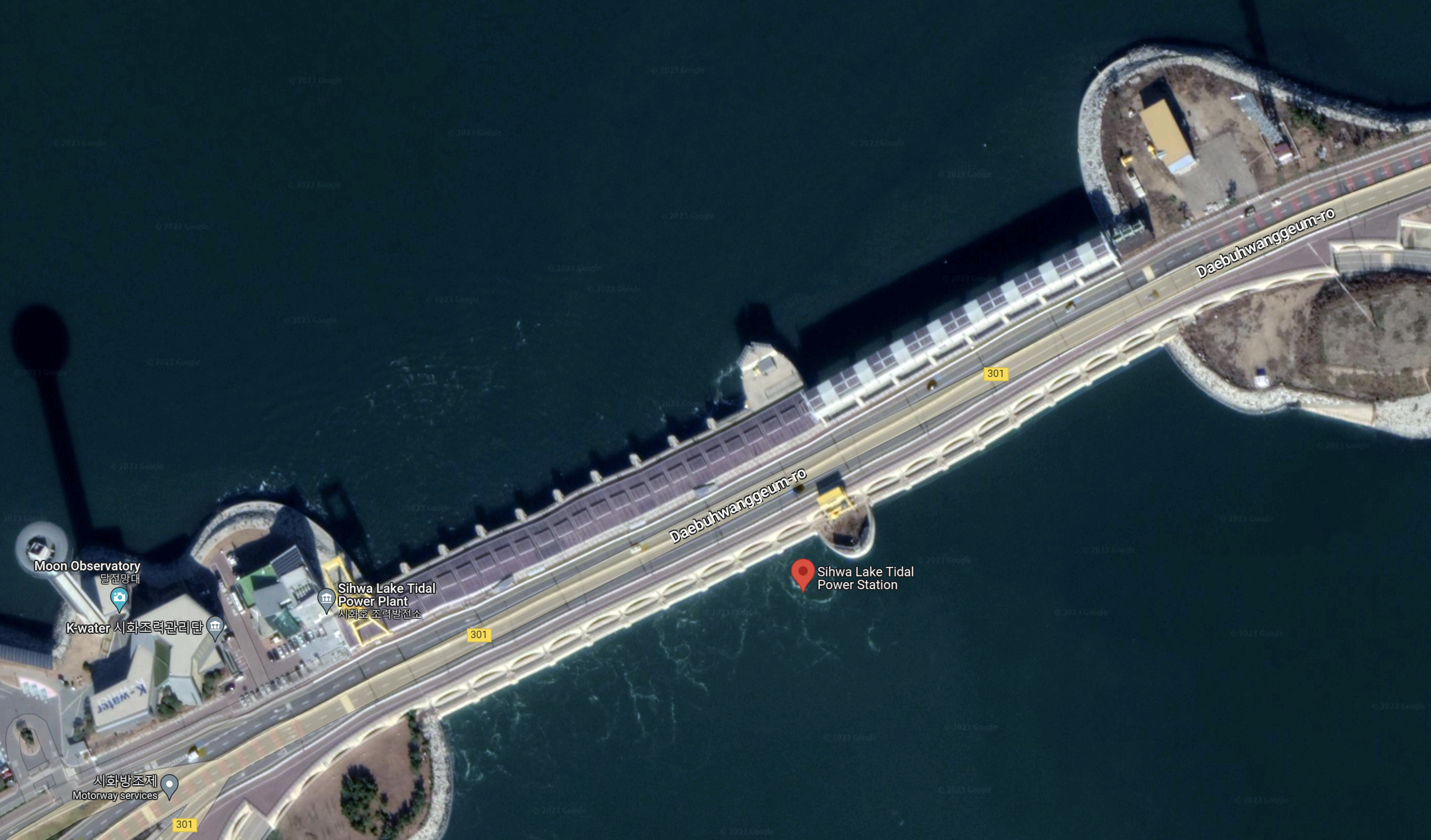
The road over the dam is clearly visible.
I took these pictures of the Mersey Estuary as I came back from Liverpool on Tuesday.





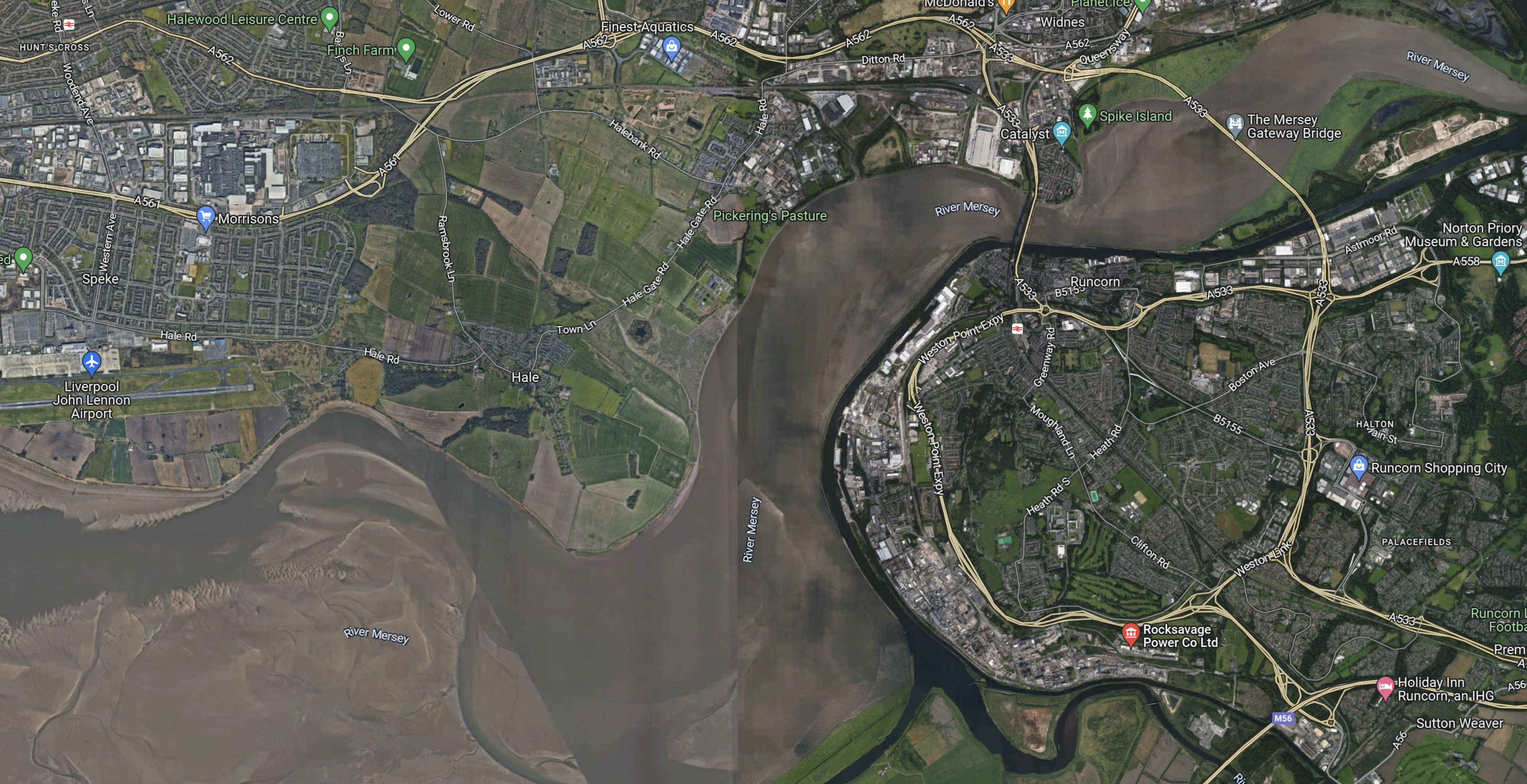
This Google Map shows the Mersey Estuary.
Note.
- The River Mersey flowing from the North-East corner of the map to the South-West corner.
- On the South Bank of the Mersey, there is the deep-water channel of the Manchester Ship Canal.
- The bridge in the North-East corner of the map is the Mersey Gateway Bridge.
- Then there is the pair of bridges at Runcorn; the Silver Jubilee Bridge and the Runcorn Railway Bridge.
I am fairly sure, that the Mersey Tidal Project would be built downstream of the pair of bridges at Runcorn.
This Google Map shows the Mersey Estuary from the Runcorn Bridges to the mouth of the Manchester Ship Canal.

Note.
- The Mersey Gateway Bridge and the two Runcorn bridges are in the North-East corner.
- The route of the Manchester Ship Canal is clearly visible.
- Liverpool John Lennon Airport is on the North Bank of the Mersey.
- The M56 and M53 Motorways run East-West across the map to the South of the River.
This map leads me to the conclusion, that a tidal barrage with a road on top could link Liverpool to the M56.
I have some thoughts.
Rail Access To Liverpool
There is an electrified railway between Liverpool and Ellesmere Port.
- The railway can be picked out running across the bottom of the map.
- In Liverpool’s Vision For Rail, I talked about Liverpool City Region’s plan to expand this service to Helsby, Frodsham and Runcorn East.
- Helsby and Frodsham are shown on the map.
I wouldn’t be surprised to see a new Park-and-Ride station, where the M56 and the railway cross.
Ship Access To Manchester And Other Ports
Barrages usually have to provide access for ships to pass through to any ports behind the barrage.
But the Mersey Tidal Project already has that access. – It was built in the 1893 and is called the Manchester Ship Canal.
There is probably strong protection between the Mersey and the Canal between the mouth of the Canal and Runcorn, which may impact positively on the costs of the barrage.
The Simple Barrage
Sihwa Lake Tidal power station is a simple barrage with a bridge over the power station in the middle.
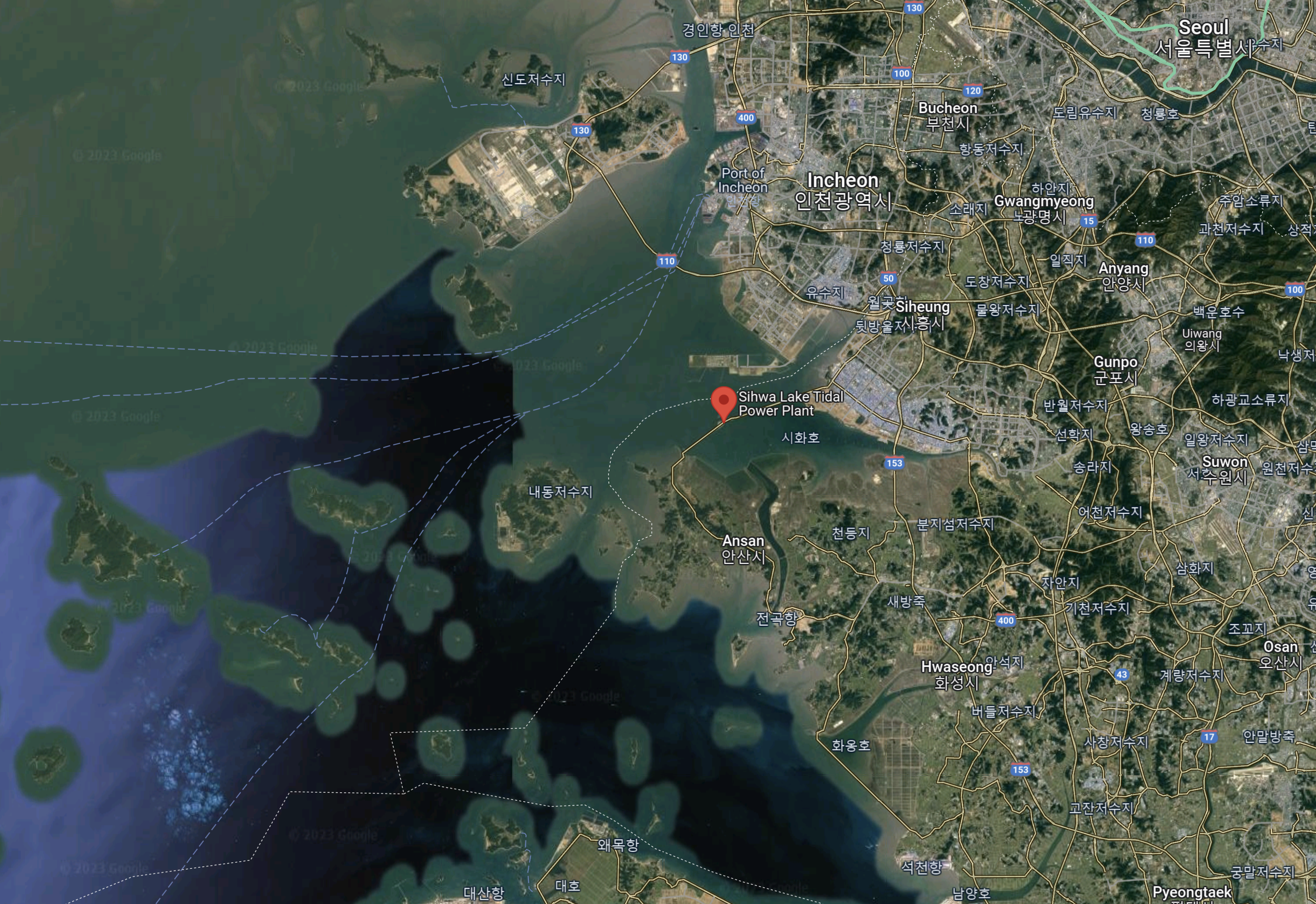
This Google Map shows the location of the power station.
Note.
- Seoul is in the North-East corner of the map.
- The Sihwa Lake Tidal power station is marked by the red arrow.
This Google Map shows a close-up of the power station.
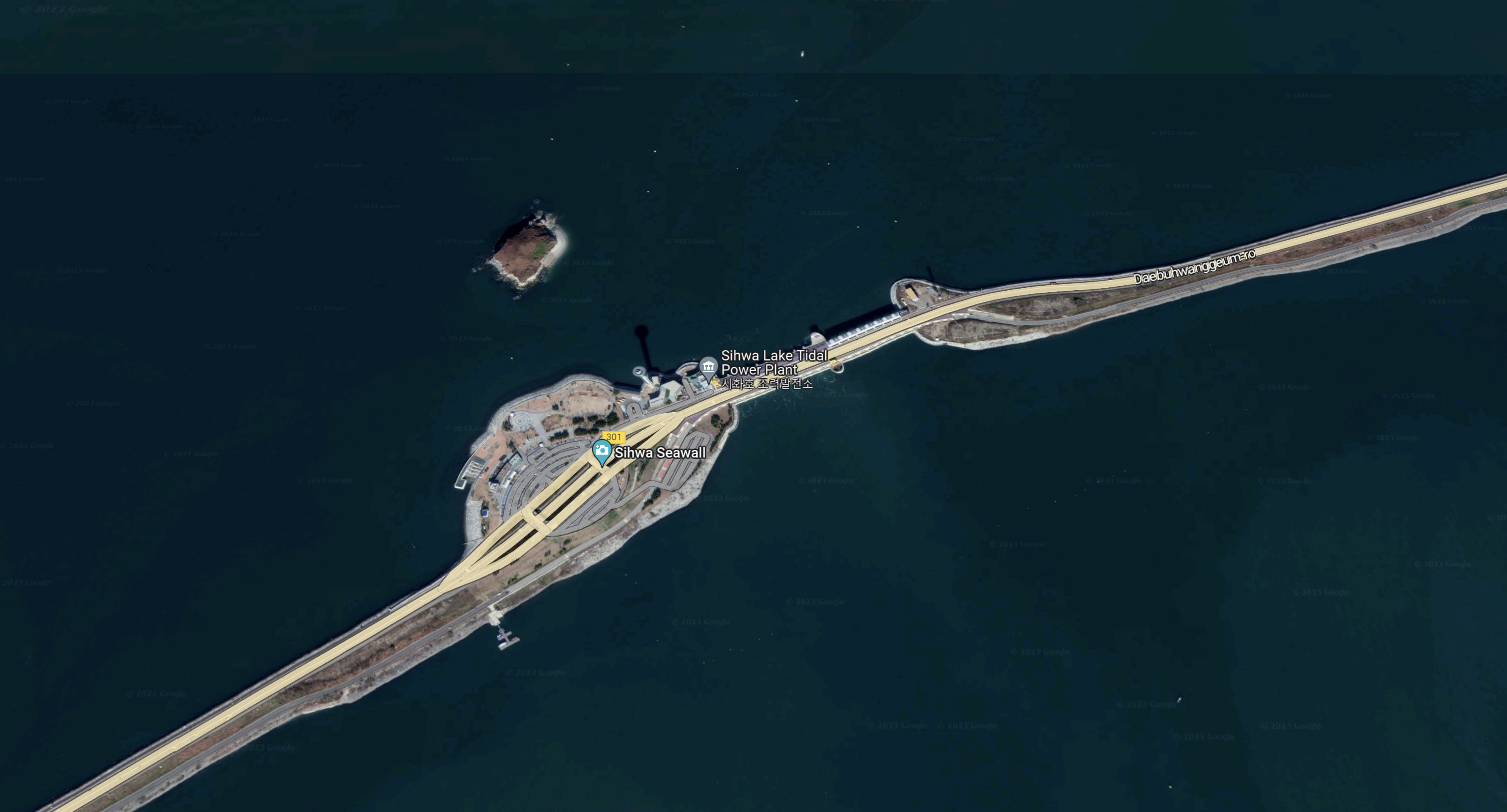
Note.
- The ten turbines appear to be in the gap.
- There appears to be a road on top of the barrage.
- The area to the West of the power station is marked as a rest area.
- A Moon Observatory is marked.
- It has bus stops, showing that it is served by the 123 and 123-1 buses.
It is an impressive structure.
I’m sure that this type of barrage would work over the Mersey.
- A road could be built on top.
- It may only be able to generate electricity,from an incoming tide, like Sihwa.
- It could incorporate a rest area.
I do suspect though Liverpudlians would add a few unique touches of their own. Perhaps some liver birds or superlambananas.
The Frederick Snow Solution
The Severn is a wide river and he proposed that there would be a dam across the river, with a spine running East along the middle of the river.
- The spine would divide the river into two lakes.
- On the incoming tide, sluices would open and allow water to flow into the Northern or high lake from the Mersey estuary.
- On the outgoing tide, sluices would open and allow water to flow out of the Southern or low lake into the Mersey estuary.
- Water would flow between the high and low lake through turbines to generate electricity.
- I have assumed that the high lake is on the North side, but if the geography is more suitable, the high and low lakes could be reversed.
In the design for the Severn Barrage, an International airport would have been built on the spine.
But Liverpool already has a nearby International airport, so perhaps it could be much better to install a large electrolyser and hydrogen storage on the spine.
Green Volt On Track To Power UK Oil & Gas Platforms By Mid-2020s
The title of this post, is the same as that of this article on offshoreWIND.biz.
This is the sub-heading.
Flotation Energy and Vårgrønn have submitted a Marine Licence application for the Green Volt floating offshore wind farm.
These two paragraphs outline the project.
This consent application could allow the project to start generating power in the mid-2020s, making it the most advanced oil and gas decarbonisation project in the UK, the developers said.
Flotation Energy and Vårgrønn are applying for a lease for Green Volt under the Crown Estate Scotland’s Innovation and Targeted Oil and Gas (INTOG) round.
Green Volt wind farm already has a web site, which gives these details of the wind farm.
- It will be 50 miles off Peterhead.
- 300-500 MW
- Operational in 2027.
The offshoreWIND.biz article also says that the project has the potential to generate enough green power to electrify all major oil and gas platforms in the Outer Moray Firth area.
I can’t wait for the successful INTOG bids to be announced in April.
Engineers are creating exciting times.
Scotland And Brittany Discuss Partnership On Floating Wind Turbines
The title of this post, is the same as that of this article on offshoreWIND.biz.
This is the sub-heading.
A delegation of fifteen Scottish companies met in Rennes, France, with companies from the Brittany offshore wind and marine energy sector to discuss the development of partnerships around floating wind turbines.
I can see more partnerships like this.
Rheenergise & University Partners Secure £1M Grant From UK Government
The title of this post, is the same as that of this press release from Reenergise.
This is the sub-heading.
The Department for Energy Security & Net Zero funded research project will identify and test minerals and discarded wastes for use in RheEnergise’s grid scale hydro energy storage system.
And these are the first three paragraphs.
In partnership with the University of Greenwich and the University of Exeter, RheEnergise, the UK company that is developing a new and advanced form of pumped hydro-energy storage, has secured a grant of £1 million funded through the Net Zero Innovation Portfolio (NZIP) as part of the UK Government’s Energy Entrepreneurs Fund. The government grant will fund work to identify and test waste materials that could be used in the high-density fluid (HDF) that is integral to RheEnergise’s grid-scale High-Density Hydro® energy storage system. The HDF is an environmentally benign alternative to water.
RheEnergise’s long duration storage system is low-cost and energy efficient. The fluid used in the system is 2½ times denser than water (similar in viscosity to cream) and is therefore able to provide 2½ times the power and 2½ times the energy when compared to conventional low-density hydro-power systems that rely on water and operate in the Scottish Highlands, Wales and across Europe. It means that RheEnergise can deploy its long duration energy storage system beneath the surface of hills rather than mountains, so opening up massive commercial opportunities in the UK, Europe and further afield.
The research project, funded by the Department for Energy Security & Net Zero’s Energy Entrepreneurs Fund, wants to identify suitable minerals and waste streams which can be recycled into the high-density fluid which can be locally sourced and are lower-cost, rather than having to rely on minerals imported from overseas.
I feel the concept of High-Density Hydro is excellent and will work.
If this research leads to lower costs, that can only help the development and deployment of High-Density Hydro.
Wind Power For 1.2m Homes Is Wasted Because Of Lack Of Storage
The title of this post, is the same as that of this article on the Daily Telegraph.
These two paragraphs outline what happened.
Enough wind power to supply 1.2m homes a day was wasted over winter because there is no capacity to store extra energy generated on gusty days, according to new research.
National Grid’s electricity system operator asked wind turbines which were expected to generate about 1.35 terawatt-hours of electricity between October and January to switch off instead because they were not needed to meet demand at the time, according to the consultancy Stonehaven.
The problem has been flagged up by Rupert Pearce of Highview Power, who in my view could have a solution with their CRYOBatteries.
Pearce is quoted as saying this.
Renewable energy storage is essential to powering a cleaner, cheaper, always-on Britain.
By capturing and storing excess renewable energy, which is now the UK’s cheapest, most secure and most abundant form of energy, we can power Britain’s homes and businesses with renewable green energy, taking millions of tonnes of carbon out of the atmosphere and ending a culture of reliance on expensive foreign imports.
He’s too bloody right! And my experience of mathematical modelling large vessels at ICI in the 1970s, says that Highview Power have one of the sensible solutions to large scale energy storage.
Multi-Turbine Windcatcher Secures More Funding
The title of this post, is the same as that of this article on offshoreWIND.biz.
This is the sub-heading.
Norway’s Wind Catching Systems AS, the developer of the Windcatcher floating offshore wind technology, has secured a pre-project grant of NOK 9.3 million (USD 0.9 Million) from ENOVA.
The Windcatcher certainly looks impressive on the home page of the Wind Catching Systems AS web site.
This image is of the over-station development at Moorgate station.
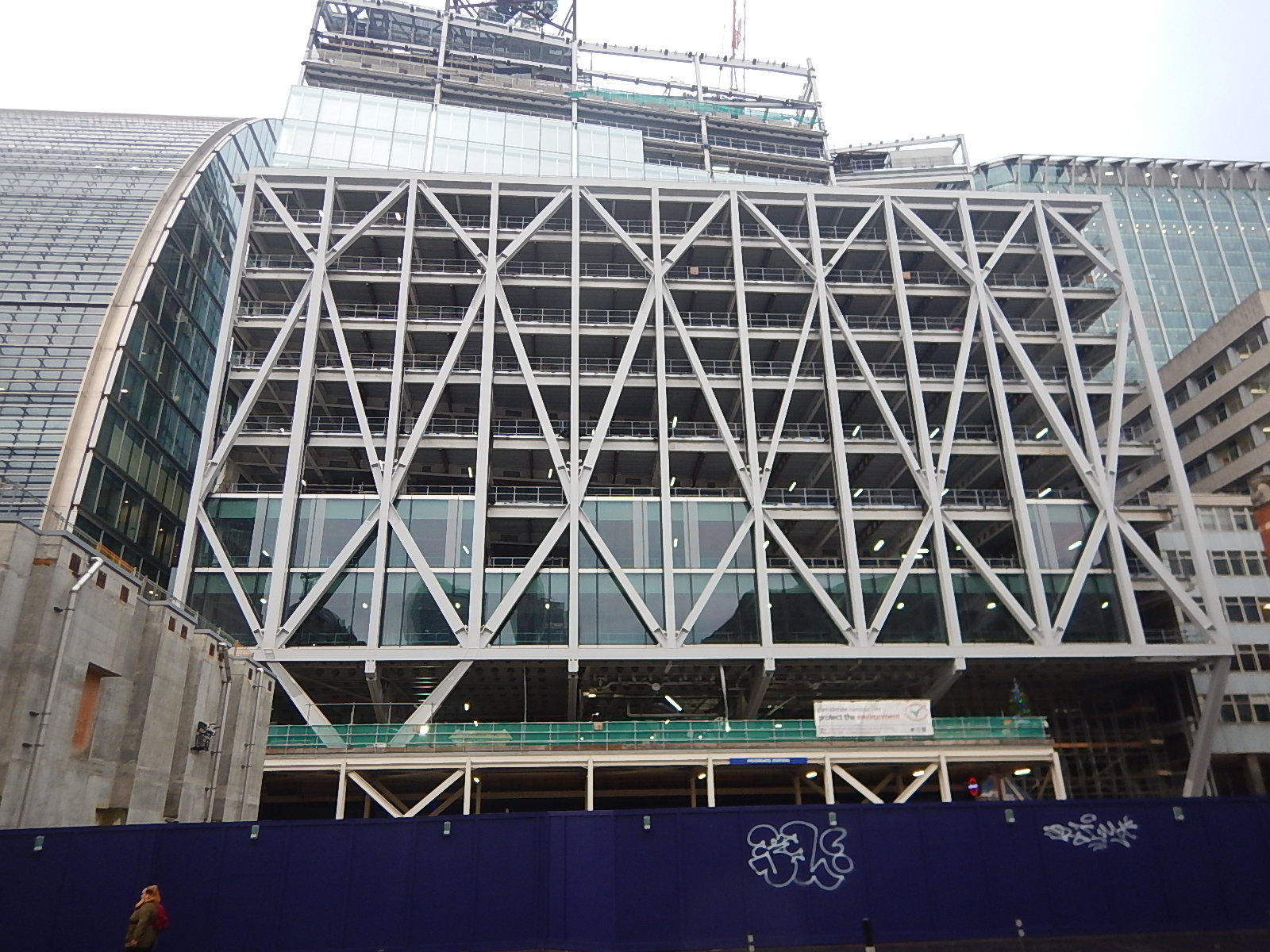
If this structure is strong enough to hold up an eight floor building, surely a system can be designed to hold up a number of small wind turbines.
But will it work well in practice or is it just something that looks good in a visualisation?
Note that aerodynamics and fluid flow are difficult subjects to model on a computer, as I say from experience of getting nowhere, when I tried to mathematically model a plastic extruder at ICI in the early 1970s.
But I did successfully invest in two guys, who went on to develop the Respimat inhaler for Boehringer Ingelheim.
So I have had mixed success in dealing with these tricky subjects.
When I look at the Windcatcher, I think there’s a fifty-percent chance, that it will be a success and a lot depends on the investors.
I do wish the company well and I feel it in my bones, that a couple of weird turbine designs will be runaway successes.
So Many Floating Wind Designs, So Few Test Sites – Norwegian METCentre Sold Out
The title of this post, is the same as that of this article on offshoreWIND.biz.
This is the sub-heading.
There are currently more than 80 floating wind technology concepts and designs worldwide, and testing even a certain number of these could prove to be an endeavour since there are not many test sites dedicated to floating wind technology in Europe.
It strikes me that we need more test centres.
As UK waters will in the next couple of decades be home to a lot more GW of wind farms, perhaps we should develop a test centre.
I wonder, if South Wales would be the place for a test centre.
- There is a lot of sea, which isn’t cluttered with oil and gas rigs, and wind farms.
- There are a lot of wind farms planned in the area.
- There are at least two good technology universities.
- There are some deep water ports.
- Electricity connections and power generation are good.
- There is good train connections to the rest of England and Wales.
- A train testing centre is being built at Nant Helen. Some tests needed to be done could be the same.
Some innovative designs for wind turbines are also being developed in South Wales.
 The Anonymous Widower