EuroLink, Nautilus And Sea Link
EuroLink, Nautilus and Sea Link are three proposed interconnectors being developed by National Grid Ventures.
EuroLink
EuroLink has a web site, where this is said.
To support the UK’s growing energy needs, National Grid Ventures (NGV) is bringing forward proposals for a Multi-Purpose Interconnector (MPI) called EuroLink, which will deliver a new electricity link between Great Britain to the Netherlands.
EuroLink could supply up to 1.8 gigawatts (GW) of electricity, which will be enough to power approximately 1.8 million homes, as well as contribute to our national energy security and support the UK’s climate and energy goals. We’re holding a non-statutory public consultation to inform you about our EuroLink proposals, gather your feedback to help refine our plans and respond to your questions.
Note, that EuroLink is a Multi-Purpose Interconnector (MPI) and they are described on this page of the National Grid website.
In EuroLink’s case, this means it is basically an interconnector between the UK and The Netherlands, that also connects wind farms on the route to the shore.
- Coastal communities get less disruption, as the number of connecting cables coming ashore is reduced.
- Less space is needed onshore for substations.
- Electricity from the wind farms can be directed to where it is needed or can be stored.
As an Electrical and Control Engineer, I like the MPI approach.
The technology to implement the MPI approach is very much tried and tested.
There are many references to EuroLink terminating at Friston.
Nautilus
Nautilus has a web site, where this is said.
Nautilus could connect up to 1.4 gigawatts (GW) of offshore wind to each country through subsea electricity whilst connecting to offshore wind farm/s at sea. By combining offshore wind generation with interconnector capacity between the UK and Belgium, Nautilus would significantly reduce the amount of infrastructure and disruption required both onshore and offshore.
With this new technology, we hope to reduce the impact of infrastructure on local communities and the environment, as well as support the government’s net zero and energy security targets. We are already working closely with other developers in the area to coordinate activities and minimise impact on local communities. We believe that through improved coordination, the UK government can achieve and support the co-existence of renewable energy with coastal communities.
Nautilus is another MPI.
This is said on the web site.
Last year, National Grid Ventures ran a non-statutory consultation for Nautilus, which proposed a connection at Friston.
NGV holds a connection agreement on the Isle of Grain in Kent as part of its development portfolio and we are currently investigating if this could be a potential location for Nautilus. Until this is confirmed to be technically feasible, Nautilus will be included as part of our coordination work in East Suffolk.
So it looks like, Nautilus could connect to the UK grid at Friston or the Isle of Grain.
Sea Link
Sea Link has a web site, and is a proposed interconnector across the Thames Estuary between Suffolk and Kent.
This is said on the web site about the need for and design of Sea Link.
The UK electricity industry is evolving at pace to help lead the way in meeting the climate challenge, whilst also creating a secure energy supply based on renewable and low carbon technologies.
The demands on the electricity network are set to grow as other sectors of the economy diversify their energy consumption from using fossil fuels towards cleaner forms, the move towards electric vehicles being just one example.
Where we’re getting our power from is changing and we need to change too. The new sources of renewable and low-carbon energy are located along the coastline. We need to reinforce existing transmission network and build new electricity infrastructure in these areas in order to transport the power to where it’s needed. This is the case along the whole of the East Coast including Suffolk and Kent.
To allow this increase in energy generation, we need to reinforce the electricity transmission system. Sea Link helps to reinforce the electricity network across Suffolk and Kent.
Our proposals include building an offshore high voltage direct current (HVDC) link between Suffolk and Kent with onshore converter stations and connections back to the national electricity transmission system.
On the web site, in answer to a question of What Is Sea Link?, this is said.
Sea Link is an essential upgrade to Britain’s electricity network in East Anglia and Kent using subsea and underground cable. The proposal includes approximately 130km of subsea cables between Sizewell area in East Suffolk and Richborough in Kent. At landfall, the cables would go underground for up to 5 km to a converter station (one at each end). The converter station converts direct current used for the subsea section to alternating current, which our homes and businesses use. A connection is then made to the existing transmission network. In Suffolk, via the proposed Friston substation; in Kent via a direct connection to the overhead line between Richborough and Canterbury.
Note, that from Kent electricity can also be exported to the Continent.
All Cables Lead To Friston In Suffolk
It looks like EuroLink, Nautilus and Sea Link could all be connected to a new substation at Friston.
But these will not be the only cables to pass close to the village.
This Google Map shows the village.
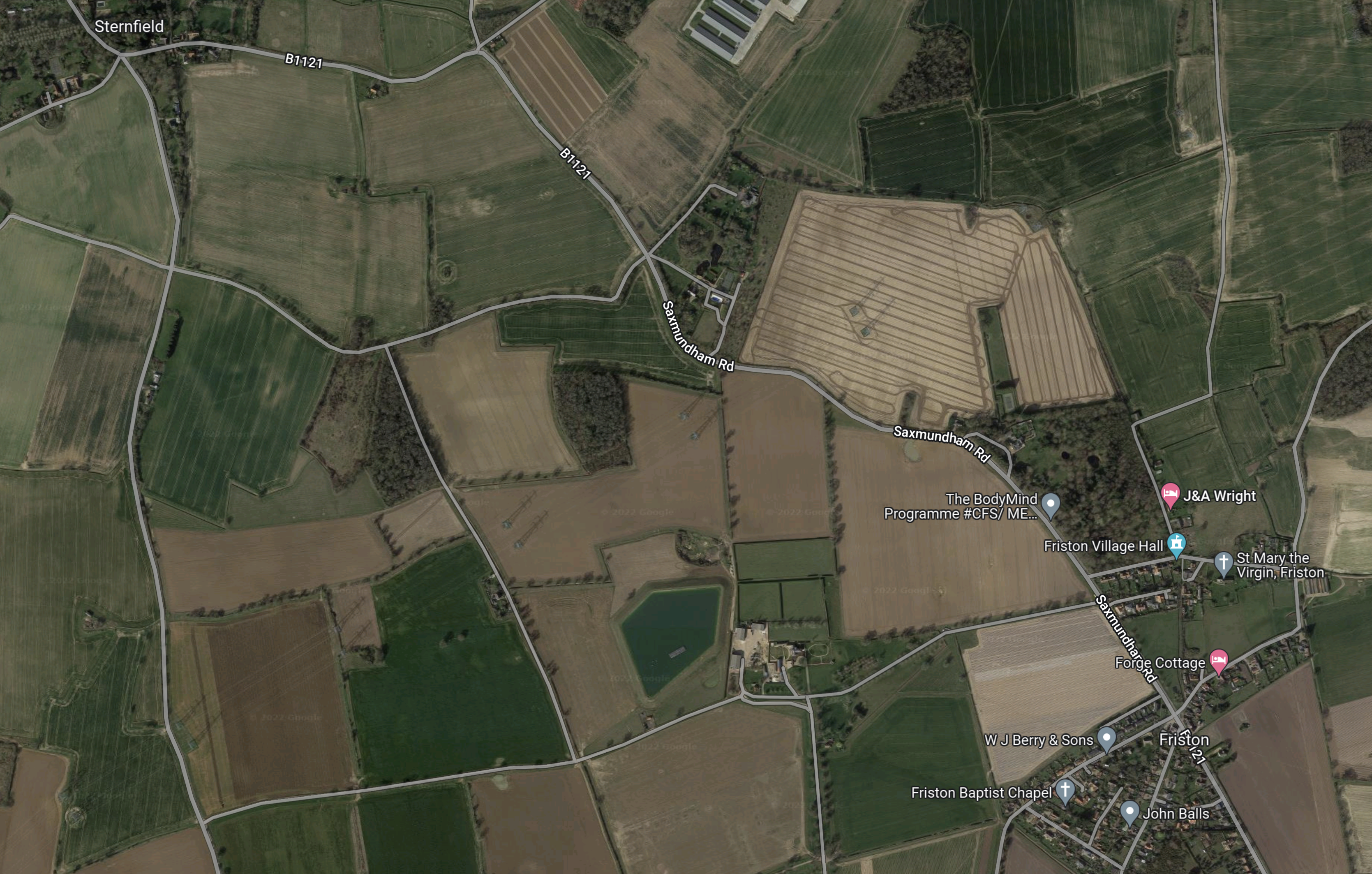
Running South-West to North-East across the map can be seen the dual line of electricity pylons, that connect the nuclear power stations at Sizewell to the UK electricity grid.
Has Friston been chosen for the substation, so that, the various interconnectors can be connected to the power lines, that connect the Sizewell site to the UK electricity grid.
This would enable EuroLink, Nautilus and/or Sea Link to stand in for the Sizewell nuclear stations, if they are shut down for any reason?
It does appear from reports on the Internet that the Friston substation is not welcome.
Exploring Opportunities For Coordination
The title of this section is a heading in the EuroLink web site, where this is said.
In response to stakeholder feedback, NGV’s Eurolink and Nautilus projects and NGET’s Sea Link project are exploring potential opportunities to coordinate. Coordination could range from co-location of infrastructure from different projects on the same site, to coordinating construction activities to reduce potential impacts on local communities and the environment.
That sounds very sensible.
Project To Develop 20+ MW Floating Offshore Wind Technology Kicks Off
This is the introductory paragraph.
Denny Bros Completes Solar Scheme At Bury St Edmunds Factory
The title of this post, is the same as that of this article on the East Anglian Daily Times.
This is the sub-title.
An energy-hungry manufacturer has completed a huge £0.5m solar array across its roofs – which on a good day can power the whole operation and more.
This Google Map from a few months ago, shows the incomplete array.
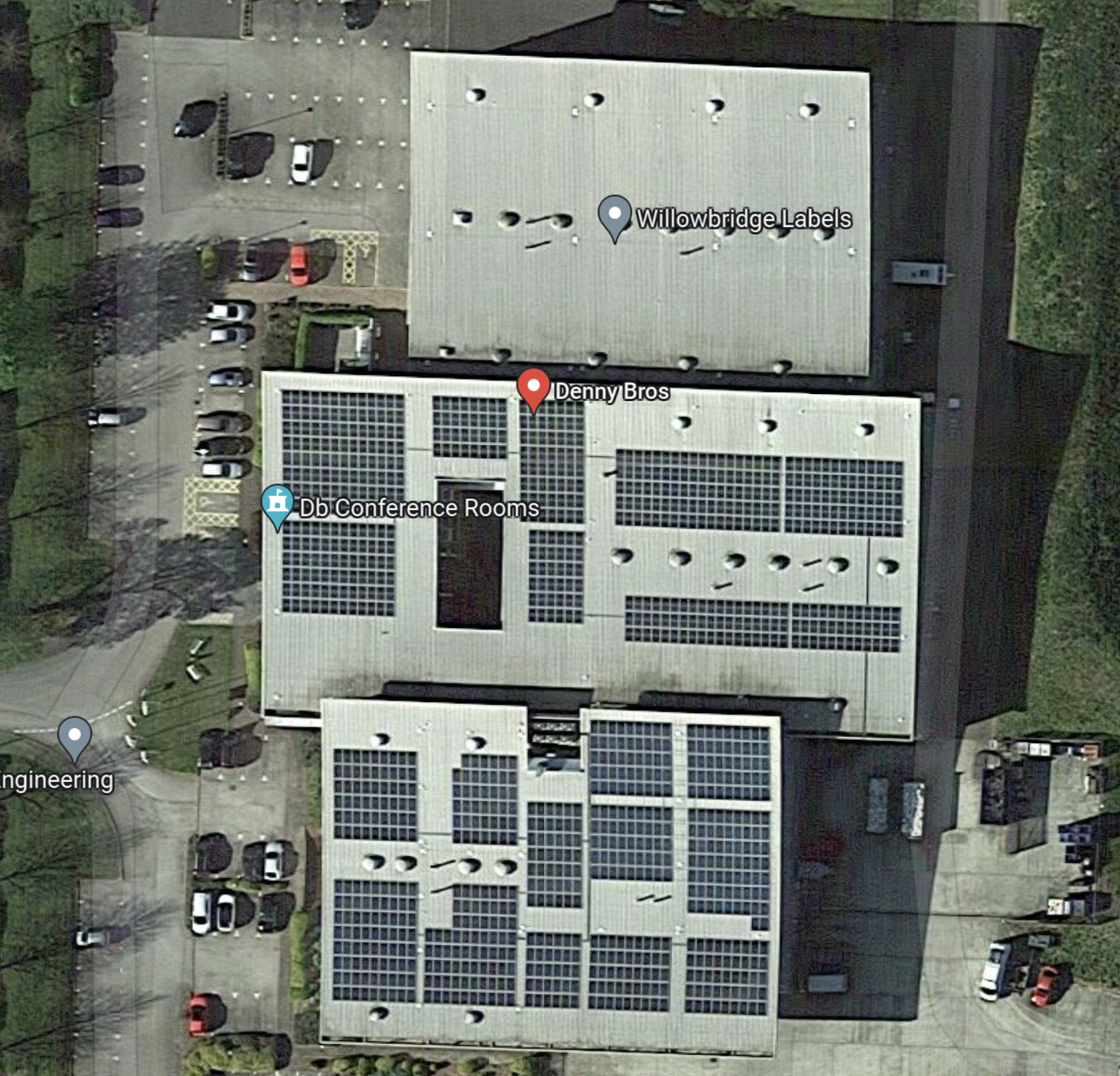
A more recent picture in the article, shows the top building with solar panels on the roof.
According to another report in the East Anglian Daily Times, the company turns over about eight millions.
As Denny Brothers appears to be a well-run company, that is partly employee-owned, the numbers must add up.
Incidentally, the article was displayed with two adverts; one for a solar panel company and the other for the well-known employee-owned company; John Lewis.
I suppose that’s the way the cookie rumbles!
I certainly don’t regret installing solar panels on my flat roof!
What About A Couple Of Wind Turbines?
I ask this question, as some MPs want to allow more onshore wind, providing the natives don’t mind.
I wrote about onshore wind in Chancellor Confirms England Onshore Wind Planning Reform and I think that in the right place they are acceptable.
I know the Government has changed since September, but if you look at the Google Map above, I suspect a couple of turbines could be squeezed in and they probably would be in Germany.
The Secret Of The TwinHub
I was reading about the TwinHub, which is a pair of wind turbines, that are to be mounted on a single float.
There is an explanatory video on the TwinHub home page. Just scroll the page down and you’ll find a full page video, that is rather beautiful and slightly hypnotic.
But note how it stops and starts in the wind and turns itself into a position, so that it is generating the maximum amount of wind.
So how does it do that?
It is not by clever computers and a whole host of actuators, but by good old-fashioned aerodynamics.
Above the video, there is a picture of the sea, with these words underneath.
This demonstration project will be located at the Wave Hub site, and will consist of two floating platforms anchored to the seabed. Each floating platform will host two turbines with inclined towers. The total installed capacity will be between 30 to 40 MW.
Two words are the key to the design – inclined towers.
The wind will apply a force to each turbine and because the towers are inclined, this will apply a force, that will turn the turbines so they are facing the wind. This will maximise the power generated.
The design is elegant, efficient and enchanting.
I can see the TwinHub becoming an unusual tourist attraction in Cornwall.
Ukraine Tender Would Pair Hydroelectric Plants With Large-Scale Battery Storage
The title of this post, is the same as that of this article on Energy Storage News.
This is a must-read article, as it outlines the damage that Russia is doing to Ukraine’s energy generation.
It also reports how the World Bank is trying to help.
Innovative Hydrogen Energy Storage Project Secures Over £7 million In Funding
The title of this post, is the same as that of this press release from the University of Bristol.
These two paragraphs outline the project.
A consortium, involving the University of Bristol, has been awarded £7.7m from the Net Zero Innovation Portfolio (NZIP) of UK Government’s Department for Business, Energy & Industrial Strategy (BEIS) to develop pioneering hydrogen storage.
The University, EDF UK, UKAEA and Urenco will together develop a hydrogen storage demonstrator, in which hydrogen is absorbed on a depleted uranium ‘bed’, which can then release the hydrogen when needed for use. When stored, the hydrogen is in a stable but reversible ‘metal hydride’ form. The depleted uranium material is available from recycling and has been used in other applications such as counterbalance weights on aircraft.
I particularly like this paragraph from Professor Tom Scott.
Professor Tom Scott from the University’s School of Physics and one of the architects of the HyDUStechnology, said: “This will be a world first technology demonstrator which is a beautiful and exciting translation of a well proven fusion-fuel hydrogen isotope storage technology that the UK Atomic Energy Authority has used for several decades at a small scale. The hydride compounds that we’re using can chemically store hydrogen at ambient pressure and temperature but remarkably they do this at twice the density of liquid hydrogen. The material can also quickly give-up the stored hydrogen simply by heating it, which makes it a wonderfully reversible hydrogen storage technology.”
It’s elegant and it certainly, is an unusual method of storing hydrogen.
I do see a problem in that depleted uranium is controversial because of its use in munitions; most notably in the Gulf War.
I also see its heavy weight being rather a disadvantage in storing hydrogen for mobile applications.
So, I will keep an open mind on this technology.
Plan For £8.25m Plymouth Energy Plant To Generate Power From Cream-Like Fluid
The title of this post, is the same as that of this article on PlymouthLive.
These two paragraphs outline the project.
Plymouth’s Hemerdon tungsten mine has been chosen as the site of a pioneering £8.25m hydro energy plant which would see a cream-like fluid used to generate electricity. London-based renewable energy company RheEnergise wants to start construction of the High-Density Hydro storage system at the Plympton site as early as summer 2023.
The company has already spoken to the parish council and is to submit plans to Devon County Council soon. It hopes permission will be given and the site will be in operation by the end of 2023 and then trialled for two years before the technology is rolled out nationally and worldwide.
Note.
- RheEnergise has a web page, which describes how their High-Density Hydro storage system works.
- The system is sized at 250kW/1MWh and is described in the article as a demonstrator plant.
- In the future, rojects will range from 5MW to 100MW of power and can work with vertical elevations as low as 100m or less.
This sentence from the article lays out the potential of the system.
RheEnergise’s analysis of potential project opportunities has indicated there are about 6,500 possible sites in the UK, about 115,000 in Europe, about 345,000 in North America and about 500,000 in Africa and the Middle East.
This method of storing energy could be very useful.
Where Is Hemerdon Tungsten Mine?
This is a Google Map of the Plymouth area.
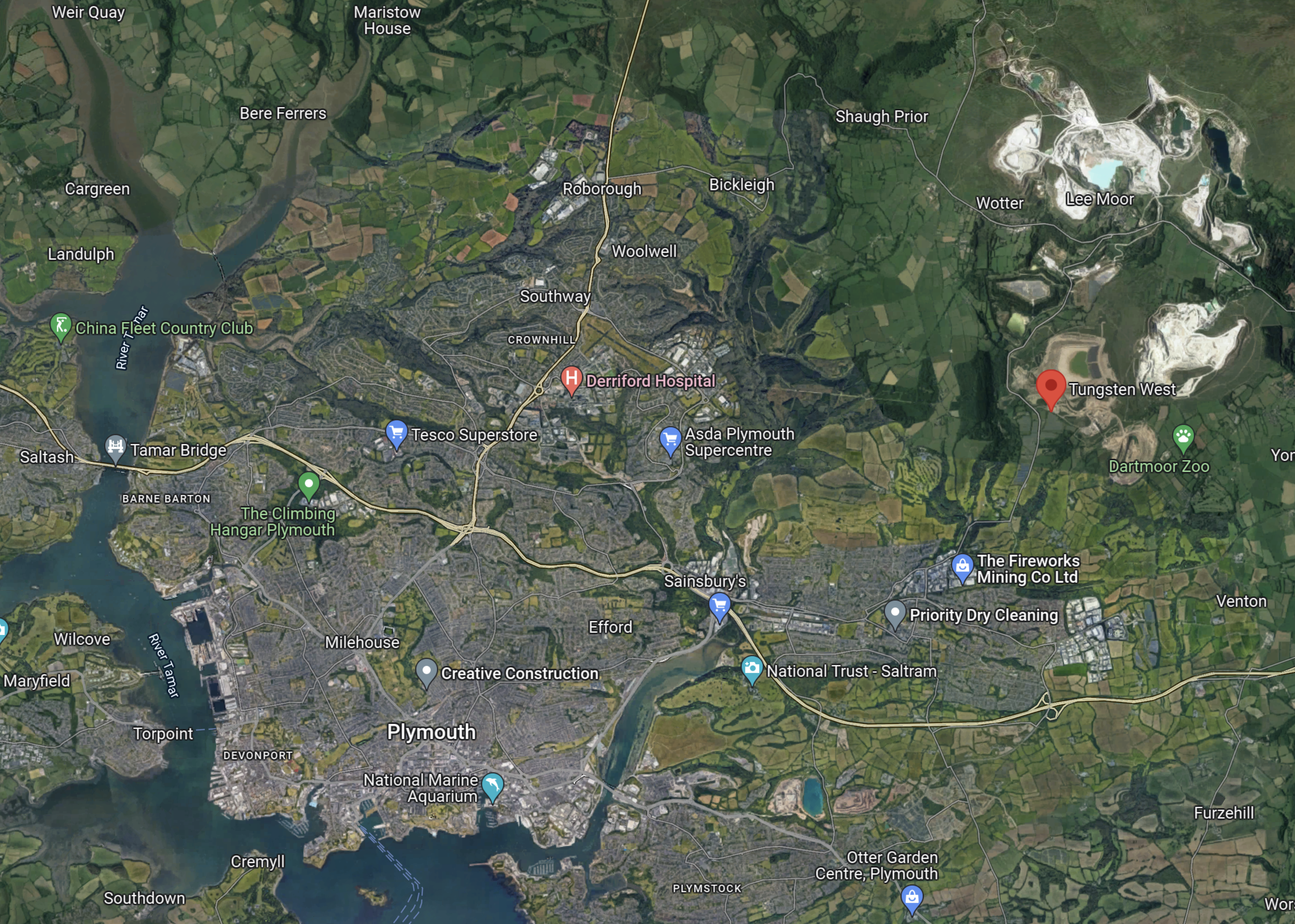
The red arrow indicates the Hemerdon Tungsten Mine, which has a Wikipedia entry as Drakelands Mine, where this is said about the last three years.
Tungsten West plc, which floated on the London Stock Exchange’s Alternative Investment Market on 21 October 2021,[49] have taken over the mine. They have conducted a review starting from the basics, of what is required to fix the problems that caused Wolf Minerals to fail. A better understanding of the mineralogy, with associated changes to the processing stream, and aggregate sales should lead to the mine re-opening at scale in 2022.
Tungsten West’s share price has had an up-and-down day. But are they adding energy storage to their income streams?
From the map, it does seem to be a possibility.
Reports: Ineos In Talks With Rolls Royce To Build Nuclear Plant At Grangemouth Refinery
The title of this post, is the same as that of this article on The Chemical Engineer.
These are the first two paragraphs.
INEOS is reportedly in talks with Rolls Royce about using its small modular nuclear reactor (SMR) technology to power the Grangemouth refinery in Scotland.
The Sunday Telegraph first reported the story, citing sources with knowledge of the discussions who claimed that early-stage talks between the companies have centred on the technology and that commercial negotiations are yet to take place.
This paragraph, also gives a useful summary of how large scale chemical plants can use low carbon energy.
Ineos is not the first chemicals major to explore using new nuclear plants to provide low-carbon power to help decarbonise its heavy operations. Options include raising low-carbon heat for use in chemicals processing and electrolysing water to produce hydrogen for use as chemical feedstocks. In August, Dow announced it will install SMRs from X-energy to provide power and process heat for its chemicals production on the US Gulf Coast.
It is interesting to note that Dow are also exploring the use of SMRs to power a large chemical plant.
This paragraph gives an assessment of the possible view of the Scottish government.
Scotland has set a target to achieve net zero emissions by 2045 – five years earlier than UK legislation. While the Scottish Government is opposed to new nuclear using current technologies it has said that it will assess how novel technologies might contribute to Scotland’s low carbon future.
So perhaps it is not the total opposition, that some would expect.
In the 1960s, when I worked at ICI, I can remember reading an article in a serious magazine about nuclear plants being used in chemical plants and for steelmaking. This application has taken a long time to come to fruition.
AVL RACETECH Builds Hydrogen Combustion Engine For Motorsport
The title of this post, is the same as that as this article on Hydrogen Central.
This is the opening paragraph.
AVL RACETECH, the motorsport department of AVL, presents the prototype of an innovative H2 internal combustion engine. The power unit is a compact, hydrogen-powered 2-liter turbo engine, with intelligent water injection that enables it to achieve a totally new performance level. The prototype is the first racing engine that AVL RACETECH is developing and building in-house.
Note.
- The engine has a size of two litres.
- It generates about 150 kW/litre.
- It features water injection.
- It appears to be very interesting technically and has been designed with extensive computer simulation.
AVL RACETECH has a web site, which gives more information.
Highview Power In The Daily Express
This article in the Daily Express is entitled The Storage Sites Around The UK That Could Provide Cheap Power To Millions Of Homes.
Highview Power gets a large mention for its plan for twenty storage sites around the UK.
This is said about their planned sites at Carrington and on Humberside.
It is hoped that the first plant, a £250million Manchester station, will come online as early as 2024. It will have a 30megawatts capacity, able to store 300megawatt hours of electricity, enough to supply 600,000 homes with clean power for an hour.
The next plants will be even larger in scale, with four a five planned for Humberside with a 200megawatt/2.5gigwatt hour capacity. The CRYOBattery site would be able to store excess energy generated by the Dogger Bank, Hornsea and Sofia wind farms.
There is also a comprehensive map, with sites indicated at places like Aberdeen, Anglesey, Inverness, Liverpool, Montrose, Norfolk and Sizewell.
The sites seem to be following the wind, which is where excess power needs to be stored and released, when the wind is on strike.

