The Anonymous Widower

Harbour Energy

This article in The Times in the Tempus column is entitled Oil And Gas Producer Harbour Energy Offers Safe Haven.

This is the first paragraph.

Booming commodity prices mean Harbour Energy is throwing off cash and yet the biggest oil and gas producer in the UK North Sea is still struggling to gain credibility in the eyes of investors.

Reading the column, it does seem a bit of a paradox, when the author says.

  • London-listed oil and gas companies are cheap.
  • Harbour Energy is in the bargain basement.
  • The share price doesn’t reflect the P/E ratio.
  • The company seems to have the money for acquisitions.
  • It doesn’t seem to have taken advantage of the Ukraine situation.
  • Revenues should transform its cash flow position.

The author finishes by recommending to buy the shares.

In Cerulean Winds Is A Different Type Of Wind Energy Company, I introduced Cerulean Winds and their £30 billion plan to decarbonise much of North Sea oil and gas production. This sensational plan is described in full on this page of their web site, which is entitled The Cerulean Winds Intog Scheme.

It strikes me that Harbour Energy could be the sort of energy company that could benefit from Cerulean Winds’s scheme.

  • It could increase their gas production by ten percent.
  • Harbour Energy probably have the money to decarbonise.
  • Would decarbonising their North Sea operations improve the company’s profile?

I will certainly watch for any links between the two companies.


October 15, 2022 Posted by | Energy | , , , | Leave a comment

The Salamander Project

The Salamander project may be a strange name for a proposed Scottish offshore wind farm, but that is what it is.

It is being developed by Ørsted and the Simply Blue Group.

There is a web site, which has this bold mission statement.

Helping To Unlock Scotland’s Floating Offshore Wind.

These paragraphs outline the project.

The Salamander project will utilise innovative and cutting-edge floating offshore wind technologies to produce zero-carbon electricity. The development aims to be a stepping stone to help Scotland and the UK to progress towards a net-zero future.

With a proposed 100 MW pre-commercial size project, the Salamander project which is located off Peterhead in the East coast of Scotland, is in an advanced planning stage. Salamander has a strong focus on supply chain development and will provide an opportunity for the local supply chain to gear up for commercial scale opportunities in Scotland, as well as de-risking floating wind technologies for the future commercial projects in Scotland and beyond. This will allow Scotland to maximise the financial benefit of its strong offshore wind resource and generate long term jobs for its local communities.

The project will contribute to the Scottish government’s target of 11 GW of installed offshore wind by 2030, as well as the UK government’s target of 5 GW of operational floating offshore wind by the same date.

There is also a video, which is very much a must-watch.

Floating offshore wind is a relatively new technology and will become the major generator of the world’s electricity within the next decade.

Note this phrase in the first paragraph.

The development aims to be a stepping stone to help Scotland and the UK to progress towards a net-zero future.

This philosophy is shared with other projects.

In DP Energy And Offshore Wind Farms In Ireland, I said this.

They are also developing the Gwynt Glas offshore wind farm in the UK sector of the Celtic Sea.

  • In January 2022, EDF Renewables and DP Energy announced a Joint Venture partnership to combine their knowledge and
    expertise, in order to participate in the leasing round to secure seabed rights to develop up to 1GW of FLOW in the Celtic Sea.
  • The wind farm is located between Pembroke and Cornwall.

The addition of Gwynt Glas will increase the total of floating offshore wind in the UK section of the Celtic Sea.

  • Blue Gem Wind – Erebus – 100 MW Demonstration project  – 27 miles offshore
  • Blue Gem Wind – Valorus – 300 MW Early-Commercial project – 31 miles offshore
  • Falck Renewables and BlueFloat Energy – Petroc – 300 MW project – 37 miles offshore
  • Falck Renewables and BlueFloat Energy – Llywelyn – 300 MW project – 40 miles offshore
  • Llŷr Wind – 100 MW Project – 25 miles offshore
  • Llŷr Wind – 100 MW Project – 25 miles offshore
  • Gwynt Glas – 1000 MW Project – 50 miles offshore

This makes a total of 2.2 GW, with investors from several countries.

It does seem that the Celtic Sea is becoming the next area of offshore wind around the British Isles to be developed.

These Celtic Sea wind farms include Erebus, which like Salamander is a 100 MW demonstration project.

Salamander And Erebus Compared

Consider.

  • Both are 100 MW floating wind demonstration projects.
  • Salamander and Erebus are 27 and 21 miles offshore respectively.
  • Salamander and Erebus are close to the deepwater ports of Peterhead and Milford Haven.
  • Both are described as stepping-stone projects.
  • Both projects talk about developing supply chains.
  • The developers of Salamander and Erebus include Ørsted and EDF Renewables respectively, who are both big beasts of the offshore wind industry.

Both wind farms are in areas, where the UK, Scottish and Welsh governments want to develop massive offshore wind farms, that will eventually total over 50 GW. I believe that Salamander and Erebus will indicate any problems, that will be likely to occur in the building of these massive offshore floating wind farms.

It is a very sensible plan and could lead to an energy rich future for the UK.

How Long Will It Take To Assemble A Floating Wind Turbine?

Each floating wind turbine requires these major components.

  • A wind turbine, which in the Kincardine Wind Farm have a capacity of 9.5 MW, is obviously needed. Some proposed floating offshore wind farm are talking of turbines between 14 and 16 MW. These turbines will be very similar to onshore turbines.
  • A float, usually made out of steel or possibly concrete. Various designs have been built or proposed. The Wikipedia entry for floating wind turbine gives several examples.
  • The anchoring system to keep the float with its turbine in the desired position.
  • The electrical system to connect the wind turbine to the offshore substation, which could also be floating.

Note that the designs for the float, anchoring and electrical systems will rely heavily on technology proven in the offshore oil and gas industry.

Principle Power are the designer of the WindFloat, which is one of the first floats to be used in floating offshore wind.

Their home page has a continuous full-screen video, that shows a WindFloat being assembled and towed out.

The video shows.

  • The completed float being floated alongside a dock, which obviously has an appropriate water depth.
  • The dock has a large crane.
  • The turbine tower and then the blades being lifted into position and securely fixed.
  • Finally, a tug tows the completed turbine/float assembly to its position in the wind farm.

This would appear to be an assembly operation, that could flow just like the production in any world-class vehicle factory.

  • There would need to be just-in-time delivery of all components.
  • The weather would need to be cooperative.
  • Lighting might be needed to work in poorer light levels.
  • This method of assembly would be turbine and float agnostic.
  • Multiple shift working could be employed.

My project management involvement tells me, that it would not be unreasonable to assemble, at least one complete turbine and its float and accessories in a working day.

I can do a small calculation.

The average size of turbine is 15 MW.

One turbine is assembled per day.

There are 300 working days possible in a year with multiple shift working, ignoring Bank Holidays and bad weather.

Just one site could produce 4.5 GW of floating wind turbines per year.

How Many Production Sites Could There Be?

These are surely the best possibilities.

  • Barrow
  • Belfast
  • Clyde
  • Devon/Cornwall
  • Forth Estuary
  • Great Yarmouth
  • Haven Ports
  • Holyhead
  • Humber
  • Liverpool
  • Milford Haven
  • Peterhead
  • Southampton Water
  • South Wales
  • Teesside
  • Thames Estuary

I have named sixteen areas, that could be suitable for the assembly of floating wind turbines.

So let’s assume that eight will be developed. That could mean as much as 36 GW of capacity per year.

The Energy Density Of Floating Wind Farms

In ScotWind Offshore Wind Leasing Delivers Major Boost To Scotland’s Net Zero Aspirations, I summarised the latest round of Scotwind offshore wind leases.

  • Six new fixed foundation wind farms will give a capacity of 9.7 GW in 3042 km² or about 3.2 MW per km².
  • Ten new floating wind farms will give a capacity of 14.6 GW in 4193 km² or about 3.5 MW per km².

Returning to the earlier calculation, which says we could have the ability to create 36 GW of wind turbines per year, with 15 MW turbines, this means with a generating density of 3.5 MW per km², the 36 GW would take up around a hundred kilometre square of sea.

Conclusion

We will become Europe’s powerhouse.

October 15, 2022 Posted by | Energy | , , , , , , , | 3 Comments

The First Of The Cavalry Arrive To Rescue Kwasi Kwarteng

Most commentators think Kwasi Kwarteng is in trouble, but I feel that he has the strength of the mathematics around him.

This press release from BP was released on Wednesday and is entitled UK Offshore Wind: Laying The Groundwork Today.

These two paragraphs outline the work BP are doing to develop wind power in the Irish Sea.

Plans are critical, but it’s putting them into action that counts. As part of our strategy to get wind turbines turning, specialist vessels and crew are out on the Irish Sea undertaking massive seabed survey work. It’s an early but important step on the road to building some of the UK’s biggest offshore wind farms.


Once up and running, our Morgan and Mona projects could deliver enough capacity to power 3.4 million homes with clean electricity and help the UK to meet its climate goals. Their near-shore location – around 30 kilometres off the coast of northwest England and north Wales – will allow for lower-cost, more reliable transmission infrastructure, making them a core part of our plans for more secure and lower carbon energy for the UK.

This EnBW-BP infographic describes the project.


Note.

  1. BP’s partner is EnBW, who are a publicly-traded German energy company.
  2. There is a project web site.
  3. The press release and the graphic are showing the same numbers.
  4. Morgan and Mona will use proven fixed-foundation wind turbine technology.
  5. The combined site is around 800 km² or a square of under thirty kilometers, so it is only quite small in the context of the Irish Sea.
  6. First operation is given on the web site as 2028.

As BP and enBW have massive financial, engineering and project management resources, I believe they will look to bring the 2028 operation date as far forward as is possible.

If you do the cash flow for a project like this, especially when you have the financial and engineering resources of BP and enBW, the mathematics show that if you can accelerate the installation of the turbines, you will start to have a cashflow earlier and this will finance the debt needed to install the wind farms.

Consider.

  • I believe the 2028 date, is one that BP know they can keep, to satisfy the Stock Market and investors.
  • BP have large cash flows from their profitable oil and gas businesses.
  • BP have probably reserved places in the manufacturing queues for wind turbines, foundations and all the electrical gubbins to connect the turbines to shore.
  • BP want to prove to themselves and sceptics, that they can handle the building of wind farms.
  • The are already lots of wind farms along the North Wales Coast, so I suspect that the problems of building wind farms in the Irish Sea are well known.

I will not speculate on the date that Mona and Morgan are complete, but I very much doubt it will be in 2028.

These are some more thoughts from the BP press release.

What’s Happening And Why?

The purpose of these deep geotechnical investigations, carried out by specialist Geo-data company Fugro, up to 100 metres below the seabed is to determine soil characteristics for foundation design (find out how it’s done in the short film, above). Collecting this data will enable bp and EnBW to build efficient offshore wind farms with the least environmental impact. It is crucial for securing government consents for the projects and defining the structure and location of the individual turbines.

Even thirty kilometres off shore, there needs to be detailed planning permission.

Our Other Offshore Wind Projects

We aim to become a leader in offshore wind and, over the past three years, we’ve built up a pipeline of projects with partners in both the US and UK that have the potential to power more than 5 million homes.

And earlier this year, we agreed to form a partnership with Marubeni to explore an offshore wind development in Japan.

It’s all part of our aim to have 20GW of developed renewable generating capacity by 2025 and 50GW by 2030 – that’s broadly enough to power the needs of 36 million people.

Note.

  1. Their ambitions are high, but then so much of the experience of offshore oil and gas can be applied to offshore wind.
  2. BP has the cashflow from oil and gas to reinvent itself.
  3. Assuming a strike price of £40/MWh and an average capacity factor of 30 %, that is an income of around five billion pounds for starters.
  4. If they added energy storage to the wind farms, there’s even more money to be generated.

As Equinor, Ørsted and SSE have shown, you have to be big in this business and BP aim to be one of the biggest, if not the biggest.

Conclusion

Wind farms like Mona and Morgan, and there are several under development, will create the electricity and revenue, that will come to the rescue of the Chancellor.

As I update this after a busy day, it looks like Jeremy Hunt has inherited KK’s excellent groundwork and mathematics.


October 14, 2022 Posted by | Energy | , , , , , , , , | 4 Comments

CIP Picks Stiesdal Floater For 100MW Scottish Offshore Wind Farm

The title of this post, is the same as that of this article on Offshore Engineering.

These two paragraphs introduce the project.

Copenhagen Infrastructure Partners (CIP) has selected Stiesdal Offshore’s TetraSub floating foundation structure for the 100MW Pentland Floating Offshore Wind Farm project, to be located off the coast of Dounreay, Caithness, Scotland.

The technology has been said to offer a lightweight and cost-effective floating solution, based on factory-made modules which are then assembled domestically in port to form a complete foundation.

Note.

  1. The TetraSub seems to have been designed for ease of manufacture.
  2. One if the aims appears to be to build a strong local supply chain.
  3. The TetraSub was designed with the help of Edinburgh University.
  4. The TetraSpar Demonstrator is in operation off the coast of Norway.
  5. This page on Mission Innovation describes the TetraSpar in detail.
  6. The TetraSpar foundation, owned by Shell, TEPCO RP, RWE, and Stiesdal.
  7. It can be deployed in water with a depth of up to 200 metres.
  8. Currently, they carry a 3.6 MW turbine.
  9. At that size, they’d need 27 or 28 turbines to create a 100 MW wind farm.

The home page of the Pentland Offshore Wind Farm gives more details.

This article on offshoreWIND.biz is entitled CIP And Hexicon To Halve Pentland Floating Wind Project Area.

  • The project area has been halved.
  • The number of turbines has been reduced from ten to seven.
  • Compact turbines will be used.
  • The project will be built in two phases, one turbine in 2025 and six in 2026.
  • Effectively, the first turbine will help to fund the second phase, which eases cash flow.

The changes show how the wind farm has changed during development due to local pressures and improved technology.

Conclusion

It does seem that the competition is growing in the field of floating wind turbines.

Given the quality of the research and backing for these floats and the fact they now have an order, I wouldn’t be surprised to see this technology be a success.

October 13, 2022 Posted by | Energy | , , , , , , , , | 2 Comments

Should Hospitals Be The Power Backup Locations?

I was reading an article in The Times about how protestors were blocking roads in Central London and they’re inadvertently stopped an ambulance.

So this question occurred to me. Why I don’t know, but my mind has always jumped about and put thoughts together?

Consider.

  • The latest generation of energy storage that could be used to back up the grid are coming down in physical size.
  • Hospitals have complex power systems, as they use a lot of electricity.
  • Hospitals need emergency power backup.
  • Because of their high electrical use, hospitals will have a high capacity connection to the National Grid.
  • Some modern treatments need a lot of electricity.
  • Will ambulances be battery-powered and will need to be charged up, whilst delivering patients?
  • Many bus routes terminate at the local hospital, so if the buses are battery-powered, these could be charged as well.

As an Electrical and Control Engineer, I feel that to put a town, city or are’s back-up battery at the hospital would be a sensible idea.

Hospitals should be designed to be health, energy and transport hubs for their communities.

October 11, 2022 Posted by | Energy, Energy Storage, Health, Transport/Travel | , , , | Leave a comment

Is There A Virtuous Circle In The Installation Of Wind Farms?

Because we are developing so much offshore wind turbine capacity, this will result in two things.

  • A big demand for steel for the foundations and floats for wind turbines.
  • A large amount of electricity at a good price.

In my view the UK would be the ideal country to develop an integrated steel and wind turbine foundation/float capability.

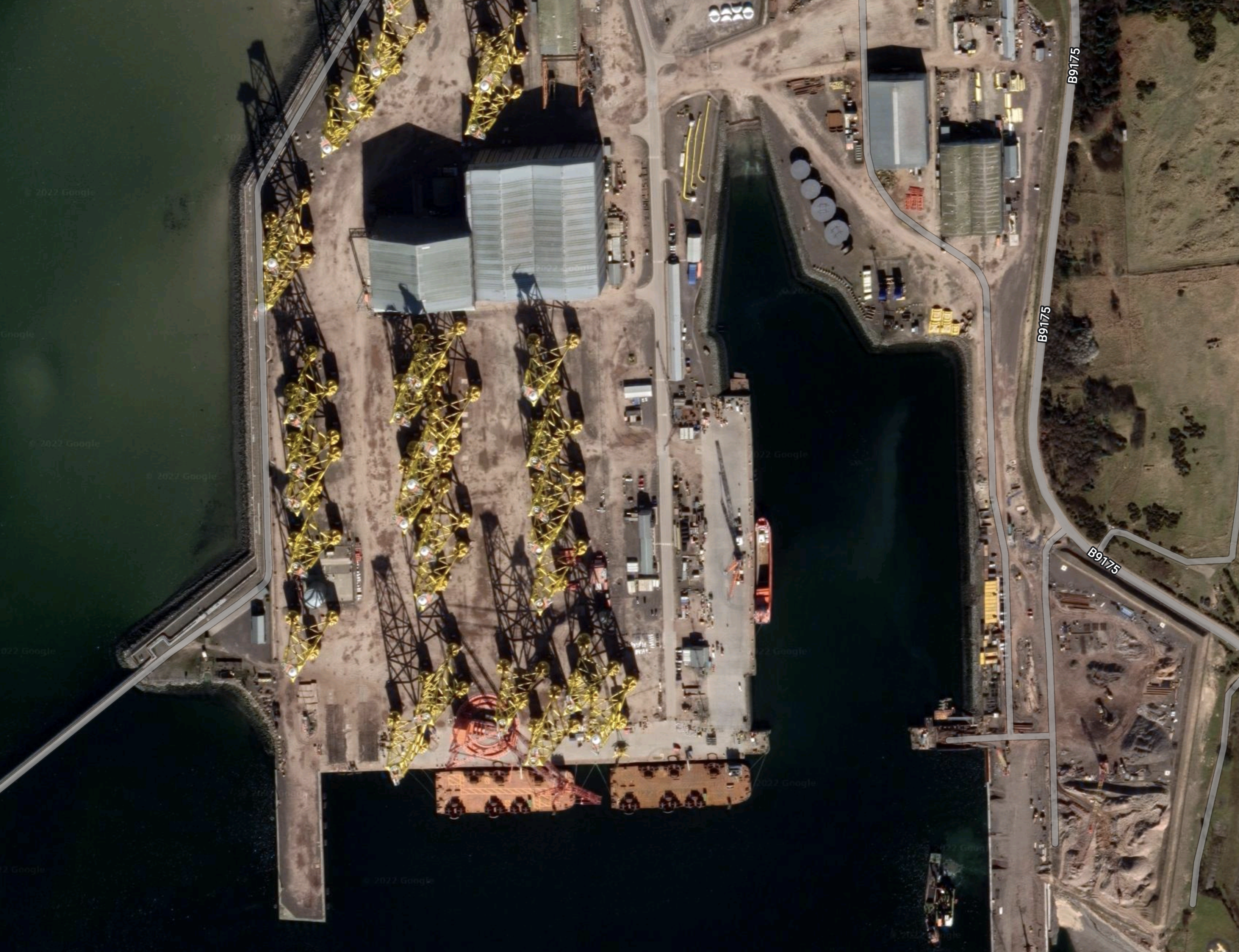
There will also be a strong demand for deep water ports and sea lochs to assemble the floating turbines.

Our geography helps in this one. We also have Milford Haven, which is just around the corner from Port Talbot. Scunthorpe is on the River Trent, so could we assemble floats and foundations and take them by barge for assembly or installation.

We probably need an integrated capability in Scotland.

Conclusion

It looks to me, that there is a virtuous circle.

  • The more offshore wind turbine capacity we install, the more affordable electricity we will have.
  • This will in turn allow us to make more steel.
  • If this steel was produced in an integrated factory producing foundations and floats for wind farms, this would complete the circle.
  • It would also be inefficient to make the foundations thousands of miles away and tow them to UK waters.

Any improvements in costs and methods, would make the system more efficient and we would have more wind turbines installed.

It looks to be a good idea.

October 8, 2022 Posted by | Energy | , , , , , , , | 1 Comment

The Monster In The Mountains That Could Save Europe’s Winter


Ulla-Førre is a complex of five hydroelectric power stations and a massive lake in the Norwegian mountains to the East of Stavanger.

  • The power stations have a total generating capacity of 2.1 GW.
  • Lake Blåsjø is able to hold enough water to generate 7800 GWh of electricity.
  • The complex is at the Norwegian end of the North Sea Link to Blyth in England.

This YouTube video from Statkraft, explains how Ulla-Førre was built.

I have some further explanation and thoughts.

What Is The Operating Philosophy Of The North Sea Link?

This press release from National Grid says this.

The Norwegian power generation is sourced from hydropower plants connected to large reservoirs, which can respond faster to fluctuations in demand compared to other major generation technologies. However, as the water level in reservoirs is subject to weather conditions, production varies throughout seasons and years.

When wind generation is high and electricity demand low in Britain, NSL will enable renewable power to be exported from the UK, conserving water in Norway’s reservoirs. When demand is high in Britain and there is low wind generation, hydro power can be imported from Norway, helping to ensure secure, affordable and sustainable electricity supplies for UK consumers.

It almost seems to me, that the North Sea Link is part of a massive pumped-storage system, where we can bank some of our wind-generated electricity in Norway and draw it out when we need it.

Suppose There Is No Wind In The UK And Norway’s Giant Reservoirs Need Filling?

We could always throw on a substitute, which is the 1,185 MW Hartlepool nuclear power station.

But over the next few years these wind farms will be connected to the North-East.

  • Sofia wind farm should commission the 1.4 GW Phase 1, which connects to Teesside in 2023.
  • Dogger Bank wind farm should commission 3.6 GW, which connects to Teesside and Humberside in 2025.
  • The 4.1 GW Berwick Bank wind farm will have a second connection to Blyth by 2030. Say 2 GW!

There’s more than enough wind there to fill up Norway’s reservoirs and replace Hartlepool nuclear station.

Will Ulla-Førre Be Expanded?

It does sound to me that the video does imply that Ulla-Førre could be expanded.


October 8, 2022 Posted by | Energy, Energy Storage | , , , , , | 3 Comments

Will Norwegian Pumped Storage Hydro Help Us Through The Winter?

In UK To Norway Sub-Sea Green Power Cable Operational, I discussed the North Sea Link interconnector to Norway.

The North Sea Link is no ordinary interconnector, as it is a lot more than a 1.4 GW cable linking the electricity grids of the UK and Norway.

  • At the UK end, there is an increasing amount of wind power. The UK has added 3.5 GW in 2022.
  • At the Norway end, there is the 2.1 GW Ulla-Førre hydropower complex.
  • The water to generate electricity at Ulla-Førre comes from the artificial Lake Blåsjø, which contains enough water to generate 7.8 TWh of electricity.
  • The storage capacity at Ulla-Førre is 857 times greater than that at the UK’s largest pumped storage hydroelectric power station at Dinorwig in North Wales.
  • The power complex consists of five power stations and some can also be used as a pump powered by UK electricity to fill Lake Blåsjø with water.

Effectively, the North Sea Link, the Ulla-Førre power complex and Lake Blåsjø are a giant pumped storage hydro battery, that can either be filled by Norwegian precipitation and water flows or by using surplus UK electricity, through the North Sea Link, which opened a year ago.

If the Norwegian precipitation goes on strike, the only way to fill Lake Blåsjø is to use surplus UK power, which I suspect will be British wind and nuclear in the middle of the night!

But then I thought we will be short of electricity this winter.

  • I suspect we will be at times, but then at others there will be a surplus.
  • So the surplus will be pumped to Norway to top up the reservoir at Lake Blåsjø.
  • When we are short of electricity, the Norwegians will turn water back into electricity and send it back through the North Sea Link.

It will be more sophisticated than that, but basically, I believe it provides us with the electricity we need, at the times, when we need it.

I wouldn’t be surprised to be told, that we’ve been squirreling away overnight wind energy to Norway over the last few months.

I have written more about Ulla-Førre in The Monster In The Mountains That Could Save Europe’s Winter.

It includes a video about the building of the complex.


October 7, 2022 Posted by | Energy, Energy Storage | , , , , , | 6 Comments

The Belgians Go Large

This press release from Elia Group is entitled Elia Presents Its Plans For An Energy Island, Which Will Be Called The Princess Elisabeth Island.

These two paragraphs outline the project.

In the presence of federal ministers Tinne Van der Straeten (Energy) and Vincent Van Quickenborne (North Sea), system operator Elia has presented its draft plans for what will be the world’s first artificial energy island.

The Princess Elisabeth Island will be located almost 45 km off the Belgian coast and will serve as the link between the offshore wind farms in the second offshore wind zone (which will have a maximum capacity of 3.5 GW) and its onshore high-voltage grid. The energy island will also be the first building block of a European offshore electricity grid that will serve as a central hub for new interconnectors with the UK and Denmark. The island is an innovative tour de force that once again puts Belgium on the map as a pioneer in offshore energy.

Note, that Princess Elisabeth is the heir apparent to the Belgian throne.

I have some thoughts.

Will The Wind Turbines Float Or Have Fixed Foundations?

Consider.

  • 3.5 GW of wind farms will probably need around 220 wind turbines.
  • Most of the large wind farms in the seas around the UK, that are below about 50 miles from the shore are on fixed foundations.
  • The seas around East Anglia and Belgium are probably fairly similar.

I suspect that using today’s technology, the turbines will have fixed foundations.

But floats with two or more turbines , that generate more electricity per square kilometre may be developed.

Will Hydrogen Be Generated On The Island?

This could happen and I don’t see why not.

Tankers could even dock on the island to transport the hydrogen.

Could The Island Service Floating Wind Turbines?

All that is needed, is sufficient depth of water and a large crane.

It is a possibility!

Will There Be A UK Interconnector To Princess Elisabeth Island?

The press release says this.

The energy island will also be the first building block of a European offshore electricity grid that will serve as a central hub for new interconnectors with the UK and Denmark.

There could be interconnectors all over the North Sea linking wind farms and energy islands to the UK, France, Belgium, The Netherlands, Germany, Denmark and Norway.

We’d all be in it together.

Conclusion

This is a very ambitious project.

October 7, 2022 Posted by | Energy, Energy Storage, Hydrogen | , , , | Leave a comment

Rolls-Royce And SOWITEC Cooperate On Power-To-X Projects

The title of this post, is the same of that of this press release from Rolls-Royce.

The press release starts with these two bullet points.

  • Target: up to 500 MW electrolysis capacity for power-to-X projects
  • Production of green hydrogen and e-fuels for shipping, aviation, mining, agriculture, data centers

In Rolls-Royce Makes Duisburg Container Terminal Climate Neutral With MTU Hydrogen Technology, I wrote how Rolls-Royce were building a carbon-neutral energy supply for the port.

This Rolls-Royce graphic illustrates the project.

It looks like SOWITEC would be the sort of company to install the decentralised renewables for this project.

Rolls-Royce seem to be collecting the technology to build complex projects like the power supply for the Duisburg Container Terminal, either by acquisition or negotiating friendly links.

But I do think, that Rolls-Royce possibly need two items for a complete portfolio.

A factory with a large capacity to build electrolysers. The press release says they need 500 MW by 2028 or nearly 100 MW per year.

Some form of GWh-sized energy storage. I wouldn’t be surprised to see Rolls-Royce do a deal with an energy storage company.


October 5, 2022 Posted by | Energy, Energy Storage, Hydrogen | , , , , | Leave a comment