Desperate Times Call For Desperate Measures
The title for this post was inspired by this article on the BBC, which is entitled Water Scheme Kicks In To Boost Severn Amid Drought.
This is the sub-heading.
A groundwater scheme in Shropshire that pumps additional water into the River Severn has been switched on
These are the first three paragraphs, which add more detail.
It comes after the Environment Agency (EA) last month declared drought status for the West Midlands, following the driest spring in 132 years.
The scheme, owned and operated by the agency, pumps groundwater stored naturally in sandstone underneath much of north Shropshire, and delivers it through an underground network of pipes into the Severn.
The scheme pumps almost 40 Olympic-sized swimming pools of fresh water every day into the river, with a total of 49 pumps and 53km (32.9m) of underground pipes.
It looks a good scheme to me, but I suspect, those pumps and pipes didn’t come cheap.
These two further paragraphs, explain how it works.
Two reservoirs in Wales – Clywedog and Vyrnwy – are the first resources used to top up the river during dry weather.
The groundwater scheme is the last option to be brought into operation during dry conditions, because of how resource-intensive it is.
I suspect politicians like Trump and Farage would not have sanctioned a scheme like this, as it only protects a river.
This page on the Environment Agency blog gives more details of the scheme.
I looked up the title, that I’ve used for this post on Google AI and received this answer.
“Desperate times call for desperate measures” is an idiom suggesting that unusual problems or difficult circumstances may require unconventional or extreme solutions that would not normally be considered. The phrase originated from an ancient Greek physician, Hippocrates, who wrote about extreme diseases needing extreme methods of cure. The saying acknowledges that when faced with significant challenges, bold or drastic decisions may be necessary for survival or success.
As it seems the scheme is working well, I feel that the decision to build it, was the right one.
New Rail Station For Mid Devon
The title of this post, is the same as that of this article on Exeter Today.
These are the first two paragraphs.
Devon is set to benefit from a major transport funding boost as the Government today confirmed plans for a new railway station in Cullompton and approved a long-awaited upgrade to the A382 between Drumbridges and Newton Abbot.
The announcement, part of a £92 billion national transport investment programme, includes over £47 million to reinstate passenger services between Portishead and Bristol — and, crucially for Devon, two brand-new stations along the Exeter to Taunton line, one of which will be in Cullompton.
It does appear, that according to its Wikipedia entry, Collumpton station has been a bit on-and-off.
In the October 2021 budget, development funding of £5m was allocated for the reopening of Wellington and Cullompton stations. However, in 2024 the Minister of State for Rail, Peter Hendy, stated that the proposed reopening of Cullompton station would no longer be funded by the UK government. Following the government’s spending review in June 2025, funding was confirmed for the station.
But now it appears to be definitely on.
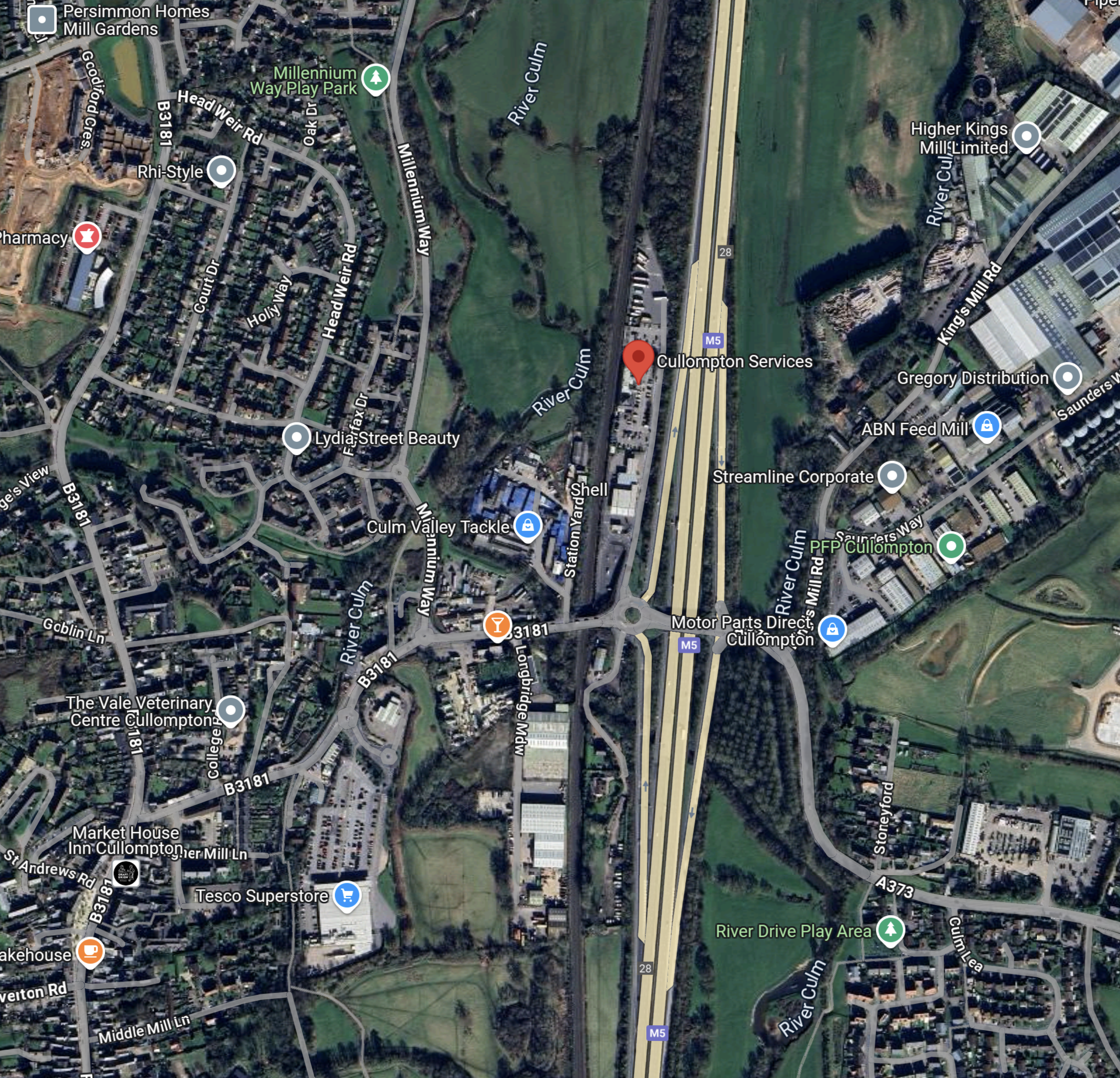
This Google Map shows, the railway and the M5 passing Collumpton.
Note.
- The M5 runs North-South across the map, with Junction 28 about half-way.
- North-west of the junction are Collumpton Motorway Services.
- The Bristol-Exeter Line runs North-South to the West of the services.
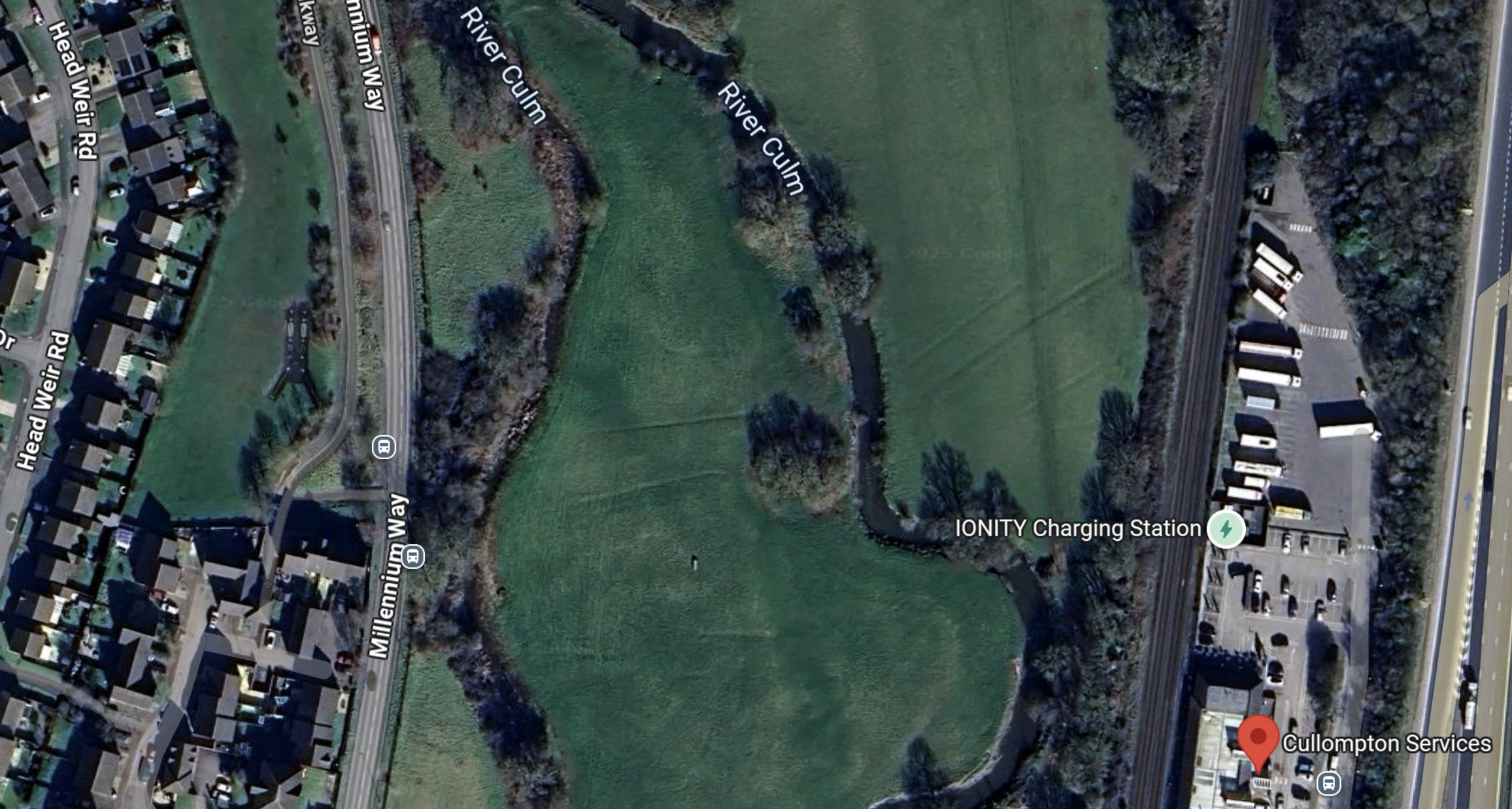
This second Google Map shows the Northern end of the services.
Note.
- Parking at the services appears rather limited.
- Trucks seem to be parked at the Northern end of the services.
- I feel there would be space to put a platform on either side of the rail lines.
- I doubt a bridge with lifts would be a problem.
- The station could share the facilities of the services.
- Could some of the fields to the West of the railway be used to create parking?
- The station could be built to accept nine-car Class 802 trains.
Collumpton station could be built to have a high capacity and direct access to the town and the M5.
I have some thoughts.
Could Collumpton Station Function As A Parkway Station?
I believe it certainly could for Exeter, Bristol and even London.
In Darlington Station – 26th June 2025, I showed how Network Rail are creating a 650-place car park at the station, which could be a major draw for travellers.
Could a large car park be provided here to attract travellers?
South West Rail Resilience Programme
This is the first paragraph of this article on Modern Railways.
The Government has paused the third phase of Midland main line electrification to Sheffield and Nottingham, plus the final phase of the South West Rail Resilience Programme (SWRRP), which involves strengthening cliffs at Holcombe.
If the final phase of the South West Rail Resilience Programme is paused, what happens if God decides to block the line through Teignmouth.
I have thought for some time, that one of the purposes of Okehampton Interchange station is to provide an alternative route to the South-West.
If the sea should destroy the coastal railway, as it did a few years ago, then passengers for the South-West could be ferried to and from Okehampton Interchange station by high-speed hydrogen-powered coaches along the A30, to catch trains to Exeter and London.
So, I would build a hydrogen filling station at Collumpton services, so that if the sea destroys the coastal railway again, the alternative of hydrogen coaches is ready.
If Okehampton Interchange station can also be used as an alternative, two alternatives might just ensure that the alternative routes never need to be used.
It’s Too Darned Hot!
The title says it all!
Earth Friendly Concrete Spotted On Moorgate
I’ve been hoping to spot one of Capital Concrete’s trucks before, but this is the first one, I’ve seen delivering Earth Friendly Concrete.





I said more about the product in Earth Friendly Concrete.
Eden Project Morecambe Revealed In New Images
The title of this post, is the same as that of this article on the BBC.
This is the sub-heading.
New images of what the long-awaited ecotourism attraction Eden Project Morecambe will look like have been released.
These three paragraphs add more detail.
The shell-inspired structure, sister site to the original Eden Project in Cornwall, is due to open in late 2028 and is expected to attract thousands of people to the Lancashire town.
CGI images, by architects Grimshaw, show how the design will look on the edge of Morecambe Bay promenade.
The project team said the structure would be “instantly recognisable” as an “emblem of sustainability” with a “deep connection to place” and complimenting heritage landmarks nearby.
The BBC article contains a selection of stunning images.
I have never been to the original Eden Project in Cornwall, as I don’t drive and it is difficult to get to by train.
But Morecambe from Euston is an easy sub-three hours train journey and not much over an hour from Liverpool and Manchester.
So the Eden Project Morecambe will be much easier to get to and will surely bring in the visitors.
But it needs a better train between Lancaster and Morecambe than this.

Note.
- The train is a British Rail-era Class 156 diesel train, that was built in the late 1980s.
- A diesel train to an eco-project is probably not the right image.
- If they get all the visitors by rail, that I think they will, a two-car train will probably not have enough capacity.
- The platform appears to be electrified and be around 70-80 metres long.
- The Lancaster and Morecambe service is less than five miles.
But I believe, that this platform could be used to charge a battery-electric train through a pantograph.
This train would then be able to trundle silently all day between Lancaster and Morecambe stations.
ENGIE And CDPQ To Invest Up To £1bn In UK Pumped Storage Hydro Assets
The title of this post, is the same as a news item from ENGIE.
These four bullet points act as sub-headings.
- Refurbishment programme to extend life of plants at Dinorwig and Ffestiniog will ensure the UK’s security of supply and support the transition to a low carbon energy future
- ENGIE owns 75% of the plants via First Hydro Company, a 75:25 joint venture with Canadian investment group CDPQ
- The two pumped storage hydro plants are the UK’s leading provider of power storage and flexibility, with 2.1GW of installed capacity
- They represent 5% of the UK’s total installed power generation capacity and 74% of the UK’s pumped storage hydro capacity
These three paragraphs give more details.
The preparation of a 10-year project of refurbishment at *ENGIE’s Dinorwig pumped storage station has begun, following an 8-year refurbishment at Ffestiniog, enabling the delivery of clean energy whenever needed.
These flexible generation assets, based in North Wales, are essential to the UK Government’s accelerated target of achieving a net zero carbon power grid by 2030. Together they help keep the national electricity system balanced, offering instant system flexibility at short notice. The plants are reaching end of life and replanting will ensure clean energy can continue to flow into the next few decades.
Re-planting could see the complete refurbishment of up to all six generating units at Dinorwig – a final investment decision is still to be made on the number of units to replace – while the re-planting at Ffestiniog will be completed at the end of 2025. The program also involves the replacement of main inlet valves – with full drain down of the stations – and detailed inspections of the water shafts.
It also looks like the complete refurbishment at Dinorwig will take ten years, as it seems they want to keep as much of the capacity available as possible.
When the replanting is complete, the two power plants will be good for twenty-five years.
Hopefully, by the time Dinorwig has been replanted, some of the next generation of pumped storage hydroelectric power stations are nearing completion.
The news item says this about Dinorwig.
Dinorwig, the largest and fastest-acting pumped storage station in Europe, followed in 1984 and was regarded as one of the world’s most imaginative engineering and environmental projects.
Dinorwig must be good, if a French company uses those words about British engineering of the 1980s.
Exceptionally Low River Levels Raise Fears Over Water Supplies
The title of this post is the same as that of this article on the BBC.
This is the sub-heading.
Many of the UK’s rivers have hit exceptionally low levels and that could worsen in the next three months, according to the Centre for Ecology & Hydrology (CEH), raising questions over supplies to households, farmers and businesses.
These three introductory paragraphs add more details.
The warning comes after the driest spring in England since 1961, with northern regions experiencing the driest start to the year in nearly a century.
Almost all of the UK is expected to have below normal or low river levels in May, apart from the south-west of England.
The Environment Agency has said that the UK is at medium risk of drought and warned households of the risk of water restrictions.
In the 1970s, I was involved in a marginal way, in the planning of the water supply network in the UK, by the then Water Resources Board. My software called SPEED was used to solve the hundreds of differential equations involved.
Since the 1970s, I have felt, that as water supply in the UK has been fairly good, that the engineers, planners and mathematicians of the Water Resources Board didn’t do a bad job.
I don’t think, I can remember a period as long as this without rain.
I am drinking heavily to keep hydrated and I’m already today on my second bottle of Adnams Ghost Ship 0.5 % Beer.
But it just seems to go straight out through my skin, which I talked about in My Strange Skin.
I am Jewish in my father’s male line and Huguenot in my mother’s, so I have lots of ancestors, who lived in poor living conditions. So did Darwinian selection produce my leaky skin, that also heals itself quickly, in the harsh living conditions.
But on the other hand does it make me dehydrated all the time? And also create lots of red spots all over my body?
It’s not something new, as I can remember feeling this this as a child and helping my mother to count all the spots.
I hope that I will be fine, when we get some rain.
Government Approval For Large Solar Farm
The title of this post, is the same as that of this article on the BBC.
This is the sub-heading.
A large solar farm in East Yorkshire has been given the go ahead by the government.
These two introductory paragraphs add more detail.
The 3,155 acre (1,277 hectares) site will be built on land around Gribthorpe, Spaldington and Wressle and Howden.
Its developers said it would produce 400 megawatts of electricity – enough to power 100,000 homes.
Note.
- This solar farm is five square miles or a 2.2 mile square.
- Due to the size of the scheme the planning application was handled by the Planning Inspectorate as it was classed as national infrastructure.
- Ed Miliband may have been involved in the final decision.
- The solar farm would connect to the National Grid at the Drax substation in North Yorkshire.
But the solar farm is not without opposition, as these last three paragraphs indicate.
George McManus, spokesman for East Riding Against Solar Expansion (ERASE), said the approval “brings us a step closer to enormous swathes of agricultural land being blanketed in a million, Chinese manufactured, solar panels.”
He added: “Other projects in the pipeline will see another 20,000 acres disappear under glass.
“The East Riding is being industrialised and people need to wake up to that.”
Nothing is said about where Reform UK’s Mayor for Hull and East Yorkshire sits.
Berkeley Scientists Finally Solve 10-Year Puzzle Enabling Efficient CO2-to-Fuel Conversion With Major Climate Impact Potential
The title of this post, is the same as that of this article on Sustainability Times.
This is the sub-heading.
In a groundbreaking advancement, scientists at Lawrence Berkeley National Laboratory and SLAC National Accelerator Laboratory have unveiled the critical mechanisms behind the degradation of copper catalysts, a revelation that promises to revolutionize the production of sustainable fuels by enhancing the efficiency and stability of CO2 conversion processes.
This paragraph gives more details.
Scientists from the Lawrence Berkeley National Laboratory and SLAC National Accelerator Laboratory have made a groundbreaking discovery in the field of artificial photosynthesis. By utilizing advanced X-ray techniques, they have uncovered the critical factors that limit the performance of copper catalysts in converting carbon dioxide and water into useful fuels. This revolutionary insight could significantly enhance the stability and efficiency of catalysts in CO2 conversion processes, potentially accelerating the production of ethanol and ethylene. The research, which tackles a decades-old puzzle, offers promising avenues for the development of more durable catalyst systems, paving the way for future advancements in sustainable energy solutions.
I first came across catalysts in my working life, when I was working at ICI. I was modelling a chemical process called sulphonation for a guy who was trying to find an efficient way to create the monomer of building block for a new engineering plastic.
Some feel that all plastics are bad for the environment, but I think that, if the plastic is designed to replace another material in a long-lasting application, then plastic is good for the environment.
This picture shows my wonderful Sheba cutlery.

Note.
- C and I bought it in the 1960s, when we got married.
- Some have been used every day for over fifty years.
- The important bits are Sheffield stainless steel, with the handles formed of black Delrin plastic.
- Some of the handles have been in the dishwasher too many times and have faded.
- From what I have seen on the Internet, the average worth of pieces could be as much as a tenner.
Perhaps, when I pass on, all the pieces should be divided between my grandchildren.
I have digressed and I will return to my modelling project with one of ICI’s catalyst experts.
I remember him telling me, that if you could improve the way catalysts worked, you would open up whole new areas of chemistry.
It looks to me, that the scientists at Berkeley may have opened up a route to turn carbon dioxide into fuel.
Whether that is a good route to decarbonisation is another long discussion.

