Island’s Birds Thriving Decade After Railway Project
The title of this post, is the same as that of this article on the BBC.
This is the sub-heading.
An island transformed into a nature haven thanks to excavations from a major engineering project is thriving with record numbers of birds.
These two paragraphs add detail to the story.
RSPB Wallasea Island, a 740-hectare reserve at Rochford in Essex, was created using more than three million tonnes of earth, brought by boat from the tunnels and shafts created by the Crossrail scheme.
Before work began more than a decade ago there were just a small number of birds present – but almost 40,000 arrived last winter.
This Google Map shows the location of Wallasea Island.
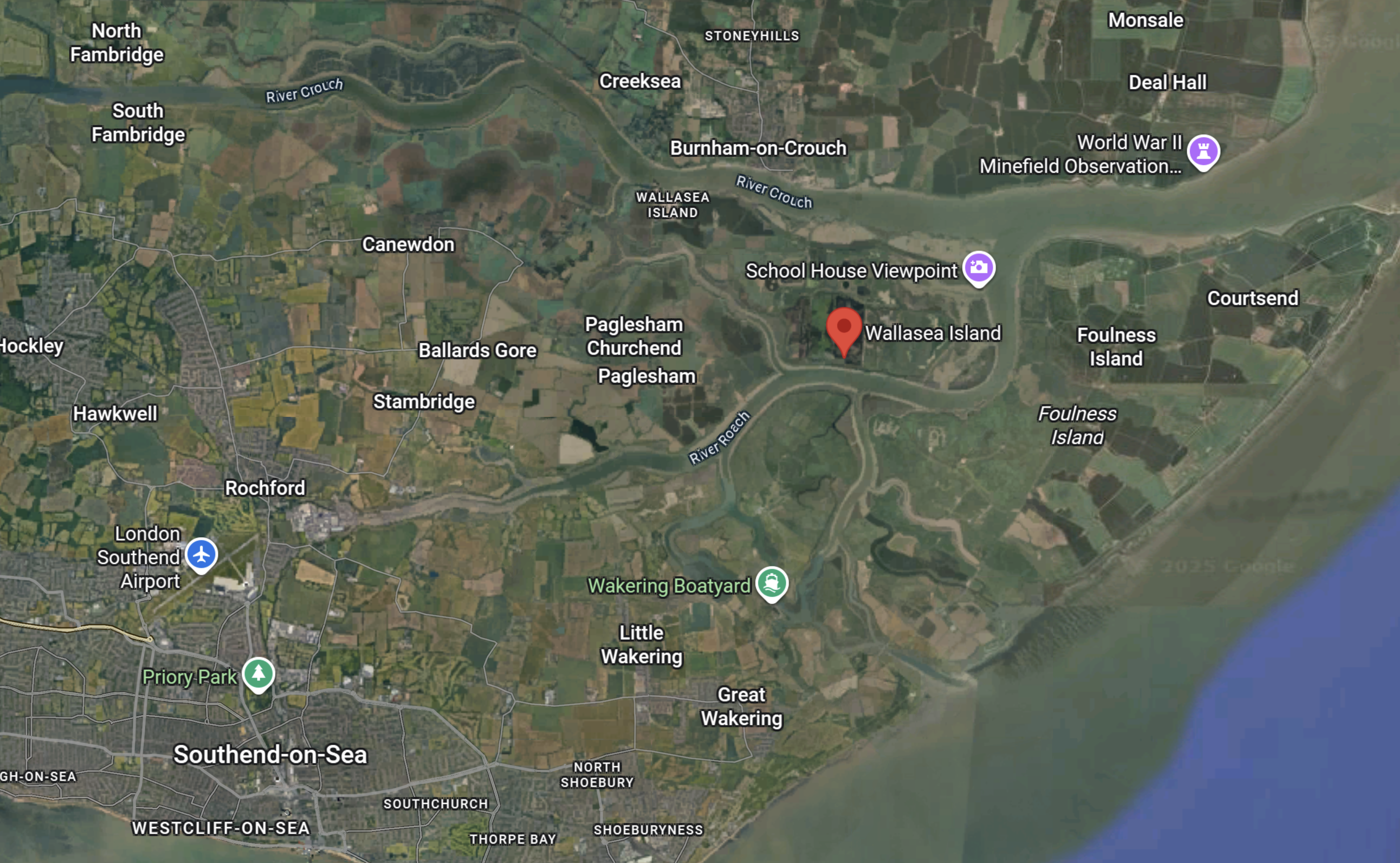
Note.
- Wallasea Island is indicated by the red arrow.
- Southend-on-Sea is in the South-West corner of the map.
- To the East of Wallasea Island is Foulness Island, which at one time was to be the location for London’s third airport.
- In the Summer, there is a ferry to Wallasea Island from Burnham-on-Crouch, where there is a railway station.
- The distance between the quay and the station loooks to be about five hundred metres.
I will make a trip.
Centrica Energy And Exodus Sign Landmark LNG Agreement
The title of this post, is the same as that of this press release from Centrica.
This is the sub-heading.
Centrica Energy has announced the signing of a long-term Sale and Purchase Agreement (SPA) to supply liquefied natural gas (LNG) to Exodus for Honduras, marking a new milestone in the country’s energy development.
These two paragraphs add more details.
Under the terms of the agreement, Centrica will deliver approximately six LNG cargoes per year to Exodus through a ship-to-ship operation into the Floating Storage Unit (FSU) Bilbao Knutsen, located in Puerto Cortes. The 15-year contract is expected to commence in 2026.
“This agreement reflects Centrica Energy’s commitment to expanding global LNG access through strategic partnerships,” said Arturo Gallego, Global Head of LNG at Centrica Energy. “By leveraging our global reach and operational expertise, we’re proud to support Exodus and Honduras in its journey toward a more sustainable and resilient energy future.”
It looks a good deal for Centrica, that has been snatched from under the American’s noses.
I also asked Google AI, if Honduras produced any natural gas and received this reply.
No, Honduras does not produce natural gas, but it is importing it through a new liquefied natural gas (LNG) agreement that begins in 2026. The country relies on imports to meet its energy needs, and this new deal aims to diversify its energy mix and provide cleaner energy for power generation.
That’s clear and it’s interesting that Honduras are looking to provide cleaner energy.
These two paragraphs from Centrica’s press release add details on power generation in Honduras.
The LNG will be transported to the Brassavola Combined Cycle Power Plant, an operating 150 MW thermal facility with its combined cycle under construction and set to reach 240 MW of power capacity, marking the first-ever import of natural gas for power generation in Honduras. This initiative represents a significant step toward diversifying the nation’s energy mix and reducing its reliance on less environmentally friendly fossil fuels.
Once operational, the FSU will serve as the backbone of LNG storage at a new terminal currently under construction on Honduras’ Caribbean coast. The project is designed to enhance energy security, improve generation efficiency, and support industrial growth.
This article on Riviera is entitled Honduras Turns To LNG To Meet Energy Needs and provides these points.
- Honduras is grappling with a 250 MW power shortage.
- Genesis Energías is spearheading efforts to introduce a reliable and cost-effective energy source by importing liquefied natural gas (LNG).
- Hyundai, who are one of Centrica’s partners in HiiROC, are converting the Bilbao Knutsen for its new role as a Floating Storage Unit (FSU).
It would certainly help Honduras’s economy, if they had more power generation.
I asked Google AI, if Honduras was developing offshore wind power and received this reply.
While Honduras has been actively developing onshore wind power for over a decade, there is currently no information to suggest it is developing offshore wind power projects. The country’s wind energy development has focused exclusively on land-based projects, with a number of operational farms and more in the pipeline.
I also asked Google AI if Honduras was developing solar power and received this reply.
Yes, Honduras is actively and significantly developing its solar power capacity as a cornerstone of its national energy strategy. The country has been a regional leader in solar energy penetration and continues to invest heavily in new projects to reduce its dependence on fossil fuels.
But, whether its offshore wind, onshore wind or solar power, these renewals will need backup and the 240 MW Brassavola Combined Cycle Power Plant, will be a good start.
I have some further thoughts.
Does HiiROC Have A Part To Play?
If would be good, if the 240 MW Brassavola Combined Cycle Power Plant could be zero-carbon, so that Honduras could be more zero-carbon.
Consider.
- Centrica own part of HiiROC, who can generate turquoise hydrogen efficiently from natural gas.
- Honduras will from 2026, have plenty of natural gas.
- In Hydrogen Milestone: UK’s First Hydrogen-to-Power Trial At Brigg Energy Park, I talked about how Centrica powered Brigg power station with a hydrogen blend.
- If the Brassavola Combined Cycle Power Plant was reasonably-modern like Brigg, I suspect it could be run on hydrogen or a hydrogen-blend.
- A reliable supply of hydrogen in Honduras would have its uses.
I wouldn’t be surprised to see a HiiROC plant in Honduras to help decarbonise the country.
HiiROC Creates A Lot Of Carbon Black
When a HiiROC system produces turquoise hydrogen, it produces carbon black as a by-product.
I asked Google AI, if Honduras has a use for carbon black, and received this reply.
Honduras likely has a use for carbon black because the material is a vital component in the production of many common industrial and consumer goods that are used globally. The primary applications are universal across most countries, including those in Central America.
But carbon black can also be used to improve poor agricultural land.
So I asked, Google AI, if Honduras has a lot of land to improve and received this reply.
Yes, Honduras has significant land to improve, but this is complicated by issues like deforestation, land degradation, and a lack of clear land rights for many communities. There is a need to balance economic activities like coffee plantations with conservation, improve sustainable agriculture practices, and address illegal land occupation.
It seems to me, that a sensible hollistic approach could use some of the carbon black.
I also believe, that there are many universities, who could advise Honduras on land restoration.
Does Highview Power Have A Part To Play?
Consider.
- Centrica are one of the backers of Highview Power, who are building their first two environmentally-friendly liquid air batteries in the UK.
- Their flagship battery is a 300 MW/3.2 GWh monster that can incorporate a stability island, that controls the grid.
- Highview Power’s batteries are zero-carbon, with a 40-50 year life.
As a Control Engineer, I believe that one of these batteries would be superb backup for the Brassavola Combined Cycle Power Plant and all those renewables.
Where Will Centrica Get Their LNG For Honduras?
I have already reported on two deals, where Centrica is purchasing LNG.
- Centrica Enters Into Long Term Natural Gas Sale & Purchase Agreement
- Centrica And PTT Sign Heads Of Agreement For Long-Term LNG Supply
I can expect more deals like this around the world.
Also, as the Grain LNG Terminal has the ability to export LNG could we be seeing UK natural gas being exported by Centrica to Honduras and the other countries hinted at in the PTT purchase?
Are Centrica Proposing A Comprehensive Solution To A Nation’s Power Problem?
It certainly looks like they are.
And Honduras would be getting a zero-carbon energy system.
This could be repeated all around the world.
Conclusion
This certainly looks like a good deal for Centrica, that can be repeated in other places.
Do People Lose Their Vision In Low Pressure Weather?
My vision was rather poor a couple of hours ago, hence the reason for this post.
I asked Google AI, the question in the title of this post, and received this reply.
While people generally do not permanently lose their vision due to typical low-pressure weather systems, they may experience temporary blurry or altered vision. This is usually associated with the physiological effects of low barometric pressure on the body or the cold, dry conditions that often accompany such weather.
That would fit the problems I encountered.
All Recyclable Blades Installed At RWE’s 1.4 GW UK Offshore Wind Farm
The title of this post, is the same as that of this article on offshoreWIND.biz.
This is the sub-heading.
All 150 recyclable blades have been installed at the 1.4 GW Sofia offshore wind farm, with more than half of the wind turbines now in place at the UK construction site.
These three paragraphs add more details.
All 150 recyclable blades are now installed, with each turbine utilising 50 sets of three blades, marking the UK’s first large-scale use of this technology at an offshore wind farm, RWE, the developer, said.
The recyclable rotor blades used at Sofia are manufactured by Siemens Gamesa at its Hull factory and use a unique resin that enables easy separation of component materials at the end of each blade’s operational life cycle.
In addition, 62 out of 100 Siemens Gamesa 14 MW turbines have now been installed at the site located 195 kilometres off the UK’s east coast. Each turbine features 108-metre blades and a 222-metre rotor diameter. Cadeler is responsible for the installation of the wind turbines.
Note.
- The Sofia wind farm has a hundred turbines, each with the customary three blades.
- Currently the 13 MW Siemens Gamesa turbines in Dogger Bank A and Dogger Bank B are the largest turbines in British waters.
- Sofia’s at 14 MW will be larger.
- But 15 MW monsters are on their way, with RWE’s Norfolk zone appearing to favour 15 MW Vesta turbines.
At the present time, turbine size seems to be creeping up. I would expect this to happen, as turbines become more affordable.
Managing Earthworks In A Changing Environment
This image shows the train derailment at Shap at 06:10 on Monday.
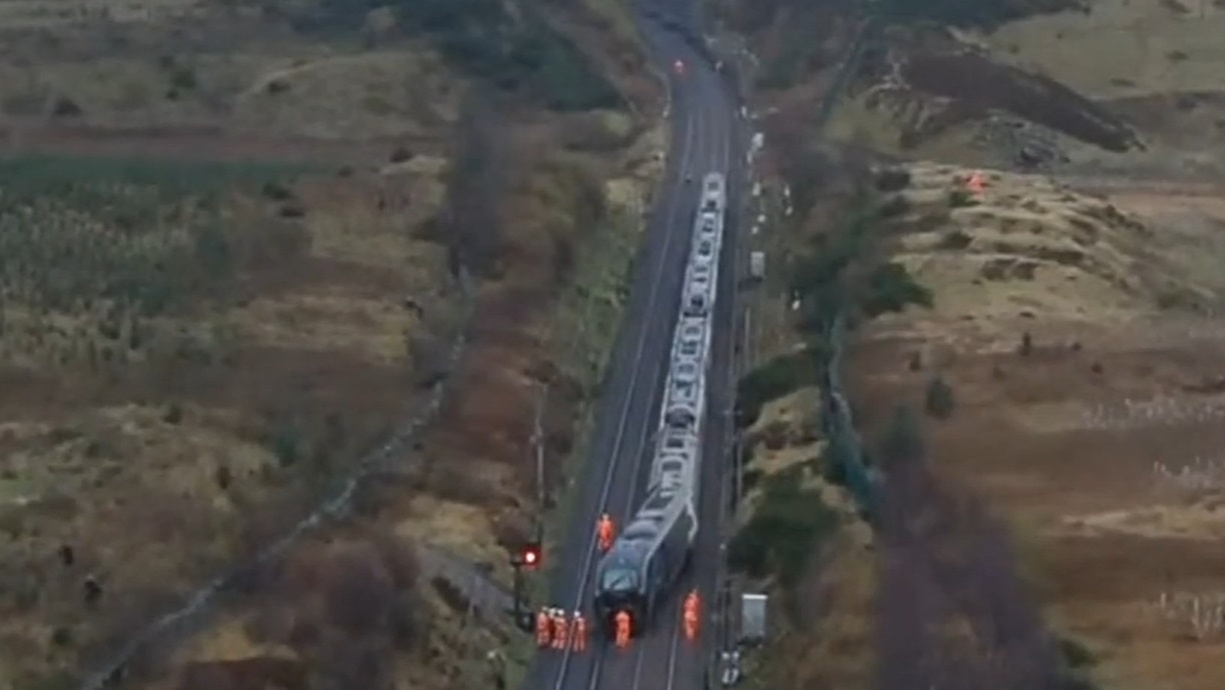
The BBC and others were talking about the cause of the derailment being a landslide.
So it was perhaps appropriate that the latest edition of Rail Engineer had a sponsorsed feature with a title of Managing Earthworks In A Changing Environment.
It is well-worth a full read.
HiiROC And Agile Energy Unite To Advance Hydrogen Production In Scotland
The title of this post, is the same as that of this article on Offshore Energy.
This is sub-heading.
HiiROC, a UK hydrogen production company, and Agile Energy Recovery Limited, a compatriot developer of low-carbon energy parks, have partnered to evaluate the deployment of HiiROC’s proprietary process to produce low-carbon hydrogen at Agile’s Thainstone Energy Park in Inverurie, Scotland.
These three paragraphs add more detail.
It is understood that Agile is building a Swedish-style Integrated Resource Facility (IRF), which is expected to process up to 200,000 tonnes of municipal and industrial residual waste per year and produce power and heat for the surrounding area.
As for HiiROC, its Thermal Plasma Electrolysis (TPE) process reportedly requires less electricity than conventional water electrolysis and does not generate CO2 emissions, aligning with the UK’s Low Carbon Hydrogen Standard (LCHS). By leveraging the existing gas network and locating hydrogen production at the point of use, the company said it can avoid costly new infrastructure or waiting for new hydrogen pipelines or CCS clusters to come online. HiiROC’s first commercial units are planned for 2026.
The partners noted they will aim to maximize integration of their two plants, with the option to combine CO2 emissions from the IRF with HiiROC’s hydrogen to produce low-carbon e-methanol, an emerging alternative to diesel in maritime applications.
This plant would appear too be built around some impressive chemistry to process 200,000 tonnes of municipal and industrial waste per year.
Out of curiosity, I asked Google AI how much waste the London Borough of Hackney, where I live, collects per year and received this answer.
The London Borough of Hackney processed approximately 113,554 tonnes of total local authority collected waste in the 2021/22 financial year.
More recent, unaudited data for the 2023/24 financial year indicates that the total amount of household waste collected was around 313.6 kg per person. With an estimated population of nearly 280,000 people, this suggests roughly 87,800 tonnes of household waste were collected in 2023/24.
It looks to me, that a lot of councils could explore the HiiROC route to dispose of their waste.
US Interior Secretary: ‘No Future For Offshore Wind Under This Administration’
The title of this post, is the same as that of this article on offshoreWIND.biz.
This is the sub-heading.
US Interior Secretary Doug Burgum said at a press conference on 10 September that offshore wind has no future in the US under the Trump administration and that the government was reviewing five offshore wind projects that are now under construction.
There is also this quote from Burgum.
Offshore wind was too expensive and not reliable enough.
Many of those projects weren’t really about electricity, they were about tax subsidies
I think the fact that the subsidies have been either cut back or limited means that it is likely that there will not be future offshore wind built in America.
He also added that there were concerns that wind turbines interfered with whales and radar systems.
I asked Google AI a few questions.
Is Offshore Wind Extremely Expensive?
Google AI replied.
No, offshore wind is not considered extremely expensive when compared to other energy sources, particularly gas-fired power stations, and its costs are projected to fall further. While initially more expensive to construct than onshore wind due to the marine environment, the higher and more consistent wind speeds offshore generate more power, leading to a competitive or lower overall levelised cost of energy (LCOE) in many regions. Recent economic challenges like inflation and supply chain disruptions have increased costs temporarily, but the sector’s financial position is recovering, and cost reductions are expected to continue.
That looks pretty fair to me.
Is Offshore Wind Reliable?
Google AI replied.
Yes, offshore wind is a reliable energy source because it generates power more consistently than onshore wind due to higher, more dependable wind speeds at sea, and can be integrated with other renewables and energy storage to provide continuous power. Offshore wind turbines operate almost all the time, and the power can be backed up by grid-level storage to ensure a steady electricity supply, even when the wind isn’t blowing.
That looks pretty fair to me.
Are Subsididies And Tax Breaks Important For Offshore Wind?
Google AI replied.
Yes, subsidies and tax breaks are important for the offshore wind industry, which faces high upfront costs and inflationary pressures, to make it more cost-competitive with fossil fuels and secure financing for projects. These incentives help reduce costs for developers, de-risk investments, and ensure the technology can meet climate targets by fostering investment and ensuring long-term viability.
That looks pretty fair to me, but if you were in the oil and gas industry you might think differently.
On the other hand some countries like Norway and the UK, are encouraging the linking of offshore wind farms to offshore oil and gas production to decarbonise offshore operations.
Does Offshore Wind Kill Whales?
This article on the BBC is entitled Fact-Checking Donald Trump’s Claim That Wind Turbines Kill Whales.
It goes into detail about Trump’s claims about wind turbines and marine life.
These are four paragraphs.
“We know what the main threats are to humpback whales: it’s very much the impact from things like fishing and ship strikes,” says Rob Deaville from the Zoological Society of London’s Cetacean Strandings Investigation Programme.
“To talk about wind farms being a problem takes away discussion around the very real threats that are a problem for those species.”
Many other areas with high numbers of wind farms have not seen an increase in whale mortality.
For example, the UK is home to the world’s four largest wind farms, but no humpback whale strandings there have been conclusively linked to the impact of those farms.
That looks pretty fair to me.
But because of our massive portfolio of offshore wind farms and top universities, who research the marine environment, the UK is in a unique position to expose fake science, that was made up on the back of a used envelope.
Does Offshore Interfere With Radar?
Google AI replied.
Yes, offshore wind farms can interfere with radar by reflecting radar signals, causing “radar clutter” or false echoes that can obscure real targets, like aircraft or ships, or create phantom images on a radar display. This interference, also known as a “blade flash,” can negatively impact air defense, air traffic control, and maritime navigation, leading to reduced accuracy and potential safety risks.
That looks pretty fair to me.
Have Wind Turbines Caused Any Air Accidents?
Google AI replied.
Yes, wind farms have caused air accidents, though they are rare. These incidents primarily involve light aircraft colliding with wind turbines or experiencing loss of control due to turbulence from turbine wakes. Examples include a pilot crashing near a wind farm due to turbulence and another fatal crash involving an aircraft hitting a turbine blade.
That looks pretty fair to me.
I learned to fly light aircraft in the 1970s and I remember being told about wake turbulence from airliners, which has been strong enough in some cases to flip an aircraft like a Cessna 150 upside down or into a spin.
What Are The CAA’s Rules For Flying Near Wind Turbines?
Google AI replied.
The primary CAA rule for flying near wind turbines is related to their visibility and safety, focusing on lighting requirements and potential hazards like turbulence. Structures 150 meters or higher require medium-intensity red lights. Pilots must avoid dazzling lights with their own, and wind turbine developers must assess and mitigate risks such as turbulence, radar interference, and impact on Instrument Flight Procedures (IFPs).
That looks like what I would have expected.
Conclusion
I have tried not to be selective with my evidence, but if you are there are reasons that could be used to ban wind turbines.
I am also happy to add any other questions.
Vape Ban Isn’t Working, Says Waste Firm Boss
The title of this post, is the same as that of this article on the BBC.
This is the sub-heading.
The ban on disposable vapes is failing to stop millions being thrown away incorrectly, and the devices are still causing chaos for the waste industry, a boss at a leading firm has said.
These three introductory paragraphs add more detail.
“We’re seeing more vapes in our system, causing more problems, more fires than ever before,” said Roger Wright, the strategy and packaging manager at Biffa.
Vape firms have launched cheap reusable devices, so instead of refilling and recycling them, people were binning them and buying more, he said.
A spokesperson for the vape industry said the June ban had been a success, and any rise in devices being thrown away was likely due to black market trade.
It looks to me, that the government didn’t get the legislation right.
Are Disposable Vapes Available On The Internet?
To find the BBC story, I typed “Disposable Vapes” into Google.
I found headlines like these.
- Cheap Disposable Vapes | From 50p | Free Delivery
- Disposable Vapes – Multi-Buys & Free Next Day Delivery
- Legal Big Puff Disposable Vapes on Sale in the UK
Why aren’t these adverts being taken down?
Shell Pulls Plug On Rotterdam Biofuels Plant
The title of this post, is the same as that of this article on The Times.
This is the sub-heading.
Retreat from green energy continues as facility that was earmarked to produce sustainable aviation fuel and renewable diesel will not now be built
These first three paragraphs add some details.
Shell has scrapped construction of one of Europe’s biggest biofuels plants as it continues its retreat from green energy
The move by the FTSE 100 oil and gas group represents a further setback for efforts to cut aviation emissions.
Shell said it would not restart construction of the biofuels facility at its Rotterdam energy and chemicals plant, which was due to produce sustainable aviation fuel (SAF) and renewable diesel.
When I wrote Centrica Secures Investment Stake In Gasrec Helping Boost UK Bio-LNG Ambitions, I took a look at the use of liquified natural gas (LNG) in transport.
This paragraph from the Centrica press release about the stake, gives the thoughts of Chris O’Shea, who is Group Chief Executive, Centrica.
Chris O’Shea, Group Chief Executive, Centrica plc, said: “Demand for bio-LNG for transport is growing fast as more HGV operators make the switch – drawn by a clean, ready-to-use fuel which slashes CO2 emissions by up to 85 per cent in comparison to diesel*. This investment in Gasrec enhances our collaboration with the leading company in the sector, and puts us in a strong position to energise a vital sector of the industry on its journey to net zero.”
Chris O’Shea of Centrica appears to feel that bio-LNG is a good alternative to diesel, so have Shell come to a similar decision, about satisfying the demand for diesel?
I asked Google AI if LNG has advantages over diesel as a truck fuel and received this answer.
Yes, LNG offers advantages over diesel, including significantly lower emissions of nitrogen oxides (NOx), sulfur oxides (SOx), and particulate matter (PM), which improves local air quality. It can also be more economically efficient, with fuel costs potentially lower than diesel depending on market conditions. However, the overall greenhouse gas (GHG) benefits are mixed; while LNG has a lower carbon content, it can result in higher lifecycle GHG emissions due to energy losses in its production and transport, as well as methane slip.
Note.
- If it drops emissions by up to 85 percent for bio-LNG, surely, it would do the same for LNG.
- I also think with tight regulations, the use of LNG could improve air quality in cities like London.
- LNG would probably be a more affordable fuel than hydrogen.
It should also be noted, that several major diesel engine makers, now make families of engines, which can handle, diesel, hydrogen and natural gas.
LNG would also be a convenient stepping stone between current fuels and hydrogen, that might give a few extra years for the transition.
Could LNG Be Used In Aircraft?
Consider.
- LNG would certainly give some reduction in carbon emissions.
- Handling LNG in aircraft could have similar problems to hydrogen, so companies like Airbus might have already solved them.
- In addition, LNG doesn’t have the fearsome reputation, that hydrogen seems to have gained because of the Hindenburg.
- It would be easier to provide LNG fuel at airports all round the world.
- Airbus have said availability of hydrogen at airports, could be a problem.
Out of curiosity, I asked Google AI if LNG could be used to power an airliner and received this answer.
Yes, liquefied natural gas (LNG) can theoretically be used to power airliners, offering a potential reduction in CO2 emissions compared to conventional jet fuel, but significant challenges exist. These challenges include the need for entirely new, larger, and heavier cryogenic fuel tanks, modifications to aircraft engines and fuel systems, and the development of a new global infrastructure for LNG supply. While experimental tests have been conducted, such as on the Soviet Union’s Tupolev Tu-155 in 1989, LNG is not currently in normal service due to these practical and infrastructural hurdles.
I would prefer it was a purpose-designed Airbus, than a Soviet-era Tupolev.
National Grid Has Awarded £12bn In HVDC Supply Chain Agreements
The title of this post, is the same as that of this press release from National Grid.
These are the first three paragraphs.
National Grid has completed the award of its High Voltage Direct Current (HVDC) civil works supply chain framework, with £12bn worth of agreements confirmed. This announcement marks the third and final stage of our £59bn supply chain framework awards and underlines the commitment to delivering the energy infrastructure needed to support the Great Grid Upgrade and the UK’s energy transition.
A total of six HVDC converter civil works suppliers have been awarded positions on Lot 1 of the Framework Agreement totalling approximately £9.07bn. In addition, three HVDC onshore cable civil works suppliers being awarded places on Lot 2 of the Framework, worth an estimated £3.7bn. The successful HVDC converter civils suppliers are Balfour Beatty, BAM Nuttall, Galliford Try, Laing O’Rourke, Skanska and Taylor Woodrow. The HVDC onshore cable civils Framework has been awarded to Balfour Beatty, Murphy, and VolkerFitzpatrick.
Contracts have been secured for a five-year period, with the potential to extend for a further three years. Both Frameworks cover confirmed and anticipated projects, including Eastern Green Link 4, in partnership with SP Energy Networks and LionLink in partnership with TenneT .
These are a lot of money allocated to projects, that will be delivered in the next few years.
Where’s the consolidated plan for capital expenditure from the Water Industry?
Water is also simpler, than electricity, as you are only dealing with one country. If you go through the paragraphs above, you’ll find TenneT, who do a similar job to National Grid in the Netherlands and parts of Germany.
I also found this advert from Thames Water, in a Southeastern train last week.
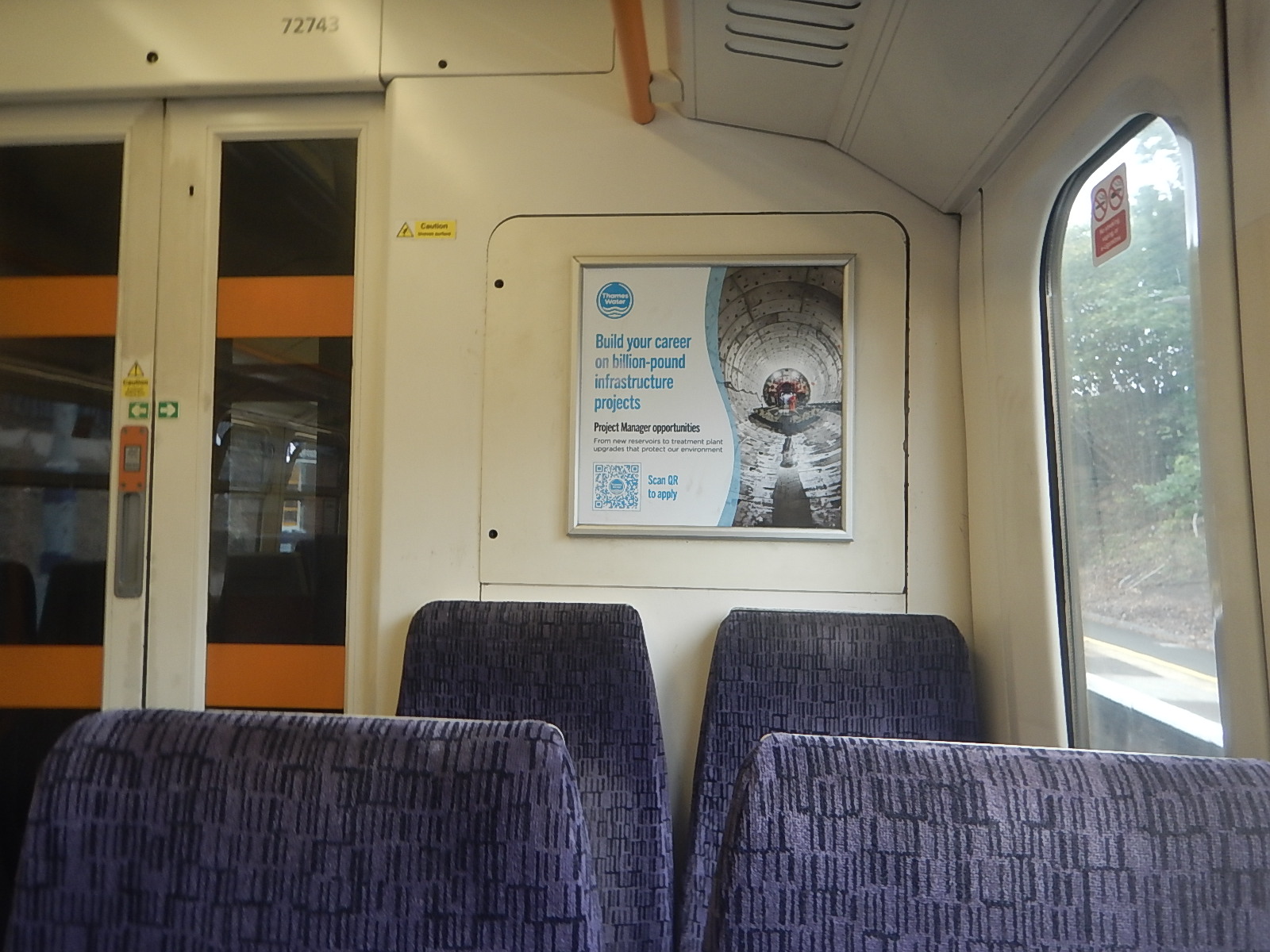
Does this indicate that Thames Water has project management problems?

